Most people think power is loud. They think it’s about making the biggest scene, throwing the heaviest punch, or being the most aggressive voice in the room. But if you look closely at the streets, the corporate boardroom, or even the block, you quickly realize the truth: the most dangerous people don’t play loud—they play slick.
They don’t use brute force; they use strategy. They utilize subtle power plays, backhanded jokes, and psychological micro-moves designed to chip away at your confidence and make you feel small, all while keeping their own hands clean. They hide behind the excuse of “I was just playing” or “You’re too sensitive,” pushing your buttons just enough to get a reaction.
If you get emotional, you lose. If you snap, you just walked right into their trap, making you look like the problem.
True power doesn’t come from beating a manipulator at their own game. True power comes from spotting the game before it even starts. When you refuse to blink, your internal energy shifts. The manipulator instantly senses that their tricks have no gravity here. The trap fails, the situation de-escalates, and the room goes quiet.
Believe it or not, this exact street-smart philosophy is the living foundation of a centuries-old martial art born from the ultimate fight for survival: Capoeira Angola.
The Anatomy of Manipulation: Understanding the “Slick”
Before you can counter a game, you have to know what it looks like. Manipulators rarely attack head-on. Instead, they rely on a chess board of micro-aggressions:
The “Just Joking” Jab: Slipping an insult into a joke to see if you’ll tolerate it.
The Bait-and-Switch: Intentionally provoking an emotional reaction so they can play the victim when you finally defend yourself.
The Power Play: Subtle shifts in body language, tone, or positioning to establish dominance without saying a word.
The goal of these tactics is simple: to get you out of character. The moment you react out of anger, fear, or insecurity, you have handed over the remote control to your emotions.
The Art of Malícia: Street Smarts in the Circle
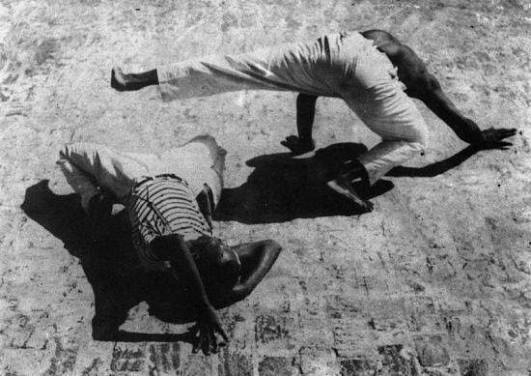
Capoeira Angola is an Afro-Brazilian martial art fundamentally built on survival, strategic cunning, and deep psychological perception. Born in Brazil out of resistance against severe chattel slavery and systematic oppression, it wasn’t an art that could rely on brute force. Enslaved practitioners couldn’t fight the heavily armed ruling class head-on, so they had to master the mind. They disguised their deadly martial art as a dance, tricking their oppressors while sharpening their lethal skills right in front of them.
In Capoeira, this philosophy is distilled into a single, powerful word: malícia.
Malícia isn’t maliciousness in the English sense; it is a blend of deception, street smarts, wit, and misdirection. It is the ability to anticipate harm and neutralize a threat before it manifests.
When two practitioners step into the roda (the circle where the game is played), they aren’t just trading physical kicks. They are engaging in a high-stakes psychological dialogue. The rhythm of the berimbau (the primary musical instrument) sets the pace, but the minds of the fighters dictate the reality. Every slow, hypnotic movement, every smile, or every extended hand can be a feint, a trap, or a deliberate setup for a sweeping takedown.
“In the roda, as in life, if you look at the foot, you miss the head. You have to watch the whole body—and the spirit behind it.”
Why the Best Fighter is the One Who Sees the Game
Just like navigating a toxic environment, a manipulative boss, or a fake friend, the master capoeirista wins by staying completely anchored in their own calm.
1. The Advantage of Total Awareness
By reading your opponent’s subtle physical shifts and auditory cues, you decode their intentions before they strike. You don’t look at where the kick is coming from; you look at the center of gravity. In life, this means ignoring the words a manipulator says and looking directly at their intent.
2. Refusing to “Blink”
Instead of meeting aggression with aggression, you remain completely unbothered. When a manipulator throws a jab and you respond with a calm, unbreaking stare, the energy in the room shifts. In Capoeira, if an opponent launches a wild, aggressive attack and you simply slip out of the way with a smooth, unbothered movement, you have instantly shattered their rhythm.
3. Using Their Momentum Against Them
When you don’t react the way a manipulator expects, they panic. They get sloppy and over-extend. In Capoeira, this is the exact micro-second you use their own weight and momentum to sweep them off their feet (rasteira). By letting them overplay their hand, they defeat themselves.
Navigating Hostile Environments
Historically criminalized and hunted by the state well after the abolition of slavery, Capoeira Angola practitioners (capoeiristas) had to move through the world with a heightened sense of situational awareness, constantly aware of the dangers that lurked in both their surroundings and social interactions. The art not only taught them how to survive from a position of absolute disadvantage but also instilled in them a profound understanding of resilience and resourcefulness. It equipped them with the skills to navigate life’s complexities while fostering a sense of community and cultural identity. Capoeira Angola demonstrated the importance of preserving their physical energy, as well as teaching them the nuances of reading the true temperature of a room—how to detect subtle shifts in mood or intent among those around them. Moreover, it helped them maintain absolute mastery over their own minds under intense pressure, turning physical movement into a form of expression that transcended mere combat; it became a vital means of retaining dignity and autonomy in a world that often sought to strip them of both. Through the rhythmic flow of the ginga, the art form became a powerful tool for liberation, self-empowerment, and an enduring legacy that still resonates today.
The block changes, the centuries pass, but human nature stays exactly the same. The same games played on the plantation and in the alleys of old Rio de Janeiro are played today in corporate offices, street corners, and relationship arguments. These timeless dynamics reveal a fundamental truth: the struggle for power, recognition, and connection drives our interactions, regardless of the setting. The intricate dance of manipulation and strategy unfolds in boardrooms, mirroring the confrontations of the past where individuals vied for dominance among their peers. Just as the street corners of Rio echoed with the laughter and conflict of everyday life, so too do modern social platforms and workplaces resonate with the same emotional undercurrents, illustrating that no matter how much the landscape may evolve, the core essence of human behavior endures. We continually witness this cyclical pattern, with history serving as a backdrop for our shared experiences and the universal challenges that bind us together, transcending time and location.
Whether you are stepping into a physical roda or just trying to survive the psychological minefields of everyday life, remember the ultimate rule of true power: Don’t play the game. See it. In every interaction and encounter, recognize the dynamics at play, the subtle shifts in energy, and the motivations of those around you. By taking a step back and observing rather than reacting, you can gain invaluable insight into the structure of these encounters. This perspective not only allows you to navigate challenges more effectively but also empowers you to make choices that align with your deeper values and intentions. Embracing this mindset transforms how you engage with your surroundings, enabling you to approach each moment with awareness and confidence.
Within the poetic architecture of Capoeira Angola, there is a ritual configuration that serves as the ultimate distillation of Eshu’s essence: the Chamada (the Call).
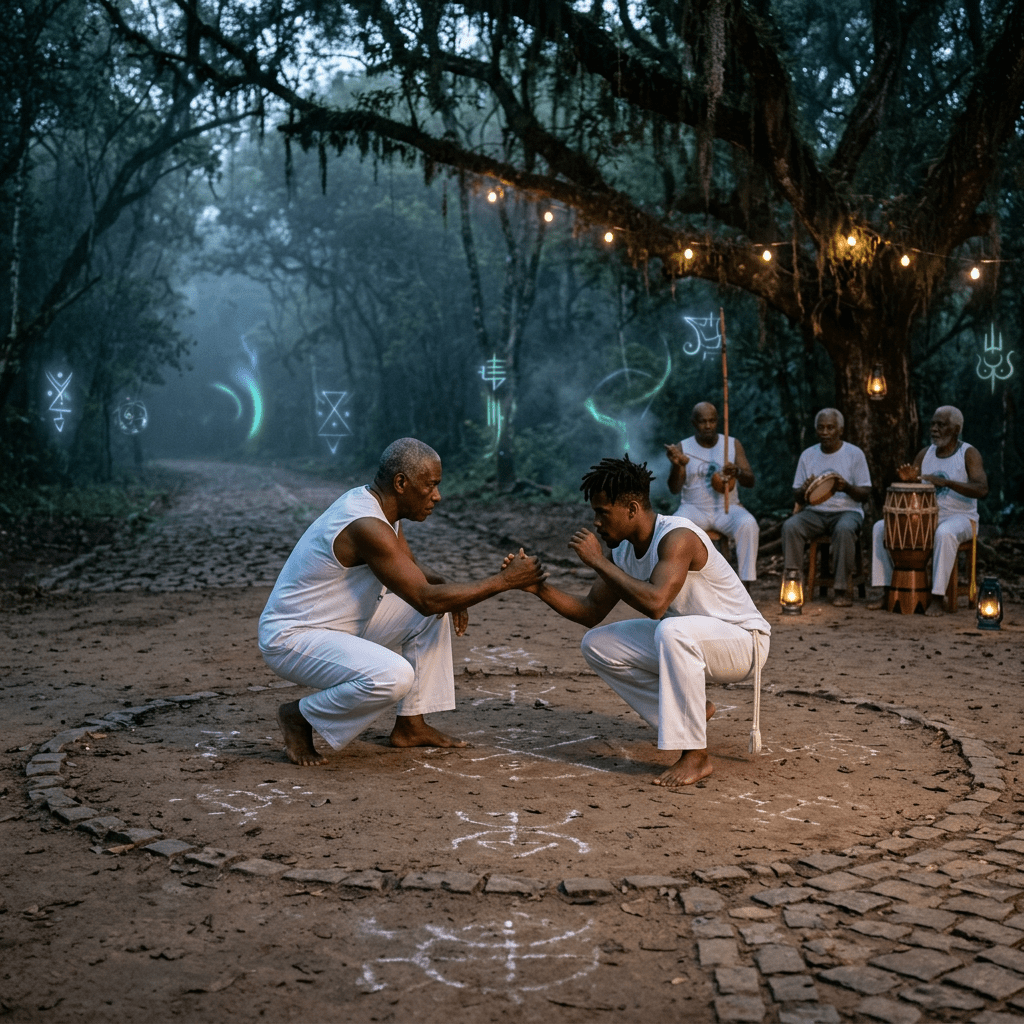
When the game inside the roda grows too intense, too chaotic, or too predictable, one player will suddenly stop. They raise their hands, freezing their movement into a ritual posture of complete vulnerability. They are calling their partner to step into a closed, intimate space of synchronized, slow walking—back and forth, three times.
The Chamada is a sacred truce, a temporary bridge between worlds. Yet, it is precisely within this moment of apparent peace that Eshu plays his most profound game.
"Valha-me Deus, Senhor São Bento
O mestre chamou pra caminhar
Segura o corpo, firma o vento
Que a malícia vai começar..."
(Help me God, Lord Saint Benedict
The master called me to walk
Hold your body steady, firm the wind
Because the trickery is about to begin...)
The Architecture of the Chamada: Eshu’s Ritual Mirror
The Chamada is not a break from the game; it is the game magnified. It embodies the precise duality of Eshu: the delicate balance between absolute trust and absolute alertness.
1. The Trap of the Open Door
To call a Chamada, you must present an open target. Your chest is exposed, your hands are raised, and your back may even be turned to your opponent. This is Eshu’s classic illusion—offering a doorway that seems perfectly safe to enter. The player answering the call must approach with immense caution, placing their hands against the caller’s body, matching their breath, and walking together in tight, tense harmony.
2. The Illusion of Safety
As the two capoeiristas walk back and forth at the foot of the berimbau, the illusion of safety deepens. But Eshu rules the thresholds of change. At any single second during this walk, the caller can suddenly drop beneath the partner’s weight to execute a lightning-fast rasteira (sweep) or drive a cabeçada (headbutt) into their chest. Alternatively, the person responding can break the truce if they sense the caller is complacent.
3. Testing the Awake Soul
The Chamada tests your sense of being more than any fast-paced exchange of kicks. It asks a fundamental question: Can you maintain absolute presence when everything feels calm? If you fall asleep in the comfort of the walk, Eshu will swiftly take your feet out from under you. If you panic or strike out of fear, you expose your lack of self-control. To survive the Chamada, you must be entirely relaxed yet entirely awake.
"Mandingueiro que é mandingueiro
Não se deita pra dormir
Na chamada do Angoleiro
É que o perigo vai surgir..."
(A true sorcerer / capoeirista
Does not lie down to sleep
It is in the Angoleiro's chamada
That the true danger will arise...)
The Chamada of Everyday Life: Navigating the Silent Storms
Outside the ring of the roda, life frequently initiates its own Chamadas. These are the moments when the frantic pace of our daily struggles suddenly drops into an eerie, deceptive quiet.
Recognizing the “Quiet” Traps: A life Chamada manifests when a toxic situation suddenly feels comfortable, when a long-standing conflict falls into a silent truce, or when things seem “too good to be true.” Eshu teaches us not to become paranoid, but to remain awake. Do not lull yourself into complacency just because the storm has paused. Use the quiet periods of life to strengthen your core and observe your surroundings.
Walking with the Adversary: Sometimes, we are forced to walk hand-in-hand with difficult people, challenging corporate structures, or our own internal demons. The Chamada teaches us how to engage with these forces without losing our footing. You can cooperate, you can synchronize your steps, and you can show respect—but you keep your center heavy, your eyes open, and your spirit anchored.
The Grace of the Silent Truce: Finally, the Chamada reminds us that we have the power to stop the chaos. When a conversation or a life situation is spinning out of control into destructive violence, you can be the one to freeze, raise your hands, and call for a collective breath. You can redefine the terms of the engagement.
Conclusion: The Heavy Center
To dance through life with Eshu is to welcome the Chamada. It is the realization that the moments of highest spiritual tension do not always look like an aggressive attack; often, they look like a slow, deliberate walk in the dark.
When life calls you to step into the tight circle of the unknown, do not shrink away. Approach the threshold with a heavy center, match the rhythm of the moment, smile at the subtle shifts of the wind, and let the trickster teach you how to remain completely unshakable.
Life does not flow in straight lines; it bends, breaks, and loops like ancient rhythm. Just when we believe we have paved a smooth road ahead, the universe throws a sudden curve, an unexpected detour, or a jarring friction that shakes our very foundation. In the modern West, we label this a test of resilience. But in the deep, poetic cosmology of the Yoruba, this chaotic, testing current carries a sacred name: Eshu.
Eshu is the Orisha of the crossroads, the master of thresholds, and the keeper of the cosmic keys, embodying the essence of duality and transformation. He is the divine trickster—not out of malice, but out of a profound love for truth, which he sees as essential for growth and enlightenment. His playful nature invites us to embrace uncertainty, for it is often in moments of disruption that we find our true selves. By challenging the status quo, he disrupts our comfort zones to strip away our illusions, exposing our raw character beneath the layers of pretense and societal expectation. Today, his spirit breathes fiercely inside the sacred circle of Capoeira Angola, a vibrant art form that blends martial prowess with rhythm and culture, offering a living, moving blueprint for navigating the beautiful chaos of existence. In doing so, Eshu guides practitioners not only in the physical realm but also through the intricate dance of life, encouraging them to embrace change and to flow like water, effortlessly adapting to the myriad pathways life presents.
The Keeper of the Threshold
In the sacred geometry of life, Eshu sits precisely where two paths collide, embodying the essence of choice and transformation. He is the whisper in the wind that forces us to choose, guiding our hearts and minds to recognize the potential that lies in each decision. The old elders say that no prayer can ascend to the heavens, and no blessing can rain down to the earth, without first paying homage to this guardian of the gate, whose playful mischief keeps the balance between the seen and the unseen realms. His presence is a reminder that every fork in the road carries not only the weight of our choices but also the possibility of new beginnings, inviting us to embrace the journey with courage and reverence. In moments of uncertainty, it is Eshu who reminds us that even the smallest step can lead to profound revelations, carving our destinies in ways we may not fully understand.
"Oia, oia, deixa a gira girar
Egbé, Eshu bará o, deixa a gira girar..."
(Look, look, let the ritual circle spin
Eshu of the body, let the circle spin...)
This traditional chant reminds us that the world is a spinning wheel of fortune and fate. Eshu’s core lesson is a poetic truth: We are blessed with free will, but every step we take writes an indelible mark upon our destiny. He is the cosmic mirror. If we walk with arrogance, he becomes the stone that trips us. If we walk with humility, he becomes the wind at our back. He shakes our world not to break us, but to awaken us from our slumber.
The Living Fire: Eshu in the Capoeira Angola Roda
Born in the shadows of Brazilian slavery as a dance of liberation disguised as play, Capoeira Angola is a physical prayer to Eshu. The roda (the circle) is not just a ring of people; it is a microcosm of the universe, a living crossroads where spirits and bodies collide.
Mandinga and the Art of the Hidden Smile
Inside the roda, players dance in the realm of malícia (guile) and mandinga (sorcery). To play Capoeira Angola is to speak the language of Eshu. You embody the trickster when you look left but strike right, or when you feign exhaustion only to spring forward with a sudden, beautiful rasteira (sweep). It is a dialogue of deception where a smile hides a trap, and a vulnerability is actually an ambush. It is a playful, lethal chess match meant to test your partner’s presence of mind.
"Lapinha de Jerusalém
Senhor São Bento me guarde
Eshú não joga capoeira
Mas ele sabe mandar..."
(Small shrine of Jerusalem
May Saint Benedict protect me
Eshu does not play capoeira
But he knows how to command the game...)
The Razor-Thin Intersection
Every second inside the ring is a split-second threshold. When an opponent’s heel cuts through the air toward your face, your world splits into infinite possibilities. Do you sink low into a negativa, sweeping the earth? Do you cartwheel away in an au, or do you counter with a strike of your own? There is no time for the analytical mind to debate. Eshu rules that exact, breathless instant where intuition takes flight and your choice dictates your survival.
Feeding the Berimbau
Just as traditional rituals must offer gifts to Eshu before any work can begin, a Capoeira roda remains dead until the music breathes life into it. The lead berimbau calls out, its single wire vibrating with ancestral memory. The songs are the food that clears the path, inviting the axé (life force) to fill the room.
"A fumaça da jurema
Subiu pro céu, balançou
Eshú tirou o chapéu
E a capoeira começou..."
(The smoke of the sacred jurema
Rose to the sky and swayed
Eshu tipped his hat
And the capoeira began...)
Walking the Crossroads of the Everyday
When the berimbau falls silent and we step outside the ring, Eshu does not vanish. He follows us into the concrete grid of daily life. To live with the consciousness of Eshu is to transform your daily existence into a work of artful awareness.
Reframe the Wrench in Your Plans: When life disrupts your harmony—a sudden heartbreak, a lost job, or a chaotic misunderstanding—do not curse your luck or see these events as mere obstacles. Instead, recognize Eshu at the door, the trickster who challenges our perceptions. See the disruption as a sacred mirror, reflecting the parts of your life that may need reassessment and healing. Ask yourself: What part of my ego is this chaos trying to dissolve? What hidden strength is it forcing me to find? Remember, these moments of turmoil often carry valuable lessons, offering insight into your resilience and inner wisdom. Embrace the uncertainty as a catalyst for growth and transformation, allowing yourself the space and time to rediscover your true self amidst the chaos.
Honor the Micro-Thresholds: We stand at thousands of crossroads every day, from how we respond to an angry text to how we choose our career paths. Pause at these intersections; take a moment to breathe and reflect. Each decision, no matter how small, shapes the trajectory of our lives in ways we may not even realize. Recognize the immense power of your free will, and accept the weight of the consequences with a brave heart, for every choice carries with it the potential to open new doors or close off others. Embrace these moments of decision-making as opportunities for growth and self-discovery, knowing that with each step taken, you are actively crafting your narrative in this complex tapestry of existence.
The Poetry of the Two-Sided Hat: A classic myth tells of Eshu walking between two friends while wearing a hat that was red on one side and black on the other, sparking a furious argument between them about what they saw. This vibrant imagery illustrates the complexity of perception, revealing how easily individuals can become entrenched in their viewpoints when confronted with differing realities. Eshu, as the trickster deity, teaches us that truth is multifaceted and often elusive, reminding us that our understanding is colored by our experiences and biases. To honor him in daily life is to abandon rigid, black-and-white thinking, embracing a spectrum of ideas and emotions that enrich our interactions. By remaining fluid and open to other perspectives, we cultivate empathy and strengthen our relationships. In moments of disagreement, it is essential to pause, reflect, and seek clarity rather than becoming defensive. Moreover, never lose your sense of humor when the world shows you its other side, for laughter can bridge divides and foster connection, illuminating the beautiful complexity of the human experience and guiding us towards a more harmonious existence.
Conclusion: The Master of the Dance
Ultimately, Eshu invites us to stop fighting the storm and learn how to dance within it. Life will always play with you, challenging our perceptions and pushing us to our limits. It will test your will, questioning your sanity and shaking your sense of being as you navigate through turmoil and uncertainty. Each gust of wind can feel overwhelming, but instead of resisting, we can embrace the chaos, finding rhythm in the unpredictability. By learning to sway gracefully amidst the turbulence, we open ourselves up to new possibilities and deeper insights. In the heart of the storm, there lies a potential for growth and transformation that can lead us toward enlightenment and resilience.
But when you embrace the trickster within, the world ceases to be a hostile battlefield. The universe becomes a grand roda, a vibrant tapestry woven with the threads of every experience and emotion. Every challenge transforms itself into a partner, testing your agility and resilience in ways you never thought possible. Each obstacle, once seen as an insurmountable foe, now appears as a fascinating puzzle waiting to be solved. Sink low, look your obstacles in the eye, and, with unwavering confidence, smile at the chaos that surrounds you. Recognize that each moment of uncertainty is an opportunity for growth, inviting you to dance at the crossroads of life, where every step taken builds your path forward. Embrace the unpredictability, for it is here that true mastery is achieved, unveiling the magic in the mundane.
Welcome to MALICIA AS A GAME OF POWER, a thought-provoking blog series that delves deeply into the intricate strategies of human interactions, meticulously focusing on themes like communication, conflict resolution, and negotiation. This series does not merely skim the surface; it aims to unveil the subtle nuances that characterize successful interactions in both personal and professional contexts. By discussing essential topics such as leadership, personal branding, and online reputation management, it seeks to offer readers a comprehensive toolbox filled with practical strategies for enhancing influence and forging authentic relationships that can withstand the test of time. Through detailed analysis and a wealth of real-world examples, the series empowers readers to navigate interpersonal relationships with increased confidence and insight, fostering a profound understanding of the complex power dynamics that influence our daily encounters. Join us on this enlightening journey as we examine the art of interaction, its implications, and its invaluable impact on various facets of our lives, encouraging meaningful connections and personal growth along the way.
Today, we will delve into Law 13 from Robert Greene’s influential work, “The Laws of Human Nature.” This law explores the concept of gender rigidity and how our internal masculine and feminine energies influence our behavior and perceptions. You can purchase a copy of the book from AMAZON.COM by clicking HERE.
THE LAWS OF HUMAN NATURE BY ROBERT GREENE – Law #13 – The law of aimlessness
The Law of Aimlessness is the thirteenth of 18 laws explored in Robert Greene’s “The Laws of Human Nature,” a comprehensive work that investigates fundamental human psychology and social behavior. This law emphasizes the importance of “advancing with a sense of purpose” to counteract the natural human tendency toward a lack of direction. By establishing clear objectives and aligning one’s actions with these goals, individuals are better equipped to navigate the complexities of life. Greene suggests that without a defined purpose, people often find themselves adrift, susceptible to external influences and distractions that can derail their progress. The law serves as a reminder that cultivating a strong sense of intention and clarity in our pursuits not only enhances personal fulfillment but also strengthens our ability to interact meaningfully with others, fostering deeper connections and more successful outcomes in various aspects of life.
In the context of this blog series “MALICIA AS A GAME OF POWER,” which examines the complex strategies of human interaction such as communication, conflict resolution, and negotiation, having a clear sense of purpose is a critical tool for increasing personal agency and effectiveness in social settings. A well-defined aim allows individuals to articulate their intentions clearly and navigate the intricate web of interpersonal relationships with confidence and clarity. Without a defined aim, individuals become passive participants in social dynamics rather than active architects of their own outcomes, often reacting instinctively to challenges instead of strategically addressing them. This passivity can lead to a cycle of frustration and dissatisfaction, where opportunities are missed, and relationships suffer. By fostering a strong sense of purpose, individuals empower themselves to create meaningful interactions, drive productive dialogues, and ultimately shape their realities, cultivating not only personal growth but also the potential for positive change in the communities they inhabit.
Law 13, From the perspective of an Angoleiro
From the perspective of an Angoleiro—a practitioner of Capoeira Angola—the Law of Aimlessness is countered by the cultivation of intent and “mandinga” within the roda. A player who lacks a clear objective becomes predictable and vulnerable to the “malícia” (cunning) of an opponent who can read their lack of focus. This vulnerability not only jeopardizes their position in the game but also diminishes the richness of their experience within the roda. The subtle art of Capoeira demands an acute awareness of both oneself and one’s opponent, where each movement and decision must be infused with purpose and clarity. Mastery in this art form, as in life, requires an individual to harmonize their internal qualities and move with intentionality, transforming every interaction into a strategic opportunity for growth. The practice extends beyond mere physicality; it involves a deep understanding of one’s emotions, thoughts, and the dynamic energy present in the surroundings, allowing one to navigate the complexities of the roda with grace and confidence. Thus, the Angoleiro not only embraces the physical challenge but also actively engages in a profound dialogue of intentions, enriching both personal development and the collective essence of the Capoeira community.
Is walking away actually quitting, or is the act of leaving sometimes a profound display of inner fortitude?
We often associate ‘walking away’ with defeat, a failure of endurance, or the easy path. The narrative of persistence—of staying and fighting, of never giving up—is deeply ingrained in our cultural psyche. But this perspective overlooks the critical distinction between reckless abandonment and a deliberate, self-preserving retreat. To ‘quit’ implies a giving up on something worthwhile—a goal, a relationship, a challenge—out of fear or lack of will.
However, there comes a point in certain struggles—be they professional, personal, or emotional—where the cost of staying far outweighs any potential benefit. This is the moment when leaving demands more courage, more self-awareness, and more strength than simply continuing to endure the familiar pain.
Or is there a point where leaving takes more strength than staying?
Staying can often become the default, the comfortable rut of inertia, even if that inertia is destructive. It can be easier to tolerate the known misery—the toxic environment, the stagnant relationship, the soul-crushing job—than to face the terror and uncertainty of the unknown future. Staying requires a kind of passive tolerance.
Leaving, on the other hand, is an active decision. It requires a brutal reckoning with reality, an acknowledgment that one’s own well-being is non-negotiable. It demands the strength to:
Acknowledge Failure: To accept that a given path, despite best efforts, has reached a dead end.
Embrace Uncertainty: To step into a void without a guaranteed safety net.
Overcome External Judgment: To face the inevitable questions and criticisms from those who mistake self-respect for weakness.
Break Momentum: To shatter the comfortable routine and rebuild from the ground up.
When staying means sacrificing one’s mental health, core values, or sense of self, the ‘walk away’ is not a surrender; it is a declaration of self-respect. It is not quitting the effort; it is quitting the path that demanded too high a price. In these instances, the true measure of strength is not how long one can suffer, but the clarity of mind required to choose life, peace, and a fresh start.
O.k., listen up. Before you start taking this too seriously, let me just state for the record: this is entirely for fun. It’s Valentine’s Day, and in the spirit of this inherently corny, commercially-driven, yet ultimately heartwarming holiday, I felt compelled to write something.
What I’ve done is a short—Well not too short—write-up, attempting to view the universal experience of “love” through the very specific, occasionally rough, but undeniably passionate lens of an Angoleiro.
You know, one of us. A Capoeira Angola player.
I’ve tried to draw parallels between the slow, grounded movements, the call-and-response rhythm of the roda, the intense focus on the berimbau, and the dizzying, complex, and utterly necessary connection between two people in love.
Think of it as a love letter (Even though it’s more of a how to kind of thing), written in the language of the jogo—a playful, yet deeply respectful, exploration of connection, balance, and the moment you realize you’ve finally met your perfect parceiro (partner) for the game of life.
It’s a tongue-in-cheek attempt to blend the sweat, the music, the history, and the philosophy of the roda with the mushy, romantic sentiments floating around this time of year.
Okay, here we go.
The Angoleiro’s guide to keep a woman in love with you forever: A comprehensive manual for enduring affection and lasting partnership.
Introduction: The Philosophy of the Angoleiro
The term “Angoleiro” refers to a dedicated practitioner of the Angolan style of Capoeira, known as Capoeira Angola. This title signifies more than just martial skill; it embodies a profound philosophy. The Angoleiro operates with a deep respect for patience, an unwavering commitment to tradition, a mastery of rhythm, and the cultivation of deep, internal connection.
In the delicate and complex context of a loving relationship, the Angoleiro’s approach is antithetical to superficial games, fleeting manipulation, or transient romance. Instead, it is a methodology built on sustained, deliberate effort, a harmonious rhythm, and a profound, intuitive understanding of the partner. These are the very, non-negotiable elements required to not just ignite, but to keep the flame of love burning “forever.” This comprehensive guide meticulously distills the Angoleiro philosophy into actionable, timeless principles for any man committed to forging an enduring and deeply fulfilling relationship.
I. Mastering the Rhythm: Consistency, Reliability, and Presence
In the practice of Capoeira Angola, the bateria (the orchestra of instruments) doesn’t just provide music; it provides the essential, governing rhythm. A lasting relationship, too, demands a consistent, reliable rhythm that can be felt and depended upon.
The Drumbeat of Presence: The Soul of the Relationship
Just as the powerful, resonant berimbau is recognized as the soul of the roda (the circle where Capoeira is played), your emotional and mental presence must be the soul of the relationship. This is not mere physical proximity; it is being fully, consciously present. This means establishing an absolute sanctuary from digital noise: putting away the phone, silencing distractions, engaging in active listening, and truly immersing yourself in shared moments. This consistent, focused presence builds the bedrock of trust and security, assuring her that she is the most important element in your immediate world.
The Daily Overture: Power in Small Gestures
The greatest loves are sustained not by grand, sporadic spectacles, but by a continuous stream of small, consistent gestures. These daily efforts significantly outweigh the impact of a single, massive act of romance. A daily “How was your day?” delivered with genuine, sincere interest, a thoughtful morning text that shows she was your first thought, or consistently sharing a meal together without rushing—these acts form the stable, comforting routine she can rely on. Love does not just survive; it thrives on this kind of daily, emotional reliability.
Adaptation and Flow (A Ginga): The Art of Dynamic Partnership
The ginga is the foundational, fluid, and adaptable back-and-forth movement in Capoeira. It teaches you to always be in motion, ready to react. Your love must possess this same dynamic fluidity. You must develop the perceptiveness to recognize and gracefully adapt to her constantly changing needs, moods, and life circumstances. The true Angoleiro knows when the moment calls for him to take the lead with decisive action and when it requires him to step back and be the gentle, non-judgmental confidante. This intelligent flow prevents stagnation and keeps the partnership vibrant.
II. The Respectful Game: Honor, Clarity, and Communication
Capoeira Angola is fundamentally a game of mutual respect, where the “opponent” is viewed as a vital partner in the dance. This principle of honor and respect is utterly paramount in a committed relationship.
The Call and Response (O Coro): Mastering Dialogue
Effective, profound communication functions as a continuous, organic call and response. You must speak your truth—your thoughts, feelings, and needs—with kindness, precision, and clarity. But more importantly, you must listen actively to her without the internal distraction of immediately formulating your rebuttal. The goal is connection, not victory. Validate her feelings and perspective, allowing her to feel heard and understood, even if your ultimate conclusion differs from hers. Validation is the cornerstone of emotional safety.
Honoring Her Space: Encouraging Autonomy
Respect for your partner extends to honoring her individuality, her deep-seated passions, and her essential need for personal space and restorative time spent with her own friends or family. A healthy, flourishing partnership is the union of two whole, complete individuals who consciously and joyfully choose to walk side-by-side, not two insecure halves clinging out of need. The Angoleiro encourages her growth, celebrates her independent successes, and trusts her freedom.
Fair Play in Conflict: Seeking Resolution, Not Domination
Arguments are an inevitable, and sometimes necessary, part of any deep relationship. However, they must be conducted under strict rules of respect. Focus relentlessly on the issue at hand, never the person. Under no circumstances should you ever weaponize past mistakes, insecurities, or vulnerabilities as ammunition. The Angoleiro seeks to resolve and understand, never to dominate or inflict lasting pain. After the conflict, always make a conscious, affectionate return to a place of mutual affection and demonstrated understanding.
III. The Art of Patience: Cultivating Deep Roots and Endurance
Capoeira Angola is not about reckless speed or explosive force; it is about strategic timing, deliberate depth, and controlled execution. Lasting love demands this exact same, profound patience.
The Long View: Building a Shared History
You must internalize the understanding that “forever” is not a sudden destination. It is built slowly, deliberately, on the vast accumulation of shared history, the resilience gained from overcoming challenges together, and the quiet joy of witnessing each other’s personal transformations over time. Resist the urge to rush significant milestones or to demand immediate, unrealistic perfection. The journey is the commitment.
The Beauty of the Slow Movement: Intentional Investment
Invest your time and attention into activities that truly deepen the bond: learning a complex new skill together, exploring shared intellectual interests, or simply enjoying the profound comfort of companionable, meaningful silence. These slow, deliberate, and deeply meaningful interactions are the enduring mortar that secures the relationship’s foundation against time and pressure.
Forgiveness as a Core Skill: Releasing the Grievance
Be swift to offer complete forgiveness and slow to entertain anger. Holding onto grudges introduces corrosive, unnecessary tension and inevitably poisons the atmosphere of mutual trust. Forgiveness is not a gift to her; it is a critical act of self-care for the relationship itself, clearing the path for growth and future connection.
IV. Maintaining the Mystery: Effort, Growth, and Self-Improvement
A dedicated Angoleiro never stops training; he continuously refines his technique, increases his strength, and deepens his knowledge. Similarly, you must never cease the effort to be the absolute best version of yourself, primarily for yourself, but also for her.
The Eternal Courting: Never Stop Earning Her
The greatest error is assuming the effort ends once the relationship status changes. Never stop courting her. The attention, creativity, and genuine effort you invested during the initial, passionate stages must be maintained and even amplified years later. Consistently plan surprise dates, write unexpected heartfelt notes, and consciously prioritize and nurture your intimate life. This continuous effort is the tangible proof that you do not, and will not, take her presence or her love for granted.
Personal Development (O Jogo Interno): The Inner Game
Focus actively on your own life and growth. Rigorously pursue your career goals, maintain your physical and mental health, and continuously nurture your own emotional and intellectual growth. A man who is confident, purposeful, striving, and genuinely happy in his own life is naturally more attractive, more intriguing, and infinitely better equipped to be a strong, stable, and supportive partner. Your personal growth is a continuous gift to the relationship.
Passion and Purpose: A Shared Destiny
Share your personal purpose and passion with her, allowing her to be part of your vision. Love achieves its greatest endurance when a couple shares a sense of destiny, a common mission, or a significant collective goal—whether it is raising a family with clear values, contributing meaningfully to the community, or simply building a remarkable life together. This shared purpose transcends the everyday and gives the relationship transcendent meaning
Conclusion: The Legacy of Enduring Love
Keeping a woman in love with you forever is not the result of a magic trick, a clever technique, or fleeting luck; it is a profound, demanding discipline. It is the conscious, daily, and unwavering choice to embody the principles of the Angoleiro: unyielding respect, emotional and physical consistency, profound patience, and the demonstration of relentless, daily effort.
By thoughtfully mastering the rhythm of your shared life, honoring her complete individuality and autonomy, and constantly striving for your own self-improvement, you will create a bond that is deep, fiercely resilient, and truly timeless. The immense reward for this discipline is a love that does not, in fact, fade or diminish over time, but instead deepens, matures, and grows more rich and resonant with every passing year, much like the powerful, magnetic sound of the berimbau calling the faithful to the roda.
The Angoleiro’s Essential Guide: Keeping a Man in Love with You Forever
For generations, the Angoleira have been revered not just for their striking beauty and formidable spirit, but for the profound, enduring relationships they cultivate. Their secret lies not in fleeting charms or superficial tactics, but in a deep-rooted understanding of human nature and the art of partnership. This guide distills their wisdom into actionable principles, ensuring the bond you share with your man is not just passionate, but permanent.
This is not merely a collection of tips, but a philosophy rooted in the profound principles of Capoeira Angola—a blend of art, strategy, and deep-seated respect. To keep a man’s love enduring and passionate, you must approach the relationship as you would the roda (the circle in which capoeira is played): with grace, intelligence, rhythm, and unwavering authenticity.
1. Master the Art of Presence and Independent Light
Do not dim your own light to fit into his. An Angoleira knows that the most potent attractant is a vibrant, fulfilled self.
Cultivate Your Own Garden: Maintain hobbies, friendships, and goals that exist entirely outside of the relationship. A man is drawn to a woman who is passionately engaged with her own life. This creates a compelling magnetic pull—he must pursue your attention, not simply receive it as a default.
The Power of Space: Understand that healthy interdependence requires moments of independence. Encourage him to pursue his interests and take your own space without generating drama or suspicion. Absence, when used judiciously, reinforces value. He should miss you, not just be accustomed to your proximity.
Be a Source, Not a Drain: Ensure that when he spends time with you, he feels energized, inspired, and respected. Do not allow the relationship to become a constant tally of grievances or emotional burdens. Your presence should be a refuge and a celebration.
2. The Unwavering Foundation of Respect
Respect is the bedrock upon which lasting love is built. Passion may ignite the flame, but respect keeps the fire burning steadily.
Honor His Efforts: Acknowledge and genuinely appreciate his contributions, no matter how small—from fixing a lightbulb to supporting your career aspirations. Men thrive on feeling competent and needed. When you show genuine appreciation, you reinforce his desire to do more for you.
Hold Him in High Regard: Never belittle him, especially in public or in front of his peers. Your unwavering belief in his capabilities is one of the greatest gifts you can give him. Be his most enthusiastic cheerleader and his fiercest defender.
Communicate with Dignity: During conflicts, focus on the issue, not his character. Avoid name-calling, generalizations (“You always,” “You never”), or bringing up past hurts. Address problems as a team facing a challenge, not as adversaries.
3. Fulfill the Core Need for Emotional Safety and Admiration
A man needs to feel safe in his vulnerability and truly seen by the woman he loves.
Be His Soft Place to Land: Create a sanctuary where he can drop his guard. The world is often demanding and critical; your relationship should be his haven. Listen without judgment, especially when he shares his fears or professional setbacks.
Admire the Man He Is, Not Just the Man You Want Him to Be: Love is accepting the whole person. Show genuine admiration for his strengths, his moral compass, his unique way of viewing the world. True, lasting love is built on a foundation of profound liking.
The Power of the Affirming Gaze: Look at him with love and admiration. The way you physically see him and respond to him—a lingering glance, a genuine smile, a touch that says “I value you”—communicates more than words ever could. Let him feel he is still the most desirable and competent man in your life.
4. Cultivate Shared Purpose and Growth
A relationship that stands still eventually suffocates. Angoleiro women are partners in life’s great adventure.
Establish a Shared Vision: Ensure you both agree on the long-term goals for your lives together—whether it’s financial freedom, raising a family, traveling, or community involvement. Working towards a common future binds you together more strongly than any romantic feeling.
Challenge and Support: Do not let him become complacent. Encourage him to take risks, learn new skills, and strive for greater achievements. Be the supportive anchor that allows him the courage to venture out. You should be the wind beneath his wings, not the weight pulling him down.
Never Stop Dating: Routines kill romance. Continuously inject novelty and excitement into the relationship. Plan dates, surprise him, introduce new shared experiences, and keep the spark of curiosity alive. The moment you stop putting in effort is the moment you invite stagnation.
By integrating these four Angoleiro principles—maintaining an independent, vibrant self, practicing unwavering respect, creating a safe emotional sanctuary, and pursuing shared growth—you build a love that is not only passionate but impervious to the trials of time. You secure his love not by trapping him, but by making your shared life the most fulfilling place he could ever imagine being.
I hope you guys enjoyed this little ‘how-to’ guide to love, viewed through the unique and insightful perspective of a capoeirista of Capoeira Angola.
Capoeira Angola is more than just a fight or a dance; it is a philosophy, a constant dialogue between two people, much like a loving relationship. The jogo (the game) in the roda (the circle) is a microcosm of the complexities of love. It requires patience, deep listening, respect for your partner’s rhythm, and the ability to anticipate and respond without dominating.
Just as a relationship thrives on mutual growth and understanding, the jogo of Capoeira Angola demands that both players are present, attentive, and fully engaged. The slower, more grounded movements of Angola teach us the beauty of taking our time, savoring the present moment, and finding strength not in aggression, but in subtlety, balance, and connection. May the lessons learned from the berimbau‘s steady beat—the grounding rhythm that guides the roda—help you find harmony, flexibility, and enduring connection in your own journey of love.
I wanted to follow up on a PREVIOUS POST with some exciting news regarding one of our own. A close friend and fellow Capoeirista is preparing for an incredible journey: she will soon be traveling with a friend to Palestine to dedicate her time and energy to helping uplift lives in the region.
Out of respect for her privacy and since I’m not entirely sure if she is comfortable with me using her real name on this public blog, I’ve decided to give her a nickname for the purpose of this story. I’m going to call her RUBY.
I chose this name for a very specific reason: she truly IS a Ruby. She is a rare gem amongst us—a person whose light shines with an uncommon brilliance and dedication. She is choosing to use a significant part of her life journey to embark on this challenging and noble mission. Her motivation is simple yet profound: to help make the world a better, more equitable, and more compassionate place.
This selflessness places her among the countless humanitarians, activists, and aid workers who have come before her, dedicating themselves to service in difficult environments. We send her off with our deepest respect and admiration, knowing that she is contributing to a legacy of hope and assistance. And, god willing, her example will inspire many more after her to follow in the footsteps of service and global citizenship. We will be following her journey closely and sharing updates as she is able to provide them. Please keep Ruby in your thoughts as she prepares for this meaningful work.
Dear Ruby,
I’m writing to you today, as you embark on this journey to Israel and Palestine, with a heart full of mixed emotions that I know are shared by everyone who cares about you. I can truly speak for all of us when I say that a deep and pervasive sense of worry accompanies your departure, primarily because of the well-documented volatility and ongoing conflict in that region. We are acutely aware of the historical and current tension that makes that part of the world an exceptionally dangerous area.
Indeed, it’s a place steeped in so much history and prophecy, even near the Valley of Megiddo, which features so prominently in ancient texts as the predicted site of Armageddon. The awareness of the continuous cycle of conflict there weighs heavily on all of our minds. This isn’t just a concern for an abstract conflict; it’s a deep fear for your personal safety, knowing that even areas considered “safe” can quickly become unpredictable in a region with such deeply rooted geopolitical instability. We follow the news closely, and every report serves as a fresh reminder of the complexity and risk you are willingly stepping into.
However, mixed with this apprehension is an enormous sense of pride and admiration for your courage. Your decision to go, despite the risks, speaks volumes about your commitment to understanding the world and your dedication to the principles you hold dear—principles, I know, that drive you to seek out truth and connection in even the most challenging environments.
We know you are not going lightly or without preparation. The Angoleira in you—the warrior, the seeker, the one who moves with grace and intention through the world—gives us some comfort. Yet, please, let that same spirit guide you to be vigilant, to be cautious, and to prioritize your well-being above all else. Remember that your personal safety is paramount. Keep us updated, check in often, and know that our thoughts are constantly with you as you navigate this powerful, volatile, and profoundly significant part of the world. We wish you an experience that is as safe as it is meaningful.
However, amidst this concern, there is also an immense and undeniable pride that swells within me—a feeling that completely eclipses any passing apprehension. I am genuinely, profoundly happy and immensely supportive to see you embark on this next chapter of your journey, not just because it represents a major life step, but because I know, intimately and without a shadow of a doubt, the kind of person you are.
I have witnessed, firsthand, the strength of the spirit you carry—a resilience that has overcome every obstacle placed in your path and a fierce determination that never allows you to settle for less than your best. It is this unwavering conviction that guides your steps, ensuring that you approach every challenge with integrity, empathy, and a clear sense of purpose.
Because of all this, I have absolute, unshakable faith that you possess everything needed to not only navigate the challenging and complex environment you are heading into but also to thrive within it. More than just surviving, I believe you will contribute profoundly, making a significant, positive, and lasting impact on everyone you meet and everything you touch. You have a unique ability to see the good, foster collaboration, and tackle essential work with a dedication that is truly inspiring, and I know you will achieve so many essential good things while you are there. This journey is a testament to your character, and I am already looking forward to hearing about the incredible successes you will undoubtedly achieve..
This deep confidence comes from knowing the authentic you, Ruby—from knowing you as a Capoeirista, an Angoleira, and a warrior. These are not merely casual titles to be worn lightly; they are a deep and undeniable reflection of your inherent discipline, your fierce resilience, your deep-seated commitment to justice, and your unyielding dedication to community. The philosophy, the strength, and the unique wisdom you have cultivated through years of intense practice and deep study within Capoeira Angola are not external skills; they are now intrinsic, foundational parts of your character.
They have forged an inner compass that points true north, regardless of the surrounding chaos. Wherever you may go—to any corner of the world, and especially to a place where true strength of character, moral clarity, and personal fortitude are paramount—you take that powerful, uplifting, and protective energy with you. It is a presence that will serve as both your shield and your light, ensuring that you remain grounded, focused, and effective in your mission. Your training has prepared you not just for the roda, but for the world. Go forth and shine your light brightly.
Your presence there is a beacon, fueled by a deeply personal and profound desire to make a tangible difference in the lives of others. This commitment, this willingness to step into a challenging environment, will undoubtedly make you a continuous source of light, hope, and steady reassurance for those you encounter. You are embarking on a truly meaningful journey.
Embrace this entire experience—the challenges, the triumphs, and the quiet moments of connection. Let it shape you and enrich your understanding of the world. Commit yourself fully, heart and soul, to the core mission of uplifting lives, one interaction at a time. Work diligently to bring a measurable degree of peace and positivity wherever your path leads you, whether through direct action, compassionate listening, or simply by maintaining a calm and encouraging demeanor. Never underestimate the impact of sharing the unique perspective, profound empathy, and defining compassion that you carry within you. These qualities are your greatest assets and will leave an indelible mark on the community you serve.
May the both of you have a truly wonderful and deeply impactful time during your journey to Palestine. Please know that we are all immensely proud of the work you are undertaking and the commitment you are showing. Go forth and do the good work that I know you are destined to do, bringing your unique compassion and powerful energy to those you meet and the causes you serve.
As you dedicate your whole heart and considerable energy to this important and vital endeavor, please carry with you the knowledge of our support, our admiration, and our most heartfelt wish for your eventual, safe return. We know you will encounter profound challenges and moments of deep inspiration. Embrace these experiences; let them shape and guide you. Come back to us stronger in spirit, enriched by the invaluable understanding and empathy you will have gained, and better for the profound experiences you will have had in contributing to such meaningful work.
And, most importantly of all, we pray that you return safe and sound. Your well-being is our greatest concern, overshadowing all other worries. Every day that you are away, we send our hopes and positive energy across the miles, wishing you protection and peace. Take the utmost care of yourself, be mindful and acutely aware of your surroundings at all times, and know that you are a constant, cherished presence in our thoughts and prayers. This absence, while a necessary part of your journey, feels like a long, quiet pause in our lives.
We will be meticulously counting the days, marking the weeks off the calendar with a dedicated attention, and anticipating the glorious moment until we can finally welcome you home. That day will be a true celebration—we long to hear every detail of your stories, share in your experiences, and celebrate all that you have accomplished during this time. Your return will complete our circle. Until then, travel well, our dear sister Angoleira, and know that a warm, loving home awaits you.
Happy Halloween! Tomorrow, we’re having a roda for the holiday, El Día de los Muertos, Spanish for the Day of the Dead.
The Day of the Dead is a vibrant and deeply meaningful Mexican celebration, primarily observed on November 1st and 2nd. Far from being an occasion of sorrow, it is a time of profound joy and lively remembrance. Families gather to honor and remember their deceased loved ones, rooted in the beautiful belief that the souls of the departed temporarily return to the world of the living to visit their families. This ancient tradition, with its origins in Mesoamerican indigenous cultures, is a testament to the enduring bond between the living and the dead.
The celebration is characterized by its colorful altars, known as ofrendas, which are lovingly decorated with marigolds (cempasúchil), candles, photographs of the departed, and their favorite foods and drinks. Calaveras (skulls), often made of sugar or clay and playfully decorated, are iconic symbols, reminding us of the cyclical nature of life and death. Music, dancing, storytelling, and shared meals create a festive atmosphere that embraces death not as an end, but as a continuation of the spiritual journey.
How, then, would such an individual navigate the raw grief of losing a loved one or a cherished friend? The pain of loss is universal, yet a Capoeirista might approach it with a unique blend of stoicism and emotional release. The communal aspect of the roda, the shared energy and support, would likely extend to moments of mourning. They might find solace in the shared memories, the songs, and the movements that bind them together. The grief would be felt deeply, but perhaps not as an ending, but as a transformation, echoing the constant shifts within the capoeira game itself. The spirit of the departed, like a powerful movement, might be seen as continuing to influence and inspire those left behind.
And even, how would they process the passing of an adversary, acknowledging the complex dance of life and conflict? In Capoeira, the “adversary” is often also a partner, a crucial element in the learning and growth process. There is respect even in conflict, a recognition that the opposition helps one to refine their own art. Therefore, the passing of an adversary might be met with a complex mix of emotions: perhaps a sense of completion, a reflection on the lessons learned from their interactions, and even a profound respect for the role they played in one’s own journey. The “game” of life and conflict, in this sense, would have concluded, leaving behind a legacy of shared experience.
More deeply still, how would a Capoeirista cultivate a life of resilience and joy, embracing the present moment, so that when their own time comes, they could face death not with fear, but with an open heart, grace, and profound acceptance? This is where the core philosophy of Capoeira Angola truly shines. The constant improvisation, the ability to adapt to any situation, and the emphasis on “mandinga”—the cunning and wisdom inherent in the art—all contribute to a mindset of resilience. The music, the singing, and the sheer physicality of Capoeira instill a deep sense of joy and vitality. By living fully in the present, by engaging with the world with an open heart and a willingness to learn and adapt, a Capoeirista would, in essence, be preparing for their own transition not as an end, but as another movement in the eternal dance of existence. Death, in this view, would not be an enemy to be fought, but a natural progression to be met with the same grace, rhythm, and profound acceptance that defines their life within and beyond the roda.
A Capoeirista, in their pursuit of a life imbued with resilience and joy, would embark on a profound journey of self-cultivation, deeply rooted in the philosophy and practice of Capoeira. This journey would emphasize not only physical prowess but also mental fortitude, emotional intelligence, and spiritual awareness.
Embracing the Present Moment:
Mindful Movement: The very essence of Capoeira—its fluid, improvisational movements, the call-and-response of the berimbau, and the dynamic interplay with a partner—demands complete presence. A Capoeirista learns to shed distractions and fully inhabit each ginga, each esquiva, each rabo de arraia. This constant practice of mindful movement translates into an ability to be fully present in all aspects of life, savoring each experience without dwelling on the past or fretting about the future.
Active Listening and Observation: In the roda, a Capoeirista must be acutely aware of their surroundings, anticipating their opponent’s moves and responding instinctively. This heightened sense of observation extends beyond the roda, allowing them to truly see and hear the world around them, to appreciate small details, and to engage deeply with others.
The Axé of Now: The concept of axé in Capoeira—a vital life force, energy, and good vibrations—is intrinsically linked to the present. A Capoeirista cultivates axé by fully engaging with the moment, pouring their energy into their practice, their community, and their daily interactions. This energetic embrace of the present fosters a deep sense of connection and vitality.
Cultivating Resilience:
Overcoming Physical Challenges: The demanding physical training of Capoeira builds incredible strength, flexibility, and endurance. Beyond the physical, it teaches a Capoeirista to push past perceived limitations, to embrace discomfort as a path to growth, and to develop a tenacious spirit that refuses to be easily defeated.
Navigating the Roda of Life: Capoeira, with its constant flow of attack and defense, provides a metaphorical training ground for life’s challenges. A Capoeirista learns to adapt to unexpected situations, to fall and rise again with grace, and to find creative solutions in moments of pressure. This constant negotiation within the roda builds a profound sense of adaptability and problem-solving.
Community and Support (Comunidade): The strong sense of community within Capoeira—the mutual support, encouragement, and shared struggle—is a powerful source of resilience. Knowing they are part of a larger family, a Capoeirista finds strength in their connections, understanding that they don’t have to face life’s difficulties alone.
Discipline and Perseverance: The journey to mastering Capoeira is long and arduous, requiring immense discipline and perseverance. This commitment to continuous improvement, to showing up even when tired or discouraged, instills a deep-seated resilience that extends to all areas of life, enabling them to weather setbacks and pursue long-term goals.
Nurturing Joy:
The Ginga of Happiness: The foundational ginga of Capoeira, a constant, swaying movement, embodies a playful and joyful spirit. It’s a dance, a game, and a fight all rolled into one, and this inherent playfulness permeates the Capoeirista’s outlook on life. They learn to approach challenges with a light heart and to find joy in the process, not just the outcome.
Musicality and Expression: The music of Capoeira—the rhythmic instruments, the songs, and the clapping—is an integral part of its joy. A Capoeirista learns to express themselves through music and movement, to release emotions, and to celebrate life with infectious enthusiasm. This deep connection to rhythm and self-expression becomes a wellspring of personal joy.
Connection and Celebration: The roda itself is a celebration—of culture, of skill, of community, and of life. The shared laughter, the camaraderie, and the collective energy create an atmosphere of profound joy that strengthens bonds and uplifts spirits.
Personal Growth and Self-Discovery: The journey of learning Capoeira is one of continuous self-discovery. As a Capoeirista gains new skills, overcomes fears, and deepens their understanding of themselves and their craft, they experience a profound sense of accomplishment and personal joy.
Facing Death with an Open Heart, Grace, and Profound Acceptance:
Detachment from Outcome, Attachment to Process: Capoeira teaches a certain detachment from rigid outcomes, focusing instead on the beauty and flow of the process. This mindset allows a Capoeirista to release the fear of what comes next, including death, and instead to appreciate the journey of life itself.
The Cycle of Life and Death in Nature: Drawing parallels from nature’s cycles of growth, decay, and renewal, a Capoeirista would understand death not as an end, but as a natural transition within the grand tapestry of existence. Their connection to the earth and its rhythms would foster a sense of harmony with this inevitability.
Living a Full Life: By living a life of presence, resilience, and joy, a Capoeirista would accumulate a wealth of experiences, wisdom, and meaningful connections. This rich tapestry of a life well-lived would provide a sense of completeness, diminishing the fear of what might be missed.
Grace in Every Movement: The grace cultivated in Capoeira extends beyond physical movement to a grace of being. This inner grace allows for a calm and composed acceptance of life’s ultimate transition, facing it with dignity and peace.
Legacy and Continuity: A Capoeirista understands that their impact, their axé, lives on through their students, their community, and the memories they create. This awareness of their legacy, of contributing to something larger than themselves, fosters a profound acceptance of the individual’s place within the continuum of life and death.
In essence, a Capoeirista cultivates a life that mirrors the roda itself: a continuous flow of challenge and grace, effort and joy, and ultimately, an understanding that every ending is simply a prelude to a new beginning, faced with an open heart and profound acceptance.
The intricate and beautiful interconnectedness of life, death, and the ancestral wisdom that underpins both Capoeira Angola and Día de los Muertos offers a remarkably rich tapestry for contemplation and understanding. These two seemingly disparate traditions, one a martial art, dance, and philosophy born from the transatlantic slave trade, and the other a vibrant Mesoamerican celebration of the departed, share a profound common ground in their recognition of the cyclical nature of existence and the enduring power of memory. They both serve as powerful cultural mechanisms for confronting mortality, honoring those who have passed, and reinforcing communal bonds across generations.
In Capoeira Angola, every movement, every song, every interaction in the roda (the circle where Capoeira is played) is a testament to the fleeting beauty of existence and the enduring spirit of those who came before. The slow, strategic, and often deceptive movements of Angola embody the struggles and resilience of enslaved Africans who used Capoeira as a means of resistance and cultural preservation. This physical expression, seemingly a dance, was a veiled form of combat training and a repository of cultural identity, ensuring that the spirit of freedom and defiance was never truly extinguished. The songs, often sung in call-and-response, narrate stories of hardship, liberation, and the wisdom of ancestors, invoking their presence and guidance in the present moment. These lyrical narratives are not merely historical recounts but active spiritual invocations, drawing the ancestors into the roda as participants and mentors. The berimbau, the central instrument of Capoeira, with its haunting melodies, acts as a conduit to the spiritual realm, connecting players to a lineage of practitioners and to the broader African diaspora. Its various tones and rhythms dictate the pace and energy of the game, guiding players through a ritualistic dance that blurs the lines between physical exertion and spiritual communion. Death in Capoeira is not just a physical end, but a transformation, a return to the ancestral realm from which new life and wisdom emerge. This perspective is deeply rooted in African cosmologies, where the line between the living and the dead is permeable, and ancestors actively participate in the lives of their descendants. The respect shown to elders and masters, both living and departed, highlights the continuous flow of knowledge and energy across generations, ensuring that the legacy of Capoeira, and the spirits that shaped it, remain vibrant and influential. The Axé, the vital life force and spiritual energy inherent in Capoeira, is passed down through these lineages, making each roda a living memorial and a dynamic continuation of ancestral practices.
Similarly, Día de los Muertos, with its vibrant altars (ofrendas), its joyful calaveras (skulls), and its heartfelt remembrances, provides a framework for honoring the departed, recognizing their continued presence in our lives, and celebrating the unbreakable bonds that transcend the veil of death. Far from a morbid observance, Día de los Muertos is a joyful and colorful celebration, a time when the veil between worlds is believed to thin, allowing the spirits of the deceased to return and commune with their families. Ofrendas are meticulously prepared with the favorite foods, drinks, and personal belongings of the departed, inviting them back to a world filled with love and warmth. The whimsical calaveras, often depicted as elegant skeletons engaged in lively activities, serve as a playful reminder of the universality of death and the importance of living life to the fullest. Through storytelling, shared meals, and the creation of beautiful artworks, families actively engage in a dialogue with their ancestors, reinforcing their identity and connection to a rich cultural heritage. This tradition emphasizes that while the physical presence may be gone, the love, influence, and memories of the departed continue to shape and enrich the lives of the living.
Both traditions, in their unique expressions, remind us that death is not an end but a transition, a part of the grand cycle of being, and an opportunity to deepen our appreciation for the precious gift of life itself. They teach us that acknowledging our mortality can lead to a more profound understanding of our humanity and a greater capacity for joy and connection. By embracing the wisdom of those who came before, and by creating spaces for remembrance and celebration, Capoeira Angola and Día de los Muertos offer powerful models for navigating the complexities of life and death, fostering a sense of continuity, community, and an enduring respect for the past that enriches the present and informs the future. They are living testaments to the universal human need to make sense of our existence, to honor our roots, and to find beauty and meaning even in the face of impermanence.
I will delve deeper into the intricate relationship between Capoeira Angola and the concept of death in a future blog post. This complex subject merits a thorough exploration, examining how the philosophy and practice of Capoeira Angola confront, symbolize, or even transcend mortality. We will explore the historical and cultural roots of Capoeira Angola, tracing its origins back to the enslaved African communities in Brazil and understanding how their struggles and beliefs shaped its worldview. This will involve analyzing specific movements, rituals, and musical elements within Capoeira Angola to uncover their hidden meanings and connections to themes of life, death, rebirth, and the ancestral realm. Furthermore, we will consider how individual practitioners experience and interpret these profound concepts through their engagement with the art form, potentially offering insights into personal resilience, confronting fear, and finding meaning in the face of impermanence. For now, however, let us set aside these profound reflections and fully embrace the spirit of the upcoming holiday, looking forward to a time of celebration and joy.
I came across this video, which is titled, THIS SONG SHOULD BE TRANSLATED TO ALL THE LANGUAGES IN THE WORLD. #WORLDPEACE, and I wholeheartedly agree with its central message about universal understanding and the power of music to connect people across cultures. The song is called Rien ne m’étonne (nothing surprised me), and it’s beautifully performed by the talented Ivorien Revolutionary singer Tiken Fah Koli. His lyrics resonate with themes of resilience and hope, touching on the struggles faced by communities while also inspiring listeners to embrace peace and unity. This song truly deserves to be shared worldwide, allowing its uplifting spirit to reach every corner of the globe and remind us of our shared humanity.
Here are the lyrics in English:
They’ve divided up the world
Nothing surprises me anymore
Nothing surprises me anymore
Nothing surprises me anymore
They’ve divided up the world
Nothing surprises me anymore
Nothing surprises me anymore
Nothing surprises me anymore
If you let me have Chechnya,
Me, I’ll let you have Armenia
If you let me have Afghanistan,
Me, I’ll let you have Pakistan
If you don’t leave Haiti,
Mе, I’ll send you to Bangui
If you help me bomb Iraq,
Mе, I’ll sort out Kurdistan for you
They’ve divided up the world
Nothing surprises me anymore
Nothing surprises me anymore
Nothing surprises me anymore
They’ve divided up the world
Nothing surprises me anymore
Nothing surprises me anymore
Nothing surprises me anymore
If you let me have Uranium,
Me, I’ll let you have Aluminum
If you let me have your mineral deposits,
Me, I’ll help you chase out the Taliban
If you give me a lot of wheat,
Me, I’ll go to war at your side
If you let me extract your gold,
Me, I’ll help you kick the General out
They’ve divided up the world
Nothing surprises me anymore
Nothing surprises me anymore
Nothing surprises me anymore
They’ve divided up the world
Nothing surprises me anymore
Nothing surprises me anymore
Nothing surprises me anymore
They divided Africa without consulting us
And they wonder why we are disunited
Part of the Mandinka Empire ended up with the Wolof
Part of the Mossi Empire ended up in Ghana
Part of the Soussou Empire ended up in the Mandinka Empire
Part of the Mandinka Empire ended up with the Mossis
They shared Africa without consulting us!
Without asking us!
Without informing us!
They’ve divided up the world
Nothing surprises me anymore
Nothing surprises me anymore
Nothing surprises me anymore
They’ve divided up the world
Nothing surprises me anymore
Nothing surprises me anymore
Nothing surprises me anymore
Let’s bring Peace for all of humanity! This aspiration goes beyond mere words; it embodies the collective hope for a world where understanding, compassion, and goodwill prevail among all individuals, transcending borders and differences. By fostering open dialogue, embracing diversity, and nurturing empathy, we can create an environment where everyone feels valued and respected.
Together, we can work towards a future where peace is not just a dream, but a reality that enriches the lives of generations to come. This vision requires collaboration and commitment from individuals, communities, and nations alike, fostering an environment where understanding and empathy prevail over conflict. By investing in education and open dialogue, we can cultivate a culture that embraces diversity and promotes harmony, allowing future generations to thrive in a world free from discord. As we unite our efforts, we pave the way for sustainable solutions that address the root causes of strife, ensuring that the dream of a peaceful coexistence becomes an integral part of our shared journey forward.
First they came for the socialists, and I did not speak out— Because I was not a socialist.
Then they came for the trade unionists, and I did not speak out— Because I was not a trade unionist.
Then they came for the Jews, and I did not speak out— Because I was not a Jew.
Then they came for me—and there was no one left to speak for me.
On March 1st of this year, I made a post called ICE ICE BABY, Where I talk about the Ice raids, and what we as law abiding citizens can do about them.
Wel, y feelings are unchanged about this subject. I’ve included this cool video below which describes my feelings.
However, in case you didn’t want to watch the video…
I stand in solidarity with immigrants, acknowledging the injustice and human rights violations they face, as families are separated and communities suffer from fear and uncertainty. Every day, countless individuals leave their homes in search of safety and a better life, often facing unimaginable challenges along the way. Immigrants enrich our society, contributing their talents, cultures, and perspectives, which ultimately strengthens our communities. It is essential to recognize the immense sacrifices they make for the hope of a brighter future for themselves and their children. Everyone deserves safety and respect in their homes, regardless of their background. I oppose mass deportation, as it contradicts our values of compassion and human dignity; instead, we should advocate for humane policies that support integration and understanding. Border walls and harsh immigration laws only serve to deepen divides and perpetuate cycles of fear. Together, we can build a more inclusive society that embraces diversity and fosters a sense of belonging for all.
Well I just had to get that off my chest. have a good day Y’all.