
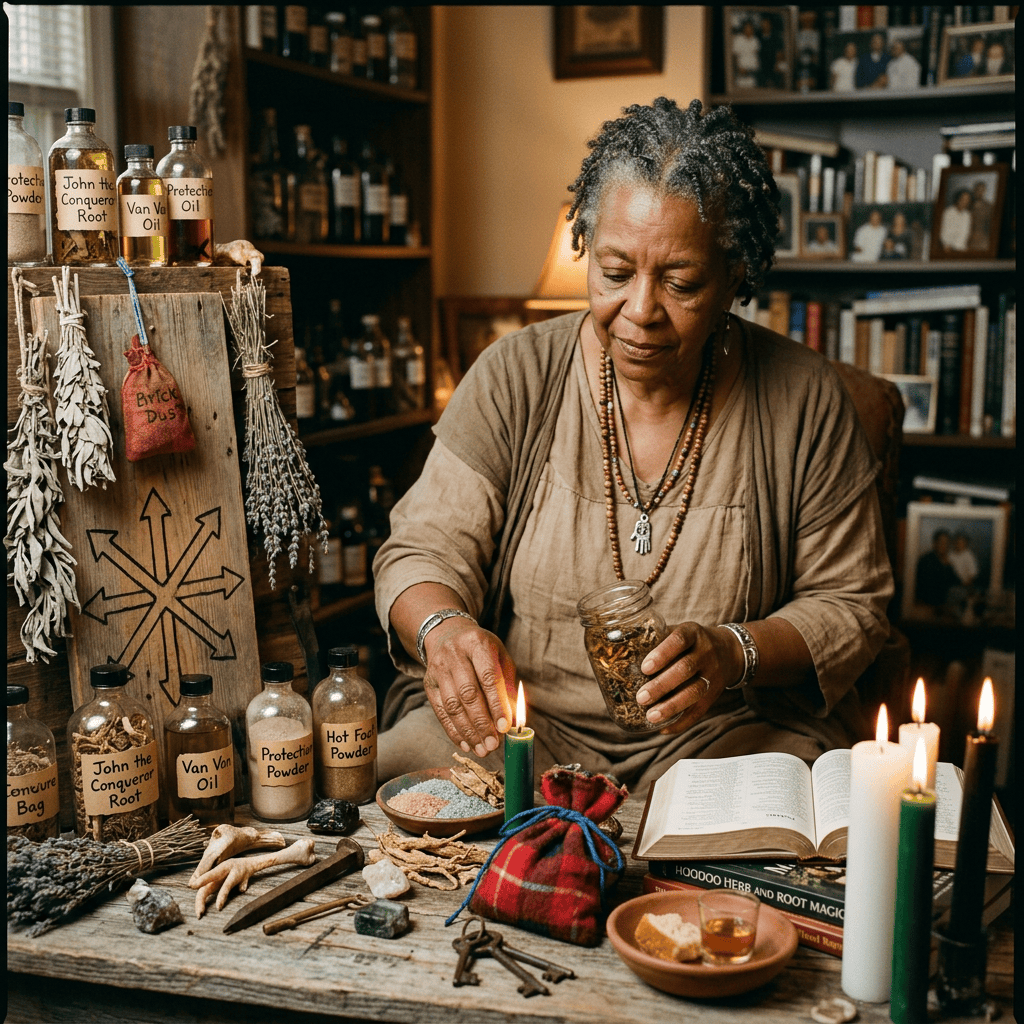
African and Diasporic sacred traditions connect the living, the divine, and ancestral spirits (Egún) within integrated cosmological systems. The Yoruba word Egún holds a profound dual meaning, signifying both “ancestors” and “bones,” which underscores the somatic and spiritual bond between living descendants and their ancestral lineage. Rather than viewing death as an absolute end, these worldviews understand the deceased as having transitioned into Ancestorhood—remaining an active, protective community acting as a first line of defense equipped with divine power and energy, or Àṣẹ.
Today, foundational worldviews such as Yoruba Òrìṣà, Gbe Vodun, and the Kongo cosmogram (dikenga dia Kongo) are experiencing a vibrant global resurgence as practitioners reclaim their cultural legacies and identities. Originating in West Africa, systems like Gbe Vodun and Yoruba Òrìṣà offer complex philosophies of life where divinities govern natural forces, human destiny, and cosmic balance. Similarly, the Kongo cosmogram illustrates the circular journey of the soul across the divide between the physical world of the living and the spiritual realm of the dead.
Blending ancestral wisdom with modern sensibilities, these traditions are sustained through resilient technologies of oral history, sacred initiation, lineage devotion, divination systems like Ifá, and embodied ritual practices including drumming and dance. During the transatlantic slave trade, enslaved Africans carried these sacred traditions across the ocean, adapting and preserving them despite severe colonial oppression. Out of this spiritual resilience, vibrant Afro-Diasporic systems emerged—including Candomblé, Santería, Haitian Vodou, Hoodoo, and Capoeira Angola—often synthesizing traditional principles with new cultural forms to safeguard their core meanings.
Ultimately, these sacred traditions provide vital grounding, communal cohesion, historical memory, and collective healing for contemporary life. By addressing ancestral trauma, offering spiritual defense, and grounding practitioners in sacred heritage, they serve as living counter-narratives and enduring frameworks for personal growth, community agency, and cosmic alignment.
In today’s installment, we explore “THE UNITED STATES OF HOODOO”.
The United States of Hoodoo: Tracing the Old African Gods in American Culture
(CLICK HERE TO WATCH THIS DOCUMENTARY)
What happens to ancient gods when their worshippers are forcibly taken across an ocean? They do not disappear. Instead, they adapt, disguise themselves, and weave their way into the very fabric of a new world.
This is the central premise of The United States of Hoodoo, a thought-provoking 2012 documentary directed by Oliver Hardt and co-written with celebrated author and satirist Darius James. Spanning 100 minutes, the German-American co-production takes viewers on a cross-country spiritual road trip to uncover how West and Central African traditions survived the transatlantic slave trade—and quietly became the bedrock of American popular culture.
A Personal and Cultural Pilgrimage
The journey begins with a deeply personal catalyst: the death of Darius James’s father. Seeking answers about grief, ancestry, and spiritual survival, James sets out across the United States to explore how African cosmologies evolved in North America.
His itinerary reads like a map of African American history and myth:
- New York’s African Burial Ground, standing as a solemn starting point for the presence of enslaved Africans in early America.
- The Mississippi Delta, including a visit to the grave of blues legend Robert Johnson, where folklore and music famously collide.
- New Orleans, the historic crossroads where African, Indigenous, and European spiritual practices merged into vibrant living traditions.
Rather than viewing Hoodoo and Vodou through a sensationalized or strictly religious lens, James and Hardt approach them as dynamic, creative forces. They show how spiritual survival required reinvention, blending old-world wisdom with new-world realities.
How the Old Gods Speak Today
One of the film’s most compelling arguments is that African deities—or Orishas and Loa—never really went into hiding. They simply found new vessels in secular American art, music, and daily life, surviving in the rhythms of jazz and blues, the symbolism of popular imagery, the rituals of community gatherings, and the intimate practices passed down through families. In this view, the boundary between the sacred and the secular is far more porous than it first appears: spiritual traditions adapted to new circumstances, transforming rather than disappearing, and continuing to shape American culture in ways that are often overlooked or misidentified.
The Rhythm of the Crossroads
In the documentary, music is presented as one of the clearest conduits for ancestral memory, carrying histories and emotions across generations even when written records have been erased, fragmented, or deliberately suppressed. The film draws a direct line from West African rhythmic traditions to the birth of the Delta blues, the improvisational spirit of jazz, and the modern “turntable wizardry” of hip-hop. In each form, rhythm becomes more than a musical structure: it serves as a language of survival, community, resistance, and remembrance. Call-and-response patterns, layered percussion, repetition, and improvisation preserve echoes of collective experience while allowing each generation to reshape that inheritance in its own voice. When a DJ scratches a record or a blues guitarist bends a note, they are participating in an unbroken chain of spiritual expression, transforming sounds rooted in the past into living forms that speak to the present. Through this connection, the documentary suggests that music does not merely recall history; it actively keeps history alive.
Visual Collage and Afrofuturism
Beyond sound, the film examines how spiritual iconography and ancestor veneration live on in visual and literary arts. Through the works of contemporary artists and Afrofuturist thinkers, viewers see how the tradition of assemblage—gathering everyday objects to create spiritual meaning—translates into modern collage, sculpture, and speculative fiction. These practices transform fragments of history, memory, and material culture into vessels of connection, allowing artists to reclaim erased narratives while imagining futures shaped by ancestral knowledge. The film also explores how recurring symbols, ritual gestures, and layered images create a dialogue between the visible and invisible worlds, demonstrating that art can function not only as representation but also as remembrance, protection, and spiritual practice.
Everyday Magic in the Kitchen and Home
Hoodoo is, at its core, a practical folk tradition rooted in everyday life, community knowledge, and a deep relationship with the natural world. Through intimate conversations with rootworkers, miracle healers, and gumbo cooks, the documentary reveals how spiritual reverence shows up in Southern culinary traditions, folk medicine, prayer, ritual, and the careful passing down of ancestral wisdom. Stirring a pot of gumbo, gathering ingredients, or tending to an herbal remedy becomes more than a household task; it becomes an act of cultural preservation, healing, and remembrance. These practices carry the stories of generations who transformed hardship into nourishment, protection, and belonging, demonstrating how Hoodoo continues to thrive through ordinary gestures imbued with spiritual meaning.
Voices Along the Road
What makes The United States of Hoodoo endlessly engaging is its cast of thinkers, practitioners, and creators. Guided by Darius James’s wry, inquisitive narration, the film features insights from a remarkable lineup of cultural figures:
- Ishmael Reed, the acclaimed novelist whose concept of “Neo-HooDoo” heavily influenced modern African American literature.
- Sallie Ann Glassman, a practicing New Orleans Vodou priestess who offers grounded perspective on the rituals and community behind the faith.
- Val Jeanty, a Haitian-born electronic composer and turntablist who bridges Vodou rhythms with avant-garde sound.
- Danny Simmons and Shantrelle P. Lewis, who unpack the visual language and curatorial power of African diasporic art.
- Nick Cave, the Australian musician who reflects on the haunting, mythic power of American Southern gothic and blues traditions.
The atmosphere of the journey is further elevated by an original score from experimental musician and producer Arto Lindsay, whose compositions mirror the film’s blend of tradition and avant-garde exploration.
Why It Still Matters
Since its release—which included screenings at the BlackStar Film Festival, the Detroit Institute of Arts, and Berlin’s Haus der Kulturen der Welt—The United States of Hoodoo has remained a vital piece of cultural criticism. It challenges long-standing stereotypes about race, rationality, and religion, inviting viewers to look closer at the American landscape and to reconsider the cultural forces that have shaped it. By tracing the connections between African diasporic traditions, popular music, spiritual practice, and everyday life, the film reveals how beliefs often dismissed as irrational can serve as sources of memory, resilience, and collective identity. Its continued relevance lies in this ability to unsettle familiar narratives while encouraging a more nuanced understanding of the ways history, spirituality, and creativity intersect in the United States.
Ultimately, the film reminds us that American culture cannot be separated from its African roots. The old gods did not perish in the Middle Passage; they learned to play the blues, spin records, and tell new stories.
Hidden Bloodlines: What The United States of Hoodoo Has to Do with Capoeira Angola
If you watch the 2012 documentary The United States of Hoodoo: Tracing the Old African Gods in American Culture, directed by Oliver Hardt and written by Darius James, you won’t see a single berimbau or ginga. The film focuses squarely on North America, exploring how African spiritual traditions survived the Middle Passage and quietly shaped American music, art, and folklore.
Meanwhile, Capoeira Angola—the traditional, ground-oriented style of Afro-Brazilian martial arts—was forged thousands of miles away in Bahia, Brazil.
On the surface, they belong to different hemispheres and different disciplines. Yet, look just beneath that surface, and you will find that The United States of Hoodoo and Capoeira Angola are telling the exact same story: how displaced African peoples preserved their sacred worldview by encoding it into rhythm, movement, and everyday survival.
1. Shared Roots in the Kongo-Angola Region
The most direct link between North American Hoodoo and Brazilian Capoeira Angola is geography—not in the Americas, but in Africa. During the transatlantic slave trade, massive numbers of people were taken from the Kongo-Angola region of Central Africa and brought to both North America and Brazil.
In The United States of Hoodoo, Darius James traces how Central and West African cosmologies took root in the American South. Hoodoo relies heavily on Bakongo spiritual concepts, such as the Kongo cosmogram (a sacred cross representing the cycle of life and the spirit world) and minkisi—objects crafted to house spiritual power, which evolved into the Southern mojo bag or hand.
Capoeira Angola draws from the exact same wellspring. Its name honors its Angolan ancestry, and historians trace its foundational kicks and inverted movements to engolo (or n’golo), a ritual combat dance practiced by Bantu peoples in southern Angola. Even the circle in which Capoeira is played—the roda—mirrors the circular sacred spaces of the Kongo cosmogram and the African American Ring Shout.
2. The Art of Hiding in Plain Sight
Because slaveholders and colonial authorities violently suppressed African religions and gatherings, both Hoodoo and Capoeira Angola had to master the art of camouflage.
- In the United States: Enslaved Africans practiced Hoodoo in secret “hush harbors” or veiled their spiritual work behind Christian imagery, psalms, and everyday household tasks. To the outside observer, a person sweeping a porch or tending a garden was just doing chores; to the initiated, they were performing spiritual cleansing and protection.
- In Brazil: Enslaved Africans disguised lethal self-defense techniques as an acrobatic folk dance. When slaveholders or police approached, the fighters seamlessly shifted into playful movement accompanied by singing and clapping.
Both traditions relied on spiritual protection to navigate a hostile world. Just as Hoodoo practitioners carried roots and charms to ward off harm and injustice, traditional capoeiristas practiced mandinga—a form of spiritual cunning, trickery, and magic—and wore protective amulets called patuás around their necks to keep themselves safe inside and outside the roda.
3. “The Old African Gods” in Rhythm and Improvisation
The central thesis of The United States of Hoodoo is that the “old African gods” never truly disappeared in America; they simply stepped into modern art forms. The film connects ancient spiritual practices to the improvisational genius of Mississippi Delta blues, jazz, funk, and hip-hop turntablism.
Capoeira Angola operates on this exact same frequency. It is not merely a sport or a fighting system; it is a physical dialogue driven by music.
In a Capoeira Angola roda, the rhythm of the berimbau dictates the speed, mood, and spiritual energy of the game. Players must improvise in real time, responding to the music and their partner with wit, deception, and grace. Just like a blues guitarist bending a note or a DJ scratching a record to summon a feeling, a capoeirista uses rhythm and improvisation to channel ancestral memory into living art.
4. Reclaiming the Lineage
Finally, both the documentary and the modern practice of Capoeira Angola are acts of cultural preservation.
In the 20th century, as Capoeira was being modernized and turned into a standardized sport, legendary masters like Mestre Pastinha fought to preserve Capoeira Angola. They insisted on keeping its rituals, music, philosophy, and African identity intact so its history wouldn’t be whitewashed.
In much the same way, The United States of Hoodoo serves as a cinematic reclamation. By traveling across the United States to interview scholars, musicians, and practitioners, Darius James pulls African American folk spirituality out of the shadows of superstition and restores it to its rightful place as a foundational pillar of American culture.
While The United States of Hoodoo doesn’t mention Capoeira Angola by name, it maps out the exact cultural DNA that made Capoeira possible. Together, they stand as twin monuments to the resilience of the African diaspora—proof that even when stripped of everything, people can carry entire worlds inside a song, a prayer, or a movement. They reveal how traditions can survive displacement, persecution, and forced assimilation by adapting to new environments without surrendering their deepest meanings. In this sense, Capoeira’s rhythms, rituals, and embodied strategies belong to a much larger history of African-descended communities transforming memory into culture and resistance into art. What appears on the surface as music, spirituality, or play can also function as education, communal protection, historical preservation, and a quiet declaration of freedom.

