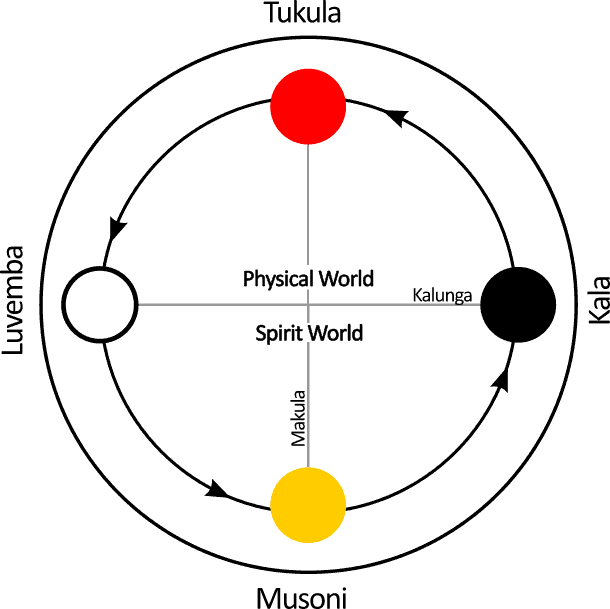
The Four Moments of the Sun (Dikenga)
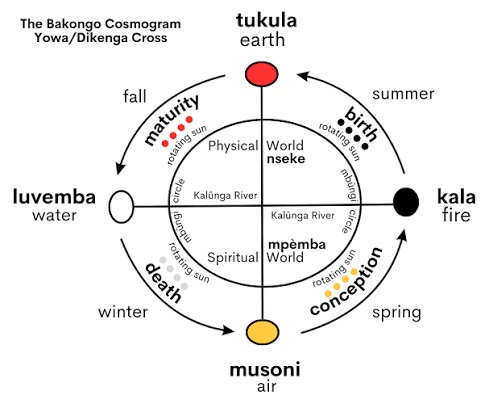
The Cosmogram is a cross inside a circle, representing the sun’s daily path across the sky and its continual influence on life. In Capoeira Angola, this loop not only symbolizes the physical and spiritual journey inside the roda (the circle), but it also embodies the interconnectedness of tradition and community. Each movement within the roda serves as a dance of expression and cultural storytelling, allowing participants to reflect on their personal journeys and shared histories, while celebrating the rhythmic harmony of life’s cycles. As performers engage in this dynamic exchange, they reconnect with their ancestral roots and the rich heritage that Capoeira embodies, infusing each moment with energy, art, and profound meaning.
- Musoni (Yellow/East – Dawn): The moment of conception. In Capoeira, this is the pê de berimbau (the foot of the musical bow) where players squat and concentrate before entering the game. It represents potential, intention, and birth.
- Kala (Black/North – Noon): The rise of life and physical strength. This matches the active, upright movements of the game where players test each other’s physical limits and skills.
- Tukula (Red/West – Sunset): The peak of maturity, power, and transformation. In the game, this is where mandinga (sorcery/strategy) peaks, and a player successfully outsmarts an opponent.
- Luvemba (White/South – Midnight): The realm of the ancestors and the dead. In Capoeira, this is represented by chamada (the ritual call) or inverted movements like headstands. The player connects directly with the ground and the spirits of past masters.
The Kalunga Line and the Inverted World
The horizontal line of the cross is the Kalunga line. It represents the surface of the water, dividing the world of the living (Nza yayi) from the world of the dead (Nza yakini).
- Crossing the Border: When a capoeirista does a cartwheel (au), headstand (bananeira), or moves low to the ground, they physically invert their body.
- Spiritual Meaning: Going upside down mimics entering the underworld. By placing their hands or head where their feet usually are, the player looks at the world through the eyes of the ancestors to gain hidden wisdom.
The Ritual Bateria as a Cosmic Clock
The bateria (the orchestra of instruments) sits at the edge of the circle, acting as the anchor for the entire cosmos.
- The Berimbau Gunga: The largest, deepest bow represents the ultimate ancestral voice. It dictates the speed and spiritual tone of the universe inside the roda.
- Counter-Clockwise Movement: Players enter the circle and move in a counter-clockwise direction. This mirrors the rotation of the soul through the Dikenga diagram, winding back time to connect with historical African roots.
Everyday Resistance and Renewal
The roda is not just a game; it is a micro-universe. By playing within the rules of the Kongo Cosmogram, capoeiristas do not just remember history—they relive it. The circle protects them from outside colonial or modern oppression, while the spiritual loop ensures that the energy of past mestres (masters) never dies.
Mestre Pastinha preserved these Central African spiritual roots by codifying and protecting Capoeira Angola from modernization. In mid-20th century Salvador, Bahia, capoeira faced intense pressure to adapt. While other styles leaned into martial efficiency and Western sport metrics, Pastinha resisted the “sportivization” of the art. He recognized capoeira as an ancestral technology. Through his academy, philosophies, and specific rituals, he anchored the roda firmly within the Central African worldview.
Direct African Lineage: The Teachings of Benedito
Pastinha’s direct preservation of these spiritual roots stems from his childhood mentor, an elderly, freeborn African man named Benedito.
- The Transmission: Benedito was from the West-Central African diaspora. He recognized the young, physically small Pastinha needed defense against a larger neighborhood bully.
- The Core Lesson: Benedito did not teach Pastinha brute violence. He taught him mandinga (sorcery/strategy) and malícia (cunning deception). This foundation prioritized cognitive and spiritual trickery over physical mass, directly mirroring the Tukula (sunset/transformation) phase of the Kongo Cosmogram.
Institutionalizing the “Safe Container” (1941)
In 1941, Pastinha founded the Centro Esportivo de Capoeira Angola (CECA) at Pelourinho, Salvador. This institution was designed to be an aquilombamento—a safe, sovereign space for preserving memory.
- The Uniform: He introduced a mandatory uniform of black trousers and a yellow shirt, mimicking the colors of the Ypiranga football club. In Kongo cosmology, black represents the realm of physical life, struggle, and human realization (Kala), while yellow/gold represents the dawn of intention, creation, and spirit (Musoni).
- The Rejection of Modernization: Pastinha openly fought the transformation of capoeira into a ring sport. By keeping the games slow, close to the ground, and highly ritualized, he guaranteed that the spatial loop of the cosmogram remained completely intact.
Codifying the Philosophy of Inversion
Often called the “Philosopher of Capoeira,” Pastinha used famous aphorisms to teach his students how to cross the Kalunga line mentally and physically.
- “Capoeira é mandinga, é manha, é malícia.” (Capoeira is sorcery, cunning, and deception). This taught students that the physical world is an illusion. True power rests in the invisible, spiritual realm.
- “Jogo de Dentro” (The Inside Game): Pastinha emphasized moving incredibly low to the floor (negativa, corta capim, rolê). Keeping the body compressed and inverted kept the capoeirista connected to the earth. In the Bakongo worldview, this physically placed the practitioner closer to the underworld (Luvemba) to access ancestral wisdom.
Global Recognition: Senegal 1966
Pastinha took these preserved roots back across the Atlantic. In 1966, he traveled to Dakar, Senegal, for the First World Festival of Negro Arts (FESMAN). By presenting Capoeira Angola on a global African stage, he validated that Bahia’s rituals were not mere street games. He proved they were a direct, living extension of classical African philosophy and cosmology.
Mandinga and Malícia as Defensive Technologies
This cosmological framework provides a “liberation geometry” for self-defense. Unlike linear martial arts that rely on the direct collision of force against force, Capoeira Angola uses circles and spirals to de-escalate high-impact strikes and mask lethal intent. By internalizing these spiral dynamics, the practitioner ensures every movement is optimized for balance and structural integrity, allowing for the “theft” of an opponent”s energy until their own momentum becomes their downfall. Key strategic principles include:
- Mandinga (Strategic Cunning): Far more than a set of tricks, mandinga is a profound spiritual, psychological, and physical strategy. It represents the intangible power to manipulate an opponent”s perception, using feigned vulnerability and psychological warfare to draw them into a trap. Rooted in West African traditions, it is often connected to ancestral knowledge and protective spiritual forces that influence the outcome of the jogo.
- Malícia (Deception): This is a form of “street smarts” or cunning awareness that allows a practitioner to read an opponent”s aggressive intentions while obscuring their own. Malícia ensures the beginning of a defense is structurally indistinguishable from an offense. It transforms the roda into a “chess match” where the mind is the primary weapon, using subtle shifts in posture or eye contact to lure an adversary into a tactical error.
- Ginga (The Sway): A continuous, elliptical figure-eight step that serves as the foundation for movement and versatility. It ensures the practitioner never becomes a static target, maintaining a state of “active stillness”. The ginga acts as a loading mechanism for weight and momentum, allowing for explosive, unpredictable attacks to be launched from any point in the cycle while keeping the opponent in constant strategic ambiguity.
- Malandragem (Cunning/Cleverness): Closely related to malícia, this philosophy prizes wit and creativity over brute force. It involves using the “Impossible Escape” to turn moments of grave danger into displays of defiant grace, communicating that the opponent”s strength is ineffective against the practitioner”s cunning.
Ultimately, the roda is not just a game but a micro-universe where the energy of past mestres is relived and renewed. Within this “safe container,” practitioners experience vulnerability and build trust through a rigorous set of rules, protecting themselves from outside oppression while preserving African spiritual roots and transforming trauma into enduring strength.
The Chamada
The Chamada (the ritual call) is the most mysterious and tense element of Capoeira Angola. It is not a break from the action, but a condensed, high-stakes physical test of malícia (cunning deception) and spiritual readiness.
Within the Kongo Cosmogram, the Chamada acts as a deliberate crossing of the Kalunga line. One player pauses the fast-paced game to freeze time, forcing both practitioners to step directly into the ancestral realm where physical strength matters less than spiritual alertness.
The Architecture of the Call: Entering the Boundary
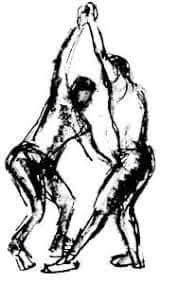
The Chamada begins when one player feels the game needs to be rebalanced or wants to test their opponent’s mental focus.
- The Freeze: The calling player stops moving, stands upright in a specific, vulnerable-looking ritual posture (e.g., holding one hand up, opening both arms, or placing a hand on their hip), and locks eyes with their opponent.
- The Invitation: This posture says: “Step across the Kalunga line with me. Let us leave the physical battle and enter the spirit realm of our ancestors.”
- The Approach: The called player must stop fighting immediately. They cannot attack the vulnerable caller. Instead, they must approach the caller cautiously, moving sideways or backwards, tracking every micro-movement of the caller’s body. They are stepping into a trap, and they know it.
The Exact Rules of the Chamada Ritual
The ritual follows strict, unwritten laws passed down through oral tradition. Breaking these rules is a sign of poor training, disrespect, or lack of spiritual maturity.
- The Convergence: The called player approaches until they are chest-to-chest or hand-to-hand with the caller. They join hands or place their palms against each other in a specific ritual connection.
- The Promenade: Once connected, the caller leads the called player back and forth across the roda (circle) in a slow, rhythmic walk—usually three steps forward, three steps back.
- The Matrix of Malícia: During this walk, the caller will try to subtly break the called player’s focus. They might look away, sigh, change their pacing, or pretend to be distracted.
- The Trap: The caller is looking for a single moment of desatenção (distraction). The second the called player relaxes, lets their guard down, or loses their physical alignment, the caller strikes with a sudden, devastating take-down (rasteira, cabeçada, or banda).
[THE KALUNGA LINE: Surface of the Water / Threshold]
▲
│ 1. THE CALL: Caller stands upright, freezing time.
│ 2. THE APPROACH: Opponent approaches with absolute caution.
——–┼————————————————————
│ 3. THE PROMENADE: Hand-to-hand walk in the Ancestral Realm.
│ 4. THE TEST: Caller breaks focus to unleash a trick (Malícia).
▼
[LUVEMBA: The Underworld / Ancestral Wisdom]
Safely Exiting the Ancestral Realm
The Chamada is a simulation of life itself: you are walking hand-in-hand with danger, and you must survive it. Because the ritual takes place at the edge of the spirit world, returning to the normal game requires a formal, safe exit.
- Maintaining the Guard: While walking, the called player never actually trusts the caller. They keep one arm up to shield their throat and chin, and their weight is distributed so they can drop to the floor instantly if a kick comes.
- The Release: If the called player successfully maintains their focus and evades all hidden traps during the walk, the caller acknowledges their spiritual readiness.
- The Salutary Bow: The caller will gently release the called player’s hands or give a subtle nod. Both players step backward away from each other, bowing slightly to reset their positions.
- Rebirth into the Game: By cleanly breaking the connection without anyone getting swept to the floor, the spell is broken. The players cross back over the Kalunga line, drop back into the ginga (the fluid, swaying movement), and resume the physical game, spiritually renewed and rebalanced.
Lineage Variations: Mestre João Grande vs. Mestre Moraes
While both Mestres trace their lineage directly back to Mestre Pastinha, their execution of the Chamada reflects slightly different interpretations of tactical patience, physical posturing, and malícia. [1]
Mestre João Grande Lineage Mestre Moraes (GCAP) Lineage
[Vulnerable & Open Feint] [Tight, Closed Shield]
* Arms spread wide open * Arm tightly masking the chin
* High-risk invitation * Compact and ready to counter
* Trap relies on total trust * Trap relies on sudden pressure
- Mestre João Grande (Extremely Open & Deceptive): Mestre João Grande favors an expansive, traditional style of invitation. He often initiates a Chamada with his arms spread wide open, exposing his entire torso. This theatrical vulnerability is the ultimate trick (manha). It demands that the approaching player maintain absolute internal focus despite the visual illusion of an easy target. The promenade in this lineage is slow and floating, relying heavily on hypnotic rhythm to lull the opponent before a sudden takedown. [1, 2]
- Mestre Moraes / GCAP (Compact & Martial): The lineage of Mestre Moraes and the Grupo de Capoeira Angola Pelourinho (GCAP) treats the Chamada with heightened tactical vigilance. The caller’s posture is more compact. Even when inviting, one arm remains tightly positioned to shield the chin and throat, and the center of gravity is kept low. The promenade is crisp and firm. Moraes emphasizes that the Chamada is an active tactical trap; the physical spacing is tighter, and the response to any lapse in the opponent’s guard is immediate and sharp.
Physical Takedowns of a Failed Chamada
If a player loses their focus, breaks eye contact, or steps incorrectly during the promenade, they have failed the test of the Kalunga line. The caller instantly executes a queda (fall) to neutralize them. [1]
- Rasteira de Chão (Ground Sweep): The most iconic punishment for a failed Chamada. If the called player steps with their weight poorly distributed, the caller drops rapidly to one hand and uses their heel to hook and drag the opponent’s supporting ankle, pulling their legs out from under them. [1]
- Cabeçada (Headbutt): Executed when the called player leans too far forward or relaxes their upper guard during the hand-to-hand walk. The caller drives the crown of their head directly into the opponent’s chest or stomach, utilizing the element of surprise to break their balance. [1, 2]
- Banda Por Dentro (Internal Trip): A subtle, close-quarters sweep. Without breaking the hand-to-hand connection, the caller steps behind or inside the opponent’s lead foot and applies lateral leverage with their own leg, forcing the distracted player to trip backward over the block. [1]
Reading the Pants: The Connection to the Ground
In Capoeira Angola, a practitioner’s clothing—specifically their trousers—is a visual report card of their skill, agility, and spiritual cleanliness.
- The Myth of the Clean Capoeirista: Historically, street capoeiristas or malandros (rogues) would play on rough, dusty earth while wearing pristine white linen suits. The ultimate display of malícia and physical mastery was to play an entire, highly inverted game close to the dirt without getting a single speck of soil on their clothes.
- Reading the Marks: If a capoeirista rises from a game with heavy dirt stains on their knees, thighs, or buttocks, it reveals they lost control, fell, or were forced to use clumsy, desperate body supports to avoid a takedown.
- The Only Acceptable Marks: The only parts of the clothing that should ever show contact with the earth are the palms of the hands, the absolute soles of the shoes, and the exact crown of the head (from flawless, controlled bananeiras or headstands). A clean uniform signifies that the player successfully navigated the underworld without letting the chaos of the environment stick to them.
In Capoeira Angola, songs are not just background tracks; they are historical records, oral literature, and spiritual incantations. Songs that explicitly evoke Kalunga (or its regional linguistic variations like Calunga) invoke the ancestral threshold, the memory of the Middle Passage, and the deep Kongo-Angolan underworld.
These musical pieces range across different formats, including slow, narrative ladainhas (litanies) and high-energy corridos (call-and-response songs).
1. “Preta Calunga” (The Ancestral Figure)
This traditional corrido uses the name Calunga to reference both the vast ocean crossed by enslaved ancestors and the physical representation of West-Central African spiritual deities used in traditional Afro-Brazilian ceremonies like Maracatu. [1]
- Portuguese Lyrics:
Solo: Ó esmola, meu irmão!
Chorus: Preta Calunga!
Solo: Ó esmola, pelo amor de Deus!
Chorus: Preta Calunga!
Solo: No tempo que eu tinha dinheiro, eu dava esmola ao meu irmão…
Chorus: Preta Calunga! - English Translation:
Solo: Oh, charity, my brother!
Chorus: Black Calunga!
Solo: Oh, charity, for the love of God!
Chorus: Black Calunga!
Solo: Back when I had money, I gave charity to my brother…
Chorus: Black Calunga! - Cosmological Meaning: In this song, “Preta Calunga” acts as a spiritual witness or protective entity. Singing it inside the roda directly acknowledges the historical poverty, survival struggles, and deep spiritual wealth of the African diaspora.
2. “Dona Alice, Não Me Pegue Não” (The Ocean Boundary)
This classic corrido explicitly highlights the regional double-meaning of “Kalunga” as the great ocean or a deep saltwater boundary that separates the living world from the homeland of the ancestors.
- Portuguese Lyrics:
Solo: Kalunga, ê…
Chorus: Kalunga, á!
Solo: Dona Alice, não me pegue não…
Chorus: Kalunga, á!
Solo: Olha o balanço que o mar dá…
Chorus: Kalunga, á!
Solo: Eu vou cruzar a Kalunga…
Chorus: Kalunga, á! - English Translation:
Solo: Kalunga, ê…
Chorus: Kalunga, á!
Solo: Dona Alice, do not catch me…
Chorus: Kalunga, á!
Solo: Look at the swaying of the sea…
Chorus: Kalunga, á!
Solo: I am going to cross the Kalunga…
Chorus: Kalunga, á! - Cosmological Meaning: When the singer proclaims “Eu vou cruzar a Kalunga” (I am going to cross the Kalunga line), they are speaking of transitioning into the spiritual realm or invoking the intense, swaying defensive movement (ginga) that mimics the ocean current to evade capture.
3. “Kalunga Grande” (The Great Beyond)
In many traditional improvised chulas and ladainhas, older Masters refer specifically to Kalunga Grande (The Great Kalunga / The Deep Sea) and Kalunga Pequena (The Small Kalunga / The Cemetery).
- Portuguese Sample Lines:
Iê, o navio negreiro correu o mar…
Cruzou a Kalunga Grande, pra nos escravizar…
Mas a força do ancestral, ninguém pode segurar!
Camará… - English Translation:
Iê, the slave ship raced across the sea…
It crossed the Great Kalunga, to enslave us…
But the power of the ancestors, no one can hold back!
Comrade… - Cosmological Meaning: This narrative style directly layers historical trauma onto the Kongo Cosmogram. The Atlantic Ocean is literally visualized as the horizontal Kalunga line of the cross—a vast watery mirror where millions of souls transitioned from the living world into the ancestral realm.
How the Music Activates the Kalunga Line
When these songs are initiated by the berimbau gunga, the energy inside the room shifts:
- The Incantation: The word “Kalunga” functions as a sonic key that commands the players to honor the floor, move with malícia (cunning), and respect the gravity of the circle.
- Rhythmic Synchronization: The choir’s repetitive response drives the axé (spiritual energy) higher, effectively transforming the physical space inside the room into a living intersection of the physical and spiritual worlds. [1]
The atabaque rhythm functions as a sonic and physiological bridge designed to puncture the Kalunga line. By aligning its structural, physical, and symbolic elements, this rhythm serves as a portal to the ancestral realm through several key mechanisms:
1. The Anatomy of the Two-World Heartbeat
The standard atabaque pattern in Capoeira Angola is a four-beat phrase. The drummer creates an acoustic simulation of a resting mammalian heart by manipulating open and closed tones:
- The Closed Slaps (The Systole): The first two strikes are sharp, high-pitched slaps muted against the calfskin drumhead. This tight constriction represents the contraction of the physical heart in Ku Nseke (the world of the living).
- The Deep Bass (The Diastole): The critical third beat is an open, unmuted center strike that produces a low-frequency rumble. In Central African cosmology, this low bass note symbolizes the expansion of the heart into Ku Mpemba (the ancestral underworld). The final fourth beat acts as a trailing rebound, completing a cyclic pattern that mirrors a heartbeat looping indefinitely.
BEAT 1 & 2: Sharp Muted Slaps ──▶ Ku Nseke (Living Realm / Constriction)
BEAT 3: Deep Open Bass ──▶ Ku Mpemba (Ancestral Realm / Expansion)
BEAT 4: Soft Trailing Rebound ──▶ The Cyclic Loop of Rebirth
2. Infrasonic Penetration of the Kalunga Threshold
The Kalunga line is traditionally visualized as a watery, horizontal mirror dividing the physical world from the spiritual plane below. Higher-pitched sounds like the viola berimbau travel horizontally through the air to guide the tactical maneuvers of the living players.
Conversely, the atabaque produces low-frequency, omnidirectional acoustic waves. These heavy vibrations travel downward through the floor and into the earth. By vibrating the literal ground upon which capoeiristas stand, the drum uses kinetic resonance to break through the metaphorical surface of the water, extending an auditory line of communication to the “neighbors downstairs.”
3. Entrainment and Vitality Synchronization
During long, exhausting games, a capoeirista’s physical heartbeat inevitably accelerates due to fatigue. The atabaque, however, maintains a strict, unyielding tempo.
This steady tempo forces the players’ bodies to undergo auditory entrainment—a physiological phenomenon where internal biological rhythms synchronize with an external acoustic pulse. By binding their physical stamina to the unchanging tempo of the drum, players step out of their fragile, personal timelines. They tap into a collective, historical life-force that has sustained the African diaspora for centuries.
In the Capoeira Angola bateria, the three berimbaus—the Gunga, Médio, and Viola—are not tuned to arbitrary musical scales. Instead, their pitch hierarchy maps onto both the Kongo Cosmogram and the human anatomy.
By linking specific acoustic frequencies to distinct physical zones of the human body, the instruments orchestrate how a capoeirista moves, thinks, and connects with the earth.
The Acoustic Map of the Human Body
[ HUMAN BODY ZONES ] [ THE THREE BERIMBAUS ]
▲ Upper Zone: Head/Mind ──▶ VIOLA (High Pitch)
│ – Intellect, Strategy – Complex Improvisations
│
┼ Middle Zone: Chest/Heart ──▶ MÉDIO (Medium Pitch)
│ – Emotion, Breath – Inverted Counter-Rhythm
│
▼ Lower Zone: Hips/Feet ──▶ GUNGA (Deep Bass)
– Grounding, Balance – The Unbending Ancestral Root
1. The Gunga (Deep Bass) ──▶ The Lower Zone (Feet, Hips, and Root)
The Gunga features the largest cabaça (gourd resonator) and produces the deepest, most resonant bass tones.
- The Physical Connection: This instrument dictates the foundational rhythm and rules of the game. Its frequencies resonate in the lower torso, hips, and legs—the physical centers of balance, gravity, and stability.
- The Cosmological Meaning: In Capoeira Angola, keeping a low center of gravity (jogo de dentro) is vital for survival. The Gunga’s deep pulse acts as a physical anchor, constantly pulling the capoeirista’s hips toward the ground (Luvemba / Midnight). It ensures that the feet remain rooted and receptive to the earth’s tactical feedback.
2. The Médio (Medium Pitch) ──▶ The Middle Zone (Chest, Lungs, and Heart)
The Médio is medium in size and pitch. It plays the exact inverse rhythm of the Gunga, creating a syncopated dialogue.
- The Physical Connection: The Médio’s frequency lands directly in the chest cavity, vibrating the lungs and heart. This zone governs breath, stamina, and emotional endurance.
- The Cosmological Meaning: Because it plays the inversion of the main rhythm, the Médio represents the Kalunga line—the watery horizon separating life and death. It forces the capoeirista to regulate their breathing and heart rate amid the physical chaos of the game, translating internal emotional control into fluid, rhythmic movement.
3. The Viola (High Pitch) ──▶ The Upper Zone (Throat, Eyes, and Brain)
The Viola has the smallest gourd and produces sharp, high-pitched, fast-paced notes. It does not stick to the basic rhythm; instead, it improvises constantly with rapid variations.
- The Physical Connection: The piercing sound of the Viola cuts through the heavy bass of the drums, stimulating the ears, eyes, and brain. It triggers the nervous system into a state of high-alert hyper-awareness.
- The Cosmological Meaning: The Viola governs mandinga (sorcery/strategy) and malícia (cunning). Its erratic, lightning-fast patterns map onto the eyes and intellect, demanding that a player remain intellectually sharp, visually vigilant, and ready to exploit any split-second opening left by their opponent.
Activating the Complete Capoeirista
When all three berimbaus play together, they form a complete sonic entity that unifies the player’s entire body:
- The Gunga keeps their hips low and stable.
- The Médio keeps their breathing steady and rhythmic.
- The Viola keeps their eyes and mind sharp.
If any of these three levels lose synchronization with the bateria, the capoeirista becomes unbalanced, leaving themselves wide open to a sudden takedown.
Conclusion:
The Kongo Cosmogram is not merely an abstract symbol but a living architectural map that dictates every physical and spiritual vibration within the Capoeira Angola roda. By aligning the instruments of the bateria with the human body and the four moments of the sun, practitioners transform a martial art into a sacred technology of memory and resistance.
- Spiritual Anchoring: Through the Chamada and the Kalunga line, players learn to navigate the threshold between the living and the ancestors, gaining the malícia necessary to survive both inside and outside the circle.
- Tactical Versatility: The shift between the Toque de Angola and São Bento Grande demonstrates the dual nature of the soul’s journey—balancing the compressed depth of ancestral wisdom with the expansive peak of physical realization.
- Cultural Sovereignty: As codified by Mestre Pastinha, the ritualized use of the cosmogram ensures that Capoeira Angola remains an aquilombamento—a safe container where the history of the African diaspora is not just remembered, but physically relived and renewed.
Ultimately, every strike of the atabaque and every rotation of the body serves to keep the eternal loop of the Dikenga in motion, ensuring that the connection between the ground and the stars remains unbroken.