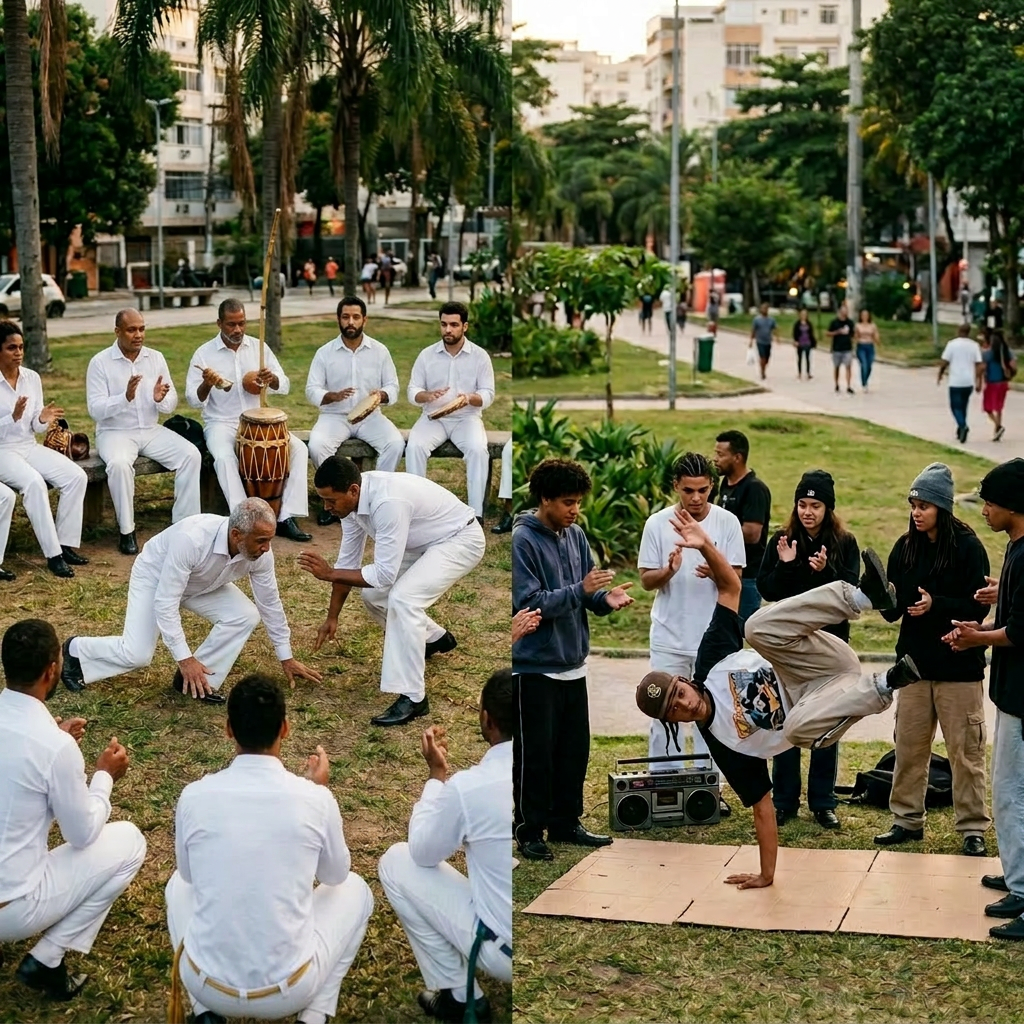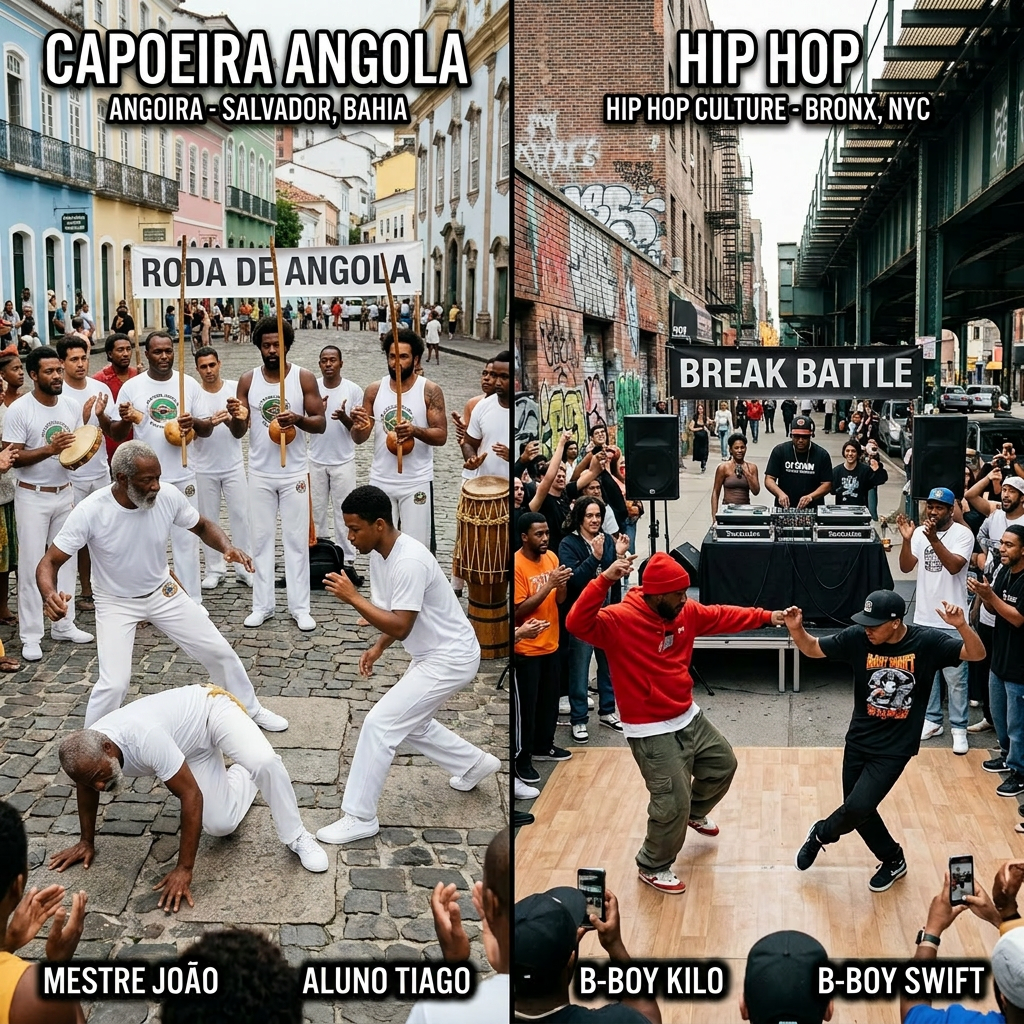
The relationship between Capoeira Angola and Hip Hop reveals a profound connection rooted in the African Diaspora, where movement serves as a tool for resistance, identity, and community building. These parallel movements represent living archives of shared history and creative ingenuity, synthesized through movement, music, and voice.
Shared Origins and Cultural Resistance
Both Capoeira Angola and Hip Hop emerged from marginalized communities as creative responses to systemic oppression. Capoeira Angola, with its roots in the struggle of enslaved Africans in Brazil, was developed as a tool for physical self-defense and cultural preservation, often disguised as a dance to evade colonial authorities. Similarly, Hip Hop culture, particularly breaking (B-boying/B-girling), developed in the Bronx during the 1970s among predominantly Black and Latino youth as a way to reclaim space and express social commentary through physical artistry amidst urban decay and social inequality. Both forms provide a self-determined space outside of dominant cultural control.
Key Points of Intersection
The Circle (Roda and Cypher): The roda in Capoeira and the cypher in Hip Hop both define the performance space where participants exchange energy and skills in a dynamic interplay of tradition and creativity. These are sacred, democratic spaces for performative identity, mastery, and communal storytelling, acting as vital cultural touchstones that encourage self-expression and community building. Within these circles, participants engage in competitive yet supportive displays of skill, showcasing their talents while simultaneously uplifting their peers. The atmosphere is charged with anticipation and excitement, as moves and rhythms evolve through a rich history of influences and innovation. In these moments, each individual contributes to the collective narrative, merging their personal stories with broader cultural themes to create an immersive experience that resonates deeply with all involved. Ultimately, both the roda and the cypher serve as essential platforms for dialogue, creativity, and connection among diverse communities, fostering a sense of belonging and shared purpose.
Musicality and Rhythm: Both forms are inseparable from their rhythms, which are based on African rhythmic traditions that have evolved over centuries. The berimbau plays a crucial role in dictating the pace and rhythm of the roda, establishing a unique ambiance that brings the participants together. Similarly, in Hip Hop, the breakbeat, often meticulously looped by a skilled DJ, serves as the backbone of the music, guiding the dancer’s movements and expression. Both musical styles utilize intricate call-and-response patterns, creating an interactive experience that fosters community participation and connection among individuals. These rhythmic elements not only enhance the performance but also deepen the cultural significance, allowing practitioners to celebrate their heritage while engaging in a vibrant dialogue through movement and sound.
Improvisation and Flow: Both arts demand high levels of physical and verbal improvisation, allowing practitioners to express themselves in a dynamic and original manner. In Capoeira, the jogo (game) is a constant, spontaneous physical dialogue between players, characterized by fluid movements, impressive acrobatics, and playful interactions that reflect the individual styles of each participant. This improvisational nature encourages creativity as players read each other’s cues and adapt their movements on the fly, creating an ever-evolving dance of anticipation and reaction. Similarly, in Hip Hop, “flow” is not just the ability to manipulate rhythm and meter to create a unique, spontaneous style; it also involves a deep understanding of wordplay, emotion, and storytelling that resonates with audiences. Rappers continuously innovate their flow to keep their performances fresh and engaging, experimenting with various patterns, pauses, and emphases that enhance their lyrical impact. Together, these elements make improvisation a foundational aspect of both Capoeira and Hip Hop, showcasing the rich, expressive potential of human movement and language.
Physical Vocabulary: There are notable aesthetic and kinetic similarities between Capoeira’s floor-based movements and the power moves and footwork found in breaking. Both emphasize mastery of body control, balance, and gravity-defying maneuvers, showcasing an impressive fusion of athleticism and artistry. In Capoeira, practitioners flow seamlessly between striking, dodging, and acrobatic displays, creating a dialogue with their partners that is as much about rhythm and expression as it is about technique. Similarly, breaking incorporates intricate transitions and spins that require not only strength but also an acute awareness of one’s surroundings and body mechanics. The shared vocabulary of these disciplines highlights the underlying principles of movement, where improvisation and creativity play crucial roles, allowing practitioners to explore the limitless possibilities of human expression through physical performance.
Capoeira Angola and Hip Hop are more than just athletic or artistic practices; they are enduring cultural legacies of the African Diaspora that continue to empower marginalized voices. By transforming tools of survival into sophisticated systems of movement and music, these traditions offer a framework for understanding how art can serve as both a shield against oppression and a bridge for community solidarity. Their shared emphasis on the circle, rhythm, and improvisation ensures that they remain dynamic, evolving dialogues that honor their history while inspiring new forms of creative resistance.