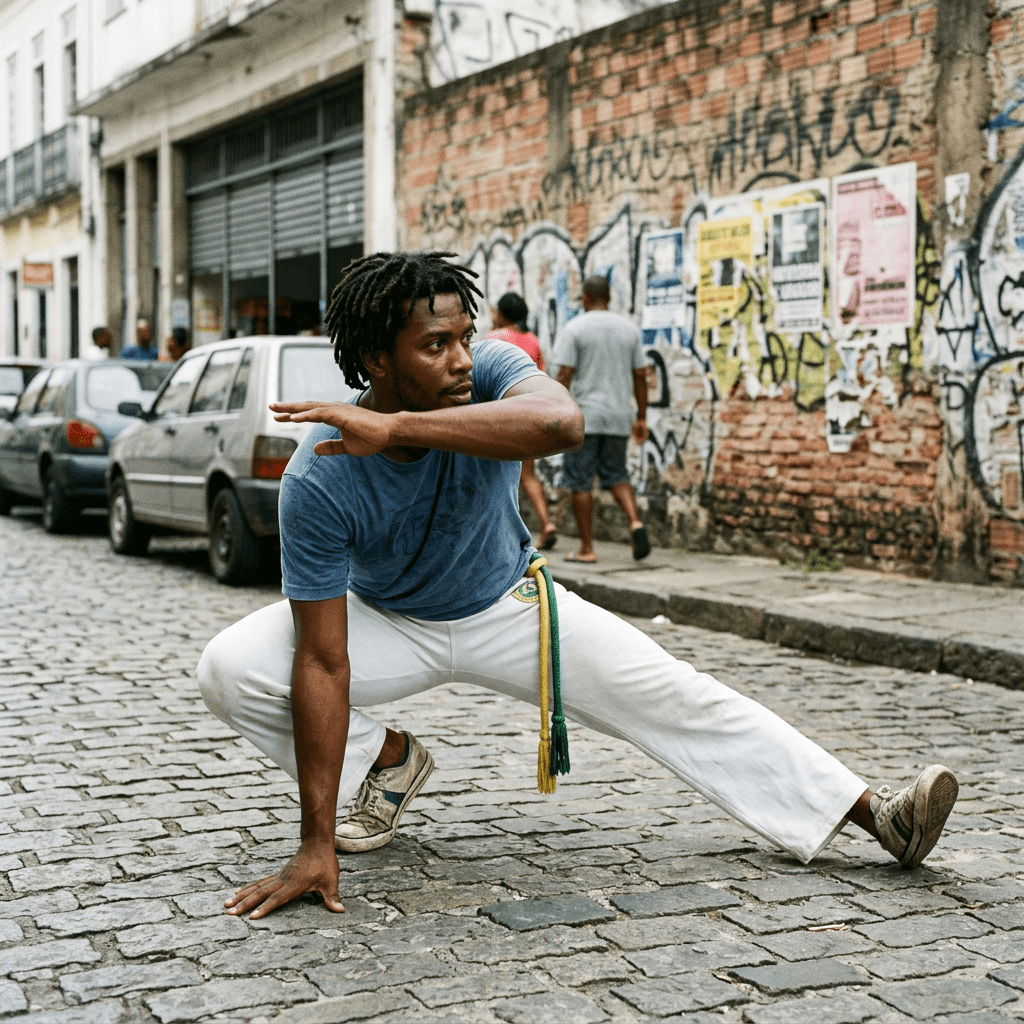
Capoeira Angola, a martial art deeply rooted in Afro-Brazilian culture and history, offers a unique and highly effective approach to self-defense in a street confrontation. Unlike its more acrobatic cousin, Capoeira Regional, Angola emphasizes low, deceptive movements, strategic evasion, and a deep understanding of malícia (malice, or street cunning). An Angoleiro—a practitioner of Capoeira Angola—is trained not for sport or flashy performance, but for survival and practical application in unpredictable, real-world scenarios.
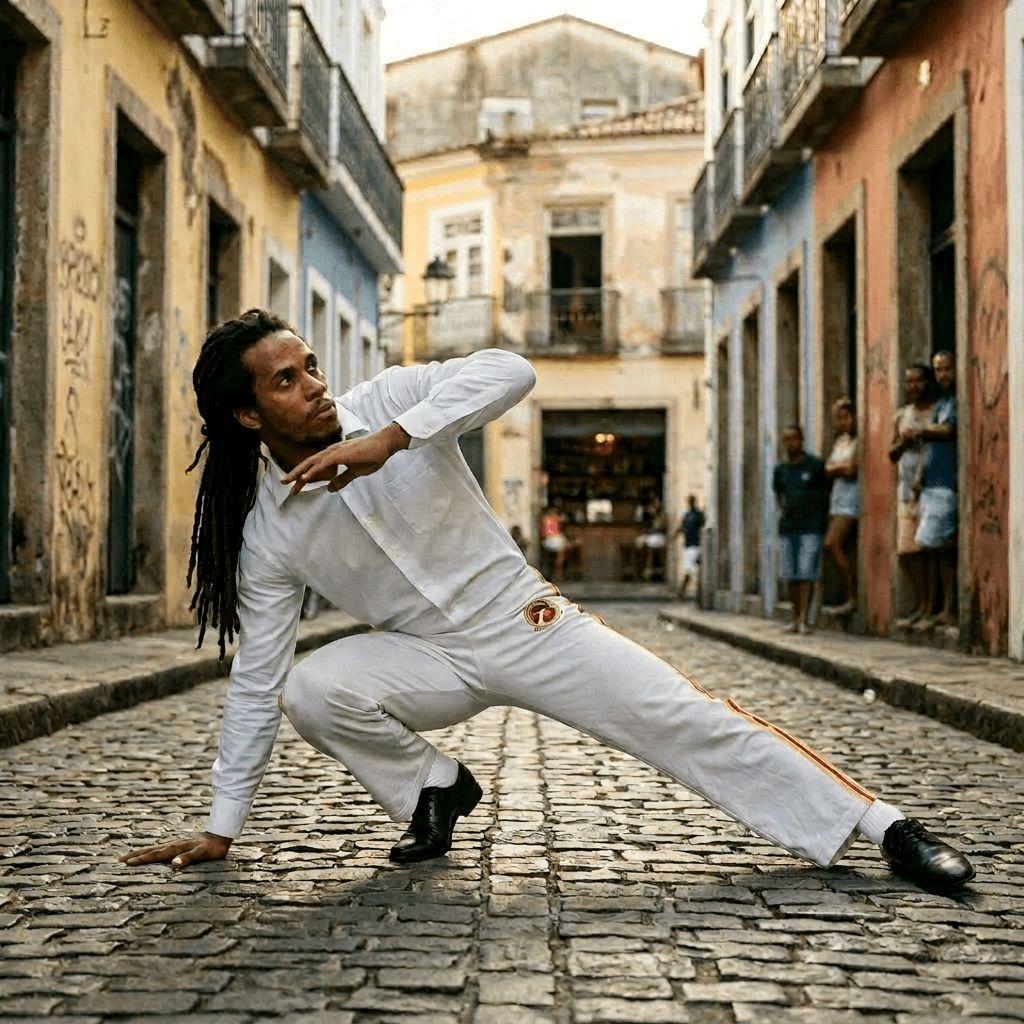
The Angoleiro’s Philosophy in Conflict: Strategy, Stance, and Street Cunning
The Angoleiro approaches conflict not as a brute-force contest, but as a strategic chess match where the primary objective is calculated survival and threat neutralization. The aim is never to inflict maximum or gratuitous damage, but rather to safely resolve the confrontation, often by leveraging non-linear and confusing movements that capitalize on the attacker’s own aggression, momentum, and predictable commitment. The fight is won through intelligence and deception, not merely physical strength.
1. Deception and Low Stance (Nêga and Cadeira)
The foundational element of the Angoleiro’s street defense is the low, grounded posture, epitomized by the Nêga (a defensive, low side-to-side evasion) and the Cadeira (a seated, grounded posture). This stance is a masterful blend of defense, mobility, and deception:
- Inherently Defensive: Operating close to the ground significantly reduces the Angoleiro’s vertical target profile, making high-line attacks like straight punches and head kicks far less effective. The body is coiled and ready, minimizing exposure.
- Maximum Mobility: While appearing stationary, these low postures provide a launchpad for explosive, multidirectional movement. The Angoleiro can pivot, weave, and roll out of the line of attack with lightning speed, often appearing to disappear entirely from the opponent’s striking plane.
- The Deceptive Invitation: The low stance is an active piece of psychological bait. It visually suggests vulnerability and presents an inviting target for a decisive high strike. This subtle invitation is a trap; the attacker, seeing an easy mark, commits with excessive force and linear motion, only to have the Angoleiro swiftly evade the strike and counter with a low sweep (rasteira), trip, or a sudden change of level into a takedown.
- Psychological Advantage (Malícia in Action): In a street environment, a low, fluid stance is far less confrontational or intimidating than a traditional high boxing guard or martial arts posture. This non-threatening appearance leverages malícia—it causes the attacker to underestimate the Angoleiro, creating a crucial moment of lapsed focus that is immediately exploited.
2. Malícia (Street Cunning and Psychological Warfare)
Malícia is the intellectual and psychological core of the Angoleiro’s conflict philosophy. It transcends physical technique, representing the ability to read the opponent’s heart, mind, and intentions, manipulate the flow of the fight, and utilize the environment as a weapon.
- Reading the Intentions: Malícia is the intuitive ability to look past the opponent’s actions and anticipate their intent. This is achieved by studying their eyes, their weight distribution, the tension in their shoulders, and their nervous habits. An Angoleiro is not reacting to a punch; they are moving before the punch is even thrown, based on the subtle signs of intent.
- Feinting and Baiting: This is the application of malícia through movement. The Angoleiro uses slow, rhythmic, and almost dance-like movements to establish a false rhythm and lull the attacker into a false sense of security. They might expose a target—like a slight lean of the head or a dropped hand—only to bait the attacker into a predictable, committed response. The feint is designed to draw out the opponent’s A-game attack prematurely, allowing the Angoleiro to study and neutralize it.
- Exploiting Openings over Meeting Force: The Angoleiro operates under the principle of minimal effort for maximum effect. Instead of engaging in a costly exchange of force-on-force—a recipe for mutual injury—the focus is on finding and exploiting windows of opportunity. These openings are created when the attacker:
- Overextends: Commits too much weight or momentum to a strike, causing a temporary loss of balance.
- Recovers: Is in the vulnerable phase of retracting a limb or setting up the next attack.
- Exhibits Lack of Balance: Has poor footing or is caught standing upright and linear.
- Environmental Awareness: A true master of malícia incorporates the terrain, obstacles, and bystanders into their strategy. A sweep is not just aimed at a leg; it’s aimed at driving the opponent into a wall, a curb, or a crowded area to further compound their disorientation and loss of control. The environment becomes an extension of the Angoleiro’s technique.
Core Defensive and Counter-Offensive Strategies
The Angoleiro’s arsenal relies on fluid transitions between defense and attack, often using the same movement for both.
| Technique | Application in Streetfighting | Rationale |
| Evasions (Esquivas) | Dodging strikes by dropping low, ducking, or shifting the body away from the line of attack while simultaneously repositioning. | Prioritizes safety. Allows the attacker’s momentum to carry them past the target, creating an instant opening for a counter. |
| Sweeps (Rasteiras) | Low, surprise leg sweeps designed to take the attacker off their feet. Executed from a low position (often Nêga or Queda de Quatro). | Highly effective for ending a fight quickly. A fall on concrete can be fight-ending, and the sudden loss of balance is unexpected. |
| Headbutts (Cabeçadas) | Used as a sudden, close-range impact strike, often delivered after an evasion or when closing the distance. | A powerful, surprising blow, especially effective against an opponent focused on hand strikes. It is one of the most direct applications of force in Angola. |
| Trapping and Take-Downs (Balanços and Boca de Calça) | Using the attacker’s clothing or limbs to disrupt their balance and execute a take-down or throw. | Utilizes the attacker’s weight and momentum against them, a crucial skill in close-quarters defense. |
The Psychological Edge: Translating the Roda to the Street
The foundation of Capoeira Angola’s efficacy in a street-defense scenario is not purely physical—it is profoundly psychological. An Angoleiro is not merely trained in movements; they are rigorously conditioned within the pressurized, fluid environment of the roda (the Capoeira circle). This training ground is a crucible for mental fortitude and heightened anticipation, a state of mind that translates directly and lethally to the unpredictability of a street confrontation.
I. The Crucible of the Roda
The roda serves as a high-fidelity simulator for stress and sudden shifts in momentum. Unlike the static or predictable movements of many martial arts drills, the jogo (the game within the roda) demands continuous, non-linear improvisation. The Angoleiro must process complex, real-time data: the rhythm and speed set by the berimbau, the energy of the surrounding participants, the unpredictable attacks and feints of the opponent, and the strategic positioning of the exit points. This constant mental load sharpens three crucial psychological assets:
- Anticipation and Pattern Recognition (Leitura): The Angoleiro develops a leitura—a form of intuitive reading—that allows them to predict an opponent’s intent not just by their footwork, but by subtle shifts in body weight, eye movement, and rhythm. In the street, this translates to an almost preternatural ability to recognize a developing threat before a punch is thrown or a weapon is brandished.
- Emotional Regulation and Presence of Mind (Controle): The atmosphere of the roda is often intimidating, filled with fast-paced music, competitive energy, and the ever-present risk of a sudden takedown (rasteira) or unexpected blow. Training within this high-stress, performative environment builds exceptional emotional controle. An Angoleiro learns to operate calmly and deliberately, rather than reacting out of panic or pure aggression, ensuring that motor skills and strategic thinking remain intact when adrenaline spikes in a genuine confrontation.
- Adaptability and Fluidity (Malícia): Malícia is the psychological weapon of the Angoleiro—a shrewd, deceptive intelligence. It is the ability to maintain a facade of calm while simultaneously setting traps, exploiting openings, and managing space. The roda teaches the practitioner to never commit to a single plan but to remain fluid, ready to pivot from defense to attack, from evasion to submission, based on the immediate reality of the interaction.
II. Translation to the Street
The moment a street confrontation begins, the Angoleiro’s conditioned mental state takes over. The noise, the sudden aggression, and the chaos are psychologically processed not as an overwhelming threat, but as a high-stakes, albeit non-musical, jogo.
- Spatial Dominance: The Angoleiro instinctively uses the Ginga, the characteristic swaying motion, not just as a physical ready stance but as a psychological tool to maintain an optimal defense and attack perimeter. This continuous movement makes the target elusive, frustrating the attacker’s ability to lock onto a static point and dictating the pace and range of the conflict.
- The Power of De-escalation through Presence: The Angoleiro’s calm, measured movement and non-committal posture, even under duress, often serve as an immediate de-escalant. The attacker is met not with panicked resistance or blind fury, but with an unnerving confidence that suggests a deeper, unpredictable capability, often causing the aggressor to pause or rethink their attack strategy.
- Leveraging the Unfamiliar: Because Capoeira Angola’s movements are so foreign to conventional fighting styles, they introduce a powerful element of cognitive dissonance for an untrained or conventionally trained attacker. The low stances, inverted positions, and sweeping movements bypass the attacker’s learned expectations and reflexes, creating momentary confusion that the Angoleiro can exploit with devastating precision. The psychological victory is often achieved before significant physical contact is even made.
Composure Under Pressure: The Angola Tempo
The core psychological advantage of Capoeira Angola lies in the deliberate, often slow, and highly strategic pace cultivated during training. This methodology stands in stark contrast to martial arts that prioritize immediate, adrenaline-fueled aggression. Instead, Angola instills a deep, almost meditative calmness—a composure under pressure—that serves as the Angoleiro’s most immediate and potent countermeasure against the attacker’s primary weapons: fear, panic, and emotional hijacking.
The Psychological Warfare of the Tempo
The Angola Tempo, the internal rhythm and measured movement ingrained by the roda, is not merely a stylistic choice; it is a sophisticated mechanism for psychological dominance and self-control.
- Countering Adrenaline and Emotional Momentum: The typical street attacker operates on a volatile surge of adrenaline, raw emotion, and a desire for rapid closure. By maintaining the slow, measured, and deceptive tempo of Capoeira Angola, the Angoleiro effectively disrupts the attacker’s emotional and physical momentum. This intentional slowing of the engagement acts as a cognitive block, forcing the assailant out of their high-arousal, instinctual state. This calmness in the Angoleiro allows for superior, rational decision-making and pattern recognition, while the attacker’s heightened emotional state often leads to tunnel vision, predictable overcommitment, and a waste of physical energy. The Angoleiro leverages this emotional imbalance to control the flow and timing of the confrontation.
- The Power of Non-Engagement: The slow, fluid movements, often incorporating low-to-the-ground evasions and feints, can project a startling lack of panic or even disinterest. This subtle psychological tactic can deflate the attacker’s ego and aggressive drive, as their initial surge of intimidation is met with unshakeable stability rather than the expected fear or frantic defense.
- Reading the Attack in Slow Motion: Through thousands of hours of practicing the slow jogo in the roda, the Angoleiro trains their mind to perceive time differently under duress. The speed of a spontaneous attack, while fast to a layperson, appears to unfold in a more manageable sequence to the Angoleiro. This expanded perception is not literal time dilation but a product of relaxed, non-panicked focus, allowing the practitioner to analyze vector, intent, and openings with high precision.
Tactical Breathing and Razor-Sharp Focus
The training methodology of Capoeira Angola is a profound lesson in maintaining internal order amidst external chaos, converting a high-stress scenario into a manageable framework.
- Breath Control as the Anchor: Years of moving, improvising, and surviving within the intense musical cadence and close-quarters proximity of the roda teaches the Angoleiro mastery over their respiratory rate. Controlled, deep, and measured breathing—learned through the sustained effort of a long, slow jogo—is the physical mechanism that regulates the nervous system, preventing the fight-or-flight response from overwhelming rational thought. This ability to maintain tactical breathing under duress is the foundation of composure.
- Transforming Environment into Jogo: The mental discipline developed within the safety of the roda is immediately transferable to a hostile environment. The Angoleiro’s training teaches them to maintain razor-sharp focus, transforming the chaos of a street confrontation into another, albeit more dangerous and high-stakes, jogo (game). By mentally reframing the fight as a dynamic jogo, the fear of the unknown is replaced by the familiar problem-solving required in the roda. The Angoleiro is not just reacting to an attack; they are actively playing the moment, improvising a counter-narrative, and searching for the opponent’s “open door.”
Peripheral Awareness: Mastering the Environment
The heart of Capoeira Angola lies within the roda, a pulsating, dynamic 360-degree environment that serves as the ultimate training ground for comprehensive situational awareness. In this circle, attention must be fluidly distributed—paid not just to the immediate opponent engaged in the jogo, but equally to the energy and rhythm provided by the musicians, the movements of the surrounding capoeiristas, and the overall flow and intensity of the energy. This constant and non-negotiable demand for peripheral awareness is the fundamental skill that translates most critically and directly to surviving and thriving on the street.Superior Situational Awareness: The 360-Degree Mindset
An Angoleiro instinctively maintains a panoramic view of the entire environment—a necessity honed by the requirement to constantly anticipate unexpected entries, sudden shifts in the game, or movements from any point in the circle’s periphery. This translates directly into a Superior Situational Awareness in a street encounter. On the street, this means:
- Rapid and Continuous Environmental Assessment: The Angoleiro’s eyes and senses are continuously scanning, rapidly assessing the terrain (uneven surfaces, potential trip hazards), identifying readily available objects that could be used as potential weapons (or obstacles to avoid), gauging the size and mood of any nearby crowds, and, most crucially, pinpointing viable escape routes.
- Threat Identification Beyond the Primary: The most critical application is the identification of secondary threats or accomplices. A person focused solely on the immediate attacker is blind to the flanking maneuver or the impending attack from a friend of the primary antagonist. The Angoleiro’s peripheral awareness ensures that the immediate threat is never divorced from the larger tactical reality of the environment. This constant scanning and assessment are not a conscious effort but a deeply ingrained, almost meditative state of vigilance.
Controlling the Engagement Space: The Art of Manipulation
The rigorous practice within the roda teaches the Angoleiro a profound mastery over space, distance, and positioning. The game demands a constant, subtle shift and management of the distance between players, always seeking the most advantageous position while simultaneously denying the opponent their desired range. This spatial intelligence is vital for Controlling the Engagement Space on the street:
- Preventing Obstruction: This trained awareness ensures that the Angoleiro never allows themselves to be strategically disadvantaged—never pinned against a wall, backed into a corner, or trapped by an immovable obstacle. The body is constantly oriented to keep an open exit vector, ensuring mobility and freedom of movement are never compromised.
- Manipulating the Attacker: The Angoleiro’s movements are designed to subtly guide and manipulate the attacker into a position that is less advantageous for them, perhaps by steering them toward a physical bottleneck, a slippery patch of ground, or into a line of sight that exposes them to a third-party distraction or obstacle. The space itself becomes a tool of defense and strategy.
Unpredictability: Deception and Non-Linearity
Capoeira Angola is fundamentally a game of deception and misdirection, a kinetic conversation built on misinterpreting intent. Its movements, deeply rooted in the cultural history of resistance and disguised combat intent, are wholly unpredictable and often incomprehensible to anyone accustomed to the linear logic of conventional combat sports. The Angoleiro’s primary weapon is confusion, which they cultivate by operating outside of the established norms of conflict.
The Angoleiro’s Non-Linear Stance and Guard
The most immediate and striking element of Angolan unpredictability is the complete absence of a fixed, recognizable fighting stance or “guard.” In conventional combat, a high guard protects the head, a wide stance provides stability, and the opponent knows where to look for an opening. The Angoleiro intentionally discards this static framework, operating from a low, constantly shifting posture, often appearing relaxed or even passive.
- Breaking the Standard Guard: This lack of a clear, linear point of attack or defense fundamentally frustrates and confuses a conventional fighter. The opponent relies on well-defined visual cues—a raised chin, a squared shoulder, a planted foot—to launch an assault or plan a combination. The Angoleiro denies the attacker this reliable visual anchor.
- Fluid, Low Movements: The constant shifts in body weight, the low queda de rins (fall on the kidneys) defenses, and the dynamic movement of the ginga (the fundamental rocking movement) deny the attacker a stable, fixed target. The body is always in motion, constantly changing plane and angle, making target acquisition a psychological drain and a physical impossibility.
- Denying Anticipation: By maintaining this fluid, non-committal posture, the Angoleiro forces the opponent to guess their intent rather than react to a predictable setup. This creates an immediate psychological advantage.
The Element of Surprise: The Disguised Attack
Capoeira Angola is mastery over transition. Its movements often start low, appearing to be a simple evasion (esquiva) or a low-profile maneuver, only to transition with explosive speed and power into a devastating attack. This element of surprise is core to its effectiveness.
- The Deceptive Transition: A movement that begins as a low, sweeping evasion to duck under a punch can instantaneously transition into a sudden, powerful sweep (rasteira), targeting the opponent’s lead leg and sending them crashing to the ground.
- Acrobatic Defense as Offense: Similarly, an acrobatic defensive posture, such as the aú (cartwheel) or cabeçada (headbutt), is rarely just for evasion. These movements, which defy the norms of upright combat, can be used to set up a trip, deliver a low kick, or transition immediately into a powerful ground game.
- Kinetic Vocabulary: This non-standard, kinetic vocabulary—where the defense becomes the attack and the retreat is a setup—makes it nearly impossible for an assailant accustomed to boxing or wrestling to anticipate the Angoleiro’s genuine response. This constant state of uncertainty creates a profound psychological and physical advantage rooted in confusion and surprise, making the Angoleiro a moving enigma in a street confrontation.e.
The Angoleiro’s Philosophy: A Tactical Game
The Angoleiro’s defense in the street is less about brute force and more about strategic elegance. They effectively turn the encounter into a tactical game, using the physics of movement, distraction, and deception to neutralize a typically more aggressive, but strategically shallow, assailant. The essence of this philosophy is the minimization of risk and the maximization of opportunity. The goal is never to dominate or inflict unnecessary harm, but rather to get home safely. This sophisticated approach elevates Capoeira Angola from a mere collection of techniques into a subtle, profound, and ultimately practical system of street self-defense.