
The evolution of Capoeira from a clandestine survival art to a contributor in modern combat sports is rooted in the early “valentões” (tough guys) of 19th and early 20th-century Brazil. These practitioners established the art’s fearsome reputation in urban centers like Rio de Janeiro and Salvador, where it functioned not as a sport, but as a ruthless system of street combat. In these urban environments, Capoeira was often associated with local gangs and political mercenaries who utilized its low sweeps and headbutts for dominance. This era defined Capoeira’s utility in high-stakes confrontation, eventually transitioning from the “malandragem” of the streets to the structured rings of contemporary mixed martial arts.
The Era of the Valentões and Maltas
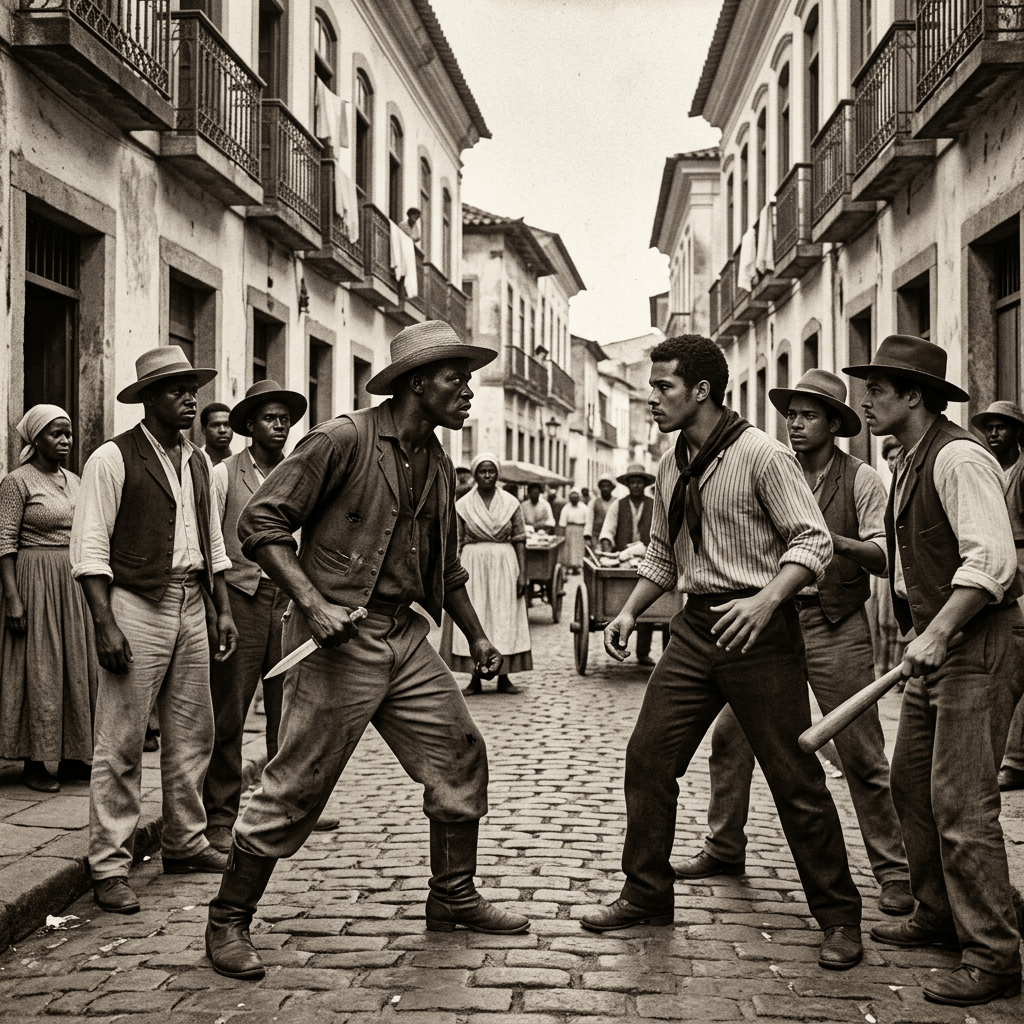
During the late 19th century, particularly following the abolition of slavery in 1888, Capoeira emerged as the primary tool for territorial dominance among marginalized populations in Brazil. In the post-abolition urban landscape, skilled fighters known as valentões utilized the art’s deceptive movements not only as a means of survival but also to establish local power and prestige. These individuals became legendary figures in the streets of Rio de Janeiro, embodying a subculture of resistance and physical prowess.
Combat Characteristics: Early bareknuckle encounters were characterized by extreme pragmatism and brutality, featuring devastating headbutts (cabeçadas) and precision leg sweeps (rasteiras) designed to incapacitate opponents instantly. To gain a lethal advantage, fighters frequently integrated weapons such as straight razors or knives into their technique. These blades were sometimes held between the toes during kicks or concealed within clothing, significantly increasing the lethality of their strikes during street brawls.
The Maltas: Capoeiristas eventually organized into highly structured rival gangs called maltas, with the Guaiamús and Nagôs being the most prominent. Far from being simple street gangs, these groups functioned as sophisticated political enforcers and mercenaries. They utilized their collective street-fighting prowess to influence local elections, protect specific neighborhoods, and control urban territory through systematic intimidation and violence.
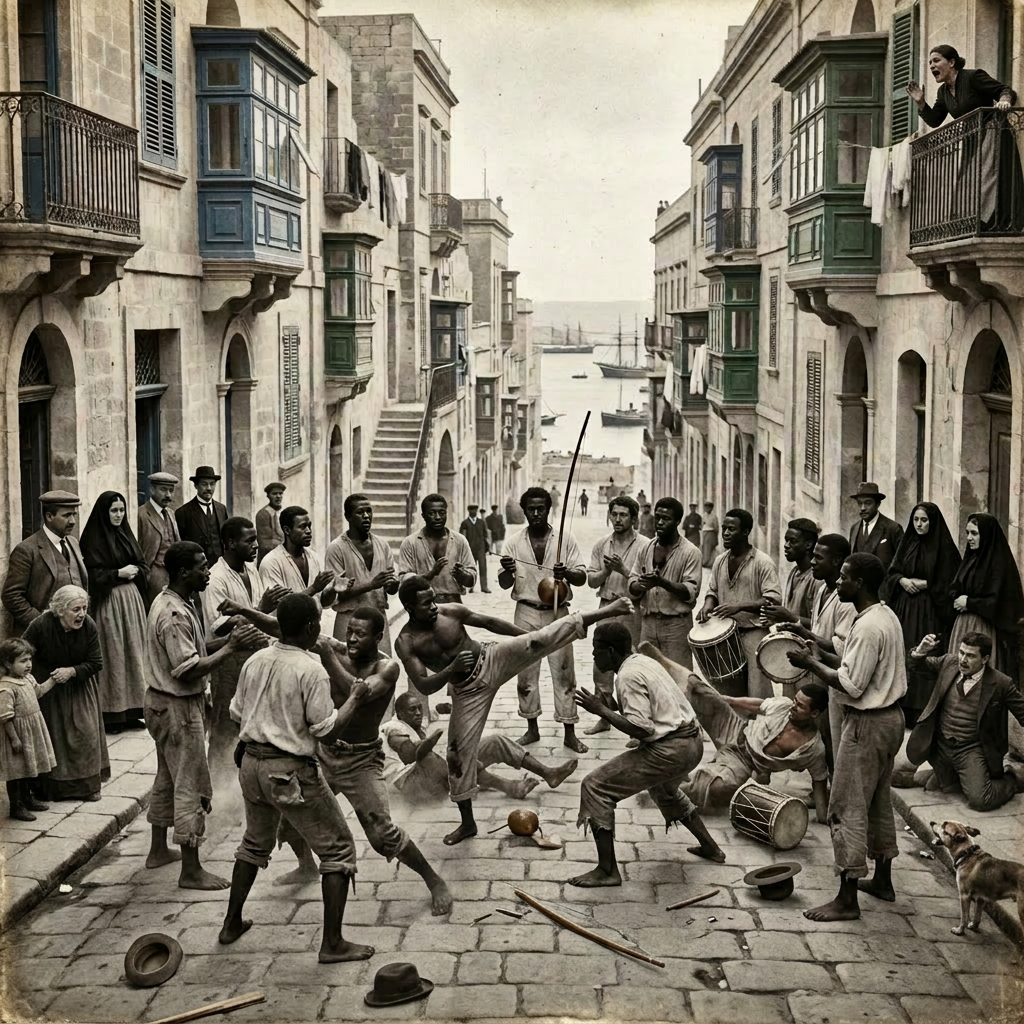
The intensification of social unrest and the increasingly overt association between Capoeira and organized crime led directly to the official nationwide prohibition of the practice in the Penal Code of 1890. This legislation specifically criminalized “making exercise of capoeiragem,” reflecting a transition from the earlier Imperial era when the art was neither formally outlawed by parliament nor included in the 1830 Criminal Code. During the Empire, repression had relied largely on local police edicts that identified Capoeira as a disorderly and dangerous practice.
The newly established Republican government, influenced by authoritarian ideologies like positivism and social Darwinism, viewed Capoeira as a profound threat to social order, a remnant of “African barbarism,” and a potential act of sedition. The state’s inability to control the disruptive influence of the maltas, who acted as political enforcers and mercenaries during turbulent election periods, served as the primary justification for this drastic legal response. Authorities sought to de-legitimize the practice, categorizing it as a dangerous technique intrinsically linked to political destabilization and criminality.
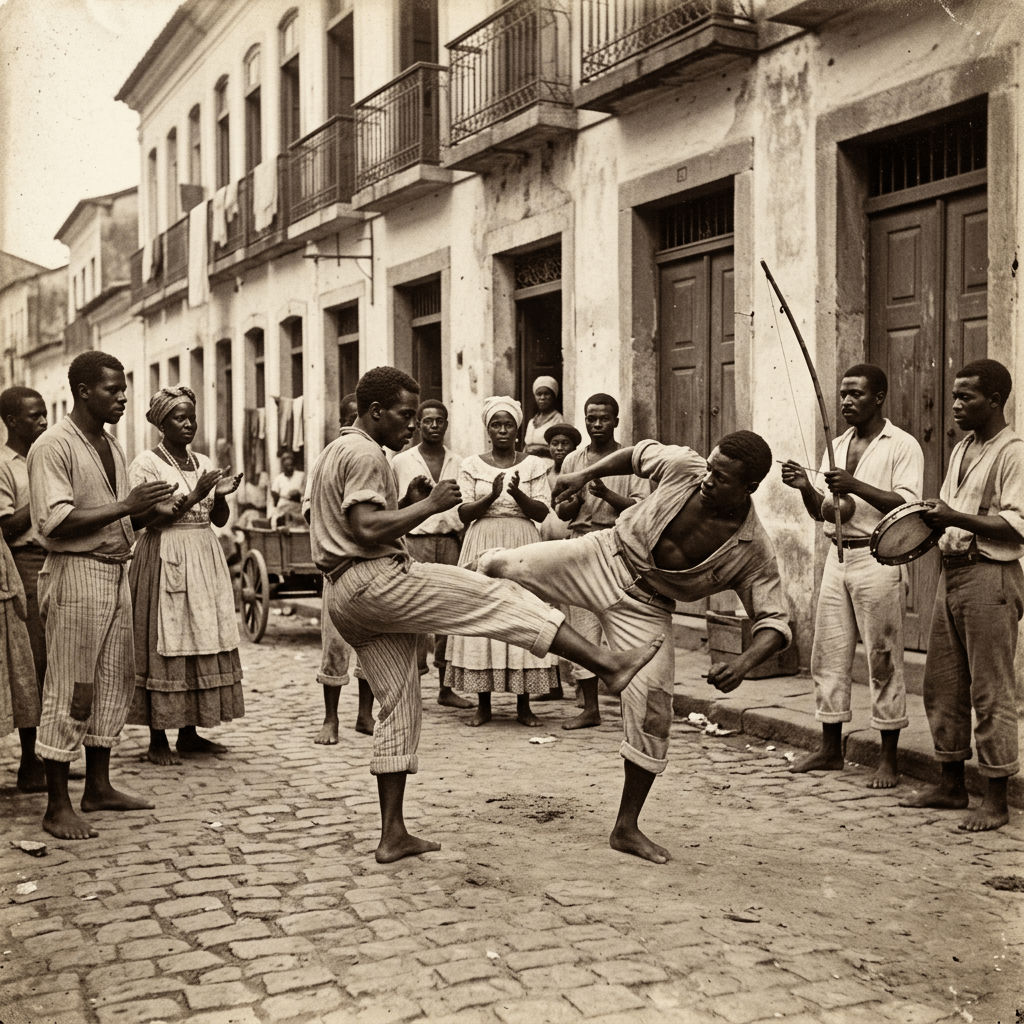
The introduction of the 1890 Penal Code inaugurated a period of brutal and systematic government repression designed to eradicate Capoeira from the urban fabric of the young Republic. This legislative offensive triggered a relentless crackdown characterized by mass arrests, summary corporal punishments, and the pervasive use of state violence against anyone suspected of practicing the art. The statutes of the code were particularly draconian, mandating severe penalties that included extended terms of imprisonment, grueling forced labor, and the dreaded sentence of internal exile to remote penal colonies like Fernando de Noronha. Such aggressive suppression proved devastatingly effective; it nearly extinguished Capoeira as a visible public practice in the streets of Rio de Janeiro. Consequently, the art and its practitioners were forced deep into the clandestine shadows of the Brazilian underworld, where the utilitarian and combative spirit of the practice was preserved in secret as a silent form of resistance against state authority.

Transition to Vale Tudo and Modern Combat
The transition of Capoeira from a traditional cultural art form to a functional component of Vale Tudo and modern combat sports represents a significant evolution in martial arts history. Originally developed in Brazil as a clandestine system of survival and resistance for enslaved Africans, Capoeira was often viewed by outsiders as more of a dance or game (jogo) than a viable fighting system. This deceptive aesthetic was a survival necessity, masking lethal headbutts (cabeçadas), sweeps (rasteiras), and even the use of weapons like razors from colonial authorities. However, the early days of Vale Tudo—”anything goes” contests—provided a rigorous testing ground where practitioners like the “valentões” sought to prove the efficacy of their art against other styles like Brazilian Jiu-Jitsu and Luta Livre.
In modern combat, particularly within Mixed Martial Arts (MMA), Capoeira’s influence is seen in the adoption of its unique kinetic movements and deceptive striking patterns. The constant motion of the ginga provides a non-linear footwork base that makes it difficult for opponents to predict the timing and trajectory of attacks. The ginga acts as a “dance of readiness,” a perpetual feint that maintains balance while searching for strategic openings, effectively allowing the practitioner to stay in a state of constant evasion while preparing for an explosive entry. Strikes such as the Meia Lua de Compasso (half-moon kick) have become recognized as some of the most powerful and dangerous kicks in combat sports, utilized by high-profile athletes to secure spectacular knockouts. This specific strike leverages the body’s torque and rotational momentum, often catching opponents off-guard as the attacker’s head drops toward the floor, moving out of the line of fire while delivering a high-impact blow. Furthermore, the integration of ground-based transitions and hand-supported maneuvers allows fighters to create defensive barriers and unique angles that traditional upright striking systems often struggle to replicate.
Beyond individual techniques, Capoeira contributes a specific philosophy of malícia or cunning to modern combat. This concept emphasizes deception, feints, and the psychological ability to mislead an opponent, allowing a practitioner to strike from unconventional angles and unexpected positions. By often utilizing the floor for leverage, balance, or as a pivot point for inverted attacks—such as the queda de rins—Capoeira challenges the traditional verticality of striking arts. This tactical approach prioritizes “yielding to overcome,” using body evasion (esquivas) and deflection to transform an opponent’s aggression into a counter-attack opportunity.
While few professional fighters rely solely on Capoeira as their primary system, its strategic integration into a multi-disciplinary striking repertoire offers a distinct advantage. Modern fighters often use its low, ground-based maneuvers to evade high attacks or manage distance before transitioning into explosive, upward-delivered strikes. This integration enhances a fighter’s unpredictability and agility, providing a unique tactical edge on the global stage of professional fighting where hybrid styles have become the standard for success.
Despite its transition to the cage, the art retains its roots as a “war of attrition,” relying on mandinga (magic or aura) and strategic wile to control the flow of the fight.
The journey of Capoeira from the clandestine street battles of the 19th-century maltas to the global stage of modern MMA illustrates a remarkable evolution of a combat system rooted in resistance. By transitioning through the unforgiving testing grounds of Vale Tudo, Capoeira refined its traditional deceptive movements and unpredictable striking angles into a viable competitive discipline. Today, the legacy of the valentões lives on as contemporary athletes integrate its unique agility and historical tactical depth into the multifaceted landscape of mixed martial arts, preserving the art’s identity as both a cultural treasure and a potent system of combat.