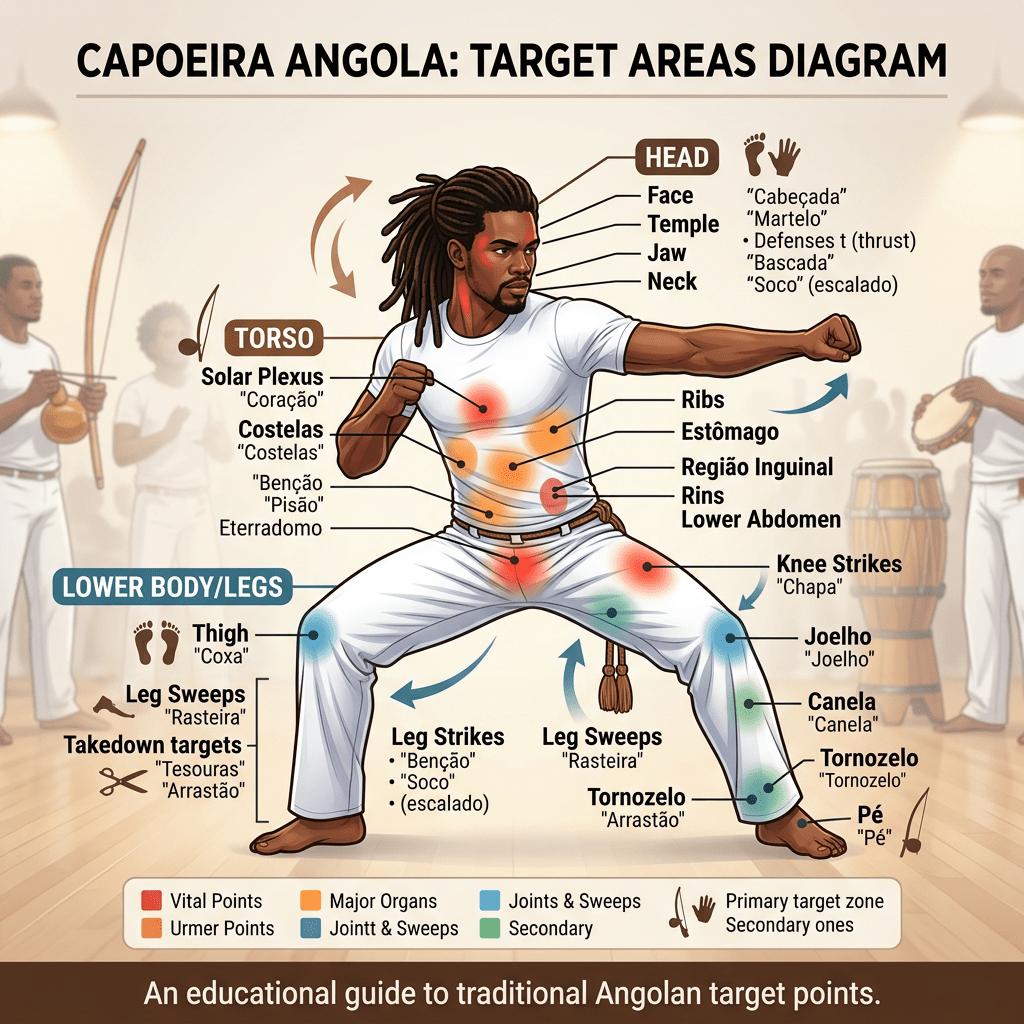
Capoeira Angola, the traditional form of the Afro-Brazilian art, emphasizes strategy, low movement, and close-quarters interaction rather than the high-flying acrobatics often associated with its contemporary counterpart, Capoeira Regional. As a result, the “target areas” are approached with a philosophy centered on disrupting balance, creating openings, and capitalizing on the opponent’s vulnerability, all within the framework of the game (jogo). The goal is less about a direct knockout and more about the elegant and strategic control of the space and the opponent’s body.
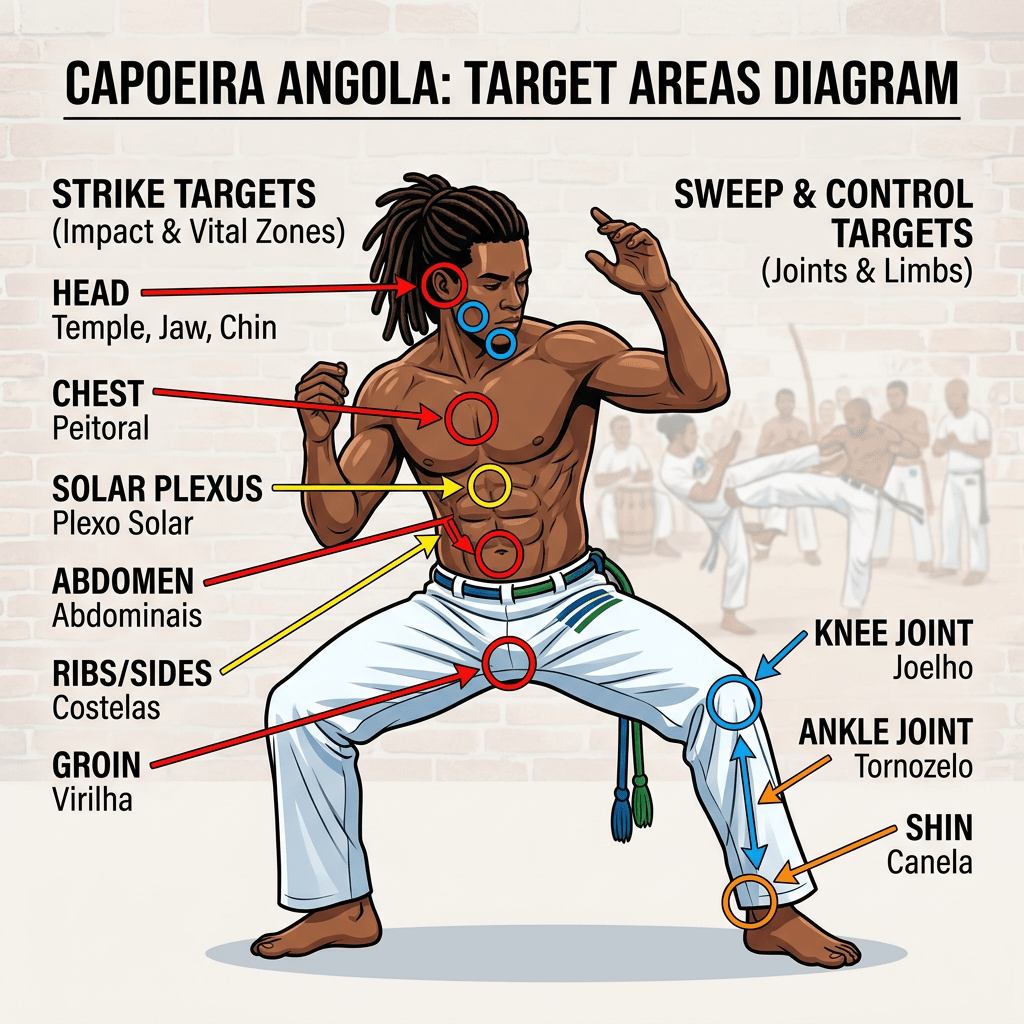
Primary Target Philosophy: Balance and Base Disruption in Capoeira Angola
The fundamental objective and most critical “target” in the jogo (the game or dance-fight) of Capoeira Angola is rarely a specific, vulnerable body part. Instead, the highest priority is the complete disruption of the opponent’s foundation and center of gravity. The philosophy dictates that a successful engagement is one that compromises the opponent’s mobility, stability, and capacity for both attack and defense, ultimately forcing them to relinquish control of the fight space. This focus on leverage and positional disadvantage over brute force is the hallmark of the Angola style.
Key Targets for Positional Disruption
Specific anatomical areas serve as tactical points of attack, all contributing to the overarching goal of balance displacement:
- The Feet and Ankles (Pé e Tornozelo): These represent the initial points of contact with the ground and are therefore the primary weak link in the opponent’s base. They are prime targets for a variety of low techniques:
- Sweeps (rasteiras): Low, circling movements designed to hook, trip, or knock the feet out from under the opponent.
- Scissoring Movements (tesouras): Techniques that trap one or both legs, applying pressure laterally or downward to force a fall.
- Various Low Traps and Hooks: Subtle positional control and movements that bind the feet, preventing a timely step or defensive movement.
The direct objective is to take the opponent completely off their base, instantly transitioning their standing height into a low block (queda—a fundamental defensive position) or a definitive fall. A clean takedown in Angola is not just a point scored; it is considered the highest form of physical punctuation and strategic victory within the jogo, momentarily signaling complete dominance.
- The Knees (Joelhos): While the ethics of the jogo and concern for the opponent’s well-being discourage direct, forceful strikes to the knee joint, which would be considered poor form and overly aggressive, the joint remains a crucial target for directional pressure and subtle control.
- Positional Leverage: Low, circling movements (cabeçadas or rasteiras initiated from a low position) or specific positional blocks (resistência) can apply non-damaging leverage to the knee joint. This action limits the opponent’s angular mobility, preventing them from stepping out of a trapped position or generating power for an evasive maneuver.
- Setting Up the Sweep: By locking or restricting the knee’s natural range of motion, the Angoleiro effectively “loads” the leg, making it far easier to execute a successful sweep or takedown on the now-rigid limb.
- The Hips and Tailbone (Quadril e Cóccix): The hips are the true engine of all Capoeira movement, responsible for power generation, directional changes, and the crucial capacity to transition between attacks and defenses.
- Control of Direction: By controlling the opponent’s hips, an Angoleiro controls their overall direction and access to space. Techniques that apply pressure, such as certain bandas (throw-sweeps) or positional traps, can lock the opponent in a difficult, vulnerable stance.
- Slowing the Counter: Strikes, pushes, or pressure directed at the hips can momentarily seize up the opponent’s core, making their escape, counter-attack, or defensive aú (cartwheel) sluggish and predictable.
- The Ultimate Destination: The tailbone (cóccix) is the metaphorical and physical ultimate destination for a successful takedown. Forcing the opponent onto their tailbone signifies a total loss of base, movement, and control, effectively concluding the immediate confrontation within the fight space.
Secondary Targets: Creating Openings, Distraction, and Postural Instability
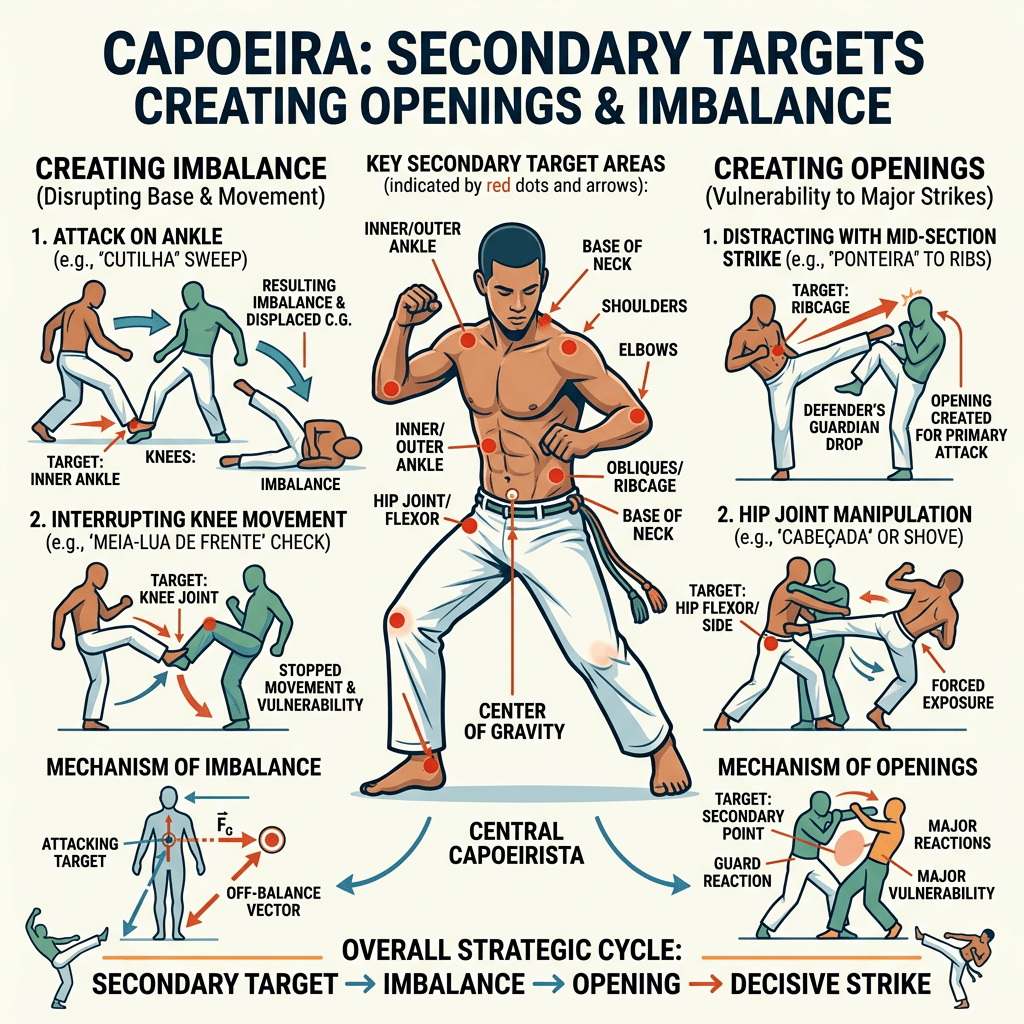
These anatomical regions are not typically primary targets for immediate takedowns or incapacitation. Instead, they are strategically addressed to create momentary postural weaknesses, elicit predictable defensive reactions, or set up the primary low-level balance disruptions that are the hallmark of Capoeira Angola.
- The Torso/Midsection (Tronco): The core of the opponent’s structure, the tronco, is targeted to disrupt the fundamental connection between the legs and the head. Strikes to the body are generally delivered as focused pressure or impact designed to create an immediate, involuntary reaction.
- Methods: This includes sharp, focused headbutts (cabeçadas) delivered low into the solar plexus or abdomen; powerful knee strikes (joelhadas) leveraged upward into the ribs or sternum; or forceful, circular scraping/pushing kicks (chapas).
- Aim and Effect: The purpose is manifold: to momentarily stun or “wind” the opponent, to generate a forceful push that physically knocks the opponent off their center of balance, or to compress their breathing. The most critical effect, however, is to create a defensive flinch or withdrawal. This reaction—often a slight upward movement of the guard or a momentary bending over—inadvertently exposes the feet or momentarily raises the center of gravity, making them highly susceptible to a quick, low sweep or rasteira.
- The Face and Head (Rosto e Cabeça): The head is constantly threatened not primarily for impact, but as a manipulative tool. The high threat level forces the opponent into a defensive posture that can be immediately exploited at a lower level.
- Ethical Context (Malícia): Direct, disabling contact is rigorously governed by the ethical code (malícia), which emphasizes cunning, evasion, and strategic deception over brute force. The intention is to control the opponent’s mind and movement, not necessarily to strike.
- Threat Mechanics: Kicks, particularly the bênção (the ‘blessing,’ a straight-line push kick), and aggressive headbutts are often initiated with full commitment but are pulled just short of making hard contact. This near-miss action is profoundly effective, forcing the opponent to instinctively retreat, duck their head, or aggressively raise their hands to guard.
- Exploitation: This forced defensive movement is a critical vulnerability. By raising their guard or straightening their posture to protect the head, the opponent invariably lifts their center of gravity (CoG). This makes their base lighter and significantly less stable, rendering them extremely vulnerable to a swift transition into a low-level sweep or takedown (rasteira).
- Close-Quarters Targets: In an extremely close-quarters clinch or control position, the back of the neck and the ears become viable targets for positional manipulation, offering leverage to break the opponent’s posture or steer them toward the ground.
- The Hands and Wrists (Mãos e Pulsos): In the tight, intimate confines of a high-level jogo, the hands are an extension of the body’s defensive and manipulative tools. Targeting them is a rhythm disruption strategy.
- Function in Jogo: Hands are used not just for high-level blocks but for pressing, feeling, and manipulating the opponent’s limbs, as well as providing the necessary support and spring for quick low defensive movements (quedas).
- Disruptive Tactics: Quick, well-timed slaps, light pushes, or specific controls against the opponent’s hands and wrists can immediately disrupt their tempo and flow. By attacking the hands, the practitioner momentarily impairs the opponent’s ability to quickly execute a crucial queda (low defensive maneuver, like an aú or rolê) or their capacity to safely post or block an incoming attack. It is a subtle but effective means of disabling their immediate reaction speed.
Primary Targets and Strategic Considerations for Unarmed and Armed Combat
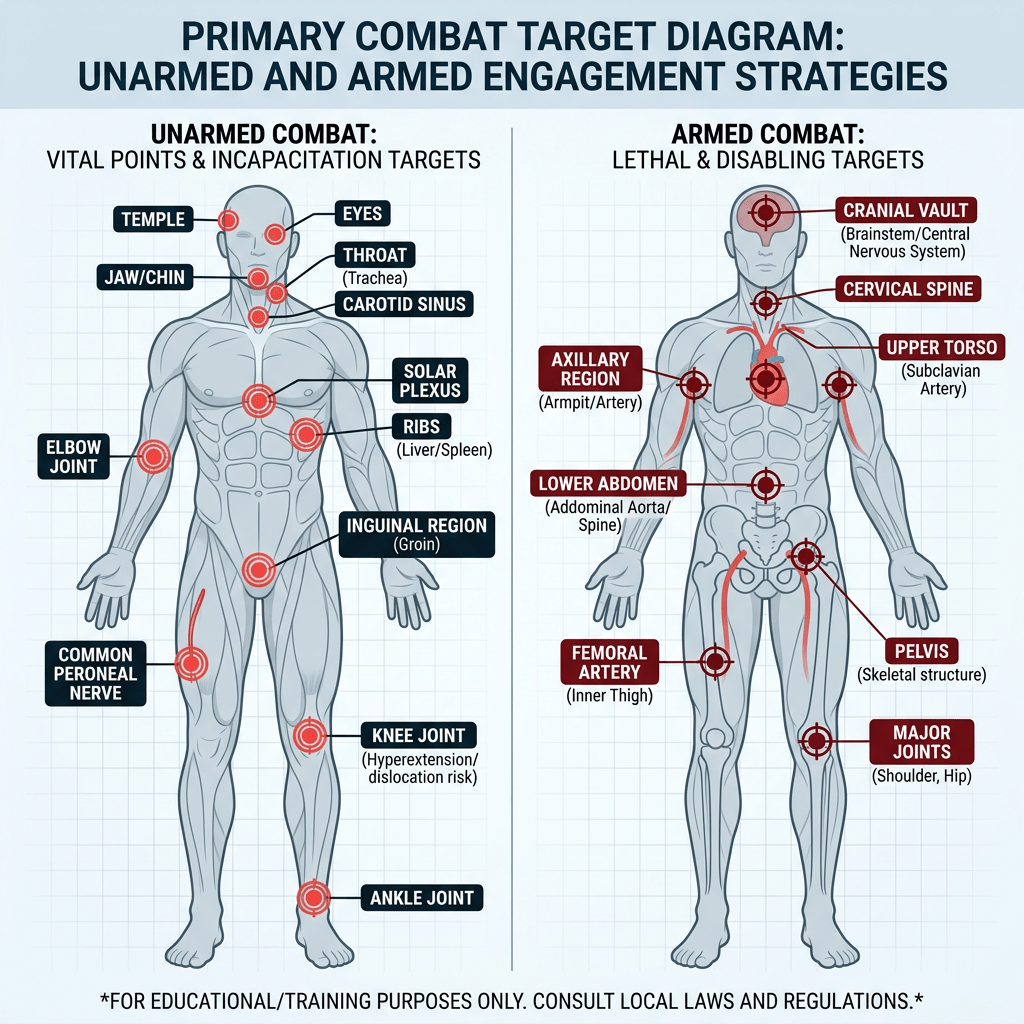
When engaged in self-defense or combat, particularly when utilizing an improvised or dedicated weapon—such as a simple striking implement like a stick or baton, a cutting instrument like a blade or knife, or a small, highly effective cutting tool like a straight razor—the selection of targets is a critical factor in determining the speed and effectiveness of the engagement. The objective is to achieve a rapid, non-lethal incapacitation or a decisive disruption of the attacker’s ability to continue the assault.
Target Categories by Effect:
- Motor/Mobility Targets (Limbs and Joints): These targets are primarily aimed at destroying the attacker’s structural integrity and ability to manipulate their body or a weapon.
- Wrist and Hand: Striking or cutting the hands and wrists, particularly the tendons and bones, can immediately disrupt the attacker’s grip, causing them to drop a weapon or rendering that hand useless for grabbing or punching.
- Elbow and Knee Joints: These are fragile hinge points. A sharp strike or a severing cut to the tendons (e.g., Achilles tendon, knee ligaments, elbow tendons) can immediately compromise the attacker’s balance, mobility, and striking power.
- Clavicle (Collarbone): A hard, focused strike to the clavicle can easily shatter the bone, immediately immobilizing the entire shoulder and arm on that side, making it impossible to wield a weapon or absorb a blow.
- Sensory/Nervous System Targets (Head and Neck): These targets are prioritized for immediate, rapid, and often decisive incapacitation by disrupting vital physiological functions or central nervous system control.
- Eyes: Poking or striking the eyes causes instantaneous pain, temporary or permanent blindness, and a massive psychological shock, providing a critical window for escape or follow-up action.
- Throat/Trachea: The larynx and trachea are soft, unprotected structures. A targeted strike or cutting motion can cause immediate respiratory distress, cutting off air supply and potentially causing immediate unconsciousness or death due to crushing the windpipe.
- Carotid Arteries/Jugular Vein: Located on the sides of the neck, these vessels are high-priority targets for a blade. Severing these results in rapid, massive blood loss and a quick loss of consciousness.
- Temples and Mandible/Jawline: Focused strikes to these areas can cause powerful concussive force to the brain, potentially resulting in a knockout or disorientation.
Primary Targets and Strategic Considerations for Unarmed and Armed Combat
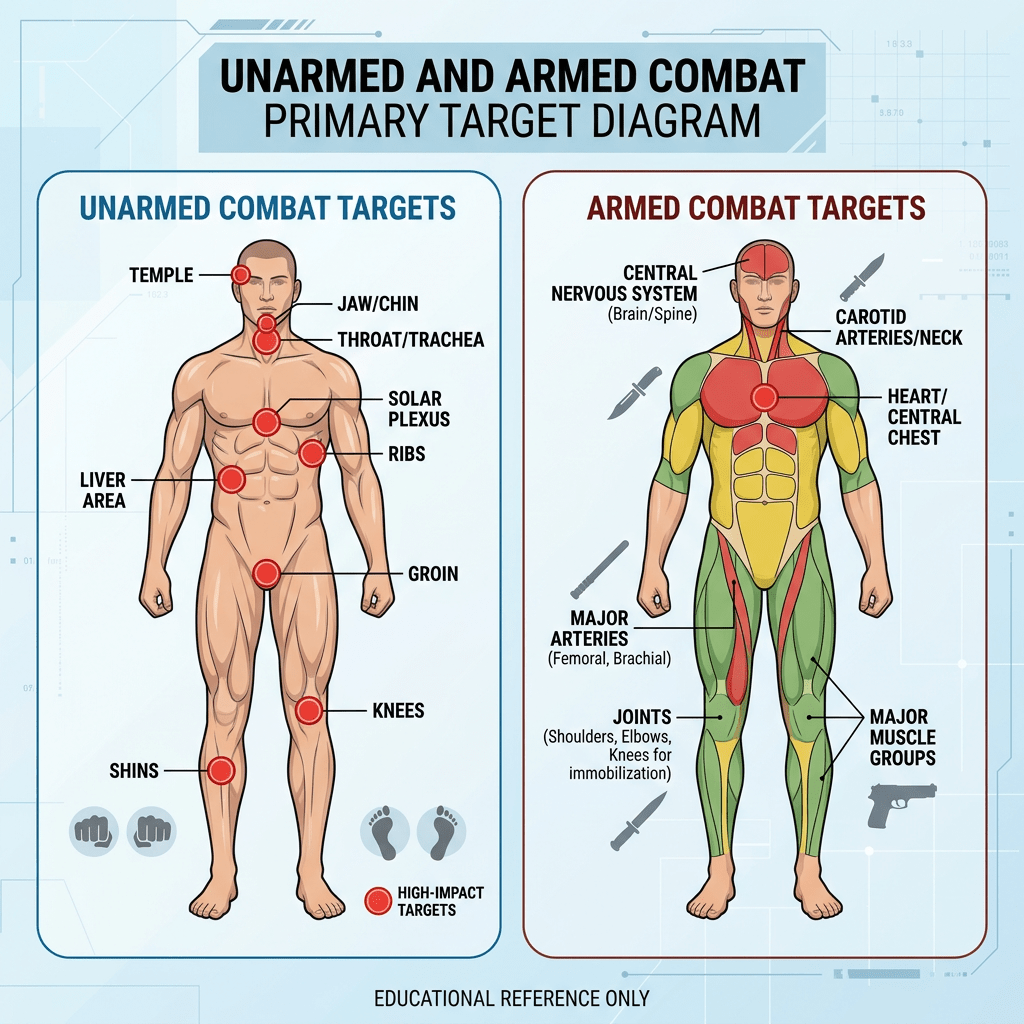
Capoeira Angola, at its core, is a deceptive martial art. While often presented as a dance or playful game, its applications in a true-to-life self-defense or combative scenario involve precise, focused attacks on vulnerable points of the human body. The targeting strategy is highly stratified, moving from debilitating motor skills to life-threatening vital centers, always governed by the principle of necessity and the proportionality of force.
1. Vitals/Thoracic and Abdominal Targets: Lethal Force Targets
These areas encompass the body’s major organ systems and central vascular hubs. Any attack directed here is inherently high-risk, carrying a significant potential for fatality or permanent, life-altering injury. Consequently, strikes to these regions are strictly reserved for the most extreme situations—those where the defender’s life or the lives of others are demonstrably in immediate peril, justifying the application of lethal or near-lethal force as unavoidable.
- Solar Plexus (Celiac Plexus): Located in the upper abdomen, directly behind the stomach and below the sternum, this is a dense network of nerves. A forceful, sharp strike—such as a focused front kick (like the chapa de frente) or a hard punch—can trigger a temporary but severe disruption. The impact causes the diaphragm to spasm and temporarily paralyze, leading to an immediate, painful “winded” effect. The opponent is left gasping for air, instantly incapacitated, and typically forced to buckle over, creating a critical opportunity for disengagement or follow-up.
- Kidneys and Liver: These visceral targets are situated in the trunk but are highly vulnerable to concentrated force.
- Kidneys: Positioned posteriorly, on either side of the spine beneath the lower ribs, they are targets for deep back-heel kicks (calcanheira) or focused horizontal strikes (banda de costas). Damage causes searing pain, shock, and potentially severe retroperitoneal hemorrhage (internal bleeding).
- Liver: Located in the upper right quadrant of the abdomen, the liver is large and relatively fragile. A powerful, penetrating strike (ponta pé) or knee (joelhada) to this area can result in rupture, leading to rapid and catastrophic internal bleeding, intense pain, and circulatory shock.
- Femoral Artery (Inner Thigh/Groin): While the groin area is a universally recognized pain target, the femoral artery, located deep within the upper inner thigh/groin crease, represents a critical vascular vulnerability. A deep, penetrating cut or thrust directed here, though not aimed at structural damage, results in the swift severing of the main blood supply to the leg. This causes immediate, catastrophic blood loss and is considered a high-lethality attack, leading to rapid extermination and death if not immediately attended to with advanced medical care.
Weapon-Specific Application Strategies
The philosophy of targeting adapts dramatically based on the weapon utilized, optimizing the attack to exploit the weapon’s inherent strengths against specific human vulnerabilities.
| Weapon Type | Primary Targets and Effect | Optimized Techniques |
| Stick/Baton (e.g., Cassetete or Pau) | Motor/Mobility Targets & Concussion: Best utilized for delivering massive kinetic energy. The focus is on breaking, shattering, and overwhelming bone structure to immediately disable movement and awareness. | High-impact, swinging or thrusting strikes aimed at joints (knees, elbows, shoulders), the clavicle (collar bone, which instantly disables shoulder/arm mobility), the hands (shattering metacarpals/phalanges to disarm), and concussive strikes to the skull (aimed at the cranium or temples). |
| Blade/Knife (e.g., Faca) | Sensory Disruption & Vital Penetration: Designed for precise cutting, slicing, and deep thrusting. The strategy is rapid incapacitation via blood loss, shock, or sensory overload. | Rapid, shallow-to-moderate cuts across exposed sensory targets (eyes, throat, facial nerves). Deeper thrusts into vital targets (neck/carotids, abdomen, chest) for organ/major vessel damage. Severance cuts targeting key tendons/ligaments (e.g., the Achilles tendon to drop the opponent, or wrist tendons to disarm/disable). |
| Straight Razor (or similar small, keen edge) | Precision Soft Tissue & Vascular Targets: The small, extremely sharp edge excels at low-mass, high-speed slashes intended for surgical, non-bone contact damage to the most exposed, high-value areas. | Focused on high-value exposed soft tissue and vascular targets: The face (slashing across the eyes/cheeks for blinding/shock and disfigurement), the throat (precisely severing the carotids and jugular for rapid death), or the wrists (slashing major tendons and vessels to disable grip and induce rapid blood loss). |
The Concept of “Targeting the Empty Space”
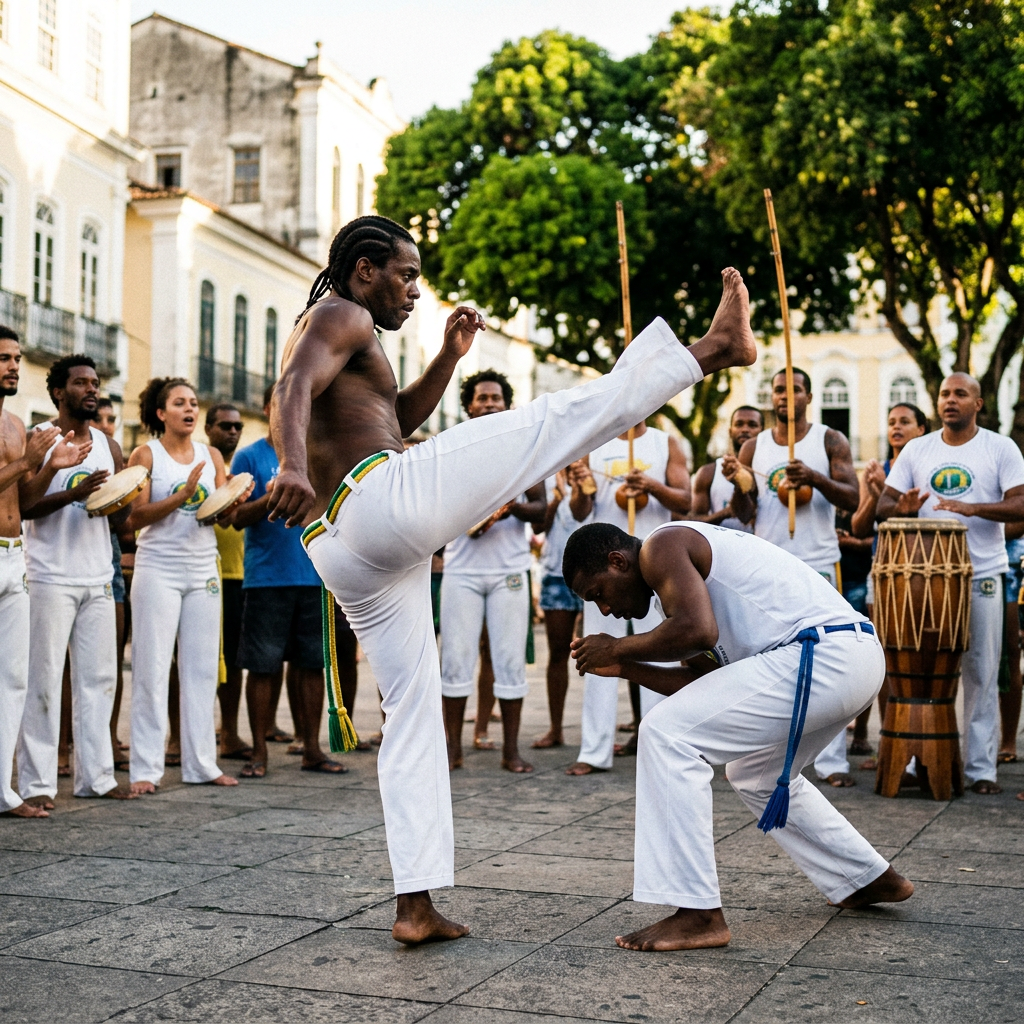
Ultimately, the most sophisticated and defining aspect of Capoeira Angola’s targeting philosophy is malícia—a blend of cunning, deceit, intuition, and psychological warfare. It moves beyond the simple physical act of striking a body part. The true target, in a masterfully played jogo, is often not the opponent’s current location, but the psychological and physical space the opponent is about to occupy, or the one they will be forced to vacate.
This principle transforms the interaction from a direct exchange of blows into a dynamic negotiation of space and pressure. A martelo (hammer kick) is thrown not necessarily to connect with the head where it currently is, but rather to serve as a chamariz (lure) aimed precisely at the space the opponent must move their head to avoid the initial attack. This forced defensive maneuver—a duck, a lean, or a simple step back—is the true objective, as it destabilizes their base, occupies their attention, and, crucially, opens a new, undefended line of attack to a secondary target, such as the feet, torso, or ribs.
Malícia dictates that the Capoeirista must not only observe the opponent’s movements but also anticipate their intent and their most likely reaction to a given stimulus. The “target” is thus constantly shifting, existing in the brief moment of transition between defense and counter-attack. It is a target of opportunity defined by the rhythm, flow, and velocity of the jogo. A deceptive movement, a feigned imbalance, or an unexpected pause in the rhythm (a quebrada), can all be tools to create the empty space—the momentary vacuum of defense—that the subsequent attack will fill. This level of engagement requires deep experiential knowledge of human reflexes and a profound understanding of the Capoeira Angola movement vocabulary.
The preceding analysis of target areas in Capoeira Angola culminates in this comprehensive Conclusion, revealing a depth to the martial art that transcends simple physical confrontation. Capoeira Angola, at its core, is a sophisticated discipline—part martial art, part dance, and part philosophical game—that fundamentally reframes the concept of a “target.” It does not prioritize blunt, disabling strikes or the pursuit of a knockout as the primary goal. Instead, the mastery lies in the fluid execution of movement, the art of strategic positioning, and the nuanced application of pressure to critical areas that control the opponent’s balance, movement, and, most importantly, their psychological state.
The target areas in Capoeira Angola are, therefore, multifaceted, extending far beyond the purely physical realm to encompass a holistic system of engagement:
1. Physical/Structural Targets: The Geometry of Desequilíbrio
The most apparent targets are those that compromise the opponent’s physical stability and structure. This includes the feet (where rasteiras and bandas are directed), the shins, knees, hips, and shoulders. These points, when effectively contacted or manipulated through sweeps, manipulative take-downs, or well-placed low strikes, serve a singular, critical purpose: to disrupt the opponent’s base and structural integrity, leading to desequilíbrio (loss of balance).
The intention here is not destruction but control. By attacking the opponent’s foundation, the Capoeirista seeks to dictate the pace and direction of the jogo (game). A physical strike is often a strategic setup—a means to open a line of attack, force a defensive reaction, or compel the opponent into a disadvantageous position, ultimately prioritizing superior positioning and control over brute-force damage.
2. Psychological Targets: The Weapon of Malícia
The most elusive and perhaps most potent targets are psychological. The skillful Capoeirista wages a mental war using malícia (a term embodying malice, cunning, and trickery). This involves the effective use of feints (fintas), unexpected changes in speed or direction, and maintaining an unreadable, deceptive jogo.
A psychological “strike” targets the opponent’s confidence, concentration, and decision-making process. The ultimate success often lies not in landing a powerful blow, but in forcing the opponent to doubt their reading of the game, hesitate in their movement, or commit a critical error. The psychological game is won when the opponent is internally defeated—when they are reacting defensively rather than acting offensively, losing control over the initiative and the flow of the encounter.
3. Rhythmic/Temporal Targets: The Harmony of the Roda
Capoeira Angola is intrinsically linked to music and rhythm, governed by the instruments, most notably the berimbau. This connection establishes the third set of targets: rhythmic and temporal.
The skilled player targets the opponent’s adherence to the tempo of the game, seeking to force them to move outside the established, comfortable rhythm dictated by the music. A move that throws off the timing, or an unexpected acceleration or deceleration of movement, is considered a successful “strike” against the flow and structure of the encounter. By disrupting the opponent’s internal rhythm, the Capoeirista creates temporal windows of vulnerability. The player who controls the rhythm controls the game, making the mastery of timing (tempo) as vital as the mastery of movement.
In summary, the study of target areas in Capoeira Angola uncovers a sophisticated, holistic system where the raw power of a strike is decidedly secondary to the intelligence and timing of the movement. The true masters of Capoeira Angola are those who possess the comprehensive skill to simultaneously target the opponent’s body, mind, and rhythm, achieving victory not through overwhelming brute force, but through superior strategy, absolute control, and a deep, philosophical understanding of the art’s intrinsic principles.