

Question: What is Dirty Fighting?
Answer: There’s NO SUCH THING as dirty fighting; There’s just FIGHTING.
The concept of “dirty fighting” is a moralistic fallacy—a judgment imposed upon the raw, pragmatic, and often brutal reality of a physical confrontation. This distinction is the luxury of a sport or a friendly sparring match, environments governed by mutually agreed-upon rules designed for safety and fair play.
In the crucible of a genuine fight, and especially within the philosophical and historical context of Capoeira Angola, which carries the indelible DNA of survival, resistance, and self-liberation, the notion of “dirty” is utterly meaningless. Capoeira Angola was developed as a tool against oppression—a concealed weapon in plain sight. Its movements, its flow, and its very foundation are predicated on the principle of overcoming a threat by any means necessary, often against a stronger, better-armed adversary.
The jogo (game/fight) is an ecosystem where the ultimate goal is not to adhere to a polite, structured set of rules, but to achieve control, establish dominance, neutralize the threat, and ultimately overcome the opponent. The moment survival or the defense of one’s freedom is at stake, the ethical judgment of a technique dissolves entirely.
When the stakes are existential, the only relevant categories for assessing a technique are: effective and ineffective.
- An effective technique exploits a weakness, creates an opportunity, disrupts the opponent’s balance, or ends the confrontation decisively, regardless of whether it involves a kick to the shin, a finger jab to the eye, or a sweep that targets the knee joint.
- An ineffective technique is one that leaves the practitioner vulnerable, wastes energy, or fails to achieve the objective of ending the threat.
The Capoeirista does not fight for points or applause; they fight to prevail. To deliberately limit one’s arsenal based on an arbitrary, externally imposed moral code of engagement is, in the context of a real fight, a strategic error—a suicidal adherence to politeness in the face of hostility. Every part of the body, every feint, every angle, and every unpredictable move is a potential weapon, and the true master understands that the “dirtiest” move is often the most vital to staying alive.
Dirty Tricks, Tactics, and Techniques… Capoeira Angola Style: The Mandate of Survival
Capoeira Angola is not merely a physical discipline; it is a complex, embodied philosophy of total survival, forged in the brutal crucible of resistance by enslaved Africans fighting for liberation. Unlike martial systems developed centuries later for sport, codified duel, or philosophical exercise, Capoeira Angola never possessed the luxury of artificial constraints, rigid rules, or the concept of “fair play.” Its genesis and continued purpose are inextricably linked to a single, uncompromising mandate: survival at any cost.
The foundational techniques and core philosophies of Capoeira Angola are deliberately engineered to bypass conventional limitations, transforming a simple confrontation into a psychological and physical chess match. At the heart of this intricate system lie two complementary, essential principles, operating in synergistic tandem: the pervasive, deceptively casual malandragem and the deep, tactical, almost mystical mandinga.
Malandragem: The Art of Deceptive Play
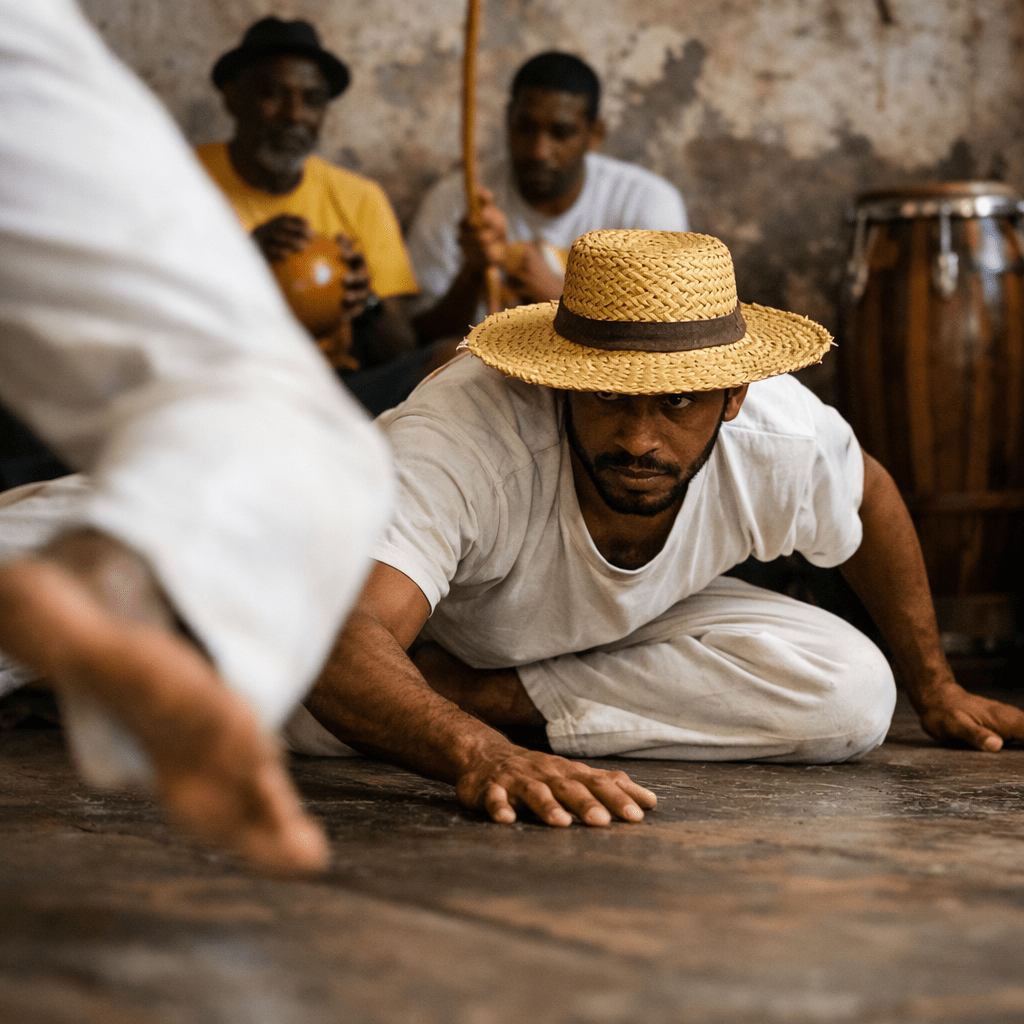
Malandragem is far more than simple trickery or mere street-smarts; it is a sophisticated, deeply ingrained blend of psychological manipulation, cunning, and deceptive, fluid play. It embodies the ‘trickster’ archetype, translating directly to the ability to navigate complex situations with shrewdness and effortless poise. In the roda (the circle where Capoeira is played), malandragem is the art of appearing innocuous, relaxed, or even overtly playful while, in reality, you are preparing a decisive, devastating action.
- Psychological Posturing: It involves projecting an image of low threat, encouraging the opponent to drop their guard, misjudge your intent, or underestimate your skill. The practitioner moves with a casualness that belies their readiness, setting up traps with movements that look like dance or rest.
- Fluid Deception: The practitioner’s movements are intentionally ambiguous, transitioning seamlessly between offense and defense, creating a constant state of uncertainty for the opponent. It is the ability to use the rhythm of the game and the environment to your advantage, capitalizing on small errors or moments of inattention.
Mandinga: Tactical Cleverness and Perceptual Manipulation
While malandragem is the method of deception, mandinga refers to the mystical or tactical cleverness that fundamentally manipulates an opponent’s perception and, consequently, the outcome of the encounter. It is the profound ability to generate systemic confusion and exploit any discernible weakness—physical, psychological, or environmental—by capitalizing on the element of surprise with overwhelming speed and precision.
- Perceptual Exploitation: Mandinga is the mastery of misdirection—the sudden feint, the unexpected shift in rhythm, or the use of peripheral vision to make the decisive move appear out of nowhere. It is about controlling the opponent’s attention and forcing them to commit their defenses to a non-existent threat, opening the true target.
- Strategic Confusion: This principle extends beyond individual movements to encompass the entire strategy. It is the use of non-linear tactics, esoteric movements, and the overall mystique of the Capoeirista to instill doubt and hesitation. The goal is to make the opponent second-guess every assumption, leading to paralyzing indecision that can be exploited instantly.
- The Mystical Edge: Historically, mandinga carried a connotation of magical protection or power, enhancing the psychological effect on the opponent by making the Capoeirista seem untouchable or unpredictable. In modern practice, this translates to an almost uncanny ability to predict, adapt, and respond, making the practitioner seem always one step ahead.
Together, malandragem and mandinga define the essence of Capoeira Angola, turning it into a complete martial art where physical technique is merely the tool for executing a sophisticated, deep-layered tactical and psychological strategy.
The Philosophical Rejection of ‘Fair Play’
Consequently, the ethical line often drawn firmly in other martial disciplines—the space defining what is “chivalrous” or “honorable”—holds no fixed or sacred place in Capoeira Angola. This unique martial art form challenges traditional norms by merging dance, music, and combat, creating a fluid environment where morals are subjective and often situational. What an outsider or opponent might conventionally label as “dirty” is simply understood by the capoeirista as a successful application of force, high-percentage physics, and psychological strategy. In this context, the concept of honor is not defined by rigid rules but rather by the versatility and creativity displayed during the game, where cunning and adaptability often lead to the most significant victories. The values of respect and community that underpin Capoeira further enrich this complex interplay, making it a living cultural expression rather than a mere competition.
The Uncompromising Reality of Combat: Capoeira Angola’s Foundational Philosophy

The core philosophy underpinning this system is built upon a single, non-negotiable principle: in the crucible of genuine combat or self-defense, efficacy stands as the solitary and ultimate measure of success. This stark, often brutal truth dictates the system’s entire tactical framework. Consequently, the strategies and applications that might be dismissed by others as “dirty tricks,” “flaws,” or unfortunate “moral compromises” are, within this art, elevated to the status of essential, non-negotiable tools. This methodology is not an accidental byproduct of desperation; it is an intentional design choice. The art form inherently, unapologetically, and systematically elevates practical effectiveness and immediate tactical advantage over any form of ethical posturing, idealistic codes of conduct, or adherence to sanitized sporting regulations. The goal is survival and immediate incapacitation of a threat, not the winning of a game.
Beyond “Dirty Tricks”: The Science of Conflict Disruption and the Ethics of Necessity
The techniques often dismissed or mislabeled as mere “dirty tricks” are, in reality, highly refined, foundational applications rooted in a deep, unsentimental understanding of three constant and unavoidable variables in any scenario of genuine, unregulated conflict: tactical psychology, leverage physics, and granular human anatomy. These three components—the mind, the mechanism, and the physical vulnerability—persist regardless of the setting, the presence or absence of spectators, or any pre-agreed ruleset that one party (the attacker) may choose to unilaterally discard.
To willfully ignore these critical elements in a life-or-death situation is not just poor judgment; it is a profound tactical error. In the context of self-preservation, this negligence can irrevocably cost one’s safety, security, or even one’s life. The successful resolution of conflict, when all other measures have failed, demands a commitment to overwhelming and immediate advantage.-
Tactics of Necessity: Prioritizing Immediate Advantage and System Failure
The following applications fall under the category of “tactics of necessity.” These are applications explicitly designed to bypass the opponent’s defenses and establish an immediate, overwhelming advantage through the systemic disruption and failure of their physical and psychological architecture.
1. The Surgical Strike (The Anatomy of Disablement)
This involves a lightning-quick, completely unexpected attack delivered with maximal force, precision, and commitment to a critical, highly vulnerable point on the human anatomy. These target areas are selected not for visible, surface damage, but for their capacity to produce instant, non-optional effects: immediate incapacitation, extreme disorientation, sensory overload, or total system failure.
- Examples of Critical Vulnerable Points (The Body’s Emergency Shut-offs):
- The Breathing Apparatus (The Throat: Larynx/Trachea): A sharp, crushing, or striking blow to the Adam’s apple or windpipe. The goal is to restrict or halt airflow, causing immediate, visceral respiratory panic, an involuntary choking reflex, and the total inability to communicate, vocalize, or effectively continue the fight due to systemic oxygen deprivation and psychological trauma.
- The Hardware Reset (The Eyes: Orbit and Cornea): Targeting the delicate sensory organs with a committed jab, rake, or gouge. This induces immediate and profound shock, unbearable pain, profuse tearing, momentary or sustained blindness, and triggers a primal, psychological breakdown of the threat response, forcing the opponent to instinctively prioritize protecting the sensory organs.
- The System Reboot (Solar Plexus): A focused, driving, percussive strike delivered upward into this major nerve nexus (the Celiac Plexus). The resulting trauma causes a massive sympathetic nervous system overload, designed to “wind” the opponent by causing sudden, total respiratory distress, acute muscular spasticity, and a momentary but complete pause in all offensive and defensive action as the body involuntarily focuses on breathing.
- The Genetic Emergency (The Groin: Testes/Pubic Bone): A strike to the testes or the hard, supporting pubic bone, leveraging the extreme, debilitating pain response hardwired into the male neurological system. This attack ensures immediate, total incapacitation and a visceral, psychological retreat from the conflict due to overwhelming, non-negotiable pain.
- The Structural Failure (The Knees): Attacks delivered to the knee joint, particularly from the side (lateral) or the front (hyperextension). The aim is to compromise the primary stabilizing structures—the ligaments and meniscus—leading to dislocation, hyperextension, or ligamentous damage. This instantly removes the opponent’s base, mobility, and structural integrity, rendering sophisticated offense impossible.
- The Fatal Switch (Base of the Skull and Mastoid Process): Targeting the occipital bone or the connection point between the head and the cervical spine. This is a potentially catastrophic strike designed to cause neurological trauma, concussion, structural failure of the spine’s delicate alignment, or loss of consciousness.
2. Targeted Sensory Disruption
This involves a defensive maneuver, block, or counter-strike executed with the explicit purpose of overloading or disrupting the opponent’s primary senses. A forceful rake or jab specifically targeting the eyes or ears is employed to instantly destroy vision, cause auditory disorientation (via a strike to the ear), and trigger the deep-seated flinch reflex. This action immediately creates a critical and absolute window for the execution of a devastating follow-up attack, securing a superior tactical position, or facilitating immediate escape.
3. The Calculated Deceptive Trip and Sweep
This tactic utilizes movements that appear non-threatening, relaxed, or even part of a stylistic flow—a characteristic frequently seen in movement arts like Capoeira Angola. These innocuous movements suddenly transition into a powerful, precisely timed trip or sweep. The profound effectiveness of this move is predicated on two factors: perfect timing and the skillful leveraging of the opponent’s own forward momentum and committed force against their base. The goal is to ensure a hard, uncontrollable fall that not only breaks their stance but also shifts the axis of the entire confrontation decisively, often resulting in injury from the fall itself.
4. Psychological and Verbal Warfare (Cognitive Overload)
The battlefield is not limited to the physical realm; it is also waged in the mind. This tactic involves the deployment of highly disruptive verbal distractions, sharp psychological feints, or even an intentional, visceral appeal to the opponent’s deep-seated fears or moral lines. The goal is to overload or manipulate the opponent’s cognitive focus, generating a moment of hesitation, confusion, emotional paralysis, or moral dissonance. This manufactured cognitive window provides the necessary opportunity for a physical attack to land before the opponent can process the threat.
5. Exploiting the Environment (The Force Multiplier)
A true tactician integrates the fight seamlessly with the physical surroundings. This involves the conscious and skillful incorporation of environmental elements—slippery ground, hidden obstacles, restrictive space, harsh or blinding light, or nearby objects—into the offensive and defensive strategy. The environment is used as a force multiplier to maximize the disadvantage for the opponent (e.g., forcing them to fight on uneven ground) and multiply the efficacy of all physical techniques (e.g., slamming them into a wall).
The Unromanticized Pursuit of Victory
To truly embrace the full, unapologetic spectrum of Capoeira Angola is to step entirely beyond the sanitized, performance-oriented perception of martial arts often found in modern culture. It demands an acknowledgment of a fundamental, brutal truth: every part of the human body and mind is a potential weapon, and every calculated action is justifiable if it contributes unequivocally to achieving victory or ensuring escape.
Capoeira Angola’s philosophical undercurrent dictates that a true fighter must not only understand but also be willing and able to utilize all available methods, tools, and environmental advantages. This pragmatic philosophy operates under an ironclad, non-negotiable principle: in a confrontation where life, freedom, or well-being is at stake, necessity dictates morality, and effectiveness is the only legitimate measure of a technique’s worth.
This philosophy eradicates the pretense of formalized rules and the gentility of sporting conduct, zeroing in on the raw, unembellished, and uncompromising pursuit of survival and effective victory. Within this framework, what might be deemed “dirty” or “unsportsmanlike” in a competitive ring is simply recognized as intelligent application of fighting science. This includes, but is not limited to, the tactical sweep of a grounded leg when an opponent is momentarily off-balance, the calculated exploitation of an opponent’s psychological vulnerabilities, or the delivery of an unexpected, decisive blow from an unconventional angle.
Such high-percentage actions are never categorized as “cheating.” They are, instead, a pure reflection of intelligence in action, embodying a deep, hard-won wisdom forged in the crucible of real-world confrontation. The fundamental lesson is this: in a life-or-death scenario, or any conflict where the stakes are absolute, nothing can be held in reserve. Every available tool, every advantage, and every psychological edge must be employed for the singular purpose of achieving dominance. The objective is not to secure a victory that is aesthetically pleasing or gracious, but to secure one that is definitive, immediate, and overwhelming, achieved by any means necessary for survival and ultimate success. This mindset acknowledges the brutal truth that in a genuine fight, morality is secondary to efficacy.

 Jogo Corpo Fechado