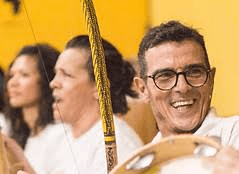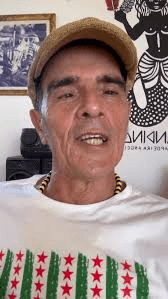
Mestre Poloca (born Paulo Barreto) is a highly respected figure in Capoeira Angola and a dedicated educator. He is a founding member of the internationally recognized Grupo Nzinga de Capoeira Angola, which he helped establish in Bahia, Brazil, in 1995 alongside Mestra Janja and Mestra Paulinha. Within this organization, he has played a pivotal role in using Capoeira Angola as a political and educational tool to protect the rights of children and adolescents, preserve Afro-Brazilian culture, and combat social discrimination.
Lineage and Training
Formative Years: His foundational capoeira education was shaped by legendary masters, including Mestre Moraes, Mestre João Grande, and Mestre Cobra Mansa. Under their guidance, he immersed himself in the rituals and specific kinematics of historical lineages, ensuring the preservation of traditional toques and instrument construction. This period was essential for his development as a practitioner, as he learned to bridge the gap between traditional street martial arts and academic studies of Afro-Brazilian heritage.
GCAP: He was an active and prominent member of the Grupo de Capoeira Angola Pelourinho (GCAP) from 1982 to 1997. During this tenure, he spent four years running voluntary social programs for children in marginalized communities like Baixa do Petróleo in Massaranduba. His work focused on the holistic development of practitioners, emphasizing movement, musicality, and reclaiming self-worth through the art, while fostering community building and social resilience. These initiatives treated Capoeira Angola as a “living archive” and a philosophy of resistance, providing a stable environment for cultural transmission.
Grupo Nzinga and Activism
Co-founder: In 1998, Mestre Poloca moved to São Paulo, where he collaborated with Mestra Janja and Mestra Paulinha to consolidate Grupo Nzinga de Capoeira Angola. This move was instrumental in expanding the group’s influence beyond Bahia, establishing it as a significant cultural force in Brazil’s largest metropolis.
Return to Bahia: In 2001, he relocated back to Salvador and established a Salvador-based nucleus of the group, which later anchored its permanent headquarters in the historic Alto da Sereia neighborhood. This return facilitated the group’s deepened engagement with its roots, providing a stable environment for cultural transmission and communal practice.
International Reach: Mestre Poloca travels globally to preserve the legacy of Mestre Pastinha, having led major Capoeira Angola workshops in Japan (Tokyo, Kyoto, Kanazawa) and across the Americas and Europe. His international efforts ensure that the specific kinematics and philosophical underpinnings of historical lineages are shared and preserved worldwide.
Community Development: Through Grupo Nzinga, he has actively contributed to community building and educational initiatives, focusing on the holistic development of practitioners. His approach emphasizes the integration of movement, musicality, and cultural context to foster social resilience and reclaiming self-worth.
Academic and Social Focus
Community Work: Mestre Poloca is deeply dedicated to social activism and youth education. He spent four years working alongside the GCAP to run voluntary social programs for children in marginalized communities, such as the Baixa do Petróleo in Massaranduba. His work focuses on the holistic development of practitioners, emphasizing musicality, movement, and the cultural context of the martial art to foster community building and social resilience.
University Ties: He has held affiliations with the Federal University of Bahia (UFBA), actively bridging the gap between traditional street martial arts and academic studies of Afro-Brazilian heritage. Through these ties, he promotes Capoeira Angola as a “living archive” and a philosophy of resistance, ensuring that ancestral nuances—such as traditional toques and instrument construction—are preserved within an educational framework.
Legacy and Philosophy
Mestre Poloca is known for his dedication to preserving the African roots, history, and philosophical underpinnings of traditional Capoeira Angola. Through Grupo Nzinga, he has actively contributed to community building, cultural transmission, and educational initiatives. He focuses heavily on the holistic development of practitioners, emphasizing musicality, movement, and the cultural context of the martial art.
His philosophy emphasizes Capoeira Angola as a “living archive” and a philosophy of resistance rooted in Afro-Brazilian identity. This approach prioritizes the preservation of ancestral nuances, such as traditional toques, instrument construction, and the specific kinematics of historical lineages. By bridging the past and present, he ensures the art remains a vital tool for communal participation and social resilience.Central to his teachings is the integration of physical mastery with psychological and spiritual depth. He advocates for the cultivation of malícia (cunning) and mandinga (strategy/magic), viewing the roda as a space where practitioners learn to navigate life’s complexities through ritualized dialogue. This holistic framework aims to build authentic confidence and internal harmony, transforming the discipline into a comprehensive scaffolding for reclaiming self-worth.