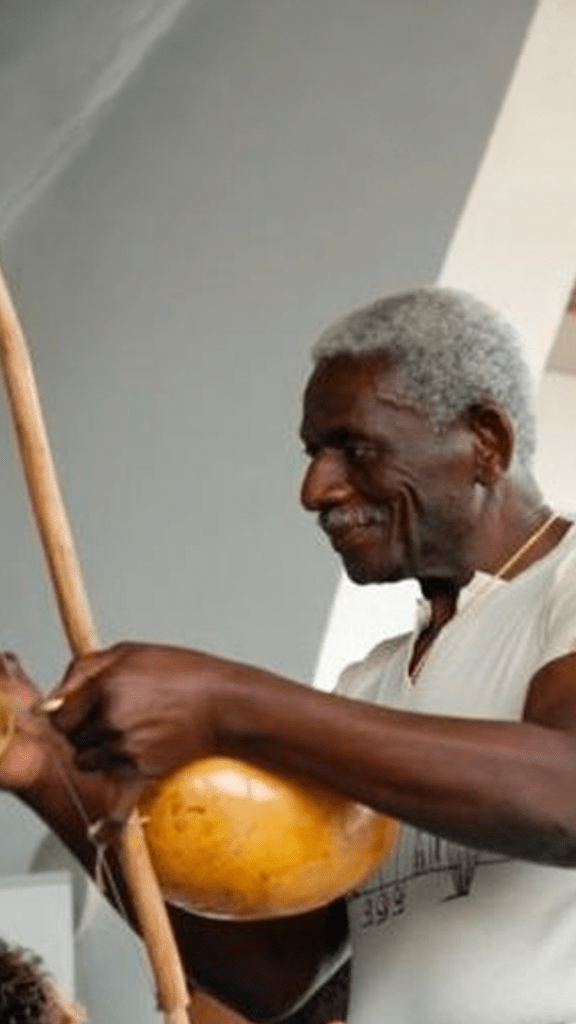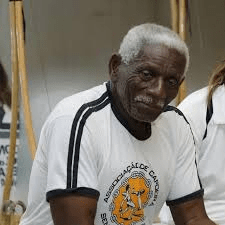
Mestre Sombra, born Roberto Teles de Oliveira, is a legendary Brazilian Capoeira master and the renowned founder of the Associação Desportiva e Cultural de Capoeira Senzala de Santos in São Paulo, Brazil. Born on Feb 6, 1941 in Santa Rosa de Lima, Sergipe, he has been active in the art form for over six decades. He is highly celebrated for expanding Capoeira’s international footprint and integrating the practice with social movements.
In 1962, Mestre Sombra emigrated to Santos in São Paulo and joined the group Bahia do Berimbau in 1963. The group was led by Mestre Olimpio Bispo dos Santos, who, like Sombra, hailed from the northeast estate of Bahia. This group practiced Capoeira in the neighboring towns of Itapema, Vicente de Carvalho, and Guarujá.
Following the passing of Mestre Bispo in 1972, Mestre Sombra began teaching independently at his newly formed school. For its first two years, the school was known as Zumbi before being officially registered as the Association of Capoeira Senzala in 1974. By 1975, the association established its current headquarters at 227 Bras Cubas Road in Santos, São Paulo, where it continues to serve as a vital cultural hub for the living tradition of Capoeira Angola.
Mestre Sombra’s contributions to Capoeira and Afro-Brazilian culture are extensive and widely recognized within the global Capoeira community. As a respected master, he has dedicated over 50 years to the art, teaching and forming hundreds of qualified instructors and masters who now promote Capoeira both in Brazil and internationally. Prominent examples of his pedagogical legacy include Mestre Marcos and Mestre Silvia, the founders of the London School of Capoeira Herança, who embody the high standard of teaching he has consistently provided.
Central to his influence is the creation of a unique style known as Capoeira from Senzala of Santos. This style is characterized by its focus on individuality, allowing students to develop and refine their own personal expression and flair within the framework of the foundational techniques taught at his school. His work is deeply embedded in the preservation of Afro-Brazilian heritage and the integration of the practice with social movements, fostering a sense of community and resilience among his disciples. Today, his headquarters, the Association of Capoeira Senzala located at 227 Bras Cubas Road in Santos, São Paulo, continues to serve as a vital hub for this living tradition.