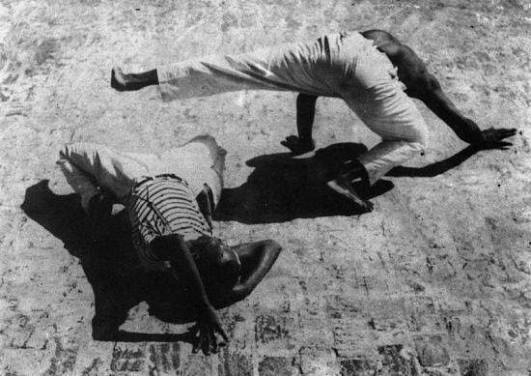
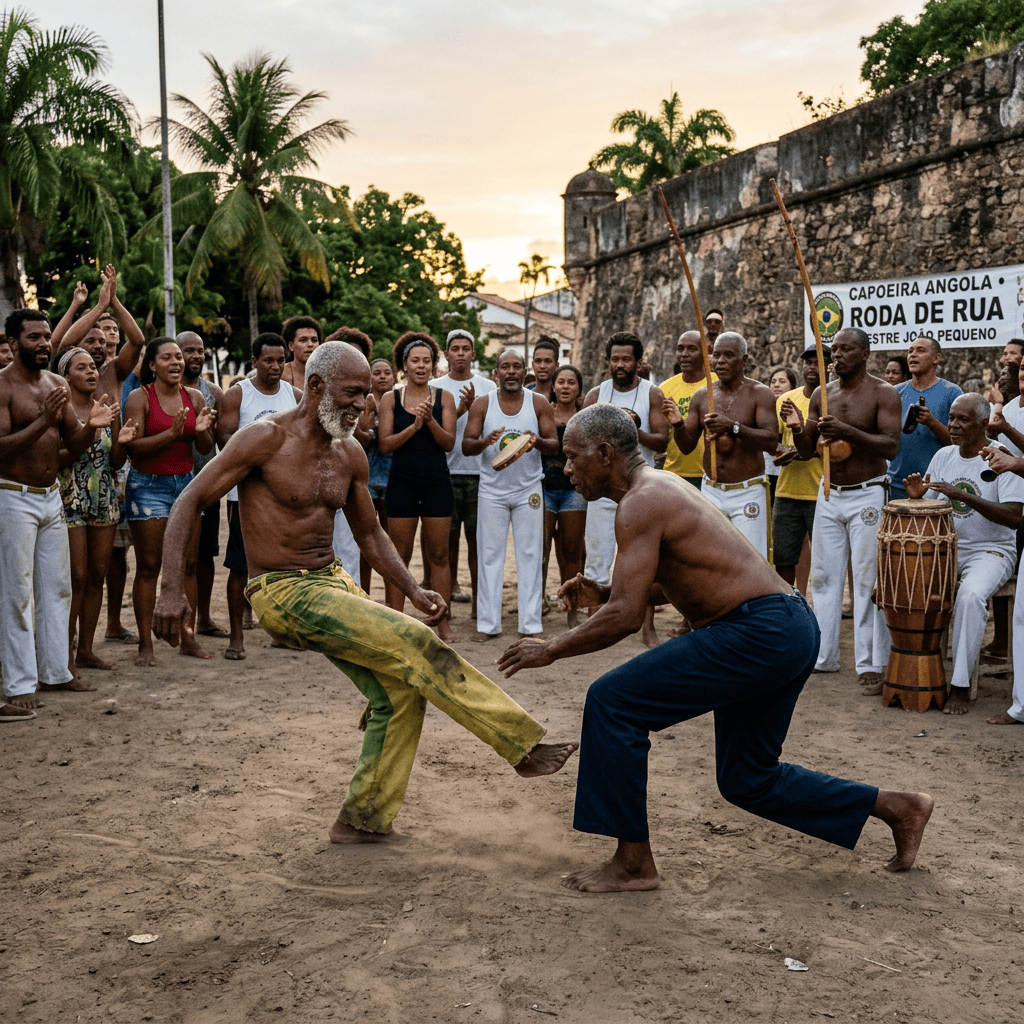
In this website are my thoughts about this amazing way of life called Capoeira Angola, and the many issues of life surrounding it.
It is my honor to share the art of CAPOEIRA ANGOLA with you. This vibrant and dynamic practice is a beautiful and rich art form that encompasses far more than just physical movements; it intertwines music, dance, and martial arts into a single expressive experience. It carries with it a deep historical and cultural significance, deeply rooted in the traditions of African heritage and Brazilian culture. Through every kick, spin, and rhythm, Capoeira tells stories of resilience, community, and celebration.
Creating this website is a labor of love, and I hope it serves as an engaging and informative resource for anyone wanting to delve deeper into the world of Capoeira, a unique blend of martial arts, dance, music, and culture that originated in Brazil.
I truly hope you find the content enriching and enjoy your time here as much as I enjoyed crafting it. AXE!
Public safety relies on law enforcement integrity. Most police officers honorably protect their communities and maintain order. However, misconduct by a few abuses power, causes harm, and erodes vital public trust.
These conduct disparities stem from complex factors, including flawed training, systemic departmental issues, insufficient mental health support, weak accountability, and societal pressures. Addressing these through enhanced screening, ethical training, oversight, and transparency is essential to protect constitutional rights and public safety.
These are their stories.
An investigation into the Charlotte-Mecklenburg Police Department (CMPD) revealed that former officer Seth Elliott was arrested for allegedly misusing Flock Safety license plate reader cameras and law enforcement databases to assist an individual under investigation for a drug-related crime. The North Carolina State Bureau of Investigation (SBI) analyzed data retrieved from Elliott’s phone, unearthing a group text thread among several officers.
The group chat contained explicit racial slurs, derogatory remarks, and discussions regarding the use of force and discharging firearms targeting Black residents. Sources further indicated that officers participated in a competition to see who could conduct the highest number of traffic stops on Black drivers. Following an internal affairs investigation, CMPD Chief Estella Patterson announced that six officers were cited for termination, with three resigning and three others recommended for firing pending Civil Service Board review. Community leaders and legal experts have called for full disclosure of the involved officers’ identities, while local prosecutors face a potential review of pending and closed criminal cases associated with these officers.
The Digital New Frontier: Modern Exploitation, Cultural Sovereignty, and the Fight for Accountability
The recent exposure of digital applications facilitating modern-day servitude and human exploitation has ignited widespread outrage and intense public scrutiny. This controversy reached a boiling point when a prominent Hollywood actor publicly walked away from a major project, drawing national attention to the issue and raising critical ethical questions surrounding human dignity, labor exploitation, and historical responsibility. As conversations unfold across media platforms, there is a growing demand for accountability, economic justice, and ethical integrity from global institutions and influential public figures alike.
The New Architecture of Servitude
While technology promises connection and convenience, the dark underbelly of the digital economy increasingly mirrors historical systems of oppression. Digital platforms that control, isolate, or exploit vulnerable workforces represent a new frontier of systemic inequity.
When technology is weaponized to strip workers of autonomy, it ceases to be a tool of progress and becomes an instrument of bondage. The current outcry emphasizes that high-tech convenience can no longer serve as a shield for corporate human rights violations.
Hollywood, Advocacy, and the Power of the Walkout
To pierce through this high-tech shield, advocates are leveraging public visibility to disrupt corporate momentum. Public figures hold unique leverage in shifting global conversations; when a high-profile actor walks away from a major project in protest, it does more than halt production—it disrupts the status quo.
[ Public Disruption ] ➔ [ National Attention ] ➔ [ Corporate Accountability ]
This act of solidarity elevates labor rights from a policy debate into a mainstream ethical imperative. By refusing to participate in systems tied to exploitation, public figures signal that human dignity must always take precedence over profit margins and creative visibility.
Historical Memory, Cultural Sovereignty, and Ancestral Resistance
For Black America and the broader African diaspora, this modern entertainment boycott is not an isolated event, but part of a long lineage of cultural sovereignty. The confrontation with digital bondage directly mirrors the historical legacy of chattel slavery and the ongoing imperative to expose systemic inequities, safeguard human rights, and maintain rigid control over cultural narratives. This refusal to accept subjugation draws deep parallels with ancestral survival strategies.
Capoeira Angola connects deeply to these themes as a traditional Afro-Brazilian art form and a profound system of resistance created by enslaved Africans in Brazil to fight oppression, preserve cultural identity, and secure survival. Developed from ancestral African practices—such as the Angolan ritual fight N’Golo—Capoeira Angola is not merely a physical discipline; it embodies an enduring philosophy of liberation and strategic cunning (malícia) explicitly designed to navigate social inequality, institutional hostility, and systemic exploitation.
It is a complex interplay of movement, music, and community that fosters a sense of belonging and solidarity among practitioners, transcending mere combat to become a vibrant expression of resilience. The rhythmic beats of the berimbau, the commanding presence of the capoeiristas, and the spirited songs sung during the rodas create an environment that honors history while simultaneously confronting modern challenges. Capoeira Angola serves as both a means of personal empowerment and a collective assertion of cultural pride, reminding us that every movement within its practice carries the weight of struggle and the potential for societal transformation.
This tradition of defiance shares a direct lineage with the historic maroon communities (quilombos) like Palmares, which organized collective resistance, economic self-reliance, and physical defense against colonial tyranny. Within the protective space of the community-centered ritual (roda), Capoeira Angola utilizes low-ground movements, deceptive play, and call-and-response songs guided by the sacred rhythms of the berimbau. Through these elements, practitioners do not just replicate historical choreography; they actively preserve historical memory, reclaim absolute bodily sovereignty, and assert a timeless blueprint for subverting systems of modern bondage.
Channeling Malícia in the Digital Age
The blueprint provided by Capoeira Angola offers crucial insights for modern advocacy. Just as enslaved ancestors used malícia (strategic cunning) to disguise a deadly martial art as an innocent dance under the watchful eyes of plantation overseers, contemporary workers and advocates must deploy their own forms of strategic sharpness to navigate digital exploitation. In today’s complex landscape, where technology often masks oppressive practices, understanding the art of subtlety becomes paramount.
Workers must learn to engage in creative resistance, utilizing digital tools not only to expose injustices but also to create spaces of solidarity and empowerment, reminiscent of how Capoeira served as both a means of survival and cultural expression. To thrive in this environment, advocates must harness their collective intelligence and resilience, crafting strategies that echo the rich heritage of those who came before them, ultimately transforming digital platforms into arenas of liberation rather than mere battlegrounds of competition and control.
In the modern gig economy and algorithm-driven workplace, practicing malícia means looking beneath the glossy interface of digital convenience. It involves organizing decentralized networks of collective resistance, subverting algorithmic surveillance, and masking worker solidarity within the very platforms designed to isolate them. By blending deceptive play with community-centered coordination, digital-age laborers can reclaim their bodily and economic sovereignty from corporate tech monopolies.
The Demand for Systemic Justice
Ultimately, channeling this strategic cunning must culminate in permanent structural reform and an institutional reckoning. True accountability involves a multi-layered approach from consumers, creators, and regulators alike.
Action Pillar
Objectives
Corporate Transparency
Demanding full visibility into supply chains and labor practices of digital platforms.
Economic Justice
Ensuring fair compensation, worker autonomy, and legal protections for digital-age laborers.
Ethical Integrity
Holding global institutions accountable for the human cost of their business models.
As this cultural moment unfolds, the message remains clear: the global community must reject any form of exploitation, ensuring that human rights, ancestral wisdom, and historical responsibility dictate the future of innovation. This imperative goes beyond mere words; it calls for actionable change that honors the dignity of every individual, uplifts marginalized voices, and fosters an environment where ethical practices reign supreme.
By embracing diverse perspectives and integrating traditional knowledge with modern advancements, we can cultivate a society that not only innovates but does so with a profound respect for our shared humanity and the Earth we inhabit. In this way, we pave the way for a more equitable and sustainable future for generations to come.
We’ve all been there. You let someone into your life, share your wins, and trust them with your secrets—only to realize later that they’ve been working against you from the shadows, subtly undermining your achievements and manipulating situations to their advantage. They often come across as charming and supportive, masking their true intentions behind a facade of friendship. In everyday slang, we call these toxic, untrustworthy individuals “snakes.”
With their sly demeanor and cunning behavior, they weave an intricate web of deceit, leaving you questioning your own judgment and the authenticity of your relationships. It’s a painful experience that can shake your confidence and make you wary of opening up to others in the future.
Spotting deceitful behavior before it causes damage is a crucial skill for protecting your peace, your reputation, and your mental health. This ability allows individuals to navigate complex social interactions with greater confidence, reducing the risk of falling victim to dishonesty and manipulation. By honing this skill, you can create healthier relationships and foster an environment of trust around you. Moreover, being vigilant about deceit not only shields you from potential harm but also enables you to address issues proactively, ensuring that your emotional well-being remains intact and your self-esteem is preserved. Understanding the nuances of deceitful behavior can empower you to make informed decisions, ultimately leading to more fulfilling and authentic connections in both your personal and professional life.
Here is a practical guide on how to read the warning signs and handle untrustworthy people with strategy and grace.
👁️ The Red Flags: How to Spot a Snake
Deceptive people rarely show their true colors upfront. Instead, they leave a trail of subtle behavioral patterns that can often go unnoticed. Their charm and charisma can initially draw you in, masking their true intentions with a veneer of friendliness. Over time, however, small inconsistencies in their stories and behaviors begin to emerge, leading to a sense of unease. If someone in your circle exhibits these traits, such as a tendency to manipulate situations for their gain or a lack of empathy in their interactions, it’s time to pay closer attention: recognizing these signs early on can help you protect yourself from potential betrayal and distress in your relationships.
The Gossip Loop: Pay attention to how they talk about people who aren’t in the room. If they are constantly sharing other people’s secrets with you, they are absolutely sharing your secrets with others.
The “Conditional” Cheerleader: True friends celebrate your success. A toxic person will offer passive-aggressive compliments, change the subject when you win, or show an unsettling amount of satisfaction when you fail.
Over-the-Top Flattery: Beware of “love bombing” or excessive praise early in a relationship. Untrustworthy individuals often use intense flattery to fast-track intimacy and lower your guards before trust is actually earned.
Boundary Pushers: Watch how they react when you say “no.” If setting a simple boundary is met with guilt trips, anger, or silent treatments, they view your boundaries as an obstacle to their control.
The One-Way Street: The relationship is entirely on their terms. They expect you to be their emotional sounding board, but when you need support, they are suddenly too busy or completely emotionally unavailable.
🛡️ The Playbook: How to Handle Untrustworthy People
Once you realize someone isn’t operating with good intentions, you need to shift from passive observation to strategic protection.
1. Document the Facts
If you operate in the same professional or social circles, it can be beneficial to start keeping a private, objective log of incidents that may occur. Take note of specific dates, relevant texts, or actions that you observe, ensuring that your entries are as detailed and factual as possible. This log serves multiple important purposes; not only does it protect you from being gaslit, but it also empowers you by providing concrete evidence should you ever need to escalate a situation to HR, community leaders, or even law enforcement. By documenting everything meticulously, you create a clear narrative that can support your case in any discussions that may arise in the future. Furthermore, this practice can aid in identifying patterns of behavior that may be concerning, allowing you to approach situations with greater awareness and preparedness. Keeping this log privately can also be a source of reassurance, knowing that you have a reliable account of events should the need to defend yourself or seek help arise.
2. Put Them on an “Information Diet”
Stop feeding them ammunition. Cut off their access to your private life, future plans, and vulnerabilities. Maintaining your personal boundaries is essential for your emotional well-being. Keep conversations strictly surface-level to create a safe distance. If they probe with deep questions that pry into your inner thoughts or feelings, skillfully pivot the conversation back to them or keep your answers brief and non-revealing. This not only protects your privacy but also discourages further attempts to invade your personal space. By focusing on neutral topics or light-hearted subjects, you can maintain a cordial atmosphere while ensuring that your true self remains shielded from scrutiny.
3. Master the “Gray Rock” Method
If you can’t completely cut contact—like a coworker or a family member—become as uninteresting as a gray rock. This means adopting a demeanor that is bland and neutral, effectively removing any appeal you may have to the toxic person. Give short, neutral, and entirely uninspiring responses that lack any emotional depth. For instance, instead of engaging in lengthy conversations, try to keep your answers to simple phrases or single words. When you stop providing emotional reactions or interesting gossip, a toxic person will naturally lose interest, as they thrive on the drama and excitement that a more reactive target offers. Over time, they will recognize that their attempts to provoke or draw you into conversation are futile, leading them to seek out someone else who fulfills their need for attention and engagement. By maintaining this gray rock approach consistently, you can gradually reclaim your peace of mind and diminish the negative influence this person has in your life.
4. Initiate the “Slow Fade”
For friends or acquaintances, you don’t always need a dramatic, explosive confrontation to end a relationship or create distance. Instead, utilize the slow fade to gradually lessen your involvement in their lives. Start by becoming less available for spontaneous hangouts, taking longer to reply to messages and texts, and allowing the conversations to dwindle. Politely decline invitations, perhaps suggesting that you have prior commitments or simply need some time for yourself. As time passes, maintain this pattern, allowing the interactions to naturally decrease in frequency and intensity until the relationship fizzles out without any hard feelings or awkwardness. This approach not only spares feelings but also provides both parties the chance to reflect on the friendship’s dynamics, ultimately leading to a more amicable disengagement.
5. Keep Accusations Factual and Brief
If a confrontation is completely unavoidable—such as addressing a direct rumor—keep your emotions entirely out of it. State the facts plainly and assertively: “I heard you mentioned X to Y. I need that to stop.” It’s crucial to approach the situation with a calm demeanor, as letting your emotions cloud your judgment can lead to misunderstandings and escalation. By sticking to the facts, you not only maintain control of the discussion but also minimize the opportunity for the other person to argue or twist your words. Remain focused on the specific issue at hand, reinforcing the importance of clarity in communication. Ensure that your message is direct and unambiguous, so there is no chance of misinterpretation. Remember, this is about addressing the behavior, not engaging in an emotional debate.
🐍 Exposing Untrustworthy People (“Snakes”) Through Capoeira Angola
In Capoeira Angola, untrustworthy individuals or hidden threats are traditionally referred to as “snakes” (cobras). This metaphor not only conveys the idea of deceit but also evokes the stealth and cunning often associated with these creatures. Rather than using direct, aggressive confrontation to unmask them, Capoeira Angola employs a rich tapestry of strategic philosophy, kinetic observation, and auditory cues rooted in centuries of Afro-Brazilian survival practices. Practitioners learn to read the subtle movements and intentions of those around them, cultivating an awareness that transcends mere physicality. Through fluid, dance-like interactions and rhythmic exchanges, they create a dynamic environment where intuition and perceptiveness take precedence over brute force. This approach reflects a deeper understanding of combat as a dialogue, where each gesture communicates layers of meaning and intention, ultimately allowing adept practitioners to identify and navigate potential threats with grace and insight.
1. Musical and Auditory Alerts (Toques and Corridos)
Music serves as a real-time tactical communication system in the roda, intricately weaving together the threads of culture, tradition, and strategy. Specific songs and rhythms are utilized to signal hidden dangers or warn a practitioner about a deceitful opponent, creating a dynamic audio landscape that enhances both awareness and interaction. Each beat, tempo, and melody carries meaning, allowing practitioners to connect not just with one another but also to navigate the complexities of the moment, responding swiftly and cohesively to the unfolding environment. In this way, music transforms the roda into a living tapestry of sound and movement, where every note plays a crucial role in ensuring the safety and efficacy of the practitioners involved.
“Valha-me Deus, Senhor São Bento, buraco velho tem cobra dentro”: This traditional corrido warns the practitioner that an opponent is setting a trap or that there is hidden danger (“a snake inside an old hole”), instructing them to alter their route or prepare a deceptive escape.
Lead Berimbau Directions: The lead berimbau player controls the energy and tempo of the interaction, shifting rhythms (toques) like Angola or São Bento Grande to dictate whether a game requires slow, cautious awareness or heightened defensive alertness against a hostile player.
2. Tactical Traps and Testing Intentions (Chamada & Malandragem)
Instead of guessing someone’s true motives, Angoleiros use specific physical setups to force an untrustworthy person to reveal their intent:
The Chamada (Ritual Call): Derived from guerrilla strategies used in historic maroon settlements like Palmares, a practitioner raises their hands to call the opponent close, intentionally presenting a vulnerable posture. If the opponent approaches with aggression, impatience, or lack of focus, their hostile intentions are instantly exposed and countered. This technique not only showcases the skill and confidence of the practitioner but also serves as a psychological tactic, undermining the opponent’s composure and revealing weaknesses that can be exploited in the ensuing confrontation. The elegance of this call lies in its ability to transform perceived vulnerability into a powerful counter-strategy, emphasizing the importance of awareness and adaptability in combat situations. Through this ritual, the practitioner embodies a deep understanding of both physical and mental dynamics at play.
Malandragem (Strategic Deception): By feigning weakness, a capoeirista lures an overconfident opponent into a premature attack, effectively exposing their malice or lack of self-control. This clever tactic not only demonstrates the capoeirista’s skill in manipulating the dynamics of the fight but also provides an opportunity to counter and gain the upper hand in the conflict. By luring the opponent in, the capoeirista can exploit the moment to achieve a decisive advantage, showcasing the intricate dance of strategy and technique inherent in the art of capoeira.
3. Observation and Psychological Profiling
Capoeira Angola emphasizes reading subtle physical cues to anticipate betrayal before it manifests:
Reading Body Language: Practitioners continuously monitor an individual’s breathing patterns, eye movement dynamics, shifts in weight distribution that may indicate emotional changes, and subtle lapses in attention that could reveal underlying thoughts or feelings, helping them to better understand the unspoken communication that occurs in interpersonal interactions.
Managing Range and Line of Sight: Through continuous low movement (jogo de chão) and evasive rotations like the rolê, practitioners keep threats within their visual field, preventing deceitful individuals from gaining an unobserved vantage point. This strategic approach not only enhances awareness but also allows for quick adjustments in positioning, ensuring that any potential danger is effectively monitored. By maintaining a dynamic and fluid posture, practitioners can respond swiftly to changing circumstances, minimizing the risk of ambush and enhancing their overall tactical advantage. Moreover, the integration of these methods fosters a deeper understanding of spatial awareness, encouraging individuals to develop instincts that are crucial in high-pressure environments where the element of surprise can dictate the outcome of an encounter.
💡 The Bottom Line
Removing or distancing yourself from untrustworthy people isn’t petty or selfish; it is an essential act of mental, emotional, and psychological self-preservation. Your inner circle should function as a secure safe harbor that fosters mutual growth and stability, not a continuous emotional minefield where you must stay perpetually on guard. Over time, tolerating deceptive or manipulative individuals erodes your peace of mind and drains your energy reserves, leaving you vulnerable to systemic burnout.
Always honor and trust your internal intuition. Our unconscious perception often detects subtle incongruencies—such as micro-expressions, shifts in energy, or inconsistencies between a person’s words and actions—long before our logical mind fully articulates the problem. If something consistently feels off about someone’s character, motives, or dependability, believe those warning signs and take proactive steps to protect your boundaries.
Most people think power is loud. They think it’s about making the biggest scene, throwing the heaviest punch, or being the most aggressive voice in the room. But if you look closely at the streets, the corporate boardroom, or even the block, you quickly realize the truth: the most dangerous people don’t play loud—they play slick.
They don’t use brute force; they use strategy. They utilize subtle power plays, backhanded jokes, and psychological micro-moves designed to chip away at your confidence and make you feel small, all while keeping their own hands clean. They hide behind the excuse of “I was just playing” or “You’re too sensitive,” pushing your buttons just enough to get a reaction.
If you get emotional, you lose. If you snap, you just walked right into their trap, making you look like the problem.
True power doesn’t come from beating a manipulator at their own game. True power comes from spotting the game before it even starts. When you refuse to blink, your internal energy shifts. The manipulator instantly senses that their tricks have no gravity here. The trap fails, the situation de-escalates, and the room goes quiet.
Believe it or not, this exact street-smart philosophy is the living foundation of a centuries-old martial art born from the ultimate fight for survival: Capoeira Angola.
The Anatomy of Manipulation: Understanding the “Slick”
Before you can counter a game, you have to know what it looks like. Manipulators rarely attack head-on. Instead, they rely on a chess board of micro-aggressions:
The “Just Joking” Jab: Slipping an insult into a joke to see if you’ll tolerate it.
The Bait-and-Switch: Intentionally provoking an emotional reaction so they can play the victim when you finally defend yourself.
The Power Play: Subtle shifts in body language, tone, or positioning to establish dominance without saying a word.
The goal of these tactics is simple: to get you out of character. The moment you react out of anger, fear, or insecurity, you have handed over the remote control to your emotions.
The Art of Malícia: Street Smarts in the Circle
Capoeira Angola is an Afro-Brazilian martial art fundamentally built on survival, strategic cunning, and deep psychological perception. Born in Brazil out of resistance against severe chattel slavery and systematic oppression, it wasn’t an art that could rely on brute force. Enslaved practitioners couldn’t fight the heavily armed ruling class head-on, so they had to master the mind. They disguised their deadly martial art as a dance, tricking their oppressors while sharpening their lethal skills right in front of them.
In Capoeira, this philosophy is distilled into a single, powerful word: malícia.
Malícia isn’t maliciousness in the English sense; it is a blend of deception, street smarts, wit, and misdirection. It is the ability to anticipate harm and neutralize a threat before it manifests.
When two practitioners step into the roda (the circle where the game is played), they aren’t just trading physical kicks. They are engaging in a high-stakes psychological dialogue. The rhythm of the berimbau (the primary musical instrument) sets the pace, but the minds of the fighters dictate the reality. Every slow, hypnotic movement, every smile, or every extended hand can be a feint, a trap, or a deliberate setup for a sweeping takedown.
“In the roda, as in life, if you look at the foot, you miss the head. You have to watch the whole body—and the spirit behind it.”
Why the Best Fighter is the One Who Sees the Game
Just like navigating a toxic environment, a manipulative boss, or a fake friend, the master capoeirista wins by staying completely anchored in their own calm.
1. The Advantage of Total Awareness
By reading your opponent’s subtle physical shifts and auditory cues, you decode their intentions before they strike. You don’t look at where the kick is coming from; you look at the center of gravity. In life, this means ignoring the words a manipulator says and looking directly at their intent.
2. Refusing to “Blink”
Instead of meeting aggression with aggression, you remain completely unbothered. When a manipulator throws a jab and you respond with a calm, unbreaking stare, the energy in the room shifts. In Capoeira, if an opponent launches a wild, aggressive attack and you simply slip out of the way with a smooth, unbothered movement, you have instantly shattered their rhythm.
3. Using Their Momentum Against Them
When you don’t react the way a manipulator expects, they panic. They get sloppy and over-extend. In Capoeira, this is the exact micro-second you use their own weight and momentum to sweep them off their feet (rasteira). By letting them overplay their hand, they defeat themselves.
Navigating Hostile Environments
Historically criminalized and hunted by the state well after the abolition of slavery, Capoeira Angola practitioners (capoeiristas) had to move through the world with a heightened sense of situational awareness, constantly aware of the dangers that lurked in both their surroundings and social interactions. The art not only taught them how to survive from a position of absolute disadvantage but also instilled in them a profound understanding of resilience and resourcefulness. It equipped them with the skills to navigate life’s complexities while fostering a sense of community and cultural identity. Capoeira Angola demonstrated the importance of preserving their physical energy, as well as teaching them the nuances of reading the true temperature of a room—how to detect subtle shifts in mood or intent among those around them. Moreover, it helped them maintain absolute mastery over their own minds under intense pressure, turning physical movement into a form of expression that transcended mere combat; it became a vital means of retaining dignity and autonomy in a world that often sought to strip them of both. Through the rhythmic flow of the ginga, the art form became a powerful tool for liberation, self-empowerment, and an enduring legacy that still resonates today.
The block changes, the centuries pass, but human nature stays exactly the same. The same games played on the plantation and in the alleys of old Rio de Janeiro are played today in corporate offices, street corners, and relationship arguments. These timeless dynamics reveal a fundamental truth: the struggle for power, recognition, and connection drives our interactions, regardless of the setting. The intricate dance of manipulation and strategy unfolds in boardrooms, mirroring the confrontations of the past where individuals vied for dominance among their peers. Just as the street corners of Rio echoed with the laughter and conflict of everyday life, so too do modern social platforms and workplaces resonate with the same emotional undercurrents, illustrating that no matter how much the landscape may evolve, the core essence of human behavior endures. We continually witness this cyclical pattern, with history serving as a backdrop for our shared experiences and the universal challenges that bind us together, transcending time and location.
Whether you are stepping into a physical roda or just trying to survive the psychological minefields of everyday life, remember the ultimate rule of true power: Don’t play the game. See it. In every interaction and encounter, recognize the dynamics at play, the subtle shifts in energy, and the motivations of those around you. By taking a step back and observing rather than reacting, you can gain invaluable insight into the structure of these encounters. This perspective not only allows you to navigate challenges more effectively but also empowers you to make choices that align with your deeper values and intentions. Embracing this mindset transforms how you engage with your surroundings, enabling you to approach each moment with awareness and confidence.
Introduction: Mestre Pastinha and the Preservation of Ancestral Lineage
During the late 19th and early 20th centuries, Capoeira faced severe existential threats. Following the abolition of slavery in Brazil in 1888, the Republican government enacted the Penal Code of 1890, which explicitly criminalized the practice of Capoeira. Practitioners (capoeiristas) faced harsh penalties, including arrest, forced labor, and exile.
To survive this era of state-sponsored repression, the art form underwent a split. While some variants modernized into a fast, aerial, sport-oriented format (Capoeira Regional), it was Vicente Ferreira Pastinha (1889–1981)—affectionately known as Mestre Pastinha—who fought to preserve the traditional, philosophical, and ritualistic essence of the art.
+—————————————+
| THE-1890 POST-ABOLITION SPLIT |
+—————————————+
|
+———————–+———————–+
| |
v v
[ Capoeira Regional ] [ Capoeira Angola ]
– Modernized & Sportified – Championed by Mestre Pastinha [2]
– Adapted for mainstream acceptance – Preserved as a system of survival & cunning
Mestre Pastinha founded the Centro Esportivo de Capoeira Angola (CECA) in 1941 in Salvador, Bahia. He formalized the name Capoeira Angola to honor the African roots of the practice. Pastinha famously declared that “Capoeira is for man, child, and woman; the only thing it doesn’t look kindly upon is those who do not want to learn.”
By institutionalizing the practice under a strict ethical code, teaching wearing the symbolic black-and-yellow uniforms of his favorite soccer team (Ypiranga), and emphasizing mental agility over raw brutality, Pastinha successfully transformed a criminalized street art into a recognized repository of Afro-Brazilian philosophy. He preserved Capoeira Angola not as a combat sport, but as an unbroken lineage of physical and psychological survival.
1. Survival in the City: Navigating Urban Conflict and Repression
In modern urban environments, Capoeira Angola provides tools for managing social tension, state surveillance, and direct conflict through strategic agility, psychological fortitude, and street smarts (mentalidade).
De-escalation and Non-Threatening Positioning: The foundational sway of the ginga serves as a psychological disarming tool. In high-stress urban encounters, freezing or adopting an overtly aggressive posture can provoke violence. Adopting an open stance, relaxed breathing, or executing a subtle step back allows practitioners to diffuse aggressive encounters before physical escalation occurs. The goal is to project calm while maintaining a highly alert and perceptive state of consciousness.
Malícia (Strategic Cunning): Rooted in reading body language, understanding intent, and anticipating threats, malícia (deception or guile) is the ultimate defense mechanism against urban volatility. Rather than meeting force with force, a practitioner uses misdirection. In the city, this translates to heightened situational awareness—knowing how to read a street, establish clear psychological boundaries, avoid traps, and navigate hostile environments or bureaucratic systems without relying on direct confrontation.
Strategic Withdrawal: When engagement carries terminal risks or drains critical resources, the practitioner utilizes stealth and calculated risk assessment to withdraw safely. Every defensive dodge in Capoeira Angola, such as the esquiva (escape), is designed to protect the centerline while looking for a way out. In an urban environment, this means using architectural cover, understanding exit routes, and conserving vital energy for essential challenges rather than engaging in pointless conflicts.
Community Networks (Pod Mapping): Drawing inspiration from the historic autonomous communities (quilombos), practitioners organize localized support structures. The roda (the physical circle in which the game is played) operates on the principle of ubuntu—”I am because we are.” In a repressive city, this philosophy translates into pod mapping: organizing mutual aid, collective defense, and self-reliance networks that function outside punitive state systems, ensuring the community’s mutual survival.
2. Survival in the Wilderness: Embodying Ecological Wisdom
Beyond urban landscapes, the physical mechanics and philosophy of Capoeira Angola closely align with natural phenomena, creating a unique relationship between movement and the environment. Training frequently takes place outdoors to foster a direct connection with the setting, whether it be in lush parks, sandy beaches, or tranquil forests. This immersion in nature not only enhances the physical experience but also deepens the spiritual aspect of practice. The natural world serves as both a backdrop and a partner, where practitioners learn to become attuned to their surroundings, gaining insights from the dynamics of wind, earth, and water. This deep alignment enables harmonious interaction with rugged terrain and natural elements, allowing for fluid movements that echo the organic rhythms of life around them. As they engage with their environment, practitioners develop greater respect for nature, fostering a philosophy that emphasizes balance, respect, and unity with all living things.
+————————+—————————————+—————————————+
| Principle | Physical Application (The Roda) | Ecological Survival (The Wilderness) |
+————————+—————————————+—————————————+
| Adaptability & Roots | Yielding to kicks, shifting weight | Navigating loose soil, high winds |
| Economy of Motion | Slower, calculated pacing | Conserving caloric energy and water |
| Low-Ground Floorwork | Negative and Rolê close to earth | Stealth, low centers of gravity |
+————————+—————————————+—————————————+
Adaptability and Rootedness: Much like the trunk of a tree or a mangrove root system, an angoleiro maintains a low, grounded posture while remaining highly flexible. In the wilderness, rigid things snap under pressure. By yielding to external forces—such as uneven terrain, steep inclines, or heavy winds—rather than resisting them rigidly, energy is absorbed and redirected through the body without causing structural injury or loss of balance.
Economy of Motion (Eficácia): Mirroring the efficiency of natural currents, movements in Capoeira Angola are executed with minimal expenditure of energy. In a survival scenario, premature exhaustion is lethal. The art teaches a practitioner to move fluidly, pacing themselves to match the rhythm of their surroundings. Conserving stamina prevents dehydration and fatigue, allowing a person to endure long journeys through challenging terrain.
Low-Ground Floorwork (Jogo do Chão): Evasions such as the negativa and transitions like the rolê utilize closeness to the earth for maximum balance and stealth. In dense wilderness, standing tall makes a person visible to predators or hostile trackers and increases the risk of dangerous falls. Moving close to the floor distributes body weight evenly across multiple points of contact, allowing for safe, silent transitions across muddy, rocky, or heavily vegetated landscapes. By touching the earth directly with hands and feet, the practitioner physically and spiritually harvests the stability of the ground to maintain equilibrium under pressure.
3. The Historical Role of the Quilombos: Collective Resistance
To understand how Capoeira Angola functions as a survival mechanism, one must examine its crucible: the quilombos. These were autonomous, self-sustaining communities established by escaped African slaves, indigenous peoples, and marginalized Europeans who fled the brutal plantation economies of colonial Brazil. Far from being mere temporary hideouts, quilombos grew into sophisticated, multi-ethnic societies that stood as the ultimate geopolitical expression of resistance against Portuguese colonial tyranny.
The Strategic Geography of Defiance
Quilombos were intentionally established in the most treacherous, inaccessible regions of the Brazilian wilderness. Settlers built these maroon societies deep within dense interiors, rugged mountain ranges, and thick mangrove swamps.
This extreme geography served a dual tactical purpose:
Natural Fortifications: The harsh terrain provided a physical buffer against colonial slave-catching expeditions (capitães-do-mato).
Tactical Foraging and Guerilla Warfare: Living in the wilderness forced maroons to master ecological literacy. They transformed the jagged landscape into defensive traps, ambush sectors, and hidden lookout points—mirroring the low-ground, deceptive physical mechanics seen in Capoeira Angola’s jogo do chão (floor work).
Palmares: The Pinnacle of Maroon Statehood
The most legendary of these communities was the Quilombo dos Palmares, a massive confederation of several smaller settlements (mocambos) located in the present-day state of Alagoas. Active for nearly the entire 17th century, Palmares grew to an estimated population of over 20,000 residents at its peak.
Palmares was not a chaotic refugee camp; it was a highly organized state featuring:
Complex Governance: Led by legendary figures like Ganga Zumba and later his nephew Zumbi dos Palmares, the society blended African centralized kinship structures with elective leadership.
Diversified Economy: While colonial plantations relied monoculturalistically on sugar cane, Palmares thrived on polyculture. They cultivated maize, beans, manioc, and sweet potatoes, and developed advanced metalworking, pottery, and trade networks with nearby Portuguese villages.
Military Innovations: Palmares successfully repelled dozens of heavily armed Portuguese and Dutch military expeditions. They utilized a combination of sophisticated trench warfare, psychological deception, and close-quarters hand-to-hand combat systems—systems heavily intertwined with the early ancestral iterations of Capoeira.
4. Operationalizing History: Connecting the Tactics of Zumbi dos Palmares to Capoeira Movements
The martial legacy of Zumbi dos Palmares is physically codified within the core movements of Capoeira Angola. As the ultimate commander of Palmares, Zumbi’s military strategy relied heavily on guerrilla tactics: ambush, structural low profiles, psychological misdirection, and rapid counter-offensives. In the roda, these battlefield strategies are distilled into specific physical kinetic responses designed for survival against a larger, more heavily armed adversary.
[ Colonial Soldier Standing ]
|
| (Expects high, linear attack)
v
[ Capoeirista drops to Negativa ] —> [ Fluid transition to Aú Queda de Rins ] —> [ Sweeping Takedown ]
The Low-Profile Ambush (Aú Queda de Rins and Negativa): Zumbi’s warriors frequently used the dense undergrowth and rocky crags of the Serra da Barriga mountains to hide from Portuguese lines, launching surprise attacks from a crouched position. In Capoeira, the Negativa paired with Aú Queda de Rins (an inverted cartwheel resting on the kidneys) shrinks the visual profile. From this compressed position, practitioners execute low-to-the-ground acrobatics that confuse the opponent’s spatial awareness, converting a defensive dodge into an immediate low-angle entry point.
Setting the Trap (Chamada): In guerrilla warfare, Zumbi frequently employed feigned retreats. Palmarino forces would pretend to break ranks and flee, drawing overconfident colonial units deep into the jungle where pre-set traps and ambushes awaited them. In the roda, the Chamada (the ritual call) mimics this strategy. One player raises their hands and calls the opponent forward, appearing vulnerable. If the approaching player breaks concentration or moves too aggressively, the initiator instantly spring-loads a strike or a takedown, punishing the lapse in situational awareness.
Disarming the Oppressor (Banda and Rasteira): Colonial forces were heavily armed with muskets, bayonets, and sabers. Standing at a distance against a firearm or a blade was suicidal. Zumbi’s fighters had to close the distance safely, duck under weapon trajectories, and strip the enemy of their balance. In Capoeira, the Banda (inside foot sweep) and Rasteira (pulling floor sweep) target the structural footing of the opponent. Rather than blocking a strike from an armed attacker, the capoeirista uses an esquiva to slip beneath the line of attack, hooks their foot behind the opponent’s heel, and uses the opponent’s own forward momentum to collapse their stance.
Total Environmental Awareness (Rolê): Surrounded by enemies on a dynamic, unpredictable battlefield, a Palmarino fighter could never afford to look away from their surroundings or expose their spine blindly. The Rolê is a low, rolling, ground-based rotation used to move across the circle. Unlike a standard spin where the back is temporarily turned, a practitioner executing a rolê keeps their head twisted between their arms, maintaining unbroken visual contact with the opponent throughout the entire rotation. It embodies Zumbi’s survival imperative: never blind yourself to the threat.
5. The Sonic Architecture of Survival: Music and Instruments
In Capoeira Angola, music commands the action. During the eras of slavery and subsequent criminalization, Africans and their descendants could not openly discuss military tactics, plot escapes, or preserve historical archives without facing execution. To survive, they codified their history, tactical commands, and psychological conditioning into a sonic landscape.
+—————————————————————–+
| THE BATERIA (THE ANGOLEIRO ORCHESTRA) |
+—————————————————————–+
|
+——————————-+——————————-+
| | |
v v v
[ The Berimbau ] [ The Pandeiro ] [ The Atabaque ]
Controls the game’s pace Keeps the senses sharp Provides structural drive
The Instruments: Tools of Focus and Deception
The Berimbau: A single-string bow instrument paired with a gourd resonator (cabaça), a bamboo stick (baqueta), a coin or stone (dobrão), and a wicker rattle (caxixi). The berimbau is the spiritual and tactical leader of the roda. By shifting between distinct rhythms (toques), the lead berimbau player controls the strategic nature of the environment. A Angola toque dictates a slow, deceptive, close-to-the-ground game driven by malícia. Shifting to São Bento Grande de Angola demands faster, more defensive, and combative physical engagements. Historically, specific rhythms like Cavalaria mimicked the sound of galloping horses, serving as an acoustic warning system to alert practitioners that colonial slave-catchers or police patrols were approaching.
The Pandeiro (Tambourine) and Agogô (Iron Bell): The pandeiro provides a steady, syncopated driving rhythm that sharpens peripheral awareness. Its continuous crisp texture prevents practitioners from falling into a trance, maintaining the high-alert state required for urban or wilderness evasion. The agogô adds a high-pitched metallic clarity, cutting through ambient noise to ground the players’ internal biological rhythms to a shared tempo.
The Atabaque (Hand Drum): The atabaque provides the low-end, resonant heartbeat of the orchestra. It connects the practitioners directly to the earth, reinforcing the angoleiro principle of rootedness. The steady bass frequencies physically regulate the nervous system, lower the heart rate under duress, and preserve physical endurance during long, exhausting confrontations.
Songs as Living Archives of Resistance
The vocal tradition of Capoeira Angola uses a call-and-response format to preserve oral histories, pass down strategic wisdom, and communicate hidden truths right in front of oppressors.
Ladainhas (The Litany of Context): Before any movement begins, the leader sings a ladainha, a solo narrative poem. In a historical survival context, the ladainha was used to size up an environment, honor ancestors, or subtly brief the community on current political dangers. By singing about historical figures like Zumbi dos Palmares or Besouro Mangangá, the song injects historical continuity into the room, reminding practitioners that their current struggle is part of an unbroken chain of resistance.
Chulas and Corridos (Real-Time Tactical Commands): Once the game begins, the singing transitions into chulas and corridos—short, repetitive phrases shouted by the leader and echoed by the chorus. These songs often carry double meanings (duplo sentido) to advise players on how to handle an opponent or an external threat:
“Valha-me Deus, Senhor São Bento, buraco velho tem cobra dentro.” (Help me God, Saint Benedict, an old hole has a snake inside.) Tactical Code: This song warns a practitioner that their opponent is setting a trap, or that the path they are navigating contains hidden urban dangers. It commands the player to look for an alternative route or use a deceptive defensive escape.
“Dona Alice não vai no mercado, que o mercado tá fechado.” (Dona Alice, don’t go to the market, because the market is closed.) Tactical Code: Originally used to signal that state authorities or hostile forces had blockaded a specific urban sector, advising the community to strategically withdraw or alter their transit route.
Through this intricate auditory architecture, Capoeira Angola operates as a living, decentralized archive of historical memory and tactical survival. By encoding strategic wisdom, physical maneuvers, and community alerts directly into song lyrics, drum rhythms, and musical tempos, the art form bypasses external censorship and state surveillance. Consequently, even if a community suffers displacement or loses its physical territory, its library of survival tactics, historical resilience, and cultural identity remains intact—safely embedded within the musical traditions and ready to be reactivated whenever the instruments begin to play.
Guess what? Today is my birthday! Yes, I know I haven’t been writing too many blogs lately, but I promise there’s a good reason for that. The reason is I’m currently working on a big project that you’ll learn about soon enough, and it’s taking a lot of my time and energy to ensure it’s perfect. However, as I celebrate this special day, I’m feeling inspired and motivated to reconnect with my writing. I’ve missed sharing my thoughts and experiences with you all, and I’m getting my groove back, determined to bring you more engaging and thought-provoking articles. So stay tuned, because there’s a lot of exciting content on the horizon!
The incident began as a standard neighborhood traffic collision in Detroit, but quickly escalated when a minor motor vehicle accident turned into a violent altercation. Following the crash, a solo Black female motorist was subjected to verbal confrontation, physical assault, and robbery by multiple individuals involved in the incident.
New Era Detroit Intervenes
In direct response to the violent assault and robbery targeting the female motorist, Zeek Williams—the founder and president of the grassroots community defense organization New Era Detroit—led a group of members to intervene directly in the situation. Demonstrating an active commitment to neighborhood protection and accountability, team members traveled directly to the residence of the individuals connected to the attack to confront them face-to-face regarding their actions. Beyond directly challenging the perpetrators, Williams and New Era Detroit broadened their intervention by initiating structured dialogues with local community leaders, neighborhood stakeholders, and local clerics. These discussions were designed to address the underlying breakdown of public safety, tackle localized hostility, and re-establish a baseline of mutual respect and collective security within the neighborhood.
The Reaction & Avoidance
The confrontation highlighted a stark shift in behavior: individuals who acted aggressively against a solo woman quickly backed down and avoided conflict when confronted by organized men from the community. This dynamic underscores how perpetrators of local violence often rely on isolation and power imbalances, which dissipate when collective community presence is brought to bear. In such moments, the strength of communal ties becomes evident, revealing not only the vulnerabilities of those who prey on the defenseless but also the profound impact of solidarity among community members. The organized men served as a powerful deterrent, demonstrating that when people unite to defend one another, they can effectively challenge and dismantle the culture of fear that allows such aggression to flourish. This confrontation serves as a potent reminder of the importance of community vigilance and proactive engagement in creating safer environments for everyone, particularly for those who may feel threatened or marginalized.
Cultural Respect & Group Accountability
This event brings broader social dynamics into focus, including anti-Black racism and the complex relationships within diverse immigrant communities in urban America. It emphasizes that cultural respect must operate as a two-way street, requiring group accountability and active efforts to eradicate prejudice across neighboring communities. Moreover, it highlights the importance of dialogue and mutual understanding in fostering inclusivity, as well as the need for collaborative initiatives that address systemic inequalities. By creating spaces for shared experiences and stories, we can cultivate empathy and solidarity among various groups, empowering them to challenge stereotypes and dismantle barriers that hinder social cohesion. In doing so, we not only enrich our collective cultural tapestry but also strengthen the foundation for a more equitable society where everyone feels valued and heard.
The Bigger Picture
The incident illustrates the vital role of direct community intervention and local defense initiatives like New Era Detroit in addressing challenges that arise within neighborhoods. When local institutions fail to provide immediate protection, grassroots safety organizations step in to enforce community standards, offer protection, and ensure local safety. These organizations not only act as a buffer against crime but also foster a sense of belonging and solidarity among residents, empowering them to take ownership of their surroundings. By establishing strong connections and engaging community members in dialogue, these initiatives cultivate trust and facilitate collaboration, ultimately leading to safer and more resilient neighborhoods. Moreover, the presence of such organizations often inspires individuals to become advocates for change, creating a ripple effect that strengthens the fabric of the community.
As the nation commemorated Sept. 11, former Military Sealift Command weapons handler Bilal Muhammad recalled how his loyalty to the United States was called into question in the immediate aftermath of the 2001 terrorist attacks. Following the tragic events of September 11, 2001, Muslim Americans and individuals of Middle Eastern descent across the country faced heightened scrutiny, discrimination, and intense government focus as law enforcement agencies reshaped their counterterrorism efforts.
Muhammad’s personal account highlights the broader climate of suspicion that deeply impacted many service members and federal employees during a period of national crisis and profound institutional transformation. The sudden shift in security protocols and workplace dynamics subjected dedicated personnel to unprecedented background re-examinations, altered security clearance evaluations, and interpersonal friction, illustrating the complex challenge of balancing national security imperatives with civil liberties and fair treatment for all federal personnel. These changes not only created an atmosphere of uncertainty and anxiety among employees but also led to a significant erosion of trust between colleagues, as longstanding relationships were strained under the weight of scrutiny. As individuals navigated the precarious landscape of heightened vigilance, many grappled with the emotional toll of having their loyalty and integrity questioned, forcing them to confront the paradox of serving their country while simultaneously feeling alienated within it. The ripple effects of these policies extended beyond the workplace, affecting personal lives and community interactions, as fears of being perceived as potential threats loomed large, thereby reshaping the narratives of patriotism and belonging in a society marked by division.
Why do some people never get messed with? It ain’t size, it ain’t age, it ain’t because they look though…
Some people never get messed with because they possess true presence, situational awareness, and total comfort under pressure, rather than an intimidating physical appearance. These individuals often exude a quiet confidence, allowing them to navigate various social situations with ease and grace.
Bullies and predators—whether in a schoolyard, a corporate boardroom, or on the street—subconsciously “pressure test” people through eye contact, boundary pushing, and body language. They are instinctively drawn to those they perceive as vulnerable, often testing the waters to gauge potential reactions. People who are left alone project subtle behavioral cues that signal they are not viable targets; they may maintain steady eye contact, exhibit open body language, and display an innate ability to read the room effectively. This quiet assurance not only deters negative attention but also creates an atmosphere where respect is paramount, proving that true strength often lies beneath the surface.
The primary reasons some individuals are never targeted include:
1. High Situational Awareness
They are actively engaged with their surroundings. They don’t walk around glued to a phone or lost in a daydream. Because they notice people before those people can target them, they eliminate the element of surprise. Predators look for easy, unaware targets; a person who makes calm, deliberate eye contact signals, “I see you, and I know exactly what you are doing.”
2. Radical Comfort Under Pressure
When someone tries to intimidate them, their emotional state doesn’t shift. They don’t get visibly nervous, flustered, or overly aggressive. True presence is marked by a profound calmness. Because they are entirely comfortable in their own skin, they don’t give off the “scent” of vulnerability or fear that instigators rely on to gain leverage.
3. Clear and Absolute Boundaries
People who aren’t messed with have an internal thermostat for disrespect. They don’t laugh off “jokes” that are actually thinly veiled insults, and they don’t let small boundary violations slide. They address disrespect immediately, calmly, and directly. They don’t need to yell or puff out their chest; their quiet refusal to accept bad behavior makes it too socially or physically costly for someone to push them further.
4. No Need to “Prove” Anything
Ironically, people who try to look tough or dominate a room usually communicate deep insecurity. They advertise their strength because they are desperate for respect. The people who are never messed with have absolutely nothing to prove. They don’t seek validation, they don’t try to look mean, and they don’t engage in petty ego battles. That total lack of thirst for conflict makes them incredibly unpredictable and dangerous to cross.
5. Genuine Indifference to Social Disapproval
A major tool of manipulation is the threat of social awkwardness or exclusion. People who don’t care about being judged or fitting in are immune to this. If you cannot leverage shame, awkwardness, or a desire to please against someone, you have zero power over them.
What does this have to do with Capoeira Angola?
Capoeira Angola is much more than a physical martial art; it is a dynamic, living philosophy of resistance, non-verbal dialogue, and strategic awareness. The psychological and behavioral traits that keep someone from being targeted—such as high situational awareness, calm composure under pressure, direct boundaries, and an unshakeable presence—form the core tactical foundation of the Angolan style.
1. Situational Awareness & Proximity Control
In Capoeira Angola, practitioners (capoeiristas) operate within a sacred circle known as the roda. Success inside the roda relies on continuously reading the opponent’s breathing, gaze, weight distribution, and timing to neutralize threats before an attack is launched. Much like navigating real-world conflict, a practitioner maintains acute spatial awareness and deliberate presence, denying opponents the element of surprise.
2. Radical Calmness & Malícia (Deceptive Wit)
Rather than meeting force with direct force, Capoeira Angola relies on malícia—a subtle, playful cunning and emotional composure under pressure. When an opponent tries to dominate or intimidate, the Angoleiro remains profoundly relaxed, utilizing low-ground evasions like the negativa to collapse beneath an attack and redirect aggressive momentum without getting flustered.
3. Unshakable Boundaries Through The Ginga
The foundational swaying movement, the ginga, serves as a constant state of physical and mental readiness. It allows a player to establish firm boundaries in space, transitioning seamlessly between defense, evasion, and counter-attacks like sweeps (rasteiras) or headbutts (cabeçadas) the moment a boundary is violated.
4. No Ego or Need to Prove Strength
Capoeira Angola explicitly rejects overt, aggressive displays of power. Historically developed as an anti-colonial strategy of survival and liberation by enslaved Africans, the art disguises deadly martial capability beneath slow, grounded movements, music, and dance-like play. True mastery lies in self-possession and patient control over the game’s tempo rather than a desperate need to look tough.
In conclusion, the psychological traits that prevent someone from being targeted in everyday life—high situational awareness, composure under pressure, direct boundaries, and an unshakeable presence—are not merely abstract qualities; they are the living, tactical core of Capoeira Angola. Developed in the 16th century by enslaved Africans and Indigenous groups as a means of survival, self-defense, and cultural resistance, Capoeira Angola embodies a profound philosophy where physical conflict is transcended through strategy, non-verbal dialogue, and malícia (cunning deception). Rather than relying on brute force or aggressive posturing, the practitioner utilizes grounded movements, circular momentum, and the foundational ginga sway to maintain total spatial control and fluid readiness. By mastering self-possession and aligning with universal forces rather than meeting force with force, Capoeira Angola demonstrates that true strength lies in a deep, peaceful composure and a continuous curve of non-linear presence.
Capoeira Angola is a traditional Afro-Brazilian martial art created in the 16th century by enslaved Africans and Indigenous groups for survival and cultural preservation. Evolving from practices like N’Golo, it emphasizes low-ground strategy, sacred rituals, and oral traditions. Mestre Pastinha formalized the practice in 1941 in Salvador, Bahia, introducing structured training while preserving its roots. Played in a roda led by a berimbau orchestra, it relies on spatial awareness, malícia (deception), and the foundational Ginga sway.
More than movement, it is a holistic lifeway and spiritual system integrating music, philosophy, and community. The bateria—featuring three berimbaus (gunga, médio, viola), pandeiros, atabaque, agogô, and reco-reco—controls game tempo and invokes memory via ladainhas and corridos. Rituals like the chamada test trust and control, while evasions like the negativa redirect force.
Today, we have an amazing short gem between Mestre Plinio of Angola sim sinho, and Contra mestre Andre of Preto do Aiye, showing their mastery of the Jogo do chao (Ground Game).
This dialogue on the floor highlights the essence of Capoeira Angola, an Afro-Brazilian martial art where low movement, continuous flow, and subtle strategy take center stage. Unlike its more acrobatic counterpart, Capoeira Regional, the Angolan style draws its power from proximity to the earth, transforming the floor into a canvas of strategic deception. Through intricate floorwork, precise evasions, and a theatrical cunning known as malícia, both practitioners demonstrate a deep physical awareness, profound core control, and a mutual respect that governs the roda (the sacred circle of play). Within this boundary, the physical exchange operates as a complex, non-verbal debate where every movement is heavily weighted with intent.
In this dynamic exchange, every roll, inverted pose, and low transition serves as an unspoken conversation between two bodies. The players do not merely react; they continuously probe for openings, testing their opponent’s balance and awareness while defending themselves with seamless fluidity. This is a game of questions and answers where a direct clash of force is considered a failure of wit. Instead of blocking a strike, players utilize evasive movements such as the negativa—a low, crouched posture—to collapse beneath an attack, using the floor to redirect momentum rather than directly clashing with an opponent’s energy. This constant redirection ensures that the energy of the roda remains cyclical and unbroken, transforming potential violence into a mesmerizing dance of survival.
Grounded in the foundational rhythmic sway of the ginga, the game expertly balances raw athleticism with psychological warfare. The ginga acts as the heartbeat of the match, a deceptive, rocking step from which all attacks, defenses, and escapes are born. It keeps the practitioner in constant motion, making it impossible for the opponent to predict when a playful sway will morph into a sweeping kick or a sudden takedown. By blending these physical demands with complex mental chess, the practice embodies the rich historical, philosophical, and artistic heritage preserved since Mestre Pastinha formalized the tradition in Salvador, Bahia. Today, every low transition and knowing glance in the roda honors that lineage, preserving a history of resistance, community, and cultural survival disguised as a game.