Sacred traditions across Africa and its Diaspora weave together the living, the divine, and the ancestral spirits (Egún) into sophisticated and integrated cosmological systems. In the current era, worldviews such as the Yoruba Òrìṣà, Gbe Vodun, and the Kongo cosmogram are witnessing a powerful global re-emergence as practitioners actively reclaim their cultural legacies and identities. These revitalized philosophies, which often thoughtfully synthesize with modern sensibilities, offer a profound sense of spiritual grounding for younger generations. Preserved through the resilient technologies of oral tradition, sacred initiation, and lineage devotion, they serve as vital anchors for communal cohesion and historical memory. By merging ancestral wisdom with strategic living, these traditions foster collective healing and personal growth, empowering practitioners to navigate the complexities of the present while remaining firmly rooted in their sacred heritage.
Before Christianity and Islam became major religious forces in West and Central Africa, communities already lived within sacred universes shaped by Vodun, Òrìṣàs, Minkisi spirits, ancestors, divination, healing, kingship, and invisible cosmic forces. The Aja-Fon religious world of Dahomey, Abomey, and Ouidah—centered on Gbe Vodun—provided a sophisticated understanding of the cosmos where deities like Mawu-Lisa, Sakpata, Hevioso, Dan, Tohossou, and Legba governed the forces of creation, earth, thunder, water, serpents, disease, healing, and the crossroads. Through systems like Fa divination led by the Bokonon, and sacred rites of initiation and embodiment, Vodun established a complete philosophy of life rather than a mere collection of myths.
Far from being the sensationally distorted stereotype of “Voodoo” generated by European and American popular culture, Vodun represents a complex, resilient, and deeply ethical worldview. During the transatlantic slave trade, enslaved Africans carried these sacred traditions, cosmological principles, and ritual technologies across the ocean. In the Americas, these philosophies survived horrific colonial oppression by adapting and synthesizing into vibrant Afro-Diasporic spiritual systems—including Candomblé, Santería, Haitian Vodou, and Capoeira Angola.
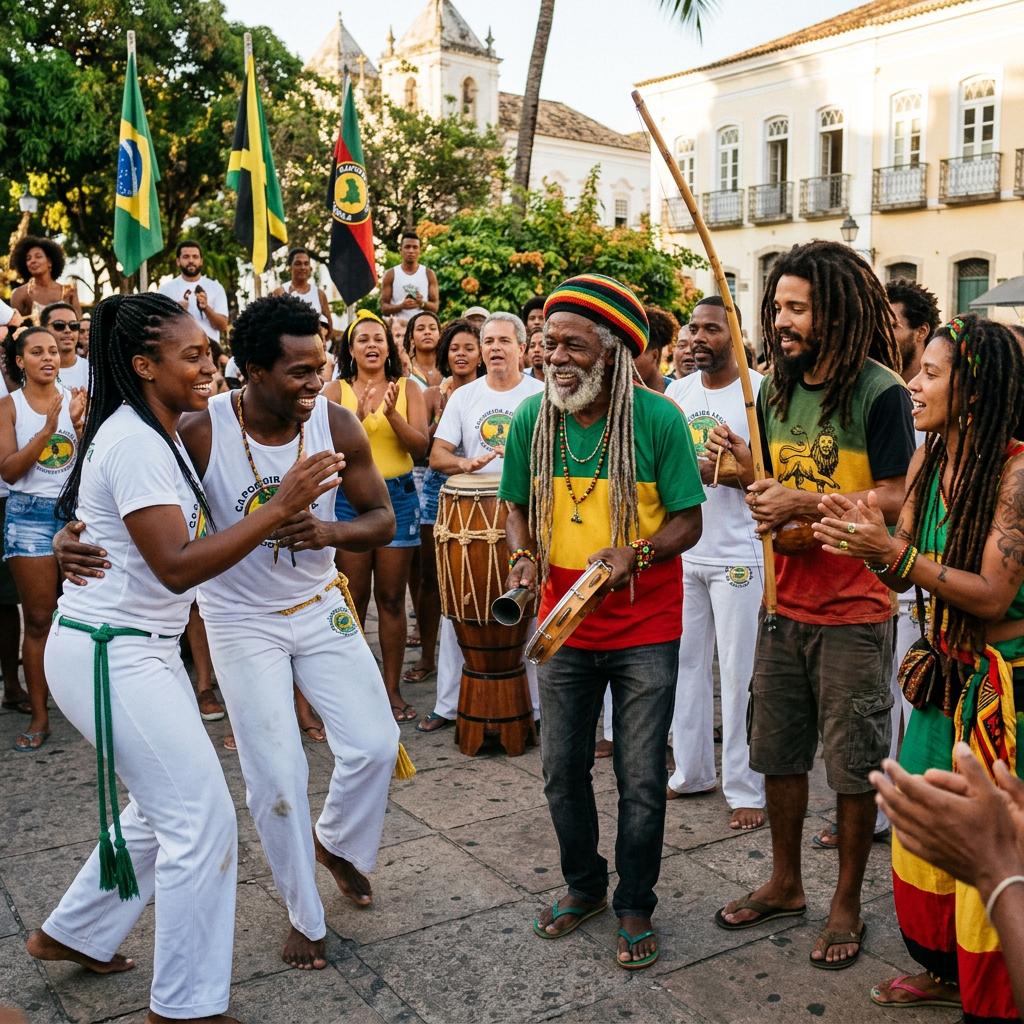
In the context of Capoeira Angola, this spiritual heritage directly informs every aspect of movement, music, and philosophy. The art form functions not only as a martial combat system developed by enslaved Africans and Indigenous peoples for physical survival and liberation, but as an embodied spiritual discipline and living archive of West and Central African cosmologies. The central circle of the game—the roda—operates as a consecrated crucible and a literal crossroads where vital spiritual energy, or axé (ashé), is invoked, concentrated, and directed.
The physical space and ritual mechanics of Capoeira Angola mirror the cosmological structures of Ifá, Candomblé, and the Kongo Cosmogram (dikenga dia Kongo):
The Berimbau and the Bateria: The single-stringed musical bow (berimbau) serves as the spiritual conductor of the roda. Accompanied by traditional instruments like the atabaque drum, pandeiros, agogô, and reco-reco, the berimbau dictates the tempo, guides the energetic field, and communicates directly with the ancestral realm. Rhythms like Angola draw down grounding earth energy, while faster toques call upon protective and combative forces.
The Archetypal Matrix in the Game: A capoeirista embodies essential cosmic archetypes inside the roda. Strategic deception and unpredictable movement (malícia) reflect the trickster energy of Exú at the crossroads; explosive directness mirrors Ogun; stealthy precision and timing align with Oxossi; and a cool, calm mind under pressure expresses the wisdom of Obatala.
Ritual Entry and Chants: Before entering the ring, players crouch at the foot of the berimbau (pé do berimbau) to touch the earth and honor the ancestors. The solo singing of historical narrations (ladainhas) lowers auditory chaos, establishes spiritual intent, and anchors the space in ancestral memory before physical engagement begins.
Spiritual Fortification (Corpo Fechado): Through herbal cleansing baths (amací), sacred prayers, protection charms (patuás), and lineage guidance from trusted Mestres and Candomblé leaders, practitioners cultivate a state of spiritual defense (closed body) to shield themselves against physical and energetic harm.
Ultimately, whether expressed through Beninese Vodun, Bahian Candomblé, or the fluid movements of Capoeira Angola, these sacred traditions represent an unbroken, living philosophy of resistance, community, and cosmic alignment. By weaving physical mastery with deep musicality, ancestral memory, and strategic wit, practitioners continue to preserve a profound heritage that honors the past while remaining vibrant and transformative in the living present.
What does it take to shake the very foundations of modern politics? Is it decades of institutional experience, high-level connections with powerful political elites, or unlimited financial resources? Not if you are Hana-Rāwhiti Maipi-Clarke, a 22-year-old New Zealand Member of Parliament representing Te Pāti Māori, who is making history not with traditional rhetoric alone, but through decisive, embodied cultural action. Elected at the age of 21 as the youngest MP in New Zealand in 170 years, Maipi-Clarke has rapidly emerged as a prominent voice for indigenous sovereignty and youth representation.
During the first reading of the controversial Treaty Principles Bill—a proposed piece of legislation introduced by the right-wing ACT party aimed at reinterpreting the foundational 1840 Treaty of Waitangi—Maipi-Clarke took an uncompromising stand on the floor of the House of Representatives. Stating her party’s six votes in opposition, she dramatically tore a copy of the bill in two and launched into a powerful execution of the iconic Ka Mate Haka. Composed in 1820 by Ngāti Toa chief Te Rauparaha, the Ka Mate Haka speaks to themes of survival and the triumph of life over death, serving as a fitting expression of indigenous defiance.
Her protest was immediately joined by fellow opposition MPs and members of the public gallery, creating an outpouring of unified voice that echoed through the legislative chamber. The disruption led the Speaker of the House, Gerry Brownlee, to temporarily suspend parliamentary proceedings, order the gallery to be cleared, and issue a 24-hour suspension to Maipi-Clarke. Despite the disciplinary actions inside Parliament, footage of the haka quickly became a global viral phenomenon, capturing international headlines and generating hundreds of millions of views across digital platforms worldwide.
Her actions drew widespread attention, particularly in regions across Africa and the global South where indigenous struggle and anti-colonial sentiment resonate deeply.
Now, why does a story about New Zealand resonate so deeply in Africa? It is simple: the overarching struggle is shared. Indigenous and historically marginalized communities in both regions continue to navigate the heavy legacies of colonialism, systemic economic exploitation, and the erasure of cultural identity. The Treaty Principles Bill itself was viewed by critics and Māori groups as an attempt to strip away long-standing Treaty rights, undermine traditional land and language protections, and reverse decades of progress toward indigenous self-determination. While Maipi-Clarke boldly used her platform to confront legislative overreach—facing subsequent parliamentary suspensions alongside her party leaders—her stance highlights a contrast that many observers draw with political leaders globally and across Africa who fail to challenge entrenched systems or address the pressing needs of their own citizens.
But there is something larger at play here. This event was more than a singular parliamentary protest or viral moment; it formed part of a wider, organized movement that included a nine-day nationwide hīkoi (protest march) across New Zealand to defend Māori rights. Elected at just 21 years old as the youngest MP in New Zealand in 170 years, Maipi-Clarke represents a rising generation of youth leaders who refuse to adhere strictly to traditional political decorum when fundamental rights are on the line. Her willingness to take an uncompromising stand where seasoned politicians might hesitate raises fundamental questions about the role of cultural identity, youth leadership, and direct action in modern democracies. How did this pivotal moment come to pass, and what does it signal for the future of indigenous rights and political activism globally?
At first glance, a parliamentary protest in New Zealand and the Afro-Brazilian art of Capoeira Angola may seem worlds apart, but they are deeply bound by a shared philosophy: the use of sacred cultural expression as an active, living tool of resistance against colonial oppression and systemic erasure. Just as Hana-Rāwhiti Maipi-Clarke invoked the Ka Mate Haka to disrupt legislative proceedings and reclaim indigenous space, Capoeira Angola was forged in the 16th century by enslaved Africans and Indigenous groups in Brazil as an embodied mechanism for survival, spiritual freedom, and anti-colonial defiance. This fusion of movement, music, and storytelling in Capoeira served not only as a means of physical defense but also as a powerful assertion of identity and heritage, creating a lineage of resistance that resonates through generations. In the same vein, the traditions upheld by those participating in protests today echo this commitment to collective memory and cultural revitalization, showcasing how indigenous and marginalized voices actively reclaim their narratives in the face of historical injustices. Both practices illustrate the enduring power of art and expression as tools of empowerment, galvanizing communities toward a united front against ongoing oppression, thereby weaving a rich tapestry of resilience that transcends geographic and temporal boundaries.
In both traditions, bodily movement, song, and ritual are not merely performance or art for entertainment; they are strategic technologies of liberation that serve as powerful expressions of resilience and identity. Under the brutal violence of slave masters and subsequent state criminalization, practitioners of Capoeira Angola (capoeiristas) cleverly disguised combative self-defense kicks, sweeps, and takedowns beneath playful acrobatics, fluid dance-like swaying (the ginga), and polyrhythmic music led by the berimbau. These elements are not only physical feats but also transformative acts that embody a deep cultural heritage and an unwavering spirit of resistance. This strategic wit and cunning deception—known as _malícia—allowed marginalized communities to creatively challenge hostile, dominant power structures from a position of material disadvantage, fostering a sense of solidarity and communal strength among those who participated. The art form thus becomes not just a means of survival, but a celebration of life and a demonstration of the indomitable will to reclaim agency and dignity in the face of oppression.
Ultimately, both the Haka in the halls of Parliament and Capoeira inside the ritual circle (the roda) demonstrate how indigenous and diaspora cultures preserve ancestral memory, heal historical trauma, and assert autonomy when formal institutional channels fail. These vibrant expressions of identity not only reflect the rich heritage of their respective communities but also symbolize the resilience and perseverance of their people in the face of adversity. They reveal that direct cultural action remains one of the most potent ways for oppressed peoples globally to challenge entrenched authority and demand self-determination. Moreover, through these practices, individuals create a powerful sense of belonging, fostering solidarity among diverse participants while raising awareness of their struggles and aspirations. By engaging in these cultural forms, they affirm their right to exist and thrive, allowing them to reclaim their narratives and foster deeper connections within and beyond their communities.
In this video, Dr. Manny Wright examines the tension between Black academics and the Black communities that produced them. He explores how academic training, professional incentives, and dominant intellectual frameworks can create distance between Black scholars and Black historical knowledge. Specifically, he analyzes how institutional pressures within higher education encourage scholars to prioritize theoretical detachment over community-centered advocacy, often disconnecting contemporary academic scholarship from lived, grassroots experiences.
He also looks at Black economic history, the institutions Black Americans built under hostile conditions, and why critiques of Black America become incomplete when that history is ignored. By revisiting historic models of collective economics, independent community building, and urban resilience—such as those forged during the Great Migration and under Jim Crow—he demonstrates how structural disinvestment, mass incarceration, and policy shifts like the 1994 Crime Bill have continually disrupted generational Black prosperity.
The larger question is whether Black scholars can engage academic thought without losing connection to the history, knowledge, and possibilities of their own communities. Dr. Wright argues for bridging this gap through intentional mentorship, rigorous scholarship grounded in local realities, and an uncompromising commitment to preserving the intellectual and social inheritance of Black communities.
The parallels between Dr. Manny Wright’s critique of academic detachment and the philosophy of Capoeira Angola run remarkably deep, as both center on the struggle to preserve community-grounded knowledge against institutional displacement . Originally forged by enslaved Africans in Brazil as a vital instrument for survival, resistance, and liberation, Capoeira Angola embodies a living archive of historical memory and collective wisdom .
Just as Dr. Wright argues against abandoning local realities for abstract theoretical models, Capoeira Angola resists being reduced to a detached physical exercise or commercialized martial art; it demands active, embodied immersion within a supportive community space (the roda). Within the circle of the roda, physical movement, rhythmic music, and call-and-response singing merge to create an environment where cultural memory is actively lived rather than merely studied. Furthermore, its practice serves as a form of liberation and somatic therapy that directly addresses generational trauma, reinstating independent community building, ancestral continuity, and holistic healing outside dominant institutional frameworks. By engaging both body and mind in a shared ritual of resilience, practitioners reclaim agency, process historical pain, and sustain an unbroken dialogue with their ancestral roots.
They did not stumble into these images. They built them. Four specific tools, four specific targets, all aimed at the same man — the Black man — and Hollywood has been running them back for over a century.
These archetypes and caricatures were deliberately crafted and reinforced across cinema history to shape public perception, control narratives, and perpetuate systemic stereotypes. From early silent films to modern blockbusters, these recurring tropes have served to marginalize Black identity, restrict the range of stories allowed on screen, and justify social and economic subjugation. By consistently portraying Black characters through narrow and often negative lenses, filmmakers have contributed to a cultural narrative that limits understanding and empathy, preventing audiences from engaging with the rich complexity of Black experiences. This manipulation of representation not only influences individual viewpoints but also perpetuates institutional biases, making it crucial to critically analyze the impact of these cinematic choices over time, highlighting the urgent need for more authentic and diverse storytelling in order to foster a more inclusive society.
Historically, mainstream media and cinema have filtered the Black American experience through a lens of prejudice, proliferating harmful caricatures rather than authentic portrayals. This skewed representation not only perpetuates stereotypes but also oversimplifies the rich tapestry of Black life and culture, reducing it to mere entertainment for the dominant culture’s consumption. By limiting representation to predictable, controlled tropes, mainstream entertainment actively stripped away the intellectual depth, complexity, and revolutionary contributions of Foundational Black Americans, whose narratives are filled with resilience, innovation, and profound impact on society.
The stories of Black Americans encompass a range of experiences, struggles, and triumphs that deserve to be told in their entirety, reflecting both the pain of systemic oppression and the joy of cultural heritage. Countering these tropes is an essential effort in cultural self-preservation, demanding that Black stories, history, and achievements be acknowledged accurately and on their own terms, allowing for a broader understanding and appreciation of their significance within the American narrative. This endeavor is not just about correcting the past, but also about shaping a future where diverse voices are celebrated and the full spectrum of human experience is represented in all its forms.
Get weekly stories of Black figures who fought back, built empires, and changed history — stories your school never taught. Discover the incredible journeys of these remarkable individuals who rose against adversity, challenged the status quo, and made lasting impacts on society. Each week, they delve into their legacies, celebrating their achievements and shedding light on their struggles. Free, every week: https://blackstories-untold.com/
Every stereotype concerning Black people carries a specific origin—a precise date, name, boardroom, or political campaign. These caricatures did not emerge organically; rather, they were deliberately crafted across distinct historical eras to serve political, economic, and social objectives. From plantation narratives in the antebellum Era designed to rationalize chattel slavery to minstrel shows under Jim Crow that codified racial hierarchy, each trope was constructed with intentionality.
These imagery choices in media and news did not appear by chance—they were engineered to manufacture perception rather than reflect reality. Early Hollywood cinema weaponized archetypes, such as submissive servants or exaggerated comedic characters, to systematically dehumanize Black individuals and erase their agency. In later years, news broadcasts and political discourse relied on dog-whistle messaging and selective framing to reinforce tropes of aggression and criminality, cultivating public anxiety to justify institutional disenfranchisement, over-policing, and systemic inequality.
By constructing false cultural narratives, dominant institutions maintain control over public perception and policy. Overcoming these constructed tropes demands a dedication to the genuine historical record—uncovering the thinkers, builders, and freedom fighters who laid the foundation of the nation. For generations, accurate accounts of Black leadership, intellect, economic innovation, and resistance were pushed aside in favor of caricatures aimed at rationalizing marginalization.
Reclaiming the truth requires more than acknowledging historical misrepresentations; it necessitates active efforts to restore narratives that have been omitted or distorted. To honor this legacy, we must commit to studying and sharing the histories omitted from standard educational curricula. Deconstruct these engineered origins, confront their persistence in modern media, and elevate authentic, self-determined narratives of Black resilience, intellect, and achievement. Engaging with the full scope of this history allows individuals to understand the systemic mechanisms shaping current social structures while reconnecting with ancestral resilience and cultural contributions.
Join Black Stories Untold to embark on an enlightening journey through history. Each week, they delve into the inspiring accounts of Black figures who not only built thriving empires but also courageously resisted oppression and transformed the course of history—narratives that are often overlooked and rarely taught in schools.
The stories they tell shine a light on the resilience, creativity, and contributions of these remarkable individuals, ensuring that their legacies are remembered and celebrated. By subscribing for free, you’ll receive these powerful tales directly to your inbox every week, providing you with a richer understanding of black history.
The conversation surrounding immigration and the lack of visible, widespread involvement from Black Americans in anti-deportation movements is complex. Many observers point out that the political, social, and economic priorities of Black American communities often center on systemic local issues such as civil rights, criminal justice reform, economic equity, and historical advocacy efforts that directly impact their own immediate communities. This baseline of domestic advocacy forms a distinct focus, leading some to question the premise that the reasons for lower involvement are mysterious or difficult to comprehend. Understanding this dynamic requires looking closely at how different historically marginalized groups navigate their unique sociopolitical challenges within the domestic landscape.
Historically, immigration policies in the United States have been shaped by anti-Black frameworks of exclusion and punishment, dating back to laws that denied legal personhood and citizenship to enslaved Africans. In recent decades, legislation like the 1994 Crime Bill and the Illegal Immigration Reform and Immigrant Responsibility Act (IIRIRA) of 1996 further entrenched these disparities by connecting the criminal justice system with immigration enforcement. Because Black communities face disproportionate rates of over-policing and criminalization, Black immigrants are funneled into the deportation pipeline at significantly higher rates. Although Black immigrants account for only a small percentage of the undocumented population, they represent a starkly disproportionate share of those facing detention and removal proceedings on criminal grounds.
Furthermore, advocacy groups have documented that Black migrants experience higher rates of abuse, longer periods of detention, and a greater likelihood of being placed in solitary confinement compared to non-Black migrants. Despite these steep challenges, Black-led grassroots organizations and activists continue a long tradition of resistance—drawing connections between systemic state violence, local law enforcement, and border control—while calling for greater solidarity across racial and immigrant rights movements to challenge these intersecting systems of oppression.
Spiritual practices across Africa and its Diaspora establish profound connections between the living, the divine, and the ancestors (Egún) through highly intricate cosmologies and varied deities. Foundational traditions, such as the Yoruba Òrìṣà and Gbe Vodun, are currently experiencing a significant contemporary global resurgence as individuals actively seek to reclaim their cultural heritage and identity. By being dynamically revitalized and blended with modern practices, these enduring traditions create vibrant expressions of spirituality that deeply resonate with younger generations. Maintained continuously for centuries through oral history, sacred rituals, and traditional storytelling, they serve as vital anchors for collective identity, belonging, and social continuity. Ultimately, the essential role of community within these systems fosters both personal growth and collective healing, effectively enabling individuals to navigate modern challenges while staying firmly grounded in their rich cultural histories.
Rather than possessing a single universal pantheon, the African continent gave rise to diverse civilizations that developed their own distinct sacred universes. Each separate tradition provided its own unique answers to fundamental questions regarding creation, death, justice, destiny, nature, morality, and divine power. These complex sacred systems functioned distinctively across numerous historical regions, including Ancient Egypt, Kush, Yorubaland, the Akan, the Igbo, the Kongo, as well as East African and Southern African traditions. Within these frameworks, supreme creators, gods, goddesses, ancestors, and spirits governed the relationship between the visible and unseen worlds. Specific regional manifestations include Amun, Ra, Isis, Osiris, Horus, Sekhmet, and Apedemak in Egypt and Kush; Olódùmarè, Ògún, Ṣàngó, Ọ̀ṣun, Orí, and Ifá in Yoruba spirituality; Nyame and Asase Yaa in Akan traditions; Chukwu and Ala in Igbo religion; Fon and Ewe Vodun; and Nzambi a Mpungu, Bisimbi, minkisi, and Kalunga in Kongo spirituality.
Spiritual practices across Africa and its Diaspora establish profound connections between the living, the divine, and the ancestors (Egún) through highly intricate cosmologies and varied deities. Foundational traditions, such as the Yoruba Òrìṣà and Gbe Vodun, are currently experiencing a significant contemporary global resurgence as individuals actively seek to reclaim their cultural heritage and identity. By being dynamically revitalized and blended with modern practices, these enduring traditions create vibrant expressions of spirituality that deeply resonate with younger generations. Maintained continuously for centuries through oral history, sacred rituals, and traditional storytelling, they serve as vital anchors for collective identity, belonging, and social continuity. Ultimately, the essential role of community within these systems fosters both personal growth and collective healing, effectively enabling individuals to navigate modern challenges while staying firmly grounded in their rich cultural histories.
Rather than possessing a single universal pantheon, the African continent gave rise to diverse civilizations that developed their own distinct sacred universes. Each separate tradition provided its own unique answers to fundamental questions regarding creation, death, justice, destiny, nature, morality, and divine power. These complex sacred systems functioned distinctively across numerous historical regions, including Ancient Egypt, Kush, Yorubaland, the Akan, the Igbo, the Kongo, as well as East African and Southern African traditions. Within these frameworks, supreme creators, gods, goddesses, ancestors, and spirits governed the relationship between the visible and unseen worlds. Specific regional manifestations include Amun, Ra, Isis, Osiris, Horus, Sekhmet, and Apedemak in Egypt and Kush; Olódùmarè, Ògún, Ṣàngó, Ọ̀ṣun, Orí, and Ifá in Yoruba spirituality; Nyame and Asase Yaa in Akan traditions; Chukwu and Ala in Igbo religion; Fon and Ewe Vodun; and Nzambi a Mpungu, Bisimbi, minkisi, and Kalunga in Kongo spirituality.
Crucially, these traditional structures operate as complete, interconnected systems rather than simple lists of standalone African gods. They explain the underlying dynamics of how supreme creators, divine powers, ancestors, spirits, landscapes, morality, and ritual action systematically connect the human world directly with the sacred realm. This comprehensive sacred network includes components such as Abosom, Alusi, Ifá divination, sacred symbols, temples, and shrines. Across the continent, these systems are actively maintained through Waaqa, Mwari, Modimo, territorial spirits, rainmaking practices, spirit mediums, priests, priestesses, diviners, offerings, and designated sacred spaces. Together, these elements reflect the deep civilizations, sacred knowledge, and living heritage of Africa.
Crucially, these traditional structures operate as complete, interconnected systems rather than simple lists of standalone African gods. They explain the underlying dynamics of how supreme creators, divine powers, ancestors, spirits, landscapes, morality, and ritual action systematically connect the human world directly with the sacred realm. This comprehensive sacred network includes components such as Abosom, Alusi, Ifá divination, sacred symbols, temples, and shrines. Across the continent, these systems are actively maintained through Waaqa, Mwari, Modimo, territorial spirits, rainmaking practices, spirit mediums, priests, priestesses, diviners, offerings, and designated sacred spaces. Together, these elements reflect the deep civilizations, sacred knowledge, and living heritage of Africa.
I was gonna make this my Sunday post, but… here we are.
The connection between Capoeira Angola and Rastafarianism lies in their shared roots as Afro-Diasporic systems of resistance, spiritual preservation, and liberation from oppression. While one developed in the recôncavo of Bahia, Brazil, and the other in the hills of Jamaica, both function as holistic lifeways designed to reclaim African identity and dismantle colonial power structures.
The Rhythm of Resistance: Where Capoeira Angola and Rastafarianism Meet
To the untrained eye, Capoeira Angola and Rastafarianism might seem like entirely different worlds. One is a ritualized martial art, characterized by deep, ground-level movements, strategic trickery, and the hypnotic ring of the berimbau. The other is a biblical, messianic spiritual movement known for its distinct livity, dreadlocks, and the heavy basslines of Reggae and Nyabinghi drumming.
Yet, beneath the surface of geography and form, Capoeira Angola and Rastafarianism are twin rivers flowing from the same fundamental source: Central and West African spiritualities adapted to survive and defeat the forces of chattel slavery and colonialism.
They are not merely hobbies or religions; they are holistic systems of liberation. Here is where and how these two profound Afro-Diasporic traditions connect.
1. Liberation Over Slavery: Rebuffing the “Babylon” System
At the core of both traditions is an uncompromising rejection of oppression. Rastafarianism identifies the corrupt, oppressive structures of the Western world as “Babylon.” For the Rastafari, Babylon is the modern continuation of the slave trade—a system designed to strip African people of their history, language, and divinity. Livity—the righteous Rastafari way of life—is a daily practice of mental and physical secession from Babylon.
Capoeira Angola shares this exact operational DNA. Born out of the struggle of enslaved Africans in Brazil, it was the ultimate tool for survival. When Africans escaped the plantations to form quilombos (maroon societies), Capoeira was the combat system that protected their freedom against colonial trackers.
Where the Rasta uses word, sound, and power to decolonize the mind, the Angoleiro (Capoeira Angola practitioner) uses movement, mandinga (craftiness), and malice to physically and psychologically outwit the oppressor. Both systems view the human body and mind as sovereign territory that no colonial system has the right to conquer.
2. Sacred Rhythms: The Drum and the Berimbau
Neither Capoeira Angola nor Rastafarianism can exist without music, because for both, music is a spiritual technology.
In Rastafarianism, the Nyabinghi drum beat is the heartbeat of the movement. Played on three drums (the pitche, funde, and bass), the rhythm represents the heartbeat of Jah and is used during “groundations” to communicate with the divine and “chant down Babylon.”
In Capoeira Angola, the berimbaugoverns everything. The lead berimbau (gunga) dictates the speed, style, and spiritual energy of the roda (the circle). Just like the Nyabinghi drums, the berimbau invokes ancestral energies, mapping out a sacred space where players communicate through a sophisticated language of rhythm and song.
In both spaces, the music creates a communal trance state, reconnecting displaced people to their ancestral lineage.
3. The Philosophy of the Counter-Attack: Deception vs. Word, Sound, and Power
The tactical connection between the two lies in how they flip colonial structures on their heads.
Capoeira Angola is famous for its use of malícia—a strategic deception. An Angoleiro rarely attacks directly; instead, they play the fool, feign vulnerability, and invite the opponent in, only to strike from an unexpected angle. It is a philosophy born from the necessity of the underdog: when you are physically outgunned, you must use your opponent’s own momentum and assumptions against them.
Rastafarianism uses a similar psychological strategy through its linguistic reinvention, known as “Iyaric” or Dread Talk. Recognizing that English was the language of the slave master, Rastas fundamentally altered the language to inject power back into the speaker. They replaced “Oppress” with “Downpress” (because oppression weighs you down, it doesn’t lift you up) and replaced “We” or “You” with “I and I” to signify that the Divine (Jah) is always present within every individual.
Both traditions recognize that to defeat an oppressor, you cannot play by their rules—you must alter the geometry of the battlefield, whether through physical movement or spoken language.
4. Ancestral Memory and the Return to the Source
Finally, both movements are anchored in a deep reverence for Africa as the spiritual homeland. Rastafarianism centers on the concept of Repatriation, both physical and spiritual, back to Africa (symbolized by Ethiopia). It demands a conscious remembering of roots in a world that pressures Black and displaced people to forget.
Mestre Pastinha, the great guardian of Capoeira Angola, famously stated: “Capoeira Angola belongs to Africa.” The ritual of the chamada (the call)—where one player freezes the game and calls the other forward in a rigid, tense ritual walk—mirrors Central African spiritual concepts like the Kikongo Cosmogram, mapping out the cycle of life, death, and rebirth. Capoeira Angola intentionally preserves the oldest, closest-to-the-source movements and rituals to keep the connection to African ancestors unbroken.
Conclusion: One Love, One Roda
Ultimately, Capoeira Angola and Rastafarianism are two sides of the same coin. They are living blueprints for how human beings can preserve their dignity, spirituality, and joy in the face of brutal adversity.
Whether you are stepping into the roda to dodge a lightning-fast kick or sitting by a fire chanting to the beat of a funde drum, you are participating in an unbroken lineage of global African resistance that spans generations and continents. This vibrant tradition, rich with history and meaning, embodies the struggles and triumphs of countless ancestors who fought against oppression. Through each movement and every rhythmic beat, you connect not only with the past but also with fellow practitioners who share in this profound experience.
They teach us that true freedom isn’t given; it is danced, drummed, spoken, and fought into existence, creating a powerful narrative that resonates with each heartbeat and inspires future generations to continue the fight for justice and equality. In this sacred space, the rhythms of resistance echo through time, uniting voices from across the globe in a chorus of resilience and hope.
Open any social media platform today, and you will likely encounter viral videos with titles like “Forbidden Truth About Black History.” These compilations attract millions of views by promising to reveal secrets hidden from school textbooks.
While some of these viral claims border on historical myth, the core urge driving them is entirely valid: a desire to uncover the suppressed, downplayed, or painful histories of Black and Indigenous peoples in America.
To separate sensational internet trends from rigorous history, let’s explore three critical areas where academic historians have used deep archival research to bring hidden truths to light.
1. The Erasure of Pre-Colonial Indigenous Alliances
A common theme in viral videos is that Black and Indigenous histories are completely separate. However, academic historians have long studied the deeply intertwined histories of African and Native American peoples—histories that colonial powers actively tried to suppress.
The Hidden History
Colonial governments in the Americas feared nothing more than a unified rebellion of enslaved Africans and Indigenous nations. To prevent this, colonial laws were specifically designed to sow division between the two groups. Despite this, vibrant communities of Afro-Indigenous peoples formed, most notably the Black Seminoles of Florida. For decades, escaped African slaves and Seminole Indians lived together, intermarried, and successfully fought off the U.S. Army during the Seminole Wars.
What the Academic Sources Say
The Text:Black Indians: A Hidden Heritage by William Loren Katz.
The Research: Katz’s pioneering work uses historical documents and photographs to prove that European conquerors intentionally drove a wedge between Africans and Native Americans. He documents how the erasure of their shared resistance served to weaken both groups’ claims to land and freedom.
2. The Physical and Economic Theft of “Black Wall Street”
For decades, the destruction of wealthy Black communities across America was a literal “forbidden truth”—omitted from state curricula, newspaper archives, and history books.
The Hidden History
The most famous example is the Tulsa Race Massacre of 1921, where a white mob destroyed the Greenwood district of Oklahoma, known as Black Wall Street. Up to 300 people were killed, and thousands of homes and businesses were burned to the ground. Crucially, the “hidden” aspect isn’t just the violence itself, but the massive, multi-generational theft of wealth. Black families were never compensated for their property losses, and insurance companies systematically denied their claims.
What the Academic Sources Say
The Text:The Nation Must Awake: My Witness to the Tulsa Race Massacre of 1921 by Mary E. Jones Parrish.
The Research: Kept alive for decades primarily through oral history and independent Black journalists, academic institutions have only recently integrated these primary accounts into mainstream American history. Scholars today use property deeds and economic data to show how the destruction of Greenwood permanently altered the trajectory of generational Black wealth in America.
3. Medical Exploitation and Unconsented Science
Viral commentary frequently touches on deep-seated distrust of medical institutions. Academics have verified that this distrust is rooted in a dark, historically suppressed reality of medical apartheid.
The Hidden History
Modern medicine was built, in large part, on the unconsented exploitation of Black bodies. In the 19th century, Dr. J. Marion Sims, celebrated as the “father of modern gynecology,” performed agonizing experimental surgeries on enslaved women without anesthesia. In the 20th century, researchers deliberately left Black men untreated to study the ravages of disease in the infamous Tuskegee Syphilis Study, while the cancer cells of an unwitting Black patient named Henrietta Lacks were taken to create the first immortal human cell line (HeLa), generating billions for the medical industry without her family’s knowledge.
What the Academic Sources Say
The Text:Medical Apartheid: The Dark History of Medical Experimentation on Black Americans from Colonial Times to the Present by Harriet A. Washington. [1]
The Research: Washington’s comprehensive study won the National Book Critics Circle Award by rigorously documenting centuries of medical racism. She reveals that these were not isolated incidents, but an institutionalized practice where the medical establishment viewed Black people as experimental subjects rather than patients.
Moving Past the Clickbait
The internet loves the word “forbidden” because it implies a conspiracy. The reality is often more mundane but equally damaging: history is written by the victors, and the narratives taught in schools have traditionally served to protect institutional power.
We do not need to rely on unverified social media conspiracies to find the truth. By turning to peer-reviewed academic history, we find a reality that is thoroughly documented, deeply challenging, and essential for understanding the modern world.
The Digital Time Machine: How to Access Real Historical Documents From Your Laptop
The internet is flooded with creators talking about “hidden history.” But you don’t have to take a stranger’s word for it. The most powerful tool against historical misinformation is the primary source—the actual diaries, photographs, court records, and audio tapes recorded by the people who lived through these events.
Thanks to massive digitization projects by universities, libraries, and museums, you can now access the raw evidence of Black and Indigenous history for free. Whether you are writing a research paper, building a video script, or simply looking for the truth, here is your ultimate guide to the best online digital archives.
1. Uncovering First-Hand Accounts of Slavery
To understand the psychological and physical realities of the Transatlantic Slave Trade and plantation life, you can bypass secondary textbooks and go straight to the voices of the people who survived it.
Born in Slavery (Library of Congress): This massive database contains more than 2,300 first-person accounts and 500 photographs of formerly enslaved individuals. These narratives were collected in the 1930s as part of the Federal Writers’ Project, offering an unfiltered look at plantation life from those who remembered it.
Voices Remembering Slavery (Library of Congress): If you want to actually hear history, this archive features rare, digitized audio recordings of freed people sharing their memories of slaveholders, family separations, and the dawn of emancipation.
Documenting the American South (UNC Chapel Hill): This project offers full-text, searchable digital editions of autobiographies and narratives written by fugitive and former slaves, providing a deep look into early African American literature and resistance.
2. Tracking Looted Wealth and Racial Violence
A major theme in modern historical commentary is the systematic destruction of Black economic power. These archives house the legal and physical evidence of that destruction.
The Smithsonian NMAAHC Digital Collection: The National Museum of African American History and Culture hosts thousands of digitized artifacts. Here, you can examine structural records, business ledgers, and items recovered directly from the ruins of the 1921 Tulsa Race Massacre (Black Wall Street).
The National Archives (NARA) African American Heritage Portal: This is the gold standard for official government records. You can search through federal military files, Freedman’s Bureau documents, maps, and land deeds to track exactly how Black and Indigenous properties were legally and physically dismantled across generations.
3. Exposing the Roots of Medical Apartheid
If you are researching the dark history of unconsented medical experimentation on Black Americans, these institutional portals hold the official paper trails.
The Tuskegee Syphilis Study Records (National Archives Catalog): You can look through the actual government correspondence, medical charts, and court filings that exposed the decades-long study where Black men were intentionally left untreated for syphilis by public health officials.
The HeLa Resource Portal (Johns Hopkins / NIH): This archive documents the historical timeline and modern ethical framework surrounding Henrietta Lacks, the Black patient whose cancer cells were harvested without her knowledge in 1951, creating the foundational cell line for modern biomedical research.
4. Exploring the Intertwined History of Black and Native Peoples
The deep political and cultural alliances between Black and Native American nations—like the Black Seminoles—are often omitted from standard school curricula. You can piece this history back together using these specialized collections.
The Amistad Research Center (Tulane University): As the nation’s oldest independent archive specializing in ethnic minority relationships, this center provides rare manuscripts letters, and organizational records detailing shared civil rights and survival struggles.
The National Museum of the American Indian (Smithsonian): This online portal allows you to browse colonial legal decrees, treaties, and cultural exhibits that highlight the overlapping histories and shared spaces of Afro-Indigenous communities.
5. The Ultimate Multi-Archive Search Tools
Instead of jumping from website to website, you can use aggregate search engines that comb through hundreds of university libraries and museum basements simultaneously.
UMBRA Search African American History: This tool acts like a specialized Google, granting you instant access to over 800,000 digitized primary source materials from more than 1,000 different libraries and archives.
Digital Schomburg (New York Public Library): Curated by one of the world’s premier research libraries on the global Black experience, this site connects you to millions of rare books, photographs, and manuscripts spanning centuries of global history.
How to Start Your Search
When diving into these archives, remember that historical language changes. If you aren’t finding what you need, try searching using the terminology of the era you are researching (for example, searching for “Freedmen” or “Colored troops” when looking into Civil War-era documents).
Legislate, Dispossess, and Control: The Real Paper Trail of American History
When viral videos talk about the “forbidden truths” of Black and Indigenous history, they often frames it as a grand conspiracy. But the most shocking reality is that the systems of land theft, human commodification, and racial control weren’t done in secret—they were explicitly written into the federal laws and treaties of the United States.
If you want to understand how these historical events were codified, you have to read the actual legal documents. Here is your digital field guide to the major laws and treaties that shaped Black and Indigenous history, along with direct links to view the primary sources online.
1. Codifying Land Theft: The Indian Removal Act (1830)
The Context: Signed into law by President Andrew Jackson, this act authorized the federal government to force Native nations off their ancestral homelands in the American Southeast. It opened up millions of acres of rich agricultural land to white settlers—land that was subsequently cleared and farmed using enslaved Black labor. This act directly caused the forced displacement known as the “Trail of Tears”.
2. Stripping Rights Across Borders: The Fugitive Slave Act (1850)
The Context: As part of the multi-statute National Archives Compromise of 1850 Guide, this draconian federal law forced citizens in free Northern states to actively assist in the capture and return of escaped slaves. It denied accused fugitives the right to a jury trial and famously paid federal judges $10 if they ruled a person was an escaped slave, but only $5 if they set them free.
The Court Cases: To see how this law operated in real-world courtrooms, browse the digitized National Archives Fugitive from Labor Records to read the actual trial transcripts of captured Black Americans fighting for their freedom.
3. Dividing Shared Heritage: The Dawes Act (1887)
The Context: This law authorized the federal government to break up communal tribal lands into individual plots. To decide who received land, the government created the “Dawes Rolls”. Government agents separated citizens into strict categories: “Indians by Blood” or “Freedmen” (the descendants of Black people enslaved by Native nations). Even if a Freedman had Native ancestry, they were frequently stripped of their tribal land rights and categorized with zero “blood quantum”, a legal division that still impacts Afro-Indigenous citizenship rights today.
The Document: Search the digitized ledger pages, names, and photographs of the original census via the National Archives Dawes Rolls Records Database.
4. Broken Sovereignty: The Treaty of Fort Laramie (1868)
The Context: Treaties are legally binding agreements between sovereign nations. In this specific document, the U.S. government recognized the Black Hills of Dakota as the exclusive territory of the Sioux and Arapaho people. However, once gold was discovered on the land, the U.S. government completely violated the treaty. In 1871, Congress officially ended the century-old practice of making treaties with Native tribes entirely.
When studying history, laws and treaties serve as immutable proof. They show that systemic displacement and racial control weren’t just a collection of bad individual choices—they were the explicit policy of the United States government, signed into law on parchment paper.
History is Not a Text Hero: How Century-Old Laws Still Rule Modern Courtrooms
Adding a final section on how these laws function today bridges the gap between historical abstractness and modern reality. It shows readers that these centuries-old legal records are not just dusty documents in a museum basement—they are actively being litigated in federal, state, and tribal courts right now.
Here is how you can write this final, impactful section for your blog post or video essay script.
From the Archives to the Courtroom: Why These Laws Still Matter Today
The biggest misconception about Black and Indigenous history is that it is strictly in the past. In reality, the legal ink dried over a century ago, but the ripple effects are still dictating massive land rights, multi-billion-dollar tax battles, and modern civil rights disputes.
1. The Dawes Act and the Modern Battle for Afro-Indigenous Citizenship
The legal division created by the 1887 Dawes Act—which partitioned tribal lands and separated families into “Indians by Blood” and “Freedmen” (the descendants of Black people enslaved by Native nations)—remains a highly contested civil rights issue.
The Modern Impact: While nations like the Cherokee Nation have fully restored citizenship rights to Black Freedmen, others are still navigating intense legal battles. For example, descendants of Muscogee (Creek) Freedmen filed a federal lawsuit. Despite a historic tribal Supreme Court ruling affirming that an 1866 treaty guarantees their citizenship, thousands of Black descendants are still fighting tribal administrative boards for their identity cards, voting rights, and healthcare access.
2. The Treaty of Fort Laramie and the Black Hills Land Dispute
When the U.S. government broke the 1868 Treaty of Fort Laramie to seize rich land in South Dakota, they created a legal battle that remains unresolved to this day. This breach not only led to the loss of valuable territory for the Lakota Sioux tribe but also ignited a series of disputes that involved various stakeholders, including indigenous rights advocates and state authorities. Over the years, numerous court cases and legislative measures have attempted to address the grievances stemming from this treaty violation, highlighting the ongoing struggle for justice and recognition faced by Native American communities. As the narrative unfolds, it emphasizes how historical grievances continue to shape contemporary discussions about sovereignty, reparations, and cultural preservation among indigenous peoples in the United States. The implications of these unresolved issues are felt not just in legal terms, but also in the social and economic disparities that persist in the lives of the affected tribes.
The Modern Impact: In the landmark case United States v. Sioux Nation of Indians, the U.S. Supreme Court officially ruled that the land was stolen and ordered a financial payout. However, the Sioux Nation famously refused the money, demanding the actual return of their sacred Black Hills land instead. That trust fund has sat in the U.S. Treasury accumulating interest for decades, now worth over $1 billion, because the sovereign nations refuse to sell their sacred heritage.
3. The Resurrection of Broken Treaties: McGirt v. Oklahoma
For over a century, the state of Oklahoma acted under the assumption that the reservations belonging to the Muscogee, Cherokee, Chickasaw, Choctaw, and Seminole nations had been legally dissolved during westward expansion. [1]
The Modern Impact: In the monumental Supreme Court case McGirt v. Oklahoma, the highest court in the land looked directly at historical treaties and ruled that because Congress never explicitly dissolved the Muscogee (Creek) reservation, almost half the state of Oklahoma remains sovereign Indian Country for criminal jurisdiction. This single decision completely upended the state’s legal system, forcing state, federal, and tribal police forces to entirely rewrite how they handle law enforcement and jurisdictional boundaries.
What does this have to do with Capoeira Angola?
Capoeira Angola is intimately linked to this legacy as a profound methodology for mobilization and resistance against historical and contemporary legacies of state repression. Far more than a martial art or folk dance, it emerged from the crucible of transatlantic slavery in Brazil as a clandestine technology for liberation, serving as a covert training regimen, a medium for political communication, and a vital mechanism for preserving ancestral knowledge.
Within the oppressive structures of colonial and post-colonial Brazil, colonial laws actively sought to suppress Afro-Indigenous alliances, such as the Black Seminoles, which were emblematic of resistance and solidarity against systemic oppression. These laws aimed to dismantle any semblance of unity among marginalized groups, fearing the power that such alliances could wield. Similarly, in Brazil, Capoeira Angola functioned alongside the revolutionary framework of the quilombos—self-governing communities established by escaped enslaved people who sought refuge from brutalities of the colonial regime. In these all-important havens of freedom,
Capoeira was not merely a form of dance or martial art; it became the essential non-state asset that ensured the quilombo’s survival, fostering a unique cultural identity and resilience among its members. This practice not only provided group defense against potential intrusions by colonial authorities but also facilitated strategic communication and community solidarity outside the control of the state apparatus. Through the rhythms and movements of Capoeira Angola, the quilombo inhabitants cultivated a profound sense of belonging, reinforcing their collective spirit and commitment to autonomy in the face of persistent threats, thereby making their legacy a pivotal aspect of Brazil’s cultural heritage.
The Takeaway
When you watch a viral video discussing the “forbidden truths” of American history, don’t look at it as a closed chapter that is neatly wrapped up and preserved for educational purposes. The laws, treaties, and contracts written in the 1800s remain the “Supreme Law of the Land” under the U.S. Constitution, echoing the intentions and circumstances of a bygone era. We aren’t just living with the memory of history—we are actively living inside the legal architecture that our ancestors built, a framework that influences our everyday lives in profound ways.
These historical documents continue to shape the social, economic, and political landscape of contemporary America, reminding us that the past is not merely a distant story but an ongoing dialogue that defines our identity as a nation. Each document serves as a testament to the values, beliefs, and challenges faced by previous generations, illustrating the complexities of their experiences and decisions. Understanding this connection allows us to engage more critically with present issues, recognizing that the struggles and triumphs of previous generations resonate within our current societal challenges. In doing so, we gain a greater appreciation for the rights and freedoms we enjoy today, while also bringing to light the ongoing injustices that persist. This awareness empowers us to advocate for change, inspiring a commitment to address the inequities that still exist, ensuring that the lessons of history guide us toward a more inclusive and equitable future.
Spiritual practices across Africa and its Diaspora connect the living with ancestors (Egún) and the divine through intricate cosmologies and deities, weaving a complex tapestry of beliefs that reveal the deep-seated connections between humanity and the spiritual world. Foundational traditions like the Yoruba Òrìṣà and Gbe Vodun are experiencing a contemporary resurgence as individuals globally reclaim their roots, driven by a renewed interest in cultural heritage and identity. As people seek to reconnect with their ancestral wisdom, these traditions are being revitalized, adapted, and blended with modern practices, creating vibrant expressions of spirituality that resonate with younger generations. Maintained for centuries through oral history, rituals, and storytelling, they remain vital anchors for collective identity and social continuity, offering a sense of belonging and purpose in an increasingly fragmented world. The role of community in these practices fosters not only personal growth but also collective healing, allowing individuals to navigate the challenges of contemporary life while staying grounded in their rich cultural histories.
Discover the hidden African science of vibration — an ancient tradition where sound, rhythm, breath and frequency shaped reality itself. Long before modern physics, Africa mastered vibration: from Kemet’s Heka, Dogon “Po,” and Zulu Umoya — to Kongo’s sacred cosmograms, Yoruba drum‑codes, Wolof & Serer rhythms, and Somali harmonic chants. This human-science of African musical sound and practice inherently embeds health and wellness objectives within its core traditions.
Ancient civilizations across the continent recognized the power of drums to communicate across long distances and serve as profound symbols of unity, spirituality, and social cohesion. The construction of these instruments reflects a rigorous scientific methodology rather than randomness. Builders carefully consider the shape, dimensions, and materials—such as specific wood, animal skins, and ropes—to achieve unique tonal qualities and precise acoustic responses. For instance, the Igbo people of Nigeria utilize the monumental Ikoro or Ekwe, a wooden slit drum of the idiophone family. Carved from cylindrical tree trunks like the cam wood tree, the Ikoro produces a deep, rich bass sound with a sustained reverberation used to transmit coded, vital information and background beats. By mastering tuning techniques like altering rope tension, African drummers manipulate pitch and volume to create complex polyrhythms that add depth through multiple simultaneous layers of sound.
In this journey, you’ll learn how sound was used for healing, divination, trance‑vision, ancestral communication, and consciousness shifting — not as myth, but as a science of the soul. Within these traditions, rhythmic exercises serve as a medium to direct life energy, creating a vibrant, tense atmosphere that reunifies the sacred with the natural. High-density, clustered melorhythmic impulses effectively eliminate the conscious ego or personal self-drives, banishing psychical presence to guide susceptible agents into a state of substituted consciousness. This ritualistic state allows human mediums to connect with ultra-mundane spirit essences for transmitting communication or effecting psychophysical cures.
Furthermore, engaging in authentic ritual music, such as the slow and deeply spiritual Zulu chants to Umoya (the Breath of Life), blends vocalizations, tribal drums, and calabash rattles to invite inner awakening, peace, and balance. These practices offer a safe environment for the release of unconscious energies, heightening the practitioner’s emotions and spirituality while drawing them closer to their ancestors. Through tools like shamanic rattles, bells, and diverse vocal chants, seekers can experience the power of dream interpretation, destiny realization, and ancestral guidance to cultivate a profound sense of self-discovery, acceptance, and communal harmony.


 Jogo Corpo Fechado