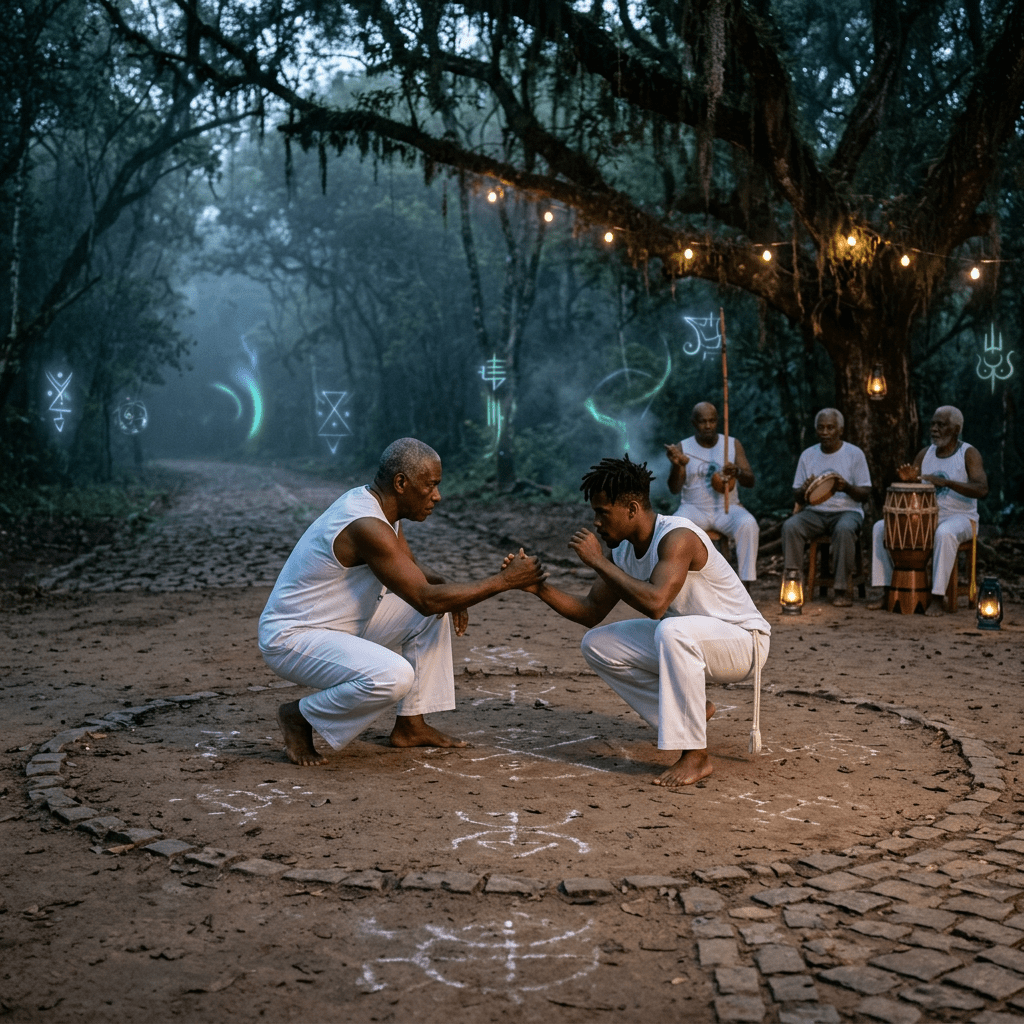
Capoeira Angola represents a profound synthesis of ritual, fight, and dance, where the practitioner seeks a state of “perfect movement.” This traditional Afro-Brazilian art form is not merely a physical exercise but a philosophical journey that integrates the physical and spiritual realms through the concept of the “jogo” (game). On the one hand, it embodies the rich cultural heritage and historical struggles of African descendants in Brazil, while on the other, it fosters a sense of community and belonging among its practitioners. Through intricate footwork, rhythmic melodies, and acrobatic moves, capoeira serves as a vibrant expression of identity and resilience. Each interaction in the roda, or circle, becomes an opportunity for dialogue, connection, and personal growth, allowing participants to embody creativity and improvisation while adhering to the traditional structures of the art, thereby enriching their understanding of both themselves and their cultural roots.
Strategic Physicality: Defense and Vulnerability
At its core, the art requires a perfect coordination of the body. This fluidity serves a dual purpose: providing an impenetrable defense against an opponent’s attacks while simultaneously identifying or creating openings to make that opponent vulnerable to one’s own strikes. The movements are deceptive, low to the ground, and constantly evolving, ensuring that the capoeirista remains an elusive target. Through the use of circularity and continuous motion, the practitioner maintains a balance between active aggression and protective restraint, embodying the principle that a well-executed defense is often the most effective form of offense.
Beyond the mechanics of combat, this strategic physicality is deeply rooted in the concept of “malícia,” or deception. By masking intent through rhythmic swaying and feigned vulnerability, the capoeirista manipulates the space and timing of the encounter. This creates a dialogue within the “jogo” where every movement is an inquiry and every response is a revelation of the opponent’s internal state. The goal of achieving “perfect movement” is thus realized when the physical body becomes a seamless instrument of the mind’s strategic will, navigating the complexities of the game with grace and precision.
Holistic Well-being: Movement as Medicine
The practice of Capoeira Angola is a pathway toward creating perfect health. Beyond cardiovascular benefits and muscular strength, the circular and rhythmic nature of the movements promotes flexibility and joint health. The focus required during the game fosters mental clarity and emotional resilience, making the movement a form of active meditation.
The ultimate goal is developing your movement and healing your trauma by engaging in the art to its full potential through the act of “playing”. This concept of “playing” within the roda serves as a safe container for profound personal transformation. By embracing the playful yet disciplined nature of the game, a capoeirista can confront personal limitations, process past experiences, and unlock a more authentic version of their physical and artistic self.
This therapeutic aspect of Capoeira Angola allows practitioners to navigate the complexities of their own history through rhythmic interaction. The “jogo” acts as a mirror, reflecting one”s internal state and providing a rhythmic space where the integration of the physical and spiritual realms becomes possible. Through the continuous cycle of movement and music, the practitioner moves beyond mere exercise into a state of active meditation that fosters long-term emotional resilience.
The Extension of Self: Ritual Weapons
In this tradition, Capoeira weapons—such as the straight-razor, the knife, billy-club, machete, the berimbau, etc.—are viewed as more than tools; they are an extension of your body and your being, embodying the very spirit of the art form itself. Historically, these armaments were indispensable for survival and self-defense, reflecting the harsh realities faced by capoeiristas throughout various epochs in Brazil, from the struggles of slavery to modern-day conflicts. The deep-rooted significance of these weapons lies not only in their practical applications but also in the cultural and historical narratives they carry. Bladed weapons, particularly the navaja (straight razor) and faca (knife), are central to understanding the art as a complete system of survival, where knowledge of armed conflict was often an expectation and an essential skill set.
This integration of weaponry into the practice of Capoeira speaks to a broader philosophy within the discipline, emphasizing resilience, adaptability, and the ability to confront adversity with grace and skill. Through rigorous training, practitioners learn not only the techniques of using these weapons but also the respect and responsibility that comes with wielding them, ensuring that the legacy of Capoeira continues to thrive amidst evolving societal landscapes.
The process of cultivating mastery with these tools involves a profound conceptual shift where the blade is treated as a direct extension of the hand and arm. This integration relies on several core principles of Capoeira Angola:
Malícia (Deception): The presence of a weapon is often concealed within the fluid rhythm of the ginga, its deployment masked by seemingly unarmed or non-threatening movements.
Strategic Asymmetry: Practitioners utilize low stances and circular movements to minimize their profile while creating unpredictable openings for decisive, short-range attacks.
Psychological Warfare: The mere sight of a drawn blade serves as a tool for manipulation, capable of de-escalating a threat through intimidation or igniting a confrontation by forcing an adversary to hesitate.
The machete holds a particularly deep symbolic resonance, representing the unbreakable connection between contemporary practitioners and the ancestral legacy of enslaved Africans who used it as both an agricultural tool of labor and a potent instrument of rebellion. This dual purpose not only highlights the ingenuity and resilience of those who wielded it but also serves as a stark reminder of their struggles against oppression. Furthermore, traditional instruments like the berimbau are recognized for their defensive versatility, capable of serving as bludgeons or concealment for other tools, underscoring the art’s practical origins in clandestine resistance. Additionally, the berimbau’s distinct sound creates a rhythmic dialogue that forms the backbone of cultural expression, allowing practitioners to communicate in ways that transcend spoken language. In this context, both tools symbolize the enduring spirit of a people who, through creativity and resourcefulness, transformed instruments of survival into symbols of cultural pride and defiance.
.
Potential through Play: Healing and Growth
The ultimate goal is developing your movement and healing your trauma by engaging in the art to its full potential through the act of “playing.” This concept of “playing” within the roda serves as a safe container for profound personal transformation. By embracing the playful yet disciplined nature of the game, a capoeirista can confront personal limitations, process past experiences, and unlock a more authentic version of their physical and artistic self.
This therapeutic aspect of Capoeira Angola allows practitioners to navigate the complexities of their own history through rhythmic interaction. The “jogo” acts as a mirror, reflecting one’s internal state and providing a rhythmic space where the integration of the physical and spiritual realms becomes possible. Through the continuous cycle of movement and music, the practitioner moves beyond mere exercise into a state of active meditation that fosters long-term emotional resilience.
Within this active meditation, the practitioner utilizes the strategic physicality and “malícia” (deception) inherent in the art to mask intent and manipulate the space and timing of the encounter. This manipulation creates a dialogue where every response reveals the opponent’s internal state, further bridging the gap between the physical body and the mind’s strategic will. By mastering these circular and rhythmic movements, capoeiristas achieve a state of “perfect movement” that not only promotes cardiovascular health and flexibility but serves as a pathway toward holistic well-being and perfect health.
HIDDEN SPIRITUALITY from Spirit Science shows how deep, universal spiritual The Unseen Threads: Decoding Spirituality in Modern Media
At HIDDEN SPIRITUALITY, we operate under the profound conviction that timeless spiritual truths and ancient archetypes are deeply woven into the fabric of modern pop culture—including contemporary films, video games, literature, and comic books. We assert that fundamental perennial principles such as the nature of consciousness, the concept of cosmic cycles, and the transformative journey of the soul are not merely philosophical abstractions but active forces that profoundly shape and permeate contemporary media narratives.
Our core mission is to decode these embedded spiritual and mythological themes, effectively turning passive entertainment consumption into a dynamic vehicle for profound self-discovery and personal awakening. We focus our analysis on universal, perennial concepts found consistently across major world spiritual and wisdom traditions:
The Hero’s Journey (The Monomyth): We explore Joseph Campbell’s foundational monomyth, which serves as a universal map for the soul’s path of transformation, individuation, and ultimate return. Every call to adventure and descent into the unknown mirrors the psychological and spiritual stages of personal growth.
Karma and Causality: We analyze how the universal law of cause and effect—that every action generates a corresponding reaction—is meticulously reflected in narrative arcs, character development, and the moral lessons inherent in storytelling. Characters’ fates are rarely accidental; they are often the inevitable consequence of their choices.
Oneness (Non-Duality): We delve into the ultimate truth of unified consciousness and the interconnectedness of all existence. Many powerful narratives subtly or overtly point toward the dissolution of the ego and the realization that all separation is ultimately an illusion.
Cycles of Death and Rebirth: We examine the constant, inescapable pattern of dissolution, transformation, and renewal that is essential for both cosmic and personal evolution. This theme symbolizes profound personal change, the necessary end of old ways of being, and the emergence of a renewed self.
Building a Conscious Community and Bridge
HIDDEN SPIRITUALITY is dedicated to fostering a conscious and interconnected global community. We empower viewers and readers to recognize the deep spiritual significance and transformative potential latent within their everyday entertainment. Our work strives to build a vital and robust bridge between casual, passive media consumption and the active application of timeless, perennial spiritual truths to navigate life’s complex challenges and foster a more awakened existence.
In Today’s Deep Dive: The Dark Enlightenment of The Joker
Beyond our featured Avatar analysis, today’s installment offers a provocative and unflinching look at the film Joker (2019). This cinematic masterpiece, starring Joaquin Phoenix, is far more than a comic-book origin story; it functions as a raw, visceral, and powerful reflection of the escalating shadows within modern, atomized society. It meticulously highlights the devastating, cascading effects of a hostile environment, profound institutional neglect, and systemic failures on the most vulnerable individuals, ultimately detailing the catastrophic collapse of one man’s quality of life and the rapid deterioration of his mental health.
But what if this cinematic narrative holds an even deeper, more challenging, and arguably more dangerous spiritual or philosophical meaning? We propose that Arthur Fleck’s transformation into The Joker is a grotesque, albeit potent, parable about the nature of enlightenment itself—a spiritual awakening that is twisted into a “dark” or shadow-laden version, a radical self-acceptance found not in light and love, but in chaos and utter rejection of the social contract.
In this featured video, we undertake a deep, psycho-spiritual exploration into the twisted, chaotic world of Arthur Fleck and his final, terrifying emergence as The Joker. Our aim is to uncover the hidden spiritual themes and subterranean philosophical currents that lie beneath the surface of his descent.
Key areas of our analysis include:
The Crippling Effect of Societal Pressure: We examine how unrelenting societal pressure, contempt, and the systematic failure of support structures (represented by the gutting of social services and mental healthcare) crush the vulnerable individual, leading to a profound alienation that is both psychological and existential.
A Controversial Examination of “True Enlightenment”: We delve into the concept of what constitutes “true enlightenment.” Is it possible for a radical break from societal norms—a full embrace of one’s authentic, uninhibited inner self, however destructive—to be seen as a form of self-realization? We explore the Joker’s journey not as a tragedy of failure, but as a disturbing success in achieving a terrifyingly uncompromised state of inner authenticity.
The Shadow Work of Madness: We meticulously examine how this disturbing, yet profoundly layered film offers a unique and unsettling perspective on critical topics like authenticity, self-acceptance, and the cost of integrity in a fractured world. Arthur’s final, manic dance is interpreted as the completion of a destructive form of “shadow work,” where the suppressed, rejected aspects of the self are not integrated in a healthy manner, but violently burst forth to consume the individual and threaten the world around him.
Join us as we undertake a complex analytical journey into the core themes and incendiary messages of the Joker movie. Our goal is to uncover the dark, unvarnished truths about the extreme, often misunderstood, and highly dangerous path to a radical form of self-realization. Discover how this film fiercely challenges our most fundamental, preconceived perceptions of what it means to be whole, sane, or “enlightened.” Ultimately, Joker provides a disquieting new perspective on the journey towards finding some twisted version of inner peace—or perhaps, just inner authenticity—even when that journey demands the ultimate cost: the complete forfeiture of societal acceptance and sanity itself.
The Spirit Science community is a vibrant and expansive collective dedicated to exploring consciousness, spirituality, and personal growth. To join the conversation and immerse yourself in this enlightening network, you can connect with us across various digital platforms.
Stay Connected on Social Media:
Facebook: Join the global discussion and engage with like-minded individuals by visiting our official Facebook page. We regularly share thought-provoking articles, updates on new content, and community-driven insights.
Instagram: Experience the visual and inspirational side of Spirit Science. Our Instagram feed is curated with uplifting visuals, concise spiritual wisdom, and sneak peeks into the creation of our content.
Twitter (X): Follow us for real-time updates, quick philosophical musings, and links to trending topics within the wider spiritual and conscious community.
Official Website: The Spirit Science Central website serves as the primary resource for all our content, including in-depth animated series, articles, courses, and more. It is the central repository for diving deeper into the concepts we explore.
We encourage you to utilize these platforms to connect with the material, participate in discussions, and become an active member of the expanding Spirit Science family.
The Enduring Tapestry of African Spirituality: From the Continent to the Diaspora
This comprehensive blog series will embark on an extensive, multi-part exploration of the profound spiritual landscape of Sub-Saharan Africa, tracing its historical roots, rich diversity, profound theological depth, and its enduring, global impact that spans continents and centuries. Our primary goal is to move beyond superficial accounts and establish a robust, systematic theological and cultural framework through which to rigorously examine a variety of foundational indigenous belief systems.
Core Cosmologies of the Continent
Central to this inquiry will be a deep dive into the specific, intricate traditions that form the bedrock of African religious thought. We will dedicate significant focus to the metaphysical and ethical systems of West Africa, illuminating traditions such as the Akan people’s sophisticated concept of the Supreme Being, Nyame—a distant yet all-powerful creator, whose will is often mediated by a complex hierarchy of lesser deities and spirits.
Furthermore, we will meticulously dissect the elaborate and highly influential cosmology of the Yoruba people, a system whose impact has resonated across the Atlantic world. This section will focus intensely on the dynamic and diverse pantheon of spiritual entities known as the Òrìṣà (or Orishas). These entities are not merely gods in the Western sense, but rather deified ancestors, forces of nature, and spiritual principles that govern all aspects of human life and the natural world, from war and fertility to the intellectual and emotional life of individuals. Key figures like Ogun (of iron and war), Yemọja (mother of all waters), and Ṣàngó (of thunder and justice) will be examined in detail to illustrate the principle of balance (àṣẹ) that underpins all Yoruba spiritual practice.
The Interplay of Global Faiths and Indigenous Practice
The series will dedicate significant attention to detailing the historical arrival, theological evolution, and cultural integration of the Abrahamic faiths—specifically Christianity and Islam—on the African continent. This segment will move beyond the colonial narrative to explore how these global religions were not simply imposed, but were actively received, interpreted, and transformed by African communities.
A core focus will be on the complex, often synergistic, and occasionally syncretic interaction of these global religions with traditional African religious practices. This profound synthesis has given rise to distinct, localized African Christian and Islamic faiths, characterized by their unique liturgical practices, a deep reverence for spiritual intermediaries (such as African-born prophets, saints, or marabouts), and a powerful adaptation of indigenous worldviews, demonstrating a compelling and vibrant indigenization of global theological frameworks. This is evident in the rise of African Initiated Churches (AICs) and unique Sufi brotherhoods, which blend the sacred texts of their global faith with African concepts of healing, prophecy, and community structure.
The Bedrock: Ancestral Veneration
A crucial and unifying theme throughout the entire exploration is the enduring, vital, and indispensable role of ancestral veneration. This practice is far more than a simple memorial rite; it is an active, central religious and social principle that serves as the very bedrock for maintaining collective identity, ensuring cultural continuity, and efficiently transmitting ethical wisdom and communal laws from one generation to the next.
In this worldview, the relationship between the living and the dead is not severed; rather, the ancestors are viewed as an active spiritual parliament—the “living dead”—intimately involved in the affairs, moral guidance, and protection of the living community. Their counsel is sought through ritual, libation, and divination, ensuring that the past remains a dynamic force in shaping the present.Resilience in the Crucible: The African Diaspora
Furthermore, the series will highlight the extraordinary resilience, sheer spiritual fortitude, and complex transformation of these traditions within the global diaspora, a phenomenon forged in the crucible of the transatlantic slave trade. This journey of spiritual survival and adaptation represents one of the most compelling narratives of intangible cultural preservation in human history.
We will cite compelling, detailed examples of African-derived religions in the Americas, illustrating how core African principles were protected, hidden, and blended with elements of Catholicism to ensure their survival. This includes the rich syncretic faiths of Haitian Vodou (Vodoun), where the West African spirits (Lwa) are veiled behind Catholic saints; Cuban Santería (or Regla de Ocha), which meticulously preserves Yoruba cosmology and ritual; and Brazilian Candomblé, a faith that has maintained the integrity of many different ethnic African spiritual systems.
The remarkable preservation of these complex spiritual and cultural systems across centuries and continents is a profound testament to the power of intangible heritage, attributed primarily to three indispensable cultural pillars: the rigorous maintenance of oral tradition (the mnemonic device for history and law), the faithful and precise execution of sacred rituals (including drumming, complex dance movements, and ritual possession), and the artistry of storytelling, which collectively ensured the survival and dynamic evolution of African cosmologies despite the systematic, violent attempts to erase them.-
Credo Mutwa & the Ancient Knowledge They Tried to Silence
In this compelling and necessary installment, we turn our attention away from a singular spiritual system to focus on a singular, monumental figure: Vusamazulu Credo Mutwa. His life was a testament to the resilience, depth, and revolutionary power of ancient wisdom in the face of relentless colonial, religious, and political erasure.The Living Library of Zulu Wisdom
Long before the seismic forces of colonization, the widespread adoption of Christianity, and the imposition of apartheid fundamentally reshaped and often fractured Africa’s spiritual and cultural landscape, there existed powerful voices—the living libraries—who fiercely guarded the authentic, old truths. They preserved the complex philosophical, historical, and cosmic knowledge of the continent.
Vusamazulu Credo Mutwa was not merely one of them; he was perhaps the last great public conduit of this ancestral memory. Born in 1921, Mutwa would rise to become a revered Zulu Sanusi (a high-ranking shaman, traditional healer, and prophet), an prolific author, a self-taught historian, and a passionate, sometimes controversial, guardian of a knowledge system that fundamentally challenges the conventional Western narrative of Africa’s past.
Unpacking a Controversial Legacy
In this deep-dive exploration, we will meticulously unpack the life, profound wisdom, and often controversial teachings of Credo Mutwa. We will trace his journey from his spiritual awakening and initiation into the sacred traditions of his people—often involving painful, mandatory training and intense spiritual communion—to his global recognition as a cultural custodian whose stories often blurred the lines between history, metaphysics, and the extraterrestrial.
His work encompasses a vast and often startling spectrum of forgotten lore, from detailed accounts of ancestral memory and pre-colonial African history, to a startlingly complex cosmology that speaks of star beings (Chitauri), ancient cosmic wars, and the true, multi-ethnic origins of humanity. He was not afraid to speak about secret societies, advanced ancient civilizations, and suppressed knowledge that contradicted the accepted academic timeline.
Mutwa’s narratives are not the simple, often-patronizing fables and myths found in colonial-era ethnographies. They are living, breathing accounts that speak of advanced ancient civilizations, forgotten technologies, and a deep, unified philosophical understanding of the universe held by indigenous African cultures. This story directly challenges—and seeks to overturn—everything the modern world thinks it knows about the true chronology, technological ingenuity, and spiritual depth of Africa’s long-suppressed past.
This is not myth, folklore, or mere legend.
This is living, unfiltered, and fiercely defended ancestral memory.
A breathtaking mixed-media sculpture depicts figures flowing together in a graceful, spiraling dance against a desert sunset.
The relentless expansion of capitalist logic has profoundly impacted cultural forms, transforming them into marketable commodities, a process that is particularly visible and damaging when applied to practices with deep spiritual and historical roots, such as Capoeira Angola. This process of cultural commodification, viewed through a critical lens, functions as a powerful mechanism of alienation. It systematically strips a practice like Capoeira Angola of its original, integrated social, spiritual, and historical context, reframing its purpose solely to serve the accumulation of capital. The art is pulled from its organic community setting—the roda (circle), the terreiro (sacred ground), and the oral tradition—and re-packaged for global consumption.
The production, packaging, and consumption of Capoeira in contemporary capitalist society often prioritize spectacle, marketability, and standardization over its deep-rooted philosophical and communal foundations. The authentic experience, which encompasses the history of resistance, the specific rhythm and movements of a tradition passed down from enslaved Africans, and the philosophical dialogue between players, is often sidelined. Instead, commercial studios and international workshops tend to focus on the acrobatic, easily digestible aspects of the art, which translate better to consumer demand for fitness, performance, and easily quantifiable skill acquisition.
This trend not only undermines the integrity of Capoeira but also obscures the rich cultural narratives that inform it, reducing a multifaceted practice to mere entertainment. The vibrant community ethos that traditionally accompanied Capoeira, characterized by collective participation and shared learning, is frequently replaced by a competitive spirit fueled by individual accomplishment. This simplification and emphasis on the superficial inevitably leads to a dilution of its essential elements—the subtle dialogue of the game, the intricate meanings of the songs and instruments, and the critical consciousness embedded within the practice, leaving future generations disconnected from the profound social and historical context that gives Capoeira its true meaning and significance.
Furthermore, this transformation fosters a profound disconnection between the practitioner and the full, authentic experience of the art. The historical trauma, resilience, and spiritual depth that gave birth to Capoeira Angola become mere footnotes in a commercial curriculum. Practitioners, especially those in Western contexts, may relate to the practice primarily as a form of exercise or an exotic hobby, rather than as a living historical document and a mode of cultural resistance. This alienation is twofold: it separates the art from its cultural producers (the Mestres and the communities of origin) by turning their knowledge into a purchasable good, and it separates the new practitioner from the art’s true, transformative power by presenting a sanitized, commodified version devoid of its radical core. The challenge, therefore, lies in preserving the integrity, philosophical weight, and communal structure of Capoeira Angola against the overwhelming pressure to conform to the standardized, profit-driven dictates of the global market.
How can a Capoeira Angola teacher navigate this commodification process in a way that is beneficial for themselves and their students?
This pervasive challenge requires a highly sensitive and delicate balance—it demands acknowledging the practical economic realities of sustaining a professional teaching practice and an escola (school) while simultaneously erecting defenses against the commercial pressures that inherently threaten the art’s cultural integrity, philosophical depth, and spiritual essence. A truly dedicated teacher must move beyond mere passive instruction and consciously employ proactive strategies that transform the traditional classroom space and the roda into a powerful site of cultural resistance, rather than allowing it to become just another compliant node in the global cultural market.
This navigational strategy involves several interconnected and mutually reinforcing principles:
Reclaiming and Prioritizing Educational Autonomy and Integrity: The core of this resistance lies in consciously moving the curriculum’s emphasis away from purely physical, measurable, and easily marketable techniques. The teacher must prioritize the holistic transmission of the art’s complete system: its profound history, its foundational Afro-Brazilian philosophy and worldview, its complex musicality (the berimbau and accompanying instruments), its songs (the quadras and chulas), and the deep ritual structure of the roda. This intentional focus ensures that students internalize Capoeira Angola as a complete, integrated, and living system of decolonial knowledge, historical memory, and resistance—not merely a convenient form of physical exercise, competitive sport, or a shallow consumer-grade entertainment product designed for immediate gratification.
Developing Ethical Pricing and Sustainable Access Models: To actively resist the market’s tendency to restrict cultural access only to those who can afford a high price, the teacher must develop sustainable and socially conscious financial models for the escola. This ethical approach directly counters economic exclusion. Practical solutions might include:
Sliding Scales: Implementing a tiered payment structure based on a student’s economic capability.
Community Outreach Programs: Actively recruiting and subsidizing training for students from economically disadvantaged or historically marginalized communities.
Cooperative or Collective Structures: Shifting the financial burden away from a purely transactional model toward a system where students and community members collectively contribute time, skills, and resources to the escola‘s maintenance and growth, fostering a deeper sense of ownership. This deliberate strategy ensures that financial hardship does not become a barrier to the preservation and transmission of this vital cultural heritage.
Fostering Critical Consciousness and Cultural Stewardship: A crucial element of the pedagogy must involve educating students not just about the history of Capoeira Angola, but about the very modern-day processes of commodification and cultural appropriation that are at play. By discussing market forces, media portrayals, and the historical struggle for cultural autonomy, the teacher empowers students to become highly informed, critically engaged participants and proactive protectors of the tradition. The goal is to move the student’s role from that of a passive consumer of a commercial product to that of an active steward, critical thinker, and responsible guardian of the art’s future.
Prioritizing the Comunidade (Community) over the Market:
Ultimately, navigating commodification requires a foundational philosophical shift in how the training environment is conceptualized and structured. The teacher must rigorously structure the roda and the entire training process to emphatically emphasize principles derived from Afro-Brazilian communal values:
Mutual Respect (Respeito) and Cooperation: Countering the hyper-individualism and self-interest promoted by capitalist competition. The roda must be a space for mutual upliftment, where the development of the collective is paramount.
Historical Memory and Ancestry: Ensuring that every practice is consciously tied to the lineage, the Mestres (Masters) of the past, and the original context of the art’s creation, thus resisting the market’s drive toward constant, decontextualized innovation for novelty’s sake.
Collective Development and Shared Responsibility: Structuring assessment and progression around contributions to the community and the roda, rather than solely on quick, measurable, individual physical results (which cater directly to a consumer mindset seeking fast, tangible returns on investment).
By intentionally embedding these collective, philosophical, and ethical principles into every facet of the escola and the roda, the Capoeira Angola teacher can ensure their practice remains economically sustainable without sacrificing the soul, purpose, and revolutionary integrity of this profound African-Brazilian art form.
How can we properly preserve Capoeira Angola as complete as possible, despite this process [of commodification]?
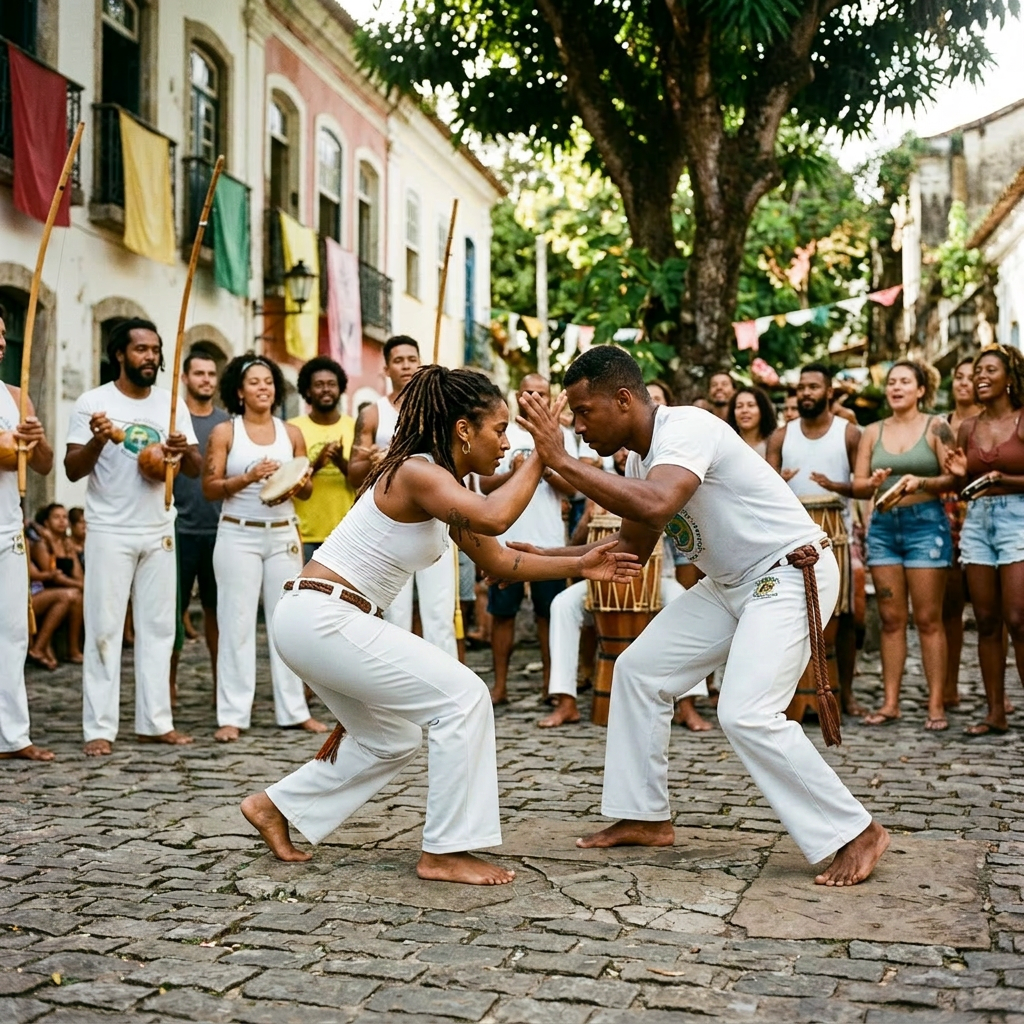
Practitioners showcase the rhythmic beauty of Capoeira during a golden hour performance in a historic Brazilian street.
The essential challenge in the modern global landscape is the preservation of Capoeira Angola’s completeness—its interwoven tapestry of fight, dance, music, history, philosophy, and spirituality. This totality demands active, intentional, and multi-faceted effort to resist the fragmenting and reductive forces of commodification that often prioritize marketable elements over deep cultural integrity.
The preservation of this complex art form hinges on several critical, interconnected actions:
1. Maintaining the Integrity of the Roda as a Sacred and Cultural Space
The roda is the crucible of Capoeira Angola, the essential arena where all its components converge. Preservation requires uncompromising vigilance in upholding its traditional structure, hierarchy, and musical canon.
Upholding Ritual Structure: The roda must be maintained as a ritual space—a circle of shared cultural performance, dialogue, and spiritual connection—and not permitted to devolve into merely a venue for athletic display or competitive spectacle. This includes adhering to the proper seating arrangement, the sequence of instruments, the call-and-response dynamics, and the appropriate reverence shown to the instruments and the space itself.
Prioritizing the Musical Core: The berimbau and the complete bateria (instrumental ensemble) are the heart and voice of the roda. Protecting the traditional rhythms (toques) and the historical song canon is paramount. The music dictates the energy, pace, and philosophical depth of the game (jogo); its authentic preservation prevents the roda from becoming a silent, purely physical exercise.
Honoring Hierarchy and Authority: The traditional hierarchy, centered around the Mestre (Master) and experienced players, is essential for maintaining order, safety, and the transmission of nuanced, often non-verbal knowledge. Respect for this structure safeguards the art from being dictated by transient, commercial interests or inexperienced practitioners.
2. Deepening the Historical, Philosophical, and Cultural Rootedness
Capoeira Angola is fundamentally an embodied form of historical memory and political resistance. Its preservation requires practitioners to continuously emphasize its profound link to the broader history of the Black Diaspora, African spiritual traditions, and anti-colonial resistance movements.
Understanding as Historical Memory: Students must be taught to understand the practice not just as a martial art or dance, but as a living testament to the resilience, ingenuity, and cultural survival of enslaved Africans in Brazil. This ensures the practice is understood as a form of political action and a continuous conversation with ancestral knowledge.
Integrating Philosophy and Malícia: Beyond physical technique, the philosophical principles—such as humility, respect, community (comunidade), and malícia (a complex blend of cunning, wisdom, and street-smarts)—must be central to the curriculum. This depth of character training is what separates Capoeira Angola from a purely physical discipline.
Engagement with Source Culture: Practitioners must be encouraged to engage deeply with Brazilian and African history, language (Portuguese), music, and spiritual practices (where appropriate to the individual and lineage) to understand the full context from which Capoeira Angola emerged.
3. Protecting Oral Tradition, Pedagogy, and Lineage (Linhagem)
Commodification thrives on standardization and mass-produced curricula, which often strip the art of its subtlety and personal touch. The traditional mode of transmission is crucial to resist this simplification.
Prioritizing Direct Transmission: The art form must safeguard the direct, hands-on transmission of knowledge and wisdom from Mestre to student. This intimate relationship fosters an understanding of the jogo that cannot be codified in books or videos. The knowledge is personal, contextual, and often passed on through observation, correction, and shared experience.
Honoring the Linhagem: Recognizing and actively honoring the continuity of the teaching lineage is vital. This establishes a sense of accountability to the past Masters and their unique contributions, preventing the practice from being detached from its historical roots and becoming a generic, self-invented interpretation.
Preserving the Nuanced Oral Culture: The traditional pedagogy relies heavily on oral tradition, metaphor, song, and subtle, non-verbal cues. This nuanced culture, which commercialization often seeks to simplify and formalize into static, easily digestible curricula (e.g., rigid belt systems or standardized lesson plans), must be actively protected.
4. Engaging with the Global Community Critically and Ethically
While Capoeira Angola’s global spread is a testament to its power and universal appeal, this expansion must be managed with stringent ethical considerations and profound respect for the source culture.
Setting Ethical Boundaries: The global community must prioritize ethical stewardship, ensuring that the art is not reduced into a generic “world music” background, a mere “fitness trend,” or a commodity stripped of its cultural context. This includes educating local instructors on the importance of cultural fidelity.
Support for Source Communities: Global schools and practitioners must find ways to ethically support the continued practice and existence of the art in its places of origin (Brazil), ensuring that the economic benefits of its globalization flow back to the traditional communities.
Distinction from Commercialized Forms: Practitioners must be clear about the distinction between Capoeira Angola and more commodified, gymnastic styles of Capoeira, and advocate for the unique importance and preservation of the Angola tradition’s deep cultural substance.
Preservation, in this context, is not a passive plea for stagnation or isolation. It is the active, conscious, and complex practice of the tradition in its complete and demanding form within the dynamic, often turbulent, pressures of the modern world. It is a continuous act of resistance against cultural erasure.
Now, I have a treat for you. The inspiration for this post, “Commodification and Capoeira Angola: Preserving an African Art in a Western World,” didn’t spring from a vacuum. It was sparked by a fascinating and rather intense conversation I had with two people deeply immersed in the world of Capoeira: my Capoeira sister, Liza Bernstein, and my highly respected Capoeira Teacher, Charles Williams.
We were wrestling with the core challenge of how to maintain the spiritual, cultural, and historical integrity of Capoeira Angola—an inherently anti-colonial, African-rooted art form—while navigating the commercial pressures and cultural appropriations so common in a Western context. It’s a conversation about survival versus popularization, tradition versus trend.
In the midst of this dialogue, Liza—always a fantastic source of academic insight—mentioned a seminal dissertation that directly addresses this very subject. The work was authored by Womualy Omowale. This academic work provides a deep dive into the mechanisms of commodification and the preservation strategies employed by practitioners.
To further enrich the discussion and provide a primary source perspective, Liza also shared a compelling video with me, which I am now sharing with you. Fair warning: this video is entirely in Portuguese, the language of Capoeira’s origin and the essential tongue for understanding its deepest cultural nuances. And honestly, if that poses a problem for you, then maybe you should just LEARN THE LANGUAGE!
The challenge of learning Capoeira Angola without relying on immediate translation is not merely an inconvenience to be overcome; it is, fundamentally, a transformative opportunity and a crucial gateway to truly understanding the profound art form you are engaging with. To truly engage with Capoeira is to wholeheartedly embrace its complete ecosystem: its language (primarily Portuguese), its deep and often challenging history, its philosophical underpinnings, and the vibrant, complex culture from which it emerged. Attempting to master the art while clinging to the ‘crutch’ of constant, on-demand translation creates a barrier, preventing a fluid and intuitive integration of the physical, musical, and oral traditions. Therefore, the accompanying video is designed as a foundational component of that deeper, essential education, urging the student to immerse themselves fully and directly into the heart of the art form’s authentic expression.
A traditional Brazilian berimbau is held against a rustic, peeling wall, showcasing the beauty of Capoeira culture.
The human experience is, at its core, a constant and vigorous contest—not primarily with external forces, but with the complex and often contradictory landscape of one’s own soul. This reflection on identity, responsibility, and the direction of your life acknowledges a profound and inescapable truth: there is a real battle happening—not just in the world, but within every man. This internal conflict is not a metaphor; it is the daily, high-stakes crucible in which character is forged or forfeited, determining the quality and impact of one’s entire existence.
The Three Fronts of the Internal Conflict
This internal war is a ceaseless, high-stakes confrontation waged across three primary fronts, each demanding intentionality and vigilance:
1. The Battle Between Discipline and Distraction
The first front is the struggle for consistent action. A battle between discipline and distraction. Discipline, the committed, consistent action toward a defined and worthy goal, represents the high road of self-mastery. It is the arduous, yet rewarding, choice to delay gratification in favor of long-term achievement. It is the accumulated power of small, intentional sacrifices. Distraction, whether manifested as aimless consumption of media, chronic procrastination, or the strategic avoidance of necessary discomfort, is the path of least resistance. It is the insidious erosion of potential, leading inevitably to stagnation and regret. To choose discipline is to choose the future you envision; to yield to distraction is to remain trapped in the comfort of the present moment.
2. The Battle Between Purpose and Self-Sabotage
The second front concerns the direction and momentum of your life. It is a struggle between purpose and self-sabotage. Purpose provides the essential compass, the unwavering why, and the deep-seated momentum that gives weight and meaning to daily efforts. It anchors a man to a vision greater than his immediate wants. Self-sabotage, however, is often insidious and unconscious, the tendency to actively undermine one’s own success and happiness. It operates through the voices of fear, doubt, and destructive habits, ensuring that extraordinary potential remains tragically unfulfilled. This self-inflicted wound stems from a deep-seated fear of success or an unconscious belief in one’s own unworthiness, making the internal victory over self-sabotage a prerequisite for external achievement.
3. The Defining Choice: Destiny vs. Mediocrity
Most critically, this is a spiritual and existential defining choice between who God called you to be—and who you settle to become. This spiritual dimension frames the entire conflict as one of destiny versus voluntary mediocrity. The “called” self is the integrated, fully realized individual operating in alignment with their highest values, intrinsic gifts, and divine design. It is the self capable of operating at maximum influence and integrity. The “settled” self is the version of you that capitulates to ease, fear, and the low expectations of the world, choosing the temporary comfort of the familiar over the challenging, yet rewarding, covenant of their potential. The victory here is the courageous act of choosing one’s destiny over comfort.The Foundation of Radical Responsibility
A man may not choose his starting point. The circumstances of birth, the wounds of childhood, the initial resources provided—all of these are outside the sphere of his initial control. You may not control how you started. These facts are the unchangeable historical context of your life.
However, the immense and sovereign power of human agency rests entirely in the present and the future. But you are responsible for how you finish. This statement is not an accusation; it is a clarion call to radical responsibility. It demands a profound shift in perspective, moving the focus from the factors that acted upon you (victimhood) to the choices you make now (agency). Radical responsibility demands ownership not just of one’s deliberate actions, but of one’s entire life trajectory, emotional state, and spiritual condition. It is the rejection of the external blame game and the full acceptance of the power inherent in the present moment to choose differently.
The Pathway to Transformation: Alignment and Action
The pathway out of the inner war and into a life of meaning and impact begins with a deliberate, foundational shift. Alignment with God changes everything. This is not merely a passive religious sentiment, but a structural change in the mind, spirit, and life architecture. It is the deliberate decision to anchor your life to a transcendent, unwavering standard and principle, thereby gaining irrefutable clarity on what is truly important, eternal, and worth dedicating your life to. This higher standard provides the blueprint for the “called” self.
This alignment initiates the transformative process, which requires continuous, disciplined effort and commitment:
When you renew your mind: This is the internal revolution, the intellectual and spiritual dismantling of the settled self. It means actively identifying and replacing old, limiting beliefs, negative self-talk, and patterns of scarcity with empowering truth. It is the daily practice of replacing the worldview shaped by fear, trauma, and culture with the truth revealed through spiritual principle and clear vision. This mental overhaul is the first battleground.
Develop discipline: Discipline is the bridge between a high-minded intention and a grounded reality. It is the practiced ability to consistently do what must be done when it needs to be done, regardless of fleeting mood or inclination. It is the accumulation of small, consistent acts of fidelity to one’s defined purpose, which builds an unshakeable foundation of reliability and self-trust.
And commit to growth: This is the lifelong posture of the learner, the rejection of finality, and the courageous embrace of challenge. It means actively seeking out opportunities for intellectual, emotional, and spiritual expansion. To commit to growth is to accept that you are an ongoing project, always becoming, never fully arrived, and always capable of more.
How does this apply to an Angoleiro, a practitioner of Capoeira Angola, whose very art is a profound study in the tension between internal discipline and external expression, between self-mastery and dynamic interaction?
The principles of “Radical Responsibility” demand that the Angoleiro acknowledge that the roda is a mirror of their internal state. Every movement, every chapa, every evasive coccix is not merely a physical technique, but a manifestation of their commitment, their focus, and their emotional control. If an Angoleiro enters the roda carrying fear, anger, or distraction, those internal states will manifest as clumsy footwork, predictable attacks, or a failure to read their opponent (the jogador). The internal war is fought and won not just in hours of solo training, but in the moment-to-moment decisions within the game.
Radical Responsibility means the Angoleiro takes full ownership of the quality of the game. If the music falters, it is their responsibility to sing louder. If the energy drops, it is their responsibility to invite greater connection and challenge through their movement. They do not blame their partner for a poor game, nor the mestre for a difficult challenge, nor their own lack of sleep for a slow response. Instead, they recognize that their level of presence is the only factor they can truly control. This responsibility extends beyond the technical execution of the jogo. It encompasses the cultural and historical weight of the art. An Angoleiro is responsible for upholding the integrity, respect (axé), and philosophical depth of Capoeira Angola, ensuring that their practice is a living testament to the resilience and wisdom of its Afro-Brazilian origins. In essence, for the Angoleiro, radical responsibility is the commitment to being a vessel for axé—the vital life force and energy of the art. They understand that to truly play Capoeira Angola is to engage in a continuous, conscious practice of bringing their highest self, their most disciplined mind, and their most generous spirit into the circle.
The Consequence: A Higher Level of Living
The inevitable consequence of this transformation is a fundamental elevation of one’s existence—you step into a higher level of living. This elevated life is not defined by material wealth or societal acclaim, but by intrinsic value, integrity, and profound impact. It is characterized by three markers:
A life of purpose: Every action is infused with meaning, contributing to something greater than self-gratification. The man knows his why and organizes his what around it.
A life of responsibility: The man accepts his essential role as a steward of his gifts, his relationships, and his entire sphere of influence. He becomes reliable, dependable, and a bedrock of strength for his family, community, and those he leads.
A life that produces: The focus shifts decisively from passive consumption to active creation. This life generates tangible value—whether through mentorship, art, entrepreneurship, service, or dedicated family stewardship—leaving a positive and enduring legacy that outlasts the man himself.
This is discipleship. It is the comprehensive, holistic process of self-mastery under a higher standard, culminating in a life that is intentional, fruitful, and fundamentally aligned with the design of its Creator. It is the courageous act of winning the inner war and becoming the man you were always meant to be.
A heartfelt SHOUT OUT is extended to Byron Rodgers for the creation and generous sharing of this insightful video content.
For those seeking more of this valuable material, we encourage you to subscribe to the MAN OF PEACE podcast on YouTube.
HIDDEN SPIRITUALITY from Spirit Science shows how deep, universal spiritual truths and ancient archetypes are woven into modern pop culture—films, games, literature, and comics. We assert that principles like consciousness, cosmic cycles, and the soul’s journey shape contemporary media.
Our mission is to decode these embedded themes, turning entertainment into a vehicle for self-discovery. We focus on perennial concepts found in major spiritual traditions:
The Hero’s Journey: Campbell’s monomyth, mapping the soul’s path of transformation and individuation.
Karma and Causality: The law of cause and effect, reflected in narrative arcs and moral lessons.
Oneness (Non-Duality): The ultimate truth of unified consciousness and interconnected existence.
Cycles of Death and Rebirth: The constant pattern of dissolution and renewal essential for evolution and symbolizing personal change.
We offer mystical analysis of symbolism and mythology in popular media, viewing these stories as profound psychological and spiritual mirrors for our inner journeys, providing clues for self-realization.
Building a Conscious Community
HIDDEN SPIRITUALITY fosters a conscious global community, empowering viewers to recognize the spiritual significance in their entertainment. We build a vital bridge between casual media consumption and the application of perennial spiritual truths to life’s challenges.
Today’s Featured Installment: Decoding the Depths of Avatar: The Last AirbenderUnlock Your Inner Elemental Power: The Four Elements Transformation
Discover the Four Elements Transformation, our newest online course and mystical experience designed to harmonize mind, body, and spirit by mastering ancient elemental principles.
Hidden Spirituality: The Journey of the Teenage Avatar
“Avatar: The Last Airbender” captured the hearts of millions with its charming ensemble of characters, exhilarating action sequences, and surprisingly profound spiritual and philosophical underpinnings. Beyond the thrill of elemental bending and the epic quest to defeat the Fire Lord, the series subtly explores themes of destiny, choice, and spiritual growth. But pause for a moment and consider a curious narrative constant in stories like this: why is it always a young teenager, often with little-to-no guidance from parental figures or established authorities, who is tasked with saving the world?
In the second and deeper part of our “Hidden Spirituality” series on “Avatar: The Last Airbender,” we move beyond the surface elements to explore the profound nature of spiritual mastery, maturity, and evolution as exemplified through Aang, the twelve-year-old Avatar, and his companions.The Paradox of Youthful Destiny
The story centers on Aang, who is technically a 112-year-old monk but a mental and emotional pre-teen, waking up to a world at war and a burden he never asked for. His journey is a powerful metaphor for the spiritual path itself. The series suggests that the lack of traditional, rigid authority and the inherent immaturity of youth may, in fact, be prerequisites for true spiritual breakthrough. Young minds are often less cluttered by the dogma, cynicism, and fear that accumulate with age and “worldly experience.”
We will dive deeper into the unique spiritual crucible Aang is forced into—a journey of rapid and intense personal development. His initial reluctance to accept his destiny and the subsequent trauma of his past life are not merely plot devices; they are examinations of the soul’s resistance to its higher purpose and the necessary process of confronting and healing ancient wounds.Mastery: Not Just Bending, But Being
Aang’s quest is ostensibly about mastering the four elements: Air, Water, Earth, and Fire. Yet, the show consistently elevates this physical mastery to a spiritual one. True mastery, as revealed through his lessons, requires overcoming personal obstacles that are far more challenging than any technical bending move:
Air Nomad Spirituality: Rooted in detachment and freedom, Aang’s native philosophy forms the foundation. His initial struggles to learn Earthbending and Firebending reflect a need to integrate seemingly contradictory spiritual principles—the stubborn resilience of Earth, and the passion and focused energy of Fire.
The Avatar State: This powerful tool is a connection to all past Avatars, but it is also a symbol of true enlightenment—the complete, integrated self. We examine Guru Pathik’s teachings on the Chakras, a clear and direct introduction to a central concept in Eastern spiritual traditions, and how Aang’s love for Katara becomes the final, most difficult “earthly attachment” to overcome for full spiritual power.
The Role of Maturity and Evolution
The core cast’s journey—Aang, Katara, Sokka, and later Zuko—is a powerful study in maturity and evolution.
The Gaang’s Support System: Aang is not truly alone; his friends form the crucial “support system” often missing in life. Katara embodies compassion and nurturing, the emotional anchor. Sokka represents grounded logic, strategy, and humor, often preventing Aang from becoming too ethereal. This small, makeshift family shows that spiritual growth is rarely solitary; it requires a community of likeminded souls.
Zuko’s Redemption Arc: The journey of Prince Zuko is arguably the most compelling spiritual evolution in the series. His path from fear, anger, and a destructive pursuit of external validation to one of self-acceptance, integrity, and genuine purpose is a profound exploration of Teshuvah (repentance and return) and the essential spiritual act of choosing one’s own destiny over a path dictated by trauma and familial expectation.
Through the thrilling narrative of “Avatar: The Last Airbender,” we uncover a universal truth: the journey towards spiritual enlightenment and saving one’s own world—whether that world is the planet or just one’s inner landscape—demands courage, self-confrontation, and the willingness to shed old identities. It is a process of evolution, where the innocent clarity of youth is tempered and strengthened by the maturity gained through hardship and unwavering purpose.
Don’t miss this fascinating exploration of one of the most beloved animated series of all time, an exploration that proves sometimes, the biggest struggles we have come from not having the right support system to help us navigate the ups and downs of life.—–Come and join the Spirit Science community and connect with likeminded souls from around the world:
This blog series is dedicated to a deep, respectful exploration of the spiritual bedrock and immense cultural influence emanating from Sub-Saharan Africa. It promises a systematic, intellectual examination of the region’s diverse indigenous belief systems. This includes a close look at foundational cosmologies, such as the Akan’s concept of the supreme creator, Nyame, and the rich, complex Yoruba Òrìṣà pantheon, which features a vast array of deified spirits and forces of nature that govern human life and the cosmos.
Beyond indigenous faiths, the series will offer a meticulous, detailed analysis of the arrival, integration, and profound evolution of the Abrahamic faiths—specifically Christianity and Islam. It will highlight how these traditions were not merely adopted but were actively synthesized into distinct, localized African expressions, resulting in vibrant syncretic movements and churches that bear unique theological and ritual characteristics.
A central, unifying theme across the series is the profound, living role of ancestral worship. The ancestors are not relegated to the past; they remain a contemporary cultural anchor, actively ensuring collective identity, guiding social continuity, and serving as the primary vehicle for the transmission of ethical and moral wisdom across generations.
Finally, the series will underscore the extraordinary resilience and preservation of these African spiritual traditions across the global diaspora. It will illustrate how practices—such as Haitian Vodou, Cuban Santería, and Brazilian Candomblé—are direct, powerful expressions of this enduring heritage. This miraculous preservation is attributed to the inherent power and efficacy of oral tradition, ritual performance, and communal storytelling, which have successfully navigated and withstood centuries of displacement, enslavement, and cultural suppression.
Today’s Journey: Unveiling the Sacred Mysticism of Africa
This particular exploration serves as an invitation to embark on a transformative journey into the very heart of Africa, a place where spiritual healing traditions form the essential bedrock of community structure, personal wellness, and cosmic order. We will dedicate our focus to discovering the pivotal roles and enduring significance of three of the continent’s most profound and widely recognized sacred spirit healers:
The Dibia of the Igbo people, primarily concentrated in Nigeria.
The Sangoma of the Nguni communities, including the Zulu and Xhosa in Southern Africa.
The Nganga, a title and function found across a vast array of Bantu cultures spanning Central, Eastern, and Southern Africa.
These revered titles—Dibia, Sangoma, and Nganga—represent much more than simple practitioners; they are the highly respected custodians of ancient wisdom, serving their communities as expert diviners, master herbalists, and essential intermediaries between the visible, temporal world and the sacred, eternal realm of the ancestors and spirits.—–The Pillars of African Spiritual Healing: A Deep Dive
The practice of these healers is built upon a sophisticated philosophical framework, summarized by these core pillars:1. Spiritual Healing as Wholeness (Holism)
In these ancient traditions, the concept of illness is radically different from a purely biomedical view. Sickness—be it a physical ailment, a psychological distress, or even social discord within a family or village—is fundamentally understood as a state of spiritual and ancestral dis-alignment. This means the individual is out of harmony with their environment, their community, or the spirit world. True spiritual healing is, therefore, a comprehensive process of restoring not just physical health, but cosmic harmony and balance. It is a profound, life-altering process of alignment with spirit, ensuring the individual is correctly positioned and fulfilling their role within the cosmic order, the social fabric, and the ancestral lineage. This restoration of balance is the only path to genuine well-being.2. Ancestral Rituals: The Foundation of Life (Continuity)
For the Igbo (Mmuo) and the Zulu (Amadlozi), the ancestors are not simply the ‘dead’ but are recognized as those who have transitioned to a higher state, remaining active, vital participants in the lives of the living community. Ancestral rituals are the essential language of communication with this realm. These rites—which can involve specific acts like pouring libations, offering specific sacrifices (often symbolic or involving livestock), and engaging in communal dances and trance possession—are performed to honor their memory, seek their indispensable guidance, and, crucially, appease them when a community’s ethical or spiritual harmony has been broken. These rites are the fundamental, guiding force for both individual and communal well-being, securing blessings and preventing calamity.3. Sacred Initiation and the Call (Vocation)
The path to becoming a Dibia, Sangoma, or Nganga is rarely a matter of personal ambition or choice; it is a sacred, often profoundly tumultuous, calling that is thrust upon the individual by the spirits or the ancestors themselves. This divine decree is often accompanied by a period of strange illness, prophetic dreams, or psychological distress until the person accepts their fate. The subsequent sacred initiation is a rigorous, demanding process involving years of often secret, specialized training guided by established, elderly mystics. This process is comprehensive, encompassing:
Mastery of the deep knowledge of medicinal and spiritual plants.
Learning the complex language of divination (through the reading of bones, cowrie shells, or entering deep trance states).
Understanding the complex etiquette and laws of the spirit world.
The trials, tests, and teachings within this process are designed to strip away the novice’s former ego and identity, preparing them to safely and effectively channel powerful healing and divinatory energies.4. Hidden Knowledge and Cosmic Law (Esotericism)
These healers are not merely practitioners; they are the living keepers of hidden knowledge—an esoteric and privileged wisdom passed down strictly through oral tradition and practical, supervised application over countless generations. This knowledge encompasses a sophisticated understanding of:
Cosmology: The structure of the universe and the relationship between the visible and invisible worlds.
Interdependence of Nature: A profound ecological awareness of the symbiotic relationship between humans, animals, and the plant kingdom.
Herbal Muti: The medicinal and spiritual uses of powerful herbal preparations.
Cosmic Law: The unseen laws that govern the operation of the visible and invisible worlds.
This wisdom is accessed through specialized techniques, including deep trance states, the precise interpretation of dreams and omens, and is often mediated by the mystics who possess the innate ability to perceive spiritual truths and realities beyond ordinary human sensory perception.—–The Role of Ancient Wisdom and Blood Rites
The essence of the healer’s practice is deeply rooted in ancient wisdom, a timeless, coherent body of knowledge that fundamentally recognizes the profound interconnectedness of all life—spiritual, human, and natural.
Healing often involves blood rites—which are not savage, but deeply symbolic acts. These may take the form of the ritual sacrifice of animals (done with respect and purpose) or the ceremonial use of blood to seal covenants, purify sacred objects, or offer profound, potent thanks to the spirits and ancestors. These acts serve to powerfully reaffirm the deep, living bond between the earthly community and the spirit realm. In every instance, the Dibia, Sangoma, or Nganga acts as the indispensable pivot point—the spiritual mediator—guiding individuals, families, and communities back toward a state of spiritual grace, ethical integrity, and vital, enduring wholeness. Their practice is a testament to the enduring power of faith and the unbroken chain of African wisdom.
HIDDEN SPIRITUALITY: Bridging Ancient Wisdom and Modern Media
HIDDEN SPIRITUALITY is the flagship initiative of Spirit Science, dedicated to demonstrating how profound, universal spiritual truths and time-honored archetypes are intricately woven into the fabric of modern pop culture. they assert that the foundational principles of spirituality—including consciousness, cosmic cycles, and the journey of the soul—actively shape and permeate contemporary media, such as blockbuster films, video games, popular literature, and comic books.
Our core mission is to meticulously decode and illuminate these embedded spiritual themes, transforming everyday entertainment into a vehicle for deeper self-discovery and enlightenment. We focus on recurring, perennial concepts that appear across all major spiritual traditions:
The Hero’s Journey (Monomyth): The archetypal structure, first articulated by Joseph Campbell, which maps the individual’s path of transformation, crisis, and triumphant return, mirroring the soul’s journey of individuation.
Karma and Causality: The immutable law of cause and effect, which dictates that every action, thought, and word generates a corresponding consequence, powerfully reflected in the narrative arcs and moral lessons of modern storytelling.
Oneness (Non-Duality): The ultimate truth that all existence is fundamentally interconnected and of the same unified consciousness, often subtly explored through narratives of empathy, unity, and the dissolution of separateness.
Cycles of Death and Rebirth: The constant, transformative pattern of dissolution followed by renewal, which is essential to both the individual soul’s evolution and the narrative rhythm of life, frequently symbolizing deep personal change.
We move beyond superficial media critique to offer an in-depth, mystical analysis of symbolism, philosophical underpinnings, and mythological parallels present in popular media. We believe that these modern stories are not just for escape; they act as profound psychological and spiritual mirrors for our personal inner journeys, providing vital clues for self-realization and transformation.
Building a Conscious Community
Beyond rigorous analysis, HIDDEN SPIRITUALITY is committed to fostering a conscious, engaged global community. We empower viewers to recognize and value the spiritual significance inherent in their entertainment consumption. Our work aims to build a vital bridge between the casual consumption of modern media and the application of perennial spiritual truths, encouraging our audience to apply the moral lessons, ethical dilemmas, and archetypal encounters found in these narratives to their own lives and existential challenges.
Today’s Featured Installment: Decoding the Depths of Avatar: The Last Airbender
Unlock Your Inner Elemental Power: The Four Elements Transformation
Are you ready to truly master the four elements within the landscape of your own consciousness? We invite you to discover the Four Elements Transformation, our newest online course and profound mystical experience designed to harmonize your mind, body, and spirit by understanding the ancient principles of the elements.
Unveiling the Hidden Spirituality of Avatar: The Last Airbender
The critically acclaimed animated series, “Avatar: The Last Airbender” (ATLA), is far more than just a captivating tale of a young hero’s journey; it is a spiritual allegory woven into a fantastical narrative. The show has garnered global adoration, successfully capturing the hearts and minds of viewers with its compelling characters, dynamic action, and rich world-building. However, our ongoing analysis reveals a deeper, more profound, and often hidden spiritual and philosophical meaning subtly embedded beneath the surface of the show’s intricate world.
In our dedicated video series, “Hidden Spirituality,” we embark on a meticulous exploration of the complex spiritual, psychological, and philosophical themes that serve as the foundational bedrock of Avatar: The Last Airbender. We treat the fictional nations, bending arts, and conflicts not as mere plot devices, but as powerful archetypes for the human condition and the universal journey toward enlightenment and self-mastery.Episode Focus: The Allegory of the Fire Nation
In this particular episode, we conduct a close, allegorical examination of the Fire Nation and its pivotal role in the narrative. We dissect what its relentless aggression, imperialistic expansion, and seemingly evil acts truly symbolize on a deeper spiritual and psychological level. The Fire Nation represents the unbridled, unbalanced energy of the ego—the destructive passion that consumes rather than illuminates, symbolizing an individual or collective consciousness driven by fear, control, and a disconnection from the natural order.The Holistic View: Balance, Peace, and the Human Condition
To fully understand the Fire Nation’s spiritual significance, we integrate its archetype with the distinct philosophies, social structures, and core values of the other three nations:
The nomadic Air Nomads embody the spirit of freedom, detachment, and inner peace, representing the mental and spiritual aspects of the self.
The resourceful Water Tribes symbolize adaptability, emotion, and community, representing the flow of feelings and the subconscious mind.
The stable Earth Kingdom signifies resilience, groundedness, and pragmatism, representing the physical world and the conscious will.
By examining the interplay between these nations and integrating them with the show’s overarching, explicit themes of balance (physical and spiritual), inner peace (essential for Airbending mastery), and responsibility (the Avatar’s core duty), we explore what “Avatar: The Last Airbender” truly reveals about the fundamental human condition, the nature of conflict, and the evolutionary path of consciousness. The Avatar, as the bridge between the physical and spirit worlds and the master of all four elements, represents the fully integrated, awakened self—the potential within all of us.
Join us on this transformative journey of discovery as we dive deep into the hidden meaning, psychological depth, and mystical symbolism of one of the most beloved animated series of all time, uncovering the profound wisdom it holds for modern spiritual seekers.—–Connect with the Community: The Spiritverse
Ready to engage directly with Team Spirit and a global community of like-minded spiritual explorers? Join Spiritverse, our dedicated spiritual social platform where you can share insights, discuss esoteric knowledge, and foster connections on your journey of awakening.
If you found value in this deep dive, we invite you to explore more of our extensive content library, which covers a wide spectrum of spiritual and philosophical topics:
The blog series opens with a comprehensive commitment to exploring the intricate spiritual topography of Sub-Saharan Africa and its enduring, transformative influence on global culture. It establishes a systematic framework for examining the rich tapestry of diverse indigenous belief systems, providing concrete examples such as the Akan’s reverence for the supreme being, Nyame, and the sprawling, influential pantheon of the Òrìṣà within the Yoruba tradition.
Crucially, the series dedicates significant attention to the historical and theological journey of the Abrahamic faiths—Christianity and Islam—within the African continent. It offers a detailed analysis of their respective arrivals, the complex dynamics of their interaction with established traditional religions, and their ultimate evolution into distinctive, localized African faiths that synthesized and reshaped foreign doctrines.
A central, unifying theme threaded throughout the exploration is the profound, continuous, and living role of ancestral worship. The series argues that the veneration of ancestors is far from an obsolete relic of the past; rather, it is a potent, contemporary expression of cultural heritage. It serves as a vital anchor, reinforcing collective identity, ensuring cultural and social continuity, and acting as the primary vehicle for transmitting essential ethical wisdom and moral frameworks from one generation to the next.
Furthermore, the blog series meticulously highlights the extraordinary resilience and preservation of these African spiritual traditions across the global diaspora, a direct consequence of the transatlantic slave trade. It underscores how practices like the Haitian Vodou, the Cuban Santería (or Regla de Ocha), and the Brazilian Candomblé have been maintained and thrived. This enduring preservation is attributed to the flexible and powerful mechanism of oral tradition, the consistent execution of sacred rituals, and the deep-seated cultural practice of storytelling, which together keep the spiritual roots firm and vibrant despite centuries of physical displacement.
An In-Depth Exploration of Yoruba Spirituality: Ifá and the Orisha Pantheon
Yoruba Spirituality, one of the most widespread and globally impactful African cosmologies, offers a complex, multi-layered worldview centered on the figure of the supreme creator, Olódùmarè. Olódùmarè is understood as the ultimate source of all existence, the creator of the cosmos, destiny, and Aṣẹ itself. Though often considered remote and transcendent, Olódùmarè’s divine power and essence are not absent but manifest throughout the entire universe. The active, accessible forces of the divine are the Orisha, a vast pantheon of deities, spirits, and deified ancestors who govern every conceivable aspect of nature, human experience, and destiny.
At the very heart of this sophisticated system is Ifá, the sacred spiritual and divinatory tradition that functions as the repository of Yoruba wisdom, philosophy, history, and ethical code. This immense body of knowledge has been meticulously preserved and passed down through an unbroken lineage over centuries. The master and embodiment of this wisdom is Orunmila, the revered Orisha of wisdom, knowledge, and ethical conduct. He is mythologically recognized as the “witness to creation” (Eléri-Ìpín) and is the direct source of the entire Ifá literary corpus. This corpus, known as the Odu Ifá, contains thousands of verses that cover every facet of human life, offering profound philosophical guidance, historical narratives, and practical solutions for navigating any life situation.
The professional practice of Ifá is led by the Babaláwo (meaning “Father of the Secrets” or “Father of Yesterday, Today, and Tomorrow”), who are highly trained, disciplined, and initiated priests. Their primary responsibility is to consult the Oracle on behalf of clients. Through a ritualistic form of divination—most commonly involving the systematic casting and interpretation of palm nuts (ikin) or the quick, rhythmic reading of the divining chain (opèlè)—the Babaláwo determines which Odu (chapter/verse) is revealed. This revelation offers diagnostic counsel, clarifies the individual’s spiritual path, prescribes necessary sacrifices (ebo) or ritual actions, and ultimately helps the individual align their conscious life with their predetermined destiny (ìpín).
The practical application of this spiritual knowledge is grounded in a foundational ethical concept: Iwà Pẹ̀lẹ́, which literally translates to “good and gentle character.” This concept is not merely a suggestion but a spiritual imperative, emphasizing the critical importance of living a life defined by morality, humility, respect, patience, and the maintenance of balance (ìwontúnwònsì). A person’s destiny is believed to be fully realized only through the consistent cultivation of Iwà Pẹ̀lẹ́.
All power, manifestation, growth, and life force in the universe are fundamentally attributed to Aṣẹ (often transliterated as Ashé). Aṣẹ is the divine, dynamic energy that allows things to happen, to grow, to create, and to be effective. It is the lifeblood of the cosmos, present in its fullest form in Olódùmarè, distributed among the Orisha, residing in the ancestors, embedded in sacred objects, and activated by the ritual words (ofo) of a Babaláwo or priestess (Ìyánífá or Ìyálòrìṣà).
The enduring connection to the collective of ancestors is also an indispensable component of Yoruba Spirituality, frequently celebrated through the veneration of Egúngún, the collective spirits of the departed. Egúngún rituals and ceremonies serve to reinforce the continuum between the living community and the spiritual realm of the dead, providing a channel for the ancestors to offer their guidance, blessings, and corrections, thereby ensuring the spiritual and physical well-being of the living.
The journey within Yoruba Spirituality often involves initiation into the mysteries of a specific Orisha (becoming a devotee) or into the full practice of Ifá (becoming a priest or priestess), marking a profound dedication and spiritual rebirth. These sacred rituals and meticulously orchestrated ceremonies are essential for establishing and maintaining cosmic and community balance, honoring the deities, and receiving vital spiritual protection and grace.
This ancient, profound wisdom has demonstrated a remarkable ability not just to survive, but to thrive across the diaspora. The brutal mechanism of the transatlantic slave trade forcibly transplanted millions of Yoruba people, yet their spiritual heritage persisted by syncretizing with indigenous Caribbean and South American practices, as well as the Catholicism imposed by colonizers. This blend gave rise to powerful, vibrant New World religions that share the core Yoruba foundation:
Santería (or Regla de Ocha) flourished in Cuba and Puerto Rico, maintaining a direct and recognizable connection to the Orisha pantheon.
Vodou in Haiti, while also incorporating Arada and Kongo elements, shares fundamental cosmological principles and ritual structures rooted in West African belief.
Candomblé developed in Brazil, becoming a crucial institution for cultural and spiritual survival, centered entirely on the worship of the Orisha.
These diasporic traditions, while now distinct socio-religious entities, share the core reverence for the Orisha, the essential philosophical principles of Ifá, and the fundamental belief in the divine interconnectedness of all things, ensuring that this profound African spiritual heritage continues to guide and enrich the lives of millions worldwide.
HIDDEN SPIRITUALITY – From Spirit Science: Unveiling the Esoteric Core of Modern Culture
Hidden Spirituality is a dedicated platform by Spirit Science that delves into the profound, often-unseen, intersection between perennial spiritual wisdom and the vibrant tapestry of contemporary popular culture. We propose that the timeless truths of ancient philosophies, universal spiritual concepts, and powerful archetypes are not relics of the past but active, formative forces shaping the stories, media, and entertainment that captivate the modern global audience.The Mission: Decoding Universal Wisdom in Contemporary Storytelling
Our primary mission is to illuminate how universal spiritual themes, mythic structures, and potent archetypes—such as the Hero’s Journey, the concept of Karma, the principle of Oneness, or the cycles of death and rebirth—are meticulously woven into the fabric of modern storytelling. This includes a deep, analytical look at:
Films and Television: Exploring the mystical symbolism in blockbuster narratives, science fiction epics, and independent cinema.
Video Games: Analyzing the spiritual lessons, moral frameworks, and deep psychological archetypes embedded in interactive worlds and character development.
Novels and Literature: Dissecting the philosophical underpinnings and esoteric messages hidden within fantasy, dystopian, and mainstream literary works.
Anime and Comics: Uncovering the complex spiritual systems and eastern philosophical influences frequently depicted in these globally influential mediums.
We seek to understand the fundamental, universal appeal of these modern myths. Why do stories from across different languages, cultures, and genres resonate so deeply with people worldwide? We believe the answer lies in their function as profound mirrors for the inner journey. These narratives offer frameworks for self-discovery, guideposts for personal transformation, and powerful conduits for connecting the individual to cosmic, universal truths that transcend dogma and geography.Fostering a Conscious Community and Spiritual Bridge
A key aspiration of Hidden Spirituality is to cultivate an engaged, thoughtful community that not only consumes entertainment but also actively recognizes its inherent spiritual value. By spotlighting the ancient wisdom and profound psychological insights embedded in modern media, we are actively building a critical bridge:
Between Contemporary Culture and Universal Spiritual Truths: We show that the spiritual journey is not limited to temples or texts but is alive and accessible through the very culture we engage with daily.
Encouraging Conscious Reflection and Personal Transformation: Our analysis encourages viewers and readers to move beyond passive consumption. By recognizing the archetypes and lessons in the media, they are empowered to apply those same insights to their personal challenges and spiritual development.
Diving Deep into Hidden Narratives: The Case of “Noah”
Beyond the familiar and often literal interpretations of scripture, a rich, hidden mystical narrative exists, one that speaks directly to the very essence of human existence and the nature of reality itself.
In the analysis of the film “Noah”, we embark on a journey that deliberately transcends time and space. It is not merely a historical or religious retelling, but an exploration of the absolute depths of the human experience—the weight of responsibility, the internal conflict between creation and destruction, and the ultimate test of faith.
Join us as we meticulously dissect the film’s symbolism and uncover the profound, transformative insights it offers. We reveal how the story of Noah is far more than a simple tale of a great flood and divine punishment; it is a timeless, allegorical lesson about:
The Power of Faith: Not as blind belief, but as radical trust in one’s highest intuition and purpose.
The Necessity of Sacrifice: Understanding that transformation often requires the dissolution of the old self or the letting go of attachments.
The Eternal Journey of the Soul: Seeing the flood not just as an external event, but as an internal cleansing and spiritual renewal.
This is not a typical movie critique or breakdown; it is an invitation to a journey of the spirit, designed to reveal hidden messages that possess the genuine power to transform your life and perception of reality.
Explore Further: Resources for Spiritual Deepening
Ready to dive deeper into the mystical side of biblical and universal wisdom?
The Four Elements Transformation Course: A compelling, in-depth course that masterfully synthesizes core Kabbalistic, Christian (esoteric), and Taoist teachings into a practical system for personal transformation.
About Spirit Science: A Journey of Open-Hearted Exploration
Our Core Mission and Philosophy
At Spirit Science, our deepest aspiration is to serve as a supportive companion and guide on your unique path of personal and spiritual evolution. We are dedicated to providing a sacred, welcoming space—a true sanctuary—where you can freely and safely explore, question, and deeply experience the essence of your spiritual journey.
Our fundamental intention is to engage with and share the diverse facets of spirituality in a manner that is always open-hearted, inclusive, and profoundly respectful. This respect extends universally, honoring the beauty, divinity, and inherent worth within every individual, every expression of nature, and the vast, wondrous tapestry of the universe itself.
The Synthesis of Science and Spirituality
Spirit Science is founded upon the open-hearted exploration and profound synthesis of both scientific inquiry and spiritual wisdom. This exploration is intentionally free of the constraints of dogma, rigid belief systems, or prescriptive doctrines. They champion a fluid, inquisitive approach, recognizing that the greatest truths often lie at the intersection of outer scientific discovery and inner spiritual realization. Their ultimate focus is on the elevation and transformation of human consciousness, guiding ourselves and our community into what we believe is an emerging era defined by love, light, compassion, and unity. They believe that true growth involves shedding outdated paradigms and embracing a higher vibrational state of being.