
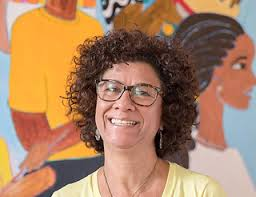
Mestra Paulina is a highly respected master practitioner, educator, and co-founder of the prominent Grupo de Capoeira Angola Nzinga (GCAN). Her full name is Paula Cristina da Silva Barreto. She stands out as a pioneering female leader in Capoeira Angola, a traditional Afro-Brazilian martial art historically dominated by men.
Mestra Paulinha initiated her journey in Capoeira Angola in 1982 within the vibrant cultural landscape of Salvador, where she joined the renowned Grupo de Capoeira Angola Pelourinho (GCAP). Under the guidance of distinguished mestres such as Mestre Moraes, Cobra Mansa, and João Grande, she immersed herself in the foundational philosophy and traditional techniques of the art.
Her training during this formative period in Bahia provided the groundwork for her future as a pioneering leader and scholar, as she mastered both the physical movements and the deep-rooted cultural heritage of the practice.
In the 1990s, Mestra Paulinha collaborated with Mestra Janja and Mestre Poloca to establish Grupo Nzinga de Capoeira Angola (GCAN) in Bahia, Brazil. This organization was founded in 1995 with the specific mission of safeguarding the Bantu origins and the foundational philosophy of Capoeira Angola, emphasizing the teachings of Mestre Pastinha and breaking away from vertical societal structures.
Under their collective leadership, the group has evolved into a significant international network, maintaining active branches and headquarters in Brazil (Salvador, São Paulo, and Brasília), Mexico City, Germany (Marburg), and Mozambique (Maputo).
By centering traditional Afro-Brazilian wisdom, the group serves as a vital platform for cultural preservation and social resistance. Since 2005, the group has been established in the community of Alto da Sereia, where it uses capoeira as a political and educational tool to empower children and adolescents. Their pedagogy focuses on protecting human rights, fighting against racism and sexism, and promoting gender equality—transforming traditional songs to be more inclusive of women. Grupo Nzinga operates autonomously, fostering a partnership among its international headquarters to ensure that the practice of Capoeira Angola serves as an instrument for social justice and the protection of marginalized groups.
2. A Scholar and A Mestra
Mestra Paulinha holds a Ph.D. in Sociology from the University of São Paulo (USP). She beautifully bridges the world of academic research with oral tradition, creating a unique intersection between formal scholarship and the lived experiences of capoeira practitioners. Her scholarly work primarily centers on:
- Anti-racist education and social resistance: Investigating how traditional Afro-Brazilian practices serve as sites of resistance against systemic racism.
- Gender equality and women’s empowerment within Afro-Brazilian spaces: Analyzing the pioneering role of women in historically male-dominated cultural spheres.
- Evaluating the role of capoeira as a community educational tool: Assessing how the practice fosters social cohesion and critical consciousness among participants.
Through this dual path, she integrates academic sociological insights with traditional Afro-Brazilian wisdom, ensuring that her research and her teaching in the roda (the capoeira circle) are mutually reinforcing. By validating oral traditions within the university setting, she advocates for a more inclusive educational paradigm that recognizes the intellectual depth of marginalized cultural practices.
3. Social and Ethical Stance
Under her guidance, training goes beyond physical kicks and defense. She champions capoeira as a tool against oppression. Her workshops emphasize human rights, protecting single mothers, fighting gender-based violence, and providing safe cultural spaces for children.
This ethical commitment is deeply rooted in the philosophy of Capoeira Angola as a form of social resistance. Mestra Paulinha utilizes the practice to address contemporary societal challenges, transforming the roda into a space for critical reflection and community building.
Her approach integrates academic sociological insights with traditional Afro-Brazilian wisdom, focusing on the empowerment of marginalized groups. By prioritizing the safety and visibility of women and children, she ensures that the cultural heritage of capoeira serves as an active instrument for social justice and human dignity.
 Jogo Corpo Fechado