A Comprehensive Manual for Personal Security and Self-Defense in High-Risk Situations

This guide is meticulously designed for individuals committed to acquiring practical, effective, and reality-tested strategies for surviving and neutralizing a sudden, violent street ambush. It moves far beyond theoretical self-defense into the realm of integrated, combative survival philosophy. The approach is deeply rooted in the principles of unwavering vigilance, subtle situational awareness, and the fluid, unpredictable combative techniques often associated with martial arts focused on volatile, real-world environments, such as Capoeira Angola. This manual provides a holistic, step-by-step approach to immediate threat assessment, decisive response, and the essential post-conflict protocols necessary for full recovery.
The Core Philosophy: Beyond Reaction—Proactive Defense and Intelligent Control
In a sudden ambush scenario, the critical resource is time—or rather, the absence of time. The philosophy underpinning the “Counterambush” is not a passive, delayed reaction to an attack, but the rapid, intelligent, and decisive application of both defensive and pre-emptive offensive actions. The overriding goal is to immediately disrupt the attacker’s plan, shatter their psychological and physical momentum, and decisively regain absolute control of the situation. This manual emphasizes four integrated pillars of defense, forming a layered security architecture:

I. Pre-Conflict Awareness (The Angoleiro’s Eye): The Art of Not Being There
Cultivating a constant, yet subtle, non-aggressive level of environmental scanning and personal discipline is the highest and most effective form of self-defense. This is the Angoleiro’s Eye—the practiced ability to see without staring and to listen without obvious focus. This state of constant, low-level surveillance transforms you from a passive target into an actively aware individual, allowing you to intercept an ambush before it is even initiated. The goal is to make yourself a “hard target”—one that presents too much risk and awareness for a predator seeking an easy mark.
Reading the Pre-Attack Indicators (The Omen): Learn to recognize the subtle, often subconscious cues that signal an impending threat or a commitment to violence. These are the “leakage points” in an attacker’s plan—moments where the stress of planning and impending action manifests physically.
Body Language and Physiological Cues:
The “Thousand-Yard Stare”: The attacker’s focus narrows intensely, often de-focusing on the surroundings and fixating solely on the target. They may cease ordinary interaction with their environment.
“Pre-Fight Grooming/Displacement Behavior”: Excessive, nervous fidgeting, unnecessary adjustments to clothing (like tightening a jacket or adjusting a belt), or repetitive, non-contextual movements are signs of high-stress internal conflict.
The “Felony Stretch”: The attacker consciously or subconsciously attempts to relax and align their body moments before initiating an attack; a sudden straightening or deep breath.
Hand-Hiding: Any sudden, unwarranted placement of hands into pockets, behind the back, or under a garment should be immediately recognized as a possible weapon draw or preparation for striking.
Shoulder Squaring: A sudden, aggressive shift of the shoulders to face the target directly, indicating the imminent initiation of the attack sequence. This is a commitment to the line of attack.
Positioning and Tactical Maneuvers:
The Aggressive Intersection: An individual crossing a street or changing direction aggressively toward you when there is no logical or pedestrian-appropriate reason to do so. They are actively closing distance on a vector toward you.
Strategic Flanking and Funneling: Groups or individuals attempting to maneuver into positions that flank you (placing individuals on both sides) or strategically cut off your pre-identified escape routes. They are actively restricting your movement options.
Rapid Distance Closing Without Acknowledgment: An individual rapidly reducing the space between you without making eye contact, offering a greeting, or any other social acknowledgment. This lack of social contract indicates a purely predatory objective.
Environmental Factors:
Unnatural Silence/Noise: A sudden, unnatural silence in a normally noisy or bustling area can be a precursor to violence, as can loud, attention-grabbing verbal aggression designed to distract and fixate the victim.
The Funnel Points: Poorly lit or confined areas such as alleys, stairwells, narrow walkways, or subway turnstiles that severely restrict your ability to maneuver, evade, or escape. These are prime ambush locations.
Visible Improvised Weapons: The visible presence of unsecured tools, loose bricks, broken bottles, or other potential improvised weapons in the immediate vicinity should elevate the threat level.
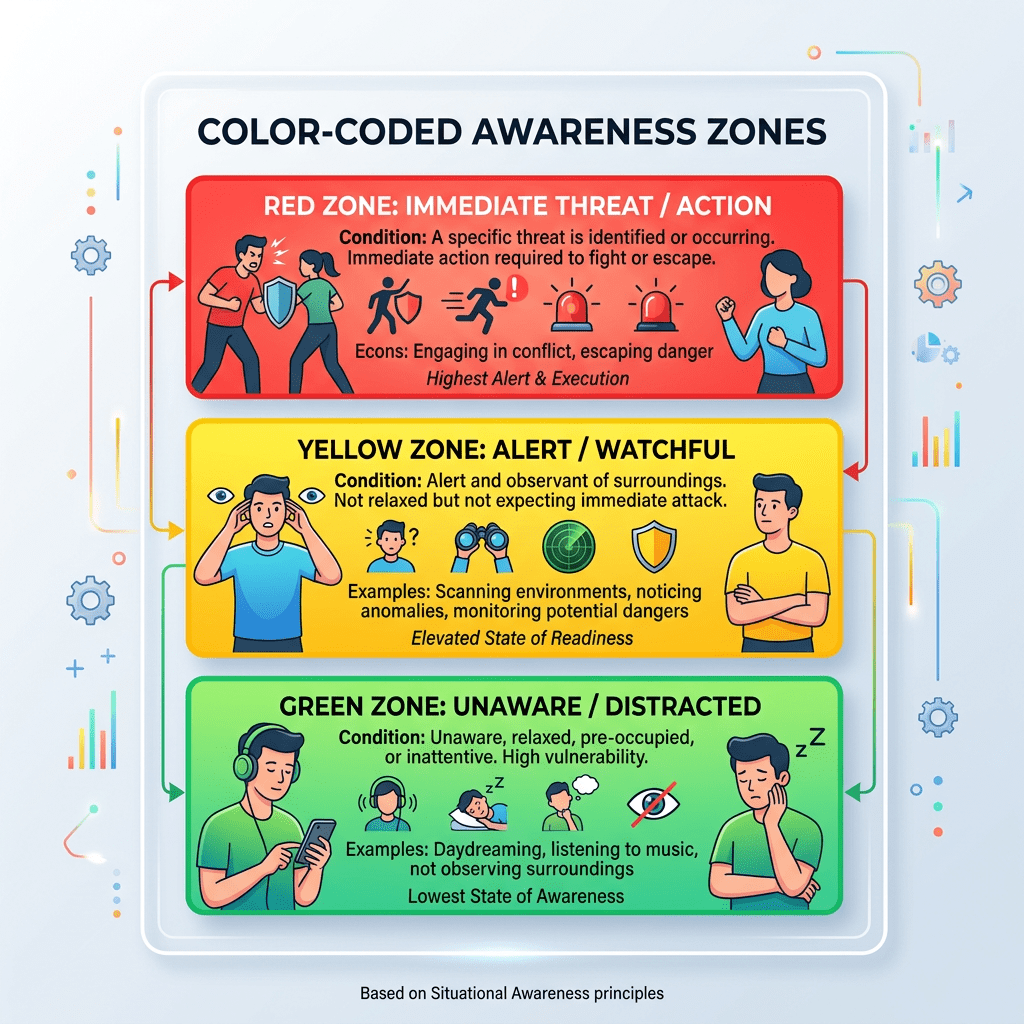
The 3-Zone Awareness System (The Color Code of Combat): This system, adapted for practical street use from military and police models, defines your necessary mental state and appropriate behavioral response in any environment.
Green Zone (Relaxed Awareness): The Sanctuary. You are inside a known, secured location (e.g., your locked home, a secure office). You can afford to relax and fully decompress mentally. Your senses are passive. Danger: Remaining in the Green Zone mentally while in a public or unsecured area is the definition of a soft target.
Yellow Zone (General Awareness): The Default State. This must be your constant, default state anytime you are in public, outside a secure area, or in transit. You are globally aware of your environment (the 360-degree sphere around you). You are scanning for “anomalies”—events, people, or objects that are out of place or context. You are alert but not paranoid, open to sensing potential threats, and actively maintaining situational awareness.
Red Zone (Tactical Alert): The Threat is Identified. An anomaly has been detected and has been verbally or physically identified as a credible threat (a person is closing distance too quickly, a confrontation has begun, or a weapon is sighted). Your senses are acutely heightened, your physical readiness increases (a subtle shift in stance, hands moving to a guard position), and you are actively preparing a concrete, immediate action plan: Evasion or Counter-Ambush.
Black Zone (Action/Engagement): The Conflict is Active. The fight is happening, and you are acting decisively, either by executing a full-speed escape or initiating a counter-ambush maneuver. In the Angoleiro’s context, this means the seamless transition from the Red Zone into a defense/offense sequence (e.g., utilizing a sudden, explosive movement or a well-timed, deceptive strike).
The Best Defense is Evasion: The most effective defense is to recognize the developing danger in the Yellow Zone and avoid the ambush entirely. This involves making a non-confrontational, tactical decision while you still have the element of choice and space. This includes:
Route Modification: Changing your route, crossing the street, or making an abrupt turn into a business.
Distance Management: Increasing your pace and distance from the anomaly, ensuring space is maintained.
Immediate Refuge: Seeking immediate refuge in a public, open business (a coffee shop, a convenience store), or moving directly into a place with high foot traffic, established security, or visible cameras. The goal is to change the environment to one less conducive to an ambush.
Exercises to Develop Awareness

Awareness exercises are not just physical drills; they are profound mental conditioning focused on making the “Yellow Zone”—a state of relaxed, yet focused, attention—the most comfortable and natural state of being. This elevated state of readiness is the Angoleiro’s most potent defense against the sudden, dynamic shifts inherent in both the roda and in life’s less predictable skirmishes.
The goal is to dismantle the reliance on the “White Zone” (unaware, relaxed, and complacent) and to significantly reduce the time spent transitioning from “Yellow” to “Orange” (specific, heightened alert to a defined threat) or “Red” (immediate action).Core Principles of Awareness Conditioning
- Normalization of “Yellow”: The exercises train the mind to perceive the Yellow Zone not as a stressful alert, but as a neutral, sustainable baseline. This is achieved through prolonged, low-intensity mental scanning and environmental processing.
- Sensory Expansion: Deliberate practice in expanding the field of perception—using peripheral vision to its maximum extent and consciously mapping the immediate acoustic and energetic environment without fixing the gaze or attention on any single point.
- Predictive Pattern Recognition: Drills that force the mind to simultaneously track multiple moving elements (people, objects, rhythm, etc.) and subconsciously predict their most likely immediate trajectory. This forms the basis for proactive counterambush.
Sample Awareness Drills (Mental and Physical)
The Peripheral Scan: While walking or resting, commit to noticing every person, object, and movement in your peripheral vision without ever turning your head or focusing your eyes directly on them. Mentally note their color, direction, and speed. The objective is to see the whole without losing sight of the immediate.
The Audio Map: Close your eyes or focus on a single, non-moving point. Consciously identify and locate a minimum of five distinct sounds (a car horn, footsteps, a bird, the wind, a conversation). Mentally place them on a 360-degree map around you. This develops auditory threat assessment.
The Roda Rhythm Absorption: During a roda, stand outside the circle. Instead of focusing on the players, focus on the overall rhythm of the music and the clapping. Allow your attention to drift between the berimbau tempo, the clapping cadence, and the players’ energy without prioritizing any one element. The goal is to feel the flow and any subtle disruption to it.
The Transition Test (From White to Yellow): Engage in a deliberate “White Zone” activity (reading, watching television). Set an arbitrary, silent mental trigger (e.g., the sound of a closing door). When the trigger occurs, instantly transition your mental state to Yellow—full environmental awareness—in less than one second, then immediately return to the White Zone activity. This sharpens the ability to snap into readiness without panic.
By practicing these awareness exercises consistently, the Angoleiro develops an internalized, non-aggressive vigilance, transforming the Yellow Zone from a temporary alert into a deep, reflexive aspect of their presence.
II. De-escalation and Disengagement: The Non-Violent Strategy
Recognizing and utilizing all opportunities to avoid physical conflict is the true hallmark of a master Angoleiro. The Angoleiro understands that the best fight is the one completely avoided, a testament to superior situational awareness and strategic discipline. The ability to seamlessly employ sophisticated verbal skills and non-threatening body language to defuse a hostile situation before it turns physical is an invaluable, often life-saving, skill that correctly prioritizes survival over ego, pride, or material possessions. This section details the psychological and tactical framework for achieving non-violent resolution.
The Psychology of Defusing Conflict: The Power of Intentional Communication
Mastering de-escalation requires treating communication as a tactical tool, often referred to as “Verbal Judo.” The goal is not to win an argument, but to manage the attacker’s emotional state and create space—both mental and physical—for a safe retreat.
A. Verbal Judo (Tactical Communication)
Calm and Controlled Voice (The Voice of Reason): The most critical non-verbal audio cue is your voice. Maintain a steady, low-pitch voice (often referred to as a “professional tone” or “voice of reason”). A lower register is inherently less aggressive and more soothing than a high-pitched one, which can convey fear or hysteria. Raising your voice, shouting, or adopting a combative, sarcastic, or aggressive tone instantly escalates the threat level and may trigger a violent pre-emptive response from an already agitated aggressor. Your primary mission is to project an exterior of calm and control, even if you do not feel it internally. This measured delivery creates a psychological anchor of stability in a volatile situation.
Active Listening and Acknowledgment (The Strategy of Buying Time): Temporarily acknowledge the attacker’s demands or emotional state (e.g., “I see you’re upset about this,” or “I understand you want my wallet, and I’m ready to comply”) without being subservient, argumentative, or making any permanent commitment. Do not challenge their narrative or legitimacy. The primary, overriding goal of this verbal engagement is to buy time—to create a necessary mental pause in the aggressor’s mind. This brief reprieve is tactically vital, allowing you to conduct a full and rapid threat assessment (determining the attacker’s intent, identifying potential weapons, and assessing their commitment level), observe the immediate environment for secondary threats (lookouts, partners, hidden weapons), and plan a safe disengagement or, if necessary, prepare for a counter-ambush. Use simple, non-committal phrases like, “Just a moment,” or “Let me think about that for a second,” to extend this critical window.
Setting Boundaries (Non-Aggressively): While the Angoleiro avoids a direct challenge, maintaining physical and psychological distance is paramount for safety. Use polite but firm language to establish a non-threatening distance without being confrontational. Examples include, “Please don’t come any closer, I’m happy to cooperate from here,” or “I’ll do what you ask, but let’s just keep some space between us for a moment.” This non-aggressive boundary setting demonstrates awareness and control without overtly threatening the aggressor’s sense of dominance.
B. Non-Aggressive Posture and Body Language
Non-verbal communication often speaks louder than words, particularly in high-stress situations. The Angoleiro must project compliance while maintaining optimal readiness.
The Neutral, Open Stance (The Fence Position): Adopt an open-handed, relaxed, and neutral stance. The body should be angled slightly off the centerline of the aggressor—the “interview stance”—which allows for maximum lateral movement and reduces the target profile. Keep your hands visible, palms facing slightly toward the attacker, generally held loosely at chest or face level (the classic “fence” position). This communicates non-aggression (“I am not a threat or a challenge, and my hands are empty”) while simultaneously placing your hands in a highly ready position, instantly poised to defend (guarding the throat and face) or launch a preemptive strike if the situation turns physical.
Avoid Challenging Cues: Absolutely do not clench your hands into fists, aggressively square your shoulders directly toward the attacker, invade the aggressor’s personal space, or exhibit overt signs of anger, contempt, or paralyzing fear. Any gesture that can be interpreted as preparation for a fight is a major escalation risk. Maintain a relaxed face and jawline to avoid conveying tension.
Strategic Eye Contact (Scanning, Not Staring): Avoid aggressive, sustained, or “staring down” eye contact, which is a universal primate signal of challenge, threat, and a prelude to combat. Instead, use brief, intermittent glances to monitor the attacker’s actions (especially their hands and hips for weapons) and simultaneously survey the surroundings for escape routes or secondary threats. Maintain a soft focus to observe the whole scene (the attacker, the environment, and escape paths) rather than fixating on one point. This scanning behavior shows vigilance without confrontation.
Compliance as a Tactical Tool: The Calculated Loss
The Angoleiro recognizes that life and safety are the ultimate currency. All material possessions are secondary.
Compliance vs. Safety (Prioritizing Life): In the vast majority of property-based crimes (e.g., mugging, armed robbery), the attacker’s primary goal is rapid material gain, not personal physical harm. Immediate and non-confrontational compliance with property demands is often the most effective and quickest way to de-escalate the situation and prevent it from escalating to unnecessary physical violence. Property is replaceable; your life and physical health are not. The moment a weapon is produced or lethal force is threatened, the tactical calculation shifts entirely toward compliance unless your life is still clearly threatened after compliance (e.g., the attacker demands you enter a car or walk to a secondary location).
The Decoy Strategy (A Controlled Exchange): The prepared Angoleiro always employs forethought. Always be prepared to use “decoy” cash or a sacrificial wallet as a means of satisfying the attacker’s objective quickly and cleanly. This “sacrificial wallet” should contain a small amount of cash, expired or cancelled cards, and absolutely no sensitive identification or valuable information. Handing over the decoy item provides a powerful psychological release for the aggressor—they have achieved their immediate objective and obtained their “trophy.” This outcome often leads to their immediate disengagement, thus allowing you to retreat safely without further interaction or opportunity for the situation to worsen.
Avoid Sudden Movements (The Transparency Rule): If you must reach for a wallet, a bag, or a decoy, it is imperative to announce your movement clearly and slowly to mitigate the attacker’s fear of being suddenly attacked. Use transparent verbal commands: “I’m reaching into my side pocket now for my wallet, I’m moving very slowly,” or “I’m going to put my hand in my jacket to get the money now.” This preemptive announcement ensures the attacker does not mistake your action for drawing a weapon or initiating a physical attack, which is a common trigger for a violent, reactionary response. Every action must be deliberate, slow, and communicated.
III. The Moment of Attack: Explosive Transition and Disruption
If the ambush is unavoidable and violence is initiated, the response must be immediate, explosive, and completely disorienting to the attacker. This is not the time for hesitant maneuvering or tentative defenses.
Break the Line (The Evasive Shift): Execute an immediate, powerful movement—a sudden shift, a deep duck, or a strong angular step—to move your center mass and head away from the attacker’s initial line of attack. This action immediately breaks the attacker’s physical targeting and shatters their psychological momentum and expectation of success.
Create Space and Time (The Esquiva): Disorienting, fluid movements, often utilizing the low, evasive steps and foundational esquivas (escapes/evasions) of Capoeira Angola, create the necessary fraction of a second to transition from a pure defense into a structured counter-offensive or a decisive, aggressive escape. The low ground movement makes you a difficult, rapidly moving target.
The Counter-Offensive Principle (Destroy the Structure): The immediate goal of the counter-attack is to destroy the attacker’s balance, disrupt their breathing, or overwhelm their vision, thus neutralizing their immediate threat capability. This could be a simple, hard palm strike to the chin, a low kick to the knee or shin, or a fast, powerful sweep (rasteira) designed to take the fight to the ground on your terms, not theirs. The counter-attack must be simple, overwhelming, and aimed at the most accessible, vulnerable target.
IV. Armed and Unarmed Protocols: Control, Control, Control – The Absolute Imperative
The execution of any defensive maneuver, irrespective of the nature, severity, or vector of the aggression—whether a spontaneous grab, a calculated, brutal strike, or a life-threatening assault with a deadly weapon—must be fundamentally and non-negotiably underpinned by the singular, ironclad principle of establishing and ruthlessly maintaining absolute physical and psychological control over the attacker. While the specific, fluid defenses employed will be dynamically tailored to the immediate, evolving threat environment, the core, unwavering mindset of imposing one’s will—of instantly turning the tables from a state of victimhood to one of decisive command—remains the constant, the essential prerequisite for survival.—–Unarmed Threats: Subverting Strength with PrecisionAgainst Grabs and Holds (Targeting Weak Points for Disruption):
A direct, symmetrical struggle against superior physical strength, greater mass, or a deeply locked, static hold is an inherently flawed, high-risk proposition. This approach leads only to the rapid, unsustainable depletion of one’s energy reserves, severe muscular fatigue, and a compounding of vulnerability. The master counterambusher operates from a position of strategic intelligence, recognizing that the human body, however impressively muscular or conditioned, is a structure riddled with critical, accessible structural and neurological weak points. The overarching strategy is thus to immediately redirect the confrontation from a futile, energy-draining test of brute strength to an asymmetrical, focused test of the attacker’s pain tolerance, ability to maintain focus, and mental fortitude under unexpected duress.
Actionable Strategy: The Doctrine of Focused Attack: One must focus laser-like intensity on immediately and violently attacking the attacker’s most vulnerable and accessible anatomical points. These are the unarmored seams in their defense: the eyes (orbital sockets), the throat (larynx and trachea), the groin (testes/perineum), the small, complex joints of the hands (fingers and thumb), and major rotational joints (the wrist, elbow, and knee). The intent is to generate an overwhelming sensory input that bypasses their muscular strength.
The Principle of the Window: Creating the Tactical Lapse: The core objective of the attack on a weak point is not necessarily to inflict an immediate, debilitating injury that ends the fight outright, but rather to create a momentary, critical lapse in the attacker’s physical and mental architecture. This violent sensory shock forces a break in their concentration, a momentary loss of mental clarity (the OODA loop disruption), and, most crucially, a reflexive slackening of their grip strength or a breakdown in their dominant posture. This singular moment—often a mere fraction of a second—is the “window.” It is the precise, fleeting opportunity that must be exploited for a strong, explosive, and decisive escape, or the rapid, seamless transition into a controlling counter-lock, highly leveraged joint manipulation, or an immediate, aggressive takedown designed to end the encounter on the ground on one’s own terms.
Leverage, Not Power: The Geometry of Conflict: The successful escape or counter-offensive is never achieved by directly struggling against the opponent’s superior strength. It is achieved by intelligently leveraging the attacker’s own pain, mass, and reflexive reactions against them. This mastery involves the precise application of angular and rotational force (creating a torque that their joints cannot absorb), the intense, sudden application of pressure to neurological points, and the skillful use of misdirection to shift their balance and attention, thereby destroying their foundation before applying the finishing control measure. The goal is to make their own body their enemy.
Against Strikes (The Integration of Defense and Offense): The Protocol of Simultaneous Action

The fundamental flaw in the traditional, reactionary model of combat—the “block, then counter” sequence—is its inherent surrender of the most critical element: time. In any high-stakes confrontation, the attacker, by initiating the motion, momentarily possesses the decisive advantage. A delayed response grants the attacker a crucial fraction of a second to recover, re-balance, or shift their attack vector.
The Angoleiro elite protocol rejects this sequential approach entirely. It demands a sophisticated, integrated motion where defense and offense occur simultaneously, creating a single, fluid, and uninterrupted action. This principle turns the defender’s response from a reaction into a pre-emptive disruption.
The Dual-Action System: Offense as Defense
The core of this system is the deliberate execution of simultaneous block-and-counter movements. The defensive action must not be seen as a mere static shield, but as the opening phase of the attack.
Execution and Target Selection: As the opponent’s strike accelerates toward its target, the defending limb or body part executes its maneuver. This movement (a sharp deflection, a firm parry, or an aggressive stop-hit that jams the strike at the source) must instantly transition into the offensive strike by the “free” limb. The counter-strike must be executed along the shortest possible line to vital, disruptive targets.
High-Priority Targets:
The throat/trachea: A debilitating strike that severely compromises the opponent’s ability to breathe and communicate.
The eyes/orbital sockets: A high-impact target that causes immediate sensory overload, disorientation, and psychological shock.
The floating ribs (T11 & T12): These ribs, unprotected by cartilage connections to the sternum, are vulnerable to a sharp, focused strike, leading to intense pain and temporary incapacitation due to diaphragm spasm.
The ‘Through-Block’: Redirection and Compromise
The concept of the ‘Through-Block’ elevates the defensive motion from a simple stopping mechanism to a tool of psychological and physical dominance.
Redirection, Not Absorption: The objective is not to absorb the incoming force, which taxes the defender’s structure, but to redirect it. By meeting the force slightly off-center and maintaining forward pressure, the defender uses the attacker’s own momentum against them, often causing the attacker’s body to twist or lurch past their intended target.
Compromising Structure and Balance: The successful Through-Block must instantly disrupt the attacker’s foundation. This subtle, yet critical, imbalance makes the subsequent counter-strike significantly more effective, as the attacker cannot brace or mount an effective secondary defense.
Maintaining the Initiative: Crucially, the counter-strike is delivered along the trajectory established by the defensive move. This continuous, flowing energy maintains the initiative. The psychological impact is profound: the attacker perceives their assault as having failed instantaneously and having been immediately punished, shifting the dynamic to the defender’s absolute control. The exchange is not two separate events (block/counter), but one unified, overwhelming act.
Armed Threats: The Rule of Control and Muzzle Discipline Weapon-Based Assaults (Blades and Impact Weapons):
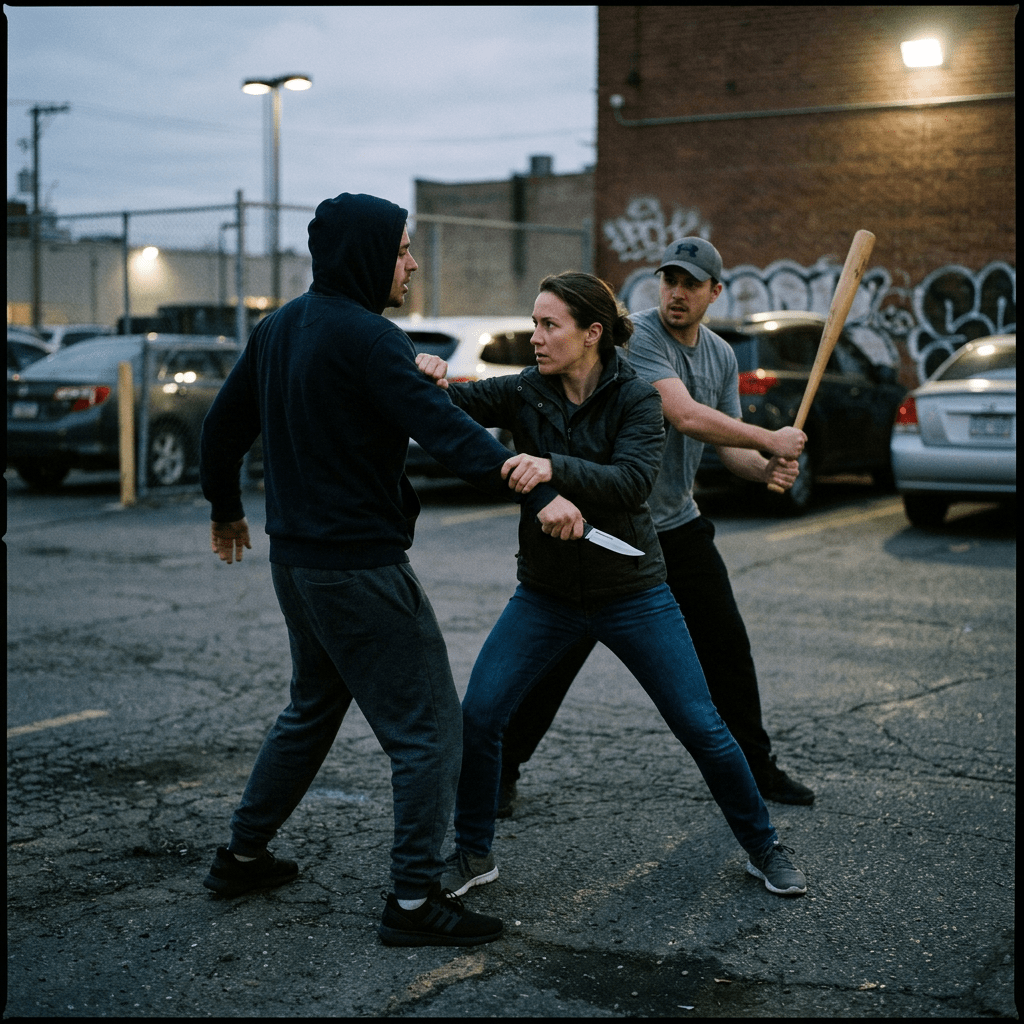
The presence of a sharp or heavy weapon fundamentally changes the risk calculation. Error tolerance drops to zero. The defense must be aggressive, committed, and focused entirely on eliminating the operational capability of the weapon.
The Primary Principle: Control the Weapon Limb: This is non-negotiable. Never attempt to block the blade or the blunt instrument directly with the forearm or hand—this guarantees severe injury. The focus must be on controlling the structure that holds the weapon (the arm, wrist, or hand).
Evasion and Entry: The first, instantaneous movement must be aggressively off the line of attack. This means moving the body out of the path of the swing, thrust, or chop, closing the distance, and initiating control simultaneously. Stepping deep into the attacker’s space disrupts their power generation.
The Follow-Up: Use the closest available counter (a strike, joint lock, or takedown) to immediately destroy the attacker’s structure, balance, and physical ability to continue the assault. This is a commitment to rapid, decisive incapacitation.
Firearms (Close Quarters: The Absolute High-Risk Scenario):
Defending against a close-range firearm threat requires an extraordinary blend of psychological commitment, speed, and precision. Hesitation is fatal. The goal shifts from merely escaping to total control of the engagement.
- The Principle: Control the Attacker and the Weapon: If a gun is pointed directly at the body at close range (within arm’s reach), the immediate, aggressive counter is mandatory. The core action is a simultaneous Control and Evasion.
- Muzzle Discipline: The head and body must be aggressively and instantly moved out of the muzzle’s line of fire. Even a fraction of an inch can change the trajectory of the bullet. This is often achieved through a lateral movement and deep entry.
- Immediate Closure and Disruption: Close the distance immediately. Once contact is made, the goal is to control the weapon and the weapon arm to disrupt the attacker’s ability to aim, cycle the weapon, or pull the trigger. Techniques often involve pinning the slide/cylinder, manipulating the wrist/hand, and simultaneous striking to overwhelm the attacker’s focus. This high-risk scenario demands absolute, unwavering commitment and zero physical or mental hesitation. Survival is predicated on initiating the attack first, not waiting for the trigger pull.

How to Keep from Getting Mugged: The Principles of Urban Security
The ultimate foundation of surviving a street ambush lies in preventing it from ever being initiated. Mugging and robbery attempts thrive on the victim’s perceived lack of awareness, preparation, and confidence. Adopting the following five principles will significantly reduce your risk profile and elevate you from a “soft target” to a “hard target”:
1. Situational Awareness (The 360° Check and Auditory Vigilance): The Foundation of Counterambush
The most effective defense against an ambush is to prevent it from ever happening. This requires cultivating a state of persistent, non-paranoid vigilance—a complete integration of your senses and intellect with the immediate environment.A. Sensory Discipline: The Proactive Elimination of Blinders
- The Veto on Personal Electronics: Never allow personal electronics to create sensory isolation. The use of headphones, particularly noise-canceling models, is strictly prohibited in transit or unsecured locations, as they completely block out vital auditory cues. Similarly, engaging in loud, distracting phone calls or succumbing to excessive screen focus monopolizes critical visual and cognitive bandwidth. Auditory and peripheral visual cues are not secondary; they are the first and most critical alert systems. The human brain can process an unexpected sound faster than a visual change in the periphery.
- Reading the Soundscape: Train yourself to identify anomalies in the ambient sound. These auditory cues often precede a visual confirmation of danger:
- Footsteps Accelerating/Decelerating: A sudden change in pace behind you, or the sound of multiple sets of feet converging.
- Muffled Conversations/Commands: Voices that are suddenly hushed or spoken with an intensity that suggests coordination.
- Vehicle Anomalies: The distinct sound of a vehicle slowing down unexpectedly in a remote area, or the revving of an engine preparing for rapid movement or a blockade.
- Inappropriate Silence: An unnerving lack of expected urban noise, which can indicate that an area has been subtly cleared or is under observation.
B. Constant Scanning and The OODA Loop
Your visual attention must be a dynamic, fluid process—not a fixed stare. This constant scanning ensures you are perpetually updating your mental model of the environment, feeding the OODA Loop (Observe, Orient, Decide, Act) which is essential for rapid defensive reaction.
- Subtle, Non-Aggressive Scanning: Your eyes should subtly and continually trace the environment—utilizing a gentle ‘Z’ or ‘S’ pattern of movement. Avoid fixed, aggressive staring, which can provoke confrontation or prematurely signal your awareness to a potential adversary.
- Utilizing Peripheral Vision: Consciously engage the full range of your peripheral vision for movement to the sides. The periphery is highly sensitive to motion and contrast, providing early warnings of convergence.
- “The Rear-View Check”: This is a mandatory, deliberate element of constant scanning. Every 15-20 seconds (adjusting frequency for high-threat environments like narrow corridors or crowded markets), execute a quick, decisive glance over the shoulder. This check must be fast enough not to impede your forward momentum but comprehensive enough to identify anyone rapidly closing the gap behind you. It denies an attacker the element of surprise from the six o’clock position.
C. Proactive Threat Mapping and Contingency Planning
Situational awareness is incomplete without leveraging observations into actionable intelligence. Threat Mapping transforms passive observation into active defensive planning.
- Identification of Immediate Threats (Hard Threats): Proactively identify individuals or objects that deviate from the normal baseline:
- Suspicious Loiterers: Individuals who appear out of place, repeatedly observing a location or moving with no apparent purpose.
- Vehicles Double-Parked or Abandoned: Vehicles positioned to obstruct traffic or movement, particularly if they contain multiple occupants or appear hastily left.
- Carrying Anomalies: Identifying individuals concealing their hands, adjusting clothing in a way that suggests a hidden object, or carrying bulky items that could serve as weapons or containers for devices.
- Identification of Escape Routes (Soft Targets for Egress): Before a threat manifests, you must have a pre-selected route of egress. Never allow yourself to be confined to a single line of travel. Look for:
- Open Side Streets and Alleys: Pathways for rapid diversion from the primary threat vector.
- Breaks in Fences, Hedges, or Barriers: Low-profile means of exiting a secured or blocked area.
- Access Points to Adjacent Buildings: Unlocked doors, loading docks, or fire escapes that offer temporary sanctuary or a change in the attack geometry.
- Identification of Immediate Sources of Help (Safe Havens): Know where you can rapidly move to secure assistance or cover:
- Open Businesses: Establishments with clear visibility, multiple employees, or security guards (e.g., banks, 24-hour diners).
- Police or Security Stations: Obvious points of authority.
- Large Groups of People: Moving toward density can deter an attack that relies on isolation. Always favor groups over isolated individuals.
- Anticipation and Simulation: Mentally run “what-if” scenarios. If that vehicle suddenly pulls across the street, where do I go? If those two people start moving toward me, which doorway offers the best momentary defense? This pre-visualization reduces decision-making lag during a genuine crisis.
- Projection of Confidence (The Unattractive Target):
- Intentional Presence: Attackers seek easy, non-confrontational targets. Walk with obvious purpose, maintaining an upright, strong posture, and a steady, determined pace. Projecting internal confidence creates an external shield.
- Eye Contact: Make brief, confident (not aggressive or staring) eye contact with people around you, especially those approaching or lingering nearby. This signals that you have seen them, you are aware of their presence, and you are not a passive, daydreaming victim. An attacker prefers to remain completely unseen and unacknowledged until the moment of the attack.
- Route Planning and Selection (The Unpredictable Path):
- Avoid Predictability: Routines create predictable target opportunities for a determined attacker who may be conducting surveillance. Whenever possible, vary the time and route of your daily commutes or walks.
- Illumination and Population: Prioritize well-lit, populated, and open routes, even if they are slightly longer. The risk reduction is dramatically worth the extra distance or time. If you are forced to walk through a known high-risk or poorly lit area, heighten your awareness level to Red Zone (Tactical Alert). Walk near the curb, facing oncoming traffic, to spot vehicles slowing down or pulling up alongside you.
- Managing Valuables and Compliance Strategy:
- Concealment: Do not flaunt expensive or desirable items (designer bags, visible jewelry, top-end electronics). Keep wallets, keys, and phones secured in inner, zippered pockets that require a deliberate effort to access. The goal is to avoid advertising yourself as a target.
- The Decoy System: Always carry a “throwaway” or “decoy” wallet containing a small amount of cash and expired, non-essential cards. If confronted and the attacker demands property, immediate and non-confrontational compliance with this demand can often satisfy the attacker’s objective and de-escalate the situation, preventing the interaction from becoming physical. Remember, property is replaceable; personal safety is not.
- ATM and Transitional Space Protocols (Heightened Vulnerability):
- Transitional Vulnerability: Be especially vigilant in transitional spaces—areas where you move from public safety to private vulnerability (parking garages, stairwells, building lobbies, public transit stations, and doorways). These areas limit your sight lines and escape routes.
- The Pre-Transaction Check: At ATMs or other transactional points, always perform a full 360-degree scan of your immediate surroundings before approaching the machine and immediately after completing the transaction. Park close to the entrance and avoid using isolated or dark ATMs late at night.
- Trust Your Instinct (Awa): If you feel the slightest sensation of unease—a gut feeling often referred to as your survival instinct or Awa—trust it implicitly. Your limbic system has likely processed subtle cues that your conscious mind has missed. Leave the area immediately, change your route, or enter a safe, open business to regain security. Your intuition is a powerful, primal survival tool that must never be ignored.
The Angoleiro’s Guide to Mastering the Counterambush: A Deep Dive into the Art of Self-Defense within Capoeira Angola

Summary: This comprehensive guide delves into the advanced strategies and techniques essential for practitioners of Capoeira Angola to effectively neutralize and counter an ambush. It is a vital resource for Angoleiros seeking to deepen their understanding of self-defense within the context of the jogo (game) and its philosophy, moving far beyond rote memorization of movements to embody the strategic, survivalist spirit of the art. The counterambush is the ultimate test of the Angoleiro’s complete mastery, demanding the seamless integration of mental fortitude, tactical deception, and fluid technical execution.
I. The Philosophical and Psychological Foundation: Cultivating the Internal Jogo

The Angoleiro must first master the internal landscape, for the battle is won or lost in the mind long before the body moves. The guide systematically breaks down the psychological preparedness required to face a surprise attack. This starts with cultivating and maintaining calma (calmness) under duress. This is not merely the absence of panic or a passive resignation; it is an active, centered state—a form of kinetic meditation—that allows for clear, immediate processing of the threat and access to the full repository of practiced movements.
The philosophy of Capoeira Angola teaches that fear is the greatest enemy, locking the body, shortening the breath, and dulling the mind’s ability to perceive opportunity. By embracing the fundamental unpredictability of the jogo and understanding that the ambush is simply the most intense, compressed form of the game, the Angoleiro can harness the biological surge of adrenaline not for panic, but for acute, laser-like focus. The initial micro-second of surprise must be met not with a freeze, but with the immediate, visceral knowledge that the body already knows how to evade and survive. This is the practical application of the philosophical ideal: to make the self-defense mechanism as automatic and beautiful as the dance itself.
II. The Strategic Acuity: Reading the Attack and Employing Malícia
The core of the counterambush lies in tactical execution and the utilization of deceptive movements, or malícia. This concept is central to Capoeira Angola and translates to cunning, trickery, or informed mischief. It is the wisdom of the oppressed, turning a position of vulnerability into one of sudden, unexpected advantage. In a counterambush scenario, malícia is the art of feigning a reaction or a movement that leads the aggressor to misread the defender’s true intent, causing them to commit their attack to an empty space or a non-critical target.
Initial Evasion and Redirection: The First Fraction of a Second
The first fraction of a second is critical and determines the success of the entire counterambush sequence. The Angoleiro must prioritize evasive movements that are simultaneously defensive and offensive in their potential. Techniques are explored for quickly shifting the body’s center of gravity—using low, grounded movements like the queda de rins (fall on the kidneys) or a sudden negativa (negative position)—not just to avoid the blow, but to simultaneously create an angular vector that disrupts the attacker’s straight-line forward momentum.
The goal is not merely to escape the attack, but to redirect the force of the attack, using the aggressor’s commitment against them, thereby turning their advantage into a vulnerability. This redirection can take the form of subtle changes in posture that cause the attacker to overshoot, or active blocks that guide the strike harmlessly past, setting the stage for the counter-attack from an unexpected angle. The Angoleiro seeks to be nowhere the attacker expects, while simultaneously positioning themselves for the immediate transition to offense
III. Mastering Technical Execution: The Seamless Counter-Attack
The guide emphasizes that the counter-attack must be rooted in the fundamental movements of Capoeira Angola, ensuring that the response is fluid, natural, and instantly deployable. The principle of ginga—the foundational swaying movement—must inform the defensive footwork, allowing for instantaneous transitions.

The Foundation of Attack: Defense into Offense
The transition from defense to offense must be seamless, a continuous expression of the jogo. After successfully evading and disrupting the attacker’s balance and psychological equilibrium, the Angoleiro deploys counter-attacks utilizing the power and geometry inherent in the art. This includes strategic use of:
Low, Sweeping Techniques (Takedowns): Utilizing the rasteira (sweep) or banda (takedown) to capitalize on the attacker’s destabilized stance from the initial evasion. By aiming low and leveraging the attacker’s forward momentum, the Angoleiro can effect a powerful, non-damaging takedown that completely neutralizes the threat by bringing them to the ground, where the dynamic of the fight is fundamentally altered.
Translating Momentum into Strikes (Grounded Power): Employing powerful, grounded kicks like the bênção (blessing – a push kick) or chapa (side kick) delivered from a low base. These kicks leverage the body’s full mass and rotational power generated from the low, evasive positions (like the negativa), providing immense force while maintaining the defender’s balance and proximity to the ground. The choice of strike depends entirely on the spatial relationship achieved during the redirection phase.
Reclaiming the Element of Surprise
Since the attacker’s initial advantage was surprise, the Angoleiro must immediately reclaim this element in the counter-phase. This is often achieved through a sudden, unexpected shift in tempo and trajectory. If the defense was slow, low, and fluid, the counter-attack must be fast, sharp, and decisive, utilizing the principle of engano (deception) to mask the final intent. The effective counterambush is a conversation without words, where the Angoleiro’s response is a sudden, definitive statement that immediately re-establishes control over the spatial and psychological dynamic of the encounter.
IV. The Ultimate Goal: Mastery and Survival
Ultimately, the work aims to elevate the Angoleiro’s capacity for immediate and intelligent response. It transforms a surprise attack from a moment of crisis into a platform for demonstrating true mastery and survival. The successful counterambush is a testament to the Angoleiro’s integration of physical acuity, philosophical grounding, and tactical cunning, proving that the deepest understanding of the jogo provides the most potent self-defense. The true master of the counterambush is the one who, through skill and malícia, is never truly caught by surprise.