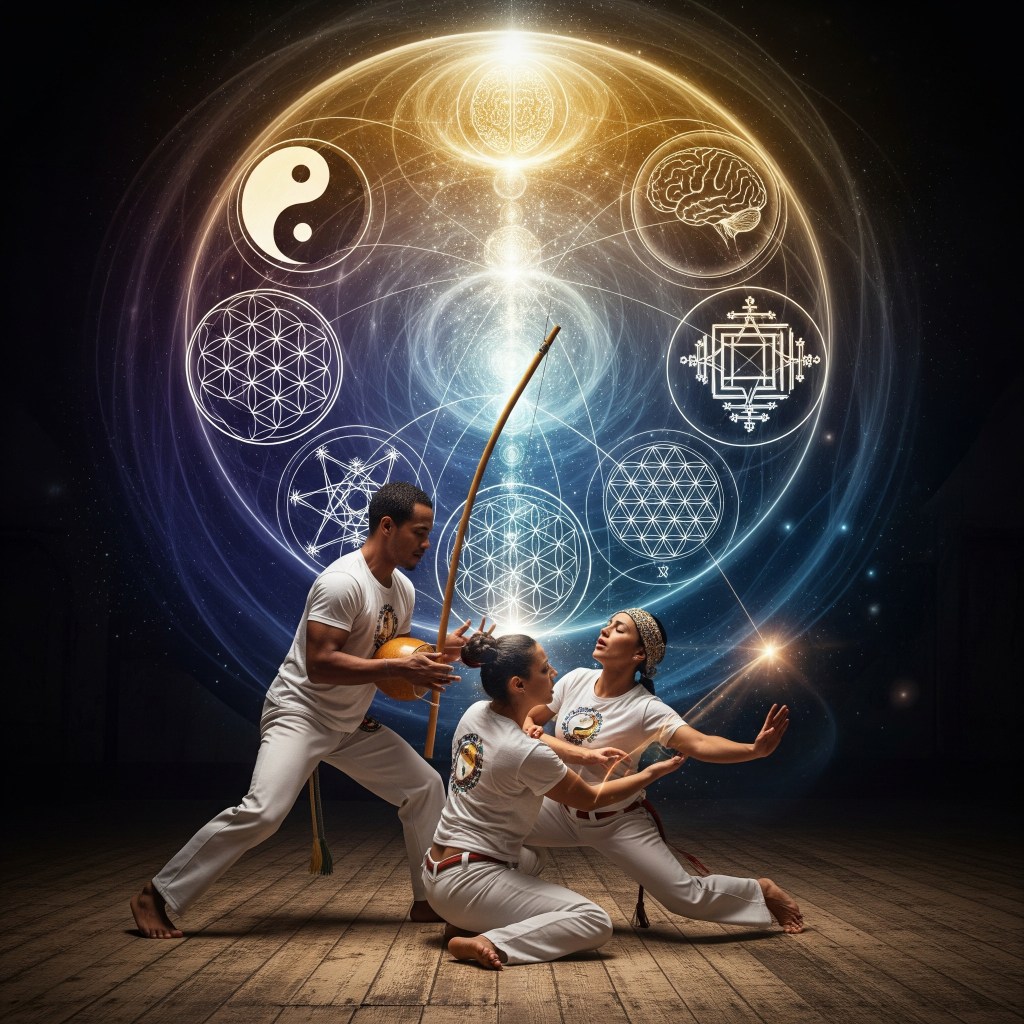
Capoeira Angola, more than just a martial art or dance, can be deeply examined through the lens of metaphysics, the branch of philosophy that investigates the fundamental nature of being and the world. Its practice embodies several core metaphysical concepts, particularly those concerning the nature of reality, mind-body dualism, time, and existence.
The Nature of Reality and Existence:

Capoeira Angola, far from being a simple martial art or dance, serves as a profound, embodied practice deeply intertwined with African-Brazilian metaphysics. At its heart, the entire endeavor is an expression and circulation of *axé* (pronounced ah-shay), a fundamental and vitalistic concept borrowed from the Afro-Brazilian Candomblé and Umbanda religions. Axé is understood as the very life force, the divine power, and the kinetic energy that animates the entire universe and connects all things.
In a metaphysical sense, axé constitutes the underlying, energetic reality that gives purpose and vibrancy to the *roda* (the circle where Capoeira is played) and every participant within it. The game itself is thus elevated beyond mere physical interaction; it becomes a sophisticated negotiation, exchange, and amplification of this essential life force. The reality experienced within the roda is not static but co-created—a dynamic, energized field shaped by the physical actions of the players, the rhythmic and spiritual calling of the musicians (who use instruments like the berimbau to channel the axé), and the invoked presence of the ancestors, whose spirit is believed to guide and protect the circle. This makes the roda a potent microcosm of a larger, constantly vibrating and spiritually charged reality.
The effective Capoeirista does not rely on brute force or simple calculation. Instead, they strive to embody *malícia* (cunning, intuition, and spiritual astuteness). Malícia is a heightened, non-linear form of knowing that radically transcends mere cognitive intellect or pre-planned strategy. It is the ability to tap into a deeper, intuitive, and almost prophetic understanding of the immediate moment, anticipating moves, reading intentions, and seizing opportunities that are invisible to the uninitiated eye. This intuitive flow state is, in essence, a metaphysical knowing of “being-in-the-world” (Dasein) as it is uniquely experienced within the ritual space of the game. The successful execution of a rasteira (sweep) or an esquiva (escape) is not just a triumph of physics; it is a manifestation of the player’s capacity to harness and manipulate the axé through the intelligence of malícia, affirming their unity with the larger, energetic flow of existence.
Mind-Body Unity (Beyond Dualism):

The Embodied Challenge to Cartesian Dualism: Capoeira Angola’s Metaphysics
Western philosophical tradition, particularly since the Enlightenment and the influential work of René Descartes, has often established a fundamental dualism: the separation of res cogitans (the thinking substance, mind, soul, or consciousness) and res extensa (the extended substance, the physical body or matter). This metaphysical chasm posits the mind and body as distinct entities, with the mind frequently granted a superior, non-physical status.
Capoeira Angola, an Afro-Brazilian martial art and cultural practice, offers a profound and practical challenge to this persistent dualism. Its entire execution is predicated on a required and total synergy between what Western thought seeks to divide. The art demands an absolute integration of the physical movement, the complex rhythms and melodies of the accompanying music, the philosophical and historical narrative of the songs, and the sophisticated, often deceptive, strategy of the game (jogo).
In this practice, the body is not merely a vessel for the mind, nor is it a passive object to be commanded. The body is the instrument of thought and expression; the physical form is the very medium through which philosophical truths are explored and articulated. Conversely, the mind is embodied in the physical flow—a spontaneous yet disciplined responsiveness that makes an intellectual distinction between ‘planning’ and ‘doing’ impossible.
The distinctive movements of Capoeira Angola—characterized by their slowness, grounded nature, deceptive fluidity, and the sudden, explosive bursts of energy—serve as a constant mechanism for integration. The practitioner is not only moving but is also engaged in a constant, active listening to the berimbau, the single-stringed musical bow that acts as the conductor, establishing the tempo, rhythm, and style of the jogo. This multi-sensory and highly kinetic engagement forces the practitioner into a state of deep, concentrated flow. In this unitive state, identified by psychologist Mihaly Csikszentmihalyi, action and awareness become one seamless, undifferentiated experience.
This achieved flow state is the metaphysical ideal of Capoeira Angola—a demonstrable non-dualistic existence. It is a state where the ‘self’ is not fragmented by internal monologue or external distraction but is fully present, cohesive, and integrated. The movements of Capoeira Angola are, in essence, a physical philosophy. The jogo articulates truths about balance (between attack and defense, momentum and stillness), opposition (the dialogue between the two players), and continuity (the seamless, perpetual nature of the movement) that are too complex, too immediate, and too kinetic to be adequately captured or preserved by conventional language alone. The body thus becomes a thinking entity, and the art itself is a living treatise on embodied consciousness.
The Metaphysics of Time and Rhythm:

The roda operates on its own temporal reality, governed by the rhythm of the berimbau. This musicality introduces a cyclical and non-linear conception of time, contrasting with the linear, progressive time of Western thought. The game is an endless loop of attack and defense, beginning and return. The tempo dictates the emotional and physical intensity, creating moments that feel drawn out or compressed. The past (ancestral movements, historical context) is constantly present and invoked, and the future (the opponent’s next move) is anticipated within the now. The constant, hypnotic rhythm is a sonic manifestation of the metaphysical truth of constant change and eternal return.
Ethics and Aesthetics of Being:
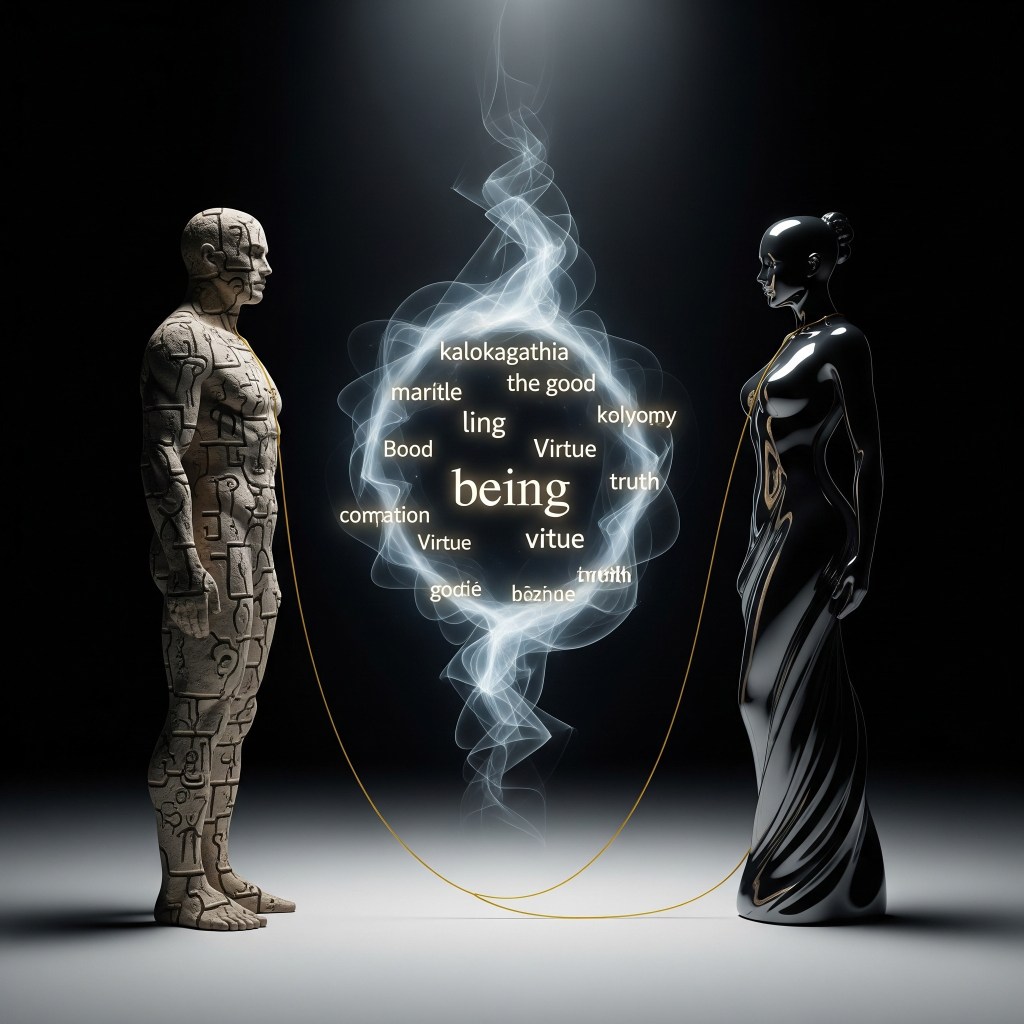
Metaphysics, at its core, delves into the fundamental nature of being and the world. Beyond questions of mere existence (ontology), it is profoundly concerned with the transcendentals: what makes a being good, true, or beautiful (axiology). In the practice of Capoeira Angola, these concepts are not abstract philosophical ideals but deeply embodied, practical realities that are inextricably intertwined.
The aesthetic beauty of the movement—the ginga (sway), the aú (cartwheel), the rasteira (sweep)—is not merely decorative; it is inseparable from the ethical performance. This beauty is characterized by grace, an economy of effort, and a deceptive quality that masks intent, embodying the principle of malícia (cunning) without maldade (malice).
Playing a “good game” (jogar bonito) is therefore a holistic mandate. It transcends mere physical skill or athletic prowess. It is a dialogue of mutual respect, a display of cleverness that seeks to elevate the interaction rather than dominate or injure. The “goodness” of the game resides in the Angoleiro’s capacity to engage fully in the metaphysical dialogue of the roda (the circle where Capoeira is played). The roda becomes a crucible where the Angoleiro’s character, skill, and spiritual focus are tested and revealed.
The Angoleiro’s performance is, in essence, a meditation on existence—a living philosophy (práxis) that defines their being in relation to others, to the historical and spiritual legacy of the Capoeira community, and to the cosmic energy of axé. Axé is the spiritual force, the life-giving power, or the energy of creation that is invoked and circulated within the roda. To play well is to channel and honor this axé.
Thus, the art of Capoeira Angola functions as a praxis of ontology. It is a continuous, physical, and spiritual process of defining what it means to exist as a conscious, social, and spiritual being. The Angoleiro’s movements are not just steps; they are philosophical statements on reciprocity, freedom, resistance, and the enduring nature of the human spirit. The physical body becomes the vessel for the expression of the highest metaphysical truths.