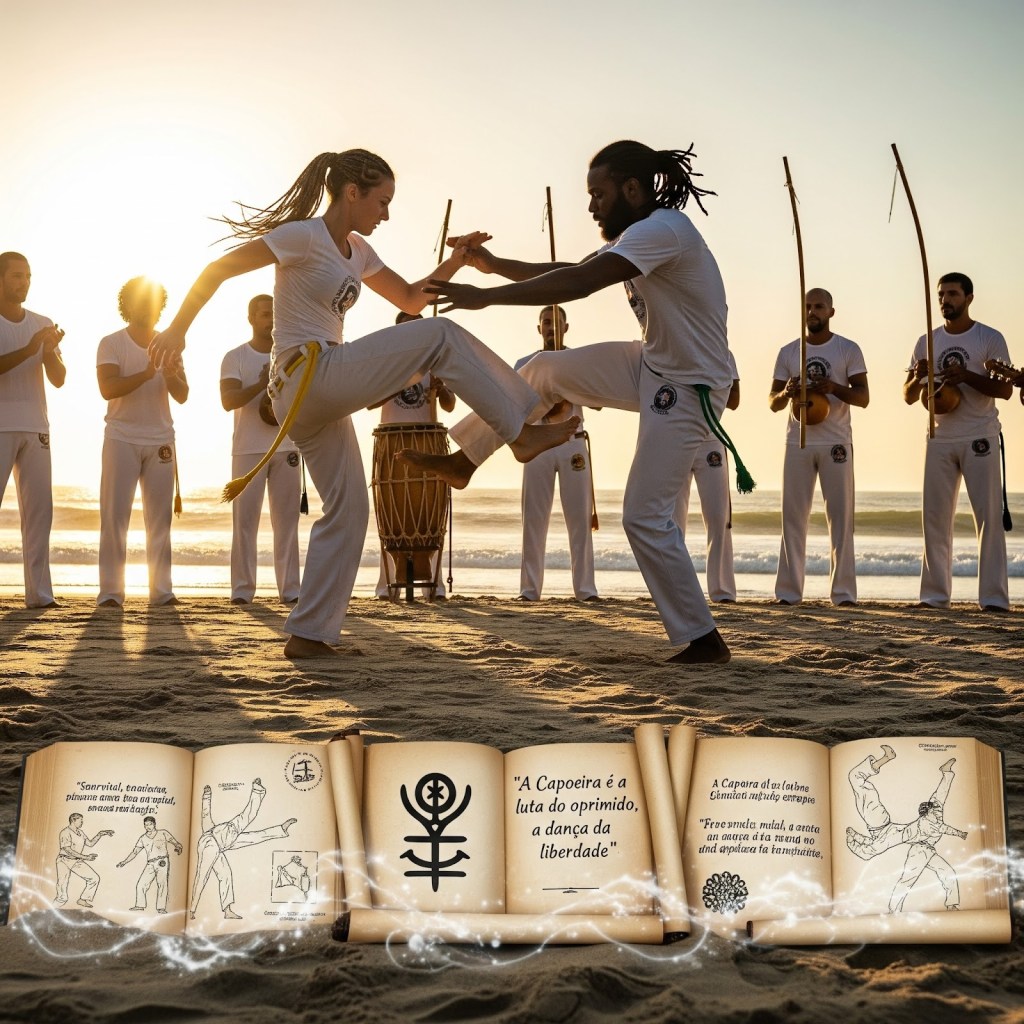
This comprehensive collection of wisdom, meticulously gleaned from a diverse array of teachers over many years, offers a profound and multifaceted insight into the intricate nature of martial arts, survival, and personal development. These axioms, while not presented in any rigid hierarchical order, each hold significant weight and become particularly prominent and applicable depending on the specific circumstances and challenges faced. They represent a living philosophy, adaptable to the fluid realities of conflict and life.

Mastering Movement and Observation: The Genesis of Effortless Action
The pursuit of achieving truly perfect movement is an intricate and deeply multifaceted journey, commencing with keen, deliberate observation. This initial phase necessitates carefully studying individuals who consistently exhibit superior fluidity, grace, and efficiency in their actions. It also extends to those who flawlessly embody the specific techniques one aspires to master, whether in the realm of physical arts, sports, or even everyday tasks requiring precision and control. This external learning is absolutely crucial, as it provides a vital visual and conceptual blueprint for the desired motion. It’s about discerning the subtle nuances, the precise angles, the economic expenditure of energy, and the harmonious sequencing of movements that collectively define mastery. This observational stage isn’t merely passive; it involves active analysis, breaking down complex actions into their constituent parts and identifying the underlying principles that govern their effectiveness. One might analyze a dancer’s pirouette, a martial artist’s strike, or a craftsman’s delicate handwork, meticulously cataloging the visible components that contribute to their effortless execution.
The journey toward mastering any physical art, from martial arts to dance, begins with a fundamental yet often underestimated step: external observation. This initial phase is about diligently studying others – their forms, their techniques, their reactions. It involves not just passively watching, but actively analyzing the nuances of their movements, the efficiency of their transitions, and the strategic underpinnings of their actions. This outward focus provides the foundational blueprint, a library of possibilities and proven methodologies from which to learn. It’s akin to a scientist observing natural phenomena or an architect studying existing structures; it offers a rich source of data and inspiration.
However, true mastery demands more than mere mimicry. The knowledge gleaned from this external perspective, while crucial, is only the very first step in a much deeper, transformative process. To truly embody and internalize this observed wisdom, one must then embark on a rigorous and consistent practice of self-observation. This represents a profound and deliberate shift of focus inward, meticulously attending to the myriad kinesthetic feelings and sensations that arise within one’s own body during movement. It’s about developing an acute, almost hyper-awareness of the internal landscape – understanding, from an intimate, internal perspective, how each individual muscle contracts and releases, the precise way joints articulate through their full range of motion, and the subtle, continuous process by which balance is maintained and dynamically adjusted. This introspective journey is profoundly driven by a clear, unwavering intent. Conscious thought becomes the guiding force, directing a slow, deliberate, and deeply mindful form of moving meditation. This isn’t about rote repetition, mindlessly going through the motions; it’s about a conscious and empathetic exploration of one’s own physical landscape, meticulously identifying areas of tension that restrict fluidity, pinpointing inefficiencies in movement patterns, and recognizing subtle imbalances that compromise stability and power.
Through this dedicated and conscious practice, each desired action is gradually and precisely imprinted into muscle memory. This is a process of neurological conditioning, where repeated,
mindful execution etches pathways in the brain, transforming what was once a conscious, arduous effort into effortless, intuitive movement. The initial struggle to execute a complex sequence gives way to a fluid, almost automatic response. This cyclical process, encompassing external observation (learning from the wisdom and experience of others), internal feeling (gaining a profound understanding of one’s own unique bodily mechanics), and intentional practice (refining the movement through mindful, purposeful repetition), is the crucible that ultimately refines and perfects the art of movement.
This continuous feedback loop cultivates an advanced state where action precedes thought, a pinnacle of intuitive response. In this elevated condition, the body operates with an innate intelligence, an almost pre-cognitive awareness that bypasses the slower processes of conscious deliberation. Movement transforms into a seamless, natural extension of intent, a direct and unhindered manifestation of one’s will. This state is not merely reactive; it is further characterized by an almost predictive quality, allowing the practitioner to anticipate and adjust to evolving circumstances or an opponent’s movements with an uncanny foresight, all without the intercession of conscious thought.
This capacity for spontaneous and highly adaptive response embodies true mastery, representing unparalleled freedom in motion. It signifies a complete and profound integration of mind and body, where the physical form ceases to be a separate entity and instead becomes a transparent conduit for intention. This allows for a level of expressiveness and effectiveness that transcends mere technique, moving beyond learned patterns to a fluid, innovative response. It’s a dynamic interplay between internal perception and external manifestation, where the practitioner is not simply executing movements but embodying the very essence of their intention. This profound connection unlocks a potential for adaptability and creativity that is boundless, enabling a responsiveness that feels both instinctive and deeply informed.
True mastery, in this context, is not merely about accumulating a vast repertoire of techniques, but rather about developing the ability to access and apply them in a way that is utterly unconstrained by rigid pre-conceptions or rote memorization. It’s the capacity to respond to any given situation with an appropriate and often novel solution, born not from a conscious effort to recall a specific movement, but from an intuitive understanding of the underlying principles. This integration of mind and body is so complete that the distinction between thought and action dissolves; the body moves as a direct extension of will, without the need for intellectual deliberation.
This state of being allows for a level of expressiveness that goes beyond the purely physical. Each movement, each posture, becomes a direct communication of the practitioner’s internal state, their intent, and their understanding of the moment. The effectiveness that arises from this is not just about physical power or speed, but about an intelligent and precise application of energy, guided by an acute awareness of the environment and the unfolding dynamic. It moves beyond the limitations of learned patterns, which, while valuable for foundational training, can ultimately become restrictive. Instead, the response becomes fluid, innovative, and perfectly tailored to the unique demands of the present.
The dynamic interplay between internal perception and external manifestation is crucial. The practitioner is not merely reacting to external stimuli, but is actively shaping the interaction through their own internal understanding and intention. This involves a heightened sense of proprioception and kinesthetic awareness, allowing for constant self-correction and refinement in real-time. It’s a continuous feedback loop where internal understanding informs external action, and external feedback refines internal perception. This means the practitioner is not simply executing movements; they are embodying the very essence of their intention, infusing each action with purpose and meaning.
This profound connection between mind and body, between intention and action, unlocks a potential for adaptability and creativity that is truly boundless. The practitioner is no longer confined by the limits of what they have been taught, but can draw upon a deeper wellspring of intuitive knowledge and creative problem-solving. This enables a responsiveness that feels both instinctive and deeply informed—instinctive because it bypasses conscious thought and flows directly from the core of the being, and deeply informed because it is built upon years of training, experience, and a nuanced understanding of fundamental principles. It is the ultimate expression of freedom, where the body becomes an instrument of pure, unadulterated will and effortless execution.
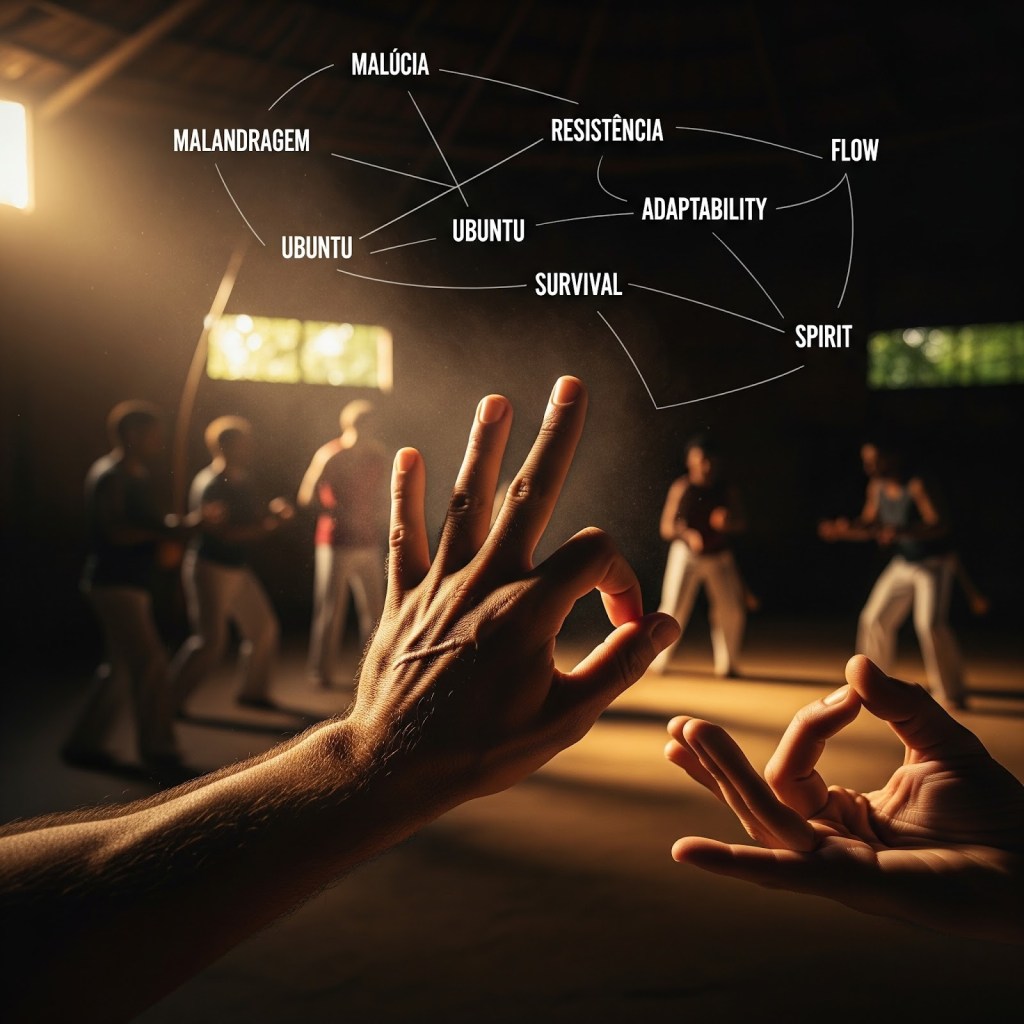
REFLECTIONS ON FIGHTING PHILOSOPHY, SURVIVAL STRATEGY, AND CAPOEIRA
This article delves deeply into the nuanced, often brutal, and always demanding realities of combat. It masterfully draws compelling parallels between established martial arts principles and broader, universal survival strategies, demonstrating their interconnectedness. It presents a comprehensive and robust framework, intelligently moving from the universal “Murphy Laws” of martial arts – which reveal immutable truths about conflict – to specific, practical applications, and then to the deeper, internal cultivation required for true and lasting mastery. The underlying philosophy consistently emphasizes adaptability, efficiency, and a profound, holistic understanding of both the physical and mental aspects of engagement. This synthesis is crucial for not just surviving, but thriving, in high-stakes situations.
The “Murphy Laws” of Martial Arts – Unveiling Inescapable Truths in Combat:
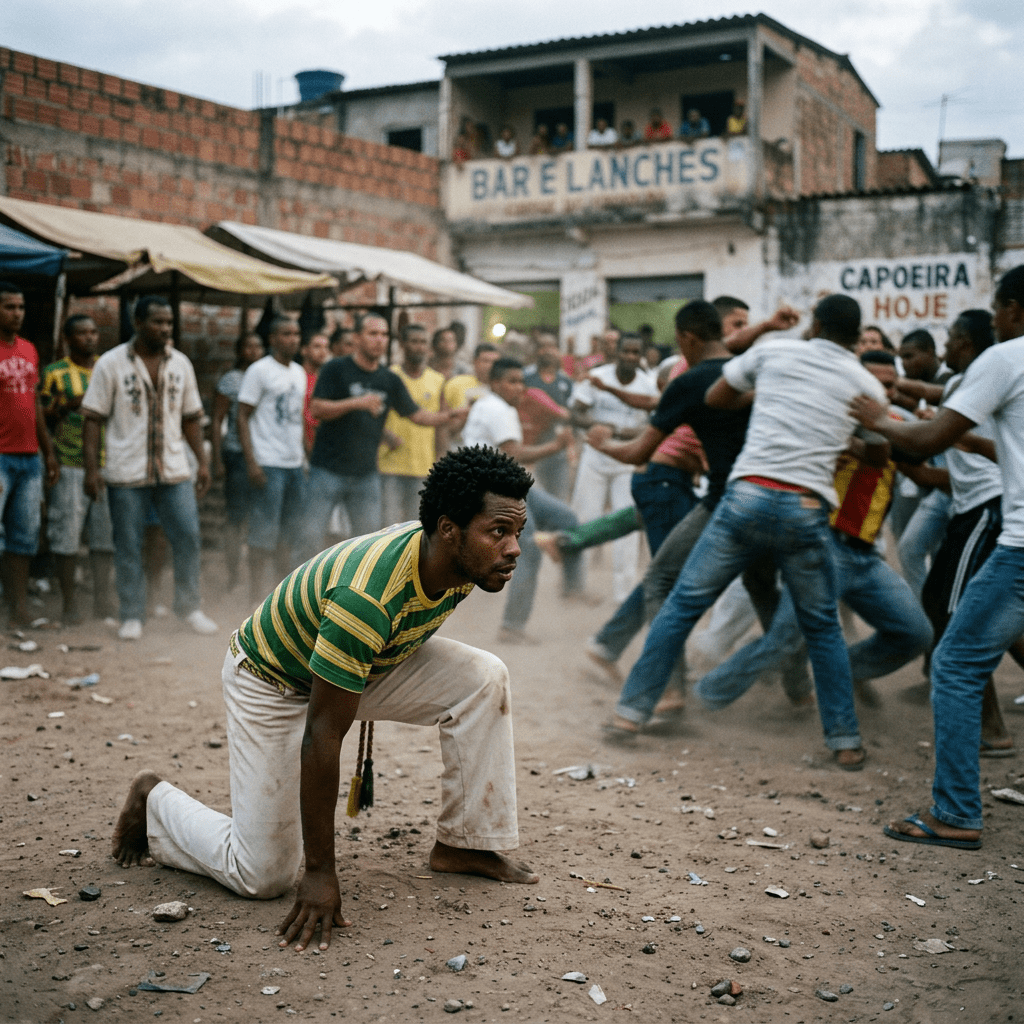
These foundational principles offer a stark, pragmatic, and often humbling view of conflict. They are not merely theoretical constructs but distilled wisdom derived from countless real-world encounters, highlighting the inescapable need to constantly evolve, adapt, and remain acutely aware of the unpredictable nature of confrontation. They serve as a constant reminder that the ideal scenario rarely unfolds, and preparation must encompass the unexpected
.
- “Think out of the box!… Push the envelope!”: True martial prowess transcends rote memorization of techniques. It demands a creative mindset, an ability to analyze unforeseen circumstances, and the courage to innovate beyond established paradigms. Mastery is achieved not by perfect replication, but by the inventive application of core principles to novel situations.
- The “Holy Trinity of Fighting & Survival”: This trinity encapsulates the essence of decisive action in a dangerous encounter.
- Do it First: Seizing the initiative is paramount. By acting proactively, one dictates the pace, direction, and scope of the conflict, preventing the opponent from establishing their own rhythm or strategy. This is about pre-emption and control.
- Do it Quicker: Speed and efficiency are not merely about physical swiftness, but about minimizing exposure to danger while maximizing the impact of one’s actions. Every movement should be economical, purposeful, and executed with an urgency that leaves the opponent little time to react or recover.
- Do it Dirtier: In a genuine life-or-death scenario, the conventional rules of engagement and notions of fair play become irrelevant. Survival is the ultimate objective, and ethical considerations shift to prioritize self-preservation. This principle, sometimes rephrased as “Do it Gracefully,” paradoxically emphasizes a brutal, unhesitating efficiency that appears almost effortless in its effectiveness. It speaks to a level of mastery where decisive action, however aggressive,
- executed with a calm, almost serene precision.
- Two Correct Fighting Distances: This concept simplifies the complexities of range management into a binary, yet profound, truth. One must either be “Too Far” for the opponent to effectively launch an attack, thereby denying them a target, or “Too Close,” negating their ability to generate power, extend their limbs fully, or utilize their complete range of motion. Any distance between these two extremes is a zone of vulnerability.
- Sparring’s True Purpose: Sparring is not merely a simulated fight but a crucible for self-discovery. Its value lies not in perfectly replicating the chaos of a real encounter, but in highlighting its distinctions. It is through the “cheating” of sparring—unexpected movements, unorthodox angles, and simulated pressures—that one’s tactical errors are exposed, forcing immediate adaptation and deeper understanding of combat’s unpredictable nature. It reveals what a real fight is not, thereby illuminating what it is.
- Clarke’s First Law (adapted for combat): This adapted law underscores the importance of wisdom while cautioning against the limitations of experience. When an experienced, elderly expert declares something possible, their deep insight and accumulated knowledge make their judgment almost invariably accurate. However, when they deem something impossible, their perspective may be constrained by their own historical experiences, potentially blinding them to new innovations and adaptations. True mastery requires an openness to constant evolution, even in the face of established wisdom.
- Darwinian Martial Arts: This principle applies the theory of natural selection to fighting techniques, positing that only the most effective and adaptable methods endure.
- Corollaries:
- Legacy of Survivors: Modern fighting manuals and techniques are essentially a distillation of successful strategies. They represent the accumulated wisdom of those who survived encounters against practitioners of earlier, less effective methods, signifying a continuous, brutal process of refinement and evolution in combat.
- The Paradox of Martial Arts: This paradox highlights the divergence between internal aspiration and external reality in martial arts.
- Internal Ideal: Within the confines of one’s own fighting school, the practitioner strives for invulnerability, aiming to master a specific system to perfection.
- External Reality: Yet, most real-world confrontations involve adversaries from diverse martial backgrounds, forcing a critical re-evaluation of isolated training.
- Convergence, Not Divergence: This leads to a crucial realization: despite stylistic differences, effective tactics across various martial arts tend to converge. The shared constraints of human physiology and universal combat principles dictate that truly effective methods will naturally resemble each other, rather than diverge into idiosyncratic forms.
- Contextual Reading: Drawing on Jacques Derrida, this corollary emphasizes the importance of context and individual interpretation when studying fighting manuals. “Everything in the universe is relevant to the text we read” means that true understanding comes from integrating a wide range of external knowledge, personal experience, and critical thought into the interpretation of any martial text.
- Corollaries:
Additional Laws of Fighting:
These aphorisms offer sharp, concise wisdom for practical application in combat:
- “Stupid tactics that work aren’t stupid”: Practical effectiveness is the ultimate arbiter of a tactic’s merit. Elegance and theoretical sophistication are secondary to tangible results.
- “Never interrupt the adversary when he’s doing a mistake” (Napoleon): Patience and observation are key. Capitalizing on an opponent’s missteps is often more effective than prematurely intervening or forcing an attack.
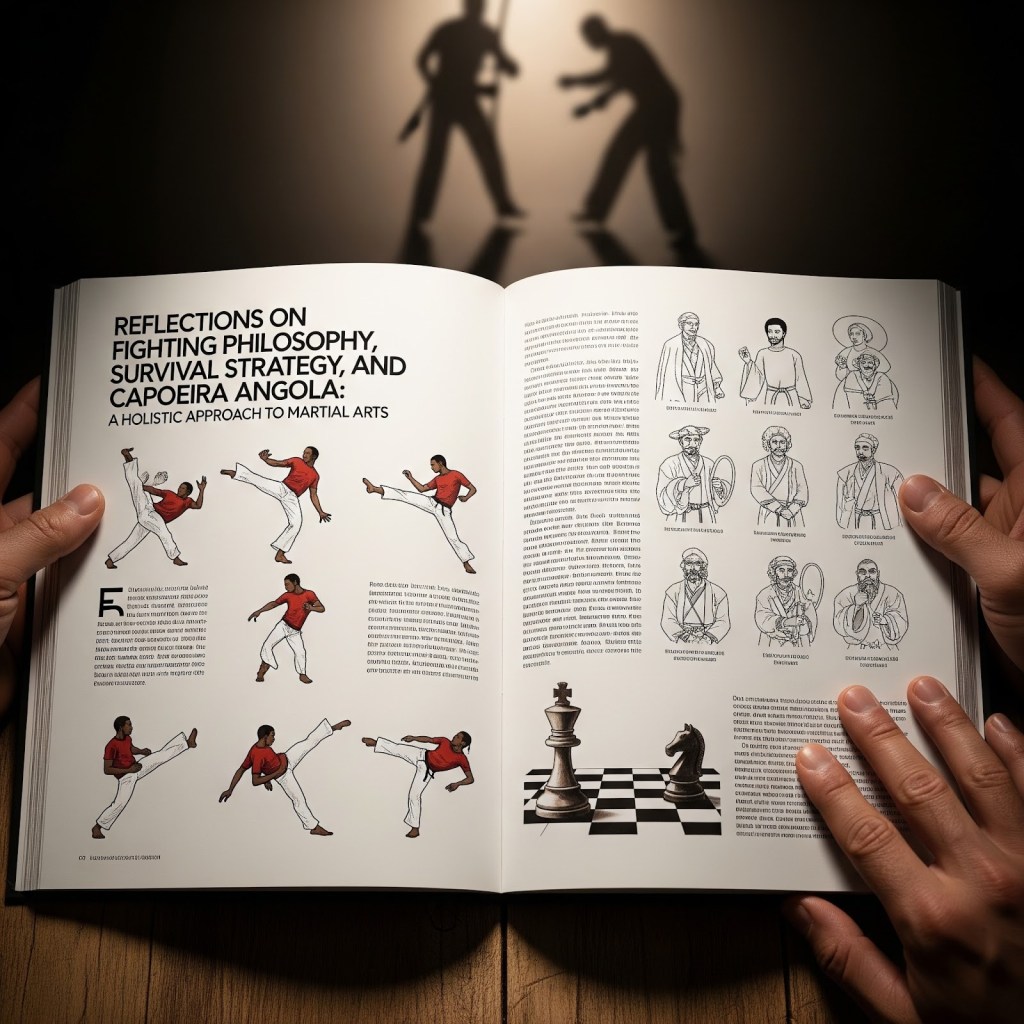
The principles of Capoeira Angola offer a profound framework for practitioners, guiding them toward holistic development that transcends mere physical prowess. This path encompasses the physical, mental, and even spiritual dimensions of martial artistry, fostering a deep understanding of oneself and the surrounding world. To truly acquire a good and effective use of Capoeira practice, certain observations and tenets must be diligently followed.Core Principles for Capoeira Angola Practitioners:
- Reverence for Tradition:
At the heart of Capoeira Angola lies a profound respect for its norms, rituals, and traditions. Practitioners must not only respect these deeply rooted elements but also actively uphold and make them respected by others. This commitment to tradition ensures the preservation of the art’s cultural heritage and philosophical depth.
- Honoring the Masters:
The knowledge and wisdom of Capoeira are passed down through generations of esteemed mestres. It is an absolute imperative to show unwavering respect to all mestres of capoeira, recognizing their dedication, experience, and their vital role in preserving and transmitting this intricate art form.
- Strategic Engagement in the Roda:
Within the roda, particularly when playing with more experienced practitioners, a nuanced approach to engagement is crucial. Aggressive or overtly forceful hits, especially linked kicks and kicks aimed below the waist, are to be avoided. The focus should be on fluid movement, strategic positioning, and a respect for the flow of the game rather than brute force.
- The Art of Focused Observation and Deception:
When crouching at the pé do berimbau to play, a deep state of concentration and relaxation is paramount. From the moment one enters the game, unwavering attention must be directed towards the partner. However, this attention is subtly masked. While playing, the gaze should be directed to the front or to the sides, giving the appearance of not paying direct attention. Staring fixedly at a partner can reveal intentions and make one predictable. The gaze should never fix itself on any single object, instead maintaining an ample field of vision to perceive all movements and potential threats
- Preparedness for Entry:
Entering the roda is a significant act that demands readiness. One should only enter when fully prepared for the intricate demands of Capoeira, both physically and mentally. This ensures a meaningful and productive contribution to the game.
- Navigating Street Rodas with Precision:
In the unpredictable environment of street rodas, the timing of one’s engagement in the jogo de dentro (the inner game) is critical. Only move into action at the exact moment of a partner’s movement, simultaneously applying a counterattack. Avoid descending prematurely when an opponent’s movement passes at a distance, or when they merely feint a movement. This highlights the importance of precise timing and discernment.
- Countering Close-Quarters Attacks:
Should a partner approach rapidly in the jogo de dentro with a kick to the face, leaving no opportunity for a rolé (evasive movement) or a direct hit, the strategy shifts. One should try to rise up with the opponent, immediately positioning oneself to apply various counter-hits. This demonstrates adaptability and the ability to turn a defensive situation into an offensive opportunity.
- Mastering the Ginga:
The ginga is the foundational movement of Capoeira, the first to be taught and, consequently, its base. Dedication to learning and perfecting the ginga is essential for all practitioners, as it underpins all other movements and the overall flow of the game.
- Constant Ginga and Feinting:
The ginga should be constant, not just a static pose. Its continuous motion aims to always create feints, keeping the opponent guessing and off-balance. This emphasizes the strategic and deceptive nature inherent in Capoeira.
- Cultivating Musicality:
A truly well-rounded capoeirista extends beyond physical performance. Every good capoeirista has the obligation to learn to play the berimbau and to sing. These musical elements are integral to the art form, enhancing the rhythm, energy, and spiritual dimension of the roda.
- Earning Respect Through Action:
True respect in the roda is earned through genuine skill and dedication, not through self-praise or boastfulness. If one is truly a good capoeirista, their abilities will speak for themselves and they will be recognized as such.
- Discretion in Displaying Skill:
The full extent of one’s Capoeira knowledge should generally be reserved for the roda or when absolutely necessary. Demonstrating skills outside these contexts can be ostentatious and may attract unwanted attention.
- Learning Through Observation:
Observation is a powerful learning tool. By closely watching more experienced training partners, practitioners can gain invaluable insights into techniques, strategies, and the subtle nuances of the game.
- Mental Preparation for Adversity:
Cultivating a proactive mindset for difficult situations is crucial. By imagining oneself in various challenging scenarios and seeking the best methods for liberation, one enhances their chances of success when confronted with such realities. This emphasizes the mental and strategic aspects of survival.
- Caution During a Chamada:
When a chamada (a call-and-response moment in the roda) is initiated, approach with extreme caution. The norms of Capoeira dictate that the caller of the chamada has the right to apply any desired hit if the other participant approaches without the necessary prudence. This highlights the element of surprise and the need for constant vigilance.
- Executing Controlled Movements:
During play, only execute Capoeira movements over which one has complete control. This prevents sloppy execution, potential injury, and maintains the integrity of the game.
- Strategic Concealment of Skill:
When playing with a stranger, it is wise not to reveal the entirety of one’s game. Saving the best hits and most complex movements for a decisive moment, should it become necessary, provides a strategic advantage.
- Environmental Awareness in Unfamiliar Rodas:
Before participating in a street roda or any unfamiliar environment, it is imperative to thoroughly observe the surroundings. Understanding the dynamics of the space and the participants can be crucial for safety and effective play.
- Vigilance During Transitions:
The moment of rising from a low position is particularly vulnerable, as it signifies the transition from the jogo de dentro (inner game) to the jogo de fora (outer game). Paying close attention during this transition is essential to avoid being caught off guard.
- Adapting to Learning Challenges:
If a graduated capoeirista still finds difficulty in mastering a particular movement, it is more beneficial to temporarily cease attempting that movement. Instead, focus should be redirected towards perfecting movements that have already been learned, building a stronger foundation before revisiting more challenging techniques.
- Emphasizing Ground Contact and Cleanliness The ideal practice of Capoeira involves playing without unnecessary contact with the ground, with only the hands and feet touching. The aspiration is to emulate the best capoeiristas of old, who could play in white clothes without soiling them, signifying clean, controlled, and efficient movement.
- Prioritizing Technique Over Speed and Power:
The development of Capoeira skills should follow a deliberate progression. Only after acquiring good technique through slow and progressive execution of offensive movements should the capoeirista begin to focus on speed and, consequently, the power of hits. This ensures a solid foundation and prevents the development of bad habits.
- The Importance of Relaxed Hands:
During Capoeira practice, maintaining relaxed hands is paramount. If a fist is briefly made, it should be relaxed immediately. A continuously closed fist is antithetical to the characteristics of Capoeira, which thrives on fluid, relaxed movements that allow for free blood circulation and the execution of spontaneous and agile actions.
- Gradual Progression in the Game:
The beginning of a Capoeira game should involve slow, circular movements within the jogo de dentro to warm up the muscles. As the game progresses, one can transition into the jogo de fora, where the rhythm may remain slow or increase in speed, dictated by the toque played by the berimbau-mestre. This structured approach optimizes performance and prevents injury.
- Avoiding Muscular Force:
In Capoeira, the reliance on brute muscular force is discouraged. The entire body should be stretched and extended, leaving no room for this superficial form of energy. The emphasis is on leverage, momentum, and body mechanics rather than sheer strength.
- Valuing Traditional Movement Over Acrobatic Flair:
Excessive focus on flips, complicated acrobatic movements, and series of extremely rapid hits that lead to exhaustion, often seen in modern Capoeira, is not aligned with traditional Capoeira Angola. In Angola, movements are executed with calmness and controlled grace, prioritizing effectiveness and longevity over flashy displays.
- Capoeira Angola as a Defensive Art:
Capoeira Angola is fundamentally a defensive art form. The practitioner’s goal is to skillfully guide an opponent’s attack to their own advantage, using body movements to attract them and subtly place them in an unfavorable position. This highlights the art’s cunning and strategic depth.
- Progressive Movement Refinement:
Beginners in Capoeira should initially focus on demonstrating hits and stretching their muscles. As they gain expertise, their movements can become more “closed,” meaning more subtle, efficient, and less overtly telegraphed.
- The Ever-Present Nature of Capoeira:
Capoeira is not merely a practice; it is a way of life. Wherever the capoeirista goes, Capoeira must accompany them. Both body and spirit must be perpetually prepared for any situation, reflecting the art’s integration into one’s daily existence.
- Situational Awareness: Cornering:
When turning a corner late at night, a specific survival strategy is employed: drag your foot and momentarily take the direction of the street before returning to your original path. This seemingly minor action can provide crucial seconds to assess potential threats around the corner.
- Situational Awareness: Seating Arrangements:
In any room, never sit with your back towards the entrance unless there is a mirror or another object that provides a full reflection of the entrance. This maintains awareness of who is entering and exiting, preventing surprise attacks.
- Situational Awareness: Dark Streets:
When traversing a dark street, always walk in the middle, never on the sides. This minimizes the risk of ambushes from hidden alcoves or shadows along the buildings.
- Situational Awareness: Dark Corridors:
Never enter a dark corridor. The lack of visibility presents an unacceptable risk, making one vulnerable to unseen threats.
- Maintaining Personal Space:
Do not allow a stranger to embrace you as a greeting. This seemingly innocuous act can be a tactic to gain control or access, and maintaining personal space is a fundamental safety measure.
- The Contained Violence of Capoeira:
Capoeira, despite its martial nature, is not about overt aggression. The violence of Capoeira is contained deep within the capoeirista, manifesting itself only at the opportune and necessary moment. This speaks to the art’s discipline and strategic restraint.
- Ethical Conduct in the Roda:
A strict ethical guideline in Capoeira is never to hit a partner when their back is turned. This upholds the principles of fair play and mutual respect within the roda.
- Loyalty Among Peers:
Loyalty to one’s friends in the fight (the Capoeira community) is a paramount virtue. This fosters a strong sense of camaraderie and mutual support.
- Avoiding Confrontation and Justified Self-Defense:
The ideal is to try and avoid fights whenever possible. Combat should only be engaged in when one is 100% in the right, underscoring the importance of conflict de-escalation and ethical justification.
- Strategic Self-Defense in Unavoidable Conflicts:
If a fight is unavoidable, the focus shifts to self-defense while maintaining composure. Avoid rushing to apply a hit; instead, wait for the moment where the probability of error is lowest. Crucially, try to take advantage of everything the environment can provide. Remember that malícia (cunning, trickery, and strategic awareness) is essential to the capoeirista and can be the decisive factor in ending a fight within seconds.
- The Deceptive “Cry” of the Capoeirista:
The “good capoeirista has the obligation to cry at the feet of the adversary.” This is not a sign of weakness, but a profound display of malícia. While appearing to cry, the eyes and the spirit remain active, observing, calculating, and preparing for the next strategic move. It is a powerful form of psychological manipulation and a testament to the art’s deceptive nature.
- Unwavering Faith in Learning:
Finally, an essential principle is to have unwavering faith in what has been learned. Trusting in the techniques, strategies, and philosophical underpinnings of Capoeira provides the confidence and mental fortitude necessary to navigate any challenge, both within and outside the roda.
- Focus on the ARTISTIC part of your system: Martial arts, at its zenith, transcends mere violence to become an art form. This involves embracing fluidity, grace, and expressive movement, which paradoxically enhances deadly effectiveness.
- Close-Range Engagement: In close quarters, maintain structural integrity. Avoid overextending limbs beyond the natural perimeter of your or your opponent’s body to prevent compromise of balance and power.
- Exploit Openings: If an opponent creates a wide, obvious block or opening, seize the most direct and efficient path of attack without hesitation.
- Essential Skills: Cultivate WIDE ANGLE VISION for comprehensive environmental awareness, and FOX WALKING for agile, stealthy, and responsive movement that minimizes telegraphing.
- Rotational Power: Never reach across your body without simultaneously engaging your torso in a rotation. This generates significant power and maintains crucial balance.
- Strategic Movement: When an attacker moves, either move in the same direction to absorb and deflect their momentum, or move decisively to the side while maintaining close contact to gain a positional advantage.
- Economy of Motion: Avoid holding limbs in static, horizontal positions, as this wastes energy and presents an easy target for attack or manipulation.
- Internal Cultivation: Regularly engage in the breathing and meditation exercises intrinsic to your martial system. These practices are vital for mental clarity, energy circulation, and emotional regulation.
- Controlled Striking: Keep your elbow below shoulder level, reserving elevation only for the precise moment of strike delivery. This maximizes power and prevents premature telegraphing of intentions.
- Timing is Everything: Execute force precisely in the transitional moment when your attacker is about to move but has not yet fully committed. This catches them off-balance and maximizes impact.
- Countering Kickers: Never retreat from a kicker. Instead, aggressively close the distance, crowding them and denying them the space and balance required for effective kicking.
- Constant Awareness: Train your mind to casually but comprehensively observe your surroundings at all times, developing an almost subconscious vigilance.
- Centerline Control in Grabs: When grabbing, avoid reaching across your centerline. Instead, TURN WITH IT to maintain your balance, generate power, and prevent your own structure from being compromised.
- Active Grabbing: Do not passively clamp down when grabbing. Your grip should be active, adaptable, and used to manipulate or control, rather than merely hold.
- Kinetic Linkage: Ensure every joint in your body is dynamically linked. This unbroken chain allows for an uninterrupted flow of power and seamless movement, transferring energy efficiently throughout your structure.
- Relentless Pursuit: If your opponent retreats, pursue them relentlessly. Continue attacking without giving them any opportunity to recover, regroup, or retaliate, until they are injured or fully neutralized.
- Self-Priority and Internal Power: Prioritize self-care and internal development through practices such as meditation, fasting, physical fitness, and specific breathing exercises like Tanaga Dallam. External aids like a Keris or Talisman are seen not as sources of power, but as amplifiers of the inherent internal power already cultivated.
- Strategic Avoidance: Do not engage a grappler in their preferred domain. Instead, choose a tactical approach that exploits their weaknesses or negates their strengths.
- TARGET DENIAL: The ultimate survival strategy is to avoid conflict entirely if possible, and never abandon others. Ego must be subservient to survival. If fighting is unavoidable, DENY YOUR OPPONENT A TARGET through constant, unpredictable movement and evasive action.
- Ground Combat Safety: If the fight goes to the ground, critically, keep your head away from your opponent’s feet to prevent devastating kicks and stomps.
- Weapon Retention vs. Hand-to-Hand: In close quarters, it is often more advantageous to abandon a weapon and engage in hand-to-hand combat than to struggle futilely for its control, especially if the struggle compromises your overall defensive posture.
- Spiritual Environment: Cultivate a conducive mental and spiritual space by surrounding yourself with sacred objects and using calming incense (Sandalwood, Myrrh, Benzoin). This aids in internal focus and mental fortitude.
- Dynamic States: Embody contrasting forces: when still, be as calm and immovable as a mountain; when in motion, possess the speed, force, and relentless flow of a torrential river.
- Full Body Power: When striking with your hands, integrate the power generated from your feet and entire body, rather than relying solely on isolated arm strength. This ensures maximum impact.
- Constant Readiness: Continuously store and cycle force within your body, not just immediately prior to an attack. This prevents telegraphing your intentions and allows for instant, explosive action.
- TRAIN WITH MUSIC!: Incorporate music into your training to enhance rhythm, deepen focus, and cultivate an internal flow that makes movements more natural and expressive.
- NEVER fight nose to nose with someone!: Avoid static, head-on confrontations at close range, as these are inherently dangerous and limit your mobility and options.
- Holistic Health: Maintain a healthy diet and lifestyle. Physical well-being is intrinsically linked to mental acuity and martial effectiveness.
- Flowing Artistry: Strive to develop movements that are fluid, artistic, and beautiful. This aesthetic quality can subtly conceal the underlying deadly effectiveness of your techniques.
- Embrace Difficulty: Acknowledge that Ilmu / Kebatinan (internal/spiritual development) is VERY HARD, a path fraught with challenges and obstacles that demand immense perseverance.
- Immediate Neutralization: In combat, prioritize disrupting an opponent’s balance or rendering them unconscious immediately. A disoriented or unconscious adversary cannot fight effectively. Always seek to undermine their mental resolve.
- Reconnect with Nature: Spend time in nature, observe animal movements relevant to your art, and practice quiet meditation outdoors, inviting an animal spirit to guide and inform your practice.
- Intercept, Don’t Chase: Do not actively pursue or chase an opponent’s strikes. Instead, position yourself to intercept their attacks, allowing their momentum to run into your counters, conserving your energy.
- Proactive Love: Do not wait for love; LOVE THEM FIRST. This principle, though seemingly counter-intuitive in a combat context, speaks to a deeper spiritual and empathetic understanding, potentially influencing one’s internal state.
- Combination Striking (High/Low): Employ unpredictable combinations. If you attack low, immediately follow with a high attack, and vice-versa, to overwhelm the opponent’s defenses.
- Spiritual Connection: Seek out and link yourself with individuals (“souls”) with whom you resonate harmoniously, fostering a supportive and enriching spiritual environment.
- Diagonal Combinations: When attacking, consider diagonal combinations. For instance, if you attack the inside of the leg, follow up with a strike to the outside of the head, and apply the reverse logic for outside leg attacks.
- Daily Mentorship: To foster continuous growth, connect with at least one “advanced soul” daily, seeking guidance, wisdom, and inspiration.
- True Friends: YOU WILL RECOGNIZE YOUR FRIENDS IN TIMES OF SUFFERING. This is a profound truth about human relationships, especially relevant in the high-stakes world of martial arts and survival.
- Constructive Feedback: Avoid criticism. Instead, focus on recognizing and appreciating the positive qualities and strengths in each person, fostering a more positive and growth-oriented environment.
- Constant Cover and Centerline Control: Maintain continuous protection of both high and low targets, and diligently control both the vertical and horizontal centerlines of your body, which are vital for both offense and defense.
- Body as Temple: Our physical bodies are sacred and must be cared for diligently through proper nutrition, exercise, and rest.
- CONSTANTLY alter all aspects of your appearance of speed, height, and tempo: Maintain unpredictability by continuously varying your perceived speed, height, and tempo of movement, keeping your opponent guessing and off-balance.
- Confronting Fear: When faced with a task that appears overwhelming, the only path is to DO IT. The act of confronting the challenge directly will cause the fear to dissipate.
- Unyielding Concentration: Maintain unwavering focus during combat and training. Do not allow your mind to wander, as distraction can be fatal.
- Break the Vertical Plane: Actively seek to disrupt an opponent’s upright posture and stability, as a compromised vertical plane makes them vulnerable to takedowns and loss of balance.
- Fasting for Rejuvenation: Fasting is a practice that can rejuvenate the body by mobilizing hidden cellular energies for regeneration and repair.
- LIFE IS MOVEMENT: Embrace dynamic, fluid, and continuous action in all aspects of your martial practice and life. Stasis leads to vulnerability.
- Unbreakable Fundamentals: A strong, deep understanding and mastery of fundamental techniques will render your blocks and defenses impenetrable.
- Natural Movement: Strive to perform movements that are natural, unforced, and aligned with the inherent laws of nature. This leads to a profound sense of flow and efficiency.
- Target Alignment: Attack an opponent’s body and spinal alignment directly. Disrupting their structural integrity will severely impair their ability to fight.
- Holistic Well-being:
- Healthy Body: KEEP YOUR BODY CLEAN. Physical hygiene and health are paramount.
- Happy Heart: KEEP YOUR HEART PURE. Emotional well-being and positive intent contribute to mental strength.
- Clear Mind: KEEP YOUR MIND CLEAR. Mental clarity is essential for strategic thinking and quick reactions.
- Relaxation and Energy: Maintain extreme relaxation at ALL TIMES. Cultivate the suppleness and whip-like quality of your body. Continuously draw and “freeze” energy (Tanaga Dallam) through each limb, making any part of your body a potential weapon or shield.
- Morning Practice: Practice early in the morning to harness the fresh energies of the dawn, aligning with the natural world and its rhythms.
- Impact Timing: Tighten muscles and tendons precisely AT THE POINT OF IMPACT, then immediately relax. This is like a light switch, maximizing power and minimizing wasted energy.
- Perseverance: A dedicated student should NEVER give up until they achieve their desired results and reach their full potential.
- Exhale on Impact: Exhale sharply (like a sneeze or “SHHHH”) with contracted abdominal muscles at the exact moment of impact, then relax. This generates internal power and protects the body.
- Body as Microcosm: Understand that the human body is a synthesis of natural processes. By understanding your own body deeply, you unlock insights into the invisible workings of the universe.
- Attack the Foundation: Target an opponent’s base and roots. Just as a tree without roots easily falls, an opponent with a compromised base is vulnerable.
- Street vs. Competition: In a street fight, the objective is rapid neutralization—aim to finish in three moves or less. In competition, the goal is to continue until your opponent concedes or is unable to continue.
- Displace Balance: Actively seek to get your opponent onto their heels or toes, or force them onto one leg, thereby drastically disrupting their balance and making them vulnerable.
- Integrated Training: CONSTANTLY integrate the external (physical) and internal (energetic/mental) aspects of your art. Physical development directly enhances internal influence and vice-versa.
- Positional Understanding: Develop a deep understanding of how to use angles strategically for shoulder position, takedowns, striking, and precise target selection.
- Counter-Proximity: If you are close enough to be hit, you are equally close enough to launch a counter-attack. Embrace this mutual proximity. “You can’t make an omelet without breaking some eggs.”
- Efficient Striking: Know precisely where to strike for maximum pain or to achieve a knockout. Avoid arbitrary or unfocused strikes.
- Economy of Motion (Striking): Extending blows to the absolute edge of your physical reach, whether offensively or defensively, will inevitably slow down your reactions and movements.
- Continuous Flow: Employ continuous hitting. If the hand hits, the elbow should seamlessly follow; if the elbow hits, the fist should follow, creating an unbroken chain of strikes.
- Simplicity in Combat: Real fighting should NOT be complicated. Complexity breeds hesitation; simplicity facilitates decisive action.
- Uninterrupted Movement: NEVER stop or freeze your movement after delivering a direct hit. Blows should seamlessly ricochet into subsequent strikes or transition into covering patterns, maintaining an aggressive flow.
- BALANCED Fighting: Combat is fundamentally a struggle over balance—maintaining your own while disrupting your opponent’s.
- Art as Life: Integrate the movements, principles, and philosophy of your expression of Capoeira Angola into ALL aspects of your daily life. BECOME the art, allowing it to permeate your very being.
- Dynamic Triangle: Create a MOVING triangle, avoiding static, fixed positions that can be exploited and lock you down. Fluidity is key.
- Artistic Integrity: Do not dilute your art by haphazardly “pirating” techniques from styles that are diametrically opposed to its core principles. Focus on mastering your OWN art with depth and purity.
- Energy Transfer: Develop a precise understanding of how to effectively transfer energy throughout your body when striking, applying locks, executing takedowns, and defending against attacks.
- Equal Balance: Maintain EQUALLY balanced posture at all times to prevent being locked down, manipulated, or taken off-balance.
- Strategic Impact: If you are hit, strategically ensure the impact lands on parts of your body that are inherently harder and more resilient than the striking part of your opponent’s body, minimizing damage.
- Power from All Positions: Cultivate the ability to hit and generate power effectively from ANY AND EVERY POSITION, whether standing, kneeling, or on the ground.
- Proprioceptive Awareness: There is no need for panic if you possess a strong FEEL for where your body is in space (proprioception). This internal map provides calm and control.
- Adhesive Body: Develop the ability to make any part of your body “adhesive” at any moment during a fight. This is CRUCIAL for knife attacks, allowing you to stick to the weapon hand without getting cut, facilitating disarming or neutralization.
- Cat-like Evasion: If you get struck in a vulnerable area, collapse inward and spin or rotate like a cat. This reduces the blow’s effectiveness by deflecting its energy and simultaneously initiates a counter-flow.
- RELAX, RELAX, RELAX: Emphasize extreme relaxation as the foundation for fluidity, speed, and explosive power. Tension inhibits true martial effectiveness.
- Yield to Overcome: When pulled, go with the pull initially until your opponent is thrown off balance. Then, exploit their momentum to reverse their action or counter-attack.
- Directed Energy: Learn to consciously direct your energy and focus to any specific point on or even outside your body, influencing the flow of combat.
- Higher Self in Combat: Prior to engagement, be acutely aware of your mental state. Upon invoking your personal mantra or internal trigger, allow your higher, trained self to take over, executing instinctual, animalistic movements. Your conscious mind becomes a calm observer.
- Unwavering Faith: ALWAYS have faith in your teacher, trusting their guidance, and ALWAYS have faith in the art itself, believing in its efficacy and depth.
- Weapon as Extension: Understand that the weapon is not separate but an extension of your hand or foot, which in turn is an extension of your mind and body. It becomes an integrated part of yourself.
- Become Unpredictable: It is far more terrifying to confront a swirling, unpredictable cloud of lightning bolts than a grimacing, muscular man. Become the black swirling cloud—elusive, unpredictable, and devastating.
- Aging Adaptations: As you age, consciously replace reliance on brute strength and raw speed with superior timing, precise positioning, and profound strategic understanding.
- Intuitive Flow: Avoid overthinking in combat. Instead, feel your body, and counters will emerge naturally, guided by instinct and deep training.
- Yin and Yang Energy: Apply the principles of Yin and Yang. Use Yin (soft, yielding) against Yang (hard, forceful), and Yang against Yin, to effectively counter an opponent’s energy and intentions.
- Internal Supremacy: As internal training deepens and becomes more refined, the reliance on external, purely physical training diminishes, as internal power becomes the primary driver.
- Strategic Control: Embody the Bullfighter, not the Bull. Maintain strategic control over the engagement, manipulating your opponent rather than being controlled by them.
- AWARENESS OF MULTIPLE ATTACKERS: ALWAYS THINK ABOUT MULTIPLE ATTACKERS AT ANY GIVEN TIME!!! Maintain constant situational awareness for additional threats, even in a single engagement.
- Penetrate and Take Over: If your opponent retreats, aggressively penetrate their defense and seize control of the space and the initiative.
- Non-Physical Victory: ALL fights can be won without throwing a single physical blow. Superior strategy, psychological advantage, and manipulation can often achieve victory.
- Generous Pukulan: You can never punch or strike enough. Pukulan (striking) is a gift of decisive action; give it generously when needed to neutralize a threat.
- Limited Retreat: You should NOT back up more than three steps. Beyond this, you lose ground and often initiative, indicating a lack of positional control.
- Strategic Striking (Soft/Hard): Employ strategic striking. Use soft parts of your body (e.g., open hand, forearm) to hit hard bone surfaces, and hard parts (e.g., fist, elbow) to hit fleshy, vulnerable regions. A slap, due to its surface area, can be incredibly dangerous. A fist to the neck is more damaging than to the skull. This also reduces the risk of self-injury.
- Ethical Teaching: This is a powerful, perhaps controversial, statement about the ethics of teaching. Teachers who withhold the internal aspects of an art for financial gain are deemed to be acting unethically, akin to “bad prostitutes” who compromise their integrity for money.
- Body Language Mastery: Learn to read body language instantly. It is a fundamental skill that immediately conveys whether an individual is peaceful or poses a threat.
- Active Visualization: Dedicate at least 5 minutes daily to ACTIVE VISUALIZATION, mentally rehearsing “What if?” scenarios to prepare for diverse combat situations.
- Movement is Survival: In a fight, as long as you MOVE, you are actively responding and adapting, reducing the likelihood of critical mistakes. Stasis is death.
- Healing Skills: Develop the ability to heal both yourself and others. This holistic approach acknowledges the cyclical nature of injury and recovery.
- Knife Attack Blunder: In a knife attack, a first move of simply grabbing the attacking arm/hand is a blunder, ESPECIALLY if striking the arm/hand was a viable and more effective option.
- Feel Opponent’s Balance: Upon contact, learn to intuitively sense your opponent’s balance and the direction of their momentum.
- Spirit and Universe: In a fight, let the universe decide, but cultivate a strong spirit. The stronger spirit usually wins the battle. This speaks to a blend of surrender to fate and unwavering internal fortitude.
- Limitations of Locks/Holds: Locks and holds, while effective in specific contexts, inherently restrict your own movement, making them highly suicidal when facing multiple opponents.
- Effective Fists: Your fists, if ever used in combat, should be capable of bruising and knocking out an attacker, signifying their potent effectiveness.
- Music and Spirit: Allow the music inherent in the art to carry and imbue the internal spirit directly to your soul, deepening your connection to the practice.
- Lowering Your Center: When fighting an opponent of similar size or shorter, strategically keep your shoulders lower than theirs. This grants control over their balance and leverage.
- Weapons for Internal Development: The use of weapons within the art is not merely for external combat; it significantly accelerates a student’s internal development and understanding of energy.
- Feet as Eyes: Your feet serve as your eyes on the ground. Cultivate the ability to feel the terrain and environment without needing to look down, maintaining visual focus on the opponent.
- Manipulate Awareness: CONSTANTLY manipulate your opponent’s awareness, drawing their attention away from your actual targets and intentions through misdirection and feints.
- Always Assume there’s a Weapon: In any fight, you NEVER know when a weapon will appear. Maintain a constant level of vigilance and preparedness for armed threats.
- Simplicity in Training: Keep your training simple, direct, and easily understandable. Avoid unnecessary complexity that can hinder learning and application.
- Two Core Thoughts: In a real fight, only two fundamental thoughts should dominate: DESTROY the threat or GET OUT of the dangerous situation.
- First Contact Dictates Fight: The FIRST physical connection you make with your opponent profoundly determines HOW YOU’RE GOING TO FIGHT! Avoid sequential, pre-planned thinking; adapt immediately.
- Multi-Dimensional Fighting: Fighting is NOT one-dimensional. It encompasses physical, mental, emotional, and often spiritual aspects, requiring a holistic approach.
- Directed Energy (Tanaga Dallam): Tanaga Dallam (internal energy, if you believe in that sort of thing) can be consciously directed to various parts of the body through focused breath and thought, enhancing power and resilience.
- Sparring for Spontaneity: The true goal of sparring is to cultivate spontaneous, instinctual self-defense capabilities, rather than merely focusing on winning a simulated match.
- Fluidity and Effectiveness: Anything forced, rigid, or stiff can NEVER be truly artistic or effectively applied in dynamic combat. Fluidity is essential.
- Body-Driven Punching: When punching, even if your hand is aimed at the center, your BODY is positioned to the side, driving the power through your core and hips, not just the arm.
- CHI Circulation: Learn to draw Chi (life energy, if you believe in that sort of thing) from Mother Earth through your feet, circulate it up your body, out the crown of your head, and allow it to flow down around your body like an aura or the branches of a tree.
- Hunter/Hunted Dynamic: The roles in combat can reverse swiftly. The hunter can quickly become the hunted, demanding constant vigilance and adaptability.
- Tool Mastery: Success in combat hinges on a deep knowledge of your available “tools” (techniques, weapons, strategies) and the ability to combine them effectively and creatively.
- Focus on BALANCE: Don’t excessively worry about isolated techniques. Instead, prioritize maintaining your own balance while actively disrupting your opponent’s.
- No Set Counters: No movement or attack has a fixed, pre-ordained counter. The defender must find their own balance and optimal position in response to unique, dynamic situations.
- Principle-Based Application: As long as the underlying principles and scientific realities of combat remain constant, the specific applications of techniques are ENTIRELY up to the practitioner’s interpretation and adaptation.
- Gain Positional Advantage: Always seek to get BEHIND your opponent, as this is where they are most defenseless and vulnerable.
- Smothering Strategy: To effectively fight a more skilled opponent, adopt a “blanket” strategy—smother them, denying them space, time, and opportunity to utilize their advanced techniques.
- Pain as Movement Catalyst: Pain, while undesirable, can be strategically employed to create movement, elicit a reaction, or force an opponent to change their posture or position.
- Striking Blocks: We don’t use blocks in Capoeira Angola. However, if you are ever forced to use blocks in a fight, don’t just think of stopping an attack. HIT with your blocks to inflict pain and create an opening before launching a counter-attack.
- Concentration in Chaos: Train to maintain focus and concentration amidst noise, music, and other distractions, replicating the chaotic environment of real combat.
- Life or Death Stakes: WHATEVER YOU LEARN, SHOULD BE LIFE OR DEATH. This emphasizes the gravity and seriousness with which martial arts training should be approached.
- MIND CONTROL: ALL fighting is MIND CONTROL. Constantly manipulate your opponent’s mind through feints, misdirection, and psychological pressure.
- Adapting Tradition: Tradition is valuable, but one must be a realist. Adapt traditional techniques and philosophies to the practicalities of everyday life and modern combat scenarios.
- Integrated Posture: Integrate your fighting posture seamlessly into your everyday posture, ensuring that you are always subtly prepared for action without appearing overtly aggressive.
- Living Art: Whatever art you learn (It should be Capoeira Angola, but whatever), should be totally ALIVE, dynamic, and applicable (like Capoeira Angola), not an archaic museum piece relegated to historical study.
- DO THE UNEXPECTED!: ALWAYS DO THE UNEXPECTED!!! Unpredictability is a powerful weapon in combat, confusing and disorienting your opponent.
- Economy of Motion (Multi-purpose): Work on using a single motion or technique to achieve two or three objectives simultaneously, maximizing efficiency.
- Footwork Leads Hands: In striking, the movement of the feet should lead and generate the power for the hands, rather than the hands acting independently.
- Opponent’s Control: You can only execute what your opponent’s actions and reactions allow you to do. Adaptability to their responses is crucial.
- Master Illusionist: Cultivate the mindset of a master illusionist, constantly creating misdirection, confusion, and deceptive movements to gain an advantage.
- FEEL in Fighting: Fighting is fundamentally about FEEL – the intuitive sense of timing, distance, balance, and knowing precisely when to employ a lock, a weapon, or a specific technique.
- Feet, Hands, Elbows: Your feet are your eyes for sensing the ground; your hands and elbows are your tentacles for feeling and manipulating the opponent. Trust your feet for survival and foundational movement.
- Key Principles: Remember these core operational principles: DEFLECTION, REDIRECTION, and EXECUTION!!!
- Respect, Not Fear: Remember, THERE’S NO FEAR, THERE’S ONLY RESPECT!!! This reframe transforms paralyzing fear into a healthy respect for the opponent and the seriousness of the situation.
- Curved Foot Switching: When switching feet, execute movements that are more curved and circular than straight, enhancing fluidity and creating advantageous angles.
- Footwork Eliminates Fear: A deep, confident understanding and mastery of your footwork will significantly diminish and ultimately eliminate fear in combat situations.
- Following Inertia: Learn to follow the inertia of a weapon or an empty hand. When swinging a weapon, switch your feet in the opposite direction before the swing completes, leveraging momentum.
- Foot Switching with Punches: When throwing a punch, simultaneously switch your feet to the opposite sides to generate rotational power and maintain balance.
- Deep Movement and Constant Motion: Move DEEP into and around your opponent in a circular fashion, continuously switching your feet. Never stop moving from the initial point of contact to create confusion and maintain control.
- Combat Mindset: Beyond mere physical training, cultivate a COMBAT MINDSET!!!! Think strategically, aggressively, and decisively about conflict.
- Hips Lead Feet: In all movement, the hips should lead the feet, acting as the primary generator of power and direction.
- Footwork is Key: Footwork is the key to EVERYTHING in combat, fundamentally eliminating fear by providing stable, adaptable movement.
- Target Elbow: Always try to get behind the opponent’s elbow, as this compromises their arm structure and offers control.
- “S” Pattern: Remember the “S” pattern in your movements, emphasizing flowing, serpentine motions that create angles and evade direct lines of attack.
- Hips Drive Movement: When the hips move deep, the feet must follow organically, and everything else in the body will naturally follow, creating a powerful, integrated movement.
- Rear Defense: Your elbows serve as crucial REAR DEFENSE WEAPONS, capable of deflecting and striking backwards.
- Effortless Action: Strive for a level of mastery where assaulting or taking someone’s life feels as easy and natural as breathing, implying a complete removal of hesitation and internal conflict.
- Blind Spots: Attack the body’s natural blind spots, such as the back of the head or below the chin, where vision and defense are compromised.
- Follow Inertia: Learn to FOLLOW THE INERTIA of an opponent’s weapon or empty hand, using their own momentum against them.
- Circular Deep Movement: Move DEEP into the opponent using circular motions, which creates confusion for them while you maintain control and advantageous positioning.
- Sniper Mentality: Adopt a sniper mentality: ONE STRIKE, ONE KILL. Emphasize precision, decisiveness, and economy of force.
- Body as Shock Absorber: Learn to utilize your entire body as a shock absorber, distributing and dissipating the force of impacts rather than allowing it to localize and cause injury.
- Art Mastery: Strive to know your art better than you know yourself, allowing its principles to become an ingrained, almost subconscious part of your being.
- Continuous Flow (Techniques): Maintain continuous movement, seamlessly flowing from one technique to the next without interruption or hesitation.
- Enduring Pain: Silat (and indeed, all serious martial arts) is fundamentally about enduring and overcoming PAIN – both physical discomfort and mental anguish – as a pathway to resilience.
- Challenge Yourself: In your art, you must ALWAYS CHALLENGE YOURSELF to grow, improve, and push

Further Elaboration: The Intricacies of Capoeira in Self-Defense
Capoeira, a vibrant and dynamic art form born from the crucible of Brazilian history, seamlessly fuses the grace of dance, the agility of acrobatics, and the power of martial arts. This unique blend culminates in a visually breathtaking and physically demanding display of movement and profound self-expression. Its inherent strengths in the realm of self-defense are undeniable, particularly its profound emphasis on fluid evasiveness, the precise and potent execution of various kicks, and an intrinsic element of unpredictability that can profoundly disorient and unsettle an aggressor. However, the direct and uncritical translation of Capoeira’s nuanced techniques into the raw, unpredictable, and often brutal reality of a street fight necessitates a careful, analytical, and deeply nuanced understanding of its inherent limitations.
To truly unlock and harness the full potential of Capoeira within the challenging and complex landscape of real-world self-defense scenarios, practitioners must engage in a critical and introspective evaluation of these crucial nuances. This rigorous assessment must unequivocally include acknowledging the conspicuous absence of dedicated ground fighting techniques, which are common and often decisive elements in many other established martial arts disciplines. Furthermore, practitioners must contend with the potential for a determined opponent to effectively negate intricate evasive maneuvers when confined to tight, restrictive spaces, where the free-flowing movement characteristic of Capoeira can be severely curtailed. Finally, the reliance on open stances, while promoting fluidity, might inadvertently create exploitable vulnerabilities in a close-quarters confrontation, where an opponent can capitalize on a practitioner’s extended reach or exposed limbs.
By consciously and strategically addressing these potential drawbacks, Capoeira practitioners can significantly enhance their overall effectiveness and adaptability in a diverse range of confrontational situations. This proactive approach might involve a strategic integration of supplementary training disciplines that specifically emphasize crucial skills such as grappling, close-range striking techniques, or robust defensive tactics designed to counter multiple opponents. Beyond the purely physical aspects, developing a highly attuned sense of situational awareness—a constant and vigilant observation of one’s surroundings—and cultivating the sophisticated ability to de-escalate burgeoning conflicts are absolutely crucial skills that transcend the boundaries of any specific martial art and are indispensable for personal safety.
Ultimately, the true efficacy of any martial art when faced with the chaotic and often terrifying environment of a street fight is not solely, or even primarily, determined by the art itself. Instead, it is the result of a complex and dynamic interplay between the practitioner’s individual skill level, their profound capacity for adaptability in rapidly evolving and high-stress circumstances, and their unwavering mental fortitude coupled with a strategically sound mindset. A truly skilled Capoeirista, one who possesses a comprehensive and realistic understanding of both the intrinsic strengths and the inherent weaknesses of their chosen art, and who is demonstrably prepared to adapt their approach and integrate supplementary skills as needed, will undeniably prove to be far more formidable and resilient than an individual who rigidly adheres to a singular, unyielding doctrine. The true and enduring power in self-defense lies not within the art as a fixed entity, but rather in the practitioner’s profound ability to transcend the art, thereby transforming it into a dynamic, adaptable, and ever-evolving tool, rather than a restrictive and dogmatic set of rules.
.Advantages Amplified: Beyond Basic Evasion
The advantages of Capoeira in a self-defense context extend beyond simple evasiveness:
- Dynamic Range Control: Capoeira excels at maintaining and manipulating distance. The constant “ginga” (swaying base movement) allows a practitioner to fluidly shift in and out of an attacker’s range, dictating the terms of engagement. This is not merely about avoiding a hit, but about creating openings for powerful counter-attacks or, more importantly, for escape. The long-range kicks are not just offensive tools; they act as deterrents, forcing an aggressor to think twice before closing in.
- Deception and Psychological Disruption: The “dance” aspect of Capoeira can be a profound psychological weapon. An attacker, especially one unfamiliar with the art, might initially perceive the movements as non-threatening or even comical. This underestimation creates a critical window of opportunity. A seemingly playful movement can suddenly transform into a devastating kick or a disorienting sweep, catching the assailant completely off guard and breaking their aggressive momentum. This element of surprise is invaluable in a real fight.
- Multi-directional Threat: Unlike many linear martial arts, Capoeira attacks can come from virtually any angle – high, low, spinning, or straight. This multi-directional threat makes it incredibly difficult for an opponent to predict and defend against. A Capoeirista can launch attacks while on the ground, during a handstand, or from a seemingly vulnerable position, creating a constant state of uncertainty for the aggressor.
- Unconventional Escapes and Maneuvers: The acrobatic elements, far from being mere showmanship, provide unique escape routes. A cartwheel, an aú (cartwheel), or a rolê (roll) can be used to break free from a grapple, evade a committed strike, or navigate crowded environments. These movements can also allow a Capoeirista to quickly re-establish distance or move to a more advantageous position.
- Exceptional Conditioning and Resilience: Capoeira training is inherently demanding, fostering remarkable cardiovascular endurance, flexibility, and powerful leg strength. This physical conditioning translates directly into real-world resilience, allowing a practitioner to maintain peak performance during a stressful encounter and absorb impacts more effectively. The mental fortitude built through rigorous training also contributes to composure under pressure, a crucial factor in any confrontation.
Limitations Explored: Bridging the Gaps
While Capoeira offers significant strengths, its limitations in a street fight context are equally important to acknowledge and understand for any serious practitioner:
- Striking and Grappling Deficiencies (Traditional Focus): The most frequently cited limitation of traditional Capoeira in a self-defense scenario is its comparatively lesser emphasis on direct, powerful hand strikes (punches) and ground grappling techniques (submissions, controls, and positional dominance). Street fights, by their very nature, are often chaotic and quickly devolve into close-quarters brawling, clinches, and uncontrolled ground exchanges. In these scenarios, a Capoeira practitioner, without supplementary training, might find themselves at a severe disadvantage against an opponent skilled in martial arts such as boxing (known for powerful punching), Muay Thai (renowned for its striking, elbows, and clinching), or Brazilian Jiu-Jitsu (expert in ground fighting and submissions). The flowing, often indirect nature of Capoeira’s striking, while effective in its own context, does not always translate directly to the brutal efficiency required in a sudden, violent confrontation.
- Environmental Constraints and Footwear: The wide, sweeping kicks, elaborate evasive movements, and acrobatic maneuvers that are hallmarks of Capoeira inherently require ample space and a stable, often smooth, surface. The unpredictable urban environment rarely provides such ideal conditions. Uneven pavement, slippery surfaces (like wet concrete or ice), crowded areas, or restrictive clothing and footwear (such as high heels, tight jeans, or even dress shoes) can severely impede a Capoeirista’s ability to execute their techniques effectively and safely. This starkly highlights the practical disconnect between the idealized roda (the Capoeira circle, often performed on a clear, even surface) and the harsh, unpredictable reality of a street. The art’s reliance on dynamic movement can be drastically curtailed by simple environmental factors.
- Vulnerability to Multiple Attackers: The fluid, often expansive, and circular nature of Capoeira, while incredibly effective for engaging and evading a single opponent, can paradoxically make it challenging to defend against multiple assailants simultaneously. The focus on individual engagement, evasive maneuvers, and maintaining the jogo (game) can leave a practitioner exposed to flanking attacks, being surrounded, or a coordinated rush from several attackers. In such dire scenarios, more linear, defensive martial arts with a strong emphasis on guarding multiple angles, maintaining a central defensive posture, and efficient target neutralization might offer better tactical options. The sheer number of threats can overwhelm the Capoeirista’s ability to constantly evade and reposition.
- The “Game” Mindset vs. Brutal Reality: The jogo (game) aspect of Capoeira, deeply ingrained in its philosophy and practice, while fostering creativity, improvisation, and flow, can sometimes instill a mindset that is counterproductive in a no-holds-barred street fight. The inherent respect, “controlled aggression,” and often performative elements within the roda need to be consciously and fundamentally adapted to the raw, decisive, and often brutal mindset required for genuine self-defense. The psychological transition from playful interaction, where the intent is not to harm, to a fight for survival, where decisive action is paramount, demands a profound shift in psychological approach and intent. This mental reorientation is as crucial as any physical technique.
- Risk of Imbalance and Grounding: While Capoeira’s sweeps (rasteiras) are highly effective for disrupting an opponent’s balance, the execution of complex spinning kicks, acrobatic movements (aús or macacos), or even deep evasions can momentarily compromise a Capoeirista’s own balance. A well-timed shove, a trip, or a committed counter-attack from an opponent can exploit this momentary vulnerability, leading to a fall. Being taken to the ground in a street fight is exceptionally dangerous, especially against multiple attackers, on an unfamiliar and potentially hazardous surface, or if the practitioner lacks specific ground fighting skills. The risk of injury, or worse, significantly increases once grounded in an uncontrolled environment
Strategic Adaptation: Maximizing Effectiveness
For Capoeira to truly shine as a viable and highly effective self-defense system in the modern world, a practitioner must adopt a strategic, adaptive, and holistic approach that extends beyond traditional training:
- Cross-Training as a Force Multiplier: This is arguably the most critical adaptation for any Capoeirista serious about self-defense. Integrating elements from other complementary martial arts directly addresses Capoeira’s inherent gaps. Training in boxing or Muay Thai can provide a practitioner with powerful, direct hand strikes (punches, hooks, uppercuts), elbow techniques, and essential clinch work, significantly enhancing their upper body offense and defense. Similarly, studying Brazilian Jiu-Jitsu or wrestling can equip a Capoeirista with crucial grappling skills, effective takedown defense, ground control, and submission techniques. This strategic cross-training transforms potential weaknesses into a more comprehensive and well-rounded defensive arsenal, allowing the Capoeirista to fluidly transition between ranges and scenarios.
- Situational Awareness and Conflict De-escalation: The most effective “self-defense technique” is undeniably avoiding the fight entirely. Capoeira’s philosophical emphasis on constant movement, evasion, and observation naturally aligns with this principle. Practitioners should cultivate acute situational awareness to proactively identify potential threats, assess their environment, and avoid dangerous situations before they escalate. Furthermore, developing strong verbal de-escalation skills is paramount. The ability to calmly and assertively defuse confrontations, set boundaries, and communicate effectively can prevent physical altercations from ever beginning, embodying the highest form of self-defense.
- Prioritizing Practicality Over Flash: In a chaotic, unpredictable street environment, simplicity, directness, and efficiency often trump elaborate or aesthetically pleasing techniques. A Capoeirista adapting their art for real-world self-defense should prioritize techniques that are effective, low-risk, and quickly executable. This might mean focusing on powerful, low kicks aimed at an assailant’s legs to disrupt their base, quick and decisive sweeps to unbalance, and efficient escapes from grabs or clinches, rather than complex acrobatic displays or high-flying kicks that require perfect conditions. The primary goal is rapid neutralization of the threat or immediate escape, not an artistic performance.
- Developing an Aggressive, Decisive Mindset: While Capoeira fosters fluid creativity and controlled playfulness, real-world self-defense demands a fundamental willingness to engage decisively, aggressively, and without hesitation when absolutely necessary. Training should consciously include scenarios that simulate the psychological pressure, fear, and unpredictability of a street fight. This includes drills that encourage a decisive and immediate response to perceived threats. Helping the practitioner cultivate mental fortitude, emotional control under duress, and the capacity for decisive, often forceful, action is crucial for effectively protecting themselves when physical confrontation becomes unavoidable.
- Environmental Drills and Adaptation: Training should extend beyond the controlled environment of the academia (gym or studio) to actively simulate real-world environments. Practicing movements and techniques on uneven surfaces, in confined spaces (like hallways or against a wall), or while wearing different types of footwear (e.g., street shoes, boots) can help a Capoeirista deeply understand and actively mitigate environmental limitations. These drills build adaptability, improve balance in less-than-ideal conditions, and foster a practical understanding of how techniques need to be modified for effective application outside the traditional training space.
Defending Against a Headlock:
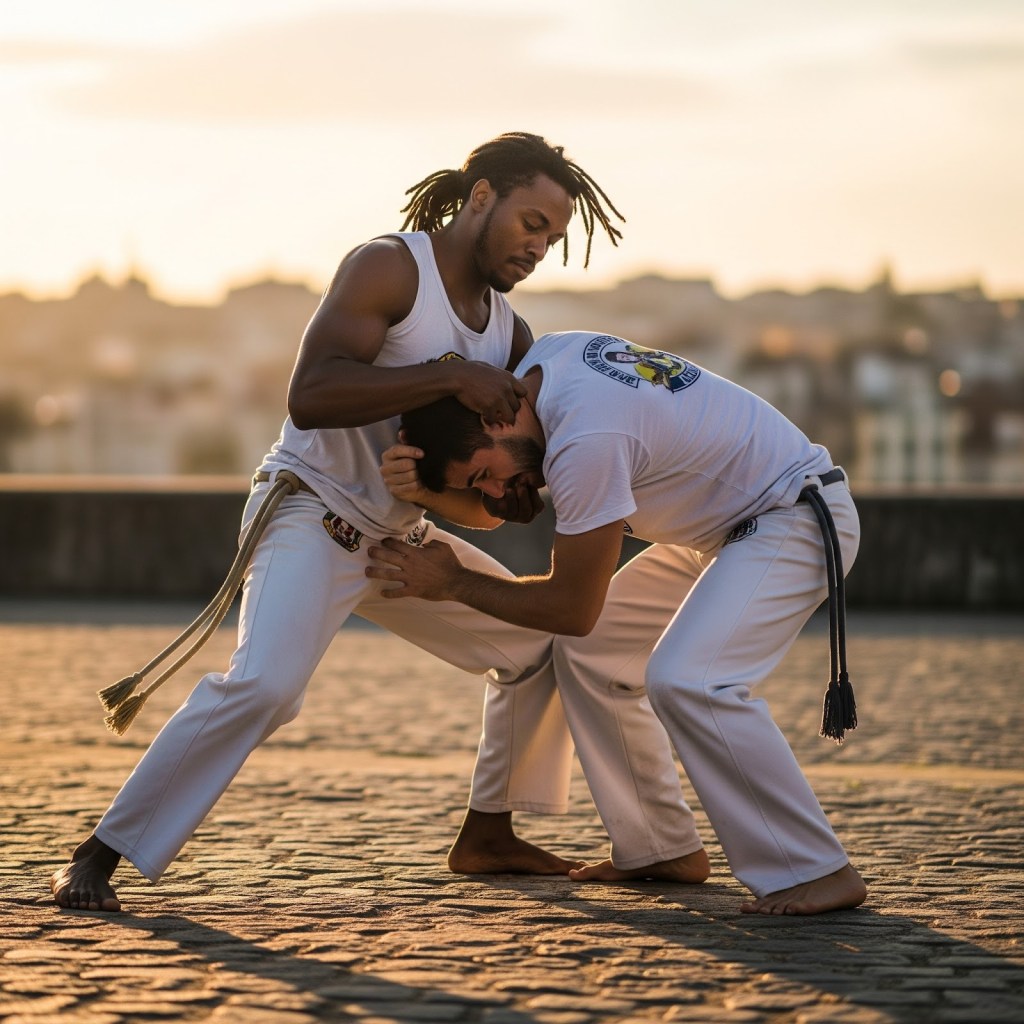
A headlock, particularly a standing one, aims to control the head and neck, often leading to a takedown or a choke. A capoeirista would likely avoid direct resistance, which can be counterproductive. Instead, their defense would focus on:
- Breaking Posture and Creating Space: The immediate goal would be to disrupt the aggressor’s balance and create a gap. This might involve a sudden drop in their center of gravity (like a queda de rins or rolê variation), forcing the opponent to adjust or lose their grip.
- Targeting Vulnerable Points: While not their primary focus, a capoeirista could use quick strikes or pressure points to the groin, eyes, or throat to create a momentary distraction, allowing them to escape.
- Utilizing Capoeira Movement for Escape: Instead of a static struggle, the capoeirista would leverage their agility. They might use a gato (cat escape) or a quick rolê to slide out from under the opponent’s arm, constantly moving to the side or rear of the attacker. The emphasis would be on escaping the hold rather than countering it directly with a grappling technique.
Defending Against an Armlock:

Armlocks aim to hyperextend or hyperflex the elbow or shoulder joint. A capoeirista’s best defense is prevention and immediate escape.
- Preemptive Movement: Capoeiristas are trained to constantly move and keep their limbs fluid, making it harder for an opponent to isolate and control an arm. They would use feints and evasive footwork to avoid having their arm caught in the first place.
- Immediate Disengagement: If an arm is caught, the capoeirista would not try to muscle their way out. Instead, they would employ their characteristic evasive movements. A negativa or a quick turn of the body might allow them to twist out of the lock before it’s fully applied.
- Using Body Momentum: They might use their entire body to roll or spin out of the lock, rather than solely relying on arm strength. The goal is to make the armlock position unsustainable for the attacker.
Escaping from a Mount Position:
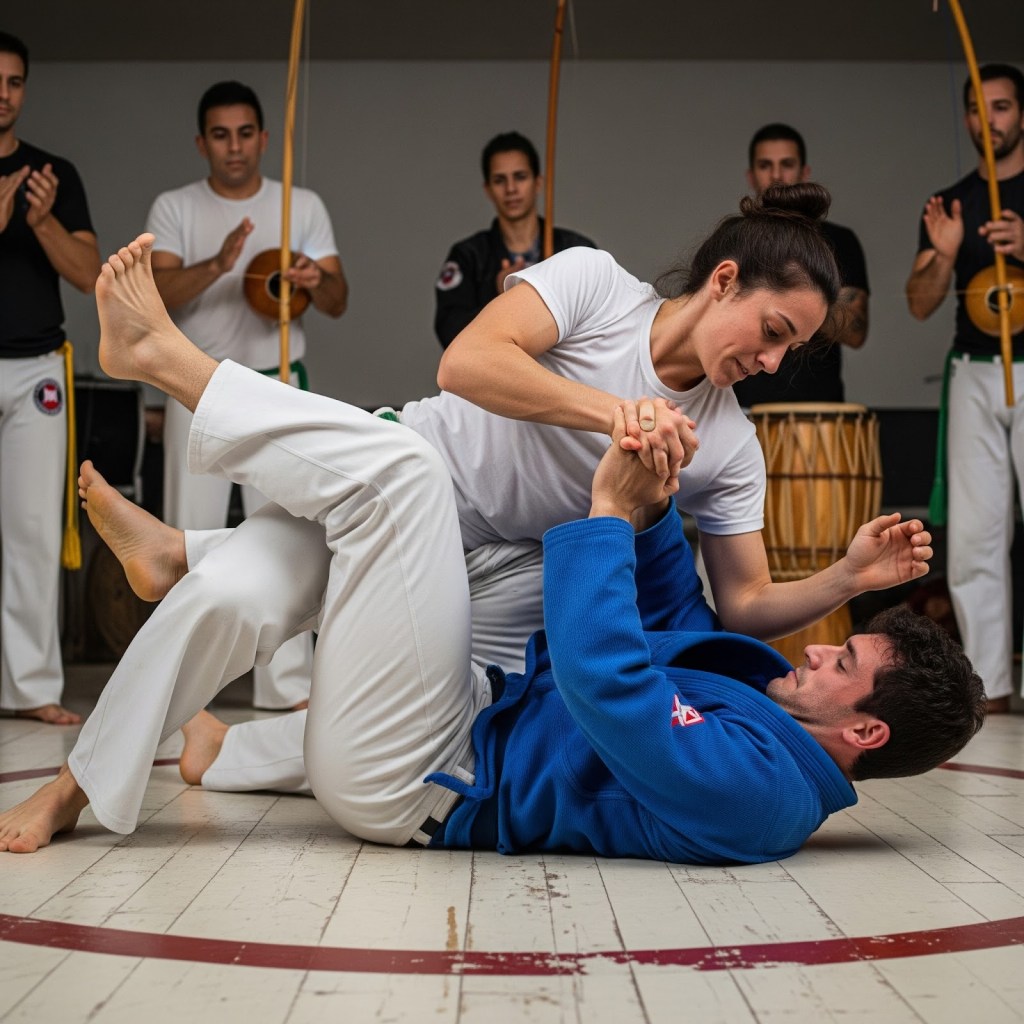
The mount is a dominant grappling position where the top fighter has superior control and striking opportunities. A capoeirista, typically preferring to be on their feet, would find this a highly disadvantageous position.
- Bridging and Bucking: Similar to traditional grappling, the capoeirista would attempt to bridge and buck, using their hips to create space and off-balance the opponent. This might be combined with a rolê or esquiva to create an opening.
- Creating Space with Legs: A capoeirista might use their legs to push against the opponent’s hips or knees, trying to create enough space to transition to a half-guard or to escape entirely.
- Exploiting Momentum: If the opponent becomes too aggressive with strikes from the mount, the capoeirista might use the opponent’s forward momentum to initiate a roll or a sweep, aiming to reverse the position or at least create enough space to stand up.
Defending from the Guard (Bottom Position):
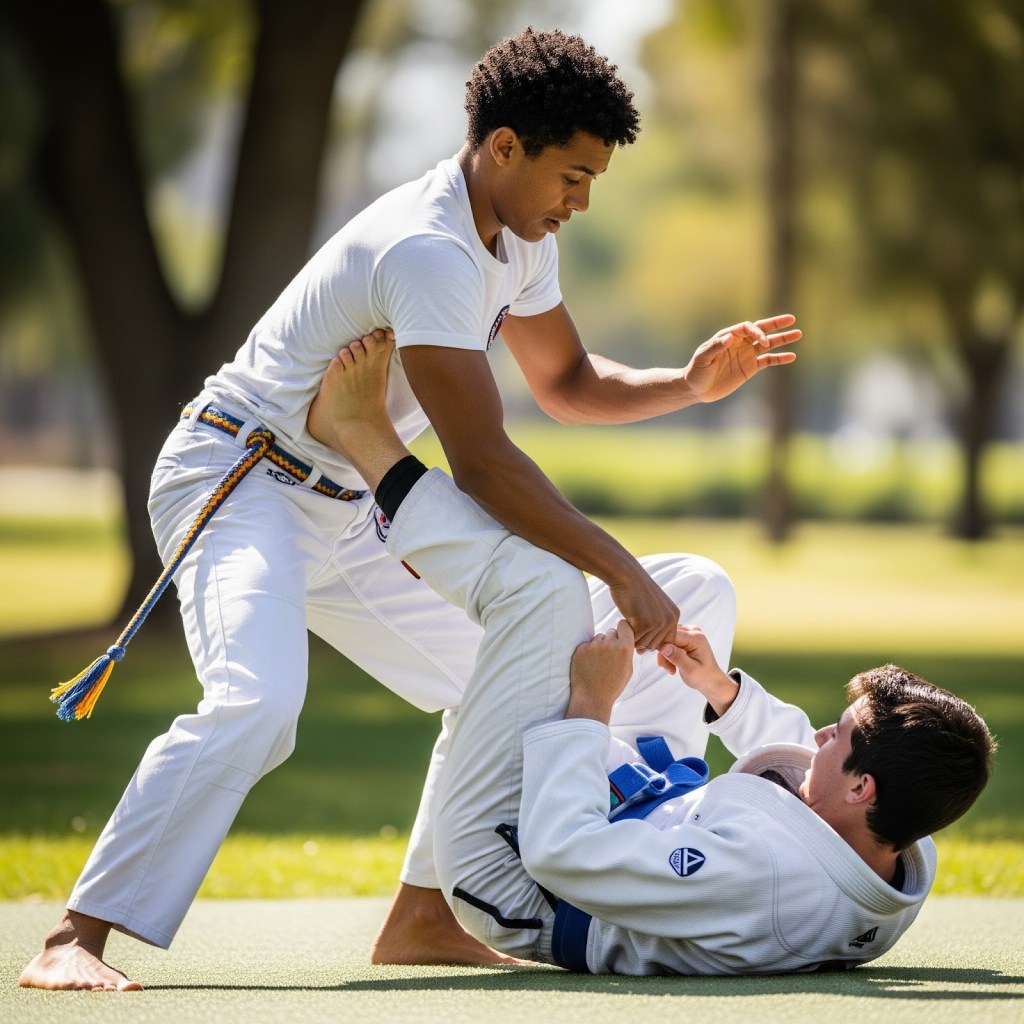
The guard involves the bottom fighter controlling the top fighter with their legs. While a capoeirista might not be adept at submitting from the guard, their goal would be to break free and return to a standing fight.
- Opening the Guard: The primary objective would be to break the opponent’s grip with their legs. This might involve pushing on the hips or knees, or using quick, explosive movements to open the guard.
- Stand-Up Escapes: Once the guard is open, the capoeirista would look for opportunities to stand up. This would involve quick movements, perhaps a queda de rins to create distance, and then explosive upward movements to regain their footing.
- Using Distraction: While less common, a capoeirista might use a quick, unexpected strike to the face or groin (if the situation dictates) to create a momentary distraction, allowing them to exploit an opening and stand up.
Defending Against a Double-Leg Takedown:
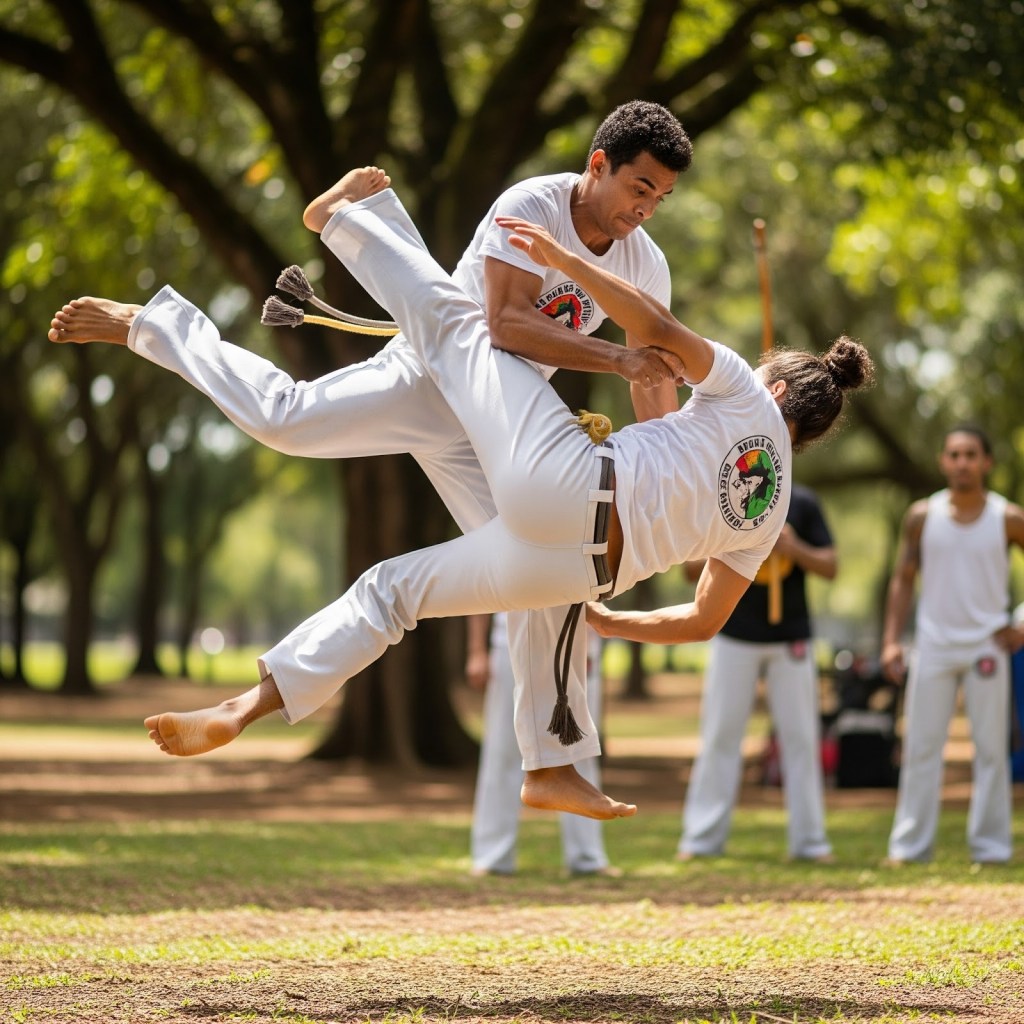
A double-leg takedown aims to lift and bring an opponent to the ground by grabbing both legs. Capoeira’s emphasis on evasive footwork and low stances provides inherent defenses.
- Sprawl and Stuff: The most effective defense is a sprawl, where the capoeirista shoots their legs back and drops their hips to the mat, flattening out and preventing the opponent from completing the takedown. This would be combined with a heavy chest on the opponent’s back, driving their head down.
- Evasive Footwork: Before the takedown even occurs, a capoeirista’s constant movement and feints make them a moving target. They would use their ginga and quick lateral movements to avoid being squarely in front of the attacker.
- “Stuffing” the Head: As the opponent shoots in, the capoeirista would attempt to “stuff” their head down, pushing it towards the mat. This disrupts the opponent’s posture and makes it harder for them to drive forward.
- Counter-Attacks and Sweeps (Transitional): If the takedown is partially successful, the capoeirista might look for a swift counter-attack. This could involve a quick sweep if the opponent’s balance is compromised, or a transition to a more favorable position like a guillotine choke (though less common in pure capoeira, it’s a practical self-defense tool).
In essence, a capoeirista’s defense against grappling attacks would not involve meeting force with force in a prolonged ground battle, which is a key distinction from many other martial arts. Instead, it would be a dynamic and fluid interplay of evasion, disengagement, and strategic movement. The primary objective is either to prevent the grappling scenario from fully developing in the first place or to quickly escape it and return to their preferred upright, fluid fighting style, which is where their strengths truly lie.
Their extensive training in capoeira heavily emphasizes maintaining a safe distance from an opponent, utilizing their exceptional agility and mobility to avoid being cornered or taken down. When grappling attempts do occur, capoeiristas are trained to exploit openings through unexpected movements, quick reversals, and acrobatic escapes. This allows them to break free from holds, create space, and regain their advantageous standing position. Their focus on circular movements, spins, and unpredictable kicks makes them a challenging opponent even in a seemingly disadvantageous grappling situation, as their movements are often hard to anticipate and counter by a grappler focused on static control. The underlying philosophy is to adapt and flow, rather than to resist directly, thereby turning an apparent weakness into an opportunity for an offensive counter-attack from a renewed standing position.
A Capoeirista’s Defense: Skill, Agility, and Tradition Against a Stick Attack
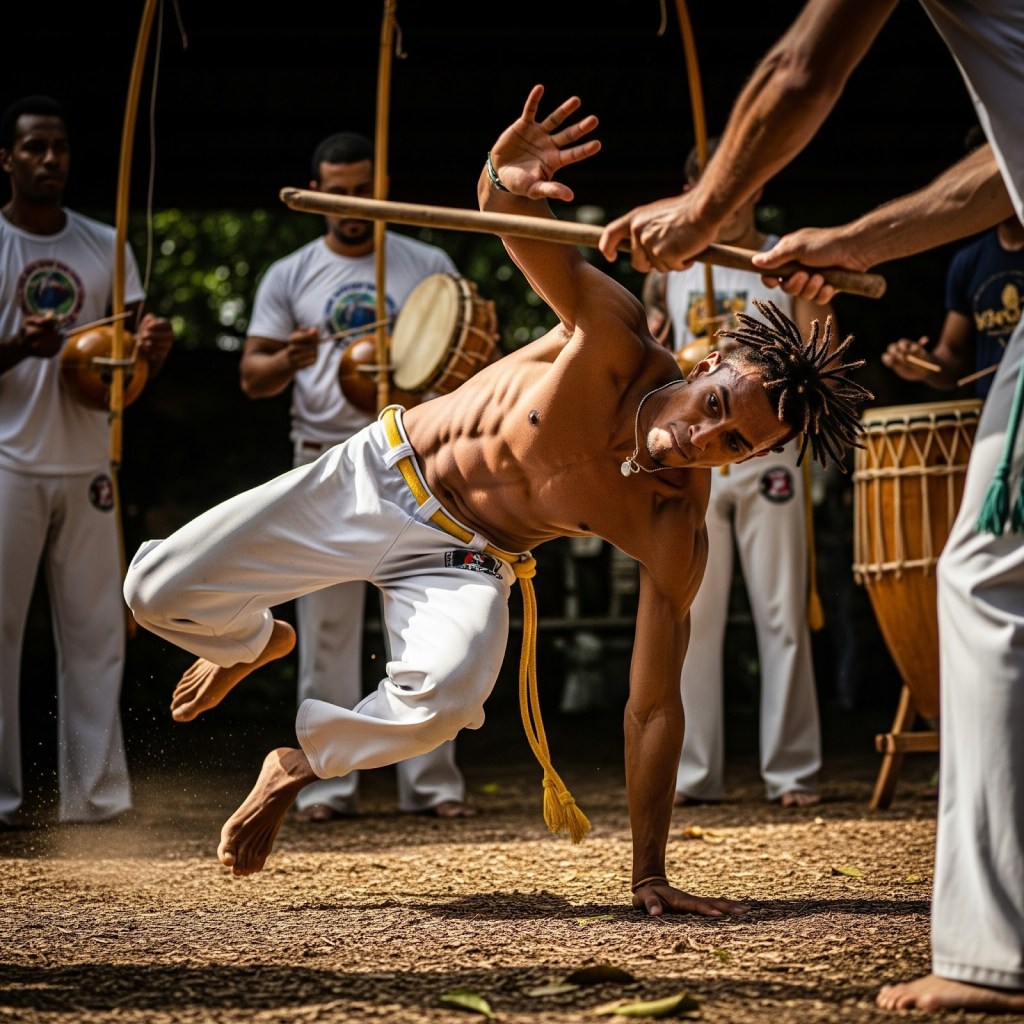
The image of a capoeirista defending against a stick attack encapsulates a pivotal moment in the dynamic and multifaceted martial art of Capoeira. This scenario highlights not only the physical prowess and agility inherent in capoeiristas but also the deep-rooted philosophy and survival strategies that underpin this Afro-Brazilian art form. It is within such encounters that the true essence of Capoeira—its historical significance, cultural richness, and practical applications—comes to life, offering a profound insight into its enduring legacy.
Capoeira, developed by enslaved Africans in Brazil as a means of self-defense and resistance, masterfully blends elements of martial arts, dance, acrobatics, and music. This unique synthesis was born out of necessity, allowing the enslaved to practice combat techniques under the guise of festive entertainment, thereby deceiving their oppressors. When faced with a stick attack, a capoeirista’s response is a testament to this unique synthesis. It’s not merely a block or a parry; it’s a fluid, almost dance-like evasion and counter, executed with precision and power. This response is deeply informed by the ginga, the foundational swaying movement that constantly keeps the capoeirista in motion, making them an elusive target while simultaneously setting up offensive maneuvers. The stick, a common weapon in many traditional martial arts, demands respect and a strategic approach, often met with Capoeira’s characteristic low sweeps, quick dodges, and acrobatic escapes that leverage momentum and surprise. The interplay of attack and defense becomes a dialogue of movement, a physical conversation where each action is a response to the other, embodying the fluid and unpredictable nature of the art.
Key elements in such a defense include:
- Ginga (Sway): The fundamental rhythmic movement in Capoeira, the ginga, is crucial for maintaining balance, generating momentum, and constantly shifting the body’s center of gravity. Against a stick, the ginga allows the capoeirista to move out of the line of attack swiftly, making them a difficult target to hit.
- Evasion and Dodging: Rather than directly meeting the force of the stick, a capoeirista will often prioritize evasion. This involves a variety of movements such as esquivas (dodges), rolês (rolls), and quedas (falls), designed to slip past the attack and create openings for counter-offensives. The emphasis is on redirecting or avoiding the impact rather than absorbing it.
- Acrobatic Maneuvers: Capoeira’s acrobatic elements, such as aús (cartwheels), armada (spinning kicks), and various handstands, can be utilized to spectacular effect in defense. A well-placed cartwheel, for instance, can not only evade a horizontal stick swing but also set up a powerful leg sweep or kick from an unexpected angle.
- Close-Quarters Combat and Disarms: If the attacker closes the distance, the capoeirista may employ a range of close-quarters techniques. These can include rasteiras (sweeps), tesouras (scissors takedowns), and balões (throws), aimed at disrupting the attacker’s balance and potentially disarming them. The goal is to gain control of the weapon or neutralize the threat it poses.
- Flow and Adaptability: A capoeirista’s defense against a stick attack is rarely a pre-planned sequence of moves. Instead, it’s an improvised and continuous flow, adapting to the attacker’s movements and the specific dynamics of the encounter. This adaptability is honed through countless hours of training in the roda, the circle where Capoeira is played.
- Awareness and Anticipation: Beyond the physical techniques, a capoeirista’s defense relies heavily on heightened awareness and the ability to anticipate the attacker’s intentions. Reading body language, observing the stick’s trajectory, and understanding the attacker’s rhythm are all vital for effective counter-action.
The scenario of a capoeirista defending against a stick attack is more than just a display of fighting prowess; it is a vivid illustration of Capoeira’s enduring legacy as a symbol of resilience, cultural expression, and a highly effective form of self-preservation. It speaks to the ingenuity of its creators who forged a powerful, expressive art form in the face of oppression, turning movement and music into an indomitable defense.
When a capoeirista faces the daunting challenge of a blade, knife, straight-razor, or a machete attack, their training and philosophy are put to the ultimate test. Capoeira, often seen as a dance, is in reality a sophisticated martial art born from the struggles of enslaved Africans in Brazil, where survival against armed oppressors was a daily reality. The movements, seemingly fluid and artistic, conceal potent defensive and offensive strategies designed to evade, disarm, and neutralize threats, even those involving lethal weaponry. The capoeirista’s response isn’t merely about physical technique; it’s deeply rooted in a profound understanding of space, timing, and an unyielding will to survive.
The historical context of capoeira is paramount to understanding its effectiveness in such dire situations. Developed in secrecy, its practitioners disguised their martial training within cultural expressions, making it appear innocuous to their overseers. This ingrained deception is a core principle even today. Against a blade, a capoeirista might not engage directly, but rather exploit the attacker’s aggression and commitment to the strike. Their philosophy emphasizes avoiding the direct line of attack, utilizing circular movements, evasive footwork (ginga), and deceptive feints to throw an assailant off balance, both physically and psychologically.
The “dance” aspect of capoeira serves a critical purpose beyond mere aesthetics. The continuous, flowing motion makes a capoeirista a difficult target to pin down. When confronted with a blade, this fluidity allows for rapid changes in direction, creating angles that make it challenging for the attacker to maintain a consistent threat. The capoeirista’s movements are not rigid or predictable; they are improvisational and adaptable, allowing them to react to the unpredictable nature of an armed assault.
Beyond evasion, capoeira incorporates powerful takedowns, sweeps, and kicks that can be deployed to create distance, disrupt an attacker’s balance, or even disarm them. A well-placed kick to the wrist or elbow, for example, could cause an attacker to drop their weapon. Furthermore, the capoeirista’s deep understanding of body mechanics allows them to utilize an opponent’s momentum against them, turning an aggressive lunge into an opportunity for a counter.
Ultimately, facing a blade with capoeira is a testament to the art’s core principles: adaptability, awareness, and an unwavering commitment to self-preservation. It is a philosophy of engagement that prioritizes survival above all else, transforming what appears to be a graceful dance into a formidable and highly effective system of self-defense against even the most lethal threats.
When a capoeirista faces the daunting challenge of multiple attackers, their very survival depends on a profound mastery of capoeira’s core tenets: fluidity, unpredictability, and ceaseless motion. Far removed from the rigid stances and predictable movements of more static martial arts, capoeira flourishes in dynamic, chaotic environments, rendering it astonishingly potent against numerical superiority. The capoeirista transforms into a living embodiment of adaptability, their strategy a complex interplay of evasion, disruption, and opportunistic strikes.
Key Defensive Principles: The Pillars of Survival
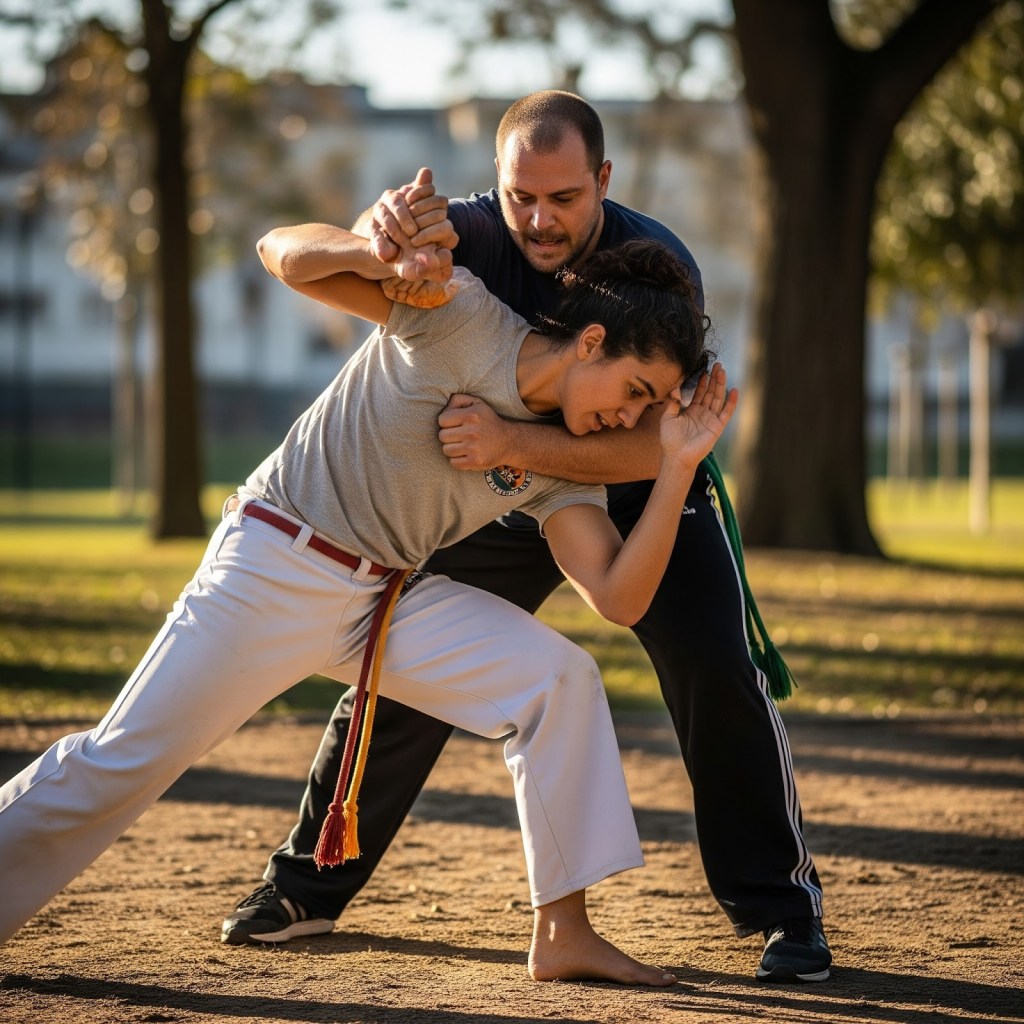
- Continuous Movement (Ginga): The ginga, capoeira’s iconic swaying base movement, transcends mere footwork; it is the heartbeat of the art. This constant, rhythmic shifting ensures the capoeirista remains an elusive, moving target, frustrating attackers’ attempts to land decisive blows. Beyond evasion, the ginga is a perpetual generator of opportunities—for sudden dodges, deceptive feints, and unexpected attacks that emerge from unconventional angles. In the crucible of a multi-opponent encounter, the ginga becomes an indispensable tool for strategic repositioning, meticulously preventing encirclement and denying attackers the psychological and tactical advantage of cornering their prey. It’s a continuous dance of threat assessment and spatial manipulation.
- Evasion and Dodging (Esquivas): Capoeira’s defensive philosophy prioritizes evasion above all else, viewing direct blocking as a static and often vulnerable response. The capoeirista employs a dazzling array of esquivas—deep squats (queda de rins), fluid rolls (rolês), and dynamic cartwheels (au)—to meticulously avoid incoming attacks. These maneuvers are not merely defensive; they are often seamlessly integrated with offensive potential, simultaneously setting up counter-attacks or creating crucial pockets of space within the chaos. Against a multitude of aggressors, these agile evasions are paramount for slipping between opponents, shattering their coordinated efforts, and skillfully avoiding the devastating impact of simultaneous strikes that would otherwise overwhelm a stationary target.
- Disruption and Off-Balancing: A capoeirista’s tactical repertoire includes a keen focus on destabilizing their opponents. Techniques like sweeping leg attacks (rasteiras), direct leg takes, and even precisely aimed kicks are deployed with the intent of knocking an attacker off their feet or, at the very least, momentarily disrupting their balance and rhythm. This disruption serves a dual purpose: it buys invaluable seconds for the capoeirista to recalibrate and maneuver, and it creates fleeting openings for follow-up actions. In a multi-opponent scenario, even temporarily incapacitating or disorienting a single attacker significantly diminishes the immediate threat, tipping the scales, however subtly, in the capoeirista’s favor.
- Unpredictable Attacks: The rich tapestry of capoeira’s offensive techniques—comprising a wide spectrum of kicks, hand strikes, headbutts, and takedowns—are characteristically delivered from surprising and unconventional angles. This inherent unpredictability makes it exceedingly difficult for a lone attacker to anticipate, let alone for multiple attackers attempting to synchronize their movements. A capoeirista might unleash a powerful spinning kick (meia lua de compasso) to forcefully create distance, immediately followed by a swift, low sweep to fell a nearby opponent, showcasing the seamless and unexpected transitions that define their fighting style.
- Utilizing the Environment: A truly skilled capoeirista possesses a heightened awareness of their surroundings, instinctively incorporating the environment into their defensive and offensive strategies. This could manifest as using obstacles to funnel attackers into narrow corridors, thereby creating advantageous chokepoints, or leveraging walls and other structures for support during evasive maneuvers, or even as platforms from which to launch surprise attacks. The environment ceases to be a mere backdrop and becomes an active participant in the unfolding struggle.
Tactical Approaches: Orchestrating Chaos
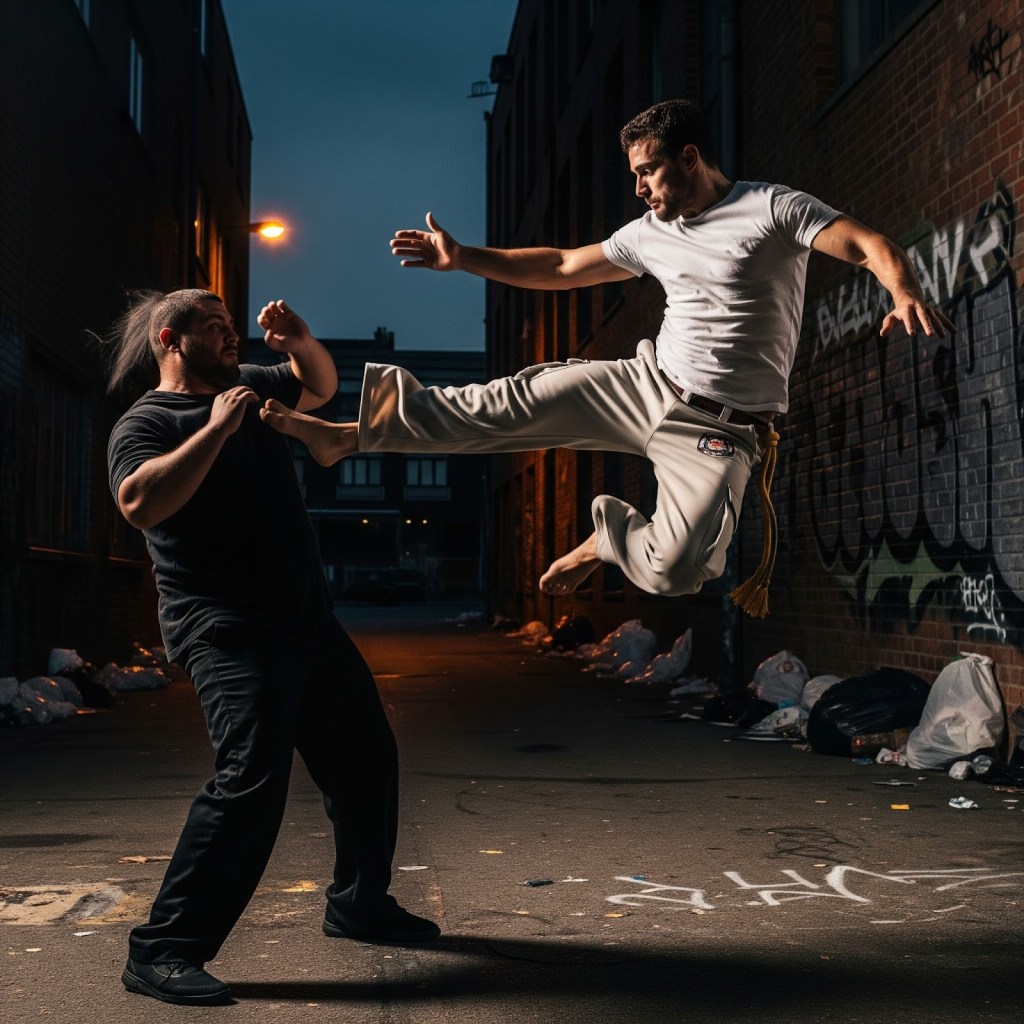
- Maintaining Distance and Creating Space: The cardinal rule for a capoeirista facing multiple threats is to vehemently avoid being cornered or overwhelmed. This dictates a relentless commitment to movement, constantly shifting angles, and employing long-range kicks to effectively keep attackers at bay. They will utilize a sophisticated series of dodges, feints, and explosive bursts of speed to consistently remain outside the immediate attack radius of all opponents, denying them the opportunity to close in and execute a coordinated assault.
- Focusing on One Attacker at a Time (Target Prioritization): While facing several adversaries, a capoeirista’s pragmatic approach typically involves attempting to incapacitate or disorient one attacker at a time, thereby establishing a momentary, albeit fleeting, advantage. This strategy does not imply a static, one-on-one engagement, but rather a dynamic process of utilizing continuous movement and exploiting fleeting opportunities to isolate and systematically address threats in a sequential manner, constantly re-evaluating and prioritizing the most pressing danger.
- Using Momentum and Circular Movement: The inherently circular and rotational movements that define capoeira are exceptionally effective against multiple assailants. A spinning kick, for instance, can simultaneously address threats emanating from various directions or compel attackers to shift their positions, disrupting their offensive alignment. Furthermore, the immense momentum generated in these fluid movements can be skillfully harnessed to chain together successive attacks or link multiple evasions, creating an unbroken, unpredictable flow.
- Deception and Feints: The art of deception is a powerful weapon in the capoeirista’s arsenal. Feinting attacks or deceptive movements can cleverly mislead attackers into committing to a specific action, inadvertently creating critical openings for the capoeirista to exploit. For example, a feigned movement in one direction, followed by a rapid and decisive change of course, can throw off an attacker’s timing and balance, leaving them vulnerable.
- Fluid Transitions Between Offense and Defense: In capoeira, the lines between attack and defense are deliberately blurred; there is no rigid separation. Every dodge is a potential prelude to a devastating kick, and every kick can seamlessly transition into a protective roll or another evasive maneuver. This continuous, uninhibited flow is absolutely paramount when confronted with multiple threats, as it allows for an uninterrupted and instantaneous adaptation to the ever-changing dynamics of the conflict.
Against multiple attackers, a capoeirista’s defense transcends mere technique; it becomes a dynamic, intricate ballet of precisely calculated evasion and strategically aggressive counter-actions. It is a fluid art form, meticulously honed over generations specifically for the crucible of survival. Their paramount objective is not to absorb the brunt of incoming blows or to engage in a static, power-for-power exchange—an approach that would swiftly lead to their being overwhelmed. Instead, they strive to become an elusive, almost intangible force, an unhittable target that confounds and frustrates their assailants. This necessitates an unyielding, unwavering commitment to perpetual mobility, transforming their body into a constantly shifting kaleidoscope of unexpected angles, deceptive feints, and lightning-fast transitions, rendering them a living, breathing puzzle that their attackers are incapable of solving.
This philosophy of perpetual motion is deeply ingrained in every aspect of capoeira training. From the fundamental ginga—the characteristic swaying motion that serves as both a warm-up and a combat stance—to the most complex acrobatic movements, every action is designed to maintain unpredictability and momentum. A capoeirista does not stand still, inviting attack, but rather continuously shifts their weight, pivots, and weaves, making it exceedingly difficult for an opponent to establish a clear line of attack. This constant flow creates an illusion of a larger, more complex target, as the capoeirista’s center of gravity and vulnerable points are never in a fixed position.
Beyond simple evasion, this mobility is interwoven with strategic aggression. The feints and deceptive movements are not merely to avoid, but to create openings, to draw an attacker into a vulnerable position, or to disrupt their balance and rhythm. A sudden lunge followed by an unexpected retreat, a low sweep that appears to be a kick, or a cartwheel that transitions into a powerful strike—these are all examples of how a capoeirista utilizes their fluidity to manipulate the engagement. The goal is to dictate the terms of the fight, to control the space, and to break down the attackers’ coordinated efforts through confusion and relentless pressure.
Furthermore, the capoeirista understands that in a multi-attacker scenario, resources are limited. Conserving energy by avoiding direct impact and utilizing the attackers’ own momentum against them becomes crucial. By sidestepping a punch, the capoeirista might subtly guide the attacker into the path of another, turning their aggression into a liability. The environment itself can also become an ally, with the capoeirista using obstacles or uneven terrain to their advantage, further complicating the attackers’ attempts to corner or overwhelm them. This intricate dance of defense and offense, evasion and counter, makes the capoeirista not just a fighter, but a master of strategic survival.
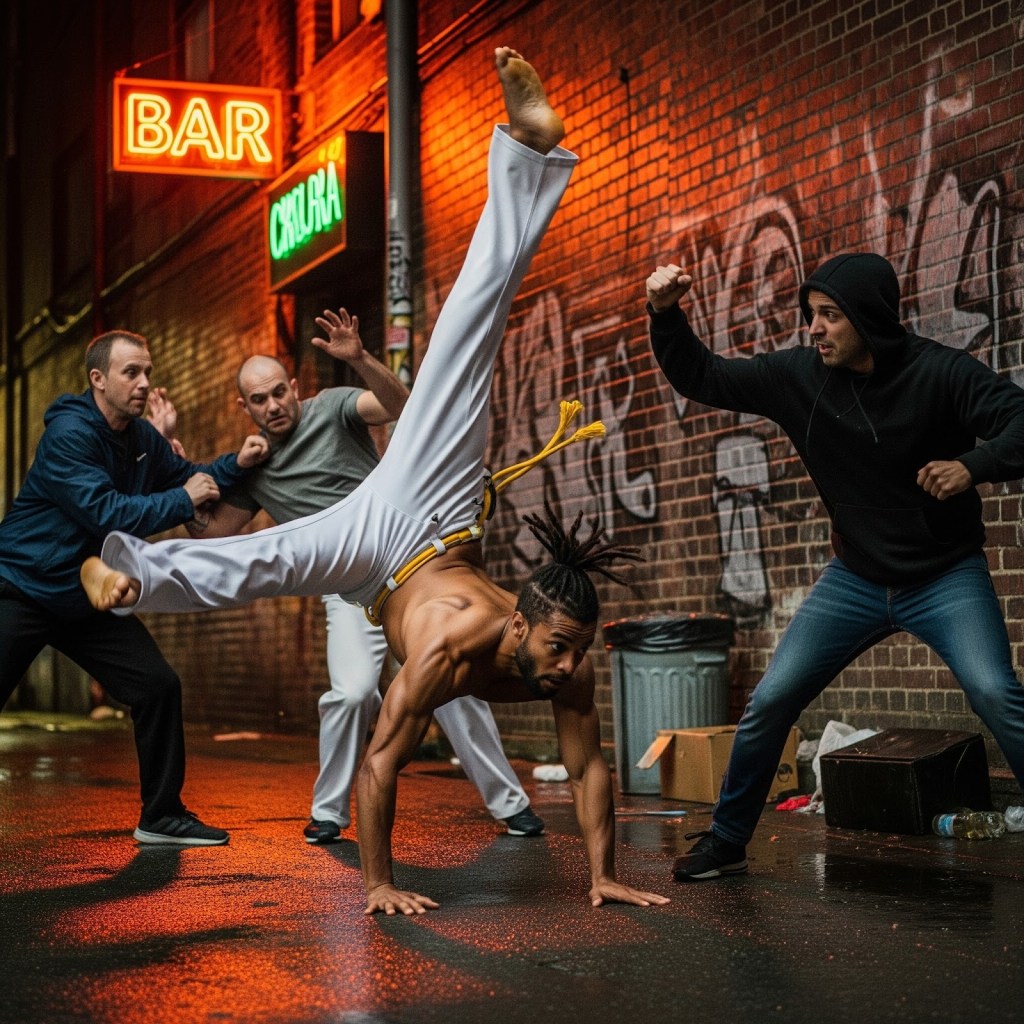
The capoeirista’s movements are meticulously designed to disrupt the attackers’ rhythm and coordination, making it exceedingly difficult for them to land a decisive blow. They might weave, dodge, and roll with incredible agility, using their low center of gravity and fluid transitions to slip past lunges and strikes that would fell a less agile combatant. The ginga, the foundational sway of capoeira, serves as a perpetual motion engine, a constant, rhythmic movement that keeps them poised and ready to react instantly to any threat, blurring the lines between defense and offense. This constant motion not only makes them harder to hit but also allows them to maintain optimal distance and positioning.
Beyond simple evasion, a skilled capoeirista uses their movement to create disorienting patterns, forcing their assailants to constantly re-adjust their footing and focus. This continuous repositioning can cause attackers to interfere with each other, creating critical openings for the capoeirista to exploit. They might subtly draw an attacker into a vulnerable position, perhaps by feigning an escape in one direction, or expertly use the momentum of one assailant to inadvertently strike another, turning the attackers’ aggression against themselves. This tactical use of space and opponent interaction is a hallmark of capoeira’s multi-attacker strategy.
The capoeirista’s defense is not purely passive; it’s an active process of creating opportunities. While masterfully avoiding direct confrontation, they are simultaneously scanning for weaknesses, anticipating their opponents’ next moves, and meticulously setting up their own counter-attacks. This could involve quick, precise strikes to pressure points, aimed at disrupting an attacker’s balance or focus rather than delivering a knockout blow, or disorienting sweeps that unbalance an attacker, clearing a path for escape or a more decisive follow-up. They might also strategically use environmental elements to their advantage, such as obstacles or uneven terrain, to further hinder their assailants. The overarching goal is to neutralize the threat, not necessarily through brute force, but through intelligent movement, impeccable timing, and the psychological disruption of their adversaries, often leading to a situation where the attackers are unable to effectively coordinate their efforts.Conclusion Revisited: The Practitioner, Not Just the Art
In conclusion, Capoeira is a formidable and beautiful martial art with undeniable self-defense applications, rich in history and cultural significance. Its unique emphasis on fluidity, evasiveness, and powerful, often deceptive, kicks offers a distinct advantage in many scenarios, particularly when facing multiple opponents where its movement-based philosophy shines. However, like any martial art, its effectiveness in the unpredictable crucible of a street fight is not absolute; it’s a tool whose efficacy depends heavily on the wielder.
The true power of Capoeira in self-defense lies not just in its techniques, though they are potent, but fundamentally in the practitioner’s ability to adapt, cross-train, and cultivate a holistic understanding of conflict. By acknowledging its inherent strengths, and critically addressing its limitations through supplementary training—perhaps incorporating elements of grappling or close-quarters combat for well-roundedness—and embracing a mindset that prioritizes awareness, de-escalation, and decisive action when necessary, a Capoeira practitioner can transform their art into a highly effective tool for real-world self-preservation. Ultimately, the martial art is merely a vehicle; the skill, adaptability, and mindset of the individual driving it are what truly dictate success in a confrontation, making the practitioner the ultimate determinant of the art’s effectiveness.
Capoeira, with its fluid movements, evasions, and focus on maintaining distance, offers a unique and often surprising approach to self-defense. However, when faced with a grappling attack—such as a restrictive headlock, a joint-locking armlock, a fighter in a dominant mount position, the complexities of the guard, or a powerful double-leg takedown—a capoeirista’s response would differ significantly from that of a traditional grappler. The effectiveness of their defense hinges crucially on their ability to transition from a close-quarters grappling scenario back to a more open, movement-based fight, utilizing their core capoeira principles such as explosive escapes, agile repositioning, and the creation of space. This might involve using their legs to push off, bridging to create distance, or employing sudden, disorienting movements to break free and re-establish the dynamic, flowing combat environment where capoeira truly excels.
We are at the end of this page. If you read through this sea of words that is this article, I want you to remember this:
EVERYTHING I SHARED WITH YOU ABOVE IS BULL%*&T!!!
THAT IS… UNTIL YOU APPLY IT.