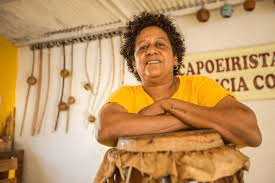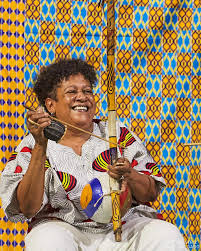
Mestra Janja, whose birth name is Rosângela Costa Araújo, is a prominent Brazilian capoeirista, historian, educator, and activist widely recognized for her leadership in Capoeira Angola and her work in Black feminism.
Born on October 4, 1959, in Feira de Santana, Bahia, she has spent decades promoting Afro-Brazilian cultural preservation, community education, and gender equality.
Her journey in Capoeira Angola began under the guidance of Mestre Moraes at the Grupo de Capoeira Angola Pelourinho (GCAP) in Salvador, where she dedicated 15 years to mastering the art form.
Grupo Nzinga
In 1995, Mestra Janja (Rosângela Araujo) co-founded the Grupo Nzinga de Capoeira Angola in São Paulo alongside Mestra Paulinha and Mestre Poloca. The organization was established with a primary mission to preserve and evolve traditional African and Afro-Brazilian knowledge while using Capoeira Angola as a political and educational tool. Today, Grupo Nzinga operates as an international network with headquarters in Salvador, São Paulo, and Brasília, and branches in Mozambique, Mexico, Germany, and Japan.
The group’s pedagogical approach is rooted in defending the rights of children and adolescents, actively fighting against sexism and racism, and promoting human diversity. Mestra Janja emphasizes that the group uses capoeira as a political practice to break vertical societal structures and empower marginalized groups, particularly women and girls. Unlike traditional social projects that aim to remove children from the streets, Grupo Nzinga seeks to occupy public spaces and transform them into cultural and musical hubs.
In its fight against sexism, the organization ensures that women and girls have equal opportunities to lead songs and play the berimbau—the symbol of power in capoeira—which is often restricted in more traditional groups. Furthermore, Grupo Nzinga protects the rights of children by educating them on human rights, Brazil’s Statute on the Child and the Adolescent, and the history of black people in Brazil. This work is viewed as a form of affirmative action, providing children from underprivileged communities like Alto da Sereia with access to educational opportunities, cultural experiences, and moral values that foster their physical, mental, and social development.
Institute INCAB: To expand her social and educational reach, she established the Instituto Nzinga de Estudos da Capoeira Angola e Tradições Educativas Banto no Brasil (INCAB) in 2001, highlighting Bantu-rooted educational traditions. INCAB serves as a platform for studying the intersection of traditional practices and formal education.
An accomplished musical leader, Mestra Janja conducts the Orquestra Nzinga de Berimbaus and IGBADU, an all-women berimbau orchestra.
Her leadership is central to Grupo Nzinga’s mission of using the berimbau—the “symbol of power within capoeira”—to challenge traditional gender roles. By encouraging women to lead songs and play the gunga, she disrupts historical patterns where women were often relegated to secondary instruments like the agogô or pandeiro.
Her musical contributions extend to academic and pedagogical frameworks, where she integrates Afro-Brazilian rhythms like funky into the berimbau orchestra’s repertoire to teach children diverse cultural interpretations. This innovation is captured in her recorded works, with tracks available on Spotify.
Within the framework of Capoeira Angola, the berimbau is the conductor of the roda, dictating the pace, energy, and style of the game. Mestra Janja utilizes this instrumental authority to promote inclusion and social change. Under her guidance, Grupo Nzinga has adapted traditional lyrics—transforming verses like “I am a man, I am not a woman” into the more inclusive “there are men and there are women”—to reflect gender equality within the art form.
Beyond its social role, the music serves as a holistic system for development, fostering:
- Creative Expression: Children are encouraged to improvise ladainhas (introductory verses) and raps, allowing them to express their individuality through the music.
- Cultural Preservation: The repertoire includes songs in African languages and references to Orixás, reconnecting practitioners to their ancestral heritage.
Therapeutic Well-being: The low-frequency vibrations of the berimbau, particularly the deep tones of the gunga, are believed to induce a meditative state and promote emotional calm.
She graduated with a degree in History from the Federal University of Bahia (UFBA) and completed both her Master’s and Doctorate degrees in Education at the University of São Paulo (USP), researching philosophy and education.
She is a professor in the Department of Gender Studies and Feminism at the Federal University of Bahia (UFBA), where she continues to bridge the gap between academic research and traditional Afro-Brazilian practices. Government Service: She served as the head of the Women’s Department for the Secretariat for the Promotion of Racial Equality in the State of Bahia, applying her expertise in Black feminism to public policy and community advocacy.
Philosophy: Mestra Janja advocates for capoeira as a community-rooted lifestyle rather than a mere sport. She coined the phrase “Gingo logo existo” (“I ginga, therefore I am”), framing the basic capoeira step (ginga) as an epistemology of human existence and Black resistance. Her philosophy emphasizes that the ginga serves as a metaphor for emotional fluidity and adaptability, training the nervous system to remain engaged during stress rather than succumbing to freeze or flight responses.This approach views capoeira as a transformative tool for healing marginalized populations and dismantling the psychological legacies of personal and historical oppression. By promoting an embodied pedagogy of self-determination, she integrates traditional African and Afro-Brazilian knowledge to foster environments characterized by respeito (respect), união (unity), and collective responsibility. Through the roda, which she treats as a “safe container,” practitioners can experience vulnerability and build trust, ultimately reclaiming their personal autonomy and narratives.