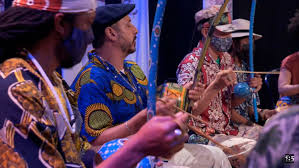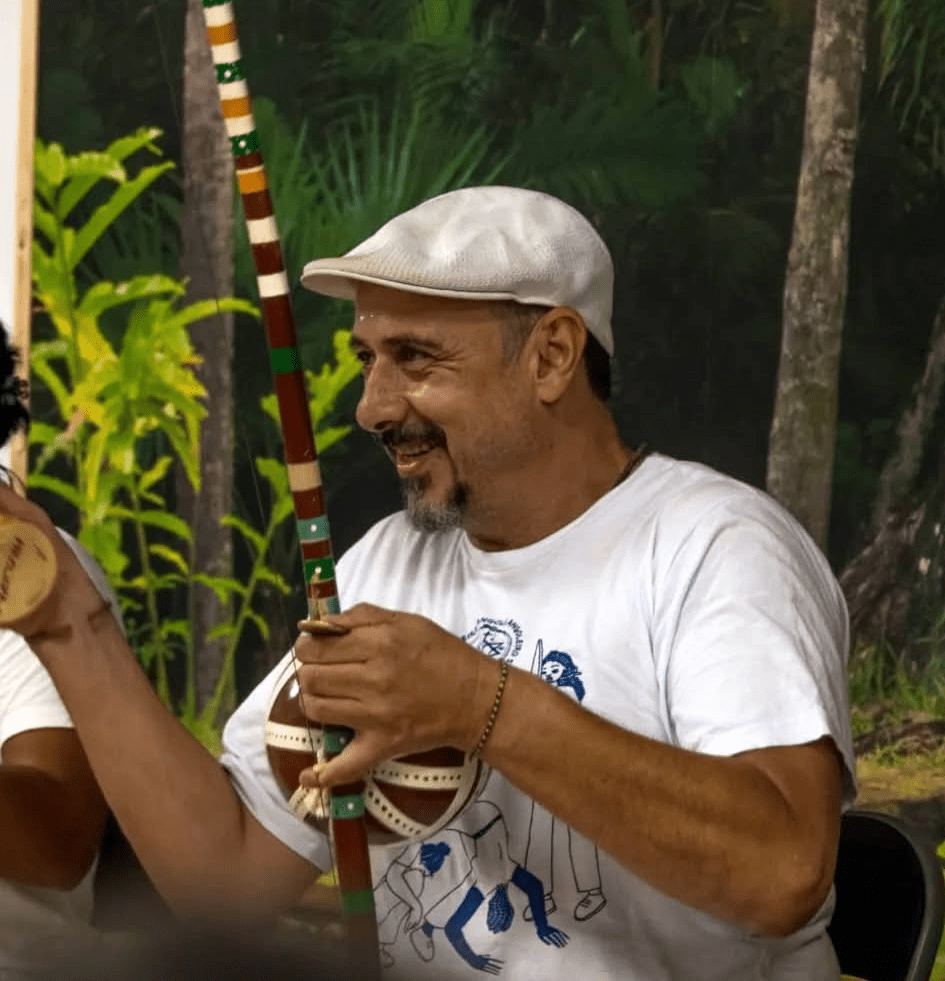
Mestre Plínio, born Plínio César Ferreira dos Santos, is a highly prominent and respected master of Capoeira Angola. Based primarily in São Paulo, Brazil, he is widely recognized for his decades-long dedication to preserving, practicing, and teaching the traditional knowledge and Afro-Brazilian roots of the art form.
Lineage and Influences
Mestre Plínio began his journey with Capoeira in the late 1970s, starting to practice in the streets of his São Paulo neighborhood in 1979. He initially trained with Almir Vitório, a disciple of Mestre Caiçara and Silvestre. Shortly after, he met Mestre Gato Preto, an Angolan capoeira practitioner from Bahia, from whom he learned capoeira from 1980 to 1983. At that time, in São Paulo, there wasn’t much of a difference between Angola and Regional as there is today; Capoeira Angola was primarily reserved for “baptisms”. His foundational philosophy was heavily influenced by these legendary masters who brought northeastern traditions to the south, instilling a commitment to “malícia” (cunning/playfulness), deep ritual structures, and ritualized “chamadas”.
When Mestre Gato Preto returned to Santo Amaro da Purificação, Bahia, in 1984, Plínio joined Mestre Suassuna’s Cordão de Ouro group, where he remained until 1990/91. During this period, he spent two years working in Salvador, which included an opportunity to train for three months with the legendary Mestre João Grande at the Miguel Santana Theater. This exposure to the old-generation masters informed his lifelong dedication to preserving the traditional rituals, music, and movements that define Capoeira Angola as an Afro-Brazilian cultural expression.
Founder of Angoleiro Sim Sinhô
In 1993, Mestre Plínio established the Angoleiro Sim Sinhô Capoeira School in São Paulo, marking a significant milestone in the preservation of Capoeira Angola. The center operates with a systematic approach to elevate the status of the art, serving as a repository for popular knowledge inherited from the old masters.
Expanding far beyond its Brazilian roots, the group has evolved into a global cultural hub. Under Mestre Plínio’s leadership, it has established influential affiliate academies throughout Europe, notably including Angoleiro Sim Sinhô Madrid and multiple branches across Barcelona.
More than just a sports academy, the school functions as a critical focal point for Afro-Brazilian musical expressions. It bridges historical oral traditions with the modern sociocultural challenges faced by Black culture in Brazil, fostering a deep sense of identity and resistance.
Through workshops, festivals, and daily practice, the school ensures that the complex rituals, music, and philosophy of Capoeira Angola remain a living, breathing tradition for future generations.
Musical Legacy & Festivals
Beyond his mastery of physical movement, Mestre Plínio is a highly celebrated musician, singer, and skilled instrument maker. His profound understanding of the berimbau and traditional rhythms is central to his teachings. He was a featured artist on the authoritative self-titled cultural album Angoleiro Sim Sinhô (Capoeira), which was released in 2009.
These tracks continue to be widely streamed across the globe, serving as an essential soundtrack for authentic training rodas and preserving the auditory heritage of Capoeira Angola.
Mestre Plínio has also been instrumental in organizing and performing in prominent artistic showcases that highlight the socio-cultural importance of the art form. Notable among these is “A Luta Continua” (The Struggle Continues), presented at the Malungo Festival.
These performances often involve collaboration with other legendary figures in the community, such as Mestra Janja, further solidifying the artistic connections within the lineage.His commitment to global education is reflected in his frequent international travels to conduct intensive training camps and “vivências” (cultural immersions). These programs span from Latin America to various European and Asian nations, including Finland and Russia. Through these workshops, he shares the deep musicality of the berimbau and traditional songs, ensuring that the philosophy and ritual structures of Capoeira Angola reach a diverse global audience.