
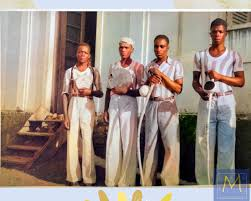
I admit, I wasn’t able to find much about this Mestre. However, I will post what I have been able to find about him, because he is a part of the history and legacy of Capoeira Angola.
19?? – While the exact year of his birth remains uncertain, it is well-established that he was born in the Norte do Paraná. His formative years were shrouded in mystery, creating a foundational enigma that would later define his renowned persona within the global spheres of sports and entertainment. This lack of precise documentation is characteristic of many great Angoleiros, whose lives often functioned as a clandestine language of resistance maintained secretly through generations of systemic oppression. The preservation of his story, despite these missing dates, remains essential to the historical, philosophical, and musical heritage of Capoeira Angola, serving as a living sanctuary of cultural memory. In this tradition, the indomitable spirit of those who survived enslavement is actively re-enacted and reinforced through every grounding step and deceptive movement in the roda.
1936 – This year marks a significant chapter in his life as he is believed to have stepped into the ring in the Odeon Park in May 1936. This period was a definitive era for Capoeira, as Mestre Bimba won the Bahian Capoeira Championship at the Parque Odéon, a victory that helped transition the art from a prohibited practice into a recognized national martial art. The intense energy of the crowd, the vibrant atmosphere, and the anticipation of the fight all contributed to this pivotal moment in his career. These demonstrations for high-level officials, including later ones for President Getúlio Vargas, began the final phase of integrating African culture into the legitimate social fabric of Brazil.
19?? – While the exact year of his birth remains uncertain, it is well-established that he was born in the Norte do Paraná. His formative years were shrouded in mystery, creating a foundational enigma that would later define his renowned persona within the global spheres of sports and entertainment. This lack of precise documentation is characteristic of many great Angoleiros, whose lives often functioned as a clandestine language of resistance maintained secretly through generations of systemic oppression. The preservation of his story, despite these missing dates, remains essential to the historical, philosophical, and musical heritage of Capoeira Angola, serving as a living sanctuary of cultural memory. In this tradition, the indomitable spirit of those who survived enslavement is actively re-enacted and reinforced through every grounding step and deceptive movement in the roda.
1936 – This year marks a significant chapter in his life as he is believed to have stepped into the ring in the Odeon Park in May 1936. This period was a definitive era for Capoeira, as Mestre Bimba won the Bahian Capoeira Championship at the Parque Odéon, a victory that helped transition the art from a prohibited practice into a recognized national martial art. The intense energy of the crowd, the vibrant atmosphere, and the anticipation of the fight all contributed to this pivotal moment in his career. These demonstrations for high-level officials, including later ones for President Getúlio Vargas, began the final phase of integrating African culture into the legitimate social fabric of Brazil.
1940 – A remarkable event took place on the 22nd of December, a Sunday, when the esteemed American Lorenzo Dow Turner from Fisk University in Nashville, Tennessee, USA, arrived in Brazil. It was on this day that he recorded captivating music at Rádio Sociedade da Bahia, which had been founded on the 24th of March 1924 in Federação. This recording not only captured the essence of the music but also became a testament to the cultural exchange between nations, bridging the gap through the universal language of music.
Such documentation serves as a vital cultural archive, preserving the nuances of traditional songs and the specific rhythmic patterns of the bateria for future generations. These archives immortalize the strategic interactions and the physical dialogue between players, highlighting the importance of mandinga and ritual that are central to the philosophy of resistance within Capoeira Angola. By documenting the delicate balance of instruments like the berimbau, atabaque, and pandeiro, Turner’s work provided a template for students to study the complex syncopation and calls that guide the energy of the game, ensuring that this auditory heritage remains accessible to practitioners worldwide.
19?? – His legacy endures long after his passing, as his impact on the world continues to be felt. The exact year of his demise remains a mystery, much like the intriguing facets of his life, ensuring that he will be remembered for generations to come. This enigma is characteristic of the great Angoleiros, whose lives were often a clandestine language of resistance secretly maintained through generations of systemic oppression.
The preservation of his story, even with its missing dates, is essential to the historical, philosophical, and musical heritage of Capoeira Angola. It serves as a living sanctuary of cultural memory, where the indomitable spirit of those who navigated and survived enslavement is actively re-enacted and reinforced with every deceptive sweep and grounding step in the roda.
Just as the berimbau gunga holds the primary authority in the bateria and dictates the pace and rhythm of the game, his enduring presence dictates a continued commitment to safeguarding Afro-Brazilian traditions. His contribution to the art form remains a potent means of expression, acting as a bridge between generations and facilitating a dynamic dialogue between the past and the present.
 Jogo Corpo Fechado