I’ve heard some version of this message in my life so many times, especially when talking about His-Story, and it pisses me off. The distortion and marginalization of African American history in the broader American narrative has long served to obscure the deep realities of a shared past.
This is for my white brothers and sisters in the world, who wonders why they might feel some type of way when feeling a little “Left out” around black spaces… Understanding this requires looking closely at the historical and contemporary divide between black and white Americans, particularly regarding perceptions of race and structural inequality.
The historical divide between Black and white Americans is deeply rooted in centuries of institutionalized oppression and systemic inequality. The marginalization and distortion of African American history within the broader American narrative have long obscured the deep realities of a shared past. For generations, structural frameworks designed around white supremacy, economic exploitation, and institutionalized subjugation have directly dictated the lived experiences and societal positioning of Black communities. From the onset of colonial chattel slavery through the oppressive legal framework of Jim Crow laws, formal and informal state and social systems have systematically restricted the political, social, and economic self-determination of Black Americans.
During the era of slavery, legal mechanisms like “Slave Codes” and subsequent federal statutes explicitly codified Black people as property, stripping them of fundamental human rights, economic agency, and the freedom of movement or literacy. Even following emancipation and the brief promises of the Reconstruction era, where the 14th and 15th Amendments granted citizenship and voting rights, a violent white nationalist backlash led to the establishment of Jim Crow segregation. This racial caste system relegated African Americans to second-class citizenship, enforcing strict public segregation through dynamic state statutes and local ordinances. These laws legally mandated separated public facilities, transportation, and education, while criminalizing low-income Black residents through vagrancy laws and convict leasing systems that effectively re-enslaved individuals for unpaid labor.
Furthermore, the justice system actively legitimized these inequalities. Landmark rulings like Plessy v. Ferguson formalized the “separate but equal” doctrine, providing constitutional shelter for pervasive discrimination. This systemic oppression extended well into the 20th century, manifesting as pervasive economic discrimination, occupational segregation, and exclusionary housing practices such as redlining and restrictive covenants. These practices effectively barred Black families from asset accumulation, homeownership benefits, and equitable job opportunities.
Although the mid-1950s and 1960s American civil rights movement achieved historic breakthroughs by utilizing nonviolent protests, civil disobedience, and major litigation to dismantle formal segregation and secure voting protections, national opposition to integration remained fierce and deeply organized. This opposition included political backlash, the formation of segregationist groups, and even violent confrontations with civil rights activists, all of which sought to undermine the progress made during this transformative period. Decades after these legislative milestones, the enduring legacy of these deeply embedded historical injustices continues to fuel profound socioeconomic disparities, persistent structural racism, and a distinct cultural divide across contemporary American society.
These disparities manifest in various forms, including unequal access to education, healthcare, and housing, further perpetuating cycles of disadvantage among marginalized communities. As the nation grapples with these ongoing challenges, it becomes increasingly clear that the struggle for true equality and justice remains unfinished, urging new generations to continue the work that those before them bravely initiated.
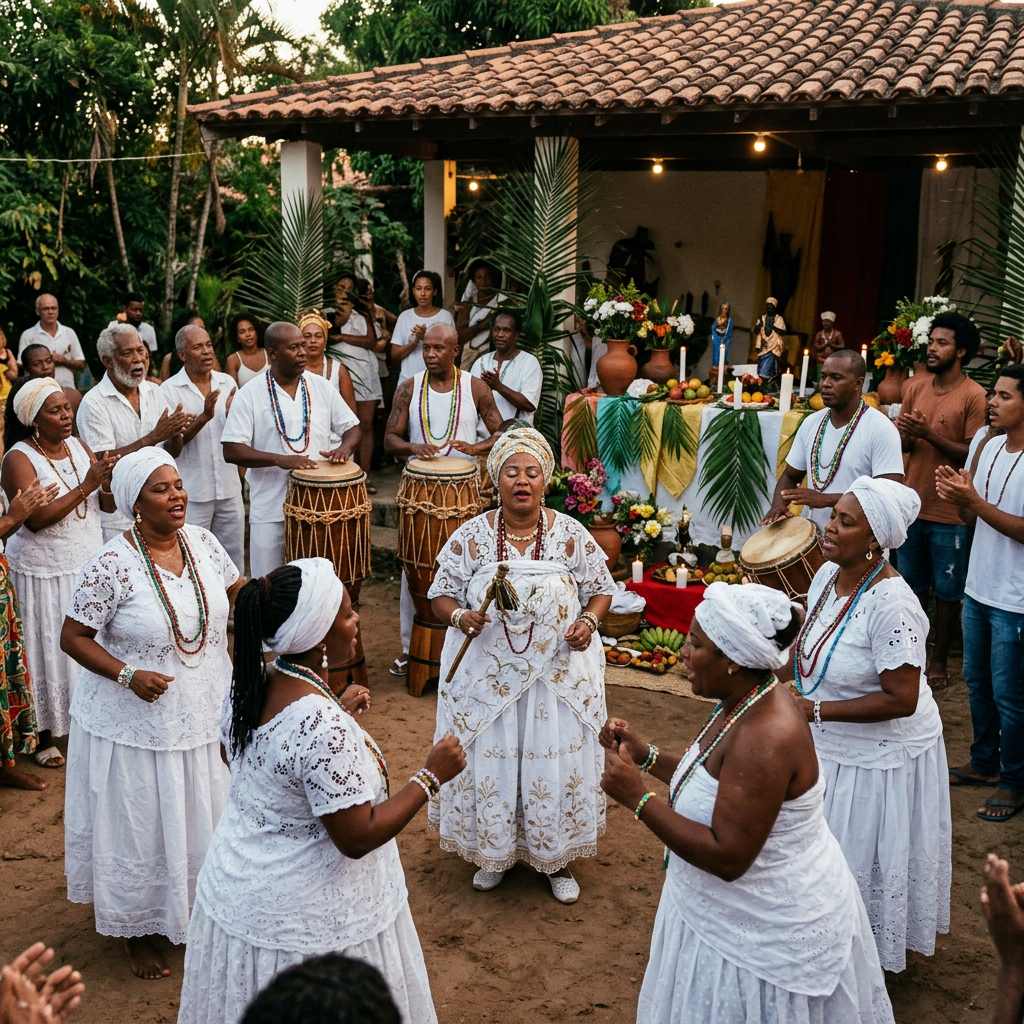
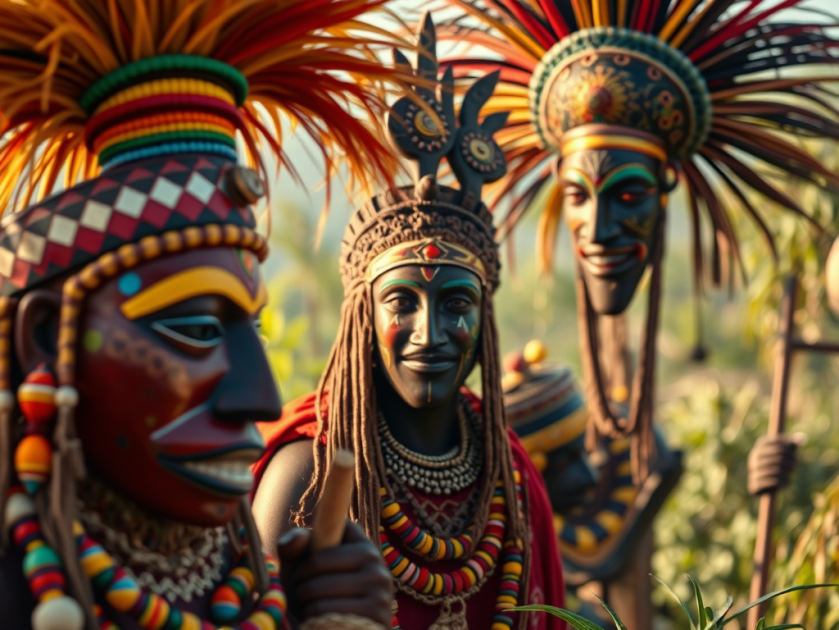
Spiritual practices across Africa and its global Diaspora serve as a profound bridge, connecting the living with their ancestors (Egún) and the divine through intricate cosmologies and mediating deities. Foundational belief systems, such as the Yoruba pantheon of Òrìṣà and Gbe Vodun traditions, are experiencing a significant contemporary resurgence as individuals worldwide seek to rediscover, reclaim, and honor their ancestral roots. These resilient traditions, structurally maintained over centuries through the flexible mechanisms of oral history, sacred rituals, and storytelling, remain vital anchors for collective identity, community belonging, and social continuity.
Foundational Cosmologies and the Resurgence of Òrìṣà and Vodun
The Yoruba Òrìṣà worship system is one of the most widely practiced African traditions globally, demonstrating a remarkable versatility to integrate into contemporary social movements, particularly across the Americas. Originating among the Yoruba people of southwestern Nigeria, these deities are also venerated by neighboring West African populations, including the Edo, the Ewe, and the Fon, who refer to them as voduns. An Òrìṣà represents a complex, multidimensional unity linking people, deified ancestors, and natural forces—such as earth, rivers, and trees. They rule, guide, and control human destiny, acting as crucial intermediaries between humanity and the untamed aspects of nature.
During the transatlantic slave trade, enslaved African captives reestablished these sacred frameworks in the New World, adapting them into highly influential traditions such as Santería (Lukumí) in Cuba, Candomblé in Brazil, and Vodou in Haiti. These adaptations often incorporated outward elements of Catholicism to survive systemic suppression while firmly preserving the core of their original philosophy, theology, and ancestral connection. Devotees cultivate deeply personal relationships with the deities through dedicated practices that include initiation, mediumship, rhythmic drum dances (bembés), and specialized divination, where a babalawo interprets the fall of consecrated palm nuts to reveal divine guidance.
Ancestral Veneration, Healing, and Spiritual Continuity
In the Yoruba cosmology, the relationship with the dead is active and continuous; ancestors are described as having transitioned into Ancestorhood rather than having died, emphasizing their close proximity to the living. The double meaning of the Yoruba word Egún—signifying both “ancestors” and “bones”—underscores this deep, somatic bond between living descendants and their lineage. Ancestors are viewed as a community’s first line of defense, possessing divine power and energy known as Àṣẹ (Aché), which they utilize to protect and guide descendants through their daily lives.
Sacred healers and mediums within these traditions play a critical role in community health by identifying and treating ancestral trauma, which can manifest as modern mental or physical health crises when an ancestor suffered an unsettled or violent death. Through targeted spiritual cleansings (limpiezas), breaking rituals (rompimientos), and festive drumming ceremonies (El Cajón), practitioners actively heal their ancestors’ souls, helping them settle in peace while subsequently restoring balance and well-being to the living descendants.
Botanical Treasures: The Ritual Role of the Kola Nut
Venerated botanical elements are essential to facilitating communion and reinforcing cultural identity within Afro-diasporic practices. Chief among these is the kola nut (known as Ọjị or Obi), which serves as a quintessential emblem of hospitality, divine covenant, and sacred communication across West and Central African societies. Revered as the “king of all fruits,” the kola nut is used to initiate communal councils, validate marriages, seal diplomatic truces, and serve as a standard ritual offering to the spirits and ancestors.
The traditional protocol of breaking the kola nut (Iwa Oji) is governed by strict protocols where the host presents the fruit using two hands to signify goodwill and respect. An elder or title holder then offers prayers and incantations to invoke blessings of long life, prosperity, and protection. Once broken, the number of internal lobes (cotyledons) holds distinct divinatory significance: three lobes signify individual achievement; four lobes represent social justice, peace, and balance; five lobes indicate fertility and communal increase; while six or more lobes signify outstanding prosperity and a direct communion with the ancestral realm. The broken pieces are shared among participants to establish an enduring bond of oneness and solidarity.
Evolutionary Contexts: Hoodoo and the Kongo Cosmogram
In North America, historical displacement necessitated alternative adaptations, resulting in autonomous spiritual systems like Hoodoo. Developed by enslaved African Americans in the Southern United States, Hoodoo synthesized traditional West and Central African spiritualities, indigenous North American botanical knowledge, and European grimoires into a practical system of healing, justice, and protection. To safeguard these traditions from suppression, practitioners utilized the “invisible institution,” blending and concealing their rituals inside traditional Christian church settings and baptismal services, such as praying to traditional Central African Simbi water spirits during Christian baptisms.
A foundational element retained within Hoodoo is the Kongo cosmogram (dikenga or Yowa cross) originating from the Bakongo people of Central Africa. Represented as a simple cross (+), the cosmogram symbolizes the trajectory of the sun and cosmic energies, where the horizontal axis represents the watery divide between the physical world of the living and the spiritual realm of the dead. This cosmology manifests physically in Hoodoo through the sacred significance of physical crossroads—spaces where specialized rituals are conducted to communicate directly with ancestral spirits, perform sacred counterclockwise circle dances, or leave ritual remains to remove negative influences.
Resilience and Counter-Narratives
The endurance and modern revitalization of these practices highlight the profound resilience of African traditions in the face of centuries of colonial governance, slavery, and forced assimilation. The systematic efforts to police language, control movements, and eliminate indigenous religious expressions aimed to strip displaced Africans of their personal and collective power. By maintaining these embodied ritual traditions, current generations actively establish direct links to an African past, constructing powerful historical counter-narratives that bypass historical trauma and foster a deep, shared sense of spiritual ethnicity and communal agency.
Deep within Africa’s sacred forests, ancient traditions remain alive, sustained across generations through customary values and local knowledge. These protected woodlands, common throughout diverse countries like Senegal, Ivory Coast, Benin, Liberia, Cameroon, and Ethiopia, serve as vital tools for biodiversity conservation and climate resilience. Guided by traditional authorities and local custodians, the preservation of these forests relies on strict community standards, prohibitions, and social taboos that regulate resource governance and limit access to prevent deforestation and resource depletion.
For generations, local communities have entered these protected woodlands to seek healing, spiritual guidance, and a connection with their ancestors. These forests are more than natural wonders—they are living temples where plants, rituals, and ancestral beliefs come together. Serving as active places of worship, they accommodate forest spirits, deities, and nature spirits. Devotees perform religio-cultural rituals, all-night ceremonies, prayers, and offerings to consult the spiritual realm, seek advice, or ensure the benevolence of ancestral spirits, such as the animal-form mhondoro in Zimbabwe, who reside within the undisturbed landscape.
These ecosystems are categorized by their specific cultural functions, including ancestral forests used for community rituals, hunting reserves, and specialized “forests of the dead” for those who suffered violent or unusual fates. Furthermore, the mystical qualities of specific botanical resources play a crucial role in traditional healing practices. The forests serve as natural medicine gardens and essential repositories of ethno-botanical knowledge. Traditional healers and practitioners gather wild fruits, herbs, and medicinal plants—such as moringa, antibiotic basil, ginger, and papaya leaves—to treat physical illnesses, manage ancestral trauma, and restore overall well-being to the living descendants.
Discover the mystery, cultural significance, and healing traditions of Africa’s sacred forests. These sacred natural sites represent some of the oldest conservation areas in the world, acting as crucial refugia, genetic reservoirs, and in-situ seed-banks that protect vulnerable, threatened, and critically endangered flora and fauna. By functioning as structural links between the physical world and the ancestral past, the continued protection of these ancient groves allows modern generations to honor their cultural heritage, promote national identity, and apply historical counter-narratives to combat contemporary climate change and biodiversity degradation across the African continent.
“The Friday Crime Report,” hosted weekly by PROFESSOR BLACK TRUTH, is a vital program offering critical insights. It serves as a platform for an analytical exploration of the societal, judicial, and economic forces that disproportionately affect the Black community. The program goes beyond a standard news broadcast; it is a call for sustained awareness and corrective action.
The show challenges mainstream media’s portrayal of systemic violence by using in-depth analysis and personal narratives to inspire community activism, with Professor Black Truth skillfully transforming listeners into informed advocates for social justice.
Over the past two consecutive months, a significant legal milestone has been achieved as two anti-black hate criminals, whose cases we have thoroughly profiled and brought to public attention, have both been officially convicted in a court of law. While these recent convictions demonstrate that committing anti-black hate crimes ultimately cost them their freedom and standing in this specific case, it remains clear that the current penalties are insufficient. We must continue our advocacy and collective efforts to ensure that the systemic and social consequences for perpetrating such hate crimes cost them far more in the future.
To support our ongoing work in profiling these vital cases and ensuring accountability, please consider contributing to our platforms. You can support us via Venmo at venmo.com/ProfessorBlacktruth, through CashApp at $ProfessorBlacktruth, or join our community on Patreon: /professorblacktruth. Additionally, direct donations can be made through PayPal at https://www.paypal.com/paypalme/ProfBlackTruth. You can also follow our real-time updates and commentary on Twitter at /profblacktruth.
Join the movement and the conversation using the hashtags #B1 and #WeAreTheBlackMedia as we continue to amplify our own narratives and document these crucial outcomes.
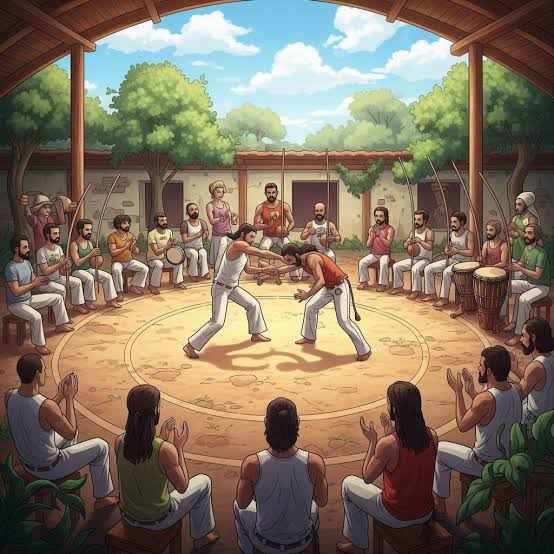
Welcome to O VIDEO DO DIA DA CAPOEIRA ANGOLA! We invite you on a journey through the curated digital archives of Capoeira Angola—a vibrant celebration of a profound heritage that continues to inspire practitioners across the globe.
Historical Roots and Origins
Capoeira Angola is the traditional style of capoeira, an Afro-Brazilian martial art whose history is deeply intertwined with the beginning of African slavery in Brazil. Starting in the 16th century, Portuguese colonists forcibly transported enslaved Africans to Brazil, with a significant portion arriving from West and Central-West Africa, particularly Angola. Enslaved Africans and Indigenous groups developed capoeira as a tool for survival, self-defense, and cultural resistance against their oppressors. By embedding elements of music, dance, and ritual into the practice, they disguised its combative nature from slave masters, allowing them to secretly preserve their traditions and hone their martial skills. Historical and oral traditions connect the discipline to traditional African rituals, notably the “n’golo” or zebra dance—a combat ritual practiced in southern Angola. During the post-abolition period, capoeira faced intense criminalization and police repression in Brazil, forcing practitioners to use nicknames (apelidos) and specific musical rhythms to evade authorities.
Philosophy, Style, and the Lineage of Masters
Unlike the faster and more aggressive Capoeira Regional developed by Mestre Bimba, Capoeira Angola stands out as a rhythm of resistance that prioritizes rituals, oral tradition, and a close connection to its African roots. It is characterized by a strategic, deceptive, and conversational style, often played low to the ground, utilizing a rich variety of speeds, counter-attacks, feints, and acrobatic movements. Vicente Ferreira Pastinha, known as Mestre Pastinha, is widely regarded as the father of modern Capoeira Angola. In 1941, he formalized and elevated the practice by founding the Centro Esportivo de Capoeira Angola (CECA) in Pelourinho, Salvador, establishing a legacy of cultural preservation carried forward by historical masters like Mestre Waldemar da Paixão and Mestre João Grande, as well as contemporary groups today. Inside the roda (circle), the game is guided by a traditional band of instruments—most importantly the berimbau, alongside the pandeiro, atabaque, and agogô—which collectively dictate the energy, polyrhythmic patterns, and spiritual depth of the dialogue.
Today’s featured video highlights historical footage from a 1984 Philadelphia television program showcasing Master Moraes and Master Cobra Mansa.
This broadcast captured a historic milestone, marking their very first visit to the United States and the profound impact it had on the martial arts community. The monumental trip was organized and realized through the formal invitation of Professor Ken Dossar, whose dedication to promoting authentic martial arts led to this significant event. Attendees had the unique opportunity to witness live demonstrations of Capoeira Angola, a traditional Afro-Brazilian martial art whose history is deeply intertwined with the beginning of African slavery in Brazil starting in the 16th century.
As a rhythm of resistance that prioritizes rituals, oral tradition, and a close connection to its African roots, Capoeira Angola stands out for its strategic, deceptive, and conversational style. Played low to the ground, it utilizes a rich variety of speeds, counter-attacks, feints, and acrobatic movements. Through this broadcast, viewers can appreciate the skills that have been passed down through generations, enriching their understanding of the art. The rare archival footage itself, a testament to a pivotal moment in martial arts history, has been meticulously preserved and provided courtesy of Prof. Daniel Dawson, ensuring that this extraordinary experience can be shared with future generations.
Capoeira Angola represents more than just a physical discipline; it stands as a profound testament to cultural resilience, ancestral wisdom, and historical endurance. From its foundational roots forged as a tool for survival and identity preservation by enslaved Africans and Indigenous groups in 16th-century Brazil, to its codification and global expansion spearheaded by legendary figures like Mestre Pastinha, Master Moraes, and Master Cobra Mansa, this Afro-Brazilian art form continues to inspire and educate communities worldwide. By merging music, strategic dialogue, and deceptive physical movement, Capoeira Angola preserves a rich heritage that honors its African roots and ensures that its legacy remains a vibrant, living practice for future generations.
Ever feel like you are constantly swinging between two extremes? One week you are saving every penny and feeling restricted; the next, you are impulse-buying things you don’t need. Or maybe you bounce between playing it too safe at work and taking reckless risks that backfire.
If this sounds familiar, you are dealing with a timeless human dilemma. Over 2,300 years ago, the Greek philosopher Aristotle looked at this exact problem and came up with a brilliant solution: The Golden Mean.
Here is how this ancient concept can help you find your footing, reduce stress, and live a more balanced life today.
What Exactly is the Golden Mean?
At its core, the Golden Mean is the idea that the right choice in any situation always lies in the middle ground between two extremes.
Aristotle argued that true moral excellence and happiness are destroyed by both deficiency (doing too little) and excess (doing too much). Virtue lives right in the sweet spot between them.
Think of it like tuning a guitar string: if it is too loose, it won’t play a note; if it is too tight, it will snap. The Golden Mean is that perfect, resonant tension.
The Three Columns of Behavior
To understand how this looks in real life, Aristotle broke human behaviors down into triplets: a deficiency, a virtue, and an excess. Here are a few relatable examples:
Courage: The middle ground between Cowardice (running away from fear) and Recklessness (charging into danger without thinking).
Generosity: The sweet spot between Stinginess (hoarding your money) and Extravagance (spending until you are broke).
Confidence: The balance between Self-Deprecation (putting yourself down) and Arrogance (thinking you are better than everyone else).
Honesty: The middle path between Deceitful Flattery (lying to please others) and Brutal Bluntness (using the truth to hurt people).
[ Deficiency (Too Little) ] <— ( THE GOLDEN MEAN ) —> [ Excess (Too Much) ]
Two Rules for Finding Your Sweet Spot
Finding your personal “mean” isn’t a fixed mathematical formula. It requires awareness. Keep these two golden rules in mind:
1. It Depends on the Context
What is balanced for one person might be extreme for another. A trained firefighter running into a burning building is showing courage. An untrained bystander doing the exact same thing is being reckless. The Golden Mean adapts to who you are and the situation you are facing.
2. Lean Away from Your Natural Weakness
We all lean naturally toward one bad habit. If you know you tend to be passive when conflicts arise, your personal “mean” will require you to push yourself harder toward assertiveness. If you tend to be naturally aggressive, you need to consciously pull yourself back.
The Takeaway
The Golden Mean is a reminder that you don’t have to be perfect; you just have to be balanced. By avoiding the traps of doing too much or too little, you can make better decisions, improve your relationships, and find a sense of peace.
Next time you are stressed about a choice, ask yourself: What do the extremes look like here, and where is my middle ground?
So, How does this Apply to Capoeira Angola?
Introduction to Liberation Geometry
In standard martial arts, combat is often a game of linear metrics. Traditional systems define efficiency by the shortest distance, straightest punches, and a direct collision of force against force. This approach relies heavily on structural mass, speed, and kinetic impact.
Capoeira Angola completely rejects this linear framework, viewing it as a mechanical limitation and a manifestation of colonial rigidity. Instead, its entire movement vocabulary—encompassing circular, spiraling, and oscillating motions—reflects a deeper understanding of human movement that transcends rigid structures. Guided by principles of efficiency and natural motion that align with universal laws, each movement is deliberately designed to flow seamlessly into the next, creating a dynamic interplay of energy and rhythm. This holistic approach maximizes power while minimizing wasted energy, allowing practitioners to harness their movements with grace and agility. By embracing these fluid dynamics, Capoeira Angola not only challenges conventional notions of combat and dance but also invites a deeper exploration of individuality and creativity within its practice, ultimately celebrating a rich cultural heritage that resists simplification.
By moving in accordance with sacred geometry and the Golden Mean, the practitioner transforms a vulnerable position into a lethal trajectory. This methodology prioritizes alignment with universal forces over the self-destructive friction of linear resistance. It turns the body into an instrument of liberation that evades capture, subverts domination, and maintains spatial sovereignty.
Linear Combat (Rigid/Colonial) vs. Liberation Geometry (Fluid/Angola)
Force ──> ◄── Force Force ──> ↻ [Spiral/Redirect]
(Collision & Friction) (Harmony & Evacuation)
The Anatomy of the Arc: Circles and Spirals
Cosmic and Biological Alignment
By internalizing spiral dynamics, the angoleiro (practitioner) mirrors the rotational mechanics found throughout the cosmos, from the double helix of DNA to the swirling arms of galaxies. Moving in curves distributes kinetic energy along an ongoing path rather than creating rigid, structural endpoints that shock the skeletal system.
Somatic Therapy and Longevity
Because circular movements distribute load evenly and eliminate high-impact stress, the art functions as a system of somatic therapy focused on functional longevity. The joints are compressed less; instead, they are rotated and lubricated through continuous movement. This allows practitioners to play the jogo (game) into advanced old age.
Mandinga and Malícia
These weaponized curves facilitate a state of mandinga (cunning) and malícia (malice). In this state, the beginning of a defense is structurally indistinguishable from the launch of an offense. For example:
A dipping evasive maneuver (esquiva) stores elastic energy in the fascia.
This energy automatically primes the hips for a whipping counter-kick (meia lua de compasso).
The transition happens without a distinct pause or reset.
Breaking the Line
Low, coiled movements deliberately break conventional vertical and linear lines. This actions transforms the practitioner into a fluid and elusive target.
The Rolê (Rolling Ground Transition): Spun along a horizontal axis close to the floor. It takes the practitioner out of the opponent’s line of sight while keeping them ready to strike from below.
The Negativa (Low Decline): Sinks the weight entirely onto one heel, pulling the body beneath the trajectory of linear strikes. It forms a compressed human spring.
Kinetic Deflection over Blocking
In defensive strategy, the practitioner does not block an incoming attack. To meet a strike directly is to accept the opponent’s terms. Instead, they introduce a curve, skillfully manipulating and redirecting the force and momentum of the opponent’s move.
The angoleiro steps off the track of aggression, slipping inside or around the strike. They use the attacker’s forward momentum to pull them off-balance, causing the attack to empty itself into a vacuum.
The Golden Mean and Aesthetic Flow
The Geometry of Phi (\(\Phi \))
The Golden Mean—or Golden Ratio, represented by the Greek letter Phi (\(\Phi \approx 1.618\))—defines a unique proportion consistently deemed aesthetically perfect and structurally optimal in the natural world. It dictates the spiral of a nautilus shell, the arrangement of pinecones, and the ideal proportions of anatomical expansion.
Golden Spiral Expansion (The Fibonacci/Phi Arc):
_________________________
| | | |
| | 5 |__2__|
| 8 |_____|_1_|1|
| | |
| | 3 |
|_____________|___________|
[The body expands and contracts along this continuous ratio]
Spontaneous Spatial Proportions
In Capoeira Angola, achieving the ideal timing (tempo) and distance (distância) in the jogo is a profound, ephemeral moment of spontaneous alignment with this universal principle. The distance between two players is never static. Instead, it expands and contracts along a fluid golden spiral.
When a player ducks under a kick, the distance between the crown of their head and the opponent’s passing heel matches this geometric proportion. This creates a visually arresting and functionally flawless margin of safety.
Non-Linear Presence
This geometric commitment ensures that a practitioner’s actions remain an extension of the natural world, achieving a state of unpredictable, non-linear presence. Linear movements have a clear, traceable intent: a fist moving from point A to point B.
Conversely, an arc or spiral hides its destination until the final moment of impact. The target changes continuously as the body rotates. This keeps the opponent trapped in a state of cognitive delay.
Fractal Conversations
This mastery transforms the physical exchange from a mere combat drill into a dynamic, flowing conversation—a living embodiment of fractal geometry. Every small movement (a wave of the hand, a tilt of the head) mirrors the grand architecture of the entire game. The players create a self-correcting, complex system where chaos and order balance perfectly.
The Roda as a Sacred Cosmos
Microcosm vs. Macrocosm
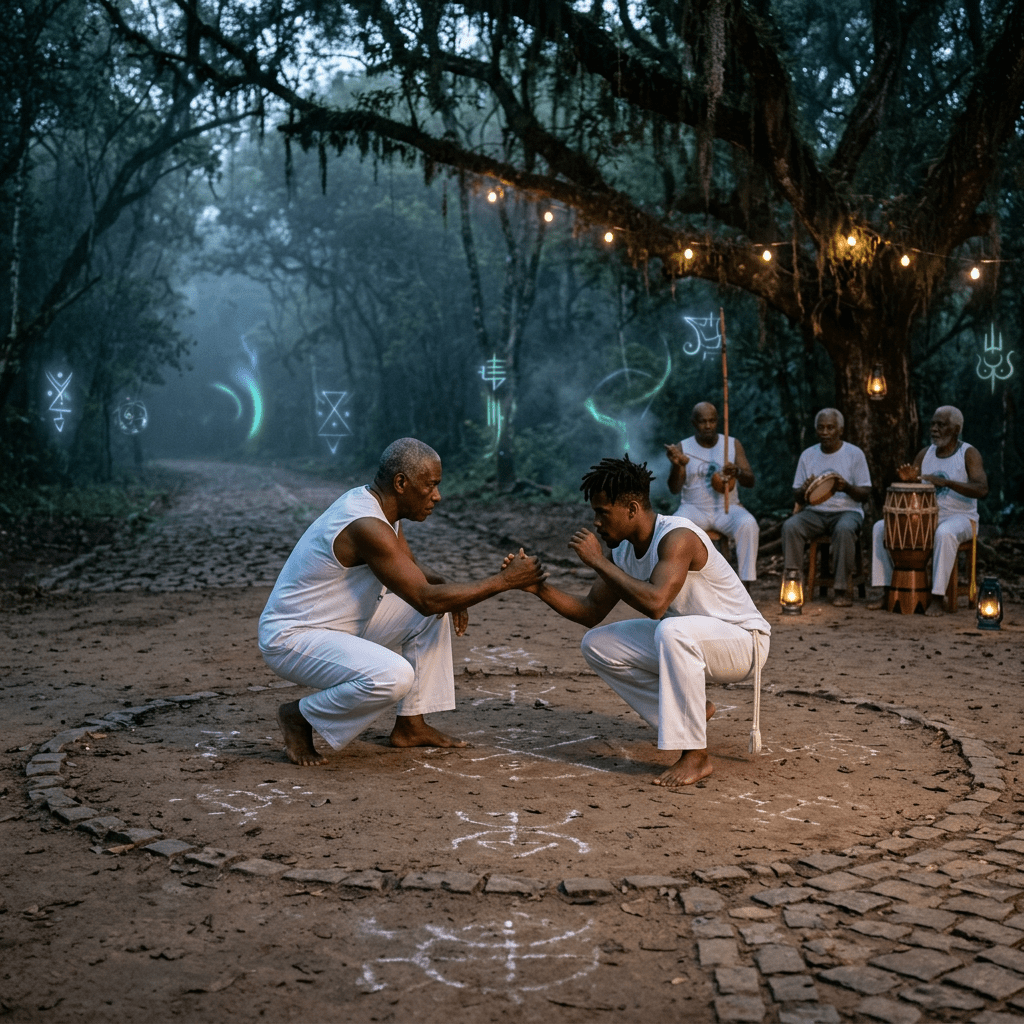
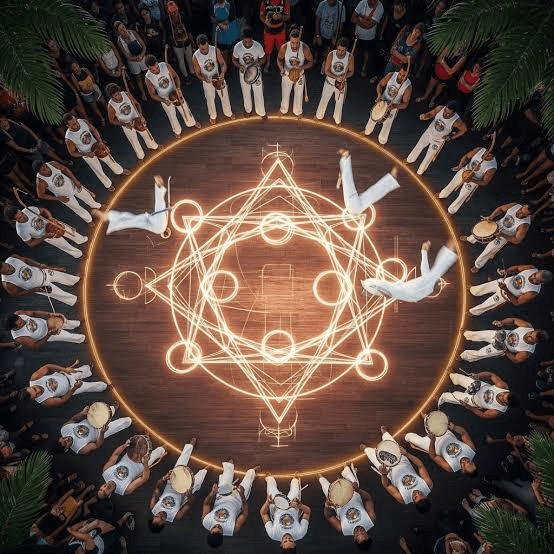
The execution of these principles culminates within the roda, the circle in which capoeira is played. The perimeter of the circle defines a sacred space. It separates the profane outside world of linear time, industrial labor, and societal division from the concentrated, intentional energy within.
The roda acts as a microcosm of the universe. Within its boundaries, the laws of gravity, time, and human interaction are rewritten through rhythm and movement.
[THE RODA: THE COUNTER-CLOCKWISE VORTEX]
◄─── Bateria ───┐
/ \
/ \
│ ▲ Mandinga │ │
│ │ & Jogo ▼ │
\ /
\ /
└─── Coro (Chorus) ──►
Communal Harmony
This space fosters communal engagement where participants embody harmony, collaboration, and the interconnectedness of all beings. The roda cannot exist with isolated individuals; it requires a collective.
The musicians (bateria) provide the rhythmic heartbeat.
The chorus (coro) chants historical narratives.
The two players inside respond directly to these sonic coordinates.
The energy flows from the circle into the center and back again, creating a closed-loop system of mutual reinforcement.
The Counter-Clockwise Vortex
Crucially, the roda moves in a counter-clockwise vortex. This direction matches the spiritual cycle of time and cosmic evolution found in Central African cosmologies, such as the Kikongo Dikenga. Moving counter-clockwise symbolizes:
The reversal of historical trauma
The undoing of oppression
An intentional step backward into ancestral time to retrieve lost wisdom (Sankofa)
It serves as a moving meditation and a living archive of Afro-Brazilian resilience. By spinning within this sacred boundary, the angoleiro ancestralizes the body. This process transforms historical survival into a geometric art of infinite liberation.
Musical Rhythms and Movement Geometry
The berimbau (musical bow) dictates the geometric configuration, velocity, and spatial limits of the jogo. Different rhythms change how an angoleiro constructs arcs and loops.
This rhythm is fast, driving, and aggressive. The shift in tempo instantly expands the geometric boundaries of the game, launching the players into a wide, upright geometry (jogo de fora).
Compressed loops open up into broad, high-velocity orbits and sweeping crescent trajectories.
Kinetic energy transitions from potential (coiled low) to kinetic (whipping outward).
Players navigate larger spatial distances, using long-range circular kicks like the martelo or armada to control the perimeter.
Rhythmic Polycentrism
The polyrhythms of the bateria break up linear timing. A steady, predictable beat encourages a straightforward, back-and-forth cadence.
In contrast, the syncopation of the agogô, atabaque, and pandeiro introduces rhythmic gaps. The player mirrors these variations by shifting mid-movement, creating a stuttering, non-linear flow that disrupts the opponent’s timing.
The Kikongo Cosmogram and Central African Spirituality
The movement patterns of Capoeira Angola directly reflect the Dikenga dia Kongo, the ancestral Central African cosmogram. This geometric cross within a circle traces the journey of the soul, the rotation of the sun, and the structure of reality.
[THE DIKENGA DIA KONGO / COSMOGRAM]
Musoni (Yellow Sun / Rebirth)
Midnight
▲
│
Vanyanga (Black / Earth) ┼─── Kala (White / Spirit)
Sunset / Maturity │ Sunrise / Birth
▼
Noon
Luvemba (Red / Ancestors)
The Four Positions of the Body
The * Dikenga* breaks a circle into four cardinal points, which match the phases of human life and the path of the sun. The angoleiro constantly traces this cycle with their torso and limbs:
Kala (Sunrise/Birth): The initial step into the roda or rising from the floor.
Luvemba (Noon/Maturity): Standing fully upright, fully visible, and at peak expression.
Vanyanga (Sunset/Passing): Dropping down into an esquiva or negativa, descending toward the earth.
Musoni (Midnight/Ancestral Realm): The inverted position, such as a handstand (bananeira or chamada). Here, the head points toward the underworld and the feet toward the sky, accessing ancestral power.
Inversion as Spiritual Reversal
Being upside down is not just an acrobatic stunt. In Central African spirituality, the ancestral realm is a mirror image of the physical world, separated by a watery boundary (Kalunga).
By inverting the body, the capoeirista crosses this line. This inversion turns weakness into strength and subverts the physical and social structures of the dominant world.
Tracing the Crossroads
The basic step of capoeira, the ginga, is not a simple side-to-side walk. It forms a triangular and cross-axial path on the ground.
By constantly stepping across these axes, the player works at the crossroads between the physical and spiritual worlds. This position gives them the cosmic authority to redirect negative energy.
Tactical Examples: Spiral vs. Linear Attack
In real-time combat, linear attacks rely on direct paths, such as a straight punch or front kick, which are often the most straightforward methods to deliver force efficiently. However, Capoeira Angola neutralizes this direct force by wrapping a spiral around that line, effectively deflecting the attack without absorbing its impact. This approach utilizes a combination of fluid, circular movements and evasive maneuvers, allowing practitioners to redirect an opponent’s energy with elegance and precision. By embracing the dynamics of angles, timing, and rhythm, Capoeira Angola not only enhances defensive capabilities but also transforms a potentially aggressive situation into an opportunity for counterattacks and fluid transitions, showcasing the art’s unique blend of combat and dance.
Tactical Scenario 1: Overcoming a Straight Front Kick (Bênção)
[Top-Down View]
Linear Strike: ───► [Target Centerline]
Spiral Pivot: ( Player steps out and rotates ) ↻
Result: Kick misses; counter-kick strikes from below.
The Linear Attack: An opponent executes a straight, high-impact front kick directed at the angoleiro’s chest.
The Spiral Counter: The practitioner does not step backward, which would keep them on the line of fire. Instead, they drop into a Meia Lua de Compasso (half-moon kick on the compass).
The Kinetic Mechanism: The player steps diagonally off the attack line, plants both hands on the floor inside the opponent’s stance, and rotates their torso. This turns the entire body into a human top.
The Outcome: The opponent’s straight kick passes harmlessly through empty air. Meanwhile, the angoleiro’s sweeping leg accelerates along a widening spiral, striking the attacker’s exposed flank or supporting leg from an unexpected, low angle.
Tactical Scenario 2: Overcoming a Straight Punch (Direct)
The Linear Attack: An opponent throws a direct, fast punch aimed at the face.
The Spiral Counter: The practitioner responds with a Rolê integrated from a low Esquiva Lateral.
The Kinetic Mechanism: Instead of blocking, the practitioner drops their weight, slipping under the punch. They immediately spin their hips and shoulders along a horizontal plane, rolling across the floor.
The Outcome: The punch’s momentum carries the attacker forward into a vacuum. The angoleiro’s spiral movement takes them behind or to the side of the attacker, positioning them perfectly to trip the opponent (rasteira) using their turning momentum.
Biomechanics of the Fascia and Elastic Energy
In Capoeira Angola, power does not come from isolated muscle contractions. Instead, it relies on the kinetic storage and release of energy within the fascial network. Fascia is the continuous, three-dimensional web of connective tissue that wraps around muscles, bones, and organs.
Linear Muscle Force: [Contraction] ──► [Bone Lever] ──► [Rigid Impact]
The human body utilizes myofascial lines that wrap around the torso and limbs in a helical fashion. Capoeira Angola maximizes this architecture through tensegrity (tensional integrity). This is a structural principle where shape is maintained by a continuous web of tensile membrane rather than rigid structural blocks.
When an angoleiro twists their torso while keeping their feet anchored, they stretch these fascial spirals. This action stores potential energy like a wound-up rubber band.
The Kinetic Loading Loop:EsquivatoRABO DE ARRAIA
The Loading Phase (Esquiva): As the practitioner drops into a low, twisting evasion, they stretch the fascial lines across the lower back, hips, and thighs. This movement loads the tissue without requiring excessive muscular strain.
The Catapult Effect: Instead of using a deliberate muscle contraction to launch the counter-attack, the player simply releases the twist. The fascia springs back to its natural shape, whipping the body into a rotational kick.
Efficiency and Endurance: This elastic recoil uses very little chemical energy (ATP) from the muscles. Because the fascia handles the structural load, the practitioner can sustain high-power movements for hours in the roda without exhausting their muscles.
Linguistic Clues in Traditional Ladainhas
The oral tradition of Capoeira Angola preserves its spatial and spiritual geometry through ladainhas (litany songs). These narrative songs are sung at the foot of the berimbau before the game begins. The lyrics contain subtle metaphors that instruct the body on how to move.
Song Metaphor Geometric Meaning Tactical Translation
“O mundo dá volta” The continuous circle Never stop in a static spot
“Cobra que me morde” The serpentine spiral Strike with a winding path
“Água de beber” Fluid adaptation Evade like flowing water
“Mundo dá volta, camará”(The world turns, comrade)
This phrase is a foundational lyric in many ladainhas. On the surface, it reflects on the changing nature of life and fortune.
Geometrically, it instructs the player that the jogo is a closed, rotating system. There are no permanent victory states or fixed positions. The body must mirror this constant rotation to survive, treating every defensive end as a new offensive beginning.
“Cobra que me morde, rabo lhe bateu”(The snake that bites me, its tail strikes)
The snake is a recurring symbol in capoeira lore, representing the ultimate master of spiral dynamics.
A snake does not strike from a rigid, straight line. It coils to store energy, then strikes along an arc.
The lyric teaches the angoleiro to move like a fluid chord. When one part of the body (the head or hands) evades an attack, another part (the tail or leg) must instantly swing around to counter-strike.
“Vou dizer ao meu senhor que a manteiga derramou”(I will tell my master the butter spilled)
This song references historical resistance, disguised as a simple domestic accident.
Slipping or spilling represents an intentional loss of rigid structure.
It teaches the player to move like a spilled liquid, spreading low across the floor without a fixed shape. This prevents the opponent from finding a solid target to hit or grab.
The Geometry of the Ginga Grid
The ginga is the foundational movement of capoeira. While it appears to be a fluid, casual step, it maps out a precise geometric blueprint on the floor. It forms a continuous shifting triangle or a three-dimensional double helix over a Cartesian grid.
[THE GINGA GEOMETRIC GRID]
A (Apex / Front Center)
/\
/ \
/ \
/ \
/ \
/__________\
B C
(Left Base) (Right Base)
* The Centerline of Vulnerability runs directly down the middle from point A.
* The practitioner constantly shifts their weight between B and C to clear this line.
Step-by-Step Trajectory
Position 1: The Base (Points B and C)
The feet are wide apart, parallel, and the knees are deeply bent. The torso is low, and one arm shields the face. This wide stance provides maximum lateral stability.
Position 2: The Parallel Transition
To move, the player draws one foot inward toward the center axis. This temporarily narrows the base, creating a brief moment of potential energy before the body expands outward again.
Position 3: The Apex Step (Point A)
One leg steps far back along a diagonal line, landing at the rear vertex of an imaginary inverted triangle. The front knee remains bent, and the arm shifts to shield the opposite side of the face.
The body’s centerline has now swung completely clear of the original line of attack.
Position 4: Returning to Balance
The back leg steps forward again, returning to the wide base (Points B and C). The player then repeats the sequence on the opposite side.
This continuous movement traces an endless figure-eight shape (\(\infty \)) on the ground. By staying in this constant, rhythmic motion, the angoleiro never gives their opponent a stationary target to lock onto.
Historical Accounts of Spatial Sabotage and Evasion
Enslaved Africans and their descendants utilized non-linear spatial geometry as a survival strategy against colonial forces, slave catchers (capitães-do-mato), and tracking hounds. Colonial warfare and policing relied heavily on linear grids, clear lines of sight, and structured paths to maintain dominance. Capoeira transformed the landscape into a tactical maze through deliberate geometric evasion.
Colonial Tracking (Linear Search Grid) vs. Quilombo Evasion (Vortex Extraction)
Historical documentation from runaway slave communities (quilombos), such as Palmares, describes tactical retreats that confused European pursuers.
Capoeiristas did not run in straight lines when pursued through the dense Brazilian mata (forest).
They moved in zigzagging patterns and looping spirals that disrupted the visual tracking of firearms.
By dropping into low positions (negativas and cocorinhas), they vanished beneath the horizon line of forest brush, making it impossible for trackers to aim effectively.
Disrupting Tracking Hounds
The circular and looping geometry of capoeira left erratic scent trails. Trackers noted that escaped laborers would step backward into their own footprints before pivoting outward at a right angle. This tactic forms a physical “crossroads” on the ground.
When tracking hounds reached these geometric intersections, the overlapping and looping scent trails confused the animals. This confusion bought the escapees time to melt back into the landscape.
The Weaponization of Spatial Ambiguity
In urban centers like Rio de Janeiro and Salvador during the 19th century, capoeira gangs (maltas) used circular crowd formations to ambush colonial police.
A small group would draw police into a narrow, winding alleyway, neutralizing the officers’ numerical advantage.
Once inside, the capoeiristas would rapidly shift from low ground sweeps to high spinning kicks.
This dynamic spatial rotation prevented the police from organizing a cohesive, linear defensive wall.
The Mathematical Harmonics of the Berimbau
The berimbau is more than a rhythmic timekeeper; it is a acoustic instrument governed by precise physical proportions. The interplay between string length, tension, and the volume of the gourd resonator dictates the geometric flow of the roda.
[THE BERIMBAU STRING DIVISIONS]
The Golden Section of theVerga
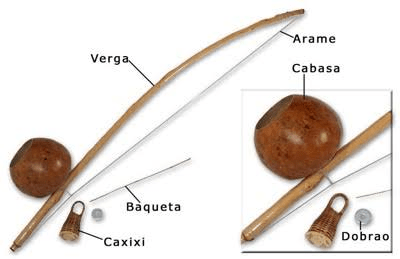
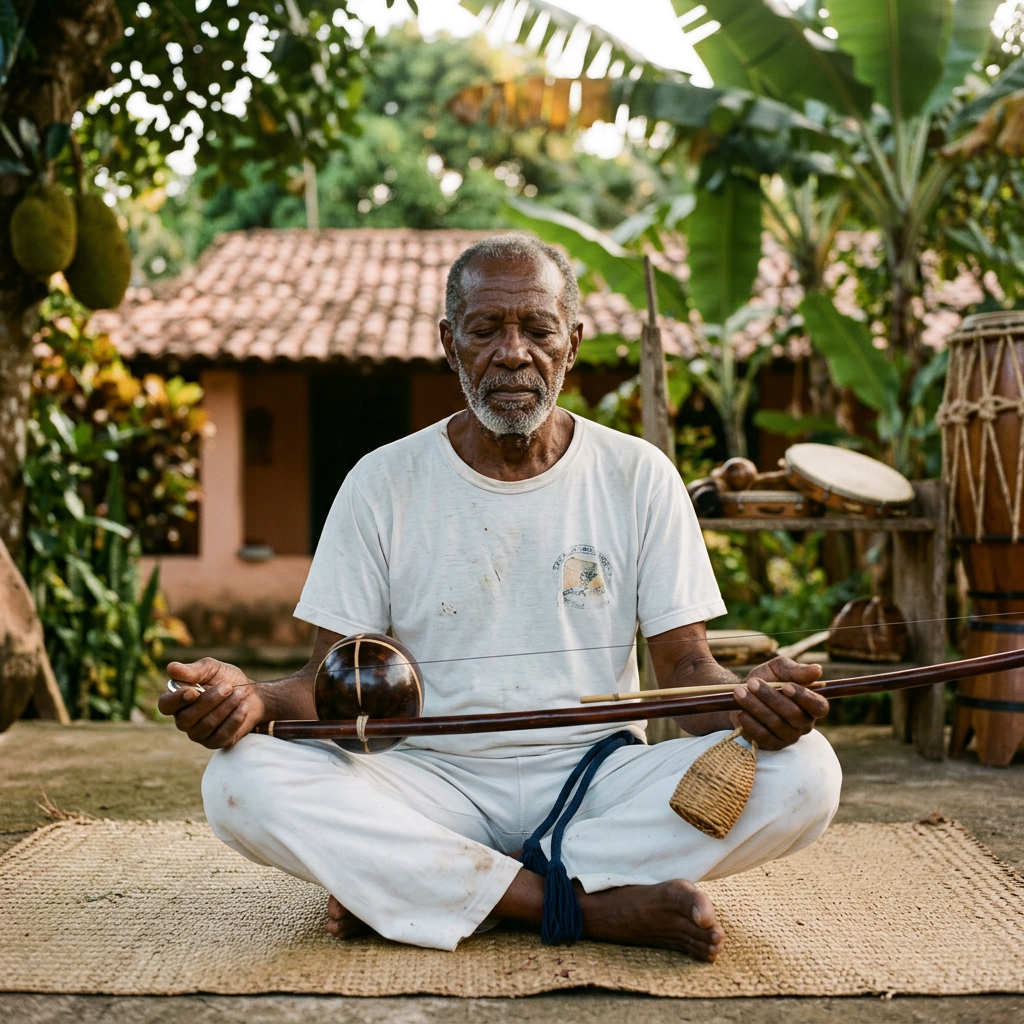
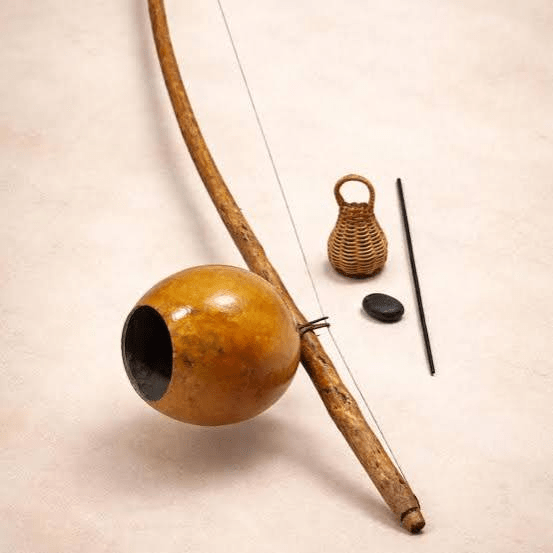
The berimbau consists of a wooden bow (verga), a steel string (arame), and a dried gourd (cabaça). [1, 2, 3, 4]
To maximize acoustic resonance, the cabaça is not placed randomly. It is tied to the lower third of the bow.
This placement closely mirrors the Golden Ratio (\(\approx 1:0.618\)) of the total string length.
Positioning the resonator at this nodal point amplifies the rich upper harmonics while preserving a deep, foundational bass note. [1]
String Division and Frequency Modulation
The practitioner holds a small stone (pedrao) or coin (dobrão) against the steel wire to alter its pitch. This action changes the active vibration length of the string:
The Open String: Striking the wire with the wooden stick (baqueta) while the dobrão is pulled away produces the deep, fundamental base tone.
The Pressed String: Pressing the dobrão firmly against the wire shortens the vibrating segment. This length reduction increases the frequency, creating a higher, brighter pitch.
The Buzz Tone: Touching the dobrão lightly against the wire creates a metallic vibration, adding a third textural layer to the sound.
Acoustic Influence on Movement
The microtonal shifts between these notes directly influence the player’s physics. The deep, open tone corresponds to low, ground-based positions (jogo de dentro). The high, sharp tone signals explosive, upright rotational movements (jogo de fora). The musical mathematics of the wire dictate the physical geometry of the body in space.
Razor Blades, Machetes, and Cane Sticks
When capoeira was criminalized in Brazil during the late 19th and early 20th centuries, practitioners weaponized their circular movements. They integrated blades and sticks into their performance, transforming dance arcs into cutting trajectories.
Linear Blade Thrust: [Point A] ───────────────────────► [Point B]
The straight razor (navalha) was a favorite weapon of urban maltas. Capoeiristas held the blade tightly between their fingers or gripped it securely between their toes.
Centrifugal Cutting Arcs: A traditional linear knife fight relies on straight stabs and thrusts. Capoeira weapon play used centrifugal force instead.
Invisible Trajectories: When a practitioner executed a spinning kick like the Rabo de arraia with a razor between their toes, the blade traveled along a wide, high-velocity arc. The speed of the spin made the small blade invisible to the eye, transforming an evasion into an orbital slice.
Subverting the Guard: Because the blade moved along a curve, it could bypass an opponent’s straight arm block. The razor wrapped around the defender’s guard to slash vulnerable tendons on the wrists or ankles.
The Machete (Facão) in Maculelê
The use of the machete is preserved in Maculelê, a dramatic dance closely linked to capoeira history.
Players wield a pair of heavy blades, striking them together to the beat of the drum.
The combat geometry uses continuous, circular weaving patterns (8-shape or infinity loops).
This constant movement keeps the heavy blades in motion, utilizing kinetic momentum so the wielder does not have to fight the weapon’s inertia. A sudden change in the circle’s angle transforms a rhythmic strike into a heavy cleaving blow.
The Cane Stick (TiriricaorPetrópolis)
Capoeiristas frequently carried walking canes made of dense, flexible wood like indaiá or peroba.
Rather than using the cane for top-down linear bludgeoning, they spun the stick in fluid wheel-like patterns around their body.
This technique created a moving shield of kinetic energy that deflected incoming blunt or edged attacks.
By dropping into a low rasteira (sweep) while spinning the cane near the ground, a practitioner could trip an opponent and deliver a striking blow in a single, continuous rotation.
The 19th-century street-fighting iteration of capoeira (capoeiragem) was documented by police forces as a highly violent urban warfare system. Rather than the codified, graceful dialogue seen today, the archives of the Imperial Court in Rio de Janeiro and the port city of Salvador da Bahia reveal a lethal combination of African foot-fighting, specialized blunt weapons, and urban guerrilla tactics.
The Legal Framework: Repression without a Name (1808–1889)
For most of the 19th century, the term “capoeira” did not exist in any formal legislative statute. This absence forced police authorities to rely on administrative workarounds to prosecute practitioners.
[PRE-REPUBLICAN LEGAL ESCALATION]
1809: Royal Guard Formed ──► Arbitrary public floggings for “disorder”
1830: Criminal Code ──► Prosecuted via Article 240 (Vagrancy)
1831: Municipal Decree ──► Explicitly bans capoeira, even for “play”
1890: Penal Decree 847 ──► Direct criminalization of “Capoeiragem”
The 1830 Criminal Code: This foundational text established a strict rule of prior law, meaning an act was only a crime if explicitly named. Since capoeira was omitted, police processed arrests under Article 240 (Vagrancy/Vadiagem) and public disturbance codes.
The 1831 Regency Decree: On July 27, 1831, the provincial government issued an emergency decree demanding the direct arrest of “effective black capoeiras as well as those who practice it, even for entertainment”.
The Republican Purge (Decree 847): Following the fall of the empire, the new Republican government codified the art as a distinct offense under Chapter XIII, Articles 402 and 403 of the 1890 Penal Code. It mandated 2 to 6 months of prison for performing “agility and dexterity exercises on the streets”. If the perpetrator was a foreigner, they faced immediate deportation upon serving their sentence.
Rio de Janeiro: The Maltas and Urban Cartels
In Rio de Janeiro, the practice grew into highly structured, territorial criminal cartels known as Maltas.
Institutional Mapping: The Guaiamus and Nagoas
By the mid-1800s, Rio was divided between two rival coalitions. The Guaiamus (associated with liberal political factions, free blacks, and working-class immigrants) controlled the city outskirts. The Nagoas (aligned with conservative monarchists and dominated by Africans of Yoruba descent) controlled the central commercial port.
Police Archive Classification of Combat Techniques
According to 19th-century police blotters, Carioca capoeira (capoeira carioca) combined five core combat techniques into a brutal street style:
Cabeçadas (Headbutts): Launched as an explosive, low-level ramming attack straight into an opponent’s sternum or chin.
Pugilism and Slaps: Heavy, open-hand blows aimed to disorient or break the sensory alignment of the target.
Weaponized Accoutrements: The use of heavy walking canes (porretes or petrópolis) to shatter guarding arms before closing the distance.
Navalha (The Razor): Kept concealed inside pockets or between shoe soles.
The “Rasteira” (Takedown): Sinking flat to the floor to hook an opponent’s ankle, slamming their skull onto cobblestone streets.
The Military Guard and Major Vidigal
The primary force tasked with hunting the maltas was the Military Division of the Royal Police Guard, established in 1809 under the command of the notorious Major Miguel Nunes Vidigal. Vidigal’s files show an institutional fear of slave rebellions modeled after the Haitian Revolution.
The Guard utilized arbitrary violence, dragnet street arrests, and public floggings at the Pelourinho to break the networks of the maltas.
Salvador da Bahia: Ancestral Subversion and Ritual Secrecy
While Rio de Janeiro’s archives paint a picture of territorial gang wars, the police documents in Salvador da Bahia reveal a practice that remained deeply intertwined with Afro-Brazilian cultural networks
RIO DE JANEIRO ARCHIVES SALVADOR DA BAHIA ARCHIVES
Bahian police registries from the 19th century routinely mixed up capoeira gatherings with batuques (drumming circles) and Candomblé religious houses.
Detectives noted that capoeiristas utilized the sacred spaces of terreiros to train secretly, viewing the athletic coordination as an extension of spiritual defense.
The Navalha and the “Vadiagem” Blotters
Arrest records from the Arquivo Público do Estado da Bahia show a distinct profile for the Bahian practitioner.
They were frequently labeled as faquistas (knife-fighters) or capoeiras navais. The files document men carrying folding razors wrapped in handkerchiefs, deploying quick, low-line kicks from the ginga to slice open the thighs or groin of police pursuers.
Geographies of Resistance
Unlike Rio, where combat took place in grand plazas during political rallies, Bahian resistance was concentrated around the commercial shipping docks of the Comércio district and the agricultural processing hubs of the Recôncavo Baiano.
The dense, rural geography of the Recôncavo allowed capoeira to maintain its structural roots. This regional preservation eventually laid the groundwork for its 20th-century legalization through pioneers like Mestre Bimba and Mestre Pastinha
Conclusion: Capoeira Angola represents a profound synthesis of natural philosophy, sacred geometry, and ancestral resilience. By rejecting the linear rigidity of colonial forces, the art form utilizes the fluid mechanics of circles, spirals, and the Golden Mean to maximize physical efficiency while preserving functional longevity and spatial sovereignty. This methodology effectively maps tactical defense onto cosmic frameworks, transforming the practitioner’s body into a dynamic instrument of liberation.
From its difficult origins in the sugarcane fields and urban maltas to its systemic criminalization under the 1890 Penal Code, capoeira survived through strategic evasion and deep cultural integration with Afro-Brazilian spiritual networks like Candomblé. The regional preservation in Salvador da Bahia and the Recôncavo Baiano laid the critical foundation for its 20th-century legitimization.
Spearheaded by visionary pioneers like Mestre Pastinha, who preserved its traditional roots and philosophical depth at the Centro Esportivo de Capoeira Angola, and Mestre Bimba, who pioneered its formal educational acceptance, the practice transitioned from a persecuted underground survival tool into a globally celebrated art form. Now inscribed as a UNESCO Intangible Cultural Heritage of Humanity, Capoeira Angola stands as an unbroken, vibrant link to ancestral wisdom, proving that balance, harmony, and strategic resistance endure as a timeless testament to human dignity.
Digital Guardians of the Roda: Rediscovering Capoeira Angola’s Soul
Welcome to O VIDEO DO DIA DA CAPOEIRA ANGOLA! We invite you on a journey through the curated digital archives of Capoeira Angola—a vibrant celebration of a profound heritage that continues to inspire practitioners across the globe.
The Significance of Digital Archives
In our digital age, online videos serve as essential cultural archives. They document a profound fusion of music, movement, and history, acting as a living repository of Afro-Brazilian identity. Born from historical struggles against colonial oppression, these digital spaces safeguard ancestral wisdom, ensuring that the sophisticated psychological warfare and historical legacy of Capoeira Angola remain accessible to everyone, everywhere.
At the heart of these archives is the traditional musical structure of the bateria. This is the pulse of the roda, dictating the tempo and commanding the game. Digital media captures the strict lineup of three berimbaus—the grave gunga, the intermediate médio, and the sharp viola—alongside pandeiros, the atabaque, agogô, and reco-reco. By documenting everything from narrative ladainhas to communal corridos, we protect the oral histories passed down through generations.
Furthermore, these repositories record the tactical dialogue of the roda. Here, concepts like mandinga (strategy and spiritual power) and malícia (cunning deception) come to life. Through tactical movement and the low-to-the-ground ginga, practitioners strategically negotiate peril, transforming vulnerability into defensive power.
Focus on GCAP: The 1995 Documentary
Today, we are thrilled to feature a legendary documentary from 1995 highlighting GCAP in Salvador da Bahia, Brazil.
Founded by Mestre Moraes and Mestre Cobra Mansa, the Grupo de Capoeira Angola Pelourinho (GCAP) is a cornerstone of the global revival of traditional Capoeira Angola. This 1995 footage is an irreplaceable archive, capturing Afro-Brazilian wisdom from the very epicenter of the art form.
Why This Archive Matters
The Pelourinho Renaissance: In the mid-90s, GCAP led a counter-cultural movement, rescuing Capoeira Angola from erasure and re-establishing its structural roots.
The Smithsonian Connection: These recordings were formally cataloged and globally distributed through the Smithsonian Folkways collection, cementing their place in world history.
Preservation of Lineage: The footage crystallizes the direct lineage of Mestre Pastinha, showing how tactical dialogues are intertwined with spiritual protection.
Core Ritual Mechanics
Core Concept
Mechanical & Ritual Expression
Digital Archive Value
Bateria Arrangement
A strict lineup of three berimbaus (gunga, médio, viola), two pandeiros, an atabaque, an agogô, and a reco-reco.
Preserves the sonic commands, precise musical tempo, and acoustic boundaries that dictate the entire physical game.
Mandinga & Malícia
Low-to-the-ground ginga, deceptive gazes, theatrical posturing, and sudden shifts between positive and negative spaces.
Visualizes psychological warfare, showing non-verbal dialogues where practitioners safely transform vulnerability into defensive power.
Ancestral Musicality
Narrative ladainhas sung solo by the leader, followed by communal, synchronized corridos.
Documents oral histories, philosophical life lessons, and ancestral memory passed across generations.
The 1995 era documented by GCAP provides a masterclass in ritual expression:
At the peak of his influence, Mestre Moraes was the visionary engine of GCAP. He fought to reclaim the Pelourinho district for Afro-Brazilian practitioners and framed Capoeira Angola as an intellectual philosophy of anti-colonial resistance.
The kinetic masterpiece of GCAP’s physical expression, Cobra Mansa was the primary tactical instructor. Renowned for his unmatched agility and mandinga, his work in 1995 laid the foundation for his own global organization, FICA.
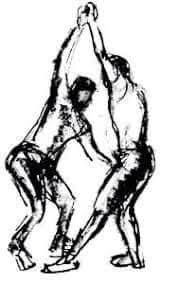
Within the poetic architecture of Capoeira Angola, there is a ritual configuration that serves as the ultimate distillation of Eshu’s essence: the Chamada (the Call).
When the game inside the roda grows too intense, too chaotic, or too predictable, one player will suddenly stop. They raise their hands, freezing their movement into a ritual posture of complete vulnerability. They are calling their partner to step into a closed, intimate space of synchronized, slow walking—back and forth, three times.
The Chamada is a sacred truce, a temporary bridge between worlds. Yet, it is precisely within this moment of apparent peace that Eshu plays his most profound game.
"Valha-me Deus, Senhor São Bento
O mestre chamou pra caminhar
Segura o corpo, firma o vento
Que a malícia vai começar..."
(Help me God, Lord Saint Benedict
The master called me to walk
Hold your body steady, firm the wind
Because the trickery is about to begin...)
The Architecture of the Chamada: Eshu’s Ritual Mirror
The Chamada is not a break from the game; it is the game magnified. It embodies the precise duality of Eshu: the delicate balance between absolute trust and absolute alertness.
1. The Trap of the Open Door
To call a Chamada, you must present an open target. Your chest is exposed, your hands are raised, and your back may even be turned to your opponent. This is Eshu’s classic illusion—offering a doorway that seems perfectly safe to enter. The player answering the call must approach with immense caution, placing their hands against the caller’s body, matching their breath, and walking together in tight, tense harmony.
2. The Illusion of Safety
As the two capoeiristas walk back and forth at the foot of the berimbau, the illusion of safety deepens. But Eshu rules the thresholds of change. At any single second during this walk, the caller can suddenly drop beneath the partner’s weight to execute a lightning-fast rasteira (sweep) or drive a cabeçada (headbutt) into their chest. Alternatively, the person responding can break the truce if they sense the caller is complacent.
3. Testing the Awake Soul
The Chamada tests your sense of being more than any fast-paced exchange of kicks. It asks a fundamental question: Can you maintain absolute presence when everything feels calm? If you fall asleep in the comfort of the walk, Eshu will swiftly take your feet out from under you. If you panic or strike out of fear, you expose your lack of self-control. To survive the Chamada, you must be entirely relaxed yet entirely awake.
"Mandingueiro que é mandingueiro
Não se deita pra dormir
Na chamada do Angoleiro
É que o perigo vai surgir..."
(A true sorcerer / capoeirista
Does not lie down to sleep
It is in the Angoleiro's chamada
That the true danger will arise...)
The Chamada of Everyday Life: Navigating the Silent Storms
Outside the ring of the roda, life frequently initiates its own Chamadas. These are the moments when the frantic pace of our daily struggles suddenly drops into an eerie, deceptive quiet.
Recognizing the “Quiet” Traps: A life Chamada manifests when a toxic situation suddenly feels comfortable, when a long-standing conflict falls into a silent truce, or when things seem “too good to be true.” Eshu teaches us not to become paranoid, but to remain awake. Do not lull yourself into complacency just because the storm has paused. Use the quiet periods of life to strengthen your core and observe your surroundings.
Walking with the Adversary: Sometimes, we are forced to walk hand-in-hand with difficult people, challenging corporate structures, or our own internal demons. The Chamada teaches us how to engage with these forces without losing our footing. You can cooperate, you can synchronize your steps, and you can show respect—but you keep your center heavy, your eyes open, and your spirit anchored.
The Grace of the Silent Truce: Finally, the Chamada reminds us that we have the power to stop the chaos. When a conversation or a life situation is spinning out of control into destructive violence, you can be the one to freeze, raise your hands, and call for a collective breath. You can redefine the terms of the engagement.
Conclusion: The Heavy Center
To dance through life with Eshu is to welcome the Chamada. It is the realization that the moments of highest spiritual tension do not always look like an aggressive attack; often, they look like a slow, deliberate walk in the dark.
When life calls you to step into the tight circle of the unknown, do not shrink away. Approach the threshold with a heavy center, match the rhythm of the moment, smile at the subtle shifts of the wind, and let the trickster teach you how to remain completely unshakable.
Spiritual practices across Africa and its Diaspora connect the living with ancestors and the divine through systems like the Yoruba Òrìṣà and Gbe Vodun. These traditions, maintained via oral history and ritual, are seeing a global resurgence as people reclaim their heritage. Sacred healers, ancestral worship, and symbolic artifacts like the kola nut maintain cosmic balance and social continuity. Despite historical displacement, these resilient practices remain vital anchors for collective identity and community belonging.
Thunder, Fire, and Justice: The Legendary Journey of Sango and His Global Legacy
Across the African Diaspora, few figures command as much awe and reverence as Sango, the Yoruba Orisha of thunder and lightning. From the ancient palaces of the Oyo Empire to the modern-day Capoeira circles of Brazil, Sango’s energy remains a vital anchor for collective identity. Join us as we explore how a historical king became a divine force of nature and how his powerful archetypes continue to shape physical mastery and spiritual practice today.
The Rise of a Warrior King
The story of Sango begins in Oyo-Ile, the capital of the Oyo Empire. As the third Alaafin (King), Sango was a revolutionary leader who transformed his nation into a powerhouse. His mixed heritage—born to a warrior prince and a Nupe princess—gave him access to unique mystical and military traditions.
Military Genius and Political Power
Sango didn’t just rule; he innovated. He capitalized on the savannah terrain by introducing a highly disciplined cavalry force, establishing Oyo as an unstoppable military might. His court was equally dynamic, anchored by three powerful queens who each brought unique strengths to the empire:
Oya: The tempestuous warrior princess who held the secrets of the wind.
Oshun: The diplomat who brought wealth and liquid intelligence to the court.
Oba: The senior wife representing tradition and domestic stability.
The Deification: From King to Orisha
Sango’s transition from a mortal king to a god is a tale of tragedy and triumph. After a catastrophic experiment with lightning medicine led to the burning of his palace, Sango walked into exile. However, his loyalists soon proclaimed that he had not died but had descended into the earth to become an Orisha. This gave birth to the mantra “Oba ko so”—The King did not hang.
Bringing Sango into the Roda: Capoeira Angola
In Afro-Brazilian Capoeira Angola, Sango (known in Brazil as Xangô) represents justice, fire, and raw authority. Integrating his energy into your practice involves more than just physical movement. It demands a tactical, psychological, and musical mindset that transforms the roda (the capoeira ring) from a simple space of physical play into an arena of spiritual and structural accountability.
I. Physical Mastery and Strategy
1. The Weighted Ginga: The Earth Stance
To embody Xangô, a capoeirista must discard light, floaty movement in favor of a low, grounded posture.
The Mechanics: Drop your hips significantly lower to the floor, bending the knees deeply and ensuring that your heels make deliberate contact with the earth on the backstep of your ginga. Your feet should feel like heavy slabs of granite sliding across the floor.
The Purpose: This physical grounding builds an unbreakable base. It makes you incredibly difficult to sweep (rasteirar) and projects an aura of immovable strength. You do not bounce; you claim the ground beneath you.
[ The Weighted Ginga Profile ]
O <- Head up, eyes locked on opponent
/|\
/ | \ <- Torso low, spine stacked
/ \
/ \ <- Wide, deep knee bend
_/__ _\_ <- Heels flat, gripping the earth
2. Sudden Explosions: The Lightning Strike
Capoeira Angola is famously slow, hypnotic, and strategic, but Xangô’s power relies on breaking that rhythm with shocking violence.
The Mechanics: Play at a slow, creeping, highly dense pace—crawling through negativas and rolês. Once your opponent matches your slow tempo and lets their guard down, you instantly unleash an explosive, maximum-velocity kick like a meia-lua de compasso or a chapa.
The Purpose: This mimics a sudden bolt of lightning breaking through a silent storm. The power comes from the contrast: the slower and heavier your setup, the more devastating and unexpected your explosive strike becomes.
3. The Courtroom Mentality: Delivering the Verdict
Xangô is the divine judge, arbiter of law, and executioner of justice. He does not attack out of petty anger or erratic emotion.
The Mechanics: Treat the roda as a courtroom. Instead of chasing your opponent or throwing frantic, unnecessary attacks, you calmly stand your ground. You observe their movement patterns, map their structural flaws, and wait for them to make a mistake—such as dropping their hand during a kick or leaving their face unprotected.
The Purpose: When that error occurs, you deliver a perfectly timed counter-attack, take-down, or head-butt (cabeçada). This strike is not an act of aggression; it is a “verdict”—a cold, precise, and undeniable cosmic correction for their sloppy technique.
II. The Psychological and Musical Mindset
Xangô’s authority must extend beyond your body and into your mind, as well as the instruments driving the circle.
[ The Trinity of Sango’s Power ]
|
+————————+————————+
| |
[ The Fire ] [ The Thunder ]
(Psychological Command) (Musical Authority)
– Unflappable calm – Heavy Atabaque slaps
– Piercing eye contact – Deep, echoing Gunga
– Absolute control of pace – Chants of cosmic law
1. Psychological Command: The Fire
The Royal Mask: Maintain a serene, unflappable facial expression. Xangô is a king; a king does not panic when pressed into a corner.
The Smoke: Before Xangô strikes with fire, he clouds the air with smoke. Use deceptive, complex floor transitions (mandinga) to confuse your opponent’s depth perception and spatial awareness.
The Gaze: Lock your eyes onto your opponent’s collarbones or hips with absolute, unwavering intensity. Your gaze should convey that you are entirely in control of the interaction, causing them to hesitate and second-guess their own strategies.
2. Musical Authority: The Thunder
The bateria (the orchestra of berimbaus, tambourines, and drum) must reflect this specific energetic shift to support the players in the center.
The Atabaque (The Drum): Xangô is the master of the drum. To call his energy into the room, the atabaque player should introduce heavy, echoing open slaps that reverberate through the floorboards, matching the stomps of the grounded players.
The Gunga: The lead, deepest-toned berimbau (Gunga) acts as the voice of thunder. It maintains a rigid, unyielding cadence that commands the entire room, dictating that the game must remain respectful, serious, and bound by traditional law.
The Songs: The chorus should sing coros and ladainhas that explicitly warn of consequences, debt, and cosmic balance (e.g., “Quem deve paga…” / “He who owes must pay”). This reminds everyone in the room that every action inside the sacred circle carries weight and destiny.
Life does not flow in straight lines; it bends, breaks, and loops like ancient rhythm. Just when we believe we have paved a smooth road ahead, the universe throws a sudden curve, an unexpected detour, or a jarring friction that shakes our very foundation. In the modern West, we label this a test of resilience. But in the deep, poetic cosmology of the Yoruba, this chaotic, testing current carries a sacred name: Eshu.
Eshu is the Orisha of the crossroads, the master of thresholds, and the keeper of the cosmic keys, embodying the essence of duality and transformation. He is the divine trickster—not out of malice, but out of a profound love for truth, which he sees as essential for growth and enlightenment. His playful nature invites us to embrace uncertainty, for it is often in moments of disruption that we find our true selves. By challenging the status quo, he disrupts our comfort zones to strip away our illusions, exposing our raw character beneath the layers of pretense and societal expectation. Today, his spirit breathes fiercely inside the sacred circle of Capoeira Angola, a vibrant art form that blends martial prowess with rhythm and culture, offering a living, moving blueprint for navigating the beautiful chaos of existence. In doing so, Eshu guides practitioners not only in the physical realm but also through the intricate dance of life, encouraging them to embrace change and to flow like water, effortlessly adapting to the myriad pathways life presents.
The Keeper of the Threshold
In the sacred geometry of life, Eshu sits precisely where two paths collide, embodying the essence of choice and transformation. He is the whisper in the wind that forces us to choose, guiding our hearts and minds to recognize the potential that lies in each decision. The old elders say that no prayer can ascend to the heavens, and no blessing can rain down to the earth, without first paying homage to this guardian of the gate, whose playful mischief keeps the balance between the seen and the unseen realms. His presence is a reminder that every fork in the road carries not only the weight of our choices but also the possibility of new beginnings, inviting us to embrace the journey with courage and reverence. In moments of uncertainty, it is Eshu who reminds us that even the smallest step can lead to profound revelations, carving our destinies in ways we may not fully understand.
"Oia, oia, deixa a gira girar
Egbé, Eshu bará o, deixa a gira girar..."
(Look, look, let the ritual circle spin
Eshu of the body, let the circle spin...)
This traditional chant reminds us that the world is a spinning wheel of fortune and fate. Eshu’s core lesson is a poetic truth: We are blessed with free will, but every step we take writes an indelible mark upon our destiny. He is the cosmic mirror. If we walk with arrogance, he becomes the stone that trips us. If we walk with humility, he becomes the wind at our back. He shakes our world not to break us, but to awaken us from our slumber.
The Living Fire: Eshu in the Capoeira Angola Roda
Born in the shadows of Brazilian slavery as a dance of liberation disguised as play, Capoeira Angola is a physical prayer to Eshu. The roda (the circle) is not just a ring of people; it is a microcosm of the universe, a living crossroads where spirits and bodies collide.
Mandinga and the Art of the Hidden Smile
Inside the roda, players dance in the realm of malícia (guile) and mandinga (sorcery). To play Capoeira Angola is to speak the language of Eshu. You embody the trickster when you look left but strike right, or when you feign exhaustion only to spring forward with a sudden, beautiful rasteira (sweep). It is a dialogue of deception where a smile hides a trap, and a vulnerability is actually an ambush. It is a playful, lethal chess match meant to test your partner’s presence of mind.
"Lapinha de Jerusalém
Senhor São Bento me guarde
Eshú não joga capoeira
Mas ele sabe mandar..."
(Small shrine of Jerusalem
May Saint Benedict protect me
Eshu does not play capoeira
But he knows how to command the game...)
The Razor-Thin Intersection
Every second inside the ring is a split-second threshold. When an opponent’s heel cuts through the air toward your face, your world splits into infinite possibilities. Do you sink low into a negativa, sweeping the earth? Do you cartwheel away in an au, or do you counter with a strike of your own? There is no time for the analytical mind to debate. Eshu rules that exact, breathless instant where intuition takes flight and your choice dictates your survival.
Feeding the Berimbau
Just as traditional rituals must offer gifts to Eshu before any work can begin, a Capoeira roda remains dead until the music breathes life into it. The lead berimbau calls out, its single wire vibrating with ancestral memory. The songs are the food that clears the path, inviting the axé (life force) to fill the room.
"A fumaça da jurema
Subiu pro céu, balançou
Eshú tirou o chapéu
E a capoeira começou..."
(The smoke of the sacred jurema
Rose to the sky and swayed
Eshu tipped his hat
And the capoeira began...)
Walking the Crossroads of the Everyday
When the berimbau falls silent and we step outside the ring, Eshu does not vanish. He follows us into the concrete grid of daily life. To live with the consciousness of Eshu is to transform your daily existence into a work of artful awareness.
Reframe the Wrench in Your Plans: When life disrupts your harmony—a sudden heartbreak, a lost job, or a chaotic misunderstanding—do not curse your luck or see these events as mere obstacles. Instead, recognize Eshu at the door, the trickster who challenges our perceptions. See the disruption as a sacred mirror, reflecting the parts of your life that may need reassessment and healing. Ask yourself: What part of my ego is this chaos trying to dissolve? What hidden strength is it forcing me to find? Remember, these moments of turmoil often carry valuable lessons, offering insight into your resilience and inner wisdom. Embrace the uncertainty as a catalyst for growth and transformation, allowing yourself the space and time to rediscover your true self amidst the chaos.
Honor the Micro-Thresholds: We stand at thousands of crossroads every day, from how we respond to an angry text to how we choose our career paths. Pause at these intersections; take a moment to breathe and reflect. Each decision, no matter how small, shapes the trajectory of our lives in ways we may not even realize. Recognize the immense power of your free will, and accept the weight of the consequences with a brave heart, for every choice carries with it the potential to open new doors or close off others. Embrace these moments of decision-making as opportunities for growth and self-discovery, knowing that with each step taken, you are actively crafting your narrative in this complex tapestry of existence.
The Poetry of the Two-Sided Hat: A classic myth tells of Eshu walking between two friends while wearing a hat that was red on one side and black on the other, sparking a furious argument between them about what they saw. This vibrant imagery illustrates the complexity of perception, revealing how easily individuals can become entrenched in their viewpoints when confronted with differing realities. Eshu, as the trickster deity, teaches us that truth is multifaceted and often elusive, reminding us that our understanding is colored by our experiences and biases. To honor him in daily life is to abandon rigid, black-and-white thinking, embracing a spectrum of ideas and emotions that enrich our interactions. By remaining fluid and open to other perspectives, we cultivate empathy and strengthen our relationships. In moments of disagreement, it is essential to pause, reflect, and seek clarity rather than becoming defensive. Moreover, never lose your sense of humor when the world shows you its other side, for laughter can bridge divides and foster connection, illuminating the beautiful complexity of the human experience and guiding us towards a more harmonious existence.
Conclusion: The Master of the Dance
Ultimately, Eshu invites us to stop fighting the storm and learn how to dance within it. Life will always play with you, challenging our perceptions and pushing us to our limits. It will test your will, questioning your sanity and shaking your sense of being as you navigate through turmoil and uncertainty. Each gust of wind can feel overwhelming, but instead of resisting, we can embrace the chaos, finding rhythm in the unpredictability. By learning to sway gracefully amidst the turbulence, we open ourselves up to new possibilities and deeper insights. In the heart of the storm, there lies a potential for growth and transformation that can lead us toward enlightenment and resilience.
But when you embrace the trickster within, the world ceases to be a hostile battlefield. The universe becomes a grand roda, a vibrant tapestry woven with the threads of every experience and emotion. Every challenge transforms itself into a partner, testing your agility and resilience in ways you never thought possible. Each obstacle, once seen as an insurmountable foe, now appears as a fascinating puzzle waiting to be solved. Sink low, look your obstacles in the eye, and, with unwavering confidence, smile at the chaos that surrounds you. Recognize that each moment of uncertainty is an opportunity for growth, inviting you to dance at the crossroads of life, where every step taken builds your path forward. Embrace the unpredictability, for it is here that true mastery is achieved, unveiling the magic in the mundane.
I was talking with a friend before we went to a roda, and she brought up the Hindu/Buddhist concept of ahimsa (non-violence). This intriguing discussion sparked a deeper contemplation about the principles of non-violence and how they can be integrated into various practices. Since then, I have wondered how that concept would apply to Capoeira Angola, a beautiful and dynamic art form that involves not only physical movement but also cultural expression and emotional connection. I found myself reflecting on the duality of the martial art, especially considering that I had given her a Straight Razor for Christmas—a symbol of sharp edges and potential harm. It was a thought-provoking contrast, prompting me to explore how Capoeira, while being a form of self-defense, could still embody the essential tenets of compassion and respect towards others. In grappling with these ideas, I realized that the spirit of ahimsa could serve as a guiding light, encouraging us to engage in our practices with mindfulness and intention.
So, here is my answer
To truly understand how an angoleiro uses ahimsa (non-violence) to sharpen their art, we must look past the surface philosophy and delve deeper into the intricacies of this practice. In Capoeira Angola, non-violence is not passive; rather, it is a highly active, strategic choice that requires immense physical prowess and psychological dominance. This approach demands that the angoleiro remain constantly aware of their surroundings, anticipating movements and intentions from their partner while embodying a spirit of respect and harmony. It’s a dance of minds and bodies, where every evasive maneuver and counteraction is laden with intention, skillfully blending playfulness with a profound understanding of one’s own limits and strengths. By embracing ahimsa, the angoleiro not only hones their fighting capabilities but also cultivates resilience, patience, and wisdom—qualities that transcend the game and enrich their broader life experiences.
Here is an in-depth breakdown of the ritual mechanics, movements, and psychological traps that turn non-violence into the ultimate display of martial mastery.
The Anatomy of Malícia: The Illusion of Vulnerability
In a standard fight, defense means hiding your weaknesses. In Capoeira Angola, defense often means flaunting your weaknesses to see what your opponent will do with them. This is the heart of malícia.
An angoleiro might deliberately turn their back, pretend to stumble, or offer an unprotected head. This is not a mistake; it is an invitation.
The Ahimsa Test: If the opponent bites the bait and rushes in with a violent, aggressive strike, they reveal their lack of control.
The Counter-Trap: Because the angoleiro anticipated this aggression, they smoothly evade the rushed attack and place themselves in a position to deliver a fatal counter-strike—such as a cabecada (headbutt to the abdomen) or a rasteira (sweeping takedown).
By stopping this counter-strike just short of impact, the angoleiro wins the psychological war. They prove that the opponent’s violent intent was their undoing, achieving victory without spilling a drop of blood.
The Chamada: The Ultimate Ritual of Trust and Peril
Nowhere is ahimsa more fiercely tested than during a chamada (the call). At any point in a traditional game, one player can freeze, raise their hands in a specific ritual posture, and “call” the other player over.
When you enter a chamada, you step into a hyper-condensed space of vulnerability. The two players walk forward and backward in close, synchronized contact.
The Philosophy: It is a physical manifestation of ahimsa. Both players voluntarily lower their guards and agree to a temporary truce. It tests whether you can suppress your ego and violent impulses when your opponent is completely exposed.
The Consequence: If a player breaks the truce and tries to sneak-attack during a chamada, they violate the sacred code of the art. Because seasoned angoleiros are always hyper-aware, they will instantly detect the shift in muscle tension and punish the betrayal with a devastating, lightning-fast takedown. True ahimsa creates the discipline required to maintain this tense, beautiful peace.
Negativa and Resistência: Winning by Yielding
In Western combat sports, a strike is often met with a block—force against force. Capoeira Angola rejects this entirely. To block is to accept the terms of violence.
Instead, angoleiros utilize negativas (low, ground-level evasions). When a high kick comes, the angoleiro does not stand their ground; they collapse fluidly to the floor, shrinking their target to almost nothing.
Martial Approach
Physical Action
Psychological Result
Aggressive Blocking
Force meets force directly
Escalates tension; breeds injury and anger
Angola Evasion (Negativa)
Fluidly collapsing to the floor
Exhausts the attacker; resets the game’s rhythm
By dropping low, the angoleiro lets the attacker’s violent energy sail harmlessly through empty air. The attacker is left off-balance and exhausted, while the angoleiro is coiled on the ground like a spring, perfectly positioned to take over the space. You win not by overpowering the enemy, but by making yourself impossible to hit.
The Berimbau: The Sonic Enforcer of Ahimsa
An angoleiro’s commitment to ahimsa is constantly measured and guided by the berimbau (the primary musical bow of the roda). The leader of the music controls the speed, tone, and intent of the game.
If the players begin to get too aggressive, the berimbau player will skillfully alter the rhythm—often switching to a slower, heavier command like Angola Pequena or to a warning rhythm such as Iúna, which serves as a gentle reminder of the delicate balance within the game. The music communicates an essential message to the players: “You are losing your cool. Bring your mind back to the art.” This subtle yet impactful shift in rhythm helps to re-establish focus, encouraging players to regain composure and redirect their energy towards a more harmonious engagement. It underscores the importance of mindfulness in capoeira, where the flow of the game is as much about mental clarity and respect as it is about physical prowess, reminding everyone involved that capoeira is not merely a fight, but a dialogue expressed through movement and sound.
A master angoleiro listens to the music as much as they watch their opponent. Aligning their movements with the instruments ensures that their physical actions remain a creative dance of survival rather than a reckless brawl.
The Peaceful Warrior’s Blueprint
Ultimately, applying ahimsa to Capoeira Angola strips away the clumsy, chaotic nature of raw violence. It forces the practitioner to develop flawless timing, supreme spatial awareness, and absolute emotional control, which are crucial elements for success not only in the game itself but also in everyday life. By embracing this philosophy, the angoleiro transforms each encounter into a dialogue of movement and intention, where the focus shifts from merely outmaneuvering an opponent to engaging in a dance of respect and mutual understanding. By choosing not to harm, the angoleiro elevates the martial art into a profound chess match where the ultimate prize is mutual survival and spiritual growth, fostering a deep sense of community among practitioners who realize that their true victories lie in uplifting one another rather than defeating each other. This approach cultivates a meaningful bond that transcends the physical aspects of Capoeira, leading to a rich tapestry of cultural expression and personal development.
Beyond the Roda: From Physical Chess to Everyday Conflict
The magic of Capoeira Angola is that the roda is not an escape from reality—it is a laboratory for it. The exact same mechanics an angoleiro uses to disarm an opponent without violence can be directly applied to our daily battles. Whether you are dealing with a hostile coworker, a heated family argument, or the internal friction of everyday stress, the philosophy of ahimsa offers a masterclass in modern conflict resolution.
Here is how to take the peaceful warrior’s blueprint out of the circle and into the world.
1. Practice “Evasion” Instead of Aggressive Blocking
When someone attacks us verbally—with a harsh insult, criticism, or an angry email—our instinct is to block. We get defensive, match their volume, and fire back. In capoeira terms, this is force meeting force, which only escalates the violence.
An angoleiro would use a esquiva (evasion). In daily life, this means refusing to absorb or fight the negative energy.
The Movement: Instead of arguing back, you step aside. You can do this by pausing, taking a breath, or asking a neutralizing question like, “Can you help me understand why you feel that way?”
The Result: By yielding and redirecting the conversation, you let their anger sail harmlessly past you. They are left off-balance because they expected a fight, giving you the strategic advantage to de-escalate the situation.
2. Spot the Bait and Avoid the Ego Trap
We have all experienced moments where someone tries to pull us into a trap—a passive-aggressive comment designed to make us lose our cool. This is the real-world equivalent of malícia (cunning).
When you react with immediate, raw emotion, you fail the ahimsa test. You give up your power and let the other person dictate the terms of the interaction. By channeling the discipline of a seasoned angoleiro, you recognize the bait for what it is: a test of your emotional control. By choosing not to bite, you maintain your dignity, stay centered, and protect your personal peace.
In Capoeira, the game collapses if the collective energy (axé) of the group is destroyed by ego. The same is true for your home, your workplace, or your friendships.
Winning an argument at the cost of destroying a relationship is a false victory. When you approach everyday disagreements with the mindset of ahimsa, your goal shifts from “winning the fight” to “preserving the relationship.” You learn to express boundaries firmly but without malice, ensuring that the shared environment remains safe, respectful, and functional for everyone involved.
The Ultimate Takeaway
Applying ahimsa doesn’t mean becoming a doormat. Just like the angoleiro, you remain highly sharp, intensely aware, and fully capable of defending yourself when necessary. The difference lies in your intent and mindset. By choosing non-violence in a chaotic world, you transform from a reactive participant in conflict into a master of human connection. This intentional shift empowers you to navigate difficult situations with grace and understanding, fostering an environment where dialogue and empathy thrive. In essence, practicing ahimsa allows you to harness your inner strength, creating space for compassion and mutual respect, ultimately leading to more harmonious relationships and a deeper sense of peace within yourself.