Within the poetic architecture of Capoeira Angola, there is a ritual configuration that serves as the ultimate distillation of Eshu’s essence: the Chamada (the Call).
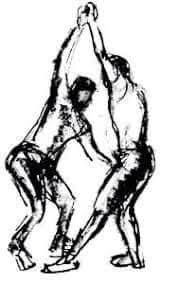
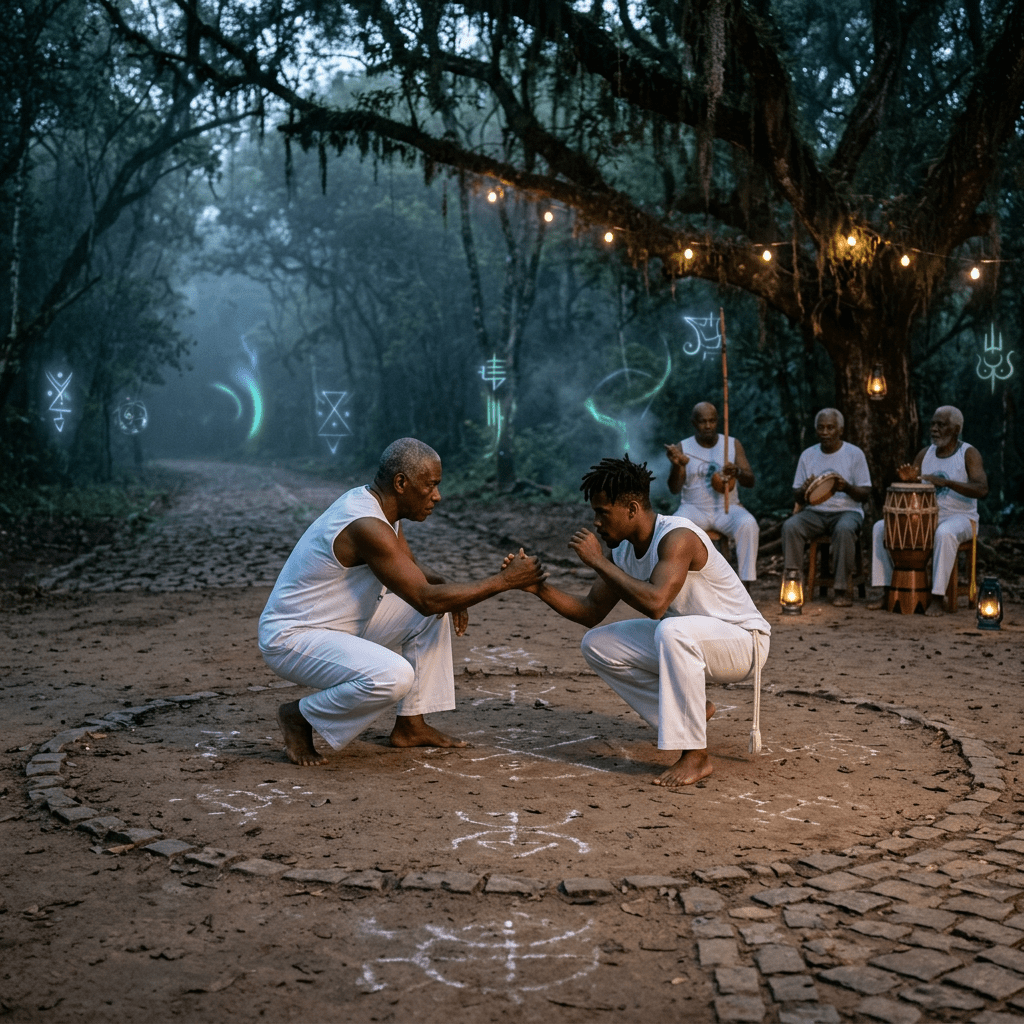
When the game inside the roda grows too intense, too chaotic, or too predictable, one player will suddenly stop. They raise their hands, freezing their movement into a ritual posture of complete vulnerability. They are calling their partner to step into a closed, intimate space of synchronized, slow walking—back and forth, three times.
The Chamada is a sacred truce, a temporary bridge between worlds. Yet, it is precisely within this moment of apparent peace that Eshu plays his most profound game.
"Valha-me Deus, Senhor São BentoO mestre chamou pra caminharSegura o corpo, firma o ventoQue a malícia vai começar..."(Help me God, Lord Saint BenedictThe master called me to walkHold your body steady, firm the windBecause the trickery is about to begin...)
The Architecture of the Chamada: Eshu’s Ritual Mirror
The Chamada is not a break from the game; it is the game magnified. It embodies the precise duality of Eshu: the delicate balance between absolute trust and absolute alertness.
1. The Trap of the Open Door
To call a Chamada, you must present an open target. Your chest is exposed, your hands are raised, and your back may even be turned to your opponent. This is Eshu’s classic illusion—offering a doorway that seems perfectly safe to enter. The player answering the call must approach with immense caution, placing their hands against the caller’s body, matching their breath, and walking together in tight, tense harmony.
2. The Illusion of Safety
As the two capoeiristas walk back and forth at the foot of the berimbau, the illusion of safety deepens. But Eshu rules the thresholds of change. At any single second during this walk, the caller can suddenly drop beneath the partner’s weight to execute a lightning-fast rasteira (sweep) or drive a cabeçada (headbutt) into their chest. Alternatively, the person responding can break the truce if they sense the caller is complacent.
3. Testing the Awake Soul
The Chamada tests your sense of being more than any fast-paced exchange of kicks. It asks a fundamental question: Can you maintain absolute presence when everything feels calm? If you fall asleep in the comfort of the walk, Eshu will swiftly take your feet out from under you. If you panic or strike out of fear, you expose your lack of self-control. To survive the Chamada, you must be entirely relaxed yet entirely awake.
"Mandingueiro que é mandingueiroNão se deita pra dormirNa chamada do AngoleiroÉ que o perigo vai surgir..."(A true sorcerer / capoeiristaDoes not lie down to sleepIt is in the Angoleiro's chamadaThat the true danger will arise...)
The Chamada of Everyday Life: Navigating the Silent Storms
Outside the ring of the roda, life frequently initiates its own Chamadas. These are the moments when the frantic pace of our daily struggles suddenly drops into an eerie, deceptive quiet.
- Recognizing the “Quiet” Traps: A life Chamada manifests when a toxic situation suddenly feels comfortable, when a long-standing conflict falls into a silent truce, or when things seem “too good to be true.” Eshu teaches us not to become paranoid, but to remain awake. Do not lull yourself into complacency just because the storm has paused. Use the quiet periods of life to strengthen your core and observe your surroundings.
- Walking with the Adversary: Sometimes, we are forced to walk hand-in-hand with difficult people, challenging corporate structures, or our own internal demons. The Chamada teaches us how to engage with these forces without losing our footing. You can cooperate, you can synchronize your steps, and you can show respect—but you keep your center heavy, your eyes open, and your spirit anchored.
- The Grace of the Silent Truce: Finally, the Chamada reminds us that we have the power to stop the chaos. When a conversation or a life situation is spinning out of control into destructive violence, you can be the one to freeze, raise your hands, and call for a collective breath. You can redefine the terms of the engagement.
Conclusion: The Heavy Center
To dance through life with Eshu is to welcome the Chamada. It is the realization that the moments of highest spiritual tension do not always look like an aggressive attack; often, they look like a slow, deliberate walk in the dark.
When life calls you to step into the tight circle of the unknown, do not shrink away. Approach the threshold with a heavy center, match the rhythm of the moment, smile at the subtle shifts of the wind, and let the trickster teach you how to remain completely unshakable.