
Ever feel like you are constantly swinging between two extremes? One week you are saving every penny and feeling restricted; the next, you are impulse-buying things you don’t need. Or maybe you bounce between playing it too safe at work and taking reckless risks that backfire.
If this sounds familiar, you are dealing with a timeless human dilemma. Over 2,300 years ago, the Greek philosopher Aristotle looked at this exact problem and came up with a brilliant solution: The Golden Mean.
Here is how this ancient concept can help you find your footing, reduce stress, and live a more balanced life today.
What Exactly is the Golden Mean?
At its core, the Golden Mean is the idea that the right choice in any situation always lies in the middle ground between two extremes.
Aristotle argued that true moral excellence and happiness are destroyed by both deficiency (doing too little) and excess (doing too much). Virtue lives right in the sweet spot between them.
Think of it like tuning a guitar string: if it is too loose, it won’t play a note; if it is too tight, it will snap. The Golden Mean is that perfect, resonant tension.
The Three Columns of Behavior
To understand how this looks in real life, Aristotle broke human behaviors down into triplets: a deficiency, a virtue, and an excess. Here are a few relatable examples:
- Courage: The middle ground between Cowardice (running away from fear) and Recklessness (charging into danger without thinking).
- Generosity: The sweet spot between Stinginess (hoarding your money) and Extravagance (spending until you are broke).
- Confidence: The balance between Self-Deprecation (putting yourself down) and Arrogance (thinking you are better than everyone else).
- Honesty: The middle path between Deceitful Flattery (lying to please others) and Brutal Bluntness (using the truth to hurt people).
[ Deficiency (Too Little) ] <— ( THE GOLDEN MEAN ) —> [ Excess (Too Much) ]
Two Rules for Finding Your Sweet Spot
Finding your personal “mean” isn’t a fixed mathematical formula. It requires awareness. Keep these two golden rules in mind:
1. It Depends on the Context
What is balanced for one person might be extreme for another. A trained firefighter running into a burning building is showing courage. An untrained bystander doing the exact same thing is being reckless. The Golden Mean adapts to who you are and the situation you are facing.
2. Lean Away from Your Natural Weakness
We all lean naturally toward one bad habit. If you know you tend to be passive when conflicts arise, your personal “mean” will require you to push yourself harder toward assertiveness. If you tend to be naturally aggressive, you need to consciously pull yourself back.
The Takeaway
The Golden Mean is a reminder that you don’t have to be perfect; you just have to be balanced. By avoiding the traps of doing too much or too little, you can make better decisions, improve your relationships, and find a sense of peace.
Next time you are stressed about a choice, ask yourself: What do the extremes look like here, and where is my middle ground?
So, How does this Apply to Capoeira Angola?
Introduction to Liberation Geometry
In standard martial arts, combat is often a game of linear metrics. Traditional systems define efficiency by the shortest distance, straightest punches, and a direct collision of force against force. This approach relies heavily on structural mass, speed, and kinetic impact.
Capoeira Angola completely rejects this linear framework, viewing it as a mechanical limitation and a manifestation of colonial rigidity. Instead, its entire movement vocabulary—encompassing circular, spiraling, and oscillating motions—reflects a deeper understanding of human movement that transcends rigid structures. Guided by principles of efficiency and natural motion that align with universal laws, each movement is deliberately designed to flow seamlessly into the next, creating a dynamic interplay of energy and rhythm. This holistic approach maximizes power while minimizing wasted energy, allowing practitioners to harness their movements with grace and agility. By embracing these fluid dynamics, Capoeira Angola not only challenges conventional notions of combat and dance but also invites a deeper exploration of individuality and creativity within its practice, ultimately celebrating a rich cultural heritage that resists simplification.
By moving in accordance with sacred geometry and the Golden Mean, the practitioner transforms a vulnerable position into a lethal trajectory. This methodology prioritizes alignment with universal forces over the self-destructive friction of linear resistance. It turns the body into an instrument of liberation that evades capture, subverts domination, and maintains spatial sovereignty.
Linear Combat (Rigid/Colonial) vs. Liberation Geometry (Fluid/Angola)
Force ──> ◄── Force Force ──> ↻ [Spiral/Redirect]
(Collision & Friction) (Harmony & Evacuation)
The Anatomy of the Arc: Circles and Spirals
Cosmic and Biological Alignment
By internalizing spiral dynamics, the angoleiro (practitioner) mirrors the rotational mechanics found throughout the cosmos, from the double helix of DNA to the swirling arms of galaxies. Moving in curves distributes kinetic energy along an ongoing path rather than creating rigid, structural endpoints that shock the skeletal system.
Somatic Therapy and Longevity
Because circular movements distribute load evenly and eliminate high-impact stress, the art functions as a system of somatic therapy focused on functional longevity. The joints are compressed less; instead, they are rotated and lubricated through continuous movement. This allows practitioners to play the jogo (game) into advanced old age.
Mandinga and Malícia
These weaponized curves facilitate a state of mandinga (cunning) and malícia (malice). In this state, the beginning of a defense is structurally indistinguishable from the launch of an offense. For example:
- A dipping evasive maneuver (esquiva) stores elastic energy in the fascia.
- This energy automatically primes the hips for a whipping counter-kick (meia lua de compasso).
- The transition happens without a distinct pause or reset.
Breaking the Line
Low, coiled movements deliberately break conventional vertical and linear lines. This actions transforms the practitioner into a fluid and elusive target.
- The Rolê (Rolling Ground Transition): Spun along a horizontal axis close to the floor. It takes the practitioner out of the opponent’s line of sight while keeping them ready to strike from below.
- The Negativa (Low Decline): Sinks the weight entirely onto one heel, pulling the body beneath the trajectory of linear strikes. It forms a compressed human spring.
Kinetic Deflection over Blocking
In defensive strategy, the practitioner does not block an incoming attack. To meet a strike directly is to accept the opponent’s terms. Instead, they introduce a curve, skillfully manipulating and redirecting the force and momentum of the opponent’s move.
The angoleiro steps off the track of aggression, slipping inside or around the strike. They use the attacker’s forward momentum to pull them off-balance, causing the attack to empty itself into a vacuum.
The Golden Mean and Aesthetic Flow
The Geometry of Phi (\(\Phi \))
The Golden Mean—or Golden Ratio, represented by the Greek letter Phi (\(\Phi \approx 1.618\))—defines a unique proportion consistently deemed aesthetically perfect and structurally optimal in the natural world. It dictates the spiral of a nautilus shell, the arrangement of pinecones, and the ideal proportions of anatomical expansion.
Golden Spiral Expansion (The Fibonacci/Phi Arc):
_________________________
| | | |
| | 5 |__2__|
| 8 |_____|_1_|1|
| | |
| | 3 |
|_____________|___________|
[The body expands and contracts along this continuous ratio]
Spontaneous Spatial Proportions
In Capoeira Angola, achieving the ideal timing (tempo) and distance (distância) in the jogo is a profound, ephemeral moment of spontaneous alignment with this universal principle. The distance between two players is never static. Instead, it expands and contracts along a fluid golden spiral.
When a player ducks under a kick, the distance between the crown of their head and the opponent’s passing heel matches this geometric proportion. This creates a visually arresting and functionally flawless margin of safety.
Non-Linear Presence
This geometric commitment ensures that a practitioner’s actions remain an extension of the natural world, achieving a state of unpredictable, non-linear presence. Linear movements have a clear, traceable intent: a fist moving from point A to point B.
Conversely, an arc or spiral hides its destination until the final moment of impact. The target changes continuously as the body rotates. This keeps the opponent trapped in a state of cognitive delay.
Fractal Conversations
This mastery transforms the physical exchange from a mere combat drill into a dynamic, flowing conversation—a living embodiment of fractal geometry. Every small movement (a wave of the hand, a tilt of the head) mirrors the grand architecture of the entire game. The players create a self-correcting, complex system where chaos and order balance perfectly.
The Roda as a Sacred Cosmos
Microcosm vs. Macrocosm
The execution of these principles culminates within the roda, the circle in which capoeira is played. The perimeter of the circle defines a sacred space. It separates the profane outside world of linear time, industrial labor, and societal division from the concentrated, intentional energy within.
The roda acts as a microcosm of the universe. Within its boundaries, the laws of gravity, time, and human interaction are rewritten through rhythm and movement.
[THE RODA: THE COUNTER-CLOCKWISE VORTEX]
◄─── Bateria ───┐
/ \
/ \
│ ▲ Mandinga │ │
│ │ & Jogo ▼ │
\ /
\ /
└─── Coro (Chorus) ──►
Communal Harmony
This space fosters communal engagement where participants embody harmony, collaboration, and the interconnectedness of all beings. The roda cannot exist with isolated individuals; it requires a collective.
- The musicians (bateria) provide the rhythmic heartbeat.
- The chorus (coro) chants historical narratives.
- The two players inside respond directly to these sonic coordinates.
The energy flows from the circle into the center and back again, creating a closed-loop system of mutual reinforcement.
The Counter-Clockwise Vortex
Crucially, the roda moves in a counter-clockwise vortex. This direction matches the spiritual cycle of time and cosmic evolution found in Central African cosmologies, such as the Kikongo Dikenga. Moving counter-clockwise symbolizes:
- The reversal of historical trauma
- The undoing of oppression
- An intentional step backward into ancestral time to retrieve lost wisdom (Sankofa)
It serves as a moving meditation and a living archive of Afro-Brazilian resilience. By spinning within this sacred boundary, the angoleiro ancestralizes the body. This process transforms historical survival into a geometric art of infinite liberation.
Musical Rhythms and Movement Geometry
The berimbau (musical bow) dictates the geometric configuration, velocity, and spatial limits of the jogo. Different rhythms change how an angoleiro constructs arcs and loops.
Toques (Rhythms) & Spatial Layouts:
Toque: Angola Toque: São Bento Grande
[Low, Compressed, Dense Loops] [Expansive, Aerial, Whipping Arcs]
_______ _______
/ (•) \ / \
| (•)(•) | | ◄───► |
\_______/ \_______/
Ground-level spirals Wide, sweeping paths
The Angola Toque: Low, Compressed, Dense Loops
The Angola rhythm is slow, heavy, and deeply syncopated. It forces the body into a low center of gravity, compressing the spatial geometry.
- Movements collapse into dense, tightly wound spirals close to the floor (jogo de dentro).
- The practitioner uses micro-adjustments, keeping elbows and knees tucked to shield the centerline.
- The physical space between players shrinks to inches, requiring small, precise circular deflections rather than large sweeping arcs.
The São Bento Grande de Angola Toque: Expansive, Aerial, Whipping Arcs
This rhythm is fast, driving, and aggressive. The shift in tempo instantly expands the geometric boundaries of the game, launching the players into a wide, upright geometry (jogo de fora).
- Compressed loops open up into broad, high-velocity orbits and sweeping crescent trajectories.
- Kinetic energy transitions from potential (coiled low) to kinetic (whipping outward).
- Players navigate larger spatial distances, using long-range circular kicks like the martelo or armada to control the perimeter.
Rhythmic Polycentrism
The polyrhythms of the bateria break up linear timing. A steady, predictable beat encourages a straightforward, back-and-forth cadence.
In contrast, the syncopation of the agogô, atabaque, and pandeiro introduces rhythmic gaps. The player mirrors these variations by shifting mid-movement, creating a stuttering, non-linear flow that disrupts the opponent’s timing.
The Kikongo Cosmogram and Central African Spirituality
The movement patterns of Capoeira Angola directly reflect the Dikenga dia Kongo, the ancestral Central African cosmogram. This geometric cross within a circle traces the journey of the soul, the rotation of the sun, and the structure of reality.
[THE DIKENGA DIA KONGO / COSMOGRAM]
Musoni (Yellow Sun / Rebirth)
Midnight
▲
│
Vanyanga (Black / Earth) ┼─── Kala (White / Spirit)
Sunset / Maturity │ Sunrise / Birth
▼
Noon
Luvemba (Red / Ancestors)
The Four Positions of the Body
The * Dikenga* breaks a circle into four cardinal points, which match the phases of human life and the path of the sun. The angoleiro constantly traces this cycle with their torso and limbs:
- Kala (Sunrise/Birth): The initial step into the roda or rising from the floor.
- Luvemba (Noon/Maturity): Standing fully upright, fully visible, and at peak expression.
- Vanyanga (Sunset/Passing): Dropping down into an esquiva or negativa, descending toward the earth.
- Musoni (Midnight/Ancestral Realm): The inverted position, such as a handstand (bananeira or chamada). Here, the head points toward the underworld and the feet toward the sky, accessing ancestral power.
Inversion as Spiritual Reversal
Being upside down is not just an acrobatic stunt. In Central African spirituality, the ancestral realm is a mirror image of the physical world, separated by a watery boundary (Kalunga).
By inverting the body, the capoeirista crosses this line. This inversion turns weakness into strength and subverts the physical and social structures of the dominant world.
Tracing the Crossroads
The basic step of capoeira, the ginga, is not a simple side-to-side walk. It forms a triangular and cross-axial path on the ground.
By constantly stepping across these axes, the player works at the crossroads between the physical and spiritual worlds. This position gives them the cosmic authority to redirect negative energy.
Tactical Examples: Spiral vs. Linear Attack
In real-time combat, linear attacks rely on direct paths, such as a straight punch or front kick, which are often the most straightforward methods to deliver force efficiently. However, Capoeira Angola neutralizes this direct force by wrapping a spiral around that line, effectively deflecting the attack without absorbing its impact. This approach utilizes a combination of fluid, circular movements and evasive maneuvers, allowing practitioners to redirect an opponent’s energy with elegance and precision. By embracing the dynamics of angles, timing, and rhythm, Capoeira Angola not only enhances defensive capabilities but also transforms a potentially aggressive situation into an opportunity for counterattacks and fluid transitions, showcasing the art’s unique blend of combat and dance.
Tactical Scenario 1: Overcoming a Straight Front Kick (Bênção)
[Top-Down View]
Linear Strike: ───► [Target Centerline]
Spiral Pivot: ( Player steps out and rotates ) ↻
Result: Kick misses; counter-kick strikes from below.
- The Linear Attack: An opponent executes a straight, high-impact front kick directed at the angoleiro’s chest.
- The Spiral Counter: The practitioner does not step backward, which would keep them on the line of fire. Instead, they drop into a Meia Lua de Compasso (half-moon kick on the compass).
- The Kinetic Mechanism: The player steps diagonally off the attack line, plants both hands on the floor inside the opponent’s stance, and rotates their torso. This turns the entire body into a human top.
- The Outcome: The opponent’s straight kick passes harmlessly through empty air. Meanwhile, the angoleiro’s sweeping leg accelerates along a widening spiral, striking the attacker’s exposed flank or supporting leg from an unexpected, low angle.
Tactical Scenario 2: Overcoming a Straight Punch (Direct)
- The Linear Attack: An opponent throws a direct, fast punch aimed at the face.
- The Spiral Counter: The practitioner responds with a Rolê integrated from a low Esquiva Lateral.
- The Kinetic Mechanism: Instead of blocking, the practitioner drops their weight, slipping under the punch. They immediately spin their hips and shoulders along a horizontal plane, rolling across the floor.
- The Outcome: The punch’s momentum carries the attacker forward into a vacuum. The angoleiro’s spiral movement takes them behind or to the side of the attacker, positioning them perfectly to trip the opponent (rasteira) using their turning momentum.
Biomechanics of the Fascia and Elastic Energy
In Capoeira Angola, power does not come from isolated muscle contractions. Instead, it relies on the kinetic storage and release of energy within the fascial network. Fascia is the continuous, three-dimensional web of connective tissue that wraps around muscles, bones, and organs.
Linear Muscle Force: [Contraction] ──► [Bone Lever] ──► [Rigid Impact]
Fascial Elastic Spiral: [Winding Rotate] ──► [Tension Storage] ──► [Whip Release]
Spiral Lines and Tensegrity
The human body utilizes myofascial lines that wrap around the torso and limbs in a helical fashion. Capoeira Angola maximizes this architecture through tensegrity (tensional integrity). This is a structural principle where shape is maintained by a continuous web of tensile membrane rather than rigid structural blocks.
When an angoleiro twists their torso while keeping their feet anchored, they stretch these fascial spirals. This action stores potential energy like a wound-up rubber band.
The Kinetic Loading Loop: Esquiva to RABO DE ARRAIA
- The Loading Phase (Esquiva): As the practitioner drops into a low, twisting evasion, they stretch the fascial lines across the lower back, hips, and thighs. This movement loads the tissue without requiring excessive muscular strain.
- The Catapult Effect: Instead of using a deliberate muscle contraction to launch the counter-attack, the player simply releases the twist. The fascia springs back to its natural shape, whipping the body into a rotational kick.
- Efficiency and Endurance: This elastic recoil uses very little chemical energy (ATP) from the muscles. Because the fascia handles the structural load, the practitioner can sustain high-power movements for hours in the roda without exhausting their muscles.
Linguistic Clues in Traditional Ladainhas
The oral tradition of Capoeira Angola preserves its spatial and spiritual geometry through ladainhas (litany songs). These narrative songs are sung at the foot of the berimbau before the game begins. The lyrics contain subtle metaphors that instruct the body on how to move.
Song Metaphor Geometric Meaning Tactical Translation
“O mundo dá volta” The continuous circle Never stop in a static spot
“Cobra que me morde” The serpentine spiral Strike with a winding path
“Água de beber” Fluid adaptation Evade like flowing water
“Mundo dá volta, camará” (The world turns, comrade)
This phrase is a foundational lyric in many ladainhas. On the surface, it reflects on the changing nature of life and fortune.
Geometrically, it instructs the player that the jogo is a closed, rotating system. There are no permanent victory states or fixed positions. The body must mirror this constant rotation to survive, treating every defensive end as a new offensive beginning.
“Cobra que me morde, rabo lhe bateu” (The snake that bites me, its tail strikes)
The snake is a recurring symbol in capoeira lore, representing the ultimate master of spiral dynamics.
- A snake does not strike from a rigid, straight line. It coils to store energy, then strikes along an arc.
- The lyric teaches the angoleiro to move like a fluid chord. When one part of the body (the head or hands) evades an attack, another part (the tail or leg) must instantly swing around to counter-strike.
“Vou dizer ao meu senhor que a manteiga derramou” (I will tell my master the butter spilled)
This song references historical resistance, disguised as a simple domestic accident.
- Slipping or spilling represents an intentional loss of rigid structure.
- It teaches the player to move like a spilled liquid, spreading low across the floor without a fixed shape. This prevents the opponent from finding a solid target to hit or grab.
The Geometry of the Ginga Grid
The ginga is the foundational movement of capoeira. While it appears to be a fluid, casual step, it maps out a precise geometric blueprint on the floor. It forms a continuous shifting triangle or a three-dimensional double helix over a Cartesian grid.
[THE GINGA GEOMETRIC GRID]
A (Apex / Front Center)
/\
/ \
/ \
/ \
/ \
/__________\
B C
(Left Base) (Right Base)
* The Centerline of Vulnerability runs directly down the middle from point A.
* The practitioner constantly shifts their weight between B and C to clear this line.
Step-by-Step Trajectory
Position 1: The Base (Points B and C)
The feet are wide apart, parallel, and the knees are deeply bent. The torso is low, and one arm shields the face. This wide stance provides maximum lateral stability.
Position 2: The Parallel Transition
To move, the player draws one foot inward toward the center axis. This temporarily narrows the base, creating a brief moment of potential energy before the body expands outward again.
Position 3: The Apex Step (Point A)
One leg steps far back along a diagonal line, landing at the rear vertex of an imaginary inverted triangle. The front knee remains bent, and the arm shifts to shield the opposite side of the face.
The body’s centerline has now swung completely clear of the original line of attack.
Position 4: Returning to Balance
The back leg steps forward again, returning to the wide base (Points B and C). The player then repeats the sequence on the opposite side.
This continuous movement traces an endless figure-eight shape (\(\infty \)) on the ground. By staying in this constant, rhythmic motion, the angoleiro never gives their opponent a stationary target to lock onto.
Historical Accounts of Spatial Sabotage and Evasion
Enslaved Africans and their descendants utilized non-linear spatial geometry as a survival strategy against colonial forces, slave catchers (capitães-do-mato), and tracking hounds. Colonial warfare and policing relied heavily on linear grids, clear lines of sight, and structured paths to maintain dominance. Capoeira transformed the landscape into a tactical maze through deliberate geometric evasion.
Colonial Tracking (Linear Search Grid) vs. Quilombo Evasion (Vortex Extraction)
┌───┬───┬───┐ \ /
├───┼───┼───┤ ──► [Predictable Path] \ ↻ / ──► [Vanishing Loop]
└───┴───┴───┘ \ /
Fragmenting the Line of Sight
Historical documentation from runaway slave communities (quilombos), such as Palmares, describes tactical retreats that confused European pursuers.
- Capoeiristas did not run in straight lines when pursued through the dense Brazilian mata (forest).
- They moved in zigzagging patterns and looping spirals that disrupted the visual tracking of firearms.
- By dropping into low positions (negativas and cocorinhas), they vanished beneath the horizon line of forest brush, making it impossible for trackers to aim effectively.
Disrupting Tracking Hounds
The circular and looping geometry of capoeira left erratic scent trails. Trackers noted that escaped laborers would step backward into their own footprints before pivoting outward at a right angle. This tactic forms a physical “crossroads” on the ground.
When tracking hounds reached these geometric intersections, the overlapping and looping scent trails confused the animals. This confusion bought the escapees time to melt back into the landscape.
The Weaponization of Spatial Ambiguity
In urban centers like Rio de Janeiro and Salvador during the 19th century, capoeira gangs (maltas) used circular crowd formations to ambush colonial police.
- A small group would draw police into a narrow, winding alleyway, neutralizing the officers’ numerical advantage.
- Once inside, the capoeiristas would rapidly shift from low ground sweeps to high spinning kicks.
- This dynamic spatial rotation prevented the police from organizing a cohesive, linear defensive wall.
The Mathematical Harmonics of the Berimbau
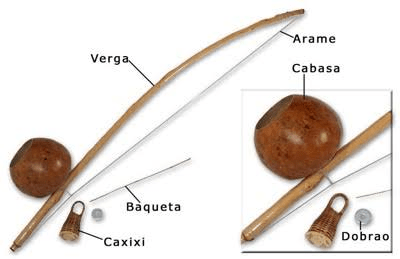
The berimbau is more than a rhythmic timekeeper; it is a acoustic instrument governed by precise physical proportions. The interplay between string length, tension, and the volume of the gourd resonator dictates the geometric flow of the roda.
[THE BERIMBAU STRING DIVISIONS]
The Golden Section of the Verga
The berimbau consists of a wooden bow (verga), a steel string (arame), and a dried gourd (cabaça). [1, 2, 3, 4]
- To maximize acoustic resonance, the cabaça is not placed randomly. It is tied to the lower third of the bow.
- This placement closely mirrors the Golden Ratio (\(\approx 1:0.618\)) of the total string length.
- Positioning the resonator at this nodal point amplifies the rich upper harmonics while preserving a deep, foundational bass note. [1]
String Division and Frequency Modulation
The practitioner holds a small stone (pedrao) or coin (dobrão) against the steel wire to alter its pitch. This action changes the active vibration length of the string:
- The Open String: Striking the wire with the wooden stick (baqueta) while the dobrão is pulled away produces the deep, fundamental base tone.
- The Pressed String: Pressing the dobrão firmly against the wire shortens the vibrating segment. This length reduction increases the frequency, creating a higher, brighter pitch.
- The Buzz Tone: Touching the dobrão lightly against the wire creates a metallic vibration, adding a third textural layer to the sound.
Acoustic Influence on Movement
The microtonal shifts between these notes directly influence the player’s physics. The deep, open tone corresponds to low, ground-based positions (jogo de dentro). The high, sharp tone signals explosive, upright rotational movements (jogo de fora). The musical mathematics of the wire dictate the physical geometry of the body in space.
Razor Blades, Machetes, and Cane Sticks
When capoeira was criminalized in Brazil during the late 19th and early 20th centuries, practitioners weaponized their circular movements. They integrated blades and sticks into their performance, transforming dance arcs into cutting trajectories.
Linear Blade Thrust: [Point A] ───────────────────────► [Point B]
Capoeira Blade Orbit: [Centrifugal Spin] ──► ↻ (Arc Cut) ──► ↺ (Return Loop)
The Razor (Navalha) in the Hand or Toes
The straight razor (navalha) was a favorite weapon of urban maltas. Capoeiristas held the blade tightly between their fingers or gripped it securely between their toes.
- Centrifugal Cutting Arcs: A traditional linear knife fight relies on straight stabs and thrusts. Capoeira weapon play used centrifugal force instead.
- Invisible Trajectories: When a practitioner executed a spinning kick like the Rabo de arraia with a razor between their toes, the blade traveled along a wide, high-velocity arc. The speed of the spin made the small blade invisible to the eye, transforming an evasion into an orbital slice.
- Subverting the Guard: Because the blade moved along a curve, it could bypass an opponent’s straight arm block. The razor wrapped around the defender’s guard to slash vulnerable tendons on the wrists or ankles.
The Machete (Facão) in Maculelê
The use of the machete is preserved in Maculelê, a dramatic dance closely linked to capoeira history.
- Players wield a pair of heavy blades, striking them together to the beat of the drum.
- The combat geometry uses continuous, circular weaving patterns (8-shape or infinity loops).
- This constant movement keeps the heavy blades in motion, utilizing kinetic momentum so the wielder does not have to fight the weapon’s inertia. A sudden change in the circle’s angle transforms a rhythmic strike into a heavy cleaving blow.
The Cane Stick (Tiririca or Petrópolis)
Capoeiristas frequently carried walking canes made of dense, flexible wood like indaiá or peroba.
- Rather than using the cane for top-down linear bludgeoning, they spun the stick in fluid wheel-like patterns around their body.
- This technique created a moving shield of kinetic energy that deflected incoming blunt or edged attacks.
- By dropping into a low rasteira (sweep) while spinning the cane near the ground, a practitioner could trip an opponent and deliver a striking blow in a single, continuous rotation.
The 19th-century street-fighting iteration of capoeira (capoeiragem) was documented by police forces as a highly violent urban warfare system. Rather than the codified, graceful dialogue seen today, the archives of the Imperial Court in Rio de Janeiro and the port city of Salvador da Bahia reveal a lethal combination of African foot-fighting, specialized blunt weapons, and urban guerrilla tactics.
The Legal Framework: Repression without a Name (1808–1889)
For most of the 19th century, the term “capoeira” did not exist in any formal legislative statute. This absence forced police authorities to rely on administrative workarounds to prosecute practitioners.
[PRE-REPUBLICAN LEGAL ESCALATION]
1809: Royal Guard Formed ──► Arbitrary public floggings for “disorder”
1830: Criminal Code ──► Prosecuted via Article 240 (Vagrancy)
1831: Municipal Decree ──► Explicitly bans capoeira, even for “play”
1890: Penal Decree 847 ──► Direct criminalization of “Capoeiragem”
- The 1830 Criminal Code: This foundational text established a strict rule of prior law, meaning an act was only a crime if explicitly named. Since capoeira was omitted, police processed arrests under Article 240 (Vagrancy/Vadiagem) and public disturbance codes.
- The 1831 Regency Decree: On July 27, 1831, the provincial government issued an emergency decree demanding the direct arrest of “effective black capoeiras as well as those who practice it, even for entertainment”.
- The Republican Purge (Decree 847): Following the fall of the empire, the new Republican government codified the art as a distinct offense under Chapter XIII, Articles 402 and 403 of the 1890 Penal Code. It mandated 2 to 6 months of prison for performing “agility and dexterity exercises on the streets”. If the perpetrator was a foreigner, they faced immediate deportation upon serving their sentence.
Rio de Janeiro: The Maltas and Urban Cartels
In Rio de Janeiro, the practice grew into highly structured, territorial criminal cartels known as Maltas.
Institutional Mapping: The Guaiamus and Nagoas
By the mid-1800s, Rio was divided between two rival coalitions. The Guaiamus (associated with liberal political factions, free blacks, and working-class immigrants) controlled the city outskirts. The Nagoas (aligned with conservative monarchists and dominated by Africans of Yoruba descent) controlled the central commercial port.
[THE DUELING MALTAS OF RIO DE JANEIRO]
┌─────────────────────────────┐ ┌─────────────────────────────┐
│ NAGOAS │ │ GUAIAMUS │
├─────────────────────────────┤ ├─────────────────────────────┤
│ • Territory: Central Port │ │ • Territory: Outskirts │
│ • Faction: Conservative │ │ • Faction: Liberal Party │
│ • Demographics: African │ │ • Demographics: Mixed Race │
└─────────────────────────────┘ └─────────────────────────────┘
Police Archive Classification of Combat Techniques
According to 19th-century police blotters, Carioca capoeira (capoeira carioca) combined five core combat techniques into a brutal street style:
- Cabeçadas (Headbutts): Launched as an explosive, low-level ramming attack straight into an opponent’s sternum or chin.
- Pugilism and Slaps: Heavy, open-hand blows aimed to disorient or break the sensory alignment of the target.
- Weaponized Accoutrements: The use of heavy walking canes (porretes or petrópolis) to shatter guarding arms before closing the distance.
- Navalha (The Razor): Kept concealed inside pockets or between shoe soles.
- The “Rasteira” (Takedown): Sinking flat to the floor to hook an opponent’s ankle, slamming their skull onto cobblestone streets.
The Military Guard and Major Vidigal
The primary force tasked with hunting the maltas was the Military Division of the Royal Police Guard, established in 1809 under the command of the notorious Major Miguel Nunes Vidigal. Vidigal’s files show an institutional fear of slave rebellions modeled after the Haitian Revolution.
The Guard utilized arbitrary violence, dragnet street arrests, and public floggings at the Pelourinho to break the networks of the maltas.
Salvador da Bahia: Ancestral Subversion and Ritual Secrecy
While Rio de Janeiro’s archives paint a picture of territorial gang wars, the police documents in Salvador da Bahia reveal a practice that remained deeply intertwined with Afro-Brazilian cultural networks
RIO DE JANEIRO ARCHIVES SALVADOR DA BAHIA ARCHIVES
┌───────────────────────────────────┐ ┌───────────────────────────────────┐
│ • Focus: Criminal Gangs (Maltas) │ │ • Focus: Religious Assemblies │
│ • Motivation: Political Muscle │ │ • Motivation: Ancestral Survival │
│ • Outcome: Total Suppression │ │ • Outcome: Cultural Preservation │
└───────────────────────────────────┘ └───────────────────────────────────┘
The Candomblé Connection
Bahian police registries from the 19th century routinely mixed up capoeira gatherings with batuques (drumming circles) and Candomblé religious houses.
Detectives noted that capoeiristas utilized the sacred spaces of terreiros to train secretly, viewing the athletic coordination as an extension of spiritual defense.
The Navalha and the “Vadiagem” Blotters
Arrest records from the Arquivo Público do Estado da Bahia show a distinct profile for the Bahian practitioner.
They were frequently labeled as faquistas (knife-fighters) or capoeiras navais. The files document men carrying folding razors wrapped in handkerchiefs, deploying quick, low-line kicks from the ginga to slice open the thighs or groin of police pursuers.
Geographies of Resistance
Unlike Rio, where combat took place in grand plazas during political rallies, Bahian resistance was concentrated around the commercial shipping docks of the Comércio district and the agricultural processing hubs of the Recôncavo Baiano.
The dense, rural geography of the Recôncavo allowed capoeira to maintain its structural roots. This regional preservation eventually laid the groundwork for its 20th-century legalization through pioneers like Mestre Bimba and Mestre Pastinha
Conclusion: Capoeira Angola represents a profound synthesis of natural philosophy, sacred geometry, and ancestral resilience. By rejecting the linear rigidity of colonial forces, the art form utilizes the fluid mechanics of circles, spirals, and the Golden Mean to maximize physical efficiency while preserving functional longevity and spatial sovereignty. This methodology effectively maps tactical defense onto cosmic frameworks, transforming the practitioner’s body into a dynamic instrument of liberation.
From its difficult origins in the sugarcane fields and urban maltas to its systemic criminalization under the 1890 Penal Code, capoeira survived through strategic evasion and deep cultural integration with Afro-Brazilian spiritual networks like Candomblé. The regional preservation in Salvador da Bahia and the Recôncavo Baiano laid the critical foundation for its 20th-century legitimization.
Spearheaded by visionary pioneers like Mestre Pastinha, who preserved its traditional roots and philosophical depth at the Centro Esportivo de Capoeira Angola, and Mestre Bimba, who pioneered its formal educational acceptance, the practice transitioned from a persecuted underground survival tool into a globally celebrated art form. Now inscribed as a UNESCO Intangible Cultural Heritage of Humanity, Capoeira Angola stands as an unbroken, vibrant link to ancestral wisdom, proving that balance, harmony, and strategic resistance endure as a timeless testament to human dignity.
 Jogo Corpo Fechado