
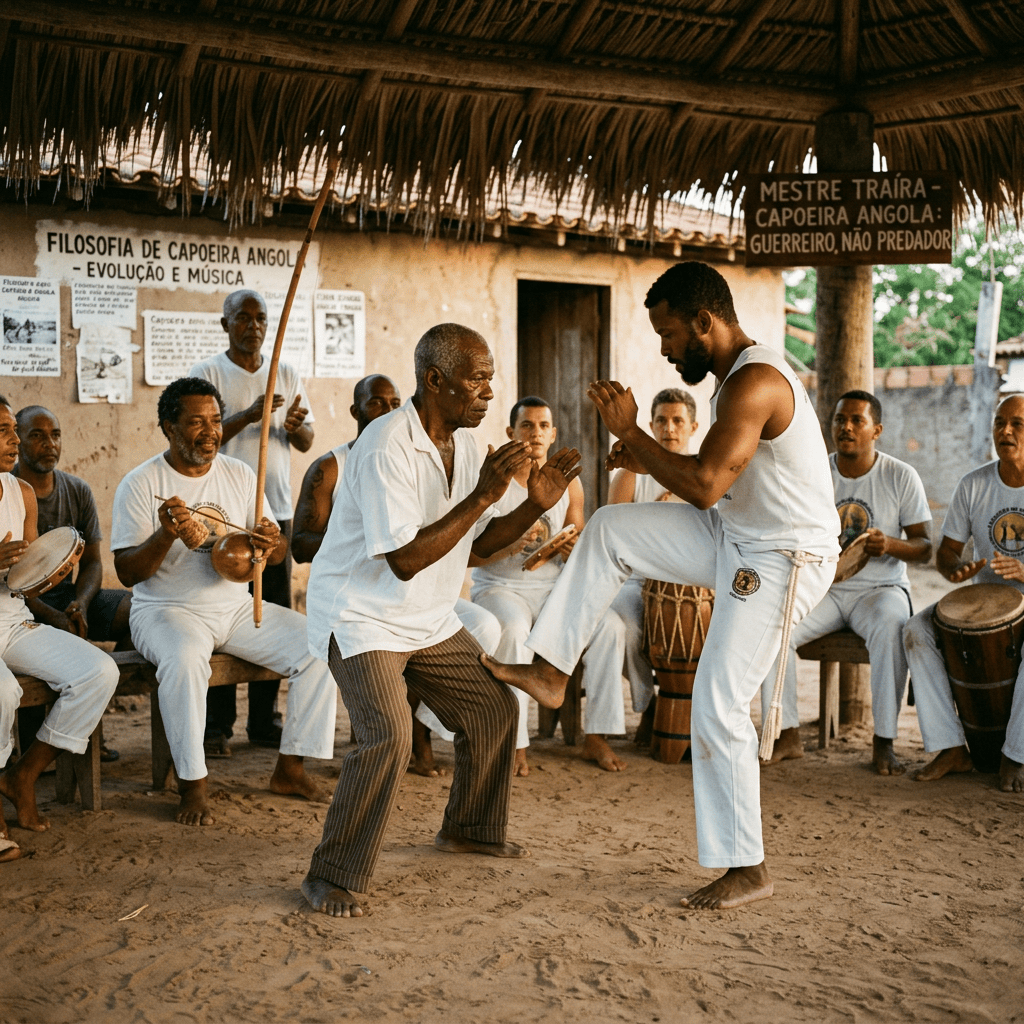
At first glance, a Capoeira Angola roda (circle) looks like a joyful, acrobatic dance set to hypnotic Afro-Brazilian rhythms. Watch a little closer, however, and you will see sweeps, headbutts, feints, and razor-sharp traps unfolding inches from the floor.
This duality often raises a fundamental question for newcomers and martial artists alike: Does Capoeira Angola cultivate a warrior mindset, or a predator mindset?
The answer lies in the art’s origins as a tool of liberation against slavery. Capoeira Angola develops a warrior mindset—one rooted in survival, self-preservation, mutual respect, and personal evolution—while actively rejecting the ego-driven dominance of a predator.
Warrior vs. Predator: The Psychological Architecture of the Roda
In martial philosophy, a predator mindset views a training space as a hunting ground and a partner as prey to be exploited for ego or immediate gratification. Capoeira Angola dismantles this mentality from the moment a student steps into the circle.
- Dialogue Over Dominance: Practitioners view the jogo (game) as a physical conversation and a test of character rather than a fight meant to destroy an opponent.
- Cunning as Survival (Malícia): While the art relies heavily on deception, misdirection, and unpredictability, these traits serve as protective camouflage. Historically, enslaved Africans used trickery to disguise combat training in plain sight as playful dance.
- Complementation Over Violence: Traditional masters refer to Capoeira Angola as “the art of fighting with a smile,” emphasizing harmonious interaction (complementation) and keeping real violence strictly as a last resort for self-defense.
| Trait | Warrior Mindset (Capoeira Angola) | Predator Mindset |
| View of Opponent | A partner in an ongoing physical dialogue. | Prey to be exploited. |
| Primary Motivation | Self-defense, preservation, and character growth. | Ego, dominance, and immediate gratification. |
| Use of Trickery (Malícia) | Camouflage, evasion, and strategic survival. | Ambush and taking advantage of weakness. |
| Role of Ego | Managed through humility and respect for protocol. | The primary driver of aggression. |
Why Studying the Predator Mindset Benefits an Angoleiro
Rejecting a predator identity does not mean remaining naive. Learning the mechanics of a predator mindset is a valuable tactical tool for an angoleiro, provided it is used strictly for defensive recognition rather than as a personal identity. Understanding how a predator thinks and operates directly sharpens malícia (streetwise cunning) and fulfills Capoeira Angola’s historic purpose of survival against real-world oppression and violence.
- Recognizing Traps Before They Close: A predator relies on ambush, target selection, and exploiting predictable habits. Studying these patterns trains an angoleiro to spot social engineering, street-level setups, and deceptive openings inside the roda before getting caught.
- Sharpening Malícia and Mandinga: Traditional mestres used animal metaphors—such as the jaguar (onça), snake (cobra), and spider (aranha)—to teach patience, stalking, and sudden counterattacks. Understanding predatory timing helps a player mask their true intentions until the exact moment an opening appears.
- Eliminating Naivety: Capoeira Angola was forged by enslaved Africans who had to outthink brutal, predatory systems to survive. Refusing to understand predatory behavior leaves a practitioner vulnerable to people who do not play by cooperative rules.
The Crucial Boundary: Tactical Tool vs. Core Identity
While studying predatory mechanics makes an angoleiro sharper, adopting a predator mindset as a way of life contradicts the foundation of the art.
- Preserving the Jogo (Dialogue): Inside the roda, treating training partners like prey destroys trust, stops mutual learning, and invites unnecessary injury. A warrior studies the predator to protect the community, not to hunt their peers.
- Subordinating Ego to the Berimbau: Predatory psychology is driven by dominance and immediate gratification. An angoleiro channels predatory awareness through patience, humility, and restraint—proving they could strike without needing to cause harm.
| Aspect | Studying Predator Mechanics (Recommended) | Adopting a Predator Identity (Counterproductive) |
| Primary Goal | Threat detection, counter-ambush, and sharper malícia. | Ego-driven dominance and exploiting weaker players. |
| Effect on the Roda | Elevates everyone’s awareness and defensive discipline. | Breaks trust and turns a cooperative dialogue into a brawl. |
| Alignment With Tradition | Honors the survival roots and animal wisdom of the elders. | Violates Mestre Pastinha’s ethics of brotherhood and restraint. |
The Elders’ Blueprint: Mestre Pastinha and the Philosophy of Restraint
Much of Capoeira Angola’s modern philosophical framework was articulated by Vicente Ferreira Pastinha (1889–1981), revered as the “philosopher of capoeira.” When he founded the first official Capoeira Angola school in 1941, he framed the art through poetic oral aphorisms rather than rigid sporting rules:
- A Tool for Freedom: Pastinha defined capoeira as “sorcery of slaves in the longing for freedom; its beginning has no method and its end is inconceivable to even the most knowledgeable capoeirista.”
- Separation From Street Violence: He insisted that capoeira is strictly a game inside the circle, teaching that outside the roda, practitioners must treat one another as brothers.
- Patience Over Impulsiveness: Warning against ego-driven rushing, Pastinha coined the maxim, “A hasty capoeirista is blind.”
His direct disciple, Mestre João Pequeno, captured the essence of warrior restraint when he explained: “The capoeirista doesn’t have to touch his foot to beat… when he takes his foot and sees that the opponent has not defended himself, he stops before the foot touches.” Proving you could strike without inflicting harm demonstrates mastery over both body and ego. Later elders like Mestre Moraes and Mestre Cobra Mansa expanded this ethos, anchoring the art in Afro-Brazilian ancestry, ecological harmony, and community empowerment.
“Quem Manda na Roda é o Berimbau”: How Music Governs the Game
In Capoeira Angola, music is not background entertainment—it is the supreme referee and moral compass of the circle. As traditional mestres say, “Quem manda na roda é o berimbau” (“The berimbau is the one who commands the circle”).
- Authority Over Ego: Players must kneel at the foot of the berimbau (pé do berimbau) and wait for permission before entering. When the lead low-pitched berimbau (gunga) changes its rhythm or lowers its gourd, the game must stop immediately.
- Setting the Emotional Temperature: Different rhythms (toques) dictate how players interact—from the slow, philosophical conversation of Angola to the sharper, closer exchanges of São Bento Grande de Angola. If a game turns overly aggressive, the mestre slows the berimbau to force an emotional reset.
- Real-Time Moral Coaching: Every roda opens with a ladainha—a solo historical lament sung while players crouch still in patient reflection. Once the game begins, call-and-response songs (corridos) comment directly on the action, warning careless players of open traps or reminding aggressive players to show humility.
Training Malícia Safely—Inside and Outside the Circle
Malícia—streetwise cleverness and strategic awareness—cannot be learned through brute-force sparring. Instead, Capoeira Angola cultivates it through structured, non-violent drills inside the roda:
- Marked Strikes: Players execute sweeps (rasteiras) or kicks right up to the point of impact and pull back, showing a partner their vulnerability without causing injury.
- The Chamada (The Call): One player pauses the game in an intentionally vulnerable posture, inviting the partner to approach. The approaching player must read the trap, maintain defensive guard, and exit safely.
- Playing in Tight Spaces (Jogo de Dentro): Restricting movement to arm’s reach near the ground forces players to spot subtle weight shifts and eye fakes rather than relying on athletic speed.
- Feinting (Fintas): Practitioners practice initiating predictable kicks and smoothly converting them mid-motion into escapes or sweeps once a partner reacts.
How Beginners Can Practice Malícia in Daily Life
Because malícia is fundamentally about reading environments and managing your own reactions, you can train it anywhere:
- Soften Your Gaze (Visão Periférica): Avoid staring at a single focal point in crowded spaces; practice taking in the entire room through peripheral vision.
- Read Preparatory Weight Shifts: Notice how people shift their balance before stepping through a doorway or reaching for an object.
- Break Your Autopilot: Vary your walking pace, take new routes, or use your non-dominant hand for daily tasks to stay adaptable.
- Take a Half-Second Pause: When surprised or frustrated in conversation, pause briefly before replying so you choose your response rather than falling for an emotional bait.
Pastinha, Bimba, and the Birth of Capoeira Contemporânea
Capoeira Angola’s philosophy becomes even clearer when contrasted with its sister lineage, Capoeira Regional, created in the 1930s by Mestre Bimba (1899–1974).
Alarmed that street capoeira was losing its martial teeth, Bimba blended traditional movements with other combat arts, introduced standardized sequences (sequências), white uniforms, and belt graduations, and emphasized upright posture and explosive speed. Pastinha and traditionalist elders worried that standardization would strip away the art’s Afro-Brazilian ritual, improvisation, and malícia.
Though often portrayed as bitter rivals, the two masters actually engaged in a respectful ideological debate. Both shared the ultimate goal of lifting capoeira out of criminalization, and memoirs confirm they greeted each other warmly and held deep mutual respect.
In the 1960s and 1970s, a new generation of mestres in Rio de Janeiro—most notably Grupo Senzala—refused to choose between the two visions. They created Capoeira Contemporânea, today’s most widely practiced global style, which bridges both worlds.
| Feature | Capoeira Angola (Pastinha) | Capoeira Regional (Bimba) | Capoeira Contemporânea |
| Core Mindset | Philosophical dialogue, malícia, and ancestral ritual. | Athletic efficiency, speed, and combat precision. | Versatility across ground strategy, combat, and acrobatics. |
| Game Height & Pace | Low to the ground; slow to moderate tempo. | Upright posture; fast, explosive tempo. | Starts low and slow, builds to high and fast. |
| Training Structure | Informal observation, improvisation, and partner drills. | Standardized sequências and belt graduations (cordas). | Combines structured drills, belts, and free improvisation. |
| Orchestra (Bateria) | Full 8-instrument ensemble (3 berimbaus). | Minimalist setup (1 berimbau, 2 pandeiros). | Adopts Angola’s full 8-instrument orchestra. |
Final Thoughts
Whether you step into a traditional Angola circle, a high-flying Regional academy, or a modern Contemporânea school, the deepest lesson of capoeira remains unchanged. True mastery isn’t measured by how hard you can strike an opponent—it is measured by your ability to read the room, recognize hidden traps, control your ego, and navigate life’s challenges with grace, awareness, and a smile.

