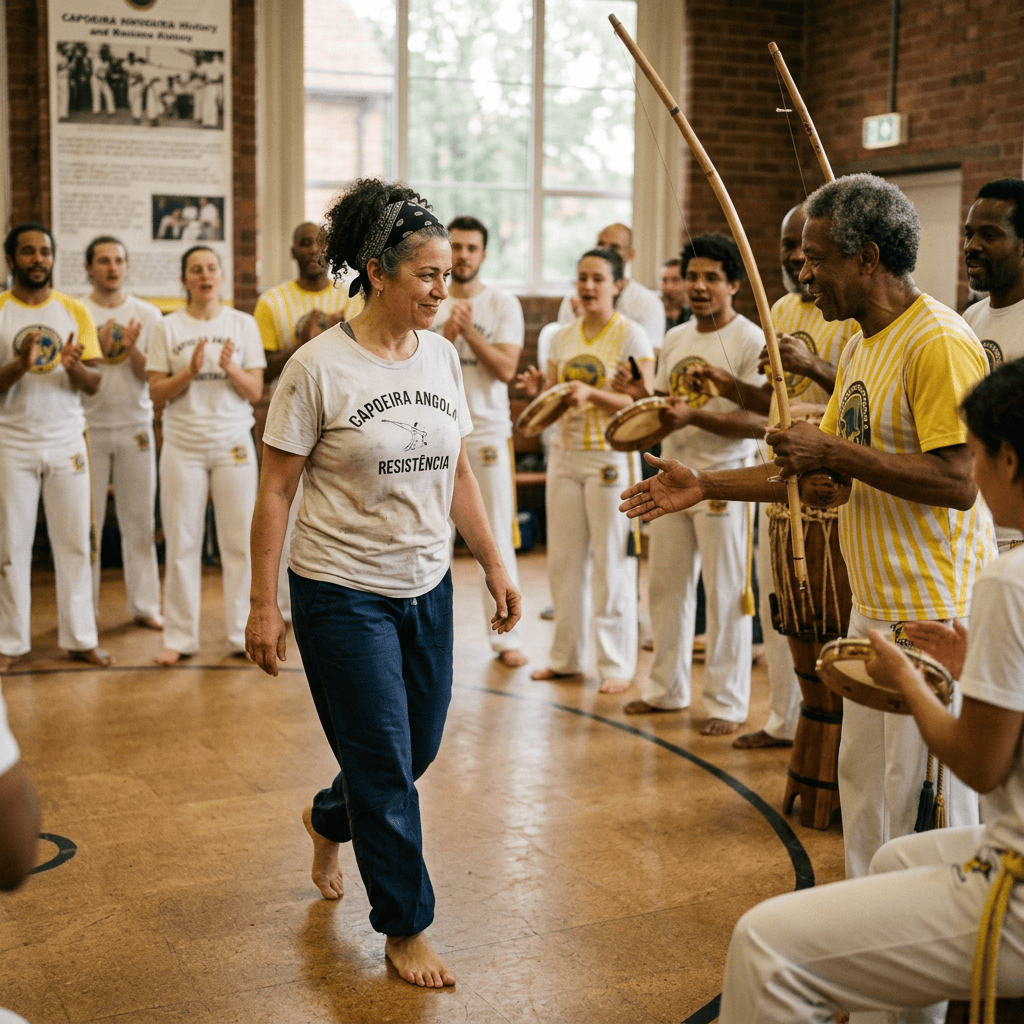
Whether you trained for three months or ten years before life got in the way, coming back to Capoeira Angola requires patience, rhythm, and a fresh perspective on your body.
Life happens. Careers shift, families grow, injuries occur, or you simply step away for a while. Whatever the reason, deciding to return to Capoeira Angola after a few years away is an exciting—and often intimidating—step.
Unlike purely fitness-based martial arts, Capoeira Angola is a conversation, a ritual, and a community. Coming back isn’t about jumping straight into intense conditioning; it’s about reconnecting with the music, the floor, and your own body as it is today.
Because a returning beginner faces very different hurdles than a seasoned capoeirista shaking off rust, here is how to navigate your comeback based on where you left off.
Start at the Foot of the Berimbau (For Everyone)
Before worrying about low quedas de rins or fluid inversions, every returning practitioner benefits from anchoring themselves in the core elements of Angola:
- Let the bateria set your pace: Spend time sitting, clapping, and singing ladainhas and corridos. Letting the berimbau dictate your rhythm prevents you from rushing movements out of nervousness or muscle memory.
- Prioritize floor connection over height: Capoeira Angola lives close to the ground. Focus on stable, balanced weight transfers in your negativa and rolê rather than forcing deep stretches or dramatic escapes on day one.
- Leave your ego at the door: Your brain will remember sequences and traps (malandragem) much faster than your tendons and joints can execute them. Honor your current physical reality rather than competing with the ghost of your past self.
If You Are a Returning Beginner: Rebuilding Your Foundation
If you stopped training while still learning the basics, your biggest hurdle is often the fear that you are starting completely from scratch. In reality, your body retains more rhythm and spatial awareness than you realize. Familiar movements may feel rusty at first, but coordination, balance, and muscle memory can gradually return with consistent practice. Instead of judging yourself against where you hoped to be, focus on rebuilding confidence through simple exercises, patient repetition, and small, measurable improvements. Each session is an opportunity to reconnect with the foundations and create a stronger, more sustainable routine.
- Treat the ginga as home base: Don’t stress about memorizing complex sequences. Use your ginga to find your balance, keep your eyes on your partner, and protect your face.
- Keep your escapes simple: Rely on foundational movements like cocorinha, esquiva lateral, and basic rolês. Clean, controlled basics are far more effective—and much safer—than attempting half-remembered acrobatic counters.
- Ask questions freely: Your mestre, contra-mestre, and senior students expect you to be rusty. Lean on the community to refresh your memory on roda etiquette and Portuguese song lyrics.
If You Are a Longtime Practitioner: Adapting Your Game
Returning after years of prior experience presents a unique challenge: navigating the gap between your advanced tactical understanding and your current physical conditioning. While your knowledge of technique, strategy, and situational awareness may remain sharp, your strength, endurance, mobility, and reaction speed may require time to rebuild. This imbalance can be frustrating, especially when your mind remembers what you once could do while your body is still adapting to the demands of training. A gradual, consistent approach is essential, allowing you to restore fitness safely, refine your fundamentals, and regain confidence without rushing the process or increasing your risk of injury.
- Trade athleticism for malandragem: You may not have the explosive strength or wrist mobility you once had, and that is completely fine. Lean into timing, deception, eye contact, and subtle angles to control the space rather than relying on physical power.
- Modify ground movements to protect joints: Wrists, shoulders, and knees take the brunt of Angola’s low game. Use fists or forearms instead of flat palms during bananeiras or aús if your wrists feel stiff, and spend extra time warming up your hips.
- Lead through your presence: Even while shaking off rust, your understanding of axé, musicality, and roda energy is invaluable. Set a welcoming tone by playing generous, conversational games with newer students rather than immediately testing your limits against the fastest players in the room.
Your First Month Back: A Realistic Pacing Plan
To avoid burnout or early strain, treat your first four weeks as a gradual re-acclimation:
- Weeks 1–2: Attend class once or twice a week. Focus entirely on joint mobility, light ginga drills, and playing instruments or singing in the bateria.
- Weeks 3–4: Enter the roda for short, playful games. Focus on breathing steadily, keeping your guard up, and exiting the roda before you hit total exhaustion.
Welcome Back to the Circle
Stepping back onto the training floor is a victory in itself. Capoeira Angola is a lifelong practice precisely because it evolves alongside you, meeting you in every season of strength, uncertainty, change, and recovery. Returning does not mean proving that nothing has changed; it means learning to listen to your body, honor your experience, and rediscover the connection between movement, breath, rhythm, and presence. By respecting your current limits and letting the music guide your return, you create space to rebuild confidence without rushing the process. Each gentle esquiva, controlled ginga, and attentive exchange becomes a reminder that progress is not always measured by speed or intensity. With patience and consistency, you may find that your game comes back deeper, smarter, and more grounded than ever before, shaped by the wisdom gained from stepping away and the courage required to begin again.

