
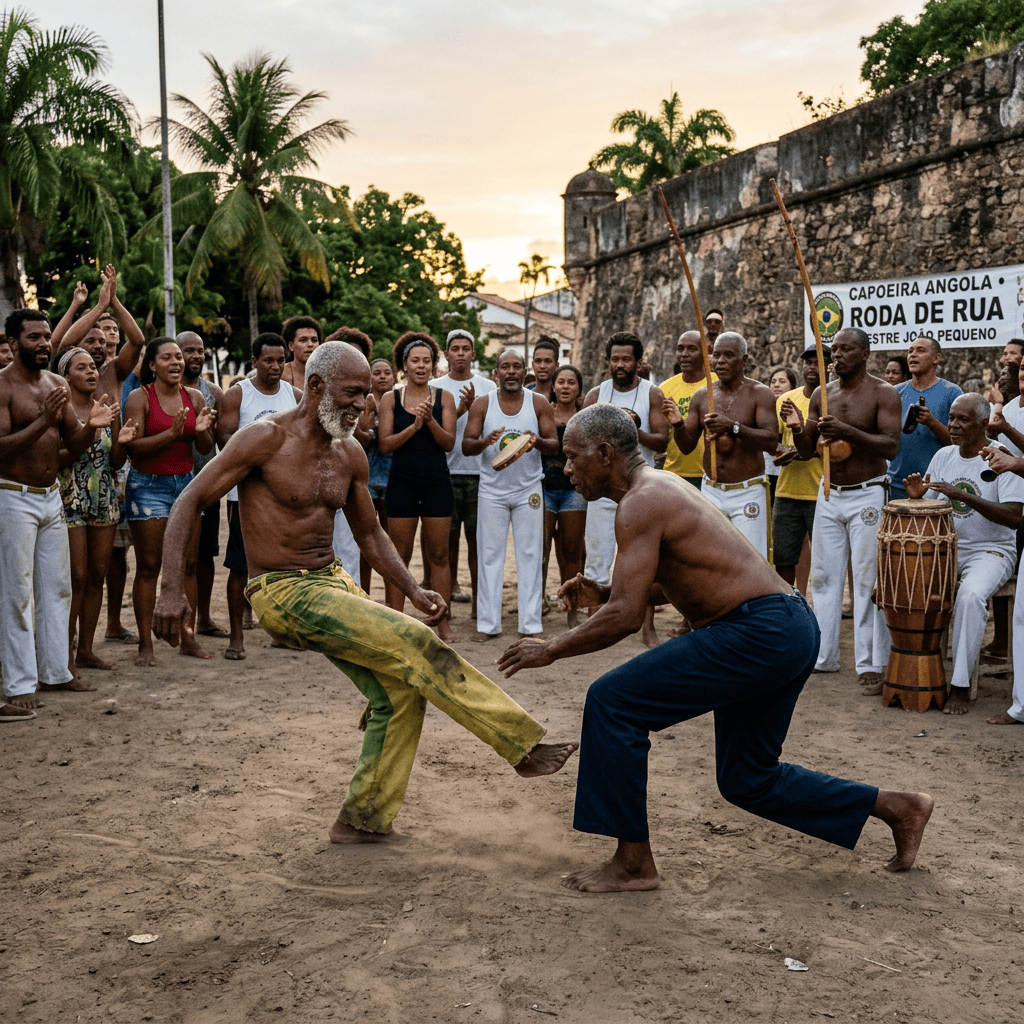
Introduction: Mestre Pastinha and the Preservation of Ancestral Lineage
During the late 19th and early 20th centuries, Capoeira faced severe existential threats. Following the abolition of slavery in Brazil in 1888, the Republican government enacted the Penal Code of 1890, which explicitly criminalized the practice of Capoeira. Practitioners (capoeiristas) faced harsh penalties, including arrest, forced labor, and exile.
To survive this era of state-sponsored repression, the art form underwent a split. While some variants modernized into a fast, aerial, sport-oriented format (Capoeira Regional), it was Vicente Ferreira Pastinha (1889–1981)—affectionately known as Mestre Pastinha—who fought to preserve the traditional, philosophical, and ritualistic essence of the art.
+—————————————+
| THE-1890 POST-ABOLITION SPLIT |
+—————————————+
|
+———————–+———————–+
| |
v v
[ Capoeira Regional ] [ Capoeira Angola ]
– Modernized & Sportified – Championed by Mestre Pastinha [2]
– Fast, aerial, upright – Traditional, ground-based, ritualistic
– Adapted for mainstream acceptance – Preserved as a system of survival & cunning
Mestre Pastinha founded the Centro Esportivo de Capoeira Angola (CECA) in 1941 in Salvador, Bahia. He formalized the name Capoeira Angola to honor the African roots of the practice. Pastinha famously declared that “Capoeira is for man, child, and woman; the only thing it doesn’t look kindly upon is those who do not want to learn.”
By institutionalizing the practice under a strict ethical code, teaching wearing the symbolic black-and-yellow uniforms of his favorite soccer team (Ypiranga), and emphasizing mental agility over raw brutality, Pastinha successfully transformed a criminalized street art into a recognized repository of Afro-Brazilian philosophy. He preserved Capoeira Angola not as a combat sport, but as an unbroken lineage of physical and psychological survival.
1. Survival in the City: Navigating Urban Conflict and Repression
In modern urban environments, Capoeira Angola provides tools for managing social tension, state surveillance, and direct conflict through strategic agility, psychological fortitude, and street smarts (mentalidade).
- De-escalation and Non-Threatening Positioning: The foundational sway of the ginga serves as a psychological disarming tool. In high-stress urban encounters, freezing or adopting an overtly aggressive posture can provoke violence. Adopting an open stance, relaxed breathing, or executing a subtle step back allows practitioners to diffuse aggressive encounters before physical escalation occurs. The goal is to project calm while maintaining a highly alert and perceptive state of consciousness.
- Malícia (Strategic Cunning): Rooted in reading body language, understanding intent, and anticipating threats, malícia (deception or guile) is the ultimate defense mechanism against urban volatility. Rather than meeting force with force, a practitioner uses misdirection. In the city, this translates to heightened situational awareness—knowing how to read a street, establish clear psychological boundaries, avoid traps, and navigate hostile environments or bureaucratic systems without relying on direct confrontation.
- Strategic Withdrawal: When engagement carries terminal risks or drains critical resources, the practitioner utilizes stealth and calculated risk assessment to withdraw safely. Every defensive dodge in Capoeira Angola, such as the esquiva (escape), is designed to protect the centerline while looking for a way out. In an urban environment, this means using architectural cover, understanding exit routes, and conserving vital energy for essential challenges rather than engaging in pointless conflicts.
- Community Networks (Pod Mapping): Drawing inspiration from the historic autonomous communities (quilombos), practitioners organize localized support structures. The roda (the physical circle in which the game is played) operates on the principle of ubuntu—”I am because we are.” In a repressive city, this philosophy translates into pod mapping: organizing mutual aid, collective defense, and self-reliance networks that function outside punitive state systems, ensuring the community’s mutual survival.
2. Survival in the Wilderness: Embodying Ecological Wisdom
Beyond urban landscapes, the physical mechanics and philosophy of Capoeira Angola closely align with natural phenomena, creating a unique relationship between movement and the environment. Training frequently takes place outdoors to foster a direct connection with the setting, whether it be in lush parks, sandy beaches, or tranquil forests. This immersion in nature not only enhances the physical experience but also deepens the spiritual aspect of practice. The natural world serves as both a backdrop and a partner, where practitioners learn to become attuned to their surroundings, gaining insights from the dynamics of wind, earth, and water. This deep alignment enables harmonious interaction with rugged terrain and natural elements, allowing for fluid movements that echo the organic rhythms of life around them. As they engage with their environment, practitioners develop greater respect for nature, fostering a philosophy that emphasizes balance, respect, and unity with all living things.
+————————+—————————————+—————————————+
| Principle | Physical Application (The Roda) | Ecological Survival (The Wilderness) |
+————————+—————————————+—————————————+
| Adaptability & Roots | Yielding to kicks, shifting weight | Navigating loose soil, high winds |
| Economy of Motion | Slower, calculated pacing | Conserving caloric energy and water |
| Low-Ground Floorwork | Negative and Rolê close to earth | Stealth, low centers of gravity |
+————————+—————————————+—————————————+
- Adaptability and Rootedness: Much like the trunk of a tree or a mangrove root system, an angoleiro maintains a low, grounded posture while remaining highly flexible. In the wilderness, rigid things snap under pressure. By yielding to external forces—such as uneven terrain, steep inclines, or heavy winds—rather than resisting them rigidly, energy is absorbed and redirected through the body without causing structural injury or loss of balance.
- Economy of Motion (Eficácia): Mirroring the efficiency of natural currents, movements in Capoeira Angola are executed with minimal expenditure of energy. In a survival scenario, premature exhaustion is lethal. The art teaches a practitioner to move fluidly, pacing themselves to match the rhythm of their surroundings. Conserving stamina prevents dehydration and fatigue, allowing a person to endure long journeys through challenging terrain.
- Low-Ground Floorwork (Jogo do Chão): Evasions such as the negativa and transitions like the rolê utilize closeness to the earth for maximum balance and stealth. In dense wilderness, standing tall makes a person visible to predators or hostile trackers and increases the risk of dangerous falls. Moving close to the floor distributes body weight evenly across multiple points of contact, allowing for safe, silent transitions across muddy, rocky, or heavily vegetated landscapes. By touching the earth directly with hands and feet, the practitioner physically and spiritually harvests the stability of the ground to maintain equilibrium under pressure.
3. The Historical Role of the Quilombos: Collective Resistance
To understand how Capoeira Angola functions as a survival mechanism, one must examine its crucible: the quilombos. These were autonomous, self-sustaining communities established by escaped African slaves, indigenous peoples, and marginalized Europeans who fled the brutal plantation economies of colonial Brazil. Far from being mere temporary hideouts, quilombos grew into sophisticated, multi-ethnic societies that stood as the ultimate geopolitical expression of resistance against Portuguese colonial tyranny.
The Strategic Geography of Defiance
Quilombos were intentionally established in the most treacherous, inaccessible regions of the Brazilian wilderness. Settlers built these maroon societies deep within dense interiors, rugged mountain ranges, and thick mangrove swamps.
This extreme geography served a dual tactical purpose:
- Natural Fortifications: The harsh terrain provided a physical buffer against colonial slave-catching expeditions (capitães-do-mato).
- Tactical Foraging and Guerilla Warfare: Living in the wilderness forced maroons to master ecological literacy. They transformed the jagged landscape into defensive traps, ambush sectors, and hidden lookout points—mirroring the low-ground, deceptive physical mechanics seen in Capoeira Angola’s jogo do chão (floor work).
Palmares: The Pinnacle of Maroon Statehood
The most legendary of these communities was the Quilombo dos Palmares, a massive confederation of several smaller settlements (mocambos) located in the present-day state of Alagoas. Active for nearly the entire 17th century, Palmares grew to an estimated population of over 20,000 residents at its peak.
Palmares was not a chaotic refugee camp; it was a highly organized state featuring:
- Complex Governance: Led by legendary figures like Ganga Zumba and later his nephew Zumbi dos Palmares, the society blended African centralized kinship structures with elective leadership.
- Diversified Economy: While colonial plantations relied monoculturalistically on sugar cane, Palmares thrived on polyculture. They cultivated maize, beans, manioc, and sweet potatoes, and developed advanced metalworking, pottery, and trade networks with nearby Portuguese villages.
- Military Innovations: Palmares successfully repelled dozens of heavily armed Portuguese and Dutch military expeditions. They utilized a combination of sophisticated trench warfare, psychological deception, and close-quarters hand-to-hand combat systems—systems heavily intertwined with the early ancestral iterations of Capoeira.
4. Operationalizing History: Connecting the Tactics of Zumbi dos Palmares to Capoeira Movements
The martial legacy of Zumbi dos Palmares is physically codified within the core movements of Capoeira Angola. As the ultimate commander of Palmares, Zumbi’s military strategy relied heavily on guerrilla tactics: ambush, structural low profiles, psychological misdirection, and rapid counter-offensives. In the roda, these battlefield strategies are distilled into specific physical kinetic responses designed for survival against a larger, more heavily armed adversary.
[ Colonial Soldier Standing ]
|
| (Expects high, linear attack)
v
[ Capoeirista drops to Negativa ] —> [ Fluid transition to Aú Queda de Rins ] —> [ Sweeping Takedown ]
- The Low-Profile Ambush (Aú Queda de Rins and Negativa): Zumbi’s warriors frequently used the dense undergrowth and rocky crags of the Serra da Barriga mountains to hide from Portuguese lines, launching surprise attacks from a crouched position. In Capoeira, the Negativa paired with Aú Queda de Rins (an inverted cartwheel resting on the kidneys) shrinks the visual profile. From this compressed position, practitioners execute low-to-the-ground acrobatics that confuse the opponent’s spatial awareness, converting a defensive dodge into an immediate low-angle entry point.
- Setting the Trap (Chamada): In guerrilla warfare, Zumbi frequently employed feigned retreats. Palmarino forces would pretend to break ranks and flee, drawing overconfident colonial units deep into the jungle where pre-set traps and ambushes awaited them. In the roda, the Chamada (the ritual call) mimics this strategy. One player raises their hands and calls the opponent forward, appearing vulnerable. If the approaching player breaks concentration or moves too aggressively, the initiator instantly spring-loads a strike or a takedown, punishing the lapse in situational awareness.
- Disarming the Oppressor (Banda and Rasteira): Colonial forces were heavily armed with muskets, bayonets, and sabers. Standing at a distance against a firearm or a blade was suicidal. Zumbi’s fighters had to close the distance safely, duck under weapon trajectories, and strip the enemy of their balance. In Capoeira, the Banda (inside foot sweep) and Rasteira (pulling floor sweep) target the structural footing of the opponent. Rather than blocking a strike from an armed attacker, the capoeirista uses an esquiva to slip beneath the line of attack, hooks their foot behind the opponent’s heel, and uses the opponent’s own forward momentum to collapse their stance.
- Total Environmental Awareness (Rolê): Surrounded by enemies on a dynamic, unpredictable battlefield, a Palmarino fighter could never afford to look away from their surroundings or expose their spine blindly. The Rolê is a low, rolling, ground-based rotation used to move across the circle. Unlike a standard spin where the back is temporarily turned, a practitioner executing a rolê keeps their head twisted between their arms, maintaining unbroken visual contact with the opponent throughout the entire rotation. It embodies Zumbi’s survival imperative: never blind yourself to the threat.
5. The Sonic Architecture of Survival: Music and Instruments
In Capoeira Angola, music commands the action. During the eras of slavery and subsequent criminalization, Africans and their descendants could not openly discuss military tactics, plot escapes, or preserve historical archives without facing execution. To survive, they codified their history, tactical commands, and psychological conditioning into a sonic landscape.
+—————————————————————–+
| THE BATERIA (THE ANGOLEIRO ORCHESTRA) |
+—————————————————————–+
|
+——————————-+——————————-+
| | |
v v v
[ The Berimbau ] [ The Pandeiro ] [ The Atabaque ]
Command & Strategy Rhythm & Alertness Heartbeat & Grounding
Controls the game’s pace Keeps the senses sharp Provides structural drive
The Instruments: Tools of Focus and Deception
- The Berimbau: A single-string bow instrument paired with a gourd resonator (cabaça), a bamboo stick (baqueta), a coin or stone (dobrão), and a wicker rattle (caxixi). The berimbau is the spiritual and tactical leader of the roda. By shifting between distinct rhythms (toques), the lead berimbau player controls the strategic nature of the environment. A Angola toque dictates a slow, deceptive, close-to-the-ground game driven by malícia. Shifting to São Bento Grande de Angola demands faster, more defensive, and combative physical engagements. Historically, specific rhythms like Cavalaria mimicked the sound of galloping horses, serving as an acoustic warning system to alert practitioners that colonial slave-catchers or police patrols were approaching.
- The Pandeiro (Tambourine) and Agogô (Iron Bell): The pandeiro provides a steady, syncopated driving rhythm that sharpens peripheral awareness. Its continuous crisp texture prevents practitioners from falling into a trance, maintaining the high-alert state required for urban or wilderness evasion. The agogô adds a high-pitched metallic clarity, cutting through ambient noise to ground the players’ internal biological rhythms to a shared tempo.
- The Atabaque (Hand Drum): The atabaque provides the low-end, resonant heartbeat of the orchestra. It connects the practitioners directly to the earth, reinforcing the angoleiro principle of rootedness. The steady bass frequencies physically regulate the nervous system, lower the heart rate under duress, and preserve physical endurance during long, exhausting confrontations.
Songs as Living Archives of Resistance
The vocal tradition of Capoeira Angola uses a call-and-response format to preserve oral histories, pass down strategic wisdom, and communicate hidden truths right in front of oppressors.
- Ladainhas (The Litany of Context): Before any movement begins, the leader sings a ladainha, a solo narrative poem. In a historical survival context, the ladainha was used to size up an environment, honor ancestors, or subtly brief the community on current political dangers. By singing about historical figures like Zumbi dos Palmares or Besouro Mangangá, the song injects historical continuity into the room, reminding practitioners that their current struggle is part of an unbroken chain of resistance.
- Chulas and Corridos (Real-Time Tactical Commands): Once the game begins, the singing transitions into chulas and corridos—short, repetitive phrases shouted by the leader and echoed by the chorus. These songs often carry double meanings (duplo sentido) to advise players on how to handle an opponent or an external threat:
- “Valha-me Deus, Senhor São Bento, buraco velho tem cobra dentro.” (Help me God, Saint Benedict, an old hole has a snake inside.) Tactical Code: This song warns a practitioner that their opponent is setting a trap, or that the path they are navigating contains hidden urban dangers. It commands the player to look for an alternative route or use a deceptive defensive escape.
- “Dona Alice não vai no mercado, que o mercado tá fechado.” (Dona Alice, don’t go to the market, because the market is closed.) Tactical Code: Originally used to signal that state authorities or hostile forces had blockaded a specific urban sector, advising the community to strategically withdraw or alter their transit route.
Through this intricate auditory architecture, Capoeira Angola operates as a living, decentralized archive of historical memory and tactical survival. By encoding strategic wisdom, physical maneuvers, and community alerts directly into song lyrics, drum rhythms, and musical tempos, the art form bypasses external censorship and state surveillance. Consequently, even if a community suffers displacement or loses its physical territory, its library of survival tactics, historical resilience, and cultural identity remains intact—safely embedded within the musical traditions and ready to be reactivated whenever the instruments begin to play.

