Why do some people never get messed with? It ain’t size, it ain’t age, it ain’t because they look though…
Some people never get messed with because they possess true presence, situational awareness, and total comfort under pressure, rather than an intimidating physical appearance. These individuals often exude a quiet confidence, allowing them to navigate various social situations with ease and grace.
Bullies and predators—whether in a schoolyard, a corporate boardroom, or on the street—subconsciously “pressure test” people through eye contact, boundary pushing, and body language. They are instinctively drawn to those they perceive as vulnerable, often testing the waters to gauge potential reactions. People who are left alone project subtle behavioral cues that signal they are not viable targets; they may maintain steady eye contact, exhibit open body language, and display an innate ability to read the room effectively. This quiet assurance not only deters negative attention but also creates an atmosphere where respect is paramount, proving that true strength often lies beneath the surface.
The primary reasons some individuals are never targeted include:
1. High Situational Awareness
They are actively engaged with their surroundings. They don’t walk around glued to a phone or lost in a daydream. Because they notice people before those people can target them, they eliminate the element of surprise. Predators look for easy, unaware targets; a person who makes calm, deliberate eye contact signals, “I see you, and I know exactly what you are doing.”
2. Radical Comfort Under Pressure
When someone tries to intimidate them, their emotional state doesn’t shift. They don’t get visibly nervous, flustered, or overly aggressive. True presence is marked by a profound calmness. Because they are entirely comfortable in their own skin, they don’t give off the “scent” of vulnerability or fear that instigators rely on to gain leverage.
3. Clear and Absolute Boundaries
People who aren’t messed with have an internal thermostat for disrespect. They don’t laugh off “jokes” that are actually thinly veiled insults, and they don’t let small boundary violations slide. They address disrespect immediately, calmly, and directly. They don’t need to yell or puff out their chest; their quiet refusal to accept bad behavior makes it too socially or physically costly for someone to push them further.
4. No Need to “Prove” Anything
Ironically, people who try to look tough or dominate a room usually communicate deep insecurity. They advertise their strength because they are desperate for respect. The people who are never messed with have absolutely nothing to prove. They don’t seek validation, they don’t try to look mean, and they don’t engage in petty ego battles. That total lack of thirst for conflict makes them incredibly unpredictable and dangerous to cross.
5. Genuine Indifference to Social Disapproval
A major tool of manipulation is the threat of social awkwardness or exclusion. People who don’t care about being judged or fitting in are immune to this. If you cannot leverage shame, awkwardness, or a desire to please against someone, you have zero power over them.
What does this have to do with Capoeira Angola?
Capoeira Angola is much more than a physical martial art; it is a dynamic, living philosophy of resistance, non-verbal dialogue, and strategic awareness. The psychological and behavioral traits that keep someone from being targeted—such as high situational awareness, calm composure under pressure, direct boundaries, and an unshakeable presence—form the core tactical foundation of the Angolan style.
1. Situational Awareness & Proximity Control
In Capoeira Angola, practitioners (capoeiristas) operate within a sacred circle known as the roda. Success inside the roda relies on continuously reading the opponent’s breathing, gaze, weight distribution, and timing to neutralize threats before an attack is launched. Much like navigating real-world conflict, a practitioner maintains acute spatial awareness and deliberate presence, denying opponents the element of surprise.
2. Radical Calmness & Malícia (Deceptive Wit)
Rather than meeting force with direct force, Capoeira Angola relies on malícia—a subtle, playful cunning and emotional composure under pressure. When an opponent tries to dominate or intimidate, the Angoleiro remains profoundly relaxed, utilizing low-ground evasions like the negativa to collapse beneath an attack and redirect aggressive momentum without getting flustered.
3. Unshakable Boundaries Through The Ginga
The foundational swaying movement, the ginga, serves as a constant state of physical and mental readiness. It allows a player to establish firm boundaries in space, transitioning seamlessly between defense, evasion, and counter-attacks like sweeps (rasteiras) or headbutts (cabeçadas) the moment a boundary is violated.
4. No Ego or Need to Prove Strength
Capoeira Angola explicitly rejects overt, aggressive displays of power. Historically developed as an anti-colonial strategy of survival and liberation by enslaved Africans, the art disguises deadly martial capability beneath slow, grounded movements, music, and dance-like play. True mastery lies in self-possession and patient control over the game’s tempo rather than a desperate need to look tough.
In conclusion, the psychological traits that prevent someone from being targeted in everyday life—high situational awareness, composure under pressure, direct boundaries, and an unshakeable presence—are not merely abstract qualities; they are the living, tactical core of Capoeira Angola. Developed in the 16th century by enslaved Africans and Indigenous groups as a means of survival, self-defense, and cultural resistance, Capoeira Angola embodies a profound philosophy where physical conflict is transcended through strategy, non-verbal dialogue, and malícia (cunning deception). Rather than relying on brute force or aggressive posturing, the practitioner utilizes grounded movements, circular momentum, and the foundational ginga sway to maintain total spatial control and fluid readiness. By mastering self-possession and aligning with universal forces rather than meeting force with force, Capoeira Angola demonstrates that true strength lies in a deep, peaceful composure and a continuous curve of non-linear presence.
Welcome to MALICIA AS A GAME OF POWER, a thought-provoking blog series that delves deep into the intricate strategies of human interactions, encompassing essential themes such as communication, conflict resolution, negotiation, and manipulation. In this series, we aim to unveil the subtle nuances that define successful interactions and the psychological principles that influence human behavior. It discusses leadership dynamics, personal branding, and the complexities of online reputation management, providing readers with practical strategies designed to enhance their influence and build authentic relationships. Through detailed analysis and real-world examples, the series seeks to empower readers to navigate the often-turbulent waters of interpersonal relationships with confidence and skill, ultimately fostering a greater understanding of the power dynamics at play in everyday encounters. Join us on this compelling journey as we explore the art of interaction and the power it wields in our personal and professional lives.
Today, We’re gonna explore Law 8 from the book, “The Laws of Human Nature” by Robert Greene. You can purchase a copy from AMAZON.COM by clicking HERE.
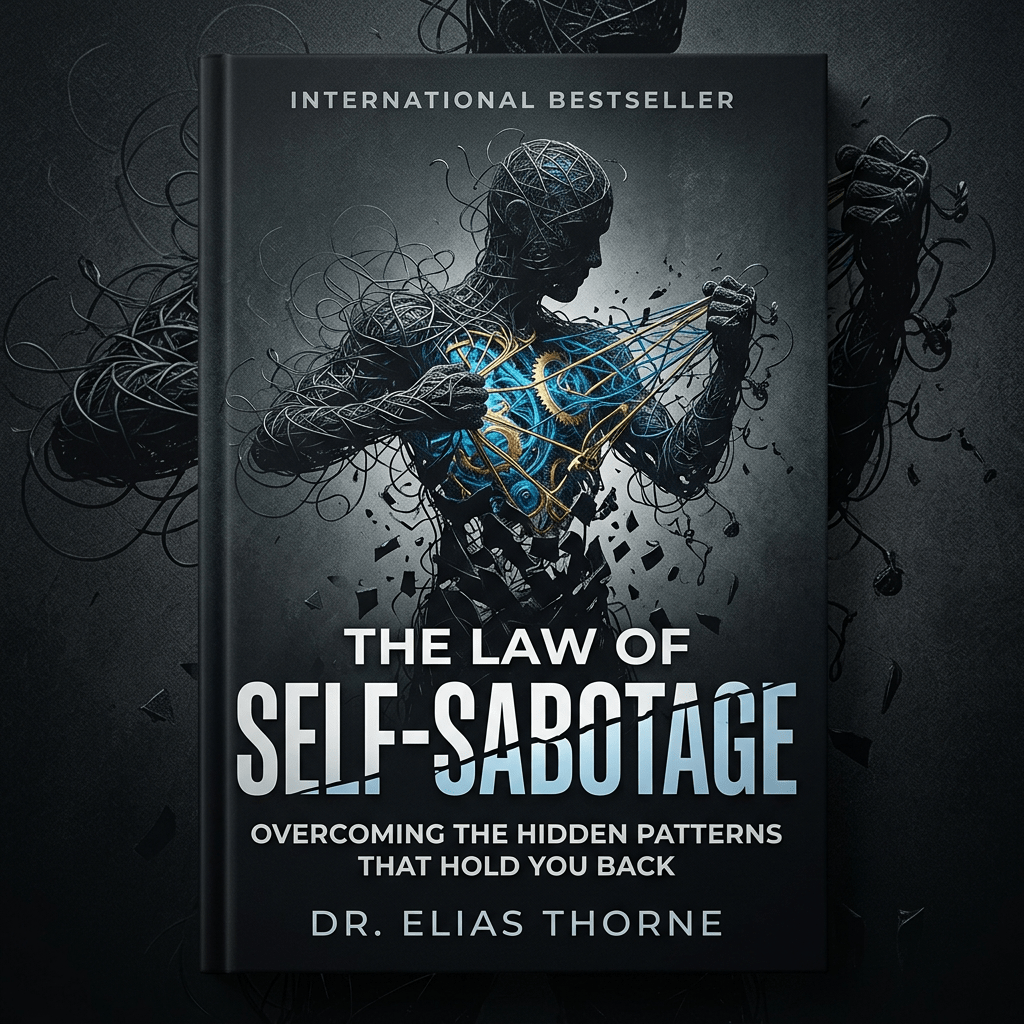
THE LAWS OF HUMAN NATURE BY ROBERT GREENE – Law #8: The Law of Self-Sabotage
The Law of Self-Sabotage suggests that our outlook on life—our attitude—acts as a self-fulfilling prophecy, often creating the very circumstances we fear or expect. This internal identity can quietly run our lives, manifesting exactly what our self-concept allows. For example, an individual who unconsciously links authenticity with suffering may sabotage their own financial success to remain “authentic” to an outdated internal rule.
The Upper Limit Block
A critical component of self-sabotage is the “Upper Limit block,” which is a ceiling installed by upbringing and culture on how much love, money, success, or joy a person is allowed to receive. These blocks are often encoded in the nervous system and subconscious before the age of ten, making them invisible to the conscious mind while they act as walls preventing breakthroughs.
Overcoming Self-Sabotage: Identity Rewiring
To move past these limitations, one must engage in a sequence of identity rewiring:
Clear: Actively release and dissolve old identities, generational money patterns, and inherited worthiness wiring.
Align: Write the new identity into the body and nervous system so the subconscious and conscious mind come into agreement.
Receive: Train the nervous system to hold the new reality as a felt state, allowing for the actualization of what has been asked for.
True wisdom involves knowing yourself and understanding the motivations behind your actions without judgment. By giving yourself permission to be human and acknowledging your intrinsic worth, you can reclaim yourself from external standards and find the connection and love you desire.
Law #8: The Law of Self-Sabotage, through the eyes of an angoleiro
An Angoleiro, a practitioner of Capoeira Angola, views the self-fulfilling prophecy of Law #8 through the lens of malícia (strategic cunning) and mandinga (the art of deception). In the roda, a player who enters with a negative or fearful attitude has already lost the “inner game,” as their body language and rhythm will telegraph their vulnerabilities to a master of intent-reading.
The Low Game and Internal Resistance
Just as the “Upper Limit block” restricts personal growth, a rigid or upright stance in Capoeira restricts mobility. The Angoleiro utilizes the jogo de baixo (low game) to stay close to the ground, which serves as a metaphor for staying emotionally grounded and neutral. By lowering one’s profile, an individual can avoid the “narcissistic injuries” or external provocations that trigger self-sabotaging reactions. True mastery in the roda is achieved when the player refuses to meet force with force, instead yielding and redirecting the opponent’s aggression—or their own internal resistance—into a fluid escape (esquiva).
Malandragem: Turning Sabotage into Strategy
While self-sabotage involves an unconscious feint against one’s own success, malandragem (cunning) is the conscious use of feints to control the environment. An Angoleiro might appear hesitant or vulnerable to draw out a predictable response from an adversary, then instantly transition into a decisive counter-move, such as a rasteira (sweep). Overcoming Law #8 requires the same level of situational awareness: observing one’s own patterns and “tells” to intercept the inception of a self-sabotaging thought before it becomes a committed action.
The Ultimate Saída: Breaking the Cycle
In both life and the roda, the most powerful move is the saída—the conscious decision to exit a destructive game. Whether it is an unproductive conflict or an outdated internal identity, the Angoleiro protects their axé (life force) by refusing to play by rules that guarantee their own downfall. By mastering the rhythm of the berimbau and the fluid ginga, the practitioner learns to move with the vectors of life, transforming every moment of danger into an opportunity for growth and domination.
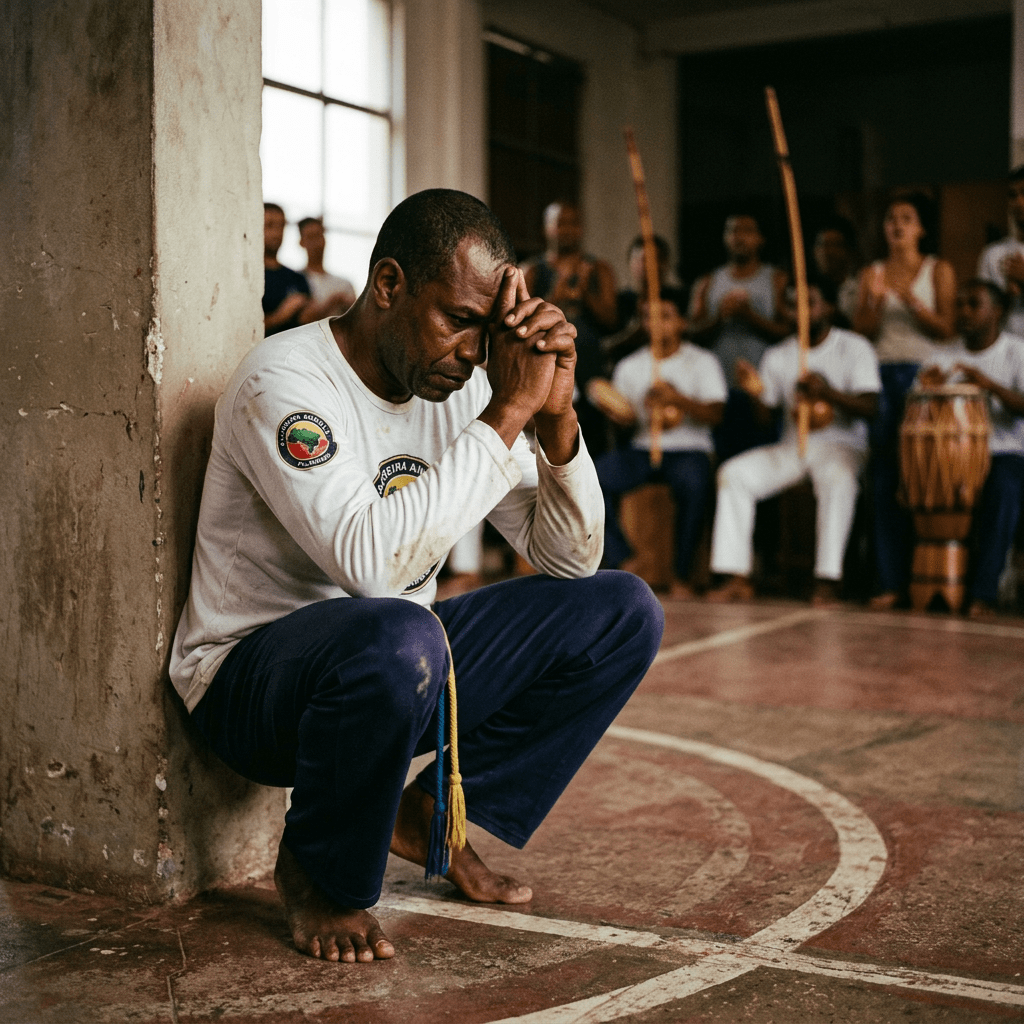
A man in a capoeira class pauses thoughtfully while others play instruments in the background
This is my second post about this subject. After watching the “Inside the manosphere” documentary, it led me to explore and post about themes of true masculinity and its place in modern society. This exploration is not about endorsing any specific ideology but rather a deep dive into the foundational qualities that contribute to a well-rounded, capable, and respected man.
To truly understand and embody positive masculinity, one must cultivate a diverse and robust set of competencies that span across several domains: physical prowess, intellectual depth, and modern practical knowledge. This approach to self-improvement is about building a man who is resilient in the face of adversity, competent in various situations, and capable of earning respect not through dominance, but through demonstrated ability and impeccable character. This guide outlines a comprehensive framework for personal development, focusing on both actionable steps for mastery and the necessary mindsets required for sustained, lifelong growth.
Skills Make the Man: A Comprehensive Competency Framework
The true measure of a man lies not in his claims or his title, but in his demonstrated skills and his unwavering willingness to use them responsibly and ethically. The following areas represent the essential competencies that form the backbone of a modern, effective, and respected man.
I. Physical and Mental Fortitude: The Platform of Resilience
A strong mind requires a strong vessel. This domain focuses on the cultivation of physical and psychological robustness—the necessary foundation for high performance and endurance in all facets of life.
Competency
Description
Mindset & Goal
Actionable Step
Strength
Functional strength is the foundation of physical competence and resilience, going far beyond mere aesthetics. This includes practical, whole-body strength required for lifting, carrying, and enduring physical hardship over time.
Goal: To be useful and durable. Mindset: Consistent challenge is the path to adaptation.
Implement a progressive resistance training program focused heavily on compound movements (squat, deadlift, press, pull-ups). Track and aim to increase weight or repetitions weekly.
Combat (Self-Defense)
Understanding self-defense is not a choice for aggression, but a necessary form of insurance. This skill provides the confidence and capability for the measured, effective protection of oneself and loved ones should the need ever arise.
Goal: Confidence through competence. Mindset: Violence is a last resort, but unpreparedness is negligence.
Study a practical, pressure-tested martial art like Brazilian Jiu-Jitsu, wrestling, or Krav Maga for at least six months. Spar regularly to simulate real-world stress.
Competition
Engaging in structured competition develops the ability to perform optimally under pressure, manage defeat gracefully with a mindset of learning, and cultivate an uncompromising strive for excellence. It is the ultimate testing ground for discipline and focus.
Goal: The pursuit of excellence, not just victory. Mindset: Defeat is information; never waste a loss.
Participate in a local competitive sport (e.g., amateur league, running race) or an intellectual league (e.g., chess club, debate society). Set a measurable goal for improvement.
Courage
Courage is not the absence of fear, but the ability to act righteously and decisively in its presence. This encompasses both physical courage (facing danger) and moral courage (the willingness to speak the difficult truth and defend one’s core values against social pressure).
Goal: Congruence between values and actions. Mindset: The right thing is often the hard thing.
Practice deliberately challenging your comfort zone weekly—this could be physical (e.g., cold exposure, high-intensity exercise) or social (e.g., initiating difficult conversations, public speaking).
II. Intellectual and Communicative Depth: Navigating the Complex World
The modern world is governed by information and relationships. A capable man must be able to understand the world, process complex ideas, and articulate his thoughts with clarity and impact.
Competency
Description
Mindset & Goal
Actionable Step
Speech (Communication)
The ability to articulate thoughts clearly, persuasively, and empathetically is crucial for leadership, negotiation, and building deep, lasting relationships. This includes mastery of public speaking, clear writing, and deep, active listening.
Goal: To transmit ideas accurately and influence positively. Mindset: Clarity is power.
Join a public speaking group like Toastmasters and practice summarizing complex technical or philosophical ideas concisely in two minutes or less.
Politics and History
A well-informed man understands the foundational forces that shape his society and the global community. Knowledge of history provides essential context, prevents repeating documented past mistakes, and allows for informed civic engagement and strategic thinking.
Goal: Contextual understanding and informed participation. Mindset: The present is a product of the past; ignorance is a vulnerability.
Dedicate time to studying primary source historical documents and analyzing current events from multiple, reputable perspectives. Develop a framework for understanding economic and geopolitical trends.
III. Practical and Creative Competence: The Pillars of the Modern Man
A comprehensive life is built not on one or two narrow strengths, but on a well-rounded set of competencies that span professional, personal, and physical domains. The following areas represent the core pillars essential for achieving genuine independence, fostering self-reliance, and contributing positively to one’s community and family.1. Industry (Vocation/Work Ethic)
A man’s capacity to contribute meaningfully to society and secure his own and his family’s welfare is paramount. This requires the continuous cultivation of valuable professional skills, a relentless work ethic, and a deep-seated commitment to lifelong learning within one’s chosen vocation. True mastery is the result of focused, deliberate practice.
Core Principle: Professional value is directly proportional to the scarcity and market demand of one’s skills.
Expansion: This pillar goes beyond merely holding a job; it encompasses the development of translatable skills such as negotiation, complex problem-solving, project management, and effective cross-functional communication. It also involves cultivating professional integrity—being known as someone who is utterly dependable, punctual, and who delivers high-quality work without exception. A strong work ethic is the discipline to execute necessary tasks with a standard of excellence, even when motivation is low.
Actionable Step:Identify the top 3-5 high-value, future-proof skills or knowledge areas in your profession (e.g., data analysis, systems architecture, advanced sales strategy, technical writing) and commit to a structured plan for mastering them within the next twelve months. Document weekly progress and seek feedback from experts.
2. Personal Finance
Financial literacy is the foundational skill for independence, security, and freedom of choice. This discipline involves not only the mechanics of money management but also the psychological maturity to live beneath one’s means and plan strategically for the long-term future.
Core Principle: True wealth is not defined by income, but by net worth and sustained financial discipline.
Expansion: Mastering personal finance involves four critical components: Budgeting (meticulously tracking spending and setting spending limits); Saving (establishing an emergency fund equivalent to 6-12 months of living expenses, fully liquid); Investing (using compounding interest to build long-term wealth, primarily through diversified, low-cost index funds or high-quality assets); and Debt Management (aggressively eliminating high-interest consumer debt, using leverage only strategically and productively). Financial independence is the state of having passive income cover one’s basic living expenses, granting true freedom of action.
Actionable Step:Create a detailed personal budget using a zero-based method. Immediately establish or refine a long-term, automated investment strategy that allocates a minimum of 15% of your gross income into diversified, tax-advantaged accounts (e.g., 401k, IRA, HSA).
3. Creativity
Creativity is the capacity for synthesis—taking existing ideas, knowledge, or materials and combining them in novel ways to solve problems, generate aesthetic value, or express complex internal states. It is a vital antidote to intellectual stagnation and a powerful tool for adaptability and innovation in a rapidly changing world.
Core Principle: Creativity is a muscle that must be consistently exercised through dedicated, focused practice.
Expansion: This does not solely refer to high art. It includes the engineer finding an elegant, efficient solution to a technical constraint, the writer structuring a persuasive argument, or the craftsman designing a functional, beautiful object. Engaging a demanding creative hobby forces the mind to work outside of its habitual, logical patterns, significantly improving lateral thinking and cognitive resilience. The act of bringing something new into the world—be it a piece of music, a refined piece of code, or a handcrafted piece of furniture—builds profound self-efficacy and ownership.
Actionable Step:Take up a demanding, hands-on creative hobby (e.g., narrative writing, functional woodworking, learning a musical instrument, coding an application) and dedicate a minimum of three structured, uninterrupted sessions per week to its practice. Focus on completing tangible projects, however small.
4. Culinary Competence (Cooking)
The ability to prepare nutritious, enjoyable, and diverse food is a foundational life skill that directly impacts health, long-term physical and mental performance, self-sufficiency, and the capacity for generous hospitality. It is a fundamental act of self-care and a powerful medium for nurturing relationships.
Core Principle: Control over one’s diet is a powerful form of control over one’s physical and mental performance.
Expansion: Culinary competence moves far beyond basic sustenance. It involves a practical understanding of nutrition, mastery of fundamental cooking techniques (e.g., knife skills, proper searing, emulsion and sauce-making, balancing flavors), and the ability to confidently host and cater to others. A man who can cook is never solely reliant on expensive takeout or pre-packaged foods. He can manage dietary needs, conserve money, and provide a welcoming, high-quality experience for friends and family. It is a practical skill that provides immediate, tangible rewards and a sense of nourishment.
Actionable Step:Master 5-10 staple, healthy, and versatile recipes (e.g., a perfect roast chicken, a flexible lentil soup, a foundational vinaigrette, a complex curry). Commit to cooking 80% of your meals at home for a designated month, prioritizing whole, unprocessed ingredients.
5. Outdoorsmanship
Competence in the natural world—encompassing basic survival skills, navigation, and environmental awareness—is a powerful generator of self-reliance, humility, and physical conditioning. It forces an individual to confront genuine challenge and adapt without the crutches of modern technology.
Core Principle: Understanding and respecting the forces of nature builds fundamental resourcefulness and character.
Expansion: Outdoorsmanship includes practical, life-saving skills such as fire-building in adverse conditions, safe and proficient use of tools (knives, axes), water purification techniques, and emergency shelter construction. Crucially, it involves the mental fortitude to remain calm, systematic, and rational under physical duress, cold, or unexpected circumstances. Learning to navigate using only a topographic map and compass is the fundamental exercise in situational awareness and trusting one’s own judgment over electronic aids. Time spent deliberately engaging with nature also acts as a necessary counterpoint to the overstimulation of the digital world, providing mental clarity.
Actionable Step:Learn to navigate proficiently using only a topographic map and a magnetic compass. Spend at least one full weekend a month away from urban environments, engaging in activities like hiking, camping, or fishing, actively practicing minimal-reliance skills.
IV. Character and Responsibility: The Moral Compass
Skills are only valuable when directed by an honorable character. This domain defines the indispensable moral and behavioral framework that underpins true manhood.Responsibility: The Cornerstone of Manhood
True masculinity is not a matter of bravado, superficial image, or dominance, but is fundamentally defined by the conscious, unwavering, and proactive acceptance of responsibility. This extends to every facet of a man’s life: his actions, both public and private; his spoken and written words, ensuring they are congruent with his intentions; his commitments, which must be treated as sacred obligations; and, most importantly, the welfare, security, and guidance of those who depend on him—whether family, subordinates, or community. A man who shirks responsibility is a man adrift, undermining his own character and forfeiting the trust of those around him.
Actionable Step:Cultivate radical ownership. Never make an excuse, deflect blame, or rationalize a failure, regardless of perceived external factors; own it completely and immediately. After accepting full responsibility, focus your entire attention on formulating and executing the solution.
Dress and Presentation: The Visual Language of Respect
Attention to one’s physical presentation is a non-verbal yet powerful form of communication. It signals respect for oneself, demonstrating discipline and self-control, and respect for others, showing that you value their time and the environment you share. Effective presentation is about being deliberate, neat, and appropriate for the specific social, professional, or cultural context—it is not an endorsement of expensive fashion trends or brand worship. The way a man presents himself acts as his calling card before he even speaks.
Actionable Step:Curate a small, versatile, and high-quality wardrobe. Focus on foundational pieces that are interchangeable, well-fitting (tailoring is essential), and appropriate for the various professional and social environments you navigate. This intentionality minimizes decision fatigue and maximizes impact.
The Intersection: How This Framework Connects to Capoeira Angola
The discipline of Capoeira Angola serves as a powerful, multi-faceted microcosm of this entire competency framework.
Capoeira Angola is not merely a dance or a fight; it is a holistic, demanding practice that inherently cultivates all three major domains:
Physical and Mental Fortitude: The demanding jogo (game) develops Strength (especially core, balance, and endurance), Combat skills (evasion, fluid movement, strategy), and Competition (performing under the pressure of the roda). It demands profound Courage—to enter the roda, to take calculated risks, and to face the unexpected movements of an opponent.
Intellectual and Communicative Depth: The roda requires sophisticated, non-verbal Speech (Communication), as the players communicate intent, respect, and challenge through movement. The knowledge required to lead the roda, play the instruments, and sing the songs is an exercise in cultural History and Tradition.
Practical and Creative Competence: Mastery of the movements requires immense Creativity and improvisation, as no two games are the same. Playing the complex rhythms on instruments like the berimbau is a hands-on, high-focus craft.
Character and Responsibility: The deep tradition and hierarchy of Capoeira Angola heavily enforce Responsibility—from showing up to practice to leading the roda correctly—and demand respect in Dress and Presentation through the uniform and manner of conduct.
Capoeira Angola, in essence, is a practical, living laboratory for forging the complete man outlined in this competency framework.
I’ll be making more posts about the subject of Masculinity and also femininity, delving deep into these fundamental aspects of the human experience. My intention is to explore these concepts not just through a superficial lens, but to examine the historical, psychological, and sociological contexts that shape our understanding of what it means to be a man or a woman in the modern world.
Future articles will dissect the current discourse surrounding traditional gender roles, the rise of conscious and healthy masculinity, and the empowering journey of self-discovery inherent in embracing conscious and healthy femininity. Expect a comprehensive framework that moves beyond stereotypes and seeks to identify the core competencies and skills that truly define a person’s character, irrespective of their gender.
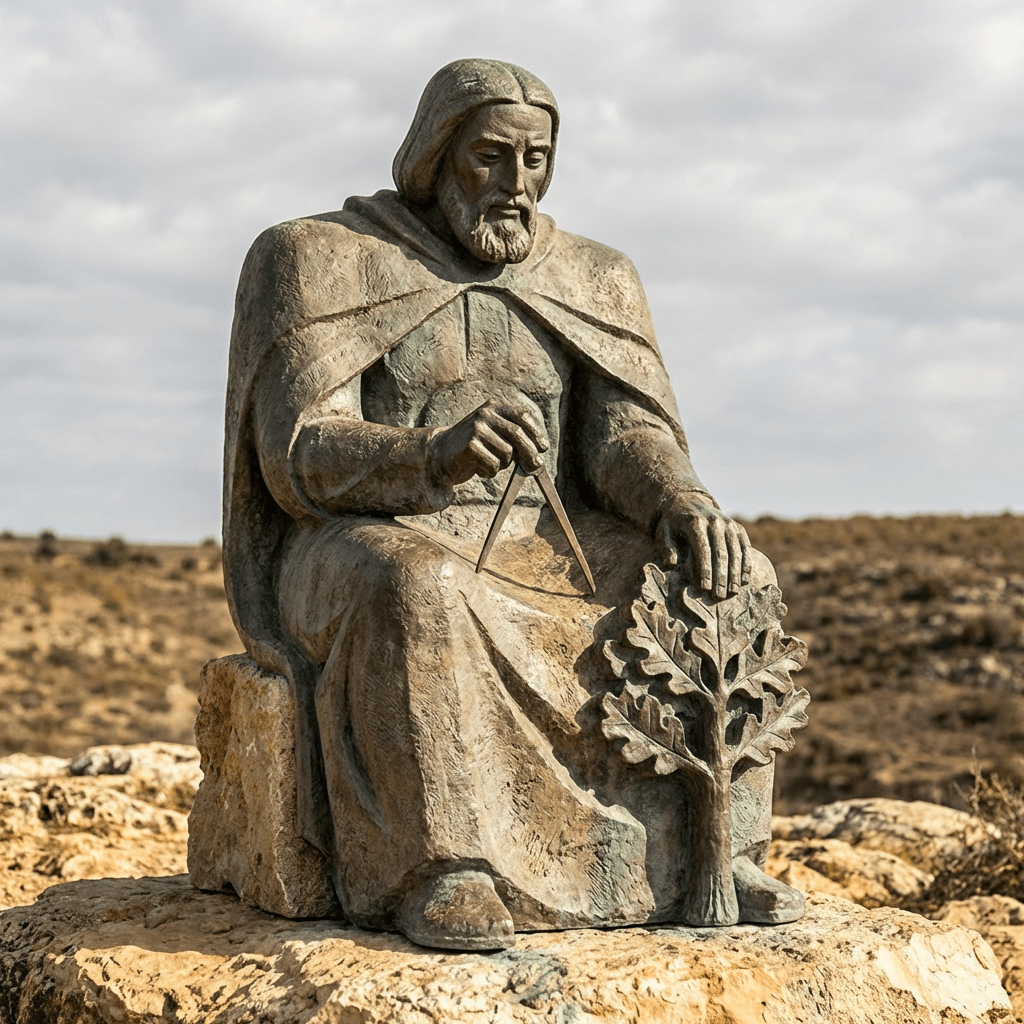
This striking sculpture titled “Harmony in Duality” by A. Chen masterfully blends industrial machinery with flowing organic forms.
The human experience is, at its core, a constant and vigorous contest—not primarily with external forces, but with the complex and often contradictory landscape of one’s own soul. This reflection on identity, responsibility, and the direction of your life acknowledges a profound and inescapable truth: there is a real battle happening—not just in the world, but within every man. This internal conflict is not a metaphor; it is the daily, high-stakes crucible in which character is forged or forfeited, determining the quality and impact of one’s entire existence.
The Three Fronts of the Internal Conflict
This internal war is a ceaseless, high-stakes confrontation waged across three primary fronts, each demanding intentionality and vigilance:
1. The Battle Between Discipline and Distraction
The first front is the struggle for consistent action. A battle between discipline and distraction. Discipline, the committed, consistent action toward a defined and worthy goal, represents the high road of self-mastery. It is the arduous, yet rewarding, choice to delay gratification in favor of long-term achievement. It is the accumulated power of small, intentional sacrifices. Distraction, whether manifested as aimless consumption of media, chronic procrastination, or the strategic avoidance of necessary discomfort, is the path of least resistance. It is the insidious erosion of potential, leading inevitably to stagnation and regret. To choose discipline is to choose the future you envision; to yield to distraction is to remain trapped in the comfort of the present moment.
2. The Battle Between Purpose and Self-Sabotage
The second front concerns the direction and momentum of your life. It is a struggle between purpose and self-sabotage. Purpose provides the essential compass, the unwavering why, and the deep-seated momentum that gives weight and meaning to daily efforts. It anchors a man to a vision greater than his immediate wants. Self-sabotage, however, is often insidious and unconscious, the tendency to actively undermine one’s own success and happiness. It operates through the voices of fear, doubt, and destructive habits, ensuring that extraordinary potential remains tragically unfulfilled. This self-inflicted wound stems from a deep-seated fear of success or an unconscious belief in one’s own unworthiness, making the internal victory over self-sabotage a prerequisite for external achievement.
3. The Defining Choice: Destiny vs. Mediocrity
Most critically, this is a spiritual and existential defining choice between who God called you to be—and who you settle to become. This spiritual dimension frames the entire conflict as one of destiny versus voluntary mediocrity. The “called” self is the integrated, fully realized individual operating in alignment with their highest values, intrinsic gifts, and divine design. It is the self capable of operating at maximum influence and integrity. The “settled” self is the version of you that capitulates to ease, fear, and the low expectations of the world, choosing the temporary comfort of the familiar over the challenging, yet rewarding, covenant of their potential. The victory here is the courageous act of choosing one’s destiny over comfort.The Foundation of Radical Responsibility
A man may not choose his starting point. The circumstances of birth, the wounds of childhood, the initial resources provided—all of these are outside the sphere of his initial control. You may not control how you started. These facts are the unchangeable historical context of your life.
However, the immense and sovereign power of human agency rests entirely in the present and the future. But you are responsible for how you finish. This statement is not an accusation; it is a clarion call to radical responsibility. It demands a profound shift in perspective, moving the focus from the factors that acted upon you (victimhood) to the choices you make now (agency). Radical responsibility demands ownership not just of one’s deliberate actions, but of one’s entire life trajectory, emotional state, and spiritual condition. It is the rejection of the external blame game and the full acceptance of the power inherent in the present moment to choose differently.
The Pathway to Transformation: Alignment and Action
The pathway out of the inner war and into a life of meaning and impact begins with a deliberate, foundational shift. Alignment with God changes everything. This is not merely a passive religious sentiment, but a structural change in the mind, spirit, and life architecture. It is the deliberate decision to anchor your life to a transcendent, unwavering standard and principle, thereby gaining irrefutable clarity on what is truly important, eternal, and worth dedicating your life to. This higher standard provides the blueprint for the “called” self.
This alignment initiates the transformative process, which requires continuous, disciplined effort and commitment:
When you renew your mind: This is the internal revolution, the intellectual and spiritual dismantling of the settled self. It means actively identifying and replacing old, limiting beliefs, negative self-talk, and patterns of scarcity with empowering truth. It is the daily practice of replacing the worldview shaped by fear, trauma, and culture with the truth revealed through spiritual principle and clear vision. This mental overhaul is the first battleground.
Develop discipline: Discipline is the bridge between a high-minded intention and a grounded reality. It is the practiced ability to consistently do what must be done when it needs to be done, regardless of fleeting mood or inclination. It is the accumulation of small, consistent acts of fidelity to one’s defined purpose, which builds an unshakeable foundation of reliability and self-trust.
And commit to growth: This is the lifelong posture of the learner, the rejection of finality, and the courageous embrace of challenge. It means actively seeking out opportunities for intellectual, emotional, and spiritual expansion. To commit to growth is to accept that you are an ongoing project, always becoming, never fully arrived, and always capable of more.
How does this apply to an Angoleiro, a practitioner of Capoeira Angola, whose very art is a profound study in the tension between internal discipline and external expression, between self-mastery and dynamic interaction?
The principles of “Radical Responsibility” demand that the Angoleiro acknowledge that the roda is a mirror of their internal state. Every movement, every chapa, every evasive coccix is not merely a physical technique, but a manifestation of their commitment, their focus, and their emotional control. If an Angoleiro enters the roda carrying fear, anger, or distraction, those internal states will manifest as clumsy footwork, predictable attacks, or a failure to read their opponent (the jogador). The internal war is fought and won not just in hours of solo training, but in the moment-to-moment decisions within the game.
Radical Responsibility means the Angoleiro takes full ownership of the quality of the game. If the music falters, it is their responsibility to sing louder. If the energy drops, it is their responsibility to invite greater connection and challenge through their movement. They do not blame their partner for a poor game, nor the mestre for a difficult challenge, nor their own lack of sleep for a slow response. Instead, they recognize that their level of presence is the only factor they can truly control. This responsibility extends beyond the technical execution of the jogo. It encompasses the cultural and historical weight of the art. An Angoleiro is responsible for upholding the integrity, respect (axé), and philosophical depth of Capoeira Angola, ensuring that their practice is a living testament to the resilience and wisdom of its Afro-Brazilian origins. In essence, for the Angoleiro, radical responsibility is the commitment to being a vessel for axé—the vital life force and energy of the art. They understand that to truly play Capoeira Angola is to engage in a continuous, conscious practice of bringing their highest self, their most disciplined mind, and their most generous spirit into the circle.
The Consequence: A Higher Level of Living
The inevitable consequence of this transformation is a fundamental elevation of one’s existence—you step into a higher level of living. This elevated life is not defined by material wealth or societal acclaim, but by intrinsic value, integrity, and profound impact. It is characterized by three markers:
A life of purpose: Every action is infused with meaning, contributing to something greater than self-gratification. The man knows his why and organizes his what around it.
A life of responsibility: The man accepts his essential role as a steward of his gifts, his relationships, and his entire sphere of influence. He becomes reliable, dependable, and a bedrock of strength for his family, community, and those he leads.
A life that produces: The focus shifts decisively from passive consumption to active creation. This life generates tangible value—whether through mentorship, art, entrepreneurship, service, or dedicated family stewardship—leaving a positive and enduring legacy that outlasts the man himself.
This is discipleship. It is the comprehensive, holistic process of self-mastery under a higher standard, culminating in a life that is intentional, fruitful, and fundamentally aligned with the design of its Creator. It is the courageous act of winning the inner war and becoming the man you were always meant to be.
A heartfelt SHOUT OUT is extended to Byron Rodgers for the creation and generous sharing of this insightful video content.
For those seeking more of this valuable material, we encourage you to subscribe to the MAN OF PEACE podcast on YouTube.
Is walking away actually quitting, or is the act of leaving sometimes a profound display of inner fortitude?
We often associate ‘walking away’ with defeat, a failure of endurance, or the easy path. The narrative of persistence—of staying and fighting, of never giving up—is deeply ingrained in our cultural psyche. But this perspective overlooks the critical distinction between reckless abandonment and a deliberate, self-preserving retreat. To ‘quit’ implies a giving up on something worthwhile—a goal, a relationship, a challenge—out of fear or lack of will.
However, there comes a point in certain struggles—be they professional, personal, or emotional—where the cost of staying far outweighs any potential benefit. This is the moment when leaving demands more courage, more self-awareness, and more strength than simply continuing to endure the familiar pain.
Or is there a point where leaving takes more strength than staying?
Staying can often become the default, the comfortable rut of inertia, even if that inertia is destructive. It can be easier to tolerate the known misery—the toxic environment, the stagnant relationship, the soul-crushing job—than to face the terror and uncertainty of the unknown future. Staying requires a kind of passive tolerance.
Leaving, on the other hand, is an active decision. It requires a brutal reckoning with reality, an acknowledgment that one’s own well-being is non-negotiable. It demands the strength to:
Acknowledge Failure: To accept that a given path, despite best efforts, has reached a dead end.
Embrace Uncertainty: To step into a void without a guaranteed safety net.
Overcome External Judgment: To face the inevitable questions and criticisms from those who mistake self-respect for weakness.
Break Momentum: To shatter the comfortable routine and rebuild from the ground up.
When staying means sacrificing one’s mental health, core values, or sense of self, the ‘walk away’ is not a surrender; it is a declaration of self-respect. It is not quitting the effort; it is quitting the path that demanded too high a price. In these instances, the true measure of strength is not how long one can suffer, but the clarity of mind required to choose life, peace, and a fresh start.
The rapid evolution of modern society is not without its hidden costs, chief among them being the insidious proliferation of toxic behavior, often manifesting in ways that escape immediate public notice. This in-depth video exploration is dedicated to uncovering and illuminating the deeply rooted cultural, psychological, and emotional tectonic shifts that are silently yet powerfully driving the creation of more toxic individuals than at any other point in recent history.
The increasing pace of digital connectivity, coupled with shifting social norms, has inadvertently cultivated environments where self-absorption, chronic comparison, and a lack of authentic empathy thrive. Psychologically, a culture of instant gratification and performance pressure has led to heightened levels of narcissism and emotional fragility, where a person’s value is often tied to external validation—a fertile ground for toxic defense mechanisms. Emotionally, the breakdown of strong community bonds and the rise of isolation have diminished natural opportunities for developing conflict resolution skills and genuine compassion.
By meticulously breaking down the “why” behind this concerning trend, viewers will gain invaluable intellectual and emotional armor. The core purpose of this elaboration is to empower you to:
Protect Your Energy: Learn to identify the subtle energy-draining tactics employed by toxic individuals—be they manipulative colleagues, emotionally volatile family members, or demanding partners—and establish robust, non-negotiable personal boundaries to preserve your vital resources.
Strengthen Your Awareness: Develop a sophisticated radar for recognizing the early warning signs of toxicity in relationships and interactions, moving beyond surface-level charm to spot underlying patterns of control, gaslighting, or victimhood.
Reclaiming Your Peace: Strategies to Break Free from Toxic Relationships
Stop Letting the Wrong People Drain Your Life. The energy you invest in high-toxicity individuals is a non-renewable resource that, when squandered, costs you your well-being, focus, and potential for growth. This critical shift begins with an unflinching recognition of the drain—identifying the people, dynamics, and repetitive patterns that leave you feeling depleted, anxious, or diminished.
Acquire actionable, evidence-based strategies to disengage from destructive cycles. Breaking free from toxic entanglement requires more than just good intentions; it demands a structured, step-by-step approach rooted in psychological awareness.
Establish Firm Boundaries (The Cornerstone of Self-Respect): This is the immediate and most potent line of defense. Learn to articulate your needs clearly, calmly, and without apology. This includes setting limits on communication frequency, conversation topics, and the level of personal access you permit. For individuals who consistently violate these boundaries, the principle of “low-contact” or “no-contact” becomes paramount.
Minimize Contact with High-Toxicity Individuals: This is the practical execution of your boundaries. High-toxicity people often thrive on drama, conflict, or constant neediness. Your goal is to systematically reduce their opportunities to engage with you. This might involve changing communication channels, avoiding specific social settings, or simply keeping interactions brief and strictly focused on neutral subjects. Recognize that some relationships require a complete, deliberate “cut-off” (no-contact) to preserve your mental health.
Practice Emotional Detachment: Learn to manage your emotional response to their predictable behaviors. Toxic individuals often seek to elicit strong reactions—anger, guilt, or fear—to maintain control. By practicing detachment, you refuse to take the bait. See their behavior not as a personal attack, but as a reflection of their own internal struggles, making it easier to remain objective and emotionally uninvolved.
Consciously curate a supportive, positive circle that uplifts and empowers your journey. The space vacated by toxic relationships must be intentionally filled with sources of authentic strength and validation. This is the proactive phase of reclaiming your agency.
Identify and Nurture Authentic Connections: Seek out people who demonstrate empathy, celebrate your successes, offer constructive support during challenges, and respect your boundaries without question. These are individuals who add energy to your life, not subtract it.
Prioritize Reciprocity: Your supportive circle should be characterized by a two-way street of mutual respect and give-and-take. Avoid relationships where you are consistently the sole provider of emotional support, resources, or effort.
Engage in Positive Environments: Actively seek out groups, clubs, or professional settings aligned with your values and goals. Surrounding yourself with people who are also focused on growth and self-improvement accelerates your own progress.
This shift in perspective and action is not just about defense, but about proactively reclaiming your peace, well-being, and personal agency. Moving beyond toxicity is an act of self-love and self-preservation. By systematically applying these strategies, you are consciously optimizing your life for harmony, fulfillment, and emotional resilience. You transition from being a passive recipient of emotional drain to becoming the active architect of a life governed by your own priorities and fueled by positive, healthy relationships..
Dealing with difficult or draining personalities is an unfortunately common aspect of modern life. If you’re interested in exploring practical and philosophical methods for navigating these challenging relationships, particularly by adopting the unique perspective and wisdom of an Angoleiro—a practitioner of the Angolan style of Capoeira—then a more detailed resource awaits you.
An Angoleiro‘s training is not just physical; it is deeply rooted in patience, observation, adaptability (malícia), and resilience, all of which are highly effective tools when confronting interpersonal toxicity. By applying principles learned from this ancient art—such as maintaining composure under pressure, using the opponent’s energy against them, and understanding the rhythm of a confrontation—you can develop a powerful, non-violent emotional and psychological defense mechanism. To dive into these specific strategies, which translate the fluid, defensive movements and mental discipline of Capoeira Angola into real-world advice for emotional self-preservation and boundary-setting with challenging people, please click HERE.
The WARRIOR CLASS podcast is your essential, unique resource for mastering self-protection and self-defense. Designed to equip every listener—regardless of background, experience level, or physical ability—with the vital skills and profound knowledge necessary for personal safety and empowerment, we go beyond simple techniques.
We believe that true self-defense begins with a “Warrior Mindset,” focusing on situational awareness, threat recognition, de-escalation tactics, and the legal and ethical considerations of using force. Our episodes feature in-depth interviews with world-class experts: tactical trainers, martial arts masters, security professionals, and legal analysts.
Tune in to explore practical strategies for:
Physical Self-Defense: Practical, high-percentage techniques for escaping grabs, defending against common assaults, and utilizing everyday objects for protection.
Situational Awareness: Developing the mindset to identify and avoid danger before it escalates.
Home Security and Personal Safety Technology: Reviews and best practices for securing your environment and leveraging modern tools.
Psychology of Conflict: Understanding fear, managing adrenaline, and maintaining control under pressure.
Join the WARRIOR CLASS community today and take charge of your personal safety journey. Your empowerment starts now!
This week…
This episode: Beyond the Veil of Visibility: Examining the Depth of Black Imagery in Media
It is an undeniable truth that Black actors today enjoy a greater quantitative presence in films and television shows than in decades past. However, this sheer increase in visibility should not be mistaken for meaningful or authentic representation. The true measure of progress lies not in the volume of appearances, but in the quality and complexity of the roles being offered.
When the characters written for Black talent are disproportionately confined to narrow, often harmful archetypes—such as criminals, servants, comedic relief, sidekicks, the emotionally detached “magical negro,” or characters whose narratives are solely defined by trauma—then representation has not genuinely progressed. It has merely diversified in the most superficial of ways, creating a false sense of inclusion.
These limiting roles frequently serve to reinforce damaging, long-standing cultural narratives, regardless of the exceptional skill and artistry of the actors embodying them. This perpetuation of tropes, even in contemporary media, normalizes a restricted and distorted view of Black humanity.
The problem extends beyond the screen and into the realm of printed media, including books, magazines, and comic books. While some Black tropes may have had historical or contextual roots, their continuous and uncritical deployment becomes fundamentally harmful. They operate by flattening the experiences of millions of people into one or two simplistic, overused personality types. This practice effectively erases the vast cultural, regional, class, and personal diversity that exists within the global Black community.
Ultimately, mere visibility is not enough. Representation that lacks authenticity, depth, and complexity is, in effect, a form of misrepresentation. It fails to honor the rich tapestry of Black life and instead promotes an easily digestible, often prejudiced caricature.
In this essential episode of Warrior Class, the Instructors will lead a rigorous and timely exploration and discussion of Black imagery, examining its evolution, impact, and authenticity across various media, including books, television, and film.
I wanted to follow up on a PREVIOUS POST with some exciting news regarding one of our own. A close friend and fellow Capoeirista is preparing for an incredible journey: she will soon be traveling with a friend to Palestine to dedicate her time and energy to helping uplift lives in the region.
Out of respect for her privacy and since I’m not entirely sure if she is comfortable with me using her real name on this public blog, I’ve decided to give her a nickname for the purpose of this story. I’m going to call her RUBY.
I chose this name for a very specific reason: she truly IS a Ruby. She is a rare gem amongst us—a person whose light shines with an uncommon brilliance and dedication. She is choosing to use a significant part of her life journey to embark on this challenging and noble mission. Her motivation is simple yet profound: to help make the world a better, more equitable, and more compassionate place.
This selflessness places her among the countless humanitarians, activists, and aid workers who have come before her, dedicating themselves to service in difficult environments. We send her off with our deepest respect and admiration, knowing that she is contributing to a legacy of hope and assistance. And, god willing, her example will inspire many more after her to follow in the footsteps of service and global citizenship. We will be following her journey closely and sharing updates as she is able to provide them. Please keep Ruby in your thoughts as she prepares for this meaningful work.
Dear Ruby,
I’m writing to you today, as you embark on this journey to Israel and Palestine, with a heart full of mixed emotions that I know are shared by everyone who cares about you. I can truly speak for all of us when I say that a deep and pervasive sense of worry accompanies your departure, primarily because of the well-documented volatility and ongoing conflict in that region. We are acutely aware of the historical and current tension that makes that part of the world an exceptionally dangerous area.
Indeed, it’s a place steeped in so much history and prophecy, even near the Valley of Megiddo, which features so prominently in ancient texts as the predicted site of Armageddon. The awareness of the continuous cycle of conflict there weighs heavily on all of our minds. This isn’t just a concern for an abstract conflict; it’s a deep fear for your personal safety, knowing that even areas considered “safe” can quickly become unpredictable in a region with such deeply rooted geopolitical instability. We follow the news closely, and every report serves as a fresh reminder of the complexity and risk you are willingly stepping into.
However, mixed with this apprehension is an enormous sense of pride and admiration for your courage. Your decision to go, despite the risks, speaks volumes about your commitment to understanding the world and your dedication to the principles you hold dear—principles, I know, that drive you to seek out truth and connection in even the most challenging environments.
We know you are not going lightly or without preparation. The Angoleira in you—the warrior, the seeker, the one who moves with grace and intention through the world—gives us some comfort. Yet, please, let that same spirit guide you to be vigilant, to be cautious, and to prioritize your well-being above all else. Remember that your personal safety is paramount. Keep us updated, check in often, and know that our thoughts are constantly with you as you navigate this powerful, volatile, and profoundly significant part of the world. We wish you an experience that is as safe as it is meaningful.
However, amidst this concern, there is also an immense and undeniable pride that swells within me—a feeling that completely eclipses any passing apprehension. I am genuinely, profoundly happy and immensely supportive to see you embark on this next chapter of your journey, not just because it represents a major life step, but because I know, intimately and without a shadow of a doubt, the kind of person you are.
I have witnessed, firsthand, the strength of the spirit you carry—a resilience that has overcome every obstacle placed in your path and a fierce determination that never allows you to settle for less than your best. It is this unwavering conviction that guides your steps, ensuring that you approach every challenge with integrity, empathy, and a clear sense of purpose.
Because of all this, I have absolute, unshakable faith that you possess everything needed to not only navigate the challenging and complex environment you are heading into but also to thrive within it. More than just surviving, I believe you will contribute profoundly, making a significant, positive, and lasting impact on everyone you meet and everything you touch. You have a unique ability to see the good, foster collaboration, and tackle essential work with a dedication that is truly inspiring, and I know you will achieve so many essential good things while you are there. This journey is a testament to your character, and I am already looking forward to hearing about the incredible successes you will undoubtedly achieve..
This deep confidence comes from knowing the authentic you, Ruby—from knowing you as a Capoeirista, an Angoleira, and a warrior. These are not merely casual titles to be worn lightly; they are a deep and undeniable reflection of your inherent discipline, your fierce resilience, your deep-seated commitment to justice, and your unyielding dedication to community. The philosophy, the strength, and the unique wisdom you have cultivated through years of intense practice and deep study within Capoeira Angola are not external skills; they are now intrinsic, foundational parts of your character.
They have forged an inner compass that points true north, regardless of the surrounding chaos. Wherever you may go—to any corner of the world, and especially to a place where true strength of character, moral clarity, and personal fortitude are paramount—you take that powerful, uplifting, and protective energy with you. It is a presence that will serve as both your shield and your light, ensuring that you remain grounded, focused, and effective in your mission. Your training has prepared you not just for the roda, but for the world. Go forth and shine your light brightly.
Your presence there is a beacon, fueled by a deeply personal and profound desire to make a tangible difference in the lives of others. This commitment, this willingness to step into a challenging environment, will undoubtedly make you a continuous source of light, hope, and steady reassurance for those you encounter. You are embarking on a truly meaningful journey.
Embrace this entire experience—the challenges, the triumphs, and the quiet moments of connection. Let it shape you and enrich your understanding of the world. Commit yourself fully, heart and soul, to the core mission of uplifting lives, one interaction at a time. Work diligently to bring a measurable degree of peace and positivity wherever your path leads you, whether through direct action, compassionate listening, or simply by maintaining a calm and encouraging demeanor. Never underestimate the impact of sharing the unique perspective, profound empathy, and defining compassion that you carry within you. These qualities are your greatest assets and will leave an indelible mark on the community you serve.
May the both of you have a truly wonderful and deeply impactful time during your journey to Palestine. Please know that we are all immensely proud of the work you are undertaking and the commitment you are showing. Go forth and do the good work that I know you are destined to do, bringing your unique compassion and powerful energy to those you meet and the causes you serve.
As you dedicate your whole heart and considerable energy to this important and vital endeavor, please carry with you the knowledge of our support, our admiration, and our most heartfelt wish for your eventual, safe return. We know you will encounter profound challenges and moments of deep inspiration. Embrace these experiences; let them shape and guide you. Come back to us stronger in spirit, enriched by the invaluable understanding and empathy you will have gained, and better for the profound experiences you will have had in contributing to such meaningful work.
And, most importantly of all, we pray that you return safe and sound. Your well-being is our greatest concern, overshadowing all other worries. Every day that you are away, we send our hopes and positive energy across the miles, wishing you protection and peace. Take the utmost care of yourself, be mindful and acutely aware of your surroundings at all times, and know that you are a constant, cherished presence in our thoughts and prayers. This absence, while a necessary part of your journey, feels like a long, quiet pause in our lives.
We will be meticulously counting the days, marking the weeks off the calendar with a dedicated attention, and anticipating the glorious moment until we can finally welcome you home. That day will be a true celebration—we long to hear every detail of your stories, share in your experiences, and celebrate all that you have accomplished during this time. Your return will complete our circle. Until then, travel well, our dear sister Angoleira, and know that a warm, loving home awaits you.
Welcome to MALICIA AS A GAME OF POWER, a blog series that delves into human interactions through communication, conflict resolution, and negotiation. It offers strategies for leadership, personal branding, and reputation management, equipping readers with tools for personal and professional growth while focusing on social influence and emotional intelligence.
In this installment, we will explore the 43rd law of power in the book, the 48 laws of power by Robert Greene. You can buy a copy by clicking HERE.
LAW 43 WORK ON THE HEARTS & MINDS OF OTHERS
The true seat of power lies not merely in physical force or overt authority, but in the subtle art of influencing the internal landscape—the hearts and minds—of those around you. This law dictates that the most enduring form of control is that which is willingly, even enthusiastically, surrendered by the subject. Instead of issuing commands or relying solely on the threat of punishment, the master of this law works to cultivate goodwill, dependency, and a deep-seated belief in their superiority and vision.
The Strategy of Infiltration:
To “work on the hearts and minds” is to bypass the rational defenses and appeal directly to the emotional and psychological needs of people. This involves several key maneuvers:
Emotional Connection and Sympathy: The astute operator first seeks to establish a connection, often by feigning commonality, expressing empathy, or appearing vulnerable. People are far more willing to follow a leader they like or pity than one they merely fear. By addressing their anxieties or articulating their unspoken desires, you win their emotional allegiance, making them receptive to your influence.
Cultivating Dependency and Gratitude: Ensure that your generosity or aid is timely and appears indispensable. By making others feel indebted to you—by providing them with things they cannot easily obtain elsewhere, whether resources, protection, or vital information—you weave a powerful psychological chain of obligation. This gratitude becomes a lever you can use far more effectively than any direct command.
The Art of Ideological Capture: True power comes from capturing the imagination. Craft a compelling narrative, an ideology, or a vision that transcends the mundane. Present your aims not as personal ambitions, but as a noble cause that aligns with their highest ideals. When people believe they are fighting for a greater principle, their zeal and commitment multiply, and they will work tirelessly on your behalf, effectively becoming self-governing agents of your will.
Psychological Disarmament: By controlling the flow of information, shaping the environment, and employing small, strategic victories, you gradually wear down the independent judgment of others. When people are constantly receiving signals that confirm your strength and their reliance on you, their internal resistance falters. They stop questioning your motives and begin to internalize your worldview.
This Law serves as a profound caution against the indiscriminate and heavy-handed application of power. A purely coercive approach, relying on brute force or overt domination, is inherently counterproductive. While force may achieve momentary compliance, its lasting legacy is one of deep-seated resentment and an unquenchable desire for vengeance, inevitably sowing the seeds of future insubordination and revolt.
The true master of power understands that the battle for control is best fought not in the physical arena, but in the psychological one. The ultimate objective is not merely to subdue the body, but to conquer the mind. A person whose mental landscape you have skillfully influenced and ultimately won over transforms from a potential threat into an enthusiastic, willing, and loyal servant. Such an individual will become a steadfast defender of your authority, often more fiercely than you would defend yourself, internalizing your will to the point of policing their own thoughts and actions.
The goal is to cultivate an environment where people genuinely desire to follow your lead, to embrace your vision as their own. When this psychological mastery is achieved, the need for overt, external coercion—the setting of rules, the threat of punishment, the display of raw force—becomes obsolete. This is the pinnacle of authority: a power that is absolute in its reach yet practically invisible in its operation, making your command appear to be a natural, self-willed act on the part of the subordinate. This subtle, internalized authority is the most enduring and impregnable form of control.
How to Use the 43rd Law of Power Ethically: “Work on the Hearts and Minds of Others”
The 43rd Law of Power, as articulated in Robert Greene’s The 48 Laws of Power, states: “Work on the Hearts and Minds of Others.” At its core, this law is about strategic persuasion, influence, and winning over people’s goodwill, not just through logic or coercion, but by appealing to their emotions, desires, and self-interest. Used unethically, it can be a tool for manipulation and deceit. However, when applied with integrity and a focus on mutual benefit, it becomes a powerful instrument for positive leadership, collaboration, and lasting influence.I. Understanding the Ethical Imperative
The ethical use of this law hinges on a shift in motivation:
Unethical Use: The goal is purely self-serving, aimed at controlling others for personal gain without regard for their well-being. It relies on exploiting vulnerabilities, faking empathy, and breaking trust.
Ethical Use: The goal is to build genuine, sustainable influence that leads to shared success, stronger relationships, and positive organizational or communal outcomes. It relies on authentic connection, transparency, and aligning one’s goals with the genuine needs of others.
II. Ethical Application Strategies
To ethically “work on the hearts and minds of others,” focus on the following principles:1. Prioritize Authentic Empathy and Connection
Instead of feigning interest to find a weakness, genuinely seek to understand the other person’s perspective, motivations, and needs.
Identify Shared Values: Find the common ground between your objective and the other person’s goals. Influence is easiest when you are helping them move toward something they already want.
Active Listening: Don’t just wait for your turn to speak. Listen to understand their fears, hopes, and concerns. Acknowledging these concerns builds trust and shows respect.
Show Genuine Appreciation: Acknowledge their contributions and value them openly. People are more willing to follow a leader who makes them feel seen and essential.
2. Frame Influence Around Mutual Benefit (Win-Win)
Ethical influence is not about taking; it’s about proposing a value exchange that benefits everyone involved.
Communicate the “Why”: Clearly articulate how your vision or proposal serves their interests. Don’t just tell them what to do; explain why it is beneficial for them, the team, or the organization.
Offer Real Value: Ensure that your request or initiative provides a tangible benefit, whether it’s career growth, recognition, improved conditions, or a sense of purpose.
Transparency in Intent: Be open about your ultimate goal. Hiding your true intentions—the essence of manipulation—destroys the trust that ethical influence is built upon.
3. Build Influence Through Deeds, Not Just Words
Long-term ethical influence is sustained by a consistent track record of integrity and competence.
Demonstrate Reliability: Consistently follow through on your commitments. Reliability is the bedrock of credibility, which is essential for winning hearts and minds.
Lead by Example: People are influenced by actions more than rhetoric. Uphold the standards and values you expect from others.
Invest in Their Growth: Help others develop their skills and advance their careers. A leader who invests in the success of their team earns deep loyalty and a powerful sphere of influence.
4. Respect Individual Autonomy
The key ethical distinction is ensuring that the other person feels they are making a free choice, not being coerced or tricked.
Provide Options: Where possible, offer choices rather than mandates. This maintains a sense of control and collaboration.
Welcome Dissent: Create an environment where people feel safe to voice disagreement. True alignment comes from debating and resolving differences, not suppressing them.
Avoid Exploiting Weaknesses: While the unethical application seeks vulnerabilities, the ethical approach recognizes and respects boundaries. Never use personal information to threaten or coerce.
III. Practical Ethical Scenarios
Unethical Application (Manipulation)
Ethical Application (Influence)
Strategy: Flattering a subordinate excessively to get them to do unpleasant work without proper credit.
Strategy: Highlighting a subordinate’s unique skills and giving them a challenging assignment with high visibility and appropriate recognition.
Strategy: Creating a false sense of crisis or urgency to bypass proper due diligence and force a quick decision.
Strategy: Clearly and honestly presenting the risks and opportunities associated with a decision, inviting constructive input from all stakeholders.
Strategy: Promising rewards you know you cannot deliver just to secure temporary compliance.
Strategy: Setting realistic expectations and consistently celebrating small wins and delivering promised incentives.
By committing to genuine connection, mutual benefit, transparency, and respect for autonomy, one can leverage the powerful 43rd Law not as a dark art of control, but as a bright tool for leadership and collective achievement. The ethical path ensures that the influence gained is sturdy, sustainable, and generates goodwill, rather than resentment.
An Angoleiro’s Perspective on Influence and Strategy
The core of Law 43—the principle of influencing the thoughts and emotions of those around you—takes on a unique and profound meaning when viewed through the lens of an Angoleiro, a practitioner of Capoeira Angola. Capoeira, at its heart, is a sophisticated interplay of physical movement, music, tradition, and psychological strategy. The Angoleiro, rooted in the foundational and often more deceptive style of Capoeira Angola, understands that true mastery lies not merely in physical dominance, but in the subtle art of persuasion and control over the minds and hearts of the opponent and the roda (the circle of participants).
Working on the Heart (The Emotional and Spiritual Connection):
For the Angoleiro, working on the heart involves cultivating a deep emotional and spiritual connection with the people in the roda, including their opponent. This is achieved through:
The Power of the Axé:Axé is the vital energy, the spiritual force, or the aura of positive intention that permeates a Capoeira roda. The Angoleiro works on the hearts of others by being the source and conduit of strong, positive axé. A compelling Angoleiro inspires respect and engagement, drawing the community into the rhythm and the drama of the game.
Narrative and Song: The songs (quadras and corridos) sung by the Angoleiro often tell stories, impart moral lessons, and evoke deep cultural memories. By choosing the right song at the right time, the Angoleiro sets the emotional tone, stirring feelings of nostalgia, melancholy, joy, or cautious awareness, thus subtly steering the collective emotional state of the roda.
Malandragem and Deception: The apparent slowness, low-to-the-ground movements, and playful feints of Capoeira Angola are designed to elicit a specific emotional response: complacency, impatience, or overconfidence in the opponent. By patiently waiting and masking their true intentions, the Angoleiro appeals to the opponent’s heart by offering a false sense of security, making the eventual, sudden move all the more devastating and surprising.
Working on the Mind (The Strategic and Psychological Game):
Working on the mind is the strategic aspect of Law 43, executed through psychological pressure and intellectual engagement:
Pacing and Control: The Angoleiro dictates the pace of the game, often starting slow and deliberate. This mental control forces the opponent to adjust to the Angoleiro’s rhythm. By refusing to rush, the Angoleiro conserves energy and compels the opponent to expend mental effort anticipating a move that may never come.
The Element of Surprise (The Mantra of the Angoleiro): The mind is kept unsettled through constant non-verbal communication of threat mixed with harmlessness. A seemingly easy-to-read movement can turn instantly into a powerful sweep (rasteira) or an unexpected head-butt (cabeçada). This psychological warfare keeps the opponent’s mind perpetually in a state of high alert, increasing the probability of a mistake.
Chave (The Key): The experienced Angoleiro seeks the “key” to their opponent—the one weakness, the tell, or the habitual reaction they can exploit. By testing the opponent with various movements and feints, the Angoleiro is essentially running a psychological experiment, gathering data to unlock the strategy that will lead to victory.
Conclusion:
For the Angoleiro, mastering Law 43 is the ultimate form of power. It is the realization that the most effective guerreiro (warrior) is not the one with the strongest kick, but the one who can control the very air, rhythm, and mindset of the engagement. By skillfully weaving together emotional manipulation and strategic foresight, the Angoleiro turns the opponent’s heart against their mind, achieving a subtle yet complete dominance over the unfolding drama of the roda.
Happy Halloween! Tomorrow, we’re having a roda for the holiday, El Día de los Muertos, Spanish for the Day of the Dead.
The Day of the Dead is a vibrant and deeply meaningful Mexican celebration, primarily observed on November 1st and 2nd. Far from being an occasion of sorrow, it is a time of profound joy and lively remembrance. Families gather to honor and remember their deceased loved ones, rooted in the beautiful belief that the souls of the departed temporarily return to the world of the living to visit their families. This ancient tradition, with its origins in Mesoamerican indigenous cultures, is a testament to the enduring bond between the living and the dead.
The celebration is characterized by its colorful altars, known as ofrendas, which are lovingly decorated with marigolds (cempasúchil), candles, photographs of the departed, and their favorite foods and drinks. Calaveras (skulls), often made of sugar or clay and playfully decorated, are iconic symbols, reminding us of the cyclical nature of life and death. Music, dancing, storytelling, and shared meals create a festive atmosphere that embraces death not as an end, but as a continuation of the spiritual journey.
How, then, would such an individual navigate the raw grief of losing a loved one or a cherished friend? The pain of loss is universal, yet a Capoeirista might approach it with a unique blend of stoicism and emotional release. The communal aspect of the roda, the shared energy and support, would likely extend to moments of mourning. They might find solace in the shared memories, the songs, and the movements that bind them together. The grief would be felt deeply, but perhaps not as an ending, but as a transformation, echoing the constant shifts within the capoeira game itself. The spirit of the departed, like a powerful movement, might be seen as continuing to influence and inspire those left behind.
And even, how would they process the passing of an adversary, acknowledging the complex dance of life and conflict? In Capoeira, the “adversary” is often also a partner, a crucial element in the learning and growth process. There is respect even in conflict, a recognition that the opposition helps one to refine their own art. Therefore, the passing of an adversary might be met with a complex mix of emotions: perhaps a sense of completion, a reflection on the lessons learned from their interactions, and even a profound respect for the role they played in one’s own journey. The “game” of life and conflict, in this sense, would have concluded, leaving behind a legacy of shared experience.
More deeply still, how would a Capoeirista cultivate a life of resilience and joy, embracing the present moment, so that when their own time comes, they could face death not with fear, but with an open heart, grace, and profound acceptance? This is where the core philosophy of Capoeira Angola truly shines. The constant improvisation, the ability to adapt to any situation, and the emphasis on “mandinga”—the cunning and wisdom inherent in the art—all contribute to a mindset of resilience. The music, the singing, and the sheer physicality of Capoeira instill a deep sense of joy and vitality. By living fully in the present, by engaging with the world with an open heart and a willingness to learn and adapt, a Capoeirista would, in essence, be preparing for their own transition not as an end, but as another movement in the eternal dance of existence. Death, in this view, would not be an enemy to be fought, but a natural progression to be met with the same grace, rhythm, and profound acceptance that defines their life within and beyond the roda.
A Capoeirista, in their pursuit of a life imbued with resilience and joy, would embark on a profound journey of self-cultivation, deeply rooted in the philosophy and practice of Capoeira. This journey would emphasize not only physical prowess but also mental fortitude, emotional intelligence, and spiritual awareness.
Embracing the Present Moment:
Mindful Movement: The very essence of Capoeira—its fluid, improvisational movements, the call-and-response of the berimbau, and the dynamic interplay with a partner—demands complete presence. A Capoeirista learns to shed distractions and fully inhabit each ginga, each esquiva, each rabo de arraia. This constant practice of mindful movement translates into an ability to be fully present in all aspects of life, savoring each experience without dwelling on the past or fretting about the future.
Active Listening and Observation: In the roda, a Capoeirista must be acutely aware of their surroundings, anticipating their opponent’s moves and responding instinctively. This heightened sense of observation extends beyond the roda, allowing them to truly see and hear the world around them, to appreciate small details, and to engage deeply with others.
The Axé of Now: The concept of axé in Capoeira—a vital life force, energy, and good vibrations—is intrinsically linked to the present. A Capoeirista cultivates axé by fully engaging with the moment, pouring their energy into their practice, their community, and their daily interactions. This energetic embrace of the present fosters a deep sense of connection and vitality.
Cultivating Resilience:
Overcoming Physical Challenges: The demanding physical training of Capoeira builds incredible strength, flexibility, and endurance. Beyond the physical, it teaches a Capoeirista to push past perceived limitations, to embrace discomfort as a path to growth, and to develop a tenacious spirit that refuses to be easily defeated.
Navigating the Roda of Life: Capoeira, with its constant flow of attack and defense, provides a metaphorical training ground for life’s challenges. A Capoeirista learns to adapt to unexpected situations, to fall and rise again with grace, and to find creative solutions in moments of pressure. This constant negotiation within the roda builds a profound sense of adaptability and problem-solving.
Community and Support (Comunidade): The strong sense of community within Capoeira—the mutual support, encouragement, and shared struggle—is a powerful source of resilience. Knowing they are part of a larger family, a Capoeirista finds strength in their connections, understanding that they don’t have to face life’s difficulties alone.
Discipline and Perseverance: The journey to mastering Capoeira is long and arduous, requiring immense discipline and perseverance. This commitment to continuous improvement, to showing up even when tired or discouraged, instills a deep-seated resilience that extends to all areas of life, enabling them to weather setbacks and pursue long-term goals.
Nurturing Joy:
The Ginga of Happiness: The foundational ginga of Capoeira, a constant, swaying movement, embodies a playful and joyful spirit. It’s a dance, a game, and a fight all rolled into one, and this inherent playfulness permeates the Capoeirista’s outlook on life. They learn to approach challenges with a light heart and to find joy in the process, not just the outcome.
Musicality and Expression: The music of Capoeira—the rhythmic instruments, the songs, and the clapping—is an integral part of its joy. A Capoeirista learns to express themselves through music and movement, to release emotions, and to celebrate life with infectious enthusiasm. This deep connection to rhythm and self-expression becomes a wellspring of personal joy.
Connection and Celebration: The roda itself is a celebration—of culture, of skill, of community, and of life. The shared laughter, the camaraderie, and the collective energy create an atmosphere of profound joy that strengthens bonds and uplifts spirits.
Personal Growth and Self-Discovery: The journey of learning Capoeira is one of continuous self-discovery. As a Capoeirista gains new skills, overcomes fears, and deepens their understanding of themselves and their craft, they experience a profound sense of accomplishment and personal joy.
Facing Death with an Open Heart, Grace, and Profound Acceptance:
Detachment from Outcome, Attachment to Process: Capoeira teaches a certain detachment from rigid outcomes, focusing instead on the beauty and flow of the process. This mindset allows a Capoeirista to release the fear of what comes next, including death, and instead to appreciate the journey of life itself.
The Cycle of Life and Death in Nature: Drawing parallels from nature’s cycles of growth, decay, and renewal, a Capoeirista would understand death not as an end, but as a natural transition within the grand tapestry of existence. Their connection to the earth and its rhythms would foster a sense of harmony with this inevitability.
Living a Full Life: By living a life of presence, resilience, and joy, a Capoeirista would accumulate a wealth of experiences, wisdom, and meaningful connections. This rich tapestry of a life well-lived would provide a sense of completeness, diminishing the fear of what might be missed.
Grace in Every Movement: The grace cultivated in Capoeira extends beyond physical movement to a grace of being. This inner grace allows for a calm and composed acceptance of life’s ultimate transition, facing it with dignity and peace.
Legacy and Continuity: A Capoeirista understands that their impact, their axé, lives on through their students, their community, and the memories they create. This awareness of their legacy, of contributing to something larger than themselves, fosters a profound acceptance of the individual’s place within the continuum of life and death.
In essence, a Capoeirista cultivates a life that mirrors the roda itself: a continuous flow of challenge and grace, effort and joy, and ultimately, an understanding that every ending is simply a prelude to a new beginning, faced with an open heart and profound acceptance.
The intricate and beautiful interconnectedness of life, death, and the ancestral wisdom that underpins both Capoeira Angola and Día de los Muertos offers a remarkably rich tapestry for contemplation and understanding. These two seemingly disparate traditions, one a martial art, dance, and philosophy born from the transatlantic slave trade, and the other a vibrant Mesoamerican celebration of the departed, share a profound common ground in their recognition of the cyclical nature of existence and the enduring power of memory. They both serve as powerful cultural mechanisms for confronting mortality, honoring those who have passed, and reinforcing communal bonds across generations.
In Capoeira Angola, every movement, every song, every interaction in the roda (the circle where Capoeira is played) is a testament to the fleeting beauty of existence and the enduring spirit of those who came before. The slow, strategic, and often deceptive movements of Angola embody the struggles and resilience of enslaved Africans who used Capoeira as a means of resistance and cultural preservation. This physical expression, seemingly a dance, was a veiled form of combat training and a repository of cultural identity, ensuring that the spirit of freedom and defiance was never truly extinguished. The songs, often sung in call-and-response, narrate stories of hardship, liberation, and the wisdom of ancestors, invoking their presence and guidance in the present moment. These lyrical narratives are not merely historical recounts but active spiritual invocations, drawing the ancestors into the roda as participants and mentors. The berimbau, the central instrument of Capoeira, with its haunting melodies, acts as a conduit to the spiritual realm, connecting players to a lineage of practitioners and to the broader African diaspora. Its various tones and rhythms dictate the pace and energy of the game, guiding players through a ritualistic dance that blurs the lines between physical exertion and spiritual communion. Death in Capoeira is not just a physical end, but a transformation, a return to the ancestral realm from which new life and wisdom emerge. This perspective is deeply rooted in African cosmologies, where the line between the living and the dead is permeable, and ancestors actively participate in the lives of their descendants. The respect shown to elders and masters, both living and departed, highlights the continuous flow of knowledge and energy across generations, ensuring that the legacy of Capoeira, and the spirits that shaped it, remain vibrant and influential. The Axé, the vital life force and spiritual energy inherent in Capoeira, is passed down through these lineages, making each roda a living memorial and a dynamic continuation of ancestral practices.
Similarly, Día de los Muertos, with its vibrant altars (ofrendas), its joyful calaveras (skulls), and its heartfelt remembrances, provides a framework for honoring the departed, recognizing their continued presence in our lives, and celebrating the unbreakable bonds that transcend the veil of death. Far from a morbid observance, Día de los Muertos is a joyful and colorful celebration, a time when the veil between worlds is believed to thin, allowing the spirits of the deceased to return and commune with their families. Ofrendas are meticulously prepared with the favorite foods, drinks, and personal belongings of the departed, inviting them back to a world filled with love and warmth. The whimsical calaveras, often depicted as elegant skeletons engaged in lively activities, serve as a playful reminder of the universality of death and the importance of living life to the fullest. Through storytelling, shared meals, and the creation of beautiful artworks, families actively engage in a dialogue with their ancestors, reinforcing their identity and connection to a rich cultural heritage. This tradition emphasizes that while the physical presence may be gone, the love, influence, and memories of the departed continue to shape and enrich the lives of the living.
Both traditions, in their unique expressions, remind us that death is not an end but a transition, a part of the grand cycle of being, and an opportunity to deepen our appreciation for the precious gift of life itself. They teach us that acknowledging our mortality can lead to a more profound understanding of our humanity and a greater capacity for joy and connection. By embracing the wisdom of those who came before, and by creating spaces for remembrance and celebration, Capoeira Angola and Día de los Muertos offer powerful models for navigating the complexities of life and death, fostering a sense of continuity, community, and an enduring respect for the past that enriches the present and informs the future. They are living testaments to the universal human need to make sense of our existence, to honor our roots, and to find beauty and meaning even in the face of impermanence.
I will delve deeper into the intricate relationship between Capoeira Angola and the concept of death in a future blog post. This complex subject merits a thorough exploration, examining how the philosophy and practice of Capoeira Angola confront, symbolize, or even transcend mortality. We will explore the historical and cultural roots of Capoeira Angola, tracing its origins back to the enslaved African communities in Brazil and understanding how their struggles and beliefs shaped its worldview. This will involve analyzing specific movements, rituals, and musical elements within Capoeira Angola to uncover their hidden meanings and connections to themes of life, death, rebirth, and the ancestral realm. Furthermore, we will consider how individual practitioners experience and interpret these profound concepts through their engagement with the art form, potentially offering insights into personal resilience, confronting fear, and finding meaning in the face of impermanence. For now, however, let us set aside these profound reflections and fully embrace the spirit of the upcoming holiday, looking forward to a time of celebration and joy.