MALICIA AS A GAME OF POWER (4/14/26)

Malicia game logo with dragon, crossed swords, and medieval castle background
The Malicia game logo features a fierce dragon and medieval weaponry against a stormy backdrop.

Welcome to MALICIA AS A GAME OF POWER, a blog series that explores the strategies of human interactions, including communication, conflict resolution, negotiation, and manipulation. It discusses leadership, personal branding, and online reputation management, providing practical strategies for influence and relationship-building. Through analysis and examples, the series aims to help readers navigate interpersonal relationships successfully.

Today, We’re gonna explore Law 1 from the book, “The Laws of Human Nature” by Robert Greene. You can purchase a copy from AMAZON.COM by clicking HERE.

The Laws of Human Nature by Robert Greene is a non-fiction book that explores human psychology, teaching readers to understand unconscious motivations, master self-control, and develop empathy by analyzing historical figures and patterns of behavior. Greene outlines 18 “laws,” such as the Law of Irrationality and the Law of Narcissism, to help readers see through people’s masks, resist conformity, and gain insight into their own and others’ actions for greater success and self-improvement. 

The Law of Narcissism: Transforming self-love into empathy.

Ancient open book titled 'The Law of Narcissism' on stone pedestal in gothic library with statues and stormy sky

The Law of Narcissism: Transforming self-love into empathy. This law explores the fundamental human need for attention and the spectrum of narcissism that exists within everyone. Robert Greene argues that by recognizing our own self-absorption, we can begin to shift our focus outward, developing “Deep Empathy” to better understand the perspectives and motivations of others. This transformation allows individuals to move beyond their own masks and conformist tendencies, gaining the insight necessary for more successful interpersonal relationships and significant self-improvement.

Applying the Law of Narcissism in Capoeira Angola

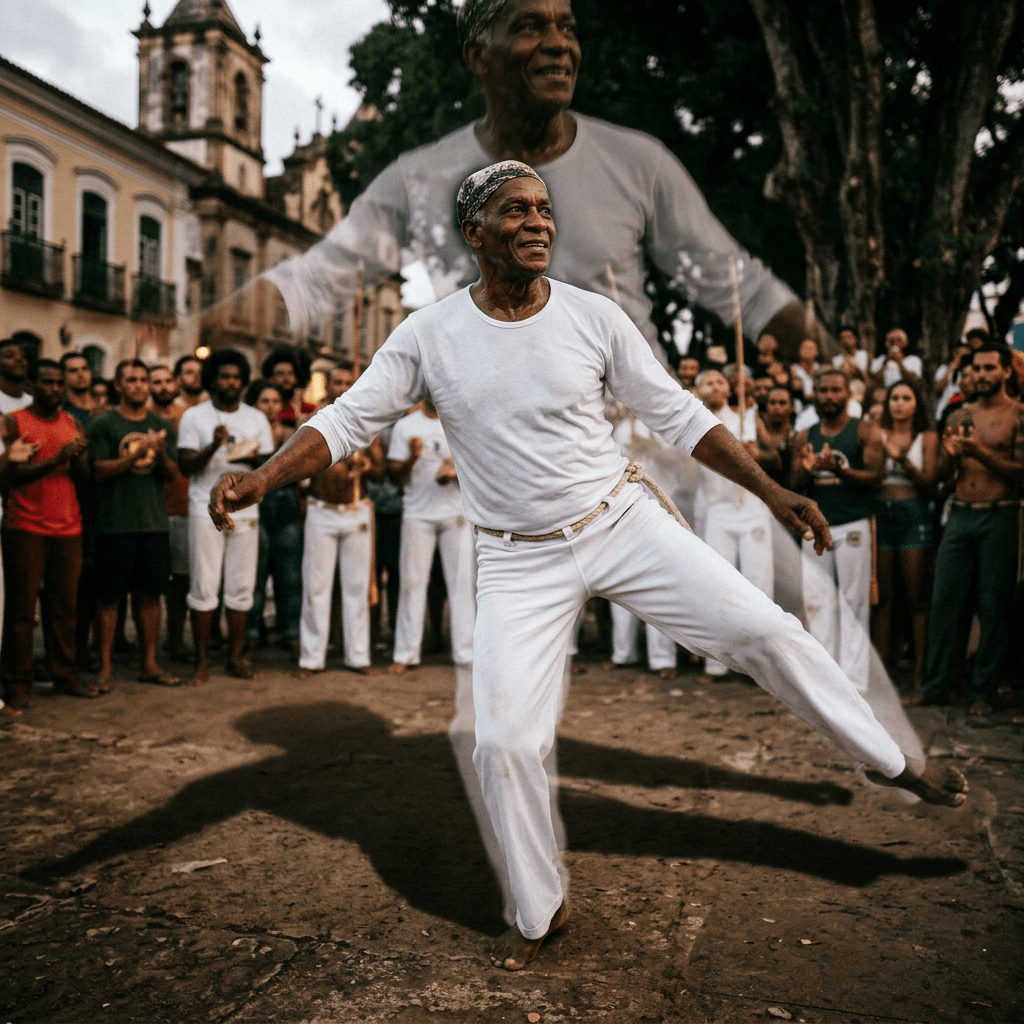
The strategic framework of Capoeira Angola offers a potent system for navigating the manipulative architecture often associated with narcissistic behaviors. By utilizing the philosophical and physical principles of the roda, a practitioner can shift from being a predictable target to an active, fluid participant in emotional self-defense.

1. The Emotional Ginga: Denying Narcissistic Supply

In the roda, the ginga is a continuous, deceptive movement that keeps a player elusive. Interpersonally, this translates to maintaining emotional mobility. Narcissists thrive on predictable emotional reactions—outbursts of anger or visible distress—to gain “narcissistic supply”. By employing “Grey Rock” techniques—responding with neutral, non-committal phrases like “I understand you feel that way”—the practitioner starves the narcissist of the emotional fuel they seek.

2. Malícia and O Jogo de Dentro: Reading Intentions

Malícia is the calculated ability to read an opponent’s hidden motives. Within o jogo de dentro (the internal game), a practitioner looks past a narcissist’s superficial charm or “flamboyant aú of grandiosity” to see the insecure core beneath. Recognizing that an effusive apology might be a “hoovering” attempt allows the individual to anticipate manipulation and protect their boundaries before an attack is launched.

3. The Roda: Breaking Isolation

Narcissists often attempt to isolate targets to maintain control. The roda represents the critical need for a supportive community. By maintaining a network of trusted allies—friends, family, or therapists—the practitioner ensures they have an external reality check against tactics like gaslighting. This collective wisdom acts as an anchor for objective truth.

4. The Ultimate Saída: Strategic Disengagement

The most powerful move in Capoeira Angola is the saída—the conscious decision to exit the game. When a dynamic becomes too costly to one’s axé (life force), the masterful choice is to refuse to play. This might involve establishing a “No Contact” boundary, which functions as a rabo de arraia—a decisive, final action that ends the toxic exchange and preserves one’s internal peace.

Conclusion: Integrating the Law of Narcissism with the principles of Capoeira Angola provides a comprehensive toolkit for emotional and psychological resilience. By viewing narcissistic behaviors through the lens of a strategic game, individuals can transform from passive victims into proactive practitioners of their own well-being. This approach emphasizes that understanding human nature, including the inherent narcissism within us all, is the first step toward developing the deep empathy necessary for genuine connection and self-improvement. Ultimately, the goal is not merely to survive toxic interactions but to master the art of interpersonal dynamics, ensuring that one’s internal peace and life force, or axé, remain intact regardless of the external “players” they may encounter.

Malicia logo with dark crown above and chess pieces below on stone background

A little “Public Service Accouncement”

To all the young girls out there:

I need you to hear this clearly and to believe it in your heart. When an adult man approaches you, showers you with attention, or tries to engage you in a relationship, I can promise you with absolute certainty that it is not because you are “mature for your age.” That phrase is a common, manipulative tactic—a lie designed to flatter you, make you drop your guard, and justify predatory behavior.

Your maturity, your intelligence, or your ability to carry on a conversation are not the reason an adult is targeting you. The reason is solely about their desire to exploit a person who they perceive as vulnerable, less powerful, and less capable of fighting back or setting firm boundaries.

Please understand this crucial context:

  1. They are the adult. They have fully developed brains, life experience, and a clear understanding of the power dynamics at play. They know the difference between right and wrong and the significant age gap.
  2. You are the minor. Your brain is still developing, you are still navigating complex social situations, and you are inherently in a position of lesser power and experience.
  3. The Flattery is a Hook. Any praise they offer about your “maturity” is a calculated tool of manipulation. It’s an attempt to blur the lines of the age difference and make their inappropriate attention seem acceptable, even deserved.

Prioritizing Your Personal Safety and Comfort

Your personal safety and sense of well-being are absolutely paramount. It is not only permissible but entirely appropriate for you to experience discomfort when subjected to unwelcome or excessive attention—the kind that makes you feel uneasy, scrutinized, or harassed. This feeling of discomfort is a vital, inherent defense mechanism, and you should trust it implicitly.

Recognizing the Difference Between a Compliment and Boundary Violation

It is critical to distinguish between sincere, respectful appreciation and attention that is manipulative or predatory. Individuals who engage in inappropriate behavior often use seemingly harmless compliments or flattery as a tool to disarm you, confuse your emotional response, or minimize the seriousness of their actions.

Do not allow these verbal attempts at charm or positive reinforcement to obscure the reality of the situation. Their compliments, no matter how effusive, do not equate to approval of their underlying actions. If their actions—their persistent presence, inappropriate touching, overly intense gaze, or continuous unsolicited communication—make you feel unsafe or uneasy, those actions are inappropriate, regardless of the words they use. Your discomfort is the most reliable gauge of a boundary violation. Trust that feeling; it is your instinct protecting you.

Please stay safe. Speak up, tell a trusted adult, and know that you are strong, you are valued, and your worth has nothing to do with the inappropriate attention of an adult man. Set firm boundaries, and never feel obligated to keep a secret for an adult who is making you uncomfortable.

SELF DEFENSE SERIES (3/12/25)

The Self-Defense Series: A Holistic Blueprint for Personal Empowerment and Survival

The traditional view of self-defense, often limited to mere physical techniques, is fundamentally incomplete. True readiness for the complexities of real-world violence demands a vital, holistic path to empowerment, one that integrates and strengthens the individual across four critical domains. The Self-Defense Series is built upon these four pillars of personal safety: physical, mental, spiritual, and legal. Our philosophy asserts that effective self-defense transcends rote techniques, requiring a deep, well-rounded foundation to foster genuine readiness, unwavering resilience, and absolute confidence in the face of danger.

Today’s Installment: The Psychology of Conflict – Why Ego is the Enemy of Self-Preservation

Some men mistakenly believe that being loud, aggressive, and confrontationally asserting dominance makes them genuinely dangerous. They mistake performance for proficiency. In reality, the men who shout the most, whose actions are driven by visible emotional volatility and a need to prove their toughness, are often the least prepared for the true nature of real-world violence. This outward display of aggression is a critical liability.

When emotions take over, specifically the ego’s urgent need for validation or status, rational decision-making collapses. The brain’s limbic system hijacks the prefrontal cortex, leading to a state of emotional flooding where poor judgment and impulsive reactions are guaranteed. Situations escalate fast, turning minor disagreements into life-threatening confrontations.

Real self-defense isn’t about proving toughness—it’s about control, awareness, and a comprehensive understanding of the dynamics of human violence.

In a real confrontation, the difference between someone who performs toughness and someone who understands violence becomes terrifyingly clear. The person driven by ego is reacting to a personal insult or perceived challenge; their goal is “winning the argument” or “saving face.” The person who understands violence is focused solely on survival, de-escalation, and creating distance to ensure their physical safety.

This is why psychology, emotional regulation, and situational awareness play a far bigger and more definitive role in survival than most people realize. The ability to remain calm under extreme pressure is the hallmark of true competence. The men who can regulate their fear, control their anger, and maintain a state of detached observation in a crisis are the ones who truly understand what is at stake when things turn physical—it’s not about winning a fight; it’s about going home.

To deepen your understanding of conflict dynamics, street fighting psychology, situational awareness, and the mindset needed to effectively deal with real-world violence, the YouTube channel @FIGHTSCIENCE explores the behavioral patterns behind aggression, intimidation, and dominance in confrontational situations. Their content meticulously breaks down how ego, fear, and status dynamics influence conflict and can fundamentally change the way you see aggressive behavior forever.
Train hard. Stay sharp. Stay calm. Remember, the ultimate victory in self-defense is avoiding the fight entirely.

The Courage to Leave: When Walking Away is Empowering

Is walking away actually quitting, or is the act of leaving sometimes a profound display of inner fortitude?

We often associate ‘walking away’ with defeat, a failure of endurance, or the easy path. The narrative of persistence—of staying and fighting, of never giving up—is deeply ingrained in our cultural psyche. But this perspective overlooks the critical distinction between reckless abandonment and a deliberate, self-preserving retreat. To ‘quit’ implies a giving up on something worthwhile—a goal, a relationship, a challenge—out of fear or lack of will.

However, there comes a point in certain struggles—be they professional, personal, or emotional—where the cost of staying far outweighs any potential benefit. This is the moment when leaving demands more courage, more self-awareness, and more strength than simply continuing to endure the familiar pain.

Or is there a point where leaving takes more strength than staying?

Staying can often become the default, the comfortable rut of inertia, even if that inertia is destructive. It can be easier to tolerate the known misery—the toxic environment, the stagnant relationship, the soul-crushing job—than to face the terror and uncertainty of the unknown future. Staying requires a kind of passive tolerance.

Leaving, on the other hand, is an active decision. It requires a brutal reckoning with reality, an acknowledgment that one’s own well-being is non-negotiable. It demands the strength to:

  • Acknowledge Failure: To accept that a given path, despite best efforts, has reached a dead end.
  • Embrace Uncertainty: To step into a void without a guaranteed safety net.
  • Overcome External Judgment: To face the inevitable questions and criticisms from those who mistake self-respect for weakness.
  • Break Momentum: To shatter the comfortable routine and rebuild from the ground up.

When staying means sacrificing one’s mental health, core values, or sense of self, the ‘walk away’ is not a surrender; it is a declaration of self-respect. It is not quitting the effort; it is quitting the path that demanded too high a price. In these instances, the true measure of strength is not how long one can suffer, but the clarity of mind required to choose life, peace, and a fresh start.

Valentine’s Day: When Gifts Don’t Define Love

The True Meaning of Valentine’s Day: A Relationship Perspective

Valentine’s Day, celebrated annually on February 14th, is often superficially viewed through a commercial lens—a flurry of red hearts, chocolates, flowers, and expensive dinners. However, when examined through the deeper, more meaningful prism of human connection and relationships, its true significance emerges as a powerful opportunity for reflection, appreciation, and intentional nurturing of emotional bonds. This holiday is far more than a mandated date for grand gestures; it is an annual pause dedicated to celebrating the diverse forms of love that enrich our lives.

Beyond Romantic Love: The Spectrum of Connection

While contemporary culture heavily emphasizes romantic partnerships on this day, the true meaning of Valentine’s Day historically and fundamentally extends far beyond the confines of a boyfriend, girlfriend, husband, or wife. It is an occasion to recognize and honor agape (unconditional love), philia (affectionate, friendly love), and storge (familial love), alongside eros (romantic love).

  • Friendships (Philia): Valentine’s Day is an ideal time to acknowledge the backbone of our social lives—our friends. These are the chosen family who provide unwavering support, shared laughter, and mutual growth. A simple, heartfelt acknowledgment can strengthen these vital bonds.
  • Familial Bonds (Storge): The love between parents and children, siblings, and extended relatives forms the foundation of our emotional security. Celebrating this day with family reinforces the deep, often unspoken, ties that define our sense of belonging.
  • Self-Love and Self-Care: Perhaps the most overlooked relationship is the one we have with ourselves. Valentine’s Day serves as a vital reminder that self-compassion and self-acceptance are prerequisites for healthy relationships with others. It’s a day to intentionally practice self-care and gratitude for one’s own journey and resilience.

The Relationship Audit: Intentional Nurturing

From a relationship perspective, Valentine’s Day functions as an annual relationship audit—a cue to pause the daily grind and assess the health and vitality of our most important connections. The true value lies not in the monetary cost of the gifts exchanged, but in the intentionality of the actions taken.

  1. Reaffirming Commitment: For romantic partners, it is a focused day to verbally and behaviorally reaffirm the commitment made to one another. This involves expressing gratitude for the partner’s role in one’s life and acknowledging the shared history and future goals.
  2. Quality Time and Presence: In an age of digital distraction, the most precious gift is often undivided attention. Valentine’s Day provides a framework for scheduling genuine, uninterrupted quality time. This presence fosters deeper intimacy and ensures both partners feel seen and heard.
  3. The Language of Appreciation: The holiday reminds us to articulate our feelings, often through the lens of Dr. Gary Chapman’s Five Love Languages (Words of Affirmation, Quality Time, Receiving Gifts, Acts of Service, Physical Touch). True celebration means expressing love in the language most meaningful to the recipient, ensuring the gesture is received as intended.

Moving Beyond Commercialism

The trap of Valentine’s Day is allowing commercial pressure to overshadow its relational core. The societal narrative often creates unrealistic expectations, leading to disappointment and stress. The healthier, truer interpretation rejects the mandate for extravagant displays and substitutes it with authenticity and meaning. A handwritten letter expressing genuine appreciation, a shared experience, or a simple act of service that addresses a partner’s ongoing need often speaks louder than the most expensive box of chocolates.

In conclusion, the true meaning of Valentine’s Day, viewed from a holistic relationship perspective, is not about the superficial exchange of commodities. It is a dedicated, annual moment to slow down, reflect on the foundational importance of love and connection in all its forms, and intentionally invest energy into nurturing the human bonds—romantic, familial, and friendly—that give life its richness and purpose. It is, fundamentally, a celebration of human interconnectedness.

HAPPY VALENTINE”S DAY!!!

A Valentine’s Day Confession (Capoeira Style)

O.k., listen up. Before you start taking this too seriously, let me just state for the record: this is entirely for fun. It’s Valentine’s Day, and in the spirit of this inherently corny, commercially-driven, yet ultimately heartwarming holiday, I felt compelled to write something.

What I’ve done is a short—Well not too short—write-up, attempting to view the universal experience of “love” through the very specific, occasionally rough, but undeniably passionate lens of an Angoleiro.

You know, one of us. A Capoeira Angola player.

I’ve tried to draw parallels between the slow, grounded movements, the call-and-response rhythm of the roda, the intense focus on the berimbau, and the dizzying, complex, and utterly necessary connection between two people in love.

Think of it as a love letter (Even though it’s more of a how to kind of thing), written in the language of the jogo—a playful, yet deeply respectful, exploration of connection, balance, and the moment you realize you’ve finally met your perfect parceiro (partner) for the game of life.

It’s a tongue-in-cheek attempt to blend the sweat, the music, the history, and the philosophy of the roda with the mushy, romantic sentiments floating around this time of year.

Okay, here we go.

The Angoleiro’s guide to keep a woman in love with you forever: A comprehensive manual for enduring affection and lasting partnership.

Introduction: The Philosophy of the Angoleiro

The term “Angoleiro” refers to a dedicated practitioner of the Angolan style of Capoeira, known as Capoeira Angola. This title signifies more than just martial skill; it embodies a profound philosophy. The Angoleiro operates with a deep respect for patience, an unwavering commitment to tradition, a mastery of rhythm, and the cultivation of deep, internal connection.

In the delicate and complex context of a loving relationship, the Angoleiro’s approach is antithetical to superficial games, fleeting manipulation, or transient romance. Instead, it is a methodology built on sustained, deliberate effort, a harmonious rhythm, and a profound, intuitive understanding of the partner. These are the very, non-negotiable elements required to not just ignite, but to keep the flame of love burning “forever.” This comprehensive guide meticulously distills the Angoleiro philosophy into actionable, timeless principles for any man committed to forging an enduring and deeply fulfilling relationship.

I. Mastering the Rhythm: Consistency, Reliability, and Presence

In the practice of Capoeira Angola, the bateria (the orchestra of instruments) doesn’t just provide music; it provides the essential, governing rhythm. A lasting relationship, too, demands a consistent, reliable rhythm that can be felt and depended upon.

The Drumbeat of Presence: The Soul of the Relationship

Just as the powerful, resonant berimbau is recognized as the soul of the roda (the circle where Capoeira is played), your emotional and mental presence must be the soul of the relationship. This is not mere physical proximity; it is being fully, consciously present. This means establishing an absolute sanctuary from digital noise: putting away the phone, silencing distractions, engaging in active listening, and truly immersing yourself in shared moments. This consistent, focused presence builds the bedrock of trust and security, assuring her that she is the most important element in your immediate world.

The Daily Overture: Power in Small Gestures

The greatest loves are sustained not by grand, sporadic spectacles, but by a continuous stream of small, consistent gestures. These daily efforts significantly outweigh the impact of a single, massive act of romance. A daily “How was your day?” delivered with genuine, sincere interest, a thoughtful morning text that shows she was your first thought, or consistently sharing a meal together without rushing—these acts form the stable, comforting routine she can rely on. Love does not just survive; it thrives on this kind of daily, emotional reliability.

Adaptation and Flow (A Ginga): The Art of Dynamic Partnership

The ginga is the foundational, fluid, and adaptable back-and-forth movement in Capoeira. It teaches you to always be in motion, ready to react. Your love must possess this same dynamic fluidity. You must develop the perceptiveness to recognize and gracefully adapt to her constantly changing needs, moods, and life circumstances. The true Angoleiro knows when the moment calls for him to take the lead with decisive action and when it requires him to step back and be the gentle, non-judgmental confidante. This intelligent flow prevents stagnation and keeps the partnership vibrant.

II. The Respectful Game: Honor, Clarity, and Communication

Capoeira Angola is fundamentally a game of mutual respect, where the “opponent” is viewed as a vital partner in the dance. This principle of honor and respect is utterly paramount in a committed relationship.

The Call and Response (O Coro): Mastering Dialogue

Effective, profound communication functions as a continuous, organic call and response. You must speak your truth—your thoughts, feelings, and needs—with kindness, precision, and clarity. But more importantly, you must listen actively to her without the internal distraction of immediately formulating your rebuttal. The goal is connection, not victory. Validate her feelings and perspective, allowing her to feel heard and understood, even if your ultimate conclusion differs from hers. Validation is the cornerstone of emotional safety.

Honoring Her Space: Encouraging Autonomy

Respect for your partner extends to honoring her individuality, her deep-seated passions, and her essential need for personal space and restorative time spent with her own friends or family. A healthy, flourishing partnership is the union of two whole, complete individuals who consciously and joyfully choose to walk side-by-side, not two insecure halves clinging out of need. The Angoleiro encourages her growth, celebrates her independent successes, and trusts her freedom.

Fair Play in Conflict: Seeking Resolution, Not Domination

Arguments are an inevitable, and sometimes necessary, part of any deep relationship. However, they must be conducted under strict rules of respect. Focus relentlessly on the issue at hand, never the person. Under no circumstances should you ever weaponize past mistakes, insecurities, or vulnerabilities as ammunition. The Angoleiro seeks to resolve and understand, never to dominate or inflict lasting pain. After the conflict, always make a conscious, affectionate return to a place of mutual affection and demonstrated understanding.

III. The Art of Patience: Cultivating Deep Roots and Endurance

Capoeira Angola is not about reckless speed or explosive force; it is about strategic timing, deliberate depth, and controlled execution. Lasting love demands this exact same, profound patience.

The Long View: Building a Shared History

You must internalize the understanding that “forever” is not a sudden destination. It is built slowly, deliberately, on the vast accumulation of shared history, the resilience gained from overcoming challenges together, and the quiet joy of witnessing each other’s personal transformations over time. Resist the urge to rush significant milestones or to demand immediate, unrealistic perfection. The journey is the commitment.

The Beauty of the Slow Movement: Intentional Investment

Invest your time and attention into activities that truly deepen the bond: learning a complex new skill together, exploring shared intellectual interests, or simply enjoying the profound comfort of companionable, meaningful silence. These slow, deliberate, and deeply meaningful interactions are the enduring mortar that secures the relationship’s foundation against time and pressure.

Forgiveness as a Core Skill: Releasing the Grievance

Be swift to offer complete forgiveness and slow to entertain anger. Holding onto grudges introduces corrosive, unnecessary tension and inevitably poisons the atmosphere of mutual trust. Forgiveness is not a gift to her; it is a critical act of self-care for the relationship itself, clearing the path for growth and future connection.

IV. Maintaining the Mystery: Effort, Growth, and Self-Improvement

A dedicated Angoleiro never stops training; he continuously refines his technique, increases his strength, and deepens his knowledge. Similarly, you must never cease the effort to be the absolute best version of yourself, primarily for yourself, but also for her.

The Eternal Courting: Never Stop Earning Her

The greatest error is assuming the effort ends once the relationship status changes. Never stop courting her. The attention, creativity, and genuine effort you invested during the initial, passionate stages must be maintained and even amplified years later. Consistently plan surprise dates, write unexpected heartfelt notes, and consciously prioritize and nurture your intimate life. This continuous effort is the tangible proof that you do not, and will not, take her presence or her love for granted.

Personal Development (O Jogo Interno): The Inner Game

Focus actively on your own life and growth. Rigorously pursue your career goals, maintain your physical and mental health, and continuously nurture your own emotional and intellectual growth. A man who is confident, purposeful, striving, and genuinely happy in his own life is naturally more attractive, more intriguing, and infinitely better equipped to be a strong, stable, and supportive partner. Your personal growth is a continuous gift to the relationship.

Passion and Purpose: A Shared Destiny

Share your personal purpose and passion with her, allowing her to be part of your vision. Love achieves its greatest endurance when a couple shares a sense of destiny, a common mission, or a significant collective goal—whether it is raising a family with clear values, contributing meaningfully to the community, or simply building a remarkable life together. This shared purpose transcends the everyday and gives the relationship transcendent meaning

Conclusion: The Legacy of Enduring Love

Keeping a woman in love with you forever is not the result of a magic trick, a clever technique, or fleeting luck; it is a profound, demanding discipline. It is the conscious, daily, and unwavering choice to embody the principles of the Angoleiro: unyielding respect, emotional and physical consistency, profound patience, and the demonstration of relentless, daily effort.

By thoughtfully mastering the rhythm of your shared life, honoring her complete individuality and autonomy, and constantly striving for your own self-improvement, you will create a bond that is deep, fiercely resilient, and truly timeless. The immense reward for this discipline is a love that does not, in fact, fade or diminish over time, but instead deepens, matures, and grows more rich and resonant with every passing year, much like the powerful, magnetic sound of the berimbau calling the faithful to the roda.

The Angoleiro’s Essential Guide: Keeping a Man in Love with You Forever

For generations, the Angoleira have been revered not just for their striking beauty and formidable spirit, but for the profound, enduring relationships they cultivate. Their secret lies not in fleeting charms or superficial tactics, but in a deep-rooted understanding of human nature and the art of partnership. This guide distills their wisdom into actionable principles, ensuring the bond you share with your man is not just passionate, but permanent.


This is not merely a collection of tips, but a philosophy rooted in the profound principles of Capoeira Angola—a blend of art, strategy, and deep-seated respect. To keep a man’s love enduring and passionate, you must approach the relationship as you would the roda (the circle in which capoeira is played): with grace, intelligence, rhythm, and unwavering authenticity.

1. Master the Art of Presence and Independent Light

Do not dim your own light to fit into his. An Angoleira knows that the most potent attractant is a vibrant, fulfilled self.

  • Cultivate Your Own Garden: Maintain hobbies, friendships, and goals that exist entirely outside of the relationship. A man is drawn to a woman who is passionately engaged with her own life. This creates a compelling magnetic pull—he must pursue your attention, not simply receive it as a default.
  • The Power of Space: Understand that healthy interdependence requires moments of independence. Encourage him to pursue his interests and take your own space without generating drama or suspicion. Absence, when used judiciously, reinforces value. He should miss you, not just be accustomed to your proximity.
  • Be a Source, Not a Drain: Ensure that when he spends time with you, he feels energized, inspired, and respected. Do not allow the relationship to become a constant tally of grievances or emotional burdens. Your presence should be a refuge and a celebration.

2. The Unwavering Foundation of Respect

Respect is the bedrock upon which lasting love is built. Passion may ignite the flame, but respect keeps the fire burning steadily.

  • Honor His Efforts: Acknowledge and genuinely appreciate his contributions, no matter how small—from fixing a lightbulb to supporting your career aspirations. Men thrive on feeling competent and needed. When you show genuine appreciation, you reinforce his desire to do more for you.
  • Hold Him in High Regard: Never belittle him, especially in public or in front of his peers. Your unwavering belief in his capabilities is one of the greatest gifts you can give him. Be his most enthusiastic cheerleader and his fiercest defender.
  • Communicate with Dignity: During conflicts, focus on the issue, not his character. Avoid name-calling, generalizations (“You always,” “You never”), or bringing up past hurts. Address problems as a team facing a challenge, not as adversaries.

3. Fulfill the Core Need for Emotional Safety and Admiration

      A man needs to feel safe in his vulnerability and truly seen by the woman he loves.

  • Be His Soft Place to Land: Create a sanctuary where he can drop his guard. The world is often demanding and critical; your relationship should be his haven. Listen without judgment, especially when he shares his fears or professional setbacks.
  • Admire the Man He Is, Not Just the Man You Want Him to Be: Love is accepting the whole person. Show genuine admiration for his strengths, his moral compass, his unique way of viewing the world. True, lasting love is built on a foundation of profound liking.
  • The Power of the Affirming Gaze: Look at him with love and admiration. The way you physically see him and respond to him—a lingering glance, a genuine smile, a touch that says “I value you”—communicates more than words ever could. Let him feel he is still the most desirable and competent man in your life.

4. Cultivate Shared Purpose and Growth

A relationship that stands still eventually suffocates. Angoleiro women are partners in life’s great adventure.

  • Establish a Shared Vision: Ensure you both agree on the long-term goals for your lives together—whether it’s financial freedom, raising a family, traveling, or community involvement. Working towards a common future binds you together more strongly than any romantic feeling.
  • Challenge and Support: Do not let him become complacent. Encourage him to take risks, learn new skills, and strive for greater achievements. Be the supportive anchor that allows him the courage to venture out. You should be the wind beneath his wings, not the weight pulling him down.
  • Never Stop Dating: Routines kill romance. Continuously inject novelty and excitement into the relationship. Plan dates, surprise him, introduce new shared experiences, and keep the spark of curiosity alive. The moment you stop putting in effort is the moment you invite stagnation.

By integrating these four Angoleiro principles—maintaining an independent, vibrant self, practicing unwavering respect, creating a safe emotional sanctuary, and pursuing shared growth—you build a love that is not only passionate but impervious to the trials of time. You secure his love not by trapping him, but by making your shared life the most fulfilling place he could ever imagine being.

I hope you guys enjoyed this little ‘how-to’ guide to love, viewed through the unique and insightful perspective of a capoeirista of Capoeira Angola.

Capoeira Angola is more than just a fight or a dance; it is a philosophy, a constant dialogue between two people, much like a loving relationship. The jogo (the game) in the roda (the circle) is a microcosm of the complexities of love. It requires patience, deep listening, respect for your partner’s rhythm, and the ability to anticipate and respond without dominating.

Just as a relationship thrives on mutual growth and understanding, the jogo of Capoeira Angola demands that both players are present, attentive, and fully engaged. The slower, more grounded movements of Angola teach us the beauty of taking our time, savoring the present moment, and finding strength not in aggression, but in subtlety, balance, and connection.
May the lessons learned from the berimbau‘s steady beat—the grounding rhythm that guides the roda—help you find harmony, flexibility, and enduring connection in your own journey of love.

I was a people person… UNTIL PEOPLE RUINED IT!

The rapid evolution of modern society is not without its hidden costs, chief among them being the insidious proliferation of toxic behavior, often manifesting in ways that escape immediate public notice. This in-depth video exploration is dedicated to uncovering and illuminating the deeply rooted cultural, psychological, and emotional tectonic shifts that are silently yet powerfully driving the creation of more toxic individuals than at any other point in recent history.

The increasing pace of digital connectivity, coupled with shifting social norms, has inadvertently cultivated environments where self-absorption, chronic comparison, and a lack of authentic empathy thrive. Psychologically, a culture of instant gratification and performance pressure has led to heightened levels of narcissism and emotional fragility, where a person’s value is often tied to external validation—a fertile ground for toxic defense mechanisms. Emotionally, the breakdown of strong community bonds and the rise of isolation have diminished natural opportunities for developing conflict resolution skills and genuine compassion.

By meticulously breaking down the “why” behind this concerning trend, viewers will gain invaluable intellectual and emotional armor. The core purpose of this elaboration is to empower you to:

  1. Protect Your Energy: Learn to identify the subtle energy-draining tactics employed by toxic individuals—be they manipulative colleagues, emotionally volatile family members, or demanding partners—and establish robust, non-negotiable personal boundaries to preserve your vital resources.
  2. Strengthen Your Awareness: Develop a sophisticated radar for recognizing the early warning signs of toxicity in relationships and interactions, moving beyond surface-level charm to spot underlying patterns of control, gaslighting, or victimhood.

Reclaiming Your Peace: Strategies to Break Free from Toxic Relationships

Stop Letting the Wrong People Drain Your Life. The energy you invest in high-toxicity individuals is a non-renewable resource that, when squandered, costs you your well-being, focus, and potential for growth. This critical shift begins with an unflinching recognition of the drain—identifying the people, dynamics, and repetitive patterns that leave you feeling depleted, anxious, or diminished.

Acquire actionable, evidence-based strategies to disengage from destructive cycles. Breaking free from toxic entanglement requires more than just good intentions; it demands a structured, step-by-step approach rooted in psychological awareness.

  1. Establish Firm Boundaries (The Cornerstone of Self-Respect): This is the immediate and most potent line of defense. Learn to articulate your needs clearly, calmly, and without apology. This includes setting limits on communication frequency, conversation topics, and the level of personal access you permit. For individuals who consistently violate these boundaries, the principle of “low-contact” or “no-contact” becomes paramount.
  2. Minimize Contact with High-Toxicity Individuals: This is the practical execution of your boundaries. High-toxicity people often thrive on drama, conflict, or constant neediness. Your goal is to systematically reduce their opportunities to engage with you. This might involve changing communication channels, avoiding specific social settings, or simply keeping interactions brief and strictly focused on neutral subjects. Recognize that some relationships require a complete, deliberate “cut-off” (no-contact) to preserve your mental health.
  3. Practice Emotional Detachment: Learn to manage your emotional response to their predictable behaviors. Toxic individuals often seek to elicit strong reactions—anger, guilt, or fear—to maintain control. By practicing detachment, you refuse to take the bait. See their behavior not as a personal attack, but as a reflection of their own internal struggles, making it easier to remain objective and emotionally uninvolved.

Consciously curate a supportive, positive circle that uplifts and empowers your journey. The space vacated by toxic relationships must be intentionally filled with sources of authentic strength and validation. This is the proactive phase of reclaiming your agency.

  1. Identify and Nurture Authentic Connections: Seek out people who demonstrate empathy, celebrate your successes, offer constructive support during challenges, and respect your boundaries without question. These are individuals who add energy to your life, not subtract it.
  2. Prioritize Reciprocity: Your supportive circle should be characterized by a two-way street of mutual respect and give-and-take. Avoid relationships where you are consistently the sole provider of emotional support, resources, or effort.
  3. Engage in Positive Environments: Actively seek out groups, clubs, or professional settings aligned with your values and goals. Surrounding yourself with people who are also focused on growth and self-improvement accelerates your own progress.

This shift in perspective and action is not just about defense, but about proactively reclaiming your peace, well-being, and personal agency. Moving beyond toxicity is an act of self-love and self-preservation. By systematically applying these strategies, you are consciously optimizing your life for harmony, fulfillment, and emotional resilience. You transition from being a passive recipient of emotional drain to becoming the active architect of a life governed by your own priorities and fueled by positive, healthy relationships..

Dealing with difficult or draining personalities is an unfortunately common aspect of modern life. If you’re interested in exploring practical and philosophical methods for navigating these challenging relationships, particularly by adopting the unique perspective and wisdom of an Angoleiro—a practitioner of the Angolan style of Capoeira—then a more detailed resource awaits you.

An Angoleiro‘s training is not just physical; it is deeply rooted in patience, observation, adaptability (malícia), and resilience, all of which are highly effective tools when confronting interpersonal toxicity. By applying principles learned from this ancient art—such as maintaining composure under pressure, using the opponent’s energy against them, and understanding the rhythm of a confrontation—you can develop a powerful, non-violent emotional and psychological defense mechanism.
To dive into these specific strategies, which translate the fluid, defensive movements and mental discipline of Capoeira Angola into real-world advice for emotional self-preservation and boundary-setting with challenging people, please click HERE.

THE MOMENT OF TRUTH FRIDAY CRIME REPORT (5/3/25)

Every Friday morning, PROFESSOR BLACK TRUTH presents “The Friday Crime Report,” a thought-provoking program that delves into the pressing challenges faced by the black community, such as systemic racism, economic inequality, and police brutality. The program not only serves as a platform to raise awareness and stimulate meaningful dialogue but also empowers individuals by providing them with the knowledge and tools necessary to advocate for change. Through compelling narratives, the program advocates for critical policy changes aimed at improving the lives of marginalized individuals, fostering a sense of solidarity and community engagement that is essential for enacting social justice and equality. By addressing these complex topics, “The Friday Crime Report” aspires to inspire action and contribute to a more equitable society for all.

In Today’s installment…

Delivery drivers have faced violence for years by entitled, violent perpetrators, with a recent incident in Chester, New York involving the town’s highway superintendent, highlighting the serious dangers that these workers encounter from White supremacists on a daily basis. As they navigate busy streets and unpredictable environments, delivery drivers become vulnerable to various forms of harassment and aggression, often resulting in traumatic experiences that affect their well-being. This alarming trend underscores the urgent need for increased awareness and protective measures for these essential workers, who play a vital role in our economy and daily lives.

Shout out to the professor for creating and posting this insightful video.

The Professor creates videos that entertain and foster critical thinking on black empowerment, addressing both historical and modern issues, making them accessible for all. His YouTube channel HERE connects viewers with a community focused on knowledge sharing about important black issues, enriching perspectives and encouraging active participation in vital conversations.

ATTEMPTING TO DECODE THE MIND (4/24/25)

Welcome to ATTEMPTING TO DECODE the mind, a fascinating journey where we delve into the intricate labyrinth of human thoughts and emotions, exploring the mechanisms that drive our behavior and shape our perceptions. This exploration is an outgrowth of the MALANDROS IN ACTION series, where we discuss the actual cons that humans perpetrate against one another, examining the darker aspects of interpersonal relationships. In this new series, we aim to investigate not only the behaviors exhibited by these individuals but also the underlying psychology and motivations that drive such toxic actions. With each layer we uncover, we will seek to understand not just the thoughts themselves, but the profound impact they have on our interactions, our motivations, and the essence of who we are. Join us as we unravel these complexities and illuminate the path to greater self-awareness and connection with others.

Today…

Everything is energy; reclaim it through stillness and self-respect. If you’re done with people-pleasing, this is your call back to self. Focus on silence, emotional boundaries, self-reclamation, and spiritual growth for inner peace and transformation in your healing journey.

By embracing the stillness, you allow space for reflection and clarity, enabling you to distinguish between your true desires and the expectations imposed by others. This conscious pause is not merely a moment of silence; it is an opportunity to delve deeper into your inner self, fostering self-awareness and understanding. Setting emotional boundaries is vital, as it protects your energy and fosters healthier relationships, ensuring that you cultivate connections that are supportive and nurturing. When you learn to say no to what does not serve you, you create room for positive interactions that uplift and inspire. Moreover, these boundaries empower you to communicate your needs effectively, paving the way for authentic relationships built on mutual respect and understanding.

Self-reclamation involves acknowledging and honoring your own needs, allowing you to rediscover your passions and purpose in life. This essential journey is not merely about self-care; it encompasses a deep exploration into the very core of your being, revealing hidden desires and aspirations that may have been neglected or suppressed. As you embark on this transformative journey, remember that spiritual growth is a continuous process, requiring patience and dedication, but it ultimately leads to a profound sense of inner peace and transformation. Embrace the lessons learned along the way, as they are vital to your evolution; each step, whether a challenge or triumph, enriches your life in unimaginable ways and illuminates the path toward a more authentic existence. Through this exploration, you will cultivate not just self-love, but also a deeper connection with the world around you, allowing for an expansive understanding of your role within the greater tapestry of life.

DOMESTIC VIOLENCE SERIES: I WANT TO SPREAD AWARENESS ABOUT THIS SUBJECT (REBOOT)

This post is my first reboot post. I posted it last year, but I think this is so important that I needed to share it again with my readers. The insights and information contained within this post continue to resonate, and I believe they are even more relevant now than before. As we navigate through changing times, revisiting core concepts can provide us with clarity and direction. Therefore, I felt compelled to highlight the key points once more to emphasize their significance and encourage engagement from those who may have missed it the first time.

——————————————————

Hello,

I’m not gonna type too much here. I just wanna show you these 2 playlists that I found on YouTube. This 1st playlist was made by YouTuber illymation, which describes in detail her experience dealing with an abusive predator that she met online. In this playlist, she candidly shares her journey of overcoming the challenges she faced, and provides insight into the lessons she learned along the way. With a mix of personal anecdotes and empowering messages, the playlist aims to raise awareness about online safety and the impact of abusive behavior. It’s a valuable resource for anyone navigating similar experiences and seeking support.


Now I’m not a psychologist, so I can’t properly break down what this young woman went through. However, I found this video playlist made by Youtuber Flower Mother, where they share illymation’s story, and added some videos created by Youtuber The Rewired Soul.

The Rewired Soul’s channel is a platform where thought-provoking social commentary is skillfully crafted to address pressing issues of our time. With a focus on providing actionable solutions, the channel aims to transform the chaos of our world into meaningful messages of hope and progress. With an engaging and thoughtfully curated approach, viewers are encouraged to join in the journey of understanding and reshaping the complex tapestry of modern society. Through insightful discussions and a commitment to fostering positive change, The Rewired Soul seeks to empower its audience to actively participate in the ongoing narrative of societal progress.

I also listed under the playlist some resources from The rewired soul’s channel, for any of you out there who may need help in this situation.


▶GET HELP! https://www.thehotline.org/ – FREE live chat, 24/7 call services, OVER 200 LANGUAGES https://www.loveisrespect.org/ – FREE live chat, 24/7 call services https://suicidepreventionlifeline.org/ – FREE live chat, 24/7 call services https://www.childhelp.org/hotline/ – FREE chat only in Arizona, nationwide 24/7 call services https://tryonlinetherapy.com/rewiredsoul – Online therapy affiliate link. (This link helps support the channel)

▶GET EDUCATED! https://www.joinonelove.org/ – LEARN MORE about abusive relationships https://www.loveisrespect.org/ – “RELATIONSHIPS 101” – LGBTQ+ inclusive https://www.thehotline.org/is-this-ab… – “IS THIS ABUSE?” – helpful guide “6 Types of Child Abuse” by Psych2Go:    • 6 Types of Childhood Abuse   “Abuse Story” by storybooth:    • Abuse Story   “Bad Boyfriend” by storybooth:    • Bad Boyfriend  

▶GET OUT THERE AND HELP! http://stoprelationshipabuse.org/https://www.joinonelove.org/take-action/https://www.childhelp.org/donate/#ste…


So in conclusion, I wanted to spread awareness on this subject, so any parents out there can have some tools needed to help keep their children safe. Additionally, it’s crucial for caregivers to understand the signs of potential risks and how to address them effectively. By educating themselves about online safety and communication techniques, parents can establish open and supportive relationships with their kids. It’s important to stay updated on the latest online trends, as the digital world is ever-evolving. Keeping an open dialogue with children about their online behaviors and ensuring they know they can come to you with any concerns is key to creating a safe online environment. Furthermore, setting clear guidelines and boundaries for internet use can also contribute to a safer online experience for children.

And for any one of you young children going through something like this, know that YOU ARE NOT ALONE, and there’s ALWAYS help and support for you. Remember, reaching out to a trusted adult, such as a teacher, family member, or counselor, can make a significant difference. There are also numerous helplines and organizations dedicated to providing guidance and assistance to children facing these challenges, some of which I listed above. It’s important to know that there are resources available and that help is always within reach. In addition to seeking help from adults, finding support from peers or support groups can also be beneficial. Connecting with others who have gone through similar experiences can provide a sense of understanding and community.

Furthermore, engaging in creative activities or hobbies can serve as a positive outlet for emotions and can contribute to a sense of empowerment. Taking time to explore your interests and passions can also lead to a greater sense of fulfillment and purpose, adding depth to your daily life. Remember, you are resilient and capable of overcoming challenges, and there are people ready to support you every step of the way, offering guidance and encouragement during difficult times. It’s important to recognize the strength within you and the potential for growth, both personally and professionally.