We have all heard Murphy’s Law: “Anything that can go wrong will go wrong.”
Named after aerospace engineer Edward A. Murphy Jr. in the late 1940s, the adage usually serves as a cynical warning against overconfidence. In everyday life, we spend endless energy trying to outsmart Murphy’s Law—building backup plans, double-checking schedules, and praying nothing goes off script.
In Capoeira Angola, however, you don’t try to avoid Murphy’s Law. You honor it as a teacher.
Stepping into the roda (the sacred circle) means accepting that control is an illusion. For an angoleiro, the certainty that things will go wrong isn’t an inconvenience to engineer away—it is the living echo of the art’s origins. Born from Afro-Brazilian resistance to colonial oppression and slavery, Capoeira Angola was forged in a world where the rules were rigged, safety was never guaranteed, and survival required turning sudden disruption into grace.
Forged in Unpredictability: The Historical Root
To understand why Capoeira Angola embraces Murphy’s Law, you have to look at its history. The enslaved Africans and Afro-Brazilians who birthed this art did not have the luxury of controlled environments, padded mats, or predictable rules. Everything could—and often did—go wrong at a moment’s notice.
Out of that reality emerged malícia—a deep, street-smart cunning, intuition, and vigilance. Malícia is not about being underhanded; it is the ancestral wisdom of reading subtle shifts in energy, expecting deception, and staying calm when the ground shifts beneath your feet. In Capoeira Angola, you assume the script will break because historically, survival depended on it. Malícia is what lets a player smile while quietly measuring distance, watching breath, and noticing the tiny flinch in a shoulder that gives away an incoming kick.
It is the choice to feign vulnerability so you can see another person’s true intention, or to turn a trap into an opening with a simple step, a lowered gaze, or a well-timed laugh. In the roda, this means you never rely only on what is declared—”just a friendly game”—because the same movements once hid the urgency of escape, resistance, and disguise. To cultivate malícia today is to honor that history: to move with beauty and play, but with eyes awake to danger, contradiction, and possibility.
Why Rigid Plans Fail in the Angola Roda
Unlike modern combat sports built around memorized combinations or athletic speed, Capoeira Angola is a slow, deceptive, and deeply philosophical conversation.
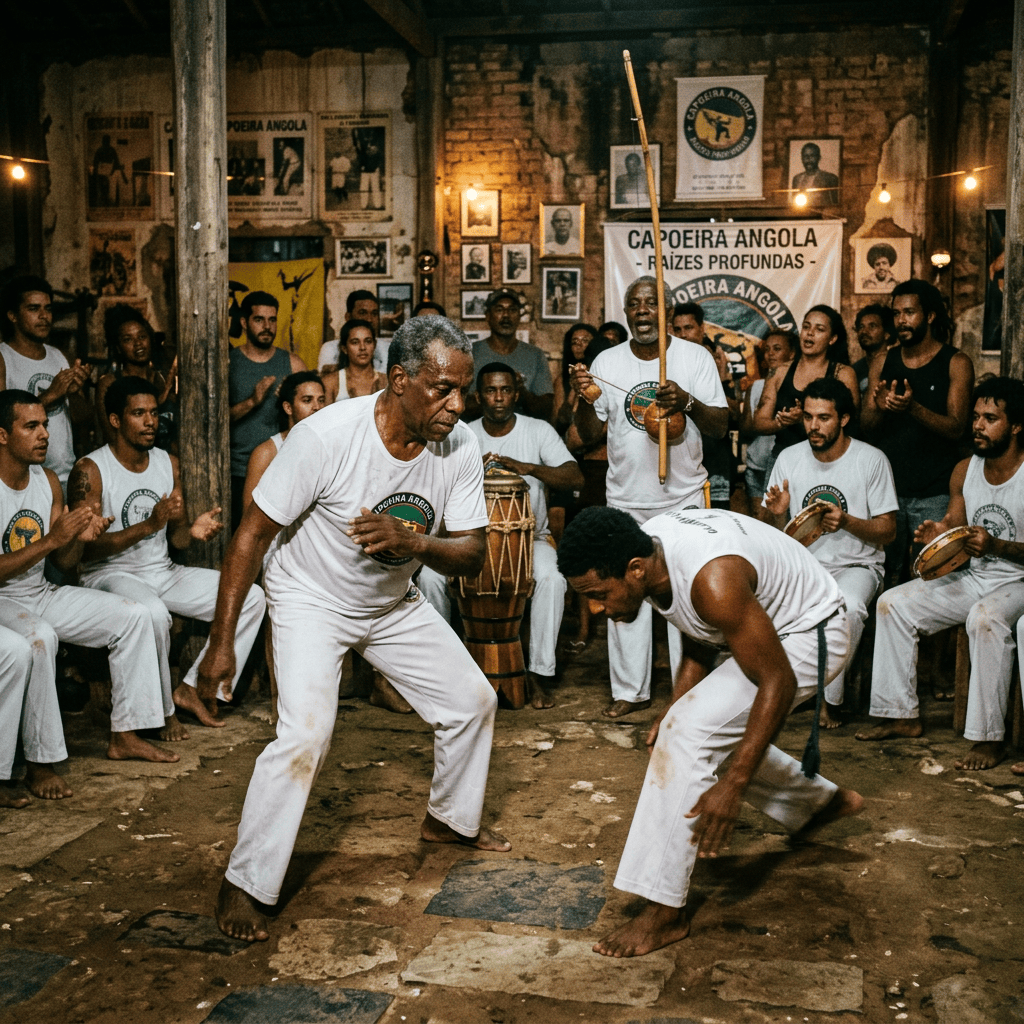
You can spend months drilling a crisp movement in class. Yet the moment you crouch at the pé do berimbau (the foot of the lead musical bow) and enter the roda, Murphy’s Law takes over:
- The bateria (the traditional orchestra of berimbaus, pandeiros, atabaque, agogô, and reco-reco) shifts the rhythm, demanding you change your pace mid-breath.
- Your partner refuses to react to your feint, smiling as they draw you into a tight corner.
- Your foot slips on an uneven floor just as a low sweep arrives from your blind spot.
If you rely on a rigid plan, the moment the plan collapses, you freeze. Capoeira Angola trains your nervous system to stay loose under pressure so that when everything goes sideways, your real game begins.
Melting Into the Ground
Nowhere is this philosophy clearer than in how an angoleiro relates to the floor. In most martial arts, losing your balance and hitting the ground means defeat. In Capoeira Angola, the earth is your sanctuary and your source of power.
When a sweep catches you off-guard or your footing gives out, Capoeira Angola teaches you not to tense up or fight the fall. Instead, you melt into it, letting your weight drop toward the floor rather than clinging to an upright stance that’s already lost. Foundational ground movements like the negativa, rolê, cocoras, and queda de quatro are designed specifically for moments of compromised balance, when you’re half-spun, off-line, or reaching to protect yourself. They allow you to absorb a stumble, stay rooted, and seamlessly transform a near-fall into an evasion or a counter-trap: a well-timed negativa turns what looked like a collapse into a low escape under a kick; a rolling rolê reorients your body so that you exit the line of attack and reappear at your partner’s flank; from cocoras, you can spring into a surprise rasteira or a deceptive feint; even in queda de quatro, with hands and feet on the ground, you can coil your hips and launch another movement before your opponent realizes you were never truly down. In the eyes of an experienced angoleiro, these “mistakes” become invitations: a lost step is a chance to change rhythm, a slip is an opening to reframe the game, and a fall only becomes a fall if you decide not to continue playing.
The Chamada: A Living Test of Vigilance
Capoeira Angola even weaves Murphy’s Law directly into its traditional rituals. Take the chamada (literally “the call”)—a sacred moment where one player suddenly pauses the exchange, opens their arms, and invites the other player to walk together in close proximity.
On the surface, the chamada looks like a truce. In reality, it is a profound test of presence and vigilance, a quiet agreement that both players will step into danger together and pretend it is safety. It exists to punish complacency and remind you that the exact second you relax and assume the danger has passed is the moment your partner will test your awareness. You walk slowly, extend a hand, maybe even smile—but behind every gesture is the possibility of a rasteira, a sudden benção, or a perfectly timed martelo thrown the instant your attention drifts. One breath of distraction, one glance away from your partner’s hips and shoulders, and the floor rushes up to meet you.
It is malícia in motion: trusting the ritual while keeping your eyes wide open. You enter the chamada not to escape the game, but to refine your sensitivity inside it—to read weight shifts, feel intention, and sense danger before it fully appears. In that slow walk, every step is a question and every pause is an answer; the way a hand hovers near your face, the way a smile lingers too long, or the way a heel shifts just a little closer can all be the beginning of an attack or simply an invitation to listen more carefully. You start noticing how the body speaks before the strike: a tightening in the shoulders, a slight change in breathing, an eye that stops following the music and locks onto you instead. Over time, you learn that the lesson of the chamada is not just about surviving a surprise attack; it is about training yourself to live in a state of relaxed readiness, where you can soften without collapsing and trust without becoming blind. Little by little, that attitude leaves the roda and enters the rest of your life, where most “truces” are temporary, every calm moment hides the potential for a sudden change, and your real protection is not hardness, but the quiet, awake presence you have learned to carry in your body.
Practicing for the World
At its core, Capoeira Angola is a living archive of resilience. As the great masters have long taught, you do not practice this art merely for yourself—you practice it to navigate and uplift the world around you. Each ginga, each song, each call-and-response becomes a way of remembering how others before you faced hardship and still found a way to play, to sing, and to resist.
Life outside the roda rarely follows our plans. A job falls through, a relationship shifts, an illness arrives, someone you love lets you down. Obstacles appear without warning, rhythms change, and mistakes happen. In the game, this shows up as a sweep you didn’t see coming, a misstep that throws you off balance, or a rhythm on the berimbau that suddenly changes the entire conversation. By stepping into a circle where Murphy’s Law is respected rather than feared, you train yourself to breathe instead of panic, to listen instead of react, and to answer unpredictability with creativity rather than despair. Slowly, you learn to transform vulnerability into strength, to accept falling as part of learning how to rise, to laugh at your own stumbles, and to keep your eyes open even when your body is inverted. In this way, the roda becomes a mirror: the way you respond to a surprising kick or a playful trap reveals how you meet conflict, uncertainty, and power in the rest of your life.
Over time, Capoeira Angola teaches you to stay grounded when things shake and to move through life’s chaos with rhythm, awareness, and dignity—never pretending that danger and injustice do not exist, but insisting that, even in the midst of them, you can still choose presence, cunning, and grace.

