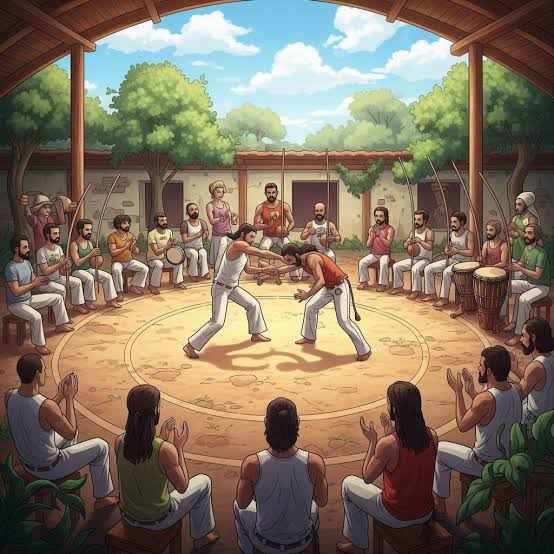
GREETINGS!
I was talking with a friend before we went to a roda, and she brought up the Hindu/Buddhist concept of ahimsa (non-violence). This intriguing discussion sparked a deeper contemplation about the principles of non-violence and how they can be integrated into various practices. Since then, I have wondered how that concept would apply to Capoeira Angola, a beautiful and dynamic art form that involves not only physical movement but also cultural expression and emotional connection. I found myself reflecting on the duality of the martial art, especially considering that I had given her a Straight Razor for Christmas—a symbol of sharp edges and potential harm. It was a thought-provoking contrast, prompting me to explore how Capoeira, while being a form of self-defense, could still embody the essential tenets of compassion and respect towards others. In grappling with these ideas, I realized that the spirit of ahimsa could serve as a guiding light, encouraging us to engage in our practices with mindfulness and intention.
So, here is my answer
To truly understand how an angoleiro uses ahimsa (non-violence) to sharpen their art, we must look past the surface philosophy and delve deeper into the intricacies of this practice. In Capoeira Angola, non-violence is not passive; rather, it is a highly active, strategic choice that requires immense physical prowess and psychological dominance. This approach demands that the angoleiro remain constantly aware of their surroundings, anticipating movements and intentions from their partner while embodying a spirit of respect and harmony. It’s a dance of minds and bodies, where every evasive maneuver and counteraction is laden with intention, skillfully blending playfulness with a profound understanding of one’s own limits and strengths. By embracing ahimsa, the angoleiro not only hones their fighting capabilities but also cultivates resilience, patience, and wisdom—qualities that transcend the game and enrich their broader life experiences.
Here is an in-depth breakdown of the ritual mechanics, movements, and psychological traps that turn non-violence into the ultimate display of martial mastery.
The Anatomy of Malícia: The Illusion of Vulnerability
In a standard fight, defense means hiding your weaknesses. In Capoeira Angola, defense often means flaunting your weaknesses to see what your opponent will do with them. This is the heart of malícia.
An angoleiro might deliberately turn their back, pretend to stumble, or offer an unprotected head. This is not a mistake; it is an invitation.
- The Ahimsa Test: If the opponent bites the bait and rushes in with a violent, aggressive strike, they reveal their lack of control.
- The Counter-Trap: Because the angoleiro anticipated this aggression, they smoothly evade the rushed attack and place themselves in a position to deliver a fatal counter-strike—such as a cabecada (headbutt to the abdomen) or a rasteira (sweeping takedown).
By stopping this counter-strike just short of impact, the angoleiro wins the psychological war. They prove that the opponent’s violent intent was their undoing, achieving victory without spilling a drop of blood.
The Chamada: The Ultimate Ritual of Trust and Peril

Nowhere is ahimsa more fiercely tested than during a chamada (the call). At any point in a traditional game, one player can freeze, raise their hands in a specific ritual posture, and “call” the other player over.
When you enter a chamada, you step into a hyper-condensed space of vulnerability. The two players walk forward and backward in close, synchronized contact.
- The Philosophy: It is a physical manifestation of ahimsa. Both players voluntarily lower their guards and agree to a temporary truce. It tests whether you can suppress your ego and violent impulses when your opponent is completely exposed.
- The Consequence: If a player breaks the truce and tries to sneak-attack during a chamada, they violate the sacred code of the art. Because seasoned angoleiros are always hyper-aware, they will instantly detect the shift in muscle tension and punish the betrayal with a devastating, lightning-fast takedown. True ahimsa creates the discipline required to maintain this tense, beautiful peace.
Negativa and Resistência: Winning by Yielding

In Western combat sports, a strike is often met with a block—force against force. Capoeira Angola rejects this entirely. To block is to accept the terms of violence.
Instead, angoleiros utilize negativas (low, ground-level evasions). When a high kick comes, the angoleiro does not stand their ground; they collapse fluidly to the floor, shrinking their target to almost nothing.
| Martial Approach | Physical Action | Psychological Result |
| Aggressive Blocking | Force meets force directly | Escalates tension; breeds injury and anger |
| Angola Evasion (Negativa) | Fluidly collapsing to the floor | Exhausts the attacker; resets the game’s rhythm |
By dropping low, the angoleiro lets the attacker’s violent energy sail harmlessly through empty air. The attacker is left off-balance and exhausted, while the angoleiro is coiled on the ground like a spring, perfectly positioned to take over the space. You win not by overpowering the enemy, but by making yourself impossible to hit.
The Berimbau: The Sonic Enforcer of Ahimsa
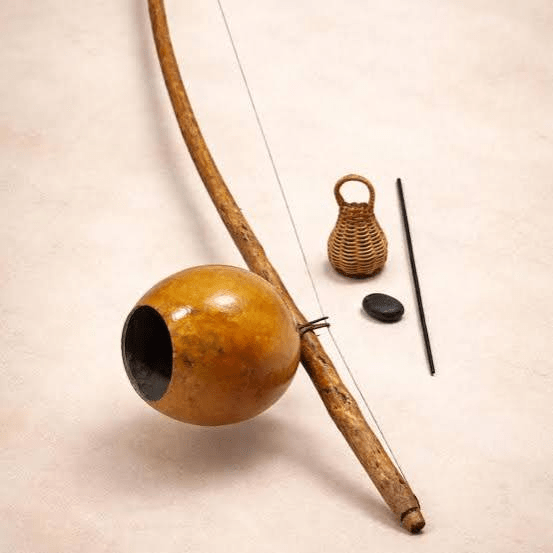
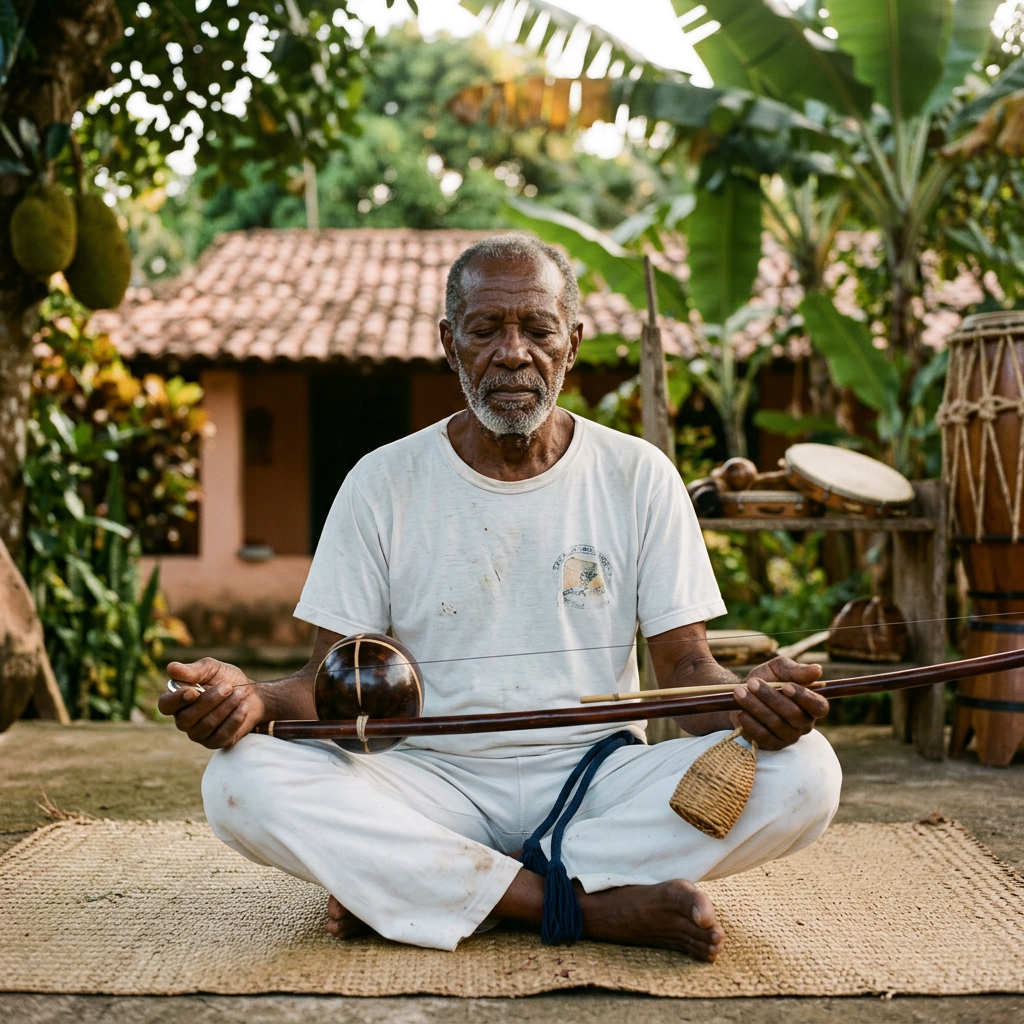
An angoleiro’s commitment to ahimsa is constantly measured and guided by the berimbau (the primary musical bow of the roda). The leader of the music controls the speed, tone, and intent of the game.
If the players begin to get too aggressive, the berimbau player will skillfully alter the rhythm—often switching to a slower, heavier command like Angola Pequena or to a warning rhythm such as Iúna, which serves as a gentle reminder of the delicate balance within the game. The music communicates an essential message to the players: “You are losing your cool. Bring your mind back to the art.” This subtle yet impactful shift in rhythm helps to re-establish focus, encouraging players to regain composure and redirect their energy towards a more harmonious engagement. It underscores the importance of mindfulness in capoeira, where the flow of the game is as much about mental clarity and respect as it is about physical prowess, reminding everyone involved that capoeira is not merely a fight, but a dialogue expressed through movement and sound.
A master angoleiro listens to the music as much as they watch their opponent. Aligning their movements with the instruments ensures that their physical actions remain a creative dance of survival rather than a reckless brawl.
The Peaceful Warrior’s Blueprint
Ultimately, applying ahimsa to Capoeira Angola strips away the clumsy, chaotic nature of raw violence. It forces the practitioner to develop flawless timing, supreme spatial awareness, and absolute emotional control, which are crucial elements for success not only in the game itself but also in everyday life. By embracing this philosophy, the angoleiro transforms each encounter into a dialogue of movement and intention, where the focus shifts from merely outmaneuvering an opponent to engaging in a dance of respect and mutual understanding. By choosing not to harm, the angoleiro elevates the martial art into a profound chess match where the ultimate prize is mutual survival and spiritual growth, fostering a deep sense of community among practitioners who realize that their true victories lie in uplifting one another rather than defeating each other. This approach cultivates a meaningful bond that transcends the physical aspects of Capoeira, leading to a rich tapestry of cultural expression and personal development.
Beyond the Roda: From Physical Chess to Everyday Conflict

The magic of Capoeira Angola is that the roda is not an escape from reality—it is a laboratory for it. The exact same mechanics an angoleiro uses to disarm an opponent without violence can be directly applied to our daily battles. Whether you are dealing with a hostile coworker, a heated family argument, or the internal friction of everyday stress, the philosophy of ahimsa offers a masterclass in modern conflict resolution.
Here is how to take the peaceful warrior’s blueprint out of the circle and into the world.
1. Practice “Evasion” Instead of Aggressive Blocking
When someone attacks us verbally—with a harsh insult, criticism, or an angry email—our instinct is to block. We get defensive, match their volume, and fire back. In capoeira terms, this is force meeting force, which only escalates the violence.
An angoleiro would use a esquiva (evasion). In daily life, this means refusing to absorb or fight the negative energy.
- The Movement: Instead of arguing back, you step aside. You can do this by pausing, taking a breath, or asking a neutralizing question like, “Can you help me understand why you feel that way?”
- The Result: By yielding and redirecting the conversation, you let their anger sail harmlessly past you. They are left off-balance because they expected a fight, giving you the strategic advantage to de-escalate the situation.
2. Spot the Bait and Avoid the Ego Trap
We have all experienced moments where someone tries to pull us into a trap—a passive-aggressive comment designed to make us lose our cool. This is the real-world equivalent of malícia (cunning).
When you react with immediate, raw emotion, you fail the ahimsa test. You give up your power and let the other person dictate the terms of the interaction. By channeling the discipline of a seasoned angoleiro, you recognize the bait for what it is: a test of your emotional control. By choosing not to bite, you maintain your dignity, stay centered, and protect your personal peace.
[ Toxic Comment / Provocation ] ──────────────────────┐
│
┌─────────────────── Your Choice ─────────────┴──────┐
▼ ▼
[ React with Anger (Ego) ] [ Pause & Evade (Ahimsa) ]
│ │
(You lose control; conflict escalates) (You retain power; tension deflates)
3. Protect the “Axé” of Your Community
In Capoeira, the game collapses if the collective energy (axé) of the group is destroyed by ego. The same is true for your home, your workplace, or your friendships.
Winning an argument at the cost of destroying a relationship is a false victory. When you approach everyday disagreements with the mindset of ahimsa, your goal shifts from “winning the fight” to “preserving the relationship.” You learn to express boundaries firmly but without malice, ensuring that the shared environment remains safe, respectful, and functional for everyone involved.
The Ultimate Takeaway
Applying ahimsa doesn’t mean becoming a doormat. Just like the angoleiro, you remain highly sharp, intensely aware, and fully capable of defending yourself when necessary. The difference lies in your intent and mindset. By choosing non-violence in a chaotic world, you transform from a reactive participant in conflict into a master of human connection. This intentional shift empowers you to navigate difficult situations with grace and understanding, fostering an environment where dialogue and empathy thrive. In essence, practicing ahimsa allows you to harness your inner strength, creating space for compassion and mutual respect, ultimately leading to more harmonious relationships and a deeper sense of peace within yourself.