Unpacking the “Forbidden Truths” of Black and Indigenous History

Open any social media platform today, and you will likely encounter viral videos with titles like “Forbidden Truth About Black History.” These compilations attract millions of views by promising to reveal secrets hidden from school textbooks.

While some of these viral claims border on historical myth, the core urge driving them is entirely valid: a desire to uncover the suppressed, downplayed, or painful histories of Black and Indigenous peoples in America.

To separate sensational internet trends from rigorous history, let’s explore three critical areas where academic historians have used deep archival research to bring hidden truths to light.


1. The Erasure of Pre-Colonial Indigenous Alliances

A common theme in viral videos is that Black and Indigenous histories are completely separate. However, academic historians have long studied the deeply intertwined histories of African and Native American peoples—histories that colonial powers actively tried to suppress.

The Hidden History

Colonial governments in the Americas feared nothing more than a unified rebellion of enslaved Africans and Indigenous nations. To prevent this, colonial laws were specifically designed to sow division between the two groups. Despite this, vibrant communities of Afro-Indigenous peoples formed, most notably the Black Seminoles of Florida. For decades, escaped African slaves and Seminole Indians lived together, intermarried, and successfully fought off the U.S. Army during the Seminole Wars.

What the Academic Sources Say

  • The Text: Black Indians: A Hidden Heritage by William Loren Katz.
  • The Research: Katz’s pioneering work uses historical documents and photographs to prove that European conquerors intentionally drove a wedge between Africans and Native Americans. He documents how the erasure of their shared resistance served to weaken both groups’ claims to land and freedom.

2. The Physical and Economic Theft of “Black Wall Street”

For decades, the destruction of wealthy Black communities across America was a literal “forbidden truth”—omitted from state curricula, newspaper archives, and history books.

The Hidden History

The most famous example is the Tulsa Race Massacre of 1921, where a white mob destroyed the Greenwood district of Oklahoma, known as Black Wall Street. Up to 300 people were killed, and thousands of homes and businesses were burned to the ground. Crucially, the “hidden” aspect isn’t just the violence itself, but the massive, multi-generational theft of wealth. Black families were never compensated for their property losses, and insurance companies systematically denied their claims.

What the Academic Sources Say

  • The Text: The Nation Must Awake: My Witness to the Tulsa Race Massacre of 1921 by Mary E. Jones Parrish.
  • The Research: Kept alive for decades primarily through oral history and independent Black journalists, academic institutions have only recently integrated these primary accounts into mainstream American history. Scholars today use property deeds and economic data to show how the destruction of Greenwood permanently altered the trajectory of generational Black wealth in America.

3. Medical Exploitation and Unconsented Science

Viral commentary frequently touches on deep-seated distrust of medical institutions. Academics have verified that this distrust is rooted in a dark, historically suppressed reality of medical apartheid.

The Hidden History

Modern medicine was built, in large part, on the unconsented exploitation of Black bodies. In the 19th century, Dr. J. Marion Sims, celebrated as the “father of modern gynecology,” performed agonizing experimental surgeries on enslaved women without anesthesia. In the 20th century, researchers deliberately left Black men untreated to study the ravages of disease in the infamous Tuskegee Syphilis Study, while the cancer cells of an unwitting Black patient named Henrietta Lacks were taken to create the first immortal human cell line (HeLa), generating billions for the medical industry without her family’s knowledge.

What the Academic Sources Say

  • The Text: Medical Apartheid: The Dark History of Medical Experimentation on Black Americans from Colonial Times to the Present by Harriet A. Washington. [1]
  • The Research: Washington’s comprehensive study won the National Book Critics Circle Award by rigorously documenting centuries of medical racism. She reveals that these were not isolated incidents, but an institutionalized practice where the medical establishment viewed Black people as experimental subjects rather than patients.

Moving Past the Clickbait

The internet loves the word “forbidden” because it implies a conspiracy. The reality is often more mundane but equally damaging: history is written by the victors, and the narratives taught in schools have traditionally served to protect institutional power.

We do not need to rely on unverified social media conspiracies to find the truth. By turning to peer-reviewed academic history, we find a reality that is thoroughly documented, deeply challenging, and essential for understanding the modern world.


The Digital Time Machine: How to Access Real Historical Documents From Your Laptop

The internet is flooded with creators talking about “hidden history.” But you don’t have to take a stranger’s word for it. The most powerful tool against historical misinformation is the primary source—the actual diaries, photographs, court records, and audio tapes recorded by the people who lived through these events.

Thanks to massive digitization projects by universities, libraries, and museums, you can now access the raw evidence of Black and Indigenous history for free. Whether you are writing a research paper, building a video script, or simply looking for the truth, here is your ultimate guide to the best online digital archives.


1. Uncovering First-Hand Accounts of Slavery

To understand the psychological and physical realities of the Transatlantic Slave Trade and plantation life, you can bypass secondary textbooks and go straight to the voices of the people who survived it.

  • Born in Slavery (Library of Congress): This massive database contains more than 2,300 first-person accounts and 500 photographs of formerly enslaved individuals. These narratives were collected in the 1930s as part of the Federal Writers’ Project, offering an unfiltered look at plantation life from those who remembered it.
  • Voices Remembering Slavery (Library of Congress): If you want to actually hear history, this archive features rare, digitized audio recordings of freed people sharing their memories of slaveholders, family separations, and the dawn of emancipation.
  • Documenting the American South (UNC Chapel Hill): This project offers full-text, searchable digital editions of autobiographies and narratives written by fugitive and former slaves, providing a deep look into early African American literature and resistance.

2. Tracking Looted Wealth and Racial Violence

A major theme in modern historical commentary is the systematic destruction of Black economic power. These archives house the legal and physical evidence of that destruction.

  • The Smithsonian NMAAHC Digital Collection: The National Museum of African American History and Culture hosts thousands of digitized artifacts. Here, you can examine structural records, business ledgers, and items recovered directly from the ruins of the 1921 Tulsa Race Massacre (Black Wall Street).
  • The National Archives (NARA) African American Heritage Portal: This is the gold standard for official government records. You can search through federal military files, Freedman’s Bureau documents, maps, and land deeds to track exactly how Black and Indigenous properties were legally and physically dismantled across generations.

3. Exposing the Roots of Medical Apartheid

If you are researching the dark history of unconsented medical experimentation on Black Americans, these institutional portals hold the official paper trails.

  • The Tuskegee Syphilis Study Records (National Archives Catalog): You can look through the actual government correspondence, medical charts, and court filings that exposed the decades-long study where Black men were intentionally left untreated for syphilis by public health officials.
  • The HeLa Resource Portal (Johns Hopkins / NIH): This archive documents the historical timeline and modern ethical framework surrounding Henrietta Lacks, the Black patient whose cancer cells were harvested without her knowledge in 1951, creating the foundational cell line for modern biomedical research.

4. Exploring the Intertwined History of Black and Native Peoples

The deep political and cultural alliances between Black and Native American nations—like the Black Seminoles—are often omitted from standard school curricula. You can piece this history back together using these specialized collections.

  • The Amistad Research Center (Tulane University): As the nation’s oldest independent archive specializing in ethnic minority relationships, this center provides rare manuscripts letters, and organizational records detailing shared civil rights and survival struggles.
  • The National Museum of the American Indian (Smithsonian): This online portal allows you to browse colonial legal decrees, treaties, and cultural exhibits that highlight the overlapping histories and shared spaces of Afro-Indigenous communities.

5. The Ultimate Multi-Archive Search Tools

Instead of jumping from website to website, you can use aggregate search engines that comb through hundreds of university libraries and museum basements simultaneously.

  • UMBRA Search African American History: This tool acts like a specialized Google, granting you instant access to over 800,000 digitized primary source materials from more than 1,000 different libraries and archives.
  • Digital Schomburg (New York Public Library): Curated by one of the world’s premier research libraries on the global Black experience, this site connects you to millions of rare books, photographs, and manuscripts spanning centuries of global history.

How to Start Your Search

When diving into these archives, remember that historical language changes. If you aren’t finding what you need, try searching using the terminology of the era you are researching (for example, searching for “Freedmen” or “Colored troops” when looking into Civil War-era documents).


Legislate, Dispossess, and Control: The Real Paper Trail of American History

When viral videos talk about the “forbidden truths” of Black and Indigenous history, they often frames it as a grand conspiracy. But the most shocking reality is that the systems of land theft, human commodification, and racial control weren’t done in secret—they were explicitly written into the federal laws and treaties of the United States.

If you want to understand how these historical events were codified, you have to read the actual legal documents. Here is your digital field guide to the major laws and treaties that shaped Black and Indigenous history, along with direct links to view the primary sources online.


1. Codifying Land Theft: The Indian Removal Act (1830)

  • The Context: Signed into law by President Andrew Jackson, this act authorized the federal government to force Native nations off their ancestral homelands in the American Southeast. It opened up millions of acres of rich agricultural land to white settlers—land that was subsequently cleared and farmed using enslaved Black labor. This act directly caused the forced displacement known as the “Trail of Tears”.
  • The Document: You can read the original text of the bill and view Congressional debates via the Library of Congress Indian Removal Act Digital Guide.
  • The Progress Report: To see how the administration justified this forced migration, read President Andrew Jackson’s Message to Congress “On Indian Removal” on the National Archives portal.

2. Stripping Rights Across Borders: The Fugitive Slave Act (1850)

  • The Context: As part of the multi-statute National Archives Compromise of 1850 Guide, this draconian federal law forced citizens in free Northern states to actively assist in the capture and return of escaped slaves. It denied accused fugitives the right to a jury trial and famously paid federal judges $10 if they ruled a person was an escaped slave, but only $5 if they set them free.
  • The Document: View the digitized physical pages of this law on the National Archives Fugitive Slaves Education Page.
  • The Court Cases: To see how this law operated in real-world courtrooms, browse the digitized National Archives Fugitive from Labor Records to read the actual trial transcripts of captured Black Americans fighting for their freedom.

3. Dividing Shared Heritage: The Dawes Act (1887)

  • The Context: This law authorized the federal government to break up communal tribal lands into individual plots. To decide who received land, the government created the “Dawes Rolls”. Government agents separated citizens into strict categories: “Indians by Blood” or “Freedmen” (the descendants of Black people enslaved by Native nations). Even if a Freedman had Native ancestry, they were frequently stripped of their tribal land rights and categorized with zero “blood quantum”, a legal division that still impacts Afro-Indigenous citizenship rights today.
  • The Document: Search the digitized ledger pages, names, and photographs of the original census via the National Archives Dawes Rolls Records Database.

4. Broken Sovereignty: The Treaty of Fort Laramie (1868)

  • The Context: Treaties are legally binding agreements between sovereign nations. In this specific document, the U.S. government recognized the Black Hills of Dakota as the exclusive territory of the Sioux and Arapaho people. However, once gold was discovered on the land, the U.S. government completely violated the treaty. In 1871, Congress officially ended the century-old practice of making treaties with Native tribes entirely.
  • The Document: Read the timeline of how this and other legal agreements were dismantled on the History Channel Broken Treaties Guide.

Why Primary Legal Source Material Matters

When studying history, laws and treaties serve as immutable proof. They show that systemic displacement and racial control weren’t just a collection of bad individual choices—they were the explicit policy of the United States government, signed into law on parchment paper.


History is Not a Text Hero: How Century-Old Laws Still Rule Modern Courtrooms

Adding a final section on how these laws function today bridges the gap between historical abstractness and modern reality. It shows readers that these centuries-old legal records are not just dusty documents in a museum basement—they are actively being litigated in federal, state, and tribal courts right now.

Here is how you can write this final, impactful section for your blog post or video essay script.


From the Archives to the Courtroom: Why These Laws Still Matter Today

The biggest misconception about Black and Indigenous history is that it is strictly in the past. In reality, the legal ink dried over a century ago, but the ripple effects are still dictating massive land rights, multi-billion-dollar tax battles, and modern civil rights disputes.

1. The Dawes Act and the Modern Battle for Afro-Indigenous Citizenship

The legal division created by the 1887 Dawes Act—which partitioned tribal lands and separated families into “Indians by Blood” and “Freedmen” (the descendants of Black people enslaved by Native nations)—remains a highly contested civil rights issue.

  • The Modern Impact: While nations like the Cherokee Nation have fully restored citizenship rights to Black Freedmen, others are still navigating intense legal battles. For example, descendants of Muscogee (Creek) Freedmen filed a federal lawsuit. Despite a historic tribal Supreme Court ruling affirming that an 1866 treaty guarantees their citizenship, thousands of Black descendants are still fighting tribal administrative boards for their identity cards, voting rights, and healthcare access.

2. The Treaty of Fort Laramie and the Black Hills Land Dispute

When the U.S. government broke the 1868 Treaty of Fort Laramie to seize rich land in South Dakota, they created a legal battle that remains unresolved to this day. This breach not only led to the loss of valuable territory for the Lakota Sioux tribe but also ignited a series of disputes that involved various stakeholders, including indigenous rights advocates and state authorities. Over the years, numerous court cases and legislative measures have attempted to address the grievances stemming from this treaty violation, highlighting the ongoing struggle for justice and recognition faced by Native American communities. As the narrative unfolds, it emphasizes how historical grievances continue to shape contemporary discussions about sovereignty, reparations, and cultural preservation among indigenous peoples in the United States. The implications of these unresolved issues are felt not just in legal terms, but also in the social and economic disparities that persist in the lives of the affected tribes.

  • The Modern Impact: In the landmark case United States v. Sioux Nation of Indians, the U.S. Supreme Court officially ruled that the land was stolen and ordered a financial payout. However, the Sioux Nation famously refused the money, demanding the actual return of their sacred Black Hills land instead. That trust fund has sat in the U.S. Treasury accumulating interest for decades, now worth over $1 billion, because the sovereign nations refuse to sell their sacred heritage.

3. The Resurrection of Broken Treaties: McGirt v. Oklahoma

For over a century, the state of Oklahoma acted under the assumption that the reservations belonging to the Muscogee, Cherokee, Chickasaw, Choctaw, and Seminole nations had been legally dissolved during westward expansion. [1]

  • The Modern Impact: In the monumental Supreme Court case McGirt v. Oklahoma, the highest court in the land looked directly at historical treaties and ruled that because Congress never explicitly dissolved the Muscogee (Creek) reservation, almost half the state of Oklahoma remains sovereign Indian Country for criminal jurisdiction. This single decision completely upended the state’s legal system, forcing state, federal, and tribal police forces to entirely rewrite how they handle law enforcement and jurisdictional boundaries.

What does this have to do with Capoeira Angola?

Capoeira Angola is intimately linked to this legacy as a profound methodology for mobilization and resistance against historical and contemporary legacies of state repression. Far more than a martial art or folk dance, it emerged from the crucible of transatlantic slavery in Brazil as a clandestine technology for liberation, serving as a covert training regimen, a medium for political communication, and a vital mechanism for preserving ancestral knowledge.

Within the oppressive structures of colonial and post-colonial Brazil, colonial laws actively sought to suppress Afro-Indigenous alliances, such as the Black Seminoles, which were emblematic of resistance and solidarity against systemic oppression. These laws aimed to dismantle any semblance of unity among marginalized groups, fearing the power that such alliances could wield. Similarly, in Brazil, Capoeira Angola functioned alongside the revolutionary framework of the quilombos—self-governing communities established by escaped enslaved people who sought refuge from brutalities of the colonial regime. In these all-important havens of freedom,

Capoeira was not merely a form of dance or martial art; it became the essential non-state asset that ensured the quilombo’s survival, fostering a unique cultural identity and resilience among its members. This practice not only provided group defense against potential intrusions by colonial authorities but also facilitated strategic communication and community solidarity outside the control of the state apparatus. Through the rhythms and movements of Capoeira Angola, the quilombo inhabitants cultivated a profound sense of belonging, reinforcing their collective spirit and commitment to autonomy in the face of persistent threats, thereby making their legacy a pivotal aspect of Brazil’s cultural heritage.


The Takeaway

When you watch a viral video discussing the “forbidden truths” of American history, don’t look at it as a closed chapter that is neatly wrapped up and preserved for educational purposes. The laws, treaties, and contracts written in the 1800s remain the “Supreme Law of the Land” under the U.S. Constitution, echoing the intentions and circumstances of a bygone era. We aren’t just living with the memory of history—we are actively living inside the legal architecture that our ancestors built, a framework that influences our everyday lives in profound ways.

These historical documents continue to shape the social, economic, and political landscape of contemporary America, reminding us that the past is not merely a distant story but an ongoing dialogue that defines our identity as a nation. Each document serves as a testament to the values, beliefs, and challenges faced by previous generations, illustrating the complexities of their experiences and decisions. Understanding this connection allows us to engage more critically with present issues, recognizing that the struggles and triumphs of previous generations resonate within our current societal challenges. In doing so, we gain a greater appreciation for the rights and freedoms we enjoy today, while also bringing to light the ongoing injustices that persist. This awareness empowers us to advocate for change, inspiring a commitment to address the inequities that still exist, ensuring that the lessons of history guide us toward a more inclusive and equitable future.
SPIRITUAL PRACTICES OF AFRICA, AND THE DIASPORA (6/28/26)

Spiritual practices across Africa and its global Diaspora serve as a profound bridge, connecting the living with their ancestors and the divine through intricate belief systems and mediating deities. Foundational cosmologies, such as the Yoruba pantheon of Òrìṣà and the Gbe Vodun traditions, are currently experiencing a significant global resurgence as individuals increasingly seek to rediscover and reclaim their ancestral roots. These traditions are maintained through the flexible mechanism of oral tradition, the consistent execution of sacred rituals, and the cultural practice of storytelling. Within these systems, sacred healers play a critical role in restoring cosmic balance, utilizing rituals and deep-seated ancestral wisdom to guide their communities. Furthermore, venerated artifacts and botanical treasures, such as the kola nut (Ọjị), facilitate spiritual communion and reinforce cultural identity. The enduring role of ancestral worship remains a potent contemporary expression of heritage, acting as a vital anchor for collective identity and ensuring social continuity by transmitting ethical frameworks across generations. This spiritual revival not only highlights the extraordinary resilience of African traditions despite historical displacement like the transatlantic slave trade but also encourages new generations to engage in practices that honor their unique cultural narratives and foster a deep sense of community belonging.

Across the African landscape, a singular fruit serves as a vital anchor for marital bonds, diplomatic truces, and the sacred remembrance of those who came before.

The Sacred Kola Nut examines the profound significance of Ọjị and Obi, illustrating how this botanical treasure evolved into a quintessential emblem of hospitality and divine covenant within West and Central African societies. This exploration delves into the cultural narratives of Cola acuminata and Cola nitida, the ancestral invocations of the Igbo, Yoruba, and Edo peoples, and the intricate divinatory meanings held within the fruit’s distinct lobes.

Transcending its role as a mere ceremonial offering, the kola nut facilitates the initiation of communal councils, festive celebrations, and spiritual assemblies. Through the lens of indigenous wisdom and historical continuity, this documentary reveals why traditional gatherings remain incomplete until this sacred artifact is elevated, consecrated, and distributed among the collective.

For those dedicated to rediscovering African heritage and the enduring legacy of the ancestors, this inquiry provides a transformative perspective on a foundational pillar of continental identity and spiritual resilience.

The kola nut, particularly the Cola acuminata known as Ọjị Igbo, is revered as the “king of all fruits” in West African societies. It serves as a sacred medium of communication, bridging the gap between the living, the ancestors, and the divine. In Igbo culture, the proverb “He who brings kola brings life” (Onye wetara ọjị, o wetara ndụ) underscores its role as a quintessential emblem of hospitality, unity, and peace.

The ritual of Iwa Oji (breaking the kola nut) follows strict traditional protocols:

  • Presentation & Blessing: The host presents the nut to guests using two hands to signify acceptance and goodwill. An elder or title holder then offers prayers and incantations, invoking blessings for long life, prosperity, and protection. This process, often conducted exclusively in the Igbo language, is a solemn ritual of thanksgiving and supplication to the Creator (Chineke).
  • Symbolism of Lobes: Upon breaking by hand—as knives are traditionally forbidden—the number of lobes (cotyledons) revealed holds profound divinatory and social meaning.
    • 2 Lobes (Ọjị Ogbi): Known as the “dumb” kola, it is considered a bad omen and is typically not served in traditional Igbo rituals.
    • 3 Lobes (Ọjị Ato / Ọjị Okike): Symbolizes individual achievement, success, and fecundity; it is often associated with warriors and achievers.
    • 4 Lobes (Ọjị Ano / Ọjị Udo na Ngozi): Represents the four Igbo market days (Eke, Orie, Afo, Nkwo) and symbolizes peace, social justice, and balanced progress.
    • 5 Lobes (Ọjị Ise): A sign of reproduction, increase, and communal fertility, traditionally offered to those with large, successful families.
    • 6 or 7 Lobes (Ọjị Asa): Signifies double prosperity and outstanding blessings; in some regions, a 6-lobed nut may require a separate celebration, such as the slaughter of a goat.
  • Sharing & Social Bond: Once broken, the pieces are distributed to all present, often served with a spicy peanut or pepper sauce. This act establishes a bond of oneness, sealing treaties and conflict resolutions.

Beyond its spiritual and social utility, the kola nut contains caffeine, theobromine, and kolatin, which provide natural stimulation and act as an appetite suppressant. Medicinally, it has been used to treat fatigue, aid digestion, and even combat infections. This unique combination of botanical properties and ancestral wisdom ensures that the kola nut remains an indispensable artifact in traditional West African life.

The ritual of Iwa Oji (breaking the kola nut) follows strict traditional protocols:

  • Presentation & Blessing: The host presents the nut to guests to signify acceptance and goodwill. An elder or title holder then offers prayers and incantations, invoking blessings for long life, prosperity, and protection.
  • Symbolism of Lobes: The number of lobes (cotyledons) revealed upon breaking holds profound divinatory meaning.
    • 3 Lobes (Ọjị Ato): Represents individual achievement and good omens.
    • 4 Lobes (Ọjị Ano): Symbolizes the four market days (Eke, Oye, Afo, Nkwo) and represents social justice, peace, and balance.
    • 5 Lobes (Ọjị Ise): Indicates fertility, reproduction, and communal increase.
    • 6+ Lobes: Signifies prosperity, double blessings, and a direct communion with the ancestors.
  • Sharing: Once broken, the pieces are distributed to all present, establishing a bond of oneness and communal resilience.

Beyond its spiritual and social utility, the kola nut contains caffeine, theobromine, and theophylline, which provide natural stimulation and aid digestion. This unique combination of botanical properties and ancestral wisdom ensures that the kola nut remains an indispensable artifact in traditional ceremonies, from marriages to conflict resolution.

Support Historyinstore

The HistoryInStore channel, which has grown to over 46,000 subscribers and features more than 250 videos, is a dedicated digital platform for exploring the profound narratives and iconic events that have shaped the global landscape. For those committed to rediscovering African heritage and the enduring legacy of ancestors, this platform provides transformative perspectives on the foundational pillars of continental identity and spiritual resilience. By uncovering hidden tales and examining the incredible people of the past, the channel aims to ignite curiosity and facilitate a deeper journey through time. Recent content includes explorations of significant historical figures, such as the 13 Gods of War who influenced Africa before major global shifts.

Beyond spiritual exploration, the channel also contextualizes botanical and cultural artifacts within broader history. For instance, the study of the kola nut—the original source for the earliest cola drinks—illustrates how African exports and indigenous wisdom have influenced global commodities from the 17th century to the present day. These inquiries highlight the resilience of African traditions despite historical displacements like the transatlantic slave trade and underscore the role of these practices in fostering a deep sense of community belonging.

To follow the journey and join the community conversation, visit the official YouTube channel at:

https://www.youtube.com/@HistoryinStore

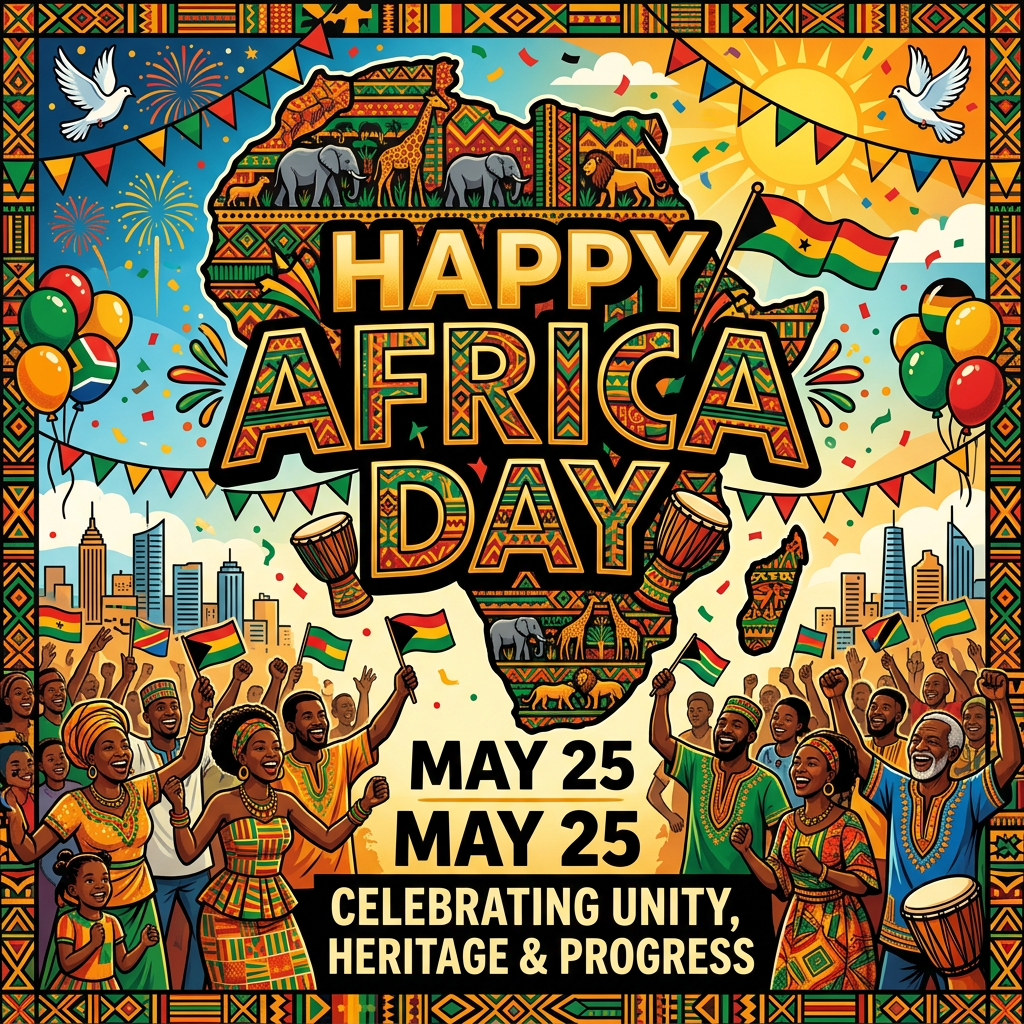
Africa Day: Reflecting on 60 Years of Unity

Diverse group celebrating Africa Day with African flags, drums, and festive decorations

Africa Day is the annual worldwide commemoration of the founding of the Organization of African Unity (OAU), which took place on May 25, 1963.

This historic event occurred in Addis Ababa, Ethiopia, where leaders from 32 independent African states gathered to sign the foundational charter, marking a monumental step toward decolonization and continental sovereignty. The OAU’s establishment was driven by a shared vision of unity, solidarity, and cooperation among African nations, aimed at addressing the continent’s challenges such as colonialism, apartheid, and economic dependency. Over the years, Africa Day has evolved into a celebration of African culture, pride, and achievements, and serves as a reminder of the importance of collaboration in building a more prosperous and equitable future for all African people. Each year, various events, discussions, and activities are organized across the globe to honor the rich diversity of the continent, highlighting its potential and the ongoing journey towards greater autonomy and self-sufficiency.

The OAU was established with the primary mission of promoting cooperation among African states, safeguarding their territorial integrity, and eradicating all forms of colonialism from the continent. This organization plays a crucial role in facilitating dialogue among member countries, fostering peace, and addressing conflicts that threaten regional stability. It is celebrated globally to honor African unity, highlight the continent’s rich cultural diversity, and reflect on the ongoing progress and challenges faced by African nations in their pursuit of self-determination and economic stability. Furthermore, the OAU seeks to empower African nations to develop sustainable economic practices while fostering a spirit of solidarity that can inspire generations to come. By addressing issues such as healthcare, education, and infrastructure development, the organization aims to create a brighter future for all Africans, ensuring that the continent’s vast potential is realized and that its voices are heard in the global arena.

Today, Africa Day serves as a vital platform to acknowledge the significant transition from the Organization of African Unity (OAU) to the African Union (AU) in 2002, a transformative move intended to accelerate socio-economic integration across the continent. This pivotal change aimed not only to enhance political collaboration among African nations but also to address pressing challenges, fostering a sense of unity and purpose that transcends borders. It continues to reinforce the collective vision for an integrated, prosperous, and peaceful continent as outlined in frameworks like Agenda 2063, which sets ambitious targets for sustainable development and economic growth. By celebrating the resilience and potential of Africa’s people, this day highlights the rich cultural diversity and shared aspirations of the continent, while emphasizing the importance of collaboration and innovation in achieving a brighter future for generations to come.

SPIRITUAL PRACTICES OF AFRICA, AND THE DIASPORA (5/10/26)

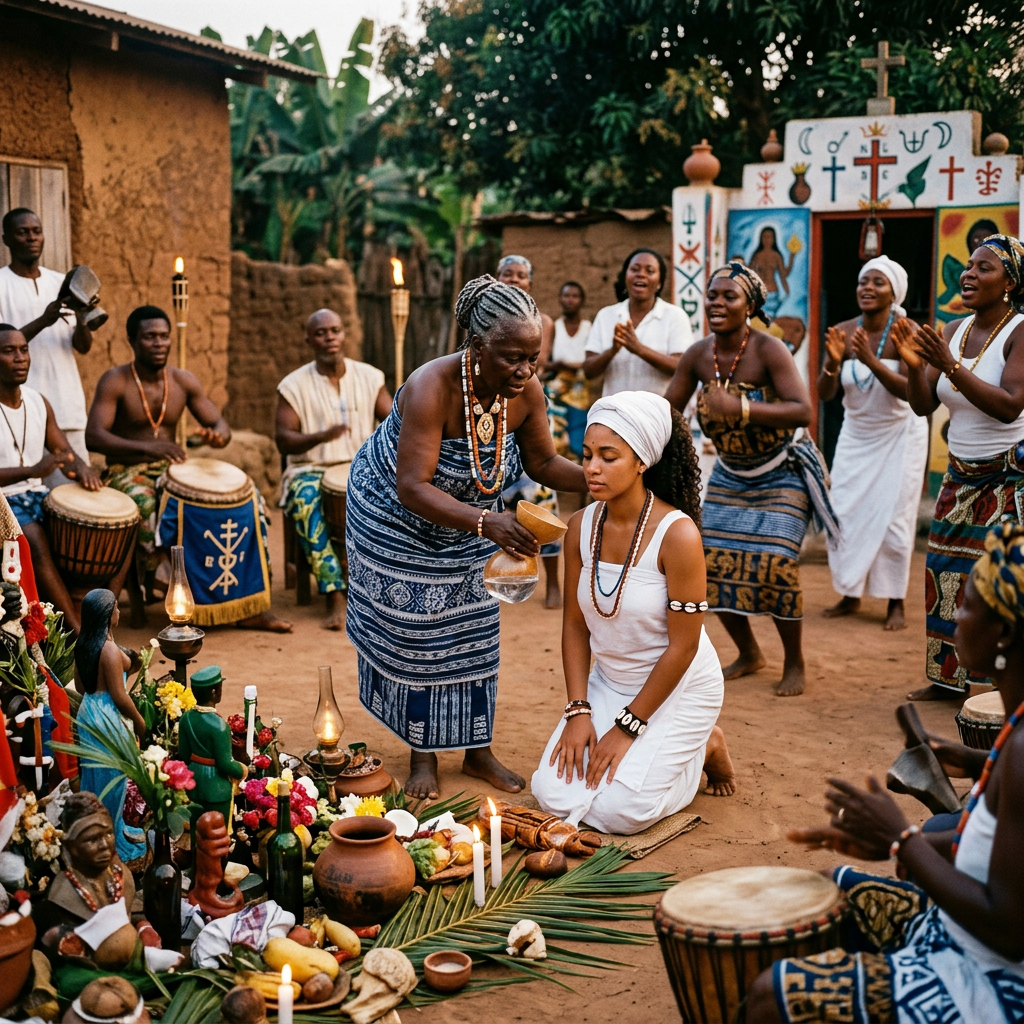
Women and men participating in a traditional African spiritual ceremony with drumming and ritual cleansing

Welcome to SPIRITUAL PRACTICES OF AFRICA, AND THE DIASPORA. These diverse indigenous belief systems emphasize the interconnectedness of the living, the deceased, and the divine. Across Africa, practices often center on a supreme being and various deities. Through the Diaspora, these philosophies evolved into related faiths like Santera, Candomble, and Vodou, continuing to shape cultural identities today.

African spirituality is deeply rooted in foundational cosmologies such as the Orishas of the Yoruba and the Vodun traditions of the Gbe-speaking peoples. These systems describe a universe built on a profound interconnectedness between the living, the ancestors, and the divine. In these worldviews, there is often a supreme being accompanied by various deities who mediate between the celestial and earthly realms.

We also explore the syncretism of Christianity and Islam with traditional beliefs. This synthesis reinterpreted foreign theology through indigenous lenses, maintaining deep ties to African soil. Despite enduring centuries of historical colonial suppression, these indigenous belief systems proved resilient through strategic syncretism, where traditional practices were shielded behind external symbols and iconography. Central to this is ancestral worship, which serves as a contemporary anchor for identity.

Today, a global revival is taking place as sacred philosophies, languages, and rituals are reclaimed. By shielding traditional practices with external symbols, these enduring worldviews provide a sacred map for navigating modern challenges, reinforcing cultural heritage, and honoring the ancestors.

In Today’s installment…

Foundational Cosmologies and the Interconnected Universe

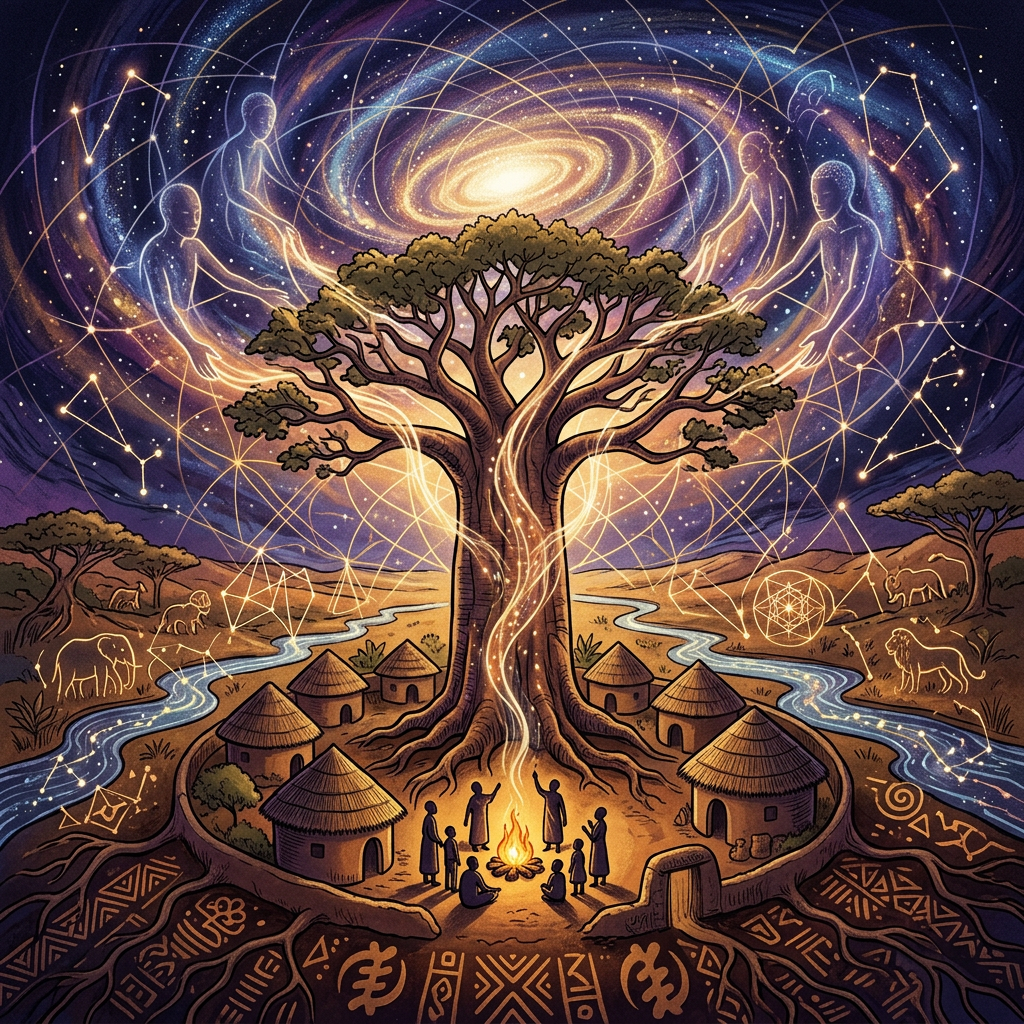
Village people around fire beneath large glowing tree with ancestral spirits and constellations

African spirituality is rooted in foundational cosmologies such as the Orishas of the Yoruba and the Vodun traditions of the Gbe-speaking peoples, which encapsulate a rich tapestry of beliefs, practices, and rituals that have been passed down through generations. These systems describe a universe built on a profound interconnectedness between the living, the ancestors, and the divine, emphasizing the importance of harmony and balance within this intricate web of existence. In these worldviews, there is often a supreme being accompanied by various deities who mediate between the celestial and earthly realms, each serving specific roles and functions that reflect the diverse aspects of life. Furthermore, rituals and offerings are integral to these practices, as they foster communication with the spiritual world, ensuring that the guidance and protection of the ancestors and deities are continually sought and maintained. This holistic approach not only reinforces community bonds but also highlights the significance of ancestry, tradition, and respect for nature within African spirituality.

Colonial Suppression and Strategic Syncretism

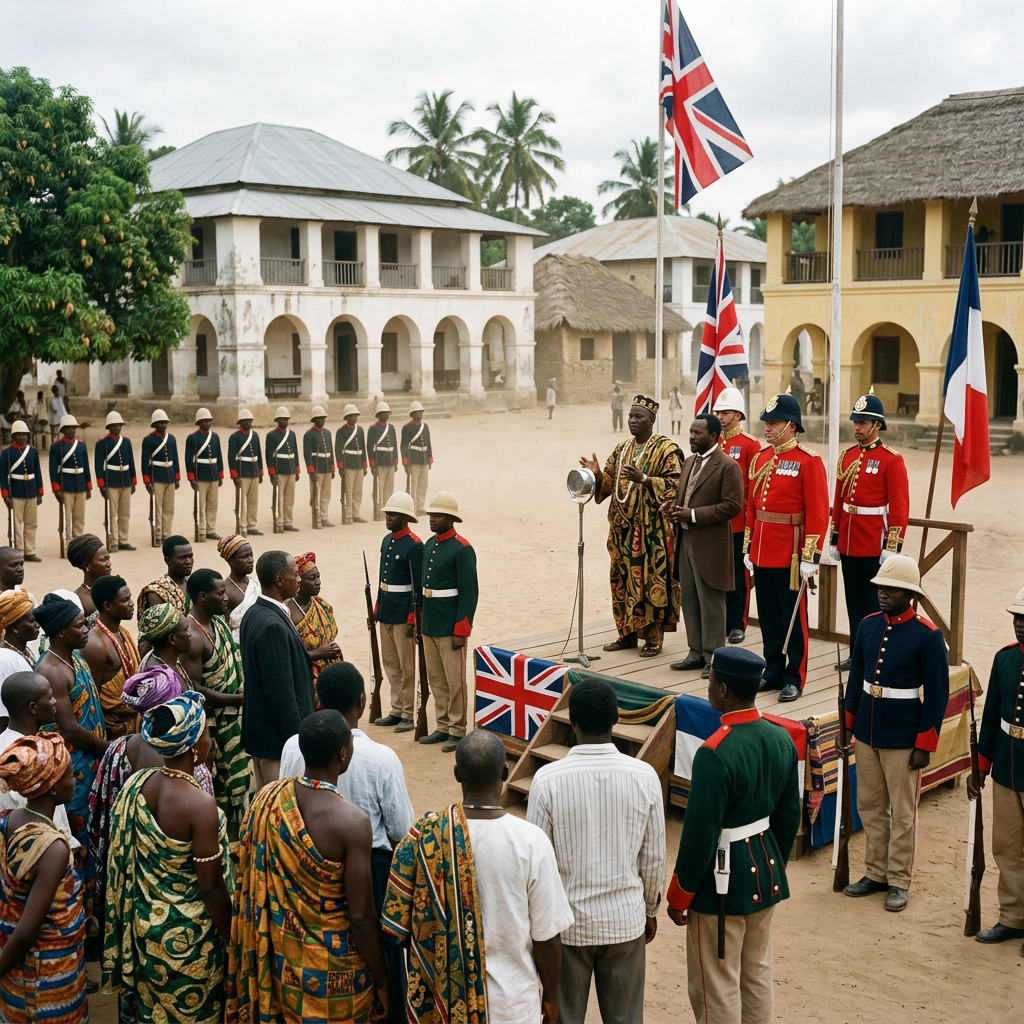
Colonial-era ceremony with African people and soldiers

Despite enduring centuries of historical colonial suppression, these indigenous belief systems proved resilient and adaptive, evolving to meet the challenges posed by external forces. They survived primarily through strategic syncretism, a method where traditional African practices were cleverly shielded behind the external symbols and iconography of Christianity and Islam, thus allowing cultural continuity amidst displacement. By reinterpreting foreign theologies through indigenous lenses, practitioners not only preserved their ancestral knowledge but also maintained deep ties to African soil. This intricate dance of belief enabled them to cultivate a spiritual identity that felt authentic, while simultaneously appearing to conform to the colonial religious mandates imposed upon them. In this way, these communities developed a rich tapestry of faith that wove together elements from different traditions, creating a unique and multifaceted spiritual landscape that continues to influence contemporary practices.

The Global Diaspora and Modern Revival

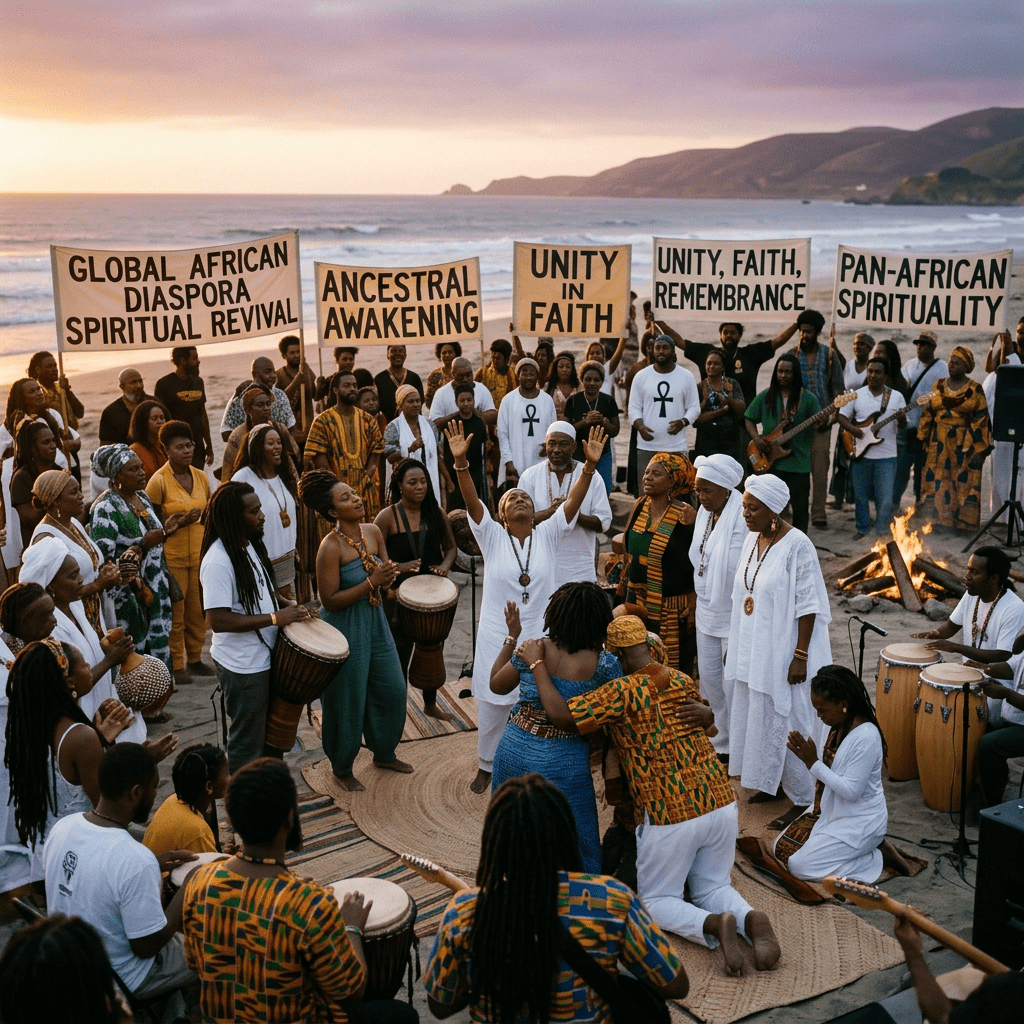
Group of people gathered on beach holding signs about African spirituality and unity
A vibrant beach ceremony celebrating Pan-African spirituality and unity

As these philosophies moved through the Diaspora, they evolved into vibrant faiths like Santería, Candomblé, and Vodou, each uniquely shaped by the cultural and historical contexts of their followers. Today, a global revival is taking place as sacred philosophies, languages, and rituals are reclaimed, drawing in individuals who seek to reconnect with their roots and navigate the complexities of contemporary life. This movement not only serves as a contemporary anchor for identity but also fosters a sense of community and belonging, allowing individuals to share their stories and experiences with others.

By reinforcing their cultural heritage and honoring ancestral worship, practitioners find strength and solace in their spiritual practices, which provide a robust framework to not only address modern challenges such as displacement, discrimination, and loss of tradition but also to cultivate a sense of community and belonging. These practices, deeply rooted in history, serve as a reminder of the resilience and wisdom of past generations, enabling individuals to draw upon age-old teachings to navigate contemporary issues. As these vibrant faiths flourish and evolve, they inspire a new generation to explore their own histories and the diverse narratives that shape their identities, leading to rich dialogues that celebrate diversity and mutual respect among different cultural expressions. This ongoing exchange of ideas fosters an environment where creativity and innovation can thrive, bridging gaps between generations and cultures, and ultimately enriching the collective human experience.

A luminous tree emitting light under a star-filled Milky Way night sky
A glowing tree illuminated with cosmic light beneath the Milky Way galaxy

O VÍDEO DO DIA DA CAPOEIRA ANGOLA (4/12/25)

Capoeira Angola videos available online offer a captivating window into a rich and vibrant cultural tradition. These digital showcases go beyond simple instruction, acting as vital archives of Capoeira’s evolution as a complex, multifaceted art form. They meticulously document the intricate interplay of music, movement, self-defense, and historical expression. Viewers are treated to demonstrations of astounding agility and technical prowess, witnessing practitioners execute intricate movements that seamlessly integrate elements of acrobatics, rhythm, and strategy. This visual record is foundational for anyone seeking a deep appreciation of the art, serving as an indispensable resource for understanding its historical roots and sociological complexity.

By providing unedited glimpses of the practice, these records are essential for understanding the historical roots, sociological complexity, and cultural significance of Capoeira Angola. These archival materials serve as a primary window into the traditional movements, rituals, and musicality that define this Afro-Brazilian art form. Beyond mere performance, this digital archive meticulously documents the intricate interplay of music, movement, self-defense, and historical expression, allowing viewers to witness the technical mastery of foundational movements like esquivas, rasteiras, and aús performed in the style’s distinctively grounded posture.

This visual medium fulfills a profound dual role: it both entertains with the physical beauty and fluid strategy of the art while serving as a vital, accessible resource for exploring Capoeira’s deep, often-untold history. By documenting the passion and commitment of the players, these videos act as dynamic educational tools that inspire future generations, portraying the art as a living tradition that embodies core values of resilience, creativity, and unwavering cultural pride. Ultimately, this medium fosters a deeper appreciation for the art as a living form of expression, historical preservation, and a testament to human resilience.

Today, we have the technical mastery of Contra Mestre Xandão do interior and Mestre Marrom SP within “Angola segura,” this archival record provides a vital window into the continuous lineage and spiritual depth of the practice.

Their participation illustrates the sophisticated technical skill and historical expression inherent in the tradition, showcasing the unwavering commitment and cultural pride that practitioners bring to the fluid strategy of the roda. Such recordings immortalize specific historical moments, capturing the interaction between esteemed figures and serving as primary sources for students and researchers worldwide. This documentation ensures that the transmission of knowledge and the continuation of the tradition are showcased in a contemporary setting, providing an immediate and invaluable window into the current vitality of the Capoeira Angola practice.

Beyond mere performance, this digital archive meticulously documents the intricate interplay of music, movement, self-defense, and historical expression, allowing viewers to witness the technical mastery of foundational movements performed in the style’s distinctively grounded posture. By documenting the passion and commitment of the players, these videos act as dynamic educational tools that inspire future generations, portraying the art as a living tradition that embodies core values of resilience, creativity, and unwavering cultural pride.

A message from the professor

The Viral Controversy: A Rebuttal to Anti-Black American Sentiments

The discourse surrounding Black Americans and the diaspora recently intensified following a highly controversial podcast episode. The episode featured guests whose comments disparaged the culture and character of Black Americans, leading to significant backlash and a crucial need for a comprehensive public rebuttal.

The Core Allegations and Their Impact

The controversy was ignited by two specific and inflammatory claims made by guests of Haitian descent on the platform:

  1. The “Dirty” Accusation: A Haitian woman on the podcast made headlines when she publicly labeled Black Americans as “dirty.” This term is not only a gross generalization but also perpetuates harmful, classist, and anti-Black stereotypes that have historically been weaponized against the community. Such a statement demonstrates a profound lack of respect and a willingness to adopt derogatory language rooted in colorism and internalized oppression.
  2. The “No Culture” Claim: A separate guest, also Haitian, asserted that Black Americans possess “no culture.” This claim is demonstrably false and erases centuries of foundational cultural contributions. African Americans have indelibly shaped global culture through innovations in music (Jazz, Blues, Hip-Hop, Rock and Roll), art, literature, dance, and distinct culinary traditions. To deny this rich, complex, and influential cultural heritage is an act of historical revisionism and intellectual dishonesty.

The Failure of the Hosts: Token Pushback

The most troubling aspect of the entire episode was not merely the offensive content itself, but the deeply concerning failure of responsibility demonstrated by the podcast’s hosts. The platform, which provides a powerful and broad-reaching vehicle for the dissemination of ideas, was leveraged to broadcast divisive, historically inaccurate, and overtly offensive remarks. In such a scenario, the role of the hosts is critical: they must act as ethical gatekeepers, ensuring that the dialogue remains productive, factual, and respectful.

Instead, what transpired was a regrettable display of inaction, characterized only by what can be accurately described as “token pushback.” This minimal, insincere, or entirely half-hearted challenge to the guests’ assertions was wholly insufficient. It failed on multiple, crucial fronts:

  1. A Failure of Advocacy: The hosts failed to adequately defend the Black American community, which was the direct target of the hurtful and bigoted rhetoric. Their silence, or weak challenge, created an environment where harmful stereotypes were normalized.
  2. A Failure of Accountability: The guests were never truly held accountable for their assertions. A strong, substantive rebuke—rooted in facts and ethical consideration—was absent. This lack of confrontation essentially allowed the rhetoric to stand unchallenged, implying legitimacy.
  3. A Failure of Editorial Judgement: A responsible media platform operates under a fundamental obligation to moderate discussions. This is not censorship, but an ethical requirement to ensure that harmful misinformation, dangerous narratives, and bigotry are not given an uninhibited, unchallenged avenue for dissemination to a mass audience.

The hosts’ inability or unwillingness to provide a strong, fact-based, and ethical rebuke suggests two deeply unsettling possibilities. It implies either a tacit endorsement of the offensive and divisive views expressed, or a cynical prioritization of sensationalism and controversial engagement—the pursuit of “clicks” and viewership—over the far more important values of communal respect, historical accuracy, and truth. This negligence compromises the integrity of the platform and deeply injures the communities it fails to protect.

Our Rebuttal and Call to Action

We must unequivocally rebuke these slanderous, factually incorrect, and utterly destructive statements. The persistent and baseless attempt to divide Black people along narrow national, ethnic, or diasporic lines is a pernicious strategy that benefits no one within the Black community. Such fragmentation serves only the insidious interests of white supremacy, which actively seeks to keep marginalized and oppressed groups fractured, disorganized, and incapable of unified political and cultural power.

It is absolutely imperative to address and celebrate the complex, multifaceted, and vibrant reality of Black American culture, a culture forged in the crucible of enslavement and resistance. This culture is not monolithic; rather, it is a dynamic tapestry characterized by extraordinary resilience, groundbreaking creativity across all art forms, intellectual profoundness, and an unparalleled influence on global culture, music, language, and social justice movements. To flatten this reality into a caricature is an act of historical and cultural vandalism.

Furthermore, we must categorically reject the use of derogatory and dehumanizing language. The use of terms like “dirty,” or any similar slur, is a calculated attempt to dehumanize, stigmatize, and moralistically condemn an entire population or subset of the Black community. This language is a tool of oppression, designed to inflict psychological damage and justify systemic neglect and discrimination. Our focus must be on unity, mutual respect, and the collective struggle for liberation, rejecting all internal and external forces that seek to diminish the inherent dignity of Black people worldwide.

Engagement and Support

This rebuttal serves as a necessary intervention against narratives that seek to degrade and divide the Black community. We are committed to fostering unity and promoting accurate, respectful dialogue about the global Black experience.

  • Support the Professor: To support the continued production of content that challenges harmful narratives and promotes Black truth, you can contribute through the following channels:
    • CashApp: $ProfessorBlacktruth
    • Patreon: [Link to Patreon / ProfessorBlacktruth]
    • PayPal: [Link to PayPal / ProfBlackTruth]
  • Follow for More Insight: Stay connected with our analysis and commentary on these crucial social issues.

Twitter: [Link to Twitter / ProfBlacktruth]

Cultural Theft: The Journey of Black Language

The Gentrification of Black Slang: A Cycle of Criticism, Co-option, and Cultural Theft

The phenomenon of Black slang being gentrified is a recurring and deeply troubling pattern within American culture. Time and time again, a clear and disheartening cycle unfolds: Black individuals innovate and popularize a form of cultural expression, usually through language. This expression is then met with initial criticism, dismissal, or outright ridicule from the mainstream—often framed as “uneducated” or “ghetto” speech. Subsequently, it is co-opted and imitated by non-Black communities, stripped of its original context and meaning, and finally, completely absorbed and rebranded as general internet slang or mainstream vernacular, effectively erasing its Black origins. The cultural originators are then often criticized for their own language once it has been deemed “cool” by others, or they are forced to innovate new terms to maintain cultural distinction.

A stark example of this cultural theft is the trajectory of the term “woke.” Originating within the Black community, particularly in the context of political awareness and social justice in the 20th century, “woke” meant being acutely aware of systemic racism and injustice. It was a call to consciousness. As it crossed over into broader usage, its meaning was first diluted and then weaponized. Now, it is often used dismissively by critics to mock social progressivism, a complete perversion of its intended, serious purpose.

This process is now visibly occurring with other elements of AAVE (African American Vernacular English).Understanding AAVE: Beyond “Slang”

It is crucial to understand that AAVE is not merely “internet slang,” “broken English,” or a collection of fleeting phrases. AAVE is a systematic, rule-governed dialect of American English, primarily spoken by Black Americans. It possesses its own distinct grammar, vocabulary, and phonology. Its roots are deep, complex, and historical, potentially linked to creole languages and Southern US dialects, evolving under unique historical and sociological conditions. For instance, AAVE often uses tense and aspect markers (such as the invariant be, as in “She be working”) in ways that precisely convey continuous or habitual actions, features distinct from Standard American English, demonstrating its internal logic and sophistication.

When elements of AAVE are extracted, sensationalized, and then misused by non-speakers—often without acknowledging the source—it constitutes a form of cultural appropriation. It reduces a rich, historically-rooted linguistic system to a mere trend, overlooking the very real social and professional penalties Black Americans often face for speaking the dialect in formal settings, penalties that non-Black speakers of the gentrified slang rarely encounter. The underlying sentiment is: when we do it, it’s wrong; when you do it, it’s cool.

Enough is enough. The cultural innovation of Black communities deserves respect, recognition, and protection from this repetitive cycle of theft and misrepresentation. Recognizing the origins and resisting the impulse to co-opt and mainstream AAVE terms without context is a necessary step in correcting this imbalance.

—–Support the Conversation and the Creator

Please support and amplify voices that are speaking directly to these issues and advocating for cultural respect and intellectual property.

Please support this young brother!

This is his main YouTube Channel:

➡️ Antonio Speaks

Stay Updated & follow him:

Tik Tok:

➡️ @toniospeakss

Instagram:➡️ @toniospeaks

Honoring Black Culture Beyond February

Once again, February arrives, marking Black History Month in the United States—a time dedicated to celebrating the profound history, rich culture, and invaluable contributions of Black people across America. It is a period of national recognition where people of all racial backgrounds and communities come together to reflect on the past, acknowledge the struggles, and honor the enduring legacy that has shaped the nation.

This annual observance serves as a vital reminder to delve deeper into the stories, achievements, and continuing journey of Black Americans. It is a moment to amplify voices that have historically been marginalized and to appreciate the indelible mark Black culture has left on every facet of American life, from science and arts to politics and social justice.

Here at Jogo de Corpo Fechado, our commitment to the celebration of Black history, culture, and excellence transcends a single month, extending far beyond the traditional confines of February. This post serves as a firm, year-round reminder of our unwavering dedication to acknowledging, honoring, and promoting the profound and dynamic heritage of the Black diaspora. We believe that true recognition is not a seasonal observance but an ongoing process requiring continuous learning, active engagement, and persistent elevation.

This daily commitment is fundamentally intertwined with the very essence of Capoeira Angola, a living, breathing testament to Black resilience, ingenuity, and cultural synthesis. We see our practice as a direct continuation of a cultural tradition forged in resistance and steeped in history. Therefore, every roda (capoeira circle), every toque (musical rhythm), and every lesson on the art’s historical roots is an act of honoring Black excellence. We are dedicated to exploring and illuminating the intricate social, political, and spiritual context from which Capoeira Angola emerged, ensuring its legacy as a powerful force for freedom and cultural preservation is never diminished.

We strive to create an environment where the achievements of Black ancestors, artists, leaders, and thinkers are not just mentioned but are central to our shared educational experience. By adopting this year-round perspective, we ensure that the narratives of struggle, triumph, and cultural richness become an integral part of our community’s identity. Our goal is to move beyond passive acknowledgment to active advocacy, supporting initiatives, artists, and scholars who champion Black culture, both within the global Capoeira community and the wider world. This is our promise: to celebrate Black history, culture, and excellence not just during one month, but profoundly and actively, every single day of the year.

Landback: A Path to Economic Independence for Tribal Nations

From Wisconsin’s lush forests to California’s sun-drenched coastlines, a profound shift is occurring as Indigenous nations actively work to reacquire ancestral territories. This vital movement is a localized manifestation of the larger, global “Landback” initiative, which is fundamentally dedicated to the repatriation of Native lands that were unjustly seized and placed under external control. The “Landback” movement aims to restore these stolen territories to the direct stewardship and sovereign control of the rightful tribal governments and communities.

This widespread restoration raises critical questions about its true impact and significance. Is the return of land merely a symbolic gesture—an acknowledgment of historical injustice that offers limited practical change? Or, more profoundly, does it represent a concrete and essential step forward on the arduous path toward healing, the full restoration of Native cultures, and the robust reestablishment of tribal sovereignty?

Proponents argue that the Landback movement constitutes more than mere symbolism; it is a fundamental and transformative act of justice that provides the necessary physical, legal, and economic foundation for authentic Indigenous self-determination.The Foundations of Sovereignty

The material and legal return of ancestral lands, they contend, is the single most vital component for empowering tribal nations to manage their territories, resources, and affairs with genuine sovereignty. This restoration is not simply about property transfer; it is a rectification of historical injustices—specifically the illegal seizure of lands—and a renewal of inherent sovereign rights. Without a secure, recognized land base, true self-governance remains perpetually hindered by external jurisdictions and economic dependency. Landback provides the physical territory where governmental authority can be fully exercised, free from the interference of state or federal bureaucracies that have historically undermined tribal power.Ecological and Cultural Revitalization

The empowerment provided by land return enables tribes to manage natural resources according to Traditional Ecological Knowledge (TEK). This holistic, centuries-old approach contrasts sharply with conventional, often extractive, resource management practices. By applying TEK, tribes can implement sustainable forestry, fisheries, and agricultural practices that prioritize biodiversity, ecosystem health, and long-term vitality, thereby benefiting not just the tribal nation but the broader environment.

Furthermore, the revitalization of cultural practices is inextricably linked to specific landscapes and ecosystems. The return of land facilitates the revival of ceremonies, languages, and traditional ways of life that are geographically specific and often impossible to practice without access to sacred sites, traditional gathering areas, and ancestral homelands. This material restoration of the land is, therefore, seen as essential to the revitalization of Indigenous identity, language transmission, and a deep connection to place.Economic Independence and Future Building

Beyond justice and culture, Landback is viewed as a pathway to crucial economic independence. With control over their lands and resources, tribal governments can establish tribally-owned enterprises, develop sustainable housing, and create infrastructure tailored to the needs of their communities. This economic base reduces reliance on federal funding and supports nation-building efforts, allowing tribes to invest in education, healthcare, and social services autonomously. Providing this vital grounding is critical for ensuring true, meaningful, and self-sufficient sovereignty in the 21st century.

WHAT IS BLACK AMERICAN CULTURE?

This is for those of you who actually think we Black Americans don’t have a culture… You know who you are!

Now family, if you don’t want to read this long article, just watch the video below from the YouTube Channel Foundational Black American History. It basically says the same thing.

Click HERE if you want to watch a longer version of this video.

The video is an excellent visual resource that summarizes the key concepts discussed in this article, providing a more engaging and easily digestible format. Watching it can offer valuable insights and a deeper understanding of the historical context, and it allows you to absorb the information while multitasking or relaxing.

Black American culture, alternatively recognized as African American culture, is an extraordinarily rich, dynamic, and fundamental component of the broader American society, and an immense force in shaping global culture. It is a profound cultural tradition that emerged from the unique and often brutal experiences of African descendants in the United States, representing a powerful synthesis of ancestral African heritage—preserved and adapted under duress—and the transformative, often oppositional, American environment. This culture is deeply forged by the historical crucible of chattel slavery, the persistent, multi-generational reality of systemic oppression, and the enduring, monumental struggle for fundamental freedom, equality, and dignity. This historical context has fostered an unparalleled collective spirit characterized by resilience, unbreakable community bonds, deep pride, and a constantly evolving, distinctive identity that finds creative expression across every facet of human endeavor.

—–Core Elements and Enduring Contributions: Transformative Influence

The contributions of Black American culture are not merely additive; they are transformative, profoundly shaping the core character of the nation and influencing global trends across numerous domains.Music: The Global Soundtrack and Revolutionary Art Forms

African American culture has exerted a pervasive, revolutionary, and foundational influence on global musical forms. Genres born from the Black experience are the undisputed bedrock of much of modern popular music, driving innovation in melody, rhythm, harmony, and performance worldwide:

  • Blues: Originating in the Deep South post-emancipation, the Blues served as a vital emotional and narrative outlet, utilizing a distinct 12-bar structure and “call-and-response” patterns to express the existential hardships, hopes, and spiritual strength of the community. It is the direct ancestor of multiple subsequent genres, carrying a foundational emotional gravitas.
  • Jazz: A uniquely American art form that developed in the vibrant, multicultural setting of New Orleans at the turn of the 20th century. Jazz—with its complexity, polyrhythms, improvisation, and syncopated rhythms—swiftly became recognized as America’s classical music, demanding high artistry and influencing musicians and composers across all continents.
  • Gospel: Evolving from spirituals—the coded songs of enslaved people—Gospel music is the uplifting, powerful, and deeply emotional voice of the Black church. It provides both profound religious inspiration and a crucial, technical foundation for R&B, Soul, and eventually, Pop music, emphasizing vocal dexterity and powerful, communal harmony.
  • R&B (Rhythm and Blues), Rock and Roll, and Funk: These genres further expanded the landscape, bridging the gap between sacred and secular music. R&B and Rock and Roll pioneers synthesized the structures of Blues and the energy of Gospel, while Funk, rooted in deep, syncopated basslines and percussive horns, utilized infectious rhythms and raw, passionate delivery to create a distinct sound that influenced disco, pop, and dance music globally.
  • Hip-Hop and Rap: Emerging from the urban centers of the late 20th century, particularly the Bronx, New York, Hip-Hop culture is a potent, multifaceted global phenomenon. Encompassing MCing (rapping), DJing, breakdancing (B-Boying), and graffiti art, it serves as a powerful and unfiltered medium for storytelling, political commentary, social critique, linguistic innovation, and entrepreneurship, constantly redefining the global popular music landscape.

Oral Tradition and Language: The Spoken Legacy

The maintenance of a strong oral tradition was critically important for cultural and historical preservation during the era of slavery, when literacy was often forbidden by law. This tradition continues to thrive, shaping communication and artistic expression:

  • Storytelling and Proverbs: These were and remain vital tools for teaching history, preserving cultural memory, communicating ethical principles, and transmitting cultural values across generations, often through stylized and highly dramatic performance.
  • African American Vernacular English (AAVE): Far from being mere slang, AAVE is a complex, structured, and linguistically rich form of English with its own consistent grammar, syntax, vocabulary, and expressive nuances. It is a powerful cultural identifier and a source of continuous linguistic innovation that profoundly shapes not only literature but also mainstream American speech and global communication via music and media.
  • Spoken-Word Poetry and Rap: These modern forms are direct and powerful descendants of the traditional oral legacy, emphasizing rhythmic language, sophisticated wordplay, rhetorical flourish, and often containing piercing social and political commentary.

Family, Church, and Community: The Social and Political Foundation

In the face of systemic adversity and the systematic destruction of biological family units during slavery, the Black community built robust, resourceful institutions that served as vital centers of survival, support, and activism:

  • The Black Church: Historically and contemporarily, the church has been more than a spiritual sanctuary; it has been the single most central social, educational, economic, and political hub for the community. It provided essential leadership, organized the monumental Civil Rights Movement, and continues to foster a critical sense of collective purpose and hope.
  • Extended Family and Kinship Networks: Strong, often non-biological, extended family structures and “fictive kinship” (treating close friends as relatives) have been essential. This network ensures the care of children, the support of the vulnerable, and the preservation of values, creating a safety net where traditional institutional support was lacking.
  • Core Values: Central values emphasize deep respect for elders as carriers of history and wisdom, a high degree of community inter-dependency (often summarized by the concept of Ubuntu—”I am because we are”), and a commitment to “giving back” for the collective upliftment of the race.

Cuisine: Soul, Sustenance, and Cultural Ingenuity

The development of “Soul food” and distinct Southern Black cooking traditions is a profound testament to cultural creativity and ingenuity, transforming limited, often poor-quality resources into flavorful, communal, and spiritually resonant meals.

  • Origins: These food ways were developed by enslaved Africans, blending West African staples (like rice, okra, and black-eyed peas) and traditional cooking techniques (like deep frying and long stewing) with the ingredients available in the Americas, often using overlooked or discarded animal parts and vegetables.
  • Key Dishes: Signature dishes include staples like fried chicken, richly seasoned macaroni and cheese, collard and other seasoned greens, black-eyed peas, candied yams, and red beans and rice. Soul food is a vital, symbolic part of celebrations, weekly family gatherings, and the preservation of cultural memory.

Art and Literature: Resistance, Identity, and A Declaration of Self

African American art, literature, and performance arts have consistently served as both a detailed record of struggle and a powerful declaration of self-worth, identity, and beauty in a society that often denied all three.

  • The Harlem Renaissance (1920s-1930s): This period marked an explosive cultural flowering in which writers (like Langston Hughes and Zora Neale Hurston), artists, and musicians celebrated Black life, asserted their intellectual and creative identity, and powerfully challenged racist narratives both domestically and internationally.
  • Themes: Contemporary expressions continue to explore universal themes—love, loss, morality—through the highly nuanced lens of the Black experience: identity formation, the persistent struggle for justice, the celebration of Black joy, and the complex, intersectional nature of Black American life.

Fashion and Aesthetics: Style, Statement, and Global Influence

Black American fashion is a dynamic force that constantly innovates and influences global trends, often turning necessity into high style:

  • African Aesthetics: Traditional African elements, such as the use of vibrant, expressive colors, intricate textiles (like kente cloth), and symbolic motifs (like Adinkra), are frequently incorporated and adapted into contemporary styles.
  • Modern Trends: Modern styles, exemplified by hip-hop fashion (e.g., oversized clothing, high-top fades, visible luxury branding) and the global impact of athletic wear (like iconic Air Jordan sneakers), not only originated in but were fiercely driven and popularized by Black American culture.
  • Cultural Practices: The tradition of elaborate, highly decorative “Sunday hats” worn by women in Black churches is a notable sartorial expression of dignity, status, and artistry that connects back to African head-wrapping traditions.

Holidays and Commemorations: Honoring History and Collective Memory

Several observances are central to acknowledging and celebrating the history, endurance, and achievements of the culture, ensuring collective memory is maintained:

  • Black History Month (February): Founded as “Negro History Week” by historian Carter G. Woodson, this month is dedicated to honoring the monumental contributions, history, and achievements of African Americans throughout U.S. and global history.
  • Juneteenth (June 19): Now a federal holiday, Juneteenth commemorates the day in 1865 when enslaved people in Galveston, Texas, finally received the news of their freedom, marking the effective, though delayed, end of slavery in the United States. It is a celebration of freedom and persistence.
  • Kwanzaa (December 26 – January 1): A cultural, non-religious holiday established in 1966 that celebrates African heritage, unity, and culture, based on seven core principles known as the Nguzo Saba (The Seven Principles).

Resilience and Activism: The Ongoing Fight for Justice

A shared history of enduring extreme circumstances—from chattel slavery to Jim Crow segregation and modern systemic inequality—has cultivated an extraordinary, deep-seated sense of resilience, collective pride, and unwavering hope against all odds.

  • Social and Political Engagement: This foundation is the engine for ongoing social and political activism, most famously embodied by the Civil Rights Movement and continuing through modern movements for social justice. This commitment ensures the culture remains active, engaged, and focused on collective advancement, constantly demanding that America live up to its stated ideals.

—–The Profound Diversity and Non-Monolithic Nature of Black American Culture

Black American culture is an extraordinarily complex, dynamic, and fundamentally diverse phenomenon that defies a single, simple definition. It is emphatically non-monolithic, meaning it cannot be treated as a uniform entity but rather as a vast, rich tapestry woven from countless threads of heritage, environment, class, region, and religious experience.

This immense richness is manifested through a broad spectrum of variations, including:

  • Regional Specificity: Distinct cultural ecosystems have emerged across different American landscapes.
    • Gullah/Geechee Culture: The unique, isolated culture of the Sea Islands (South Carolina, Georgia, Florida), which has preserved a deep linguistic, artisanal (e.g., basket weaving), and spiritual connection to West Africa that is unparalleled in the continental U.S.
    • Louisiana Creole and Cajun Traditions: Vibrant, syncretic cultures that blend African, French, Spanish, and Native American influences, giving rise to unique music (Zydeco) and cuisine.
    • Urban Cultures: The diverse, fast-paced urban cultures of Northern and Midwestern cities like New York, Chicago, and Detroit, which fostered landmark movements in Jazz, Blues, Motown, and Hip-Hop, and developed distinct local dialects and style.
  • Socioeconomic and Class Stratifications: Experiences within the Black community are also shaped by economic status and social class. Different socioeconomic groups often have distinct cultural markers, traditions, educational priorities, and leisure activities, further fragmenting the idea of a singular “Black experience” while still sharing the overarching legacy of the struggle for racial equality.
  • Religious and Spiritual Practices: A wide array of spiritual traditions contribute to the culture, from the historically central Black Christian denominations (Baptist, AME, CME) that served as cultural and political anchors, to the significant presence of Islam (including the Nation of Islam and Sunni communities), African indigenous religions, and non-theistic belief systems.

Crucially, the dynamism of Black American culture is continuously enhanced by the growing population of Black immigrants from the Caribbean and the continent of Africa. This ongoing infusion acts as a profound catalyst for cultural evolution, deepening and broadening the overall Black experience in the United States. Each incoming group contributes invaluable, unique elements:

  • Caribbean Contributions: Immigrants from nations like Jamaica, Haiti, Trinidad, and Barbados introduce distinct English, French, and Spanish-based creole languages, influential musical forms (e.g., Reggae, Soca, Zouk), rich political traditions, and diverse culinary staples (e.g., jerk seasoning, roti, patties).
  • African Contributions: New arrivals from West, East, and South Africa bring a multitude of national languages (e.g., Yoruba, Amharic, Swahili), diverse cuisines, and specific cultural practices, enriching the community’s connection to the global African diaspora.

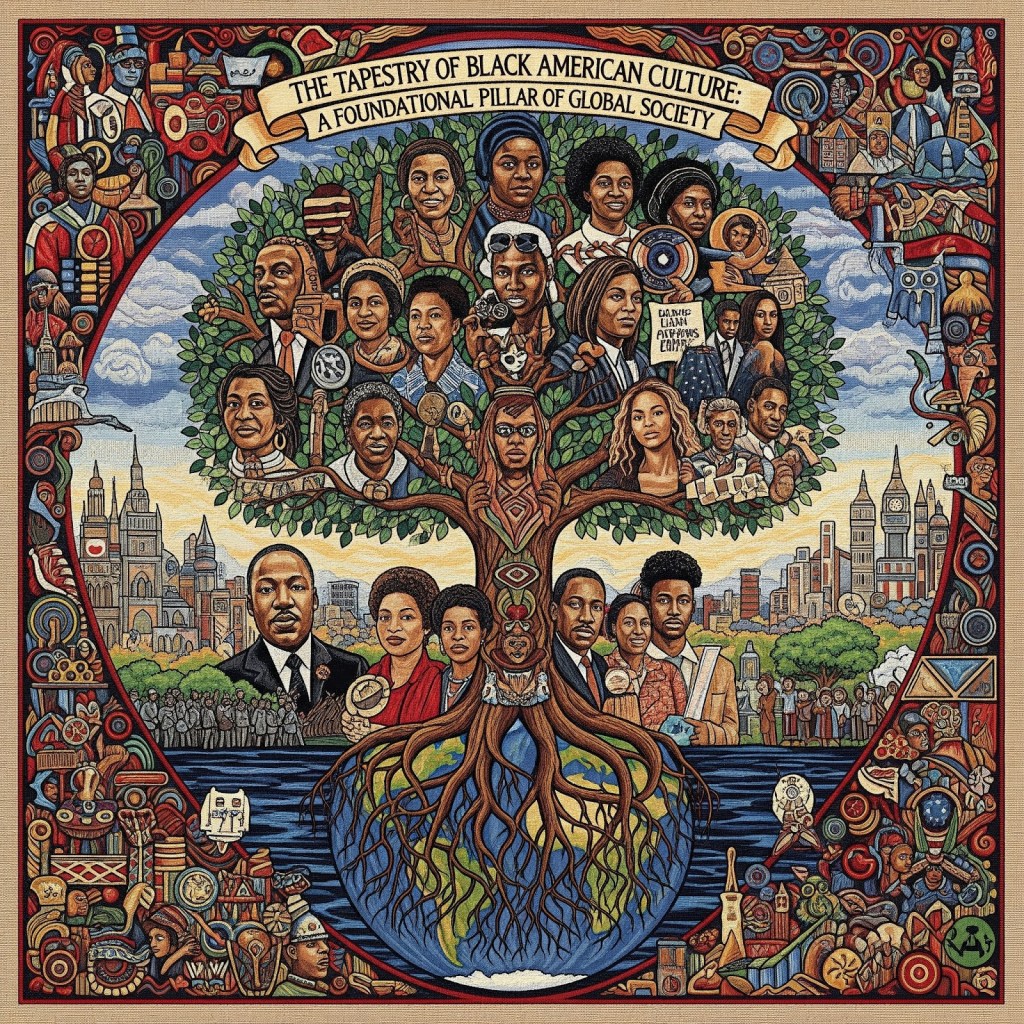
The rich tapestry of Black American culture is a dynamic and ever-evolving mosaic, continuously enriched by a multitude of influences. These influences, particularly the recent cultural contributions from the African diaspora—including immigrants from the Caribbean, various African nations, and elsewhere—interact with and often hybridize established Black American traditions. This makes the culture a living, breathing entity that is perpetually redefining itself.

This continuous process of synthesis and cross-pollination is visible across all facets of Black American life. In music, the sounds of Afrobeats and Caribbean dancehall blend seamlessly with the foundational genres of jazz, hip-hop, R&B, and gospel, creating new, globally infectious rhythms and styles. In cuisine, new spices, cooking techniques, and ingredients from West Africa and the islands are being incorporated into and expanding the scope of traditional Southern and soul food, leading to a culinary renaissance. Fashion, language, and artistic expression also reflect this vibrant fusion, with distinctive accents, sartorial choices, and narrative perspectives adding layers of complexity to the broader cultural narrative.

The vibrant tapestry of Black American culture is a dynamic and ever-evolving phenomenon, rooted in the profound history of the descendants of enslaved Africans, whose resilience, ingenuity, and cultural contributions form the indispensable bedrock of the American experience. This deep historical foundation, marked by both struggle and triumph, acts as the primary source of its unique character, artistic forms, and community structures.

Yet, this culture is not a static relic of the past; it is a constantly shifting, self-renewing mosaic, significantly enriched by the ongoing cultural dialogue with recent Black immigrants from the Caribbean, Africa, and other parts of the global Black diaspora. The interplay between these two powerful streams—the established Black American heritage and the expansive, diverse traditions brought by new arrivals—creates a cultural entity that is more complex, resilient, inventive, and globally connected than ever before. This convergence is a powerful demonstration that Black culture in the United States is fundamentally not monolithic. Instead, it is an integrated network of local, national, and transnational identities, each drawing strength from its deep historical roots while simultaneously expanding its scope through global connections.

This ongoing cultural dialogue manifests across every facet of American life. In music, for example, the foundational genres of jazz, blues, gospel, and hip-hop, created by the descendants of the enslaved, continually absorb and integrate new rhythms and sonic textures from Afrobeats, Dancehall, and Zouk, propelling Black music to the forefront of global innovation. In cuisine, new spices, cooking techniques, and ingredients from West Africa and the Caribbean blend with established soul food and Creole traditions, creating a fusion that is both nostalgic and avant-garde. In language and fashion, the infusion of global Black perspectives keeps the culture at the cutting edge of identity expression.

This continual cross-pollination ensures that Black American culture remains a potent engine of American creativity and global soft power. It is an enduring testament to the power of cultural synthesis, demonstrating how the retention of a painful, yet ultimately powerful, heritage can coexist and thrive alongside a radical, expansive embrace of the new. It is this unique ability to draw strength from both deep history and expansive global input that guarantees Black American culture will remain at the very forefront of global innovation, social discourse, and identity formation for generations to come.