
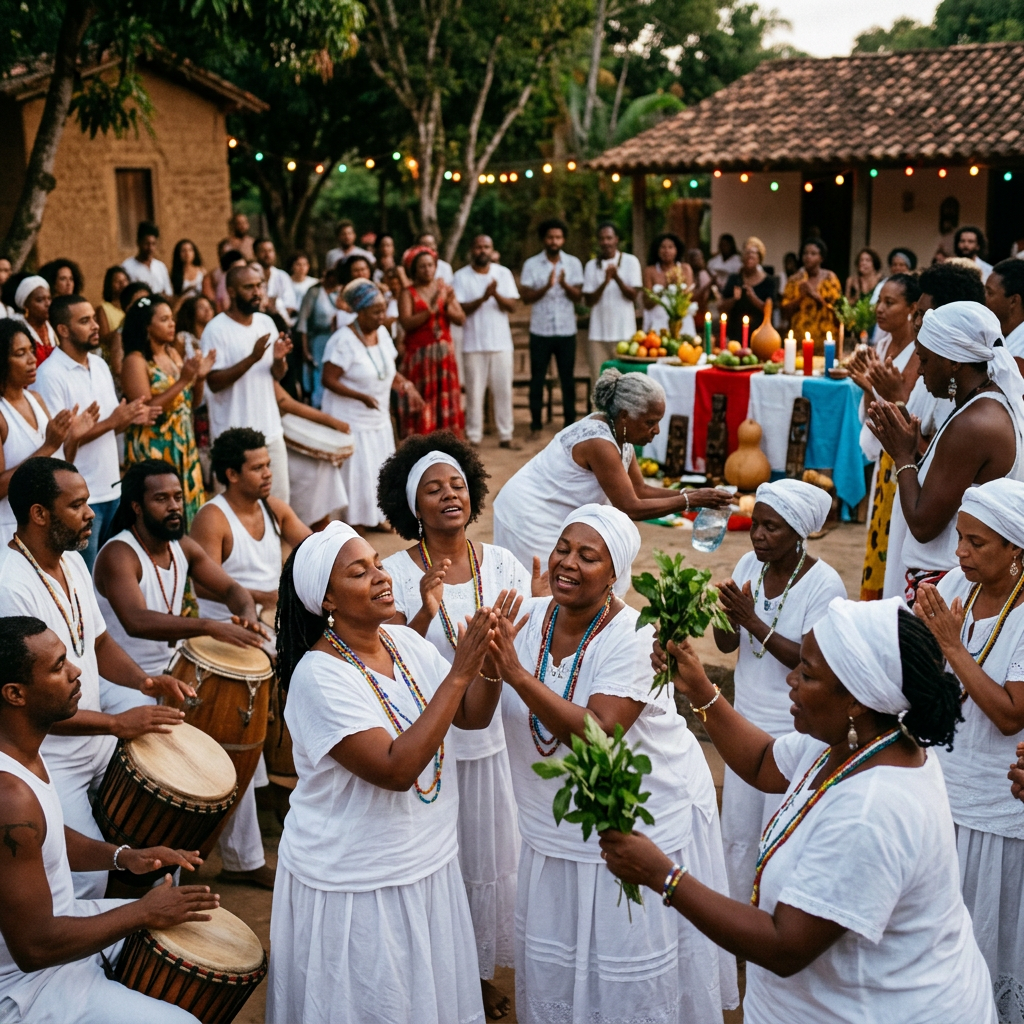
Welcome to SPIRITUAL PRACTICES OF AFRICA AND THE DIASPORA. Spiritual practices in Africa and the Diaspora center on the interconnectedness of the living, ancestors, and the divine, often featuring a supreme being and various mediating deities. These intricate belief systems reflect the rich cultural heritages and histories of diverse communities, embodying values and teachings that have been transmitted through generations. Foundational cosmologies, such as Yoruba Orishas and Gbe Vodun, have evolved into faiths like Santera, Candomble, and Vodou, each adapting to the specific cultural and environmental contexts in which they exist. These resilient systems survived colonial suppression by syncretizing with Christianity and Islam, using external symbols to shield traditional rituals while preserving core spiritual principles. Today, a global revival is reclaiming these sacred philosophies, appealing to individuals seeking deeper connections to their roots and identities, serving as a cultural anchor for navigating modern challenges, and fostering a renewed sense of community and belonging across the globe.
In Today’s installment…
Let’s explore Elemental Africa: The Science of Fire, Water, Air, Earth & Spirit—a profound exploration of ancestral wisdom where the elements are recognized not as inert matter, but as living, intelligent, and purposeful entities that contribute to the intricate web of life. This ancient paleo-science, deeply rooted in traditions that span millennia, provides a sophisticated framework for understanding the relationship between the self and the cosmos, emphasizing the interconnectedness of all things.
It invites us to reflect on how these elemental forces shape our existence and influence our experiences, encouraging a holistic approach that moves beyond the limitations of contemporary perspectives. In doing so, it includes not only the tangible aspects of the physical world but also the invisible, subtle influences of the universe that have a profound impact on our spiritual and emotional well-being, urging us to tune in to the rhythms and cycles of nature that surround us every day.
Within this worldview, the five elements serve as both a diagnostic lens for holistic healing and a roadmap for spiritual alignment:
Fire: A transformative force linked to the etheric body and the power of will. It acts as a catalyst for clearing and renewal, transmuting stagnant energy into vibrant purpose through the legacy of Yoruba metallurgy and ancestral warrior spirits.
Water: A repository of memory and a symbol of ceaseless flow. It teaches adaptability and non-resistance, exemplified by the “Water Principle” in martial arts where energy is absorbed and redirected rather than fought.
Air: Carrying the spoken word and the power of thought, air is linked to the mental body and Zulu traditions of sacred breath. It facilitates the expansion of intellect and the clarity of expression, allowing for the navigation of complex mental landscapes.
Earth: Anchoring cosmic law and the physical body, earth provides grounding and stability. It embodies a receptive, feminine essence that transforms unbeneficial forces through patience and rooted presence.
Spirit: The vital life force that facilitates divine alignment when the four tangible elements are in balance. In the Yoruba tradition, this spiritual power (Ase) flows through the human aura, or emi, supported by the sacred geometry of the merkaba.
By delving into these intricate legacies—from the ethical foundations of Igbo philosophy to the depth of Kongo cosmology—we reclaim a sacred dialogue with the universe that resonates deeply within our collective consciousness. This synthesis of movement, breath, and ancient science not only challenges us to confront our limitations but also inspires a profound exploration of self-awareness and interconnectedness.
As we navigate through the wisdom embedded in these traditions, we are called to embrace our unique purpose within the grand tapestry of life, recognizing that each thread, colored by our experiences, contributes to the rich narrative of existence. This journey invites us to honor our ancestors, learn from their insights, and apply their teachings in our modern context, creating a bridge between past and present that enriches our understanding of the world around us.

