I was gonna make this my Sunday post, but… here we are.
The connection between Capoeira Angola and Rastafarianism lies in their shared roots as Afro-Diasporic systems of resistance, spiritual preservation, and liberation from oppression. While one developed in the recôncavo of Bahia, Brazil, and the other in the hills of Jamaica, both function as holistic lifeways designed to reclaim African identity and dismantle colonial power structures.
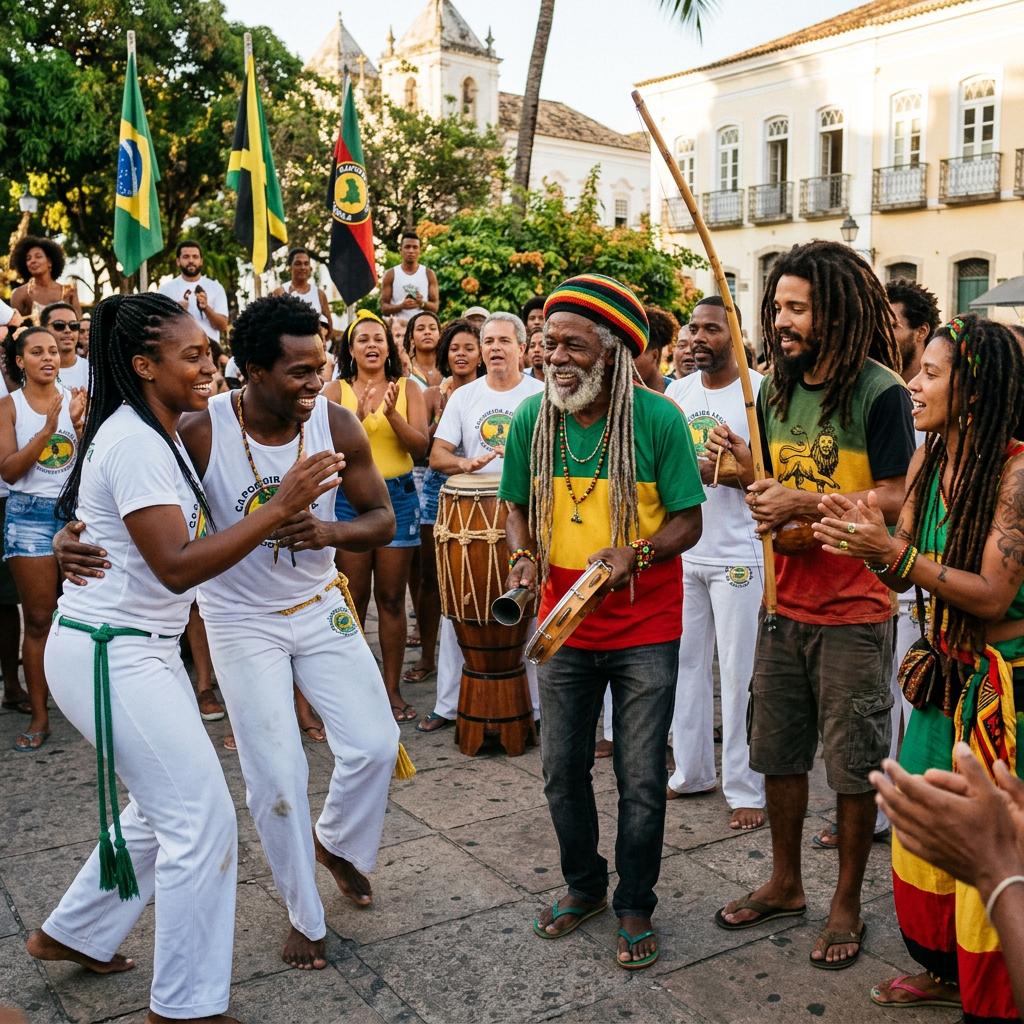
The Rhythm of Resistance: Where Capoeira Angola and Rastafarianism Meet
To the untrained eye, Capoeira Angola and Rastafarianism might seem like entirely different worlds. One is a ritualized martial art, characterized by deep, ground-level movements, strategic trickery, and the hypnotic ring of the berimbau. The other is a biblical, messianic spiritual movement known for its distinct livity, dreadlocks, and the heavy basslines of Reggae and Nyabinghi drumming.
Yet, beneath the surface of geography and form, Capoeira Angola and Rastafarianism are twin rivers flowing from the same fundamental source: Central and West African spiritualities adapted to survive and defeat the forces of chattel slavery and colonialism.
They are not merely hobbies or religions; they are holistic systems of liberation. Here is where and how these two profound Afro-Diasporic traditions connect.
1. Liberation Over Slavery: Rebuffing the “Babylon” System
At the core of both traditions is an uncompromising rejection of oppression. Rastafarianism identifies the corrupt, oppressive structures of the Western world as “Babylon.” For the Rastafari, Babylon is the modern continuation of the slave trade—a system designed to strip African people of their history, language, and divinity. Livity—the righteous Rastafari way of life—is a daily practice of mental and physical secession from Babylon.
Capoeira Angola shares this exact operational DNA. Born out of the struggle of enslaved Africans in Brazil, it was the ultimate tool for survival. When Africans escaped the plantations to form quilombos (maroon societies), Capoeira was the combat system that protected their freedom against colonial trackers.
Where the Rasta uses word, sound, and power to decolonize the mind, the Angoleiro (Capoeira Angola practitioner) uses movement, mandinga (craftiness), and malice to physically and psychologically outwit the oppressor. Both systems view the human body and mind as sovereign territory that no colonial system has the right to conquer.
2. Sacred Rhythms: The Drum and the Berimbau
Neither Capoeira Angola nor Rastafarianism can exist without music, because for both, music is a spiritual technology.
In Rastafarianism, the Nyabinghi drum beat is the heartbeat of the movement. Played on three drums (the pitche, funde, and bass), the rhythm represents the heartbeat of Jah and is used during “groundations” to communicate with the divine and “chant down Babylon.”
In Capoeira Angola, the berimbaugoverns everything. The lead berimbau (gunga) dictates the speed, style, and spiritual energy of the roda (the circle). Just like the Nyabinghi drums, the berimbau invokes ancestral energies, mapping out a sacred space where players communicate through a sophisticated language of rhythm and song.
In both spaces, the music creates a communal trance state, reconnecting displaced people to their ancestral lineage.
3. The Philosophy of the Counter-Attack: Deception vs. Word, Sound, and Power
The tactical connection between the two lies in how they flip colonial structures on their heads.
Capoeira Angola is famous for its use of malícia—a strategic deception. An Angoleiro rarely attacks directly; instead, they play the fool, feign vulnerability, and invite the opponent in, only to strike from an unexpected angle. It is a philosophy born from the necessity of the underdog: when you are physically outgunned, you must use your opponent’s own momentum and assumptions against them.
Rastafarianism uses a similar psychological strategy through its linguistic reinvention, known as “Iyaric” or Dread Talk. Recognizing that English was the language of the slave master, Rastas fundamentally altered the language to inject power back into the speaker. They replaced “Oppress” with “Downpress” (because oppression weighs you down, it doesn’t lift you up) and replaced “We” or “You” with “I and I” to signify that the Divine (Jah) is always present within every individual.
Both traditions recognize that to defeat an oppressor, you cannot play by their rules—you must alter the geometry of the battlefield, whether through physical movement or spoken language.
4. Ancestral Memory and the Return to the Source
Finally, both movements are anchored in a deep reverence for Africa as the spiritual homeland. Rastafarianism centers on the concept of Repatriation, both physical and spiritual, back to Africa (symbolized by Ethiopia). It demands a conscious remembering of roots in a world that pressures Black and displaced people to forget.
Mestre Pastinha, the great guardian of Capoeira Angola, famously stated: “Capoeira Angola belongs to Africa.” The ritual of the chamada (the call)—where one player freezes the game and calls the other forward in a rigid, tense ritual walk—mirrors Central African spiritual concepts like the Kikongo Cosmogram, mapping out the cycle of life, death, and rebirth. Capoeira Angola intentionally preserves the oldest, closest-to-the-source movements and rituals to keep the connection to African ancestors unbroken.
Conclusion: One Love, One Roda
Ultimately, Capoeira Angola and Rastafarianism are two sides of the same coin. They are living blueprints for how human beings can preserve their dignity, spirituality, and joy in the face of brutal adversity.
Whether you are stepping into the roda to dodge a lightning-fast kick or sitting by a fire chanting to the beat of a funde drum, you are participating in an unbroken lineage of global African resistance that spans generations and continents. This vibrant tradition, rich with history and meaning, embodies the struggles and triumphs of countless ancestors who fought against oppression. Through each movement and every rhythmic beat, you connect not only with the past but also with fellow practitioners who share in this profound experience.
They teach us that true freedom isn’t given; it is danced, drummed, spoken, and fought into existence, creating a powerful narrative that resonates with each heartbeat and inspires future generations to continue the fight for justice and equality. In this sacred space, the rhythms of resistance echo through time, uniting voices from across the globe in a chorus of resilience and hope.
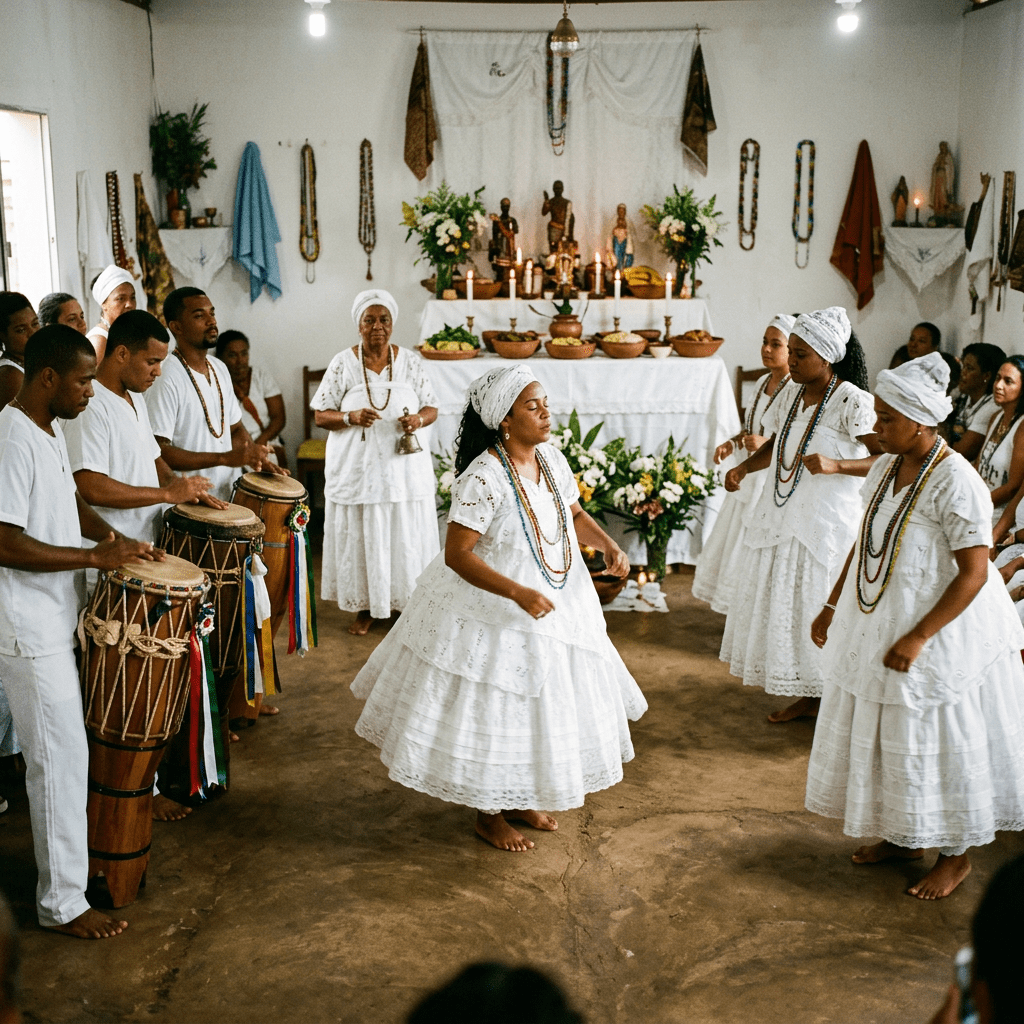
Women dressed in white perform a ritual dance surrounded by musicians in a sacred space.
Greetings! In this expansive blog series, we shall embark on a journey to explore Sub-Saharan Africa’s rich spiritual topographies, meticulously tracing ancestral lineages and their profound global resonance. Our primary objective is to establish a comprehensive framework for examining indigenous cosmologies, ranging from the Akan people’s deep reverence for Nyame to the complex and vibrant Yoruba Orisha pantheon.
This analytical framework further investigates the historical arrival and subsequent localization of world religions such as Christianity and Islam, observing how they synthesized with traditional African faiths to create unique spiritual landscapes. Central to this exploration is the practice of ancestral worship, which serves as a vital contemporary anchor for collective identity and ensures social continuity across generations.
Furthermore, we highlight the remarkable resilience of traditions like Haitian Vodou, Cuban Santería, and Brazilian Candomblé, all of which continue to thrive through the power of oral tradition and storytelling. Investigating these deep-seated roots fosters a more nuanced understanding of how faith, identity, and African cultural resilience intersect and persist in the modern world.
In contemporary Brazil, however, this resilience is frequently tested. The frequency of attacks directed at practitioners of Afro-Brazilian religions significantly exceeds those targeting any other religious groups in the nation. Activists and scholars identify this systematic persecution as “religious racism,” a term specifically utilized to highlight that these acts of violence and discrimination are fundamentally driven by deep-seated racial prejudice against spiritual traditions with African origins.
This framework analyzes the historical arrival and localization of Christianity and Islam as they synthesized with traditional faiths. Central to this is ancestral worship, a vital contemporary anchor for collective identity and social continuity.
Furthermore, we highlight the resilience of traditions like Haitian Vodou, Cuban Santería, and Brazilian Candomblé, which thrive through oral tradition and storytelling. Investigating these roots fosters a nuanced understanding of faith, identity, and African cultural resilience.
In Brazil, the frequency of attacks directed at practitioners of Afro-Brazilian religions significantly exceeds those targeting any other religious groups. Activists and scholars characterize this systematic persecution as “religious racism,” a term used to highlight that these acts of violence and discrimination are fundamentally driven by deep-seated racial prejudice against traditions with African origins.
This phenomenon is particularly visible in the Federal District, where official statistics illustrate a profound inequality: while individuals who follow Candomblé make up a mere 0.2% of the local religious population, they represent a staggering 59% of the registered victims of religious intolerance.
These patterns of disproportionate aggression are documented consistently across various regions of Brazil, reflecting a broader national challenge that poses a severe threat to the preservation of indigenous cosmologies. Despite these challenges, the resilience of faiths such as Candomblé continues to be a central theme in the study of African cultural continuity.
In Brazil, the frequency of attacks directed at practitioners of Afro-Brazilian religions significantly exceeds those targeting any other religious groups. Activists and scholars characterize this systematic persecution as “religious racism,” a term used to highlight that these acts of violence and discrimination are fundamentally driven by deep-seated racial prejudice against traditions with African origins. This phenomenon is particularly visible in the Federal District, where official statistics illustrate a profound inequality: while individuals who follow Candomblé make up a mere 0.2% of the local religious population, they represent a staggering 59% of the registered victims of religious intolerance. These patterns of disproportionate aggression are not isolated incidents but are documented consistently across various regions of Brazil, reflecting a broader national challenge. This systematic targeting poses a severe threat to the preservation of indigenous cosmologies and ancestral worship, which remain essential pillars for the social continuity and collective identity of these communities. Despite these challenges, the resilience of faiths such as Candomblé, alongside Haitian Vodou and Cuban Santería, continues to be a central theme in the study of African cultural continuity, as these traditions utilize oral history and storytelling to maintain their vital presence.
The resilience of these traditions, including Haitian Vodou, Cuban Santería, and Brazilian Candomblé, remains a central theme in the study of African cultural continuity. These faiths often thrive through oral tradition and storytelling, serving as vital anchors for collective identity and social stability. Investigating these roots provides a nuanced understanding of how faith and identity intersect with historical resilience.
In Brazil, this resilience is tested by systematic targeting that activists define as religious racism. This form of intolerance is deeply rooted in racial prejudice against traditions of African descent. Statistics from the Federal District highlight a stark disparity: despite followers of Candomblé making up only 0.2% of the religious population, they account for 59% of the victims of religious intolerance. Such disproportionate aggression is documented throughout the country, yet these communities continue to preserve their indigenous cosmologies and ancestral worship as essential frameworks for social continuity.
For comprehensive insights into the socio-cultural landscape and the ongoing struggle against religious intolerance in Brazil, please visit the Black Brazil Today website. This platform provides extensive resources and reporting on the systematic targeting of Afro-Brazilian religions and the broader implications of religious racism. You can access more information at: https://blackbraziltoday.com/
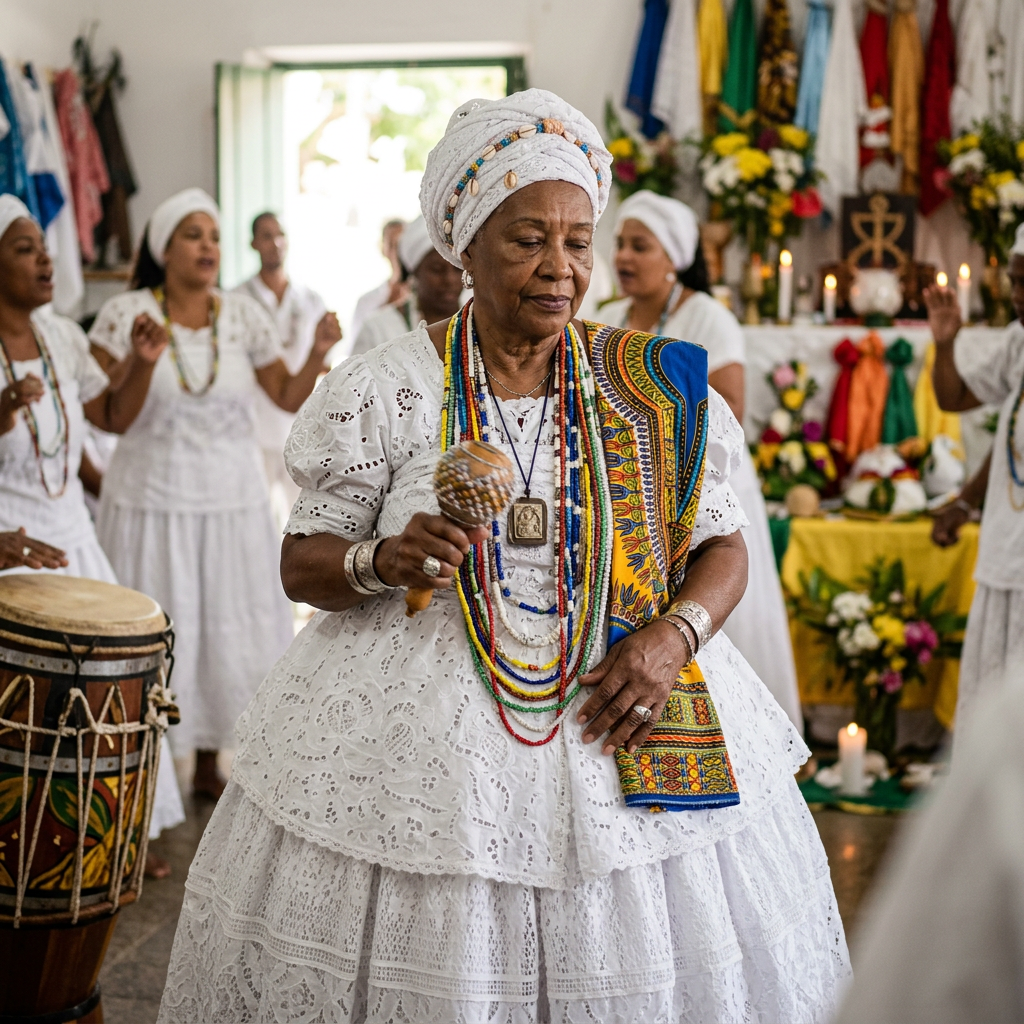
A woman leads a ritual in traditional white attire and colorful beads.
If you find this content valuable and wish to support the continued production of these educational materials and the advocacy work of the channel, please consider making a contribution via CashApp to: $MrMarques72. Your support helps maintain the visibility of these critical narratives regarding African cultural resilience and identity.
The preservation and promotion of these critical narratives regarding African cultural resilience and identity serve as a cornerstone for understanding the diverse socio-cultural fabric of the African diaspora.
Explore the true narrative of Brazil by engaging with platforms dedicated to the depth and complexity of the Afro-Brazilian experience. We invite you to subscribe to Black Brazil Today, a vital resource for insightful discussions on race, culture, and the evolving landscape of media representation. By joining our community, you gain access to nuanced perspectives on how indigenous cosmologies and traditional faiths like Candombl’e continue to navigate and resist systemic challenges such as religious racism and intolerance.
Stay connected with our latest tutorials and advocacy work by visiting their YouTube channel: https://www.youtube.com/@blackbraziltoday3316. Your engagement helps amplify these essential stories of historical localization, social continuity, and the enduring power of oral traditions.
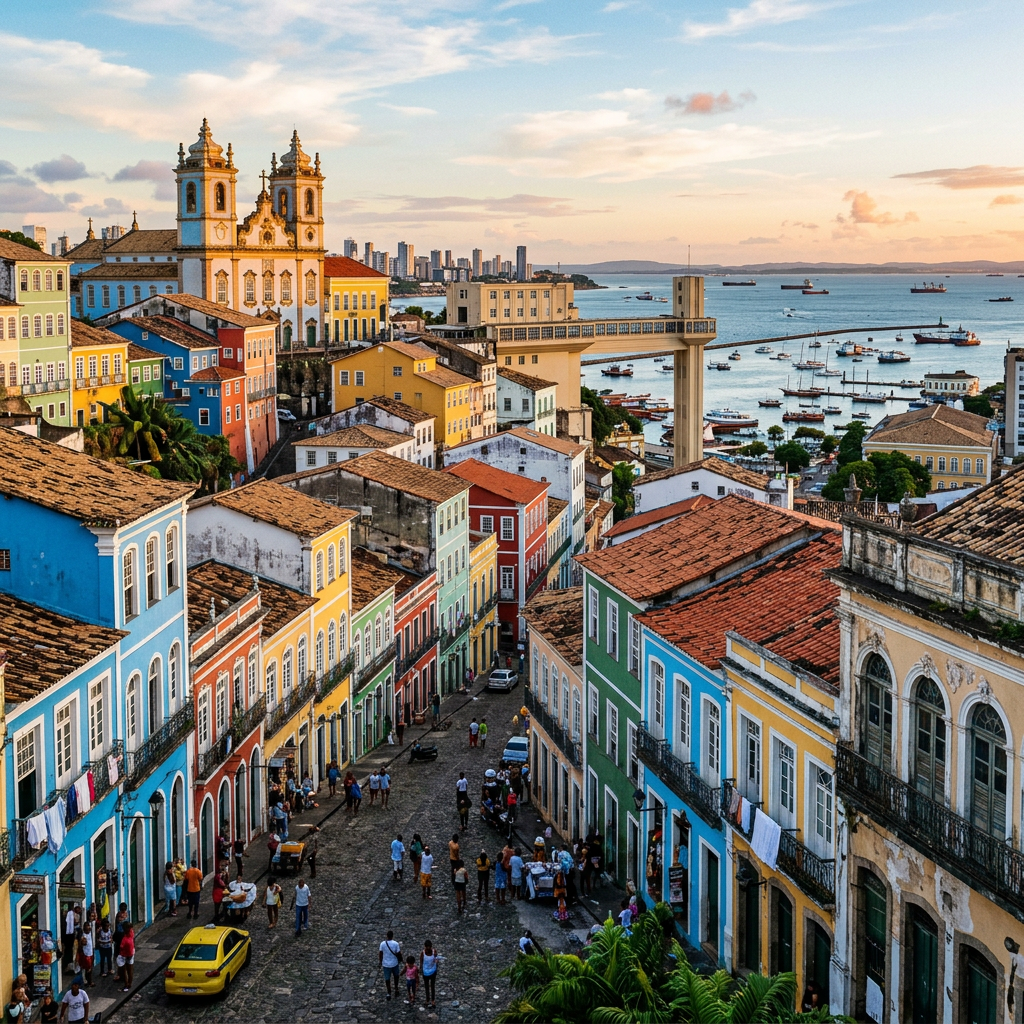
People stroll through a vibrant, historic neighborhood near the water at sunset.
I recently had the opportunity to watch a compelling documentary on Netflix that immediately sparked a deep line of questioning about the current state of manhood.
Louis Theroux is back, delivering a thought-provoking, and arguably controversial, look into the so-called ‘manosphere.’ This feature-length documentary, titled Louis Theroux: Inside The Manosphere, follows Louis from the sun-drenched streets of Miami to the exclusive resorts of Marbella, introducing us to the figures and followers who are actively working to reshape—and in the view of many, radicalise—the fundamental ideas that young men hold about masculinity and manhood. The film premiered on March 11th and is currently available to watch on Netflix.
Setting aside my own critical observation that the documentary seems to miss the mark in several ways concerning an accurate portrayal of the “manosphere” as a whole, the central question it raises is unavoidable: What has truly become of masculinity in this contemporary age? It feels distinctly like a profound departure from the values and examples that shaped my own understanding—the quiet strength, responsibility, and moral compass I learned from my father, his generation of friends, and the elders who were formative influences in my life.
This widespread cultural conversation about what it means to be a man has only intensified following the documentary’s release.
Performative vs. Authentic Masculinity
Louis Theroux’s documentary, by highlighting polarizing figures such as Andrew Tate, has thrust the debate about masculinity back into the mainstream spotlight. The figures gaining the most attention are often those championing a rigid, aggressive, and often explicitly anti-feminist brand of manhood. However, I believe the core of the public discussion is fundamentally misplaced, focusing too narrowly on the symptoms of a societal malaise rather than its historical root. We are witnessing a public obsession with performative masculinity—a hollow, manufactured display—while the genuine article, authentic masculinity, remains obscured.
A closer look at history suggests that the issue is not with the concept of masculinity itself, but rather with the distorted form it has been allowed to take in a modern, disconnected world. Historically, the virtues associated with manhood—strength, courage, discipline, and protectiveness—were not divorced from morality, honor, and self-control. They were, in fact, contingent upon them.
Consider the early 19th century in Britain, where one of the most celebrated men was a legendary prizefighter named John “Gentleman” Jackson (1769–1845). Jackson was a brutal, successful combatant by trade—the bare-knuckle champion of England. Yet, he was simultaneously revered as a mentor and teacher, a man who commanded the respect and admiration of poets, politicians, and the upper echelons of society, including the renowned Romantic poet Lord Byron.
Jackson’s nickname, “Gentleman,” was earned not in spite of his profession, but because of the character he demonstrated within and outside of it. He embodied a powerful, physical form of masculinity tempered by discipline, integrity, and grace. He founded a highly respected academy for “pugilistic science” where he taught the aristocracy how to fight, not just for aggression, but as a discipline—a way to build physical fortitude and moral courage. Jackson understood that true strength required a gentle hand and a well-regulated mind. His legacy serves as a powerful reminder that the man of action and the man of character were once considered two sides of the same coin, proving that genuine power is rooted in self-mastery, not dominance over others.
The modern crisis, therefore, is not a crisis of masculinity but a crisis of character. In the absence of authentic examples, men are adopting extreme, cartoonish personas—the performative mask—to signal belonging and strength in a world that offers them few genuine rites of passage or moral frameworks. The challenge is to retrieve the historical, richer understanding of authentic masculinity, one where strength is in service of honor, and power is a tool for responsibility.
So, what accounts for the dramatic shift between Jackson’s era and our own?
The key distinction lies between performative masculinity—a superficial display often built on aggressive posturing and material wealth—and the authentic, enduring masculinity that is forged through pressure, genuine responsibility, and meaningful real-world experience.
From the raw, unscripted arenas of Georgian prizefighting, where survival depended on raw grit and honor, to the controlled, highly-regulated environments of modern combat sports like professional boxing, MMA, and jiu-jitsu, a consistent, undeniable thread of authentic masculine development exists. This profound thread connects acts of physical courage—the willingness to face a difficult opponent or challenge—with the deeper, often overlooked necessity of moral responsibility. The courage displayed in the ring must be mirrored by the integrity shown in life. The pursuit of genuine manhood is not, in my view, what the popular media—or the sensationalist documentary that seeks to define it through controversy and fleeting trends—is currently suggesting.
The genuine path to manhood is rarely found in the fleeting glow of viral videos, the performative posturing on social media, or the insular, aggressive echo chambers of online discourse. Instead, it is forged in the crucible of real-world experience: in the demanding, challenging, and often painful character-building experiences of life. It’s found in showing up when it’s difficult, honoring one’s commitments, and accepting the full weight of one’s consequences. This is a path of action, not mere assertion.
So, what is authentic masculine development? It is the conscious, continuous effort to integrate strength with discipline, courage with compassion, and capability with humility. It is the journey of transforming latent potential into reliable, ethical action.
Authentic masculine development is not a passive state, but a dynamic, lifelong process of self-cultivation. It is the conscious, continuous effort to integrate inherent strength—both physical and mental—with rigorous self-discipline, ensuring power is directed constructively and ethically. This development requires merging profound courage—the willingness to face fear and uncertainty—with genuine compassion, extending kindness and understanding outward to others and inward to oneself. Furthermore, it demands combining robust capability and competence—the honed skills and knowledge to navigate the world effectively—with deep humility, acknowledging one’s limitations and remaining open to growth and learning.
Fundamentally, this is the demanding yet profoundly rewarding journey of transforming latent potential—the raw abilities, the undiscovered strengths, and the deep, often intimidating emotional and intellectual reserves within every man—into reliable, ethical, and courageous action in the world.
It is about moving past passive contemplation to active contribution; not merely possessing good intentions, but consistently embodying them. This process is the crucible for building a resilient character, one that is emphatically not defined by outdated metrics of bravado, unearned confidence, or the need for dominance and control over others.
The modern definition of manhood is not built on outdated stereotypes of stoicism or physical dominance, but on a more robust and ethical framework anchored by three fundamental principles: Unwavering Integrity, Profound Responsibility, and The Commitment to Purpose and Service.
1. Unwavering Integrity
This is the bedrock of modern manhood. Integrity is the active and constant commitment to align one’s private reality—core values, secret thoughts, and internal moral compass—with one’s public life—spoken words, outward actions, and decisions. It is not merely the absence of deceit, but the presence of consistent moral discipline.
Trustworthiness and Transparency: It means being a reliable person whose word is a bond. This involves transparency in one’s dealings, sharing intentions honestly, and avoiding the creation of misleading appearances.
Accountability Before Coercion: A man of integrity holds himself accountable for his actions and failures before external pressure or discovery forces him to do so. This proactive ownership is a hallmark of true character, demonstrating self-respect and respect for others.
The Cost of Convenience: Integrity is most critically tested when it is inconvenient or costly. The modern man chooses the harder, ethical path over the easier, compromised one, even if it entails financial loss, social discomfort, or personal sacrifice.
2. Profound Responsibility
Manhood demands an active and conscious acknowledgment of one’s duties and the subsequent, vigorous effort to shoulder those burdens. It is an expansive concept of duty that extends far beyond self-interest.
Duty to Self and Growth: Responsibility begins with the self—to maintain one’s health, mental acuity, and moral fitness, and to continuously strive for personal development and emotional maturity.
The Family and Immediate Community: This involves providing stability, emotional support, and leadership within one’s family unit, and being a reliable pillar within one’s immediate circle of friends and colleagues. It is the commitment to not be a burden, but a source of strength.
Ownership of Mistakes and Repair: A profound sense of responsibility means taking complete ownership of one’s missteps, failures, and the consequences they create. It is not enough to simply apologize; the modern man dedicates his energy, resources, and time to the arduous process of repair, reconciliation, and subsequent behavioral growth.
Civic and Global Duty: Extending one’s sphere of responsibility to the wider community and the world, recognizing a duty to contribute to social justice, environmental stewardship, and the overall well-being of the broader society.
3. The Commitment to Purpose and Service
The essence of a meaningful life, and therefore of modern manhood, lies in transcending purely selfish or material pursuits. A man must find a meaningful mission that drives him, dedicating his unique gifts and energy toward its realization.
Identifying a Mission: This requires deep introspection to identify a purpose, mission, or cause that resonates with one’s core values—whether it is in art, business, education, or community activism. The mission acts as a moral and professional compass.
Contribution Over Consumption: The energy and talents developed are not merely tools for personal gain or accumulating wealth, but are deployed in service of this greater purpose. This means intentionally fostering an environment of support, opportunity, and flourishing for those within one’s influence—mentoring, building, and contributing to systems that benefit others.
Leaving a Legacy of Value: The ultimate aim is to leave the world, or at least one’s corner of it, better than one found it. This service-oriented mindset transforms ambition from a narcissistic pursuit into a powerful engine for collective good.
True strength, in this elevated and complex context, is fundamentally redefined. It is not measured by physical dominance or unfeeling stoicism. Instead, it is measured by self-control in the face of temptation, emotional intelligence in navigating relationships and internal conflicts, and the quiet, persistent effort—the daily grind of doing the right thing—required to maintain these high ethical standards amidst the inherent complexities, temptations, and ceaseless challenges of the modern world.
So, how does this process of authentic masculine development apply specifically to an angoleiro?
An angoleiro, as a practitioner of Capoeira Angola, embodies a role deeply rooted in tradition, community, and a nuanced understanding of self and history. The journey of masculine development for an angoleiro is intrinsically linked to the philosophy and practice of their art.
Embracing Tradition and History: Authentic masculinity, in this context, requires the angoleiro to deeply internalize the history and lineage of Capoeira Angola. This is not merely an intellectual exercise but a physical, emotional, and spiritual connection to the masters, or mestres, who preserved and developed the art. The maturity of the angoleiro is reflected in their respect for tradition, their commitment to the established rituals of the roda, and their dedication to passing this cultural heritage on to the next generation. This act of preservation is a powerful expression of responsible manhood—one that honors the past to enrich the future.
The Role of Malícia and Patience: The jogo (game) of Capoeira Angola demands qualities that mirror authentic masculine maturity. Malícia, often mistranslated as malice, is better understood as cunning, street-smarts, and psychological wisdom. A developed angoleiro uses malícia not for aggression, but for strategic self-protection and to control the flow of the game. Coupled with this is profound patience. The slow, grounded movements of Angola require the discipline to wait, to observe, and to choose the precise moment for action—a metaphor for thoughtful, measured conduct in life outside the roda.
Leadership and Community (The Roda): The roda itself is a microcosm of community and leadership. The angoleiro’s development is evident in their capacity to lead the music, maintain the energy of the roda, and ensure the safety and inclusion of all participants. True strength is demonstrated not through physical dominance, but through the ability to harmonize the group, support newer players, and humbly accept correction from elders. This sense of shared responsibility and servant leadership is a cornerstone of mature masculinity.
Groundedness and Self-Knowledge: The low, close-to-the-earth stance of Capoeira Angola symbolizes groundedness and humility. Authentic masculine development for the angoleiro involves cultivating this internal state—being rooted in one’s values, aware of one’s limitations, and connected to the immediate reality of the moment. The constant, subtle dialogue between two players in the jogo forces intense self-awareness. The angoleiro must know his own fears, strengths, and reactions to truly engage with his partner, a process that accelerates self-knowledge and emotional regulation.
In essence, for the angoleiro, authentic masculine development is a lifelong process articulated through the practice of Capoeira Angola—a commitment to wisdom over brute strength, community service over personal glory, and historical reverence over fleeting trend.
This blog series is dedicated to a deep and expansive exploration of the complex, vibrant, and multifaceted spiritual landscape of Sub-Saharan Africa and its profound, often underappreciated, global impact. It is a comprehensive endeavor that systematically examines the rich tapestry of indigenous belief systems, from the Akan’s reverence for the Supreme Being Nyame to the Yoruba’s intricate Òrìṣà pantheon.
Crucially, the series meticulously traces the historical trajectory and theological integration of the Abrahamic faiths—Christianity and Islam—within the African context. We analyze their initial arrival, their dynamic interaction with existing traditional religions, and their eventual transformation into distinctly African expressions of faith.
A central and enduring theme woven throughout this series is the continuous, living role of ancestral worship. Far from being a relic of the past, this practice is a potent, contemporary expression of cultural heritage. It serves as a vital anchor, reinforcing collective identity, establishing continuity between the past and present, and transmitting a sophisticated body of ethical wisdom and moral philosophy across successive generations.
Furthermore, the series highlights the remarkable and resilient preservation of these African traditions within the vast global diaspora. The continuity of these spiritual practices—from Candomblé in Brazil to Vodou in Haiti and Santería in Cuba—is often achieved and maintained through the potent and flexible power of oral tradition, ritual performance, and ancestral storytelling, ensuring that the roots remain firmly planted even when the physical location changes.
Today’s Post: A Short, but Necessary, Digression
Today is going to be a short post, but one I feel is essential to address a common misconception. If any of you out there wonder why I repeatedly emphasize that Christianity is not exclusively, or even primarily, a European or Western religion, here is the historical and theological foundation for that assertion.
The standard narrative surrounding Christianity often harbors a profound historical oversight, one that minimizes or entirely omits the faith’s deep and ancient African story. This critical omission is not just a detail; it fundamentally distorts the global history of the religion, perpetuating the myth that Christianity is primarily a “European” import to the continent.
The Faith’s Immediate African Roots
Contrary to the colonial-centric view, Christianity did not arrive in Africa merely through 19th-century missionary movements. Its genesis and establishment were nearly simultaneous with its birth in the Levant. From its very inception, a foundational presence was established on the continent. The Book of Acts, for instance, documents the conversion of the Ethiopian eunuch by the deacon Philip, an event traditionally dated to the first century. This act is the historical cornerstone for the Ethiopian Orthodox Tewahedo Church, a tradition that stands today as one of the oldest continuous Christian communities in the world, demonstrating an independent and indigenous development of the faith stretching back nearly two millennia.
North Africa: The Intellectual Crucible of Early Christianity
Furthermore, the northern coast of Africa was not merely a recipient of the faith; it was, for centuries, the intellectual and spiritual heart of early Christianity. It was a nexus of theological innovation and cultural synthesis that profoundly shaped the nascent church.
Theologians of Influence: North Africa gave the global church towering figures whose writings remain foundational to Christian doctrine today. Tertullian, often called the “father of Latin theology,” was a prolific Carthaginian author (c. 155–c. 220 AD) who coined essential theological concepts and was the first to use the term Trinitas (Trinity) in a Latin context. His contemporary, Cyprian of Carthage (c. 200–258 AD), was a celebrated bishop and martyr whose works on church unity and the role of the bishop are still studied.
St. Augustine of Hippo: Perhaps the most influential theologian in Western history, St. Augustine of Hippo (354–430 AD) was born in what is now Algeria. His works, including Confessions and The City of God, provided the philosophical and theological framework for much of medieval and Reformation thought, bridging classical philosophy with Christian doctrine. His African heritage is an undeniable part of his legacy.
The Desert Fathers and Monasticism: From the deserts of Egypt came the Desert Fathers and Mothers, a movement of hermits and ascetics who pioneered Christian monasticism in the third and fourth centuries. Figures like St. Anthony the Great and St. Pachomius of Egypt established the principles of both solitary and communal monastic life. Their spiritual wisdom, collected in the Apophthegmata Patrum (Sayings of the Desert Fathers), migrated across the Mediterranean, profoundly shaping the global monastic tradition, from St. Benedict in Europe to the monasteries of the East.
To claim Christianity as purely “European” is to deliberately erase centuries of African theological, mystical, and liturgical contribution that predates its widespread adoption and institutionalization across much of Europe.Resurgence and Continued Presence in Sub-Saharan Africa
While the indigenous churches of North Africa and Ethiopia represent the ancient continuum, Christianity also established footholds in other parts of the continent long before the high tide of colonialism. Beginning in the 16th century, Catholic missionaries established a Christian presence in parts of West and Central Africa, notably in the Kingdom of Kongo, where they engaged with local rulers and cultures. These missions, though distinct from the ancient traditions, further illustrate the complex, non-linear timeline of Christian engagement with the continent.
The African story of Christianity is not a footnote; it is a central chapter. It encompasses indigenous antiquity, intellectual primacy, and profound spiritual innovation. A complete and honest historical account must recognize that Africa was a theological engine and a spiritual cradle, not just a later mission field.
This comprehensive blog series, titled “SPIRITUAL PRACTICES OF AFRICA, AND THE DIASPORA,” is dedicated to an in-depth exploration of the rich and varied tapestry of indigenous beliefs and organized religions across Sub-Saharan Africa. The series will meticulously focus on three foundational pillars: the profound significance of ancestral worship, the pervasive influence of Christianity, and the widespread reach of Islam.
A core objective of the series is to celebrate and highlight the extraordinary cultural heritage of the region. This is achieved through a close examination of the diverse array of rituals and community gatherings that serve critical functions within society. These practices are not mere historical relics; they are living traditions that actively reinforce collective identity and are the primary mechanisms for cultural transmission, ensuring that the wisdom, values, and norms of previous generations are effectively passed down.
Furthermore, the series broadens its scope to examine how these enduring traditions have adapted and transformed within the diaspora—the communities of African descent scattered across the globe. A special emphasis is placed on the vital role of storytelling as a foundational cultural technology. Storytelling is the essential vehicle for the preservation of oral histories, acting as a living archive, and is the principal method for conveying complex moral, spiritual, and practical lessons to future generations. Ultimately, “SPIRITUAL PRACTICES OF AFRICA, AND THE DIASPORA” is an ambitious project with a singular goal: to significantly enhance understanding of the complex interplay between faith, identity, and cultural resilience throughout Sub-Saharan Africa and its global diaspora, offering readers a nuanced perspective on how these powerful forces continue to shape the contemporary world.
In today’s Installment…
Let’s delve into the rich heritage of the African Methodist Episcopal (AME) Church, a pioneering and profoundly influential denomination in African American religious and social history. The AME Church’s narrative is one of resilience, self-determination, and a powerful quest for spiritual and civil liberty.
The African Methodist Episcopal (AME) Church: A Pillar of Faith, Freedom, and Social Justice
The African Methodist Episcopal Church is a storied, historically Black Christian denomination that represents one of the most pivotal moments in the history of the African diaspora in the Americas. It was officially founded in Philadelphia, Pennsylvania, in 1816 by the visionary leader Richard Allen. This establishment was not merely the creation of a new religious sect; it marked the first major religious denomination in the Western world to be founded solely by people of African descent. In doing so, the AME Church created a vital, autonomous, faith-based institution that was fundamentally independent of white control and passionately dedicated to the spiritual, social, political, and economic upliftment of Black communities throughout the burgeoning United States and, eventually, the world.
The Struggle for Spiritual Autonomy
The genesis of the AME Church was rooted in the fierce resistance to the rampant and humiliating racial discrimination experienced by Black worshippers at white-led churches, most notably St. George’s Methodist Episcopal Church in Philadelphia. The seminal and catalytic event occurred in 1787 when Richard Allen and other Black congregants, seeking a place for prayer, were forcibly removed and physically barred from the main sanctuary for kneeling in a segregated section designated for Black members. This blatant act of systemic racism and spiritual marginalization solidified Allen’s resolve and spurred him to lead a decisive movement for complete spiritual and ecclesiastical independence.
Allen and his followers initially organized the Free African Society in 1787, a non-denominational mutual aid and benevolent society designed to support the community’s temporal needs. This groundwork soon led to the founding of Bethel African Methodist Episcopal Church in 1794, which became affectionately known as “Mother Bethel.” Despite establishing their own church property and forming their own congregation, white Methodist officials repeatedly attempted to exert control over Mother Bethel’s property, finances, and worship practices, claiming jurisdictional authority.
This continuous, decades-long struggle for autonomy reached its climax and resolution in 1816. The Pennsylvania Supreme Court issued a landmark decision affirming the undeniable independence and complete ownership of the Black congregation over their property and worship. Immediately following this monumental legal victory, representatives from various Black Methodist congregations scattered across the Mid-Atlantic states—including Pennsylvania, Delaware, Maryland, and New Jersey—convened a historic conference in Philadelphia. This gathering officially consecrated and formally constituted the African Methodist Episcopal Church, a unified and sovereign denomination born out of a quest for dignity and freedom.
A Foundation Beyond the Sanctuary
The foundational purpose and expansive mission of the African Methodist Episcopal (AME) Church extended far beyond conventional religious worship and spiritual devotion. From its very inception, the AME Church has powerfully and enduringly served as a multifaceted engine for radical social justice, unparalleled educational advancement, and sustained political activism within the African diaspora. Its churches served as essential stations on the Underground Railroad, platforms for abolitionist rhetoric, centers for community organizing, and bastions of learning. The AME Church has consistently championed civil rights, fostered Black economic self-sufficiency, and provided essential leadership training for generations of activists, theologians, and politicians, cementing its legacy as one of the most influential and enduring institutions in African American history.
The Pillars of the AME Mission:
Social Justice and Civil Rights Advocacy: The commitment to justice is central to the AME identity. During the tumultuous antebellum period, AME churches in the North were crucial hubs and key stations on the Underground Railroad, providing sanctuary and a path to freedom for enslaved people. AME bishops and ministers, such as the founder Richard Allen, were among the nation’s earliest and most vocal abolitionists, using the pulpit as a platform to denounce the immorality of slavery. This legacy continued throughout the 20th-century Civil Rights Movement, with many AME churches hosting critical meetings and clergy playing leadership roles in the struggle against segregation and racial discrimination.
Educational Empowerment: Recognizing that true emancipation required intellectual freedom, the AME Church placed an exceptionally high priority on education. The church was instrumental in founding numerous schools and colleges, seeing these institutions as essential for the uplift and self-determination of African Americans. A landmark achievement was the co-founding of Wilberforce University in 1856 (in partnership with the Methodist Episcopal Church), which became the first historically Black college or university (HBCU) owned and operated by African Americans. Following the Civil War, the church significantly expanded its educational outreach, establishing institutions like Morris Brown College in Atlanta, Georgia, and Allen University in Columbia, South Carolina. These schools were vital in educating newly emancipated people, training teachers, ministers, and leaders, and ensuring that succeeding generations had access to higher education despite systemic barriers.
A Ministry with Global Reach:
The AME Church’s vision was not confined to the United States. It rapidly expanded its influence globally, primarily throughout the Caribbean and the continent of Africa. Through the establishment of missions and new churches, the AME Church played a significant role in fostering African self-determination, providing spiritual guidance, and supporting community development. This global missionary effort connected African-descended peoples across continents, contributing to the rise of independent spiritual and political thought in places like South Africa and West Africa, thereby reinforcing a transnational identity and a shared commitment to liberation.
Today, the African Methodist Episcopal (AME) Church stands as a vibrant, enduring, and international denomination, rooted deeply in its 19th-century origins as a spiritual and social refuge for people of African descent. The Church continues to be guided by the profound and inclusive motto, “God Our Father, Christ Our Redeemer, the Holy Spirit Our Comforter, Humankind Our Family.” This declaration not only encapsulates its Trinitarian theology but also underscores its commitment to universal human kinship and dignity.
Building upon the pioneering spirit of its founders, the AME Church continues its legacy as a prophetic voice in the modern world. It tirelessly advocates for civil rights, social equality, and economic empowerment for all people, both domestically and across its global network. The denomination actively engages in ministry through education, healthcare, and community development initiatives, operating colleges, universities, and various social programs worldwide. This commitment ensures that the Church remains a dynamic force for change, carrying forward its historic mission to address systemic injustices and promote the spiritual and material well-being of the marginalized and oppressed.
Welcome to MALICIA AS A GAME OF POWER, a compelling blog series that delves deeply into the intricate strategies of human interactions, encompassing a wide range of topics such as effective communication, conflict resolution, negotiation techniques, and the subtle art of manipulation. This series not only addresses essential themes like leadership, personal branding, and online reputation management but also offers insightful and practical strategies designed to enhance influence and build meaningful relationships in both personal and professional contexts. Through thorough analysis, engaging discussions, and real-life examples, the series aims to empower readers to navigate the complexities of interpersonal dynamics, equipping them with the tools and knowledge necessary to strengthen their personal and professional lives. As we journey through various scenarios and strategies, expect to uncover the nuances of social influence, the importance of emotional intelligence, and the impact of strategic thinking in fostering successful interactions, ultimately helping you to thrive in a world where power dynamics are at play.
In this installment, we will explore the 40th law of power in the book, the 48 laws of power by Robert Greene. You can buy a copy by clicking HERE.
Law 40: Despise the free lunch
In a world increasingly driven by convenience and immediate gratification, it’s easy to fall into the trap of accepting what’s offered for free. However, a closer examination reveals a crucial principle: What’s offered for free is often dangerous. This isn’t to say all free things are inherently bad, but rather that true value, independence, and respect are rarely found without personal investment.
Consider the act of paying your own way to avoid guilt and gratitude. When you receive something for free, particularly from another individual, a subtle (or not-so-subtle) debt is incurred. This can manifest as an obligation, a feeling of being beholden, or a desire to reciprocate that may not always be convenient or desirable. By taking responsibility for your own expenses and contributions, you maintain your autonomy and freedom from such entanglements. This fosters genuine relationships built on mutual respect rather than a perceived imbalance of favors.
Furthermore, there’s a profound connection between investment and quality. No cutting corners with excellence is a principle that extends beyond financial outlays. When you commit your resources – be it time, effort, or money – to a pursuit, you are inherently striving for the highest possible standard. Conversely, seeking shortcuts or free alternatives often leads to compromised results, diminished quality, and ultimately, dissatisfaction. Excellence demands commitment, and that commitment is often reflected in the willingness to invest appropriately.
This commitment to investment isn’t about hoarding resources; quite the opposite. It’s about understanding the power of circulation. Be lavish with your money, keep it circulating. This isn’t an endorsement of reckless spending, but rather a recognition that money, like energy, gains power when it flows. Investing in quality products and services, supporting local businesses, and contributing to worthy causes all contribute to a vibrant economy and create opportunities for others. True wealth isn’t measured by what you accumulate, but by the positive impact your resources have when put into motion.
Ultimately, this philosophy culminates in a profound understanding of Generosity as a sign and magnet for power. This isn’t about transactional giving, where you expect something in return. Rather, it’s about a deep-seated belief in abundance and the understanding that true generosity, extended freely and without expectation, broadcasts a powerful message. It signals confidence, security, and a capacity to give beyond oneself. Such an attitude naturally attracts opportunities, alliances, and resources, making generosity a powerful force in both personal and professional life.
Example: Gypsies and Gifts offers a historical and cultural illustration of this principle. Traditionally, many Romani (Gypsy) communities have been known for their reluctance to accept gifts or favors without offering something in return, even if it’s a small token or a performance. This cultural practice, whether conscious or unconscious, serves to preserve their independence and prevent them from becoming indebted or perceived as reliant on others. It underscores the wisdom of maintaining a balance in exchanges, ensuring that dignity and autonomy are preserved. This example, while specific to a particular culture, highlights a universal truth: true power and freedom are often intertwined with self-sufficiency and the judicious management of exchanges, both material and immaterial.
How to use the 40th Law of Power ethically:
The 40th Law of Power, often summarized as “Despise the Free Lunch,” suggests that what is offered for free is often a trick or comes with a hidden cost, and that one should always pay one’s way, as it is a mark of respect, independence, and intelligence. While the law in its raw form is a tool for self-protection and maintaining power, its ethical application requires a nuanced understanding of its underlying principles. Applying this law ethically means using its wisdom to foster healthy, transparent, and mutually beneficial relationships, rather than simply as a defense mechanism against perceived exploitation.
Ethical Interpretation and Application:
Value Transparency over Suspicion: The ethical approach is to use the principle of “Despise the Free Lunch” as a prompt for inquiry and due diligence, not automatic rejection. Instead of assuming malice, inquire about the terms, costs, and expectations attached to any offer.
Ethical Action: When presented with something “free,” ask clear, respectful questions about the value exchange: “What is the expected outcome for you/your company?” or “What responsibilities are attached to this offer?”
Foster True Reciprocity, Not Debt: The law rightly warns against the psychological burden and manipulation inherent in one-sided transactions. Ethically, this translates to a commitment to genuine reciprocity. Instead of simply refusing a gift, seek a commensurate, non-monetary way to contribute or offer assistance in return, ensuring the balance of power remains equal.
Ethical Action: If a mentor offers time or resources, actively look for ways to pay their generosity forward, either by offering your unique skills in a small capacity or by committing to mentor others in the future. The focus is on balancing the exchange in a way that preserves the dignity and independence of both parties.
Invest in Relationships, Not Just Transactions: Applying the law ethically means recognizing that some “gifts” are sincere expressions of goodwill, friendship, or love. In these cases, to rigidly refuse them can be an insult. The ethical judgment lies in distinguishing a manipulative ploy from a genuine relationship-building gesture. The principle of paying your own way should be focused on professional or transactional settings where power dynamics are in play.
Ethical Action: In personal relationships, accept a genuine gift graciously, reciprocating with authentic appreciation and commitment to the friendship. In professional settings, insist on clear contractual terms and fair compensation, ensuring your contribution is valued and paid for.
Promote Self-Sufficiency and Dignity: The most ethical aspect of the 40th Law is its emphasis on self-reliance. Ethically, this means refusing to become dependent on charity or favors when one is capable of earning their own way. By paying the fair market value for services and goods, one supports a functioning, equitable economy and reinforces their own sense of capability.
Ethical Action: Always strive to pay your fair share in collaborative projects or social settings. If someone does a favor for you, offer to pay for their expenses or return the favor with something of equal effort, thereby respecting both their time and your own self-sufficiency.
Use the Insight for Altruism: Recognizing the subtle ways people can be manipulated by free offers allows you to protect others. An ethically powerful person can use their insight to warn others about predatory “free” schemes or ensure that when they themselves give, it is a clean, unconditional gift designed truly to help, not to indebt the recipient.
Ethical Action: If you choose to offer a service pro-bono or a gift, make the terms of its freeness explicitly clear—stating that there are no strings attached—to prevent the recipient from feeling the psychological burden of debt that the law warns about.
The 40th law of power, often summarized as “Despise the Free Lunch,” carries a unique and profound resonance when viewed through the lived experience of an angoleiro. An angoleiro, a practitioner of Capoeira Angola, understands that true mastery and respect are never simply given; they are earned through persistent effort, sweat, and a deep commitment to the tradition’s rigorous philosophy.
For the angoleiro, the “free lunch” is a seductive illusion—a shortcut that inevitably leads to weakness, dependence, and the stagnation of one’s jogo (the game/fight). The law is interpreted not just as financial prudence, but as a core principle of self-reliance and the necessity of personal investment:
1. The Price of the Axé (Energy/Life Force):
In Capoeira Angola, the axé is the spiritual and physical energy that vitalizes the roda. An angoleiro knows this energy must be constantly generated and renewed. If you receive a favor, a lesson, or even a moment of glory without paying for it—whether through dedicated practice, respect for the Mestre, or service to the community—the axé is unstable. The 40th law teaches that everything of value has a cost, and an unpaid debt (even a non-monetary one) leaves one vulnerable to control. The greatest masters demand investment, not compliance.
2. The Illusion of the Shortcut:
The journey of Capoeira Angola is defined by patience, repetition, and the slow, deep internalization of the movements, music, and philosophy. A beginner might seek “quick tips” or “easy moves.” The angoleiro understands that free, readily available knowledge (the “free lunch” of the internet tutorial or the lazy lesson) lacks the weight and foundation of hard-earned understanding. True power in the roda comes from the muscle memory forged in countless hours of disciplined training, which cannot be outsourced or acquired for free.
3. The Danger of Dependence:
When something is given freely, the receiver becomes indebted to the giver, consciously or unconsciously. In the context of power, this is a fatal flaw. The angoleiro must be sovereign, self-contained, and independent in their skill. To rely on the free generosity of a patron or the free advice of a rival is to surrender a measure of one’s autonomy. The 40th law demands that the angoleiro earn their place, their nickname, and their belt, ensuring that their standing is rooted in their own merit, not the unstable favor of others.
Conclusion:For the Capoeirista, “Despise the Free Lunch” is an affirmation of the principle that genuine power is internal. The angoleiro pays for their knowledge with sweat, their respect with sincerity, and their skill with dedication, thereby ensuring that the jogo they play is truly their own.
This series examines the modern malandro in contemporary society, showcasing their resourcefulness, charm, and adaptability as they navigate urban life while evading deception and addressing issues like economic disparities and social justice. While linked to Capoeira, the individuals featured are diverse and possess unique stories. The series highlights their resilience and clever tactics, celebrating their ingenuity and spirit, while inviting readers to engage with their lives to gain insight into navigating the complexities of contemporary urban environments.
In today’s installment…
Okay, I realize this is a scene from the movie Zombie land, and not a real person… But this is how a MALANDRO operates. The gas station attendant, with a sly smile, thought he would get away with pocketing $3000 for the seemingly mundane transaction, completely underestimating the situational awareness of those around him. So the $400 he gave to the little girl was nothing more than a minimal sacrifice, a mere distraction to keep her quiet and compliant. It showcased the lengths to which he would go to secure his gain, reflecting a calculated mindset often seen in the most cunning of swindlers. The best cons not only deceive but also make the victim want to participate, creating a web of manipulation that entices their targets to willingly engage in the deception. This creates a false sense of partnership, leaving the victim oblivious to the true motives at play, often resulting in their own misfortune.
Like I said, this series was created to show scams like these, so hopefully, you don’t fall for them. By shedding light on the tactics and strategies employed by scammers, we aim to empower viewers with the knowledge they need to recognize and avoid becoming victims. Through real-life examples and expert insights, we hope to raise awareness and promote vigilance in our audience, ensuring they can navigate the complexities of today’s digital landscape with confidence. Remember, staying informed is your best defense against these deceitful schemes.