The Real Reason America Created Police Spoiler Alert: It Had Nothing to Do With Crime

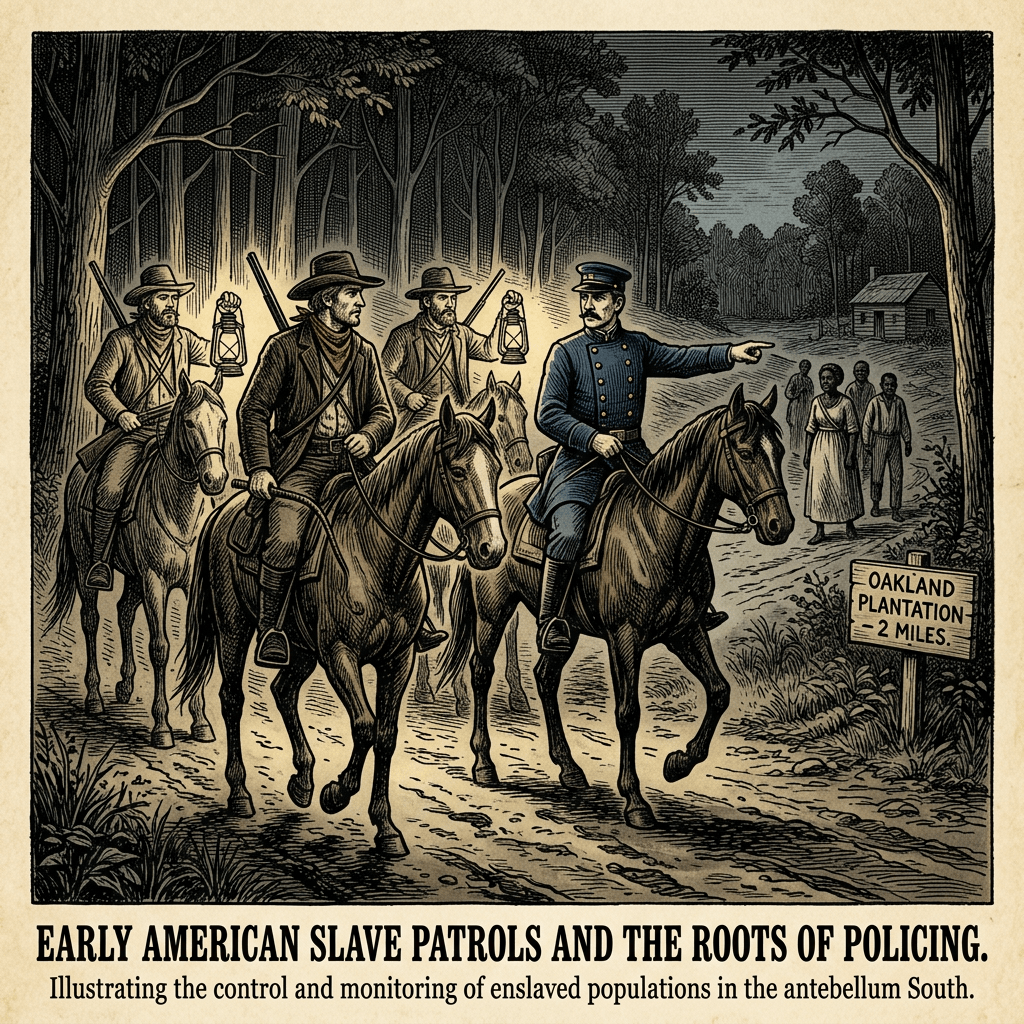
Four men on horseback, including a uniformed officer holding a lantern, oversee a group of enslaved people walking near Oakland Plantation sign
A mounted patrol monitors enslaved people near a Southern plantation at night.

The Historical Evolution and Socio-Economic Foundations of American Policing

The development of American policing is a complex convergence of regional systems, commercial interests, and mechanisms of social control. While modern narratives often suggest police departments emerged as a natural response to urban growth and the need for “law and order,” the historical record reveals a more unsettling foundation rooted in the colonial night watch system, Southern slave patrols, and Gilded Age political patronage.

Regional Origins: From Night Watches to Slave Patrols

In the Northern United States, early policing was largely informal and decentralized. Municipalities typically relied on a combination of part-time constables and night watches, which were often poorly managed, reactive, and funded through a haphazard system of inconsistent fees and fines. These early watchmen were frequently volunteers or individuals serving as a form of communal duty, which led to issues with discipline and effectiveness. This model shifted significantly in 1838 when Boston established the Day Police, marking the creation of the first publicly funded, full-time organized force in the nation. This unit eventually merged with the traditional night watch in 1854 to form the modern Boston Police Department, setting a precedent for municipal policing across the North.

In contrast, the evolution of policing in the Southern United States was inextricably linked to the institution of slavery. Southern forces grew out of organized slave patrols, the first of which were established in the Carolina colonies in 1704. Unlike the Northern night watches, which focused on general public order, these patrols served as a formal and legal mechanism for the surveillance, pursuit, and control of enslaved people. Patrol members were authorized to conduct warrantless searches of slave quarters and enforce codes designed to maintain racial order and prevent insurrection—a paramilitary system of social control that persisted as a primary form of law enforcement until the end of the Civil War.

Commercial Interests and Political Machines

The transition to professionalized forces was frequently driven by economic motives. In Boston, commercial shipping interests sought to shift the cost of protecting private cargo onto the public treasury. Similarly, the creation of New York’s modern force in 1845 was quickly overshadowed by machine politics, particularly Tammany Hall. Policing became an instrument of political patronage and elite influence; notably, NYPD Superintendent Thomas Byrnes admitted to amassing a personal fortune through investments facilitated by industrial titans Cornelius Vanderbilt and Jay Gould.

This era of Gilded Age political patronage meant that police departments often functioned as extensions of the local political machine rather than independent law enforcement agencies. Appointments and promotions were frequently tied to political loyalty, ensuring that the interests of the elite were prioritized over public safety. These historical structures—designed for labor suppression, merchant protection, and racial control—form the fundamental architecture of the modern police system. Today, this institution has expanded into a massive public enterprise, with national expenditures on police, public order, and safety now absorbing hundreds of billions of dollars annually as a major component of government current expenditures.

Legacy and Modern Expenditure

The historical structures of American policing—originally designed for labor suppression, merchant protection, and racial control—constitute the fundamental architecture of the modern police system. From its early iterations in Northern night watches and Southern slave patrols, the institution has evolved into a massive, professionalized public enterprise. This transition was often catalyzed by economic motives, such as Boston’s commercial shipping interests shifting the cost of private cargo protection to the public treasury, and the rise of political patronage in New York City.

Today, this system has expanded into an extensive public order and safety infrastructure. National expenditures on policing and public safety have grown significantly, now absorbing hundreds of billions of dollars annually as a major component of government current expenditures. While the responsibility for law enforcement remains primarily with local departments and sheriff’s offices, it is supported by state services and specialized federal agencies like the FBI and U.S. Marshals Service. Despite the scale of this investment, modern policing continues to face scrutiny regarding its historical origins and its role in maintaining social and racial order.

Shoutout to the YouTube channel Erased Century for consistently creating and posting engaging and informative videos featured in this Blog. Their content not only covers a wide range of fascinating topics but also provides viewers with unique insights and entertaining perspectives. Please take a moment to check out https://www.youtube.com/@ErasedCentury and help support this incredible Channel by subscribing, liking, and sharing their videos with friends and fellow enthusiasts. Your support can make a huge difference in helping them grow and continue producing quality content that informs and entertains audiences around the world.

Source Links:

The future of artificial intelligence text with two glowing digital human heads facing each other

CORRUPT POLICE FILES (4/7/26)

The bedrock upon which a safe and functioning society is built is the integrity and professionalism of its law enforcement agencies. The vast majority of police officers, in every country across the globe, are dedicated men and women who approach their demanding jobs with a profound sense of honor, unwavering commitment, and inherent dignity. They are the essential, vital protectors of their communities, standing as the very first line of defense against chaos and crime. These officers routinely and selflessly risk their lives to uphold the rule of law, maintain civil order, and ensure the protection of life and property. Their service is, in its purest form, a cornerstone of a just society.

However, this critically important and noble profession is, on occasion, tragically marred and undermined by the actions of a relatively small fraction of what are often termed “bad actors.” These officers commit egregious abuses of the immense power and public trust explicitly granted to them, flagrantly violate the very laws they solemnly swore an oath to enforce, and, in doing so, inflict direct and lasting harm on the very communities they were hired to protect. Such betrayals of the badge do not merely cause immediate, localized injury; they systemically erode the indispensable public trust and community cooperation that are absolutely necessary for effective, constitutional policing to take place. When citizens fear their protectors, the entire system of public safety begins to fail.

The observable and concerning disparities in conduct and ethics among law enforcement personnel are not simply random occurrences or isolated incidents; they are the logical, albeit tragic, outcomes of multiple, deeply interwoven systemic and cultural factors. These multifaceted contributing elements include, but are not limited to: outdated, inadequate, or inherently biased training protocols; deeply embedded systemic issues and problematic cultural norms within police departments (such as the “blue wall of silence”); a pervasive lack of sufficient mental health resources and stress management support for officers dealing with daily trauma; weak or ineffective internal accountability mechanisms that shield misconduct; and profound societal pressures and prejudices that disproportionately affect both the officers and the communities they serve.

Addressing this complex constellation of factors is far more than an optional, incremental reform; it is an absolute, ethical, and legal imperative to ensure the physical safety, psychological well-being, and constitutional rights of all individuals within society. Comprehensive, meaningful police reform must therefore focus aggressively on several fronts: the implementation of enhanced psychological and ethical screening processes for all new recruits; continuous, rigorous ethical training and mandatory de-escalation techniques; the establishment of robust, independent oversight bodies with real enforcement power; and, perhaps most critically, fostering a department-wide culture of uncompromising transparency, accountability, and ethical conduct, driven decisively from the top leadership down.

The following accounts presented in this series delve unreservedly into the darker, more troubling side of law enforcement—the critical points where the community’s supposed protectors dangerously transform into the very perpetrators of misconduct and crime.

These are their stories—unflinching tales of officers who catastrophically crossed the line, violated their sacred trust, and ultimately betrayed the badge, the uniform, and the public they swore to serve.

In this installment…

The unsettling encounter unfolded on a quiet suburban street, becoming an instant study in boundary violation and swift poetic justice. The homeowner, a man known for his calm but protective demeanor, was approached by a police officer during what seemed like a routine, if unnecessary, stop. The interaction took a dark and personal turn when the officer, apparently attempting to assert dominance or simply being inappropriately intrusive, began to steer the conversation away from any official matter and toward the homeowner’s personal life. Specifically, the creepy cop made a pointed and highly suggestive reference to the homeowner’s wife, a woman the officer had likely only seen in passing or perhaps looked up on a public database.

The officer’s comment, dripping with casual impropriety and an attempt at misplaced familiarity, was clearly designed to rattle the homeowner. It was an appalling abuse of his authority and uniform, stepping far beyond the bounds of professional conduct. He might have been trying to make a crude joke, intimidate the resident, or simply indulging a deeply inappropriate impulse.

However, the officer’s smug confidence was instantly shattered. The homeowner’s reaction was not one of fear or confusion, but one of icy, authoritative dismissal. The tables turned in a heartbeat. Whether the homeowner produced a higher-ranking official’s business card, mentioned a powerful personal connection to internal affairs, or simply delivered a scathing, memorable retort that exposed the officer’s unprofessionalism for what it was, the effect was immediate and devastating to the cop’s ego.

The officer, having grossly misjudged the man he was speaking to, visibly recoiled. His demeanor shifted from one of unwarranted control to palpable discomfort and instant regret. He realized that his cheap, unprofessional shot had not only failed to intimidate but had potentially put his own conduct—and career—under intense scrutiny. The attempt to be “creepy” was immediately met with a consequence he hadn’t anticipated, forcing him to backtrack and attempt a clumsy, face-saving retreat from the conversation. The initial intention to provoke or intrude had backfired spectacularly, leaving the officer chastened and the homeowner with a clear victory in the battle for personal dignity and boundaries.

CORRUPT POLICE FILES (3/11/26)

The foundation of public safety rests on the integrity of its law enforcement. The vast majority of police officers, worldwide, are dedicated men and women who fulfill their duties with a profound sense of honor, commitment, and dignity, serving as vital protectors of their communities. They are the first line of defense, often risking their lives to uphold the law and maintain civil order.

Unfortunately, this crucial profession is occasionally marred by the actions of a few bad actors. These officers abuse the power entrusted to them, violate the very laws they swore to enforce, and inflict harm on the communities they are meant to protect. Such behavior not only causes direct injury but also erodes the indispensable public trust necessary for effective policing.

The disparities in conduct among law enforcement personnel are not random; they are the result of multiple, interwoven factors. These contributing elements include inadequate or biased training protocols, systemic issues within police department cultures, lack of sufficient mental health and stress management support, ineffective internal accountability mechanisms, and societal pressures that disproportionately affect officers. Addressing these complex factors is not merely an optional reform; it is an absolute imperative to ensure the safety, well-being, and constitutional rights of all individuals within society. Comprehensive reform must focus on enhanced screening, continuous ethical and de-escalation training, robust oversight, and fostering a culture of transparency and accountability from the top down.

The following accounts delve into the darker side of law enforcement, where the protectors become the perpetrators.

These are their stories—tales of officers who crossed the line and betrayed their badge.

In this installment, we shine a spotlight on officers whose gender did not exempt them from accountability: 

When FEMALE Cops Get CAUGHT Breaking The Law!

The public holds police officers, regardless of gender, to an exceptionally high standard. They are entrusted with upholding the law, ensuring public safety, and embodying justice. When female officers—or any officer—are caught on camera or through internal investigations engaging in criminal activity, the breach of trust is profound and the public’s reaction is often intense.The Double Standard and Media Scrutiny

The Double Standard and Media Scrutiny

Instances of female law enforcement officers being arrested, investigated, or convicted for offenses like theft, excessive force, drug offenses, misuse of power, or even violent crimes tend to draw significant media attention. This disproportionate focus can be attributed to several factors:

  • Breach of Trust: The uniform is a symbol of authority. When the person wearing it is the one violating the very laws they swore to protect, it creates a deep sense of betrayal.
  • Novelty Factor: While police misconduct is a recurring news topic, the arrest of a female officer can be perceived as less common, leading to greater sensationalism.
  • Erosion of Confidence: These incidents not only damage the reputation of the individual officer but can also contribute to a broader distrust in the police department, particularly around issues of accountability and internal oversight.

The Scope of Misconduct

The offenses committed by female officers can span a wide range, often reflecting the same types of crimes committed by officers of any gender, but are compounded by the power of their position:

  • Abuse of Authority: This can include planting evidence, making false arrests, misusing police databases for personal reasons, or coercing citizens.
  • Financial Crimes: Theft from crime scenes, embezzlement from police funds or unions, and fraudulent activities are not uncommon.
  • Substance Abuse and Related Offenses: Being caught with illegal drugs or driving under the influence (DUI) while off-duty can immediately end a career.
  • Crimes of Passion/Domestic Issues: High-stress jobs can sometimes lead to officers being involved in domestic violence or other violent crimes that cross into their professional lives.

Accountability and Aftermath

When female cops are caught breaking the law, the immediate actions taken by the department are crucial for maintaining public confidence. These steps typically include:

  1. Administrative Leave: The officer is usually placed on immediate paid or unpaid leave pending the outcome of the investigation.
  2. Internal Affairs Investigation (IA): The department’s IA division launches a thorough internal inquiry to determine if department policies were violated.
  3. Criminal Prosecution: Depending on the severity of the offense, the officer faces criminal charges brought by the District Attorney’s office.
  4. Disciplinary Action: If found guilty internally, the officer faces a range of penalties, from suspension and demotion to, most often, termination of employment and decertification, which bars them from working in law enforcement again.

The consequences are not merely professional; they are intensely personal, leading to public shaming, legal penalties, and the destruction of a career built on public service.

CORRUPT POLICE FILES (5/4/25)

Greetings! The majority of police officers are dedicated to protecting their communities and building trust through outreach programs like community events and educational workshops that foster engagement and understanding between law enforcement and the public. These proactive initiatives not only educate citizens about safety and crime prevention but also create opportunities for dialogue that can help bridge the gap between diverse communities. Unfortunately, a small number of officers abuse their power, which damages their reputations and undermines public trust in law enforcement, leading to skepticism and fear among the very people they are sworn to protect. This reality emphasizes the need for ongoing ethical training and stricter oversight to ensure accountability, as well as the importance of transparent policies that govern police conduct. Amid these challenges, it’s essential to recognize the dedication of many officers who serve their communities with integrity and selflessness, as their work is vital in restoring faith in the justice system and demonstrating the positive impact that law enforcement can have when it operates with compassion and respect for all citizens.

In today’s installment…

Monongalia County Sheriff’s Deputy Lance Kuretza was indicted by the Feds as a result of this never-before-seen bodycam footage showing him suddenly confronting and arresting an innocent man, who was sleeping in a hotel room. The footage raises serious questions about the judgment and conduct of law enforcement officers, as it starkly reveals the chaotic moments during the arrest and the implications of acting on assumptions rather than facts. Mr Bryan has tried to get the footage over two years ago, hoping it would shed light on the case and ensure accountability.

Since then, he was acquitted by a federal jury in his criminal prosecution, which has left many in the community outraged and concerned about the message it sends regarding police conduct. This acquittal, while legally justified, has sparked intense debates about accountability and the moral implications of the judicial process. Now he’s back to work as a deputy, resuming his duties in a role that is supposed to be rooted in protecting the public. However, the skepticism surrounding his return is palpable; many local residents are left questioning whether he truly embodies the values and responsibilities that come with wearing the badge.

But should he have a badge in light of this footage, showing what really happened that night? That footage, which provides a stark contrast to the court’s decision, serves as a powerful reminder of the need for transparency in law enforcement. Shouldn’t there be a higher standard for those who are entrusted with enforcing the law and maintaining public trust? Given the sworn duty to uphold justice, it raises critical questions about the integrity of those in power and what is required to restore faith in a system that some feel has failed them.

Shout out to THE CIVIL RIGHTS LAWYER YouTube channel for creating and posting this informative and thought-provoking video. Their content not only highlights critical issues surrounding civil rights but also empowers viewers by providing insights and educating the public on various legal matters. For more engaging content, please click HERE to check out his channel, where you’ll find a wealth of resources and intriguing videos that challenge and inspire action in the realm of civil liberties.

CORRUPT POLICE FILES (12/4/24)

The majority of police in the world are good men and women who serve their communities with honor and dignity, often risking their lives to protect others and maintain public order. Unfortunately, there are bad police officers who abuse the law and hurt their communities, tarnishing the reputation of their colleagues and undermining public trust.

These are their stories.

In today’s installment…


Times when corrupt cops faced instant karma in court are always shocking and serve as a vivid reminder of the importance of upholding the law with integrity. In recent years, there have been several high-profile cases where officers who abused their power faced swift justice in the courtroom, revealing the deep impact of their actions on communities and the justice system. These instances not only highlight the significance of accountability within law enforcement but also underscore the crucial role of transparency and fairness in our legal system, emphasizing the need for continuous efforts to maintain public trust and confidence in the justice system.

It is crucial for the general public to have confidence in the integrity and accountability of those tasked with upholding the law and ensuring public safety. These high-profile cases underscore the unwavering commitment to maintaining the highest ethical standards within the law enforcement and justice systems. As these impactful narratives unfold, they reinforce the message that every individual, regardless of status or position, is subject to the same standards of justice and will be held accountable for their actions. This ongoing spotlight on accountability serves as a powerful reminder that the principles of fairness and justice are upheld, and that transparency and integrity are paramount in maintaining public trust.

CORRUPT POLICE FILES (10/10/24)

The majority of police in the world are good men and women who serve their communities with honor and dignity. Unfortunately, there are bad police officers who abuse the law and hurt their communities. Multiple factors contribute to the differences among law enforcement officers, and it is crucial to address those factors to ensure the safety and well-being of all individuals within society.

These are their stories.

In this installment…


Alastair Morgan, whose brother was brutally murdered in 1987, and Neil Woods, a former undercover police officer who now dedicates his life to investigating police corruption, spoke to Insider about the insidious ways in which police corruption actually operates within the force. In the detailed interview, Neil elaborated on his firsthand experiences, breaking down the various types of corruption he witnessed, and even engaged in, while working undercover for a grueling 14-year stint in the UK.

During his time within the police system, Neil arrived at a distressing conclusion: that most “corruption within the police is driven by the substantial income generated from the illicit drugs market,” which has pervasive effects on law enforcement integrity. Alastair Morgan recounted the harrowing circumstances of his brother, Daniel Morgan, who was murdered with a vicious axe in a pub car park in South London in 1987, a shocking act that has left lasting scars on the family and community. He told Insider, “Within three weeks of the murder, I was convinced, because of the events that took place, there had been police involvement in Daniel’s murder. Which was a terrifying prospect,” reflecting on the weight of his discovery.

At the time of the murder, Daniel was managing a detective agency alongside his business partner, Jonathan Rees, further complicating the narrative. Alastair firmly believes that both Jonathan Rees and corrupt police officers collaborated in the conspiracy that led to his brother’s tragic death. Since Daniel Morgan’s murder, there have been five separate police investigations, yet each one seems to have missed the mark. Jonathan Rees and Detective Sergeant Sid Fillery have faced multiple arrests over the years, but shockingly, each time, the charges have been dropped without explanation.

In a turn of events in 2014, both Jonathan Rees and Sid Fillery received substantial six-figure damages from the Metropolitan Police after they successfully brought a malicious prosecution claim against the department, a situation that raises many eyebrows. The pain and frustration of the Morgan family’s battle for justice continued when, in 2021, an independent inquiry concluded that the Met Police was “institutionally corrupt” in its mishandling of the investigation into Daniel Morgan’s murder, a damning assessment that echoed the family’s long-held suspicions. Alastair is currently in the arduous process of suing the Metropolitan Police, underlining the relentless pursuit of truth and justice for his brother, as the murder case remains unsolved. This episode delves deeply into the alarming realities of Police Corruption within the UK, shedding light on a critical issue that demands ongoing attention and reform.

If you have been affected by violent crime please contact the resources below.

US: National Center for Victims of Crime on 1 (202) 467-8700 or https://victimsofcrime.org

UK: Victim Support on 0808 1689 111 or https://www.victimsupport.org.uk