The Historical Evolution and Socio-Economic Foundations of American Policing
The development of American policing is a complex convergence of regional systems, commercial interests, and mechanisms of social control. While modern narratives often suggest police departments emerged as a natural response to urban growth and the need for “law and order,” the historical record reveals a more unsettling foundation rooted in the colonial night watch system, Southern slave patrols, and Gilded Age political patronage.
Regional Origins: From Night Watches to Slave Patrols
In the Northern United States, early policing was largely informal and decentralized. Municipalities typically relied on a combination of part-time constables and night watches, which were often poorly managed, reactive, and funded through a haphazard system of inconsistent fees and fines. These early watchmen were frequently volunteers or individuals serving as a form of communal duty, which led to issues with discipline and effectiveness. This model shifted significantly in 1838 when Boston established the Day Police, marking the creation of the first publicly funded, full-time organized force in the nation. This unit eventually merged with the traditional night watch in 1854 to form the modern Boston Police Department, setting a precedent for municipal policing across the North.
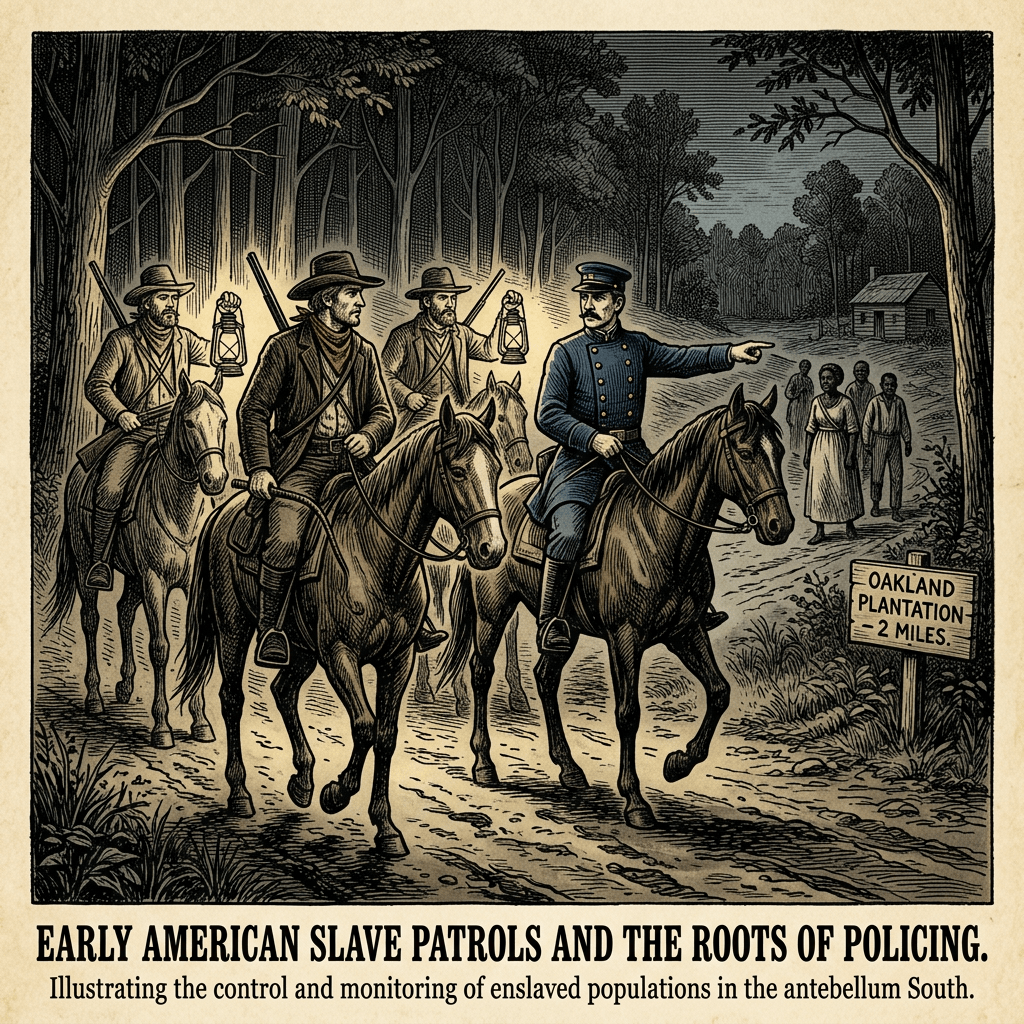
In contrast, the evolution of policing in the Southern United States was inextricably linked to the institution of slavery. Southern forces grew out of organized slave patrols, the first of which were established in the Carolina colonies in 1704. Unlike the Northern night watches, which focused on general public order, these patrols served as a formal and legal mechanism for the surveillance, pursuit, and control of enslaved people. Patrol members were authorized to conduct warrantless searches of slave quarters and enforce codes designed to maintain racial order and prevent insurrection—a paramilitary system of social control that persisted as a primary form of law enforcement until the end of the Civil War.
Commercial Interests and Political Machines
The transition to professionalized forces was frequently driven by economic motives. In Boston, commercial shipping interests sought to shift the cost of protecting private cargo onto the public treasury. Similarly, the creation of New York’s modern force in 1845 was quickly overshadowed by machine politics, particularly Tammany Hall. Policing became an instrument of political patronage and elite influence; notably, NYPD Superintendent Thomas Byrnes admitted to amassing a personal fortune through investments facilitated by industrial titans Cornelius Vanderbilt and Jay Gould.
This era of Gilded Age political patronage meant that police departments often functioned as extensions of the local political machine rather than independent law enforcement agencies. Appointments and promotions were frequently tied to political loyalty, ensuring that the interests of the elite were prioritized over public safety. These historical structures—designed for labor suppression, merchant protection, and racial control—form the fundamental architecture of the modern police system. Today, this institution has expanded into a massive public enterprise, with national expenditures on police, public order, and safety now absorbing hundreds of billions of dollars annually as a major component of government current expenditures.
Legacy and Modern Expenditure
The historical structures of American policing—originally designed for labor suppression, merchant protection, and racial control—constitute the fundamental architecture of the modern police system. From its early iterations in Northern night watches and Southern slave patrols, the institution has evolved into a massive, professionalized public enterprise. This transition was often catalyzed by economic motives, such as Boston’s commercial shipping interests shifting the cost of private cargo protection to the public treasury, and the rise of political patronage in New York City.
Today, this system has expanded into an extensive public order and safety infrastructure. National expenditures on policing and public safety have grown significantly, now absorbing hundreds of billions of dollars annually as a major component of government current expenditures. While the responsibility for law enforcement remains primarily with local departments and sheriff’s offices, it is supported by state services and specialized federal agencies like the FBI and U.S. Marshals Service. Despite the scale of this investment, modern policing continues to face scrutiny regarding its historical origins and its role in maintaining social and racial order.
Shoutout to the YouTube channel Erased Century for consistently creating and posting engaging and informative videos featured in this Blog. Their content not only covers a wide range of fascinating topics but also provides viewers with unique insights and entertaining perspectives. Please take a moment to check out https://www.youtube.com/@ErasedCentury and help support this incredible Channel by subscribing, liking, and sharing their videos with friends and fellow enthusiasts. Your support can make a huge difference in helping them grow and continue producing quality content that informs and entertains audiences around the world.
Source Links:
- • Boston Police Department — Official History https://police.boston.gov/history/
- • TIME — “How the U.S. Got Its Police Force” https://time.com/4779112/police-histo…
- • History of the New York City Police Department — Wikipedia https://en.wikipedia.org/wiki/History…
- • National Law Enforcement Officers Memorial Fund — “Slave Patrols: An Early Form of American Policing” https://nleomf.org/slave-patrols-an-e…
- • South Carolina Encyclopedia — “Slave Patrols” https://www.scencyclopedia.org/sce/en…
- • TIME — “The Origins of Corruption in the New York City Police Department” https://time.com/4384963/nypd-scandal…
- • FRED / U.S. Bureau of Economic Analysis — Government Current Expenditures: Public Order and Safety: Police https://fred.stlouisfed.org/series/G1…