
I was gonna make this my Sunday post, but… here we are.
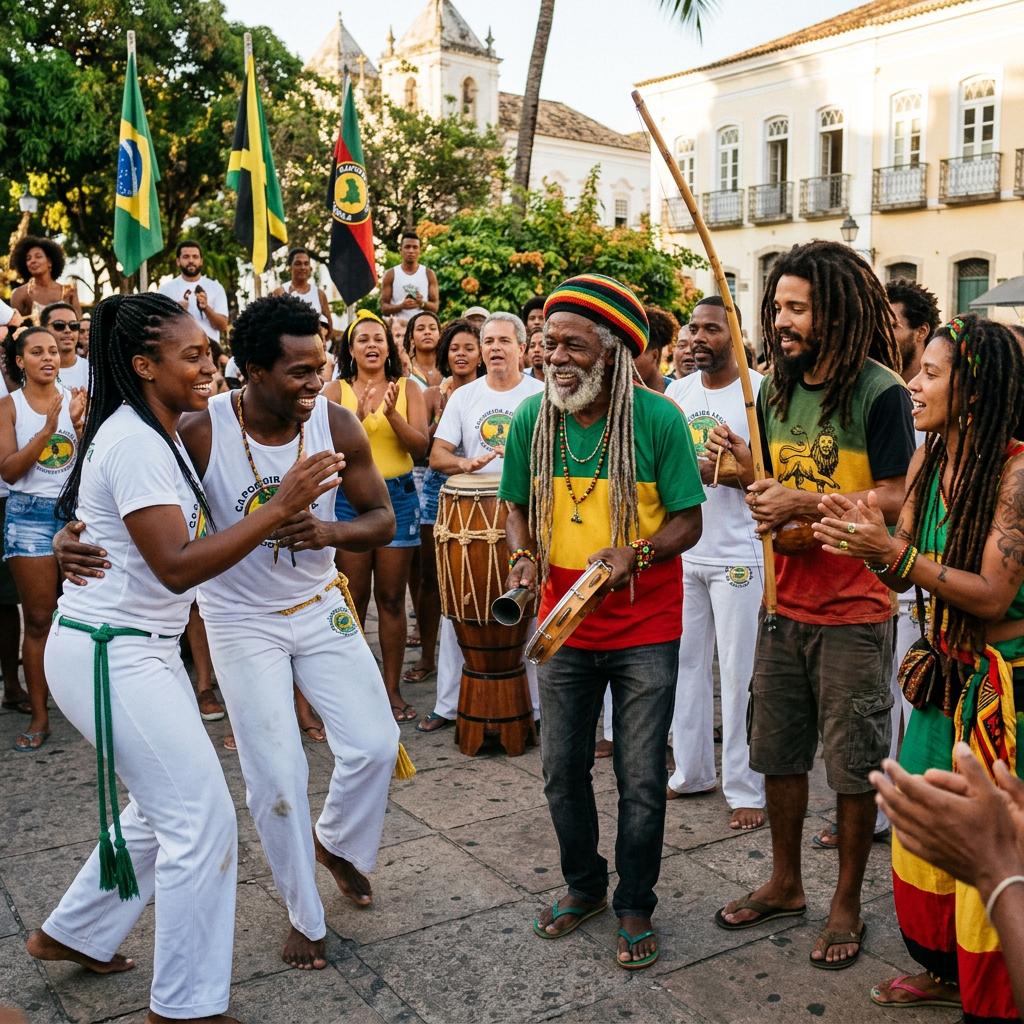
The connection between Capoeira Angola and Rastafarianism lies in their shared roots as Afro-Diasporic systems of resistance, spiritual preservation, and liberation from oppression. While one developed in the recôncavo of Bahia, Brazil, and the other in the hills of Jamaica, both function as holistic lifeways designed to reclaim African identity and dismantle colonial power structures.
The Rhythm of Resistance: Where Capoeira Angola and Rastafarianism Meet
To the untrained eye, Capoeira Angola and Rastafarianism might seem like entirely different worlds. One is a ritualized martial art, characterized by deep, ground-level movements, strategic trickery, and the hypnotic ring of the berimbau. The other is a biblical, messianic spiritual movement known for its distinct livity, dreadlocks, and the heavy basslines of Reggae and Nyabinghi drumming.
Yet, beneath the surface of geography and form, Capoeira Angola and Rastafarianism are twin rivers flowing from the same fundamental source: Central and West African spiritualities adapted to survive and defeat the forces of chattel slavery and colonialism.
They are not merely hobbies or religions; they are holistic systems of liberation. Here is where and how these two profound Afro-Diasporic traditions connect.
1. Liberation Over Slavery: Rebuffing the “Babylon” System
At the core of both traditions is an uncompromising rejection of oppression. Rastafarianism identifies the corrupt, oppressive structures of the Western world as “Babylon.” For the Rastafari, Babylon is the modern continuation of the slave trade—a system designed to strip African people of their history, language, and divinity. Livity—the righteous Rastafari way of life—is a daily practice of mental and physical secession from Babylon.
Capoeira Angola shares this exact operational DNA. Born out of the struggle of enslaved Africans in Brazil, it was the ultimate tool for survival. When Africans escaped the plantations to form quilombos (maroon societies), Capoeira was the combat system that protected their freedom against colonial trackers.
Where the Rasta uses word, sound, and power to decolonize the mind, the Angoleiro (Capoeira Angola practitioner) uses movement, mandinga (craftiness), and malice to physically and psychologically outwit the oppressor. Both systems view the human body and mind as sovereign territory that no colonial system has the right to conquer.
2. Sacred Rhythms: The Drum and the Berimbau
Neither Capoeira Angola nor Rastafarianism can exist without music, because for both, music is a spiritual technology.
In Rastafarianism, the Nyabinghi drum beat is the heartbeat of the movement. Played on three drums (the pitche, funde, and bass), the rhythm represents the heartbeat of Jah and is used during “groundations” to communicate with the divine and “chant down Babylon.”
In Capoeira Angola, the berimbau governs everything. The lead berimbau (gunga) dictates the speed, style, and spiritual energy of the roda (the circle). Just like the Nyabinghi drums, the berimbau invokes ancestral energies, mapping out a sacred space where players communicate through a sophisticated language of rhythm and song.
In both spaces, the music creates a communal trance state, reconnecting displaced people to their ancestral lineage.
3. The Philosophy of the Counter-Attack: Deception vs. Word, Sound, and Power
The tactical connection between the two lies in how they flip colonial structures on their heads.
Capoeira Angola is famous for its use of malícia—a strategic deception. An Angoleiro rarely attacks directly; instead, they play the fool, feign vulnerability, and invite the opponent in, only to strike from an unexpected angle. It is a philosophy born from the necessity of the underdog: when you are physically outgunned, you must use your opponent’s own momentum and assumptions against them.
Rastafarianism uses a similar psychological strategy through its linguistic reinvention, known as “Iyaric” or Dread Talk. Recognizing that English was the language of the slave master, Rastas fundamentally altered the language to inject power back into the speaker. They replaced “Oppress” with “Downpress” (because oppression weighs you down, it doesn’t lift you up) and replaced “We” or “You” with “I and I” to signify that the Divine (Jah) is always present within every individual.
Both traditions recognize that to defeat an oppressor, you cannot play by their rules—you must alter the geometry of the battlefield, whether through physical movement or spoken language.
4. Ancestral Memory and the Return to the Source
Finally, both movements are anchored in a deep reverence for Africa as the spiritual homeland. Rastafarianism centers on the concept of Repatriation, both physical and spiritual, back to Africa (symbolized by Ethiopia). It demands a conscious remembering of roots in a world that pressures Black and displaced people to forget.
Mestre Pastinha, the great guardian of Capoeira Angola, famously stated: “Capoeira Angola belongs to Africa.” The ritual of the chamada (the call)—where one player freezes the game and calls the other forward in a rigid, tense ritual walk—mirrors Central African spiritual concepts like the Kikongo Cosmogram, mapping out the cycle of life, death, and rebirth. Capoeira Angola intentionally preserves the oldest, closest-to-the-source movements and rituals to keep the connection to African ancestors unbroken.
Conclusion: One Love, One Roda
Ultimately, Capoeira Angola and Rastafarianism are two sides of the same coin. They are living blueprints for how human beings can preserve their dignity, spirituality, and joy in the face of brutal adversity.
Whether you are stepping into the roda to dodge a lightning-fast kick or sitting by a fire chanting to the beat of a funde drum, you are participating in an unbroken lineage of global African resistance that spans generations and continents. This vibrant tradition, rich with history and meaning, embodies the struggles and triumphs of countless ancestors who fought against oppression. Through each movement and every rhythmic beat, you connect not only with the past but also with fellow practitioners who share in this profound experience.
They teach us that true freedom isn’t given; it is danced, drummed, spoken, and fought into existence, creating a powerful narrative that resonates with each heartbeat and inspires future generations to continue the fight for justice and equality. In this sacred space, the rhythms of resistance echo through time, uniting voices from across the globe in a chorus of resilience and hope.

