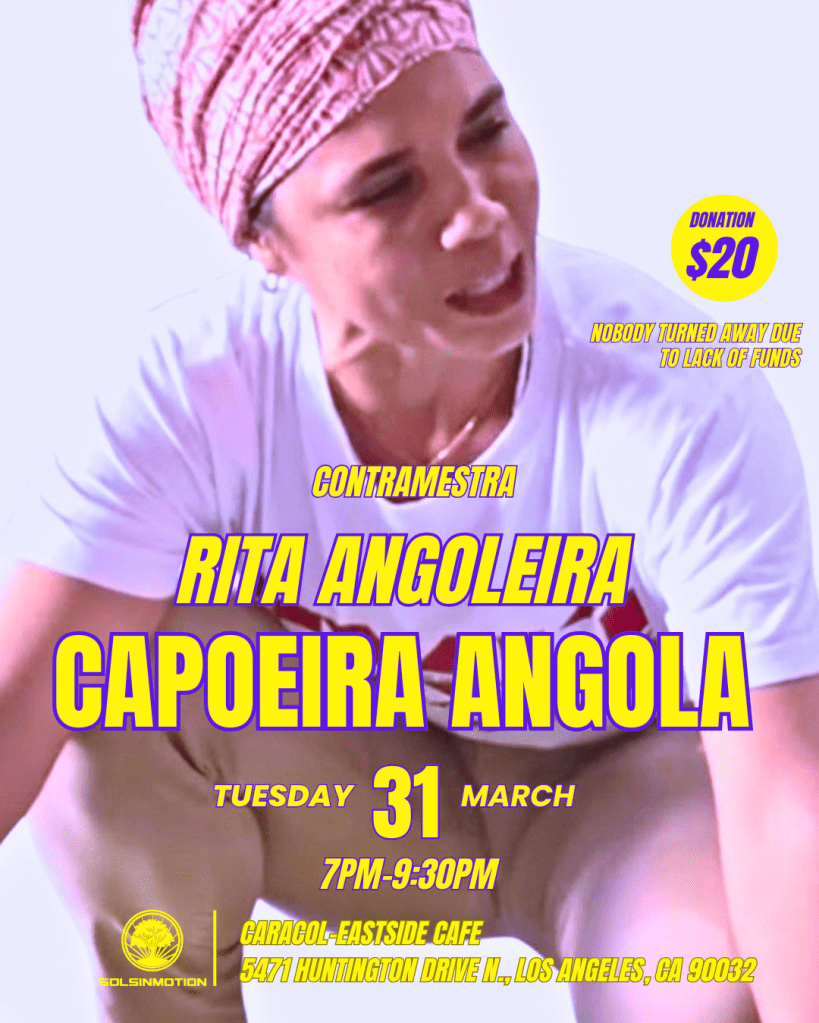
Capoeira Angola: Empowering Change Through Movement

I want to introduce you to an organization that I have the pleasure to be a part of. It’s called, “Capoeiristas for Change”.

This movement is founded on the principles of Capoeira Angola, a sophisticated Afro-Brazilian martial art, dance, and philosophical system that was born from the struggle for freedom and resistance against oppression.

The Embodied Pedagogy of Capoeira Angola: A Path to Personal and Collective Liberation

The practice of Capoeira Angola is not merely a martial art; it is a profound philosophy and a living, embodied pedagogy of self-determination and cultural memory. At its core, it represents a spiritual and physical return to the principles of freedom, born from the crucible of slavery and resistance.

Liberation Through Movement: The Jogo as Dialogue and Decolonization

Capoeira Angola is fundamentally a practice of embodied liberation. The **jogo** (game), played within the circle of the roda, transcends mere physical exercise. It is a complex, non-verbal dialogue in motion—a conversation between two practitioners that requires deep listening, spontaneous creativity, and absolute presence. In this sacred space, the **capoeiristas** (practitioners) engage in an act of shedding the constraints of societal expectations, internalized oppressions, and the psychological chains of historical trauma. The jogo becomes a laboratory for self-reclamation.

The fluid, often deceptive, and low-to-the-ground movements are deeply symbolic. The **ginga** (the characteristic rocking, swaying step) is the foundational matrix—it is not an attack or a defense, but a state of perpetual readiness and strategic mobility. It symbolizes the continuous, resourceful, and resilient nature required to navigate and overcome adversity, mirroring the survival strategies of the enslaved ancestors. Evasions, sweeping maneuvers, and sudden accelerations are not just techniques; they are metaphors for the intelligence, cunning, and resourcefulness necessary to outmaneuver a more powerful opponent.

Through the demanding physical and mental discipline inherent in the art, individuals cultivate not just physical strength and agility, but a profound and integrated sense of personal power. The practice forces practitioners to confront and move beyond perceived physical limitations and, more importantly, internalized mental chains, leading to a palpable sense of self-mastery and self-determination.

Culture as a Catalyst for Consciousness: The Holistic Ecosystem of the Roda

Capoeira is far more than its movements; it is a holistic cultural ecosystem. The **roda** (the circle in which Capoeira is played) is the complete world of the art, a communal space where music, movement, and history converge.

The Orchestral Heartbeat: The music is the undisputed heartbeat of the roda, acting as the conductor and the soul of the game. Instruments such as the **berimbau** (the single-stringed musical bow, which is the most vital instrument, determining the speed and style of the jogo), the **atabaque** (a tall, wooden hand drum providing the deep rhythm), and the **pandeiro** (a Brazilian tambourine) create a rhythmic tapestry that dictates the pace, energy, and, critically, the intention of the game.

The Oral Tradition: The call-and-response songs (**corridos**) are the living archive of the art. They are not mere accompaniments but transmitters of historical narratives, complex philosophical teachings, ethical principles, and ancestral wisdom. They recount tales of legendary capoeiristas, lament the hardships of the past, and offer spiritual guidance for the present. By immersing themselves in this tradition—by singing the songs and understanding their context—capoeiristas engage in a critical process of historical retrieval and cultural affirmation. This immersion connects them directly to the legacy of enslaved Africans who brilliantly forged this art as a veiled form of self-defense, resistance, and community preservation—a practice hidden in plain sight.

This resulting cultural consciousness is arguably the most powerful element of the practice. It transforms the physical discipline into a framework for historical and sociological analysis, providing a powerful foundation for understanding, confronting, and ultimately addressing contemporary forms of social and systemic injustice. The roda thus serves as a model for an equitable and resilient community, rooted in respect, history, and collective strength.

Capoeira Angola: A Framework for Community-Driven Social Action

The initiative “Capoeiristas for Change” is fundamentally rooted in the philosophy and practice of Capoeira Angola. It is an intentional effort to translate the profound, embodied lessons learned within the musical circle, the roda, into effective and ethical community engagement and social action. This translation process is not accidental; it is a direct application of the art form’s underlying humanistic principles.

The core principles of this Afro-Brazilian art form—namely respect (respeito), unity (união), discipline (disciplina), and responsibility (responsabilidade)—do not merely serve as static guidelines for the physical game or the musical performance. Instead, they form a comprehensive, dynamic moral and ethical compass that guides all external social endeavors undertaken by the initiative.

  • Respect (Respeito): This principle extends beyond acknowledging the skill of an opponent in the roda. In community work, respeito mandates deep listening, valuing local knowledge, and honoring the autonomy of the communities being served. It ensures that interventions are collaborative, not prescriptive, and are based on genuine partnership rather than a top-down model.
  • Unity (União): The collective energy and seamless interaction required for a successful roda are mirrored in the social mission. União emphasizes the necessity of coalition-building, the power of collective action, and the commitment to inclusivity. It is the understanding that shared goals are achieved through the strength of a diverse and interconnected network of individuals.
  • Discipline (Disciplina): The rigorous training, patience, and commitment to mastering the movements and music of Capoeira Angola translate into the diligence required for sustainable social change. Disciplina ensures that actions are strategic, well-planned, and consistently executed, focusing on long-term impact rather than short-lived, superficial efforts. It fosters the resilience needed to overcome inevitable obstacles.
  • ****Responsibility (Responsabilidade): The inherent accountability each player has to the safety, rhythm, and flow of the roda is expanded into a civic duty. Responsabilidade compels the Capoeiristas to critically assess their impact, hold themselves accountable to the community’s needs, and ensure that their actions contribute positively to the broader social fabric.

This approach ensures that every social action undertaken by “Capoeiristas for Change” is not only impactful and strategically sound but is also deeply grounded in humanistic, ethical, and collaborative values, forging a path for sustainable change through embodied philosophy.

—–Translating the Principles of the Roda into Social Strategy

The roda is the crucible where these principles are forged and tested, offering direct, applicable models for collective action:

  • Unity (União) and the Collective Effort: In the Capoeira Angola roda, success is indivisible. The energy, rhythm, and safety of the game rely on the seamless contribution of every participant—the two players (jogadores), the instrumentalists at the bateria, and the choir of singers (coro). A single discordant instrument or a lack of participation weakens the entire structure. “Capoeiristas for Change” adopts this model of collective effort (mutirão), emphasizing that complex social issues—such as poverty, inequality, or lack of resources—cannot be solved by isolated individuals. It necessitates mutual support, shared ownership, and a harmonious synthesis of diverse skills and perspectives within the community being served.
  • The Ginga as a Social and Strategic Posture: The ginga, the foundational, continuous movement of Capoeira Angola, is often misunderstood as a simple dance or warm-up. In reality, it is a sophisticated, deceptive, and highly adaptable posture—a moving state of readiness. In the context of social strategy, the ginga teaches advocates to adopt a flexible, non-linear approach to problem-solving. Systemic obstacles are rarely straightforward; rigid plans often fail. The ginga encourages the initiative to:
    • Adapt and Evolve: Be ready to shift strategies immediately when faced with unexpected resistance or new community needs.
    • Utilize Deception (Non-Confrontation): Often, the most effective path forward is one that avoids direct, power-draining confrontation, instead utilizing indirect, creative, and strategic means to achieve long-term goals.

Historical Resilience and Modern Empowerment: The Legacy of Capoeira Angola

The history of Capoeira Angola is not merely an interesting footnote; it is a powerful, living testament to human resilience and cultural preservation, and it remains the single most profound source of inspiration for modern practitioners and community action initiatives. Born from the crucible of brutal chattel slavery in Brazil, Capoeira was ingeniously crafted by enslaved Africans as a covert martial art, cleverly disguised as a dance. This dual nature allowed them to simultaneously retain physical prowess, sharpen their mental acuity, and, critically, preserve their African cultural identity—all while under the watchful, oppressive gaze of the slave masters. It was a secret language of movement, a practical tool for self-defense, and a spiritual mechanism for asserting their inherent humanity.

This deep historical root of resistance and liberation is the foundational philosophy that drives organizations like Capoeiristas for Change today. The mission is to channel this powerful legacy into contemporary social justice efforts. The goal transcends simple charity or mere assistance; it is a dedicated effort to actively advocate for marginalized communities by focusing on building genuine, deeply embedded resilience and empowerment programs. By sharing the rigorous training, philosophical framework, and community structure of Capoeira Angola, these programs aim to equip community members with tangible tools for transformation:

  1. Reclaim Narrative and Personal Agency: Just as enslaved people utilized Capoeira to assert their worth and covertly prepare for freedom, modern programs facilitate a journey for participants to reclaim their own self-worth and powerfully challenge the negative, limiting narratives and systemic biases imposed by society. This reclamation of self-definition is the first step toward collective liberation.
  2. Develop Integrated Physical and Mental Acuity: The intense discipline, strategic thinking, and demanding physical movements inherent in the art instill far more than just physical fitness. They cultivate deep-seated confidence, unwavering focus, and practical problem-solving skills. Participants gain a tangible, internal understanding of their own strength and capability, which translates directly into other aspects of their lives, including educational and professional pursuits.

Foster a Profound Sense of Belonging and Safety (A Roda como Santuário): The central element of Capoeira—the roda (the circle or ring where the game is played)—is more than just a performance space. It provides an immediate, profoundly inclusive, and disciplined social environment. Within the roda, individuals feel physically and emotionally safe to explore their limits, make mistakes, test their personal boundaries, and form deep, authentic bonds with others. It functions as a microcosm of an ideal community, built on mutual respect, trust, and shared purpose, thereby combating the isolation and alienation often experienced by marginalized groups.

    Capoeiristas for Change: Embodying Liberation Through Movement, Culture, and Community Action

    Ultimately, “Capoeiristas for Change” is far more than an organization; it is a dynamic movement and a profound philosophy that transcends the boundaries of mere physical training, acting as an essential and potent vehicle for individual and communal transformation. At its core, it harnesses the vibrant, complex, and historically subversive power of Capoeira Angola, interpreting the practice not only as a sophisticated martial art and an expressive dance but as a deep-rooted cultural and philosophical practice fundamentally dedicated to the concept of liberation.

    This initiative’s mission begins at the personal level, fostering transformative individual growth in every practitioner. By rigorously engaging with the demanding physical and mental disciplines of Capoeira, the movement instills a deep sense of discipline, cultivates unwavering resilience in the face of adversity, and builds a profound sense of self-worth and inner strength. Practitioners learn to move with grace, think strategically, and endure challenges, enabling them to navigate personal, professional, and societal hurdles with composure and potent efficacy. The jogo (game) of Capoeira becomes a direct, kinetic metaphor for the challenges of life, and mastering it translates into a powerful personal mastery that sustains practitioners outside the roda.

    Beyond the sphere of personal development, the organization acts as a powerful catalyst for collective social progress. It deliberately channels the profound historical and political legacy of Capoeira—a tradition born from the ingenious resistance of enslaved Africans against systemic oppression in Brazil—into targeted, meaningful modern community action. “Capoeiristas for Change” actively translates this legacy of resistance into tangible impact. They engage in comprehensive outreach programs, develop and deliver educational workshops focused on cultural awareness and empowerment, and forge collaborative projects that directly address systemic inequalities, advocate for human rights, and work to dismantle structural barriers that perpetuate injustice.

    Through these consistent, tangible results and the unwavering, dedicated effort of its members, the movement powerfully demonstrates that liberation is not an abstract, utopian ideal to be achieved in some distant future. Instead, it is framed as a continuous, deliberate, and daily practice—a state of being that must be embodied and fought for every moment. This continuous practice of liberation is fundamentally manifest and embodied in several interconnected elements: the fluid, complex, and strategic movement of the roda (the circle where Capoeira is played), which demands cooperation and respect; the rich cultural traditions—including music, history, and language—that sustain the practice and ground it in a collective heritage of resilience; and the absolute, unwavering dedication of its members to genuine, impactful, and sustainable community action.

    Through this deeply integrated approach—merging mind, body, history, and activism—the initiative not only preserves the art of Capoeira but also demonstrates its enduring and powerful relevance as an essential tool for building a more just, equitable, and liberated society for all.

    To learn more about how to join the movement, or support our vital community initiatives, we invite you to visit our comprehensive website: www.capoeiristasforchange.com.

    HIDDEN SPIRITUALITY – From Spirit Science (1/14/26)

    Welcome to HIDDEN SPIRITUALITY – From Spirit Science, a unique platform dedicated to the profound exploration of spiritual practices, wisdom, and philosophies as they are subtly or explicitly woven into the fabric of popular culture, particularly in movies, video games, and other compelling narratives. Here, we delve deeper into how these spiritual themes resonate with audiences, unlocking layers of meaning that enhance the experience of storytelling. By examining iconic films and beloved games, we aim to illuminate the connections between entertainment and the age-old quest for knowledge and understanding, fostering a community that embraces diverse perspectives and encourages reflective dialogue about the spiritual dimensions of our shared cultural experiences. Through articles, discussions, and multimedia content, we invite you to journey with us as we reveal the hidden threads that link spirituality to the art that shapes our lives.

    Our mission is to move beyond the surface level of entertainment, highlighting the deep, often profound spiritual and philosophical wisdom embedded within these diverse narratives. We believe that modern storytelling, from epic fantasy sagas to complex sci-fi worlds, serves as a powerful mirror reflecting universal truths and ancient teachings. By delving into the intricacies of character development and intricate plotlines, we uncover layers of meaning that resonate with the human experience. Through this exploration, we aim to connect with audiences on a deeper level, igniting reflections on their own journeys and encouraging them to seek and understand the deeper lessons that these stories impart. In doing so, we hope to foster a greater appreciation for the art of storytelling and its potential to inspire transformative change in both individual lives and society as a whole.

    In today’s installment…

    Unveiling the Deeper Meaning: A Spiritual Exploration of The Two Towers

    Join us as we continue our profound exploration of the enduring spiritual themes and hidden messages woven into the fabric of J.R.R. Tolkien’s epic masterpiece, The Lord of the Rings. Our journey now takes us deeper into the curious and pivotal second chapter of the saga: The Two Towers. Far from being a mere transitional narrative, this middle-chapter is packed with powerful insights and timeless lessons concerning the nature of our ego, the complexities of the human psyche, and the fundamental ways we navigate through the relentless challenges and trials of life.

    In this dedicated video exploration, we will meticulously dissect the rich symbolism and profound meaning underpinning the central characters, significant events, and interconnected landscapes of The Two Towers. Our goal is to uncover the universal truths and profound wisdom that resonate beneath the captivating surface of this epic tale of conflict and companionship.

    The narrative splits into distinct yet spiritually interconnected paths, each offering a unique lens into the human condition:

    The Path of Inner Struggle and Redemption: We will follow the grueling, isolated journey of Frodo Baggins and Samwise Gamgee as they press into the shadow of Mordor. Their burden—the One Ring—is a powerful symbol of the corrupting influence of desire and attachment, mirroring the heavy burdens we carry in our own lives. We will analyze their unwavering friendship and loyalty as the essential spiritual anchors that prevent their complete descent into despair. Their odyssey is a powerful meditation on sacrifice, demonstrating that true spiritual progress often requires the relinquishing of comfort and self-interest for a greater good, ultimately pointing toward the themes of redemption from the dark influence of the ego.

    The Shadow of the Inner Demon: Central to this exploration is the tragic and complex figure of Gollum/Sméagol. He serves as a potent, harrowing representation of the darker, shadow aspects of the human psyche—the internal division between the higher self and the utterly corrupted ego. We will examine the psychological and spiritual implications of his addiction to the Ring, illustrating the challenges we all face in overcoming our own inner demons, those deep-seated habits and destructive voices that threaten to hijack our authentic self. Gollum’s presence acts as a cautionary tale about the irreversible damage caused by prolonged obsession and isolation.

    The Path of Action and External Conflict: Simultaneously, we track the struggles and evolution of the remaining Fellowship—Aragorn, Legolas, and Gimli. Their epic chase across Middle-earth and their involvement in the great war for Rohan symbolize the external battles we must fight to defend what is pure, good, and worth preserving in the world. Aragorn’s journey is an unfolding of destiny, a lesson in embracing one’s true, noble identity and leadership potential despite fear and doubt. The deepening bond between the Elf Legolas and the Dwarf Gimli becomes a powerful allegory for transcending superficial differences and tribal prejudices, demonstrating that unity and mutual respect are essential for collective spiritual survival and victory over powerful external forces.
    By delving into these parallel storylines, we gain a comprehensive view of the spiritual battles fought both within the heart of the individual and on the grand stage of the world. So, come along with us on this illuminating journey, as we peel back the layers of adventure and fantasy to uncover the profound, hidden spirituality of The Two Towers—a timeless guide for navigating the challenges of self-discovery and destiny.

    Enhance Capoeira with Qigong and Neigong Principles

    The seemingly disparate martial arts of Capoeira Angola, the Afro-Brazilian art form rooted in resistance and cultural expression, and the traditional Chinese practices of Qigong (Chi Kung) and Neigong (Nei Kung), dedicated to self-cultivation, share profound, yet often unexamined, connections. These connections are particularly salient concerning the principles of internal energy management, the achievement of movement efficiency, and the development of deep mind-body unity.

    This exploration delves into how the core principles and methodologies of Qigong and Neigong can inform, deepen, and significantly expand the understanding and practice of Capoeira Angola. Qigong, broadly translated as “skill with Qi,” and Neigong, referring to “internal skill” or the deeper, often static, internal practices, both center on a meticulous focus on breath control, the maintenance of precise static postures (similar to the foundational or Negativa in Capoeira), the execution of slow, mindful movements, and the conscious circulation of Qi (life energy).

    In Capoeira Angola, this internal cultivation manifests as the characteristic fluidity, resilience, and deceptive power—often referred to as malícia or the ‘hidden danger’—that belies the relaxed external appearance. By integrating the internal focus of Chinese practices, Capoeiristas can move beyond mere physical technique to tap into a wellspring of sustainable energy, enhance their balance and stability, and achieve a deeper state of Jogo (the game), where spontaneous, efficient movement flows directly from a calm, unified mind and body. This integration offers a powerful lens through which to re-examine the core movements and philosophy of Capoeira Angola, bridging geographical and cultural divides through the universal language of embodied internal energy.

    Capoeira Angola: Movement as Dynamic Meditation: The Internal Matrix of Capoeira Angola

    Capoeira Angola, when observed from an external perspective, presents itself as a captivating, complex, and profound synthesis of movement, rhythm, and strategic engagement. Characterized distinctively by its low, deeply grounded stances and movements, the nuanced, often deceptive strategic dialogue of the jogo (the game), and the absolutely integral, guiding role of its musicality, the art form is frequently viewed through lenses that prioritize its highly physical, acrobatic, or purely dance-like aesthetic. This common external perception, while undeniably capturing the immediate visual poetry and kinetic beauty of the art, often overlooks, and sometimes entirely obscures, the profound and sophisticated internal mechanisms that are the true definers of mastery, longevity, and deep effectiveness within the practice.

    The superficial observation tends to categorize Capoeira Angola merely as a demanding physical discipline—a strenuous workout or a cultural performance. Such a view misses the transformative core: the internalization of energy, strategy, and presence. While the physical conditioning is certainly rigorous, it is a byproduct of the practice, not its primary goal. The focus on low, stable postures, for instance, is not simply a stylistic choice; it is a fundamental engineering decision designed to root the practitioner to the earth, cultivating a profound sense of grounded power that is energetically efficient and structurally sound.

    However, at its most advanced and refined level, Capoeira Angola fundamentally transcends the domain of mere physical skill acquisition and rote technique performance. It operates instead on a sophisticated, deeply integrated internal matrix—a system of energetic and consciousness cultivation. This internal matrix is what allows a master to execute movements that defy conventional biomechanics, to maintain unwavering composure under pressure, and to play a jogo that feels less like a competition of speed and more like a fluid, intellectual, and energetic conversation.

    The defining elements that give the art its unique character and power—specifically, the continuous, fluid, and often hypnotic swaying of the Ginga (the foundational and connecting movement), the profoundly deceptive nature and impeccable timing of attacks and defenses, and the remarkable, almost counter-intuitive endurance required for prolonged, intense, and emotionally charged games—are not simply the eventual products of brute muscular strength, elite cardiovascular fitness, or the exhaustive, uninspired memorization of isolated techniques. Instead, they are the direct, inevitable results of cultivating a deep, systemic energetic efficiency and internal equilibrium.

    The Ginga, often misunderstood as a simple shifting of weight, is the primary vehicle for this energetic cultivation. Functionally, it is a moving meditation—a continuous, low-impact exercise that prevents stagnation and cultivates flow (fluxo). By maintaining this perpetual motion, the practitioner is continuously cycling and generating energy, remaining elusive, centered, and ready to explode into action without the tell-tale preparatory movements that betray an intention. The effectiveness of the ginga is directly correlated to the practitioner’s ability to remain internally relaxed and outwardly dynamic.

    Furthermore, the “deceptive nature” of the game is not based on feints alone; it is born from an internal stillness that allows for the perfect synthesis of malícia (cunning) and presence. An advanced capoeirista does not think about what to do; they feel the energetic shifts of their opponent and respond instinctively from a place of deep, cultivated intuition. This capability is the essence of internal work—moving from the center of gravity (the dantian in internal martial arts terminology) rather than relying on peripheral muscular effort.

    This concept of energetic refinement is not an ancillary benefit; it is a core structural principle. Mastery in Capoeira Angola is defined by the ability to move with grace and power for extended periods while appearing almost effortless—a tell-tale sign of highly developed internal energy management. This makes Capoeira Angola’s internal function closely and meaningfully aligned with the highest principles found within traditional internal martial arts, such as Qigong and Neigong, where the focus is similarly placed on the cultivation, circulation, and explosive utilization of intrinsic energy (or axé in the Capoeira context) over mere external physical force. The art is thus transformed from a physical practice into a dynamic form of internal cultivation, where the jogo itself becomes a mirror for the practitioner’s inner state.

    The Ginga, for instance, must not be mischaracterized as a simple placeholder shuffle or a neutral transitional step. It is, in essence, a moving meditation—a continuous, active, and dynamic practice that serves simultaneously as the energetic engine, the psychological shield, and the core principle of evasion and unpredictability. It is the continuous, figure-eight or circular momentum that permits the practitioner to transition seamlessly and instantly between attack, defense, and escape without any perceptible break in flow, loss of postural integrity, or, crucially, loss of deep connection to the ground. This constant, low-center-of-gravity motion is meticulously designed to facilitate the preservation, storage, and smooth circulation of Axé or vital energy (similar to Qi or Chi), thereby making the practitioner a dynamic, constantly moving, yet fundamentally stable and rooted force. True mastery of the Ginga dictates that the fluidity, speed, and deceptive power of movement are powered significantly less by overt, metabolically expensive muscular effort and more by the efficient generation, storage, and recycling of kinetic and potential energy. This reflects the foundational principle of all internal practice: that minimal, intelligent effort should yield maximum, sustainable output. The Ginga teaches the body to move from the deep core, utilizing the fascial slings and skeletal alignment, rather than superficial muscle groups.

    The strategic depth, complexity, and psychological intensity of the jogo further highlight and substantiate this deep internal focus. The deceptive nature inherent in the movements—where a seemingly passive, relaxed, or even vulnerable posture can instantly, and with no telegraphing, coil into a powerful, decisive strike (chapa) or an unexpected, gravity-defying escape ( or rolê)—demands not just elite physical coordination and motor control, but a refined, hyper-vigilant internal awareness. This is a cultivated state that involves a heightened sense of presence, a calm mind amidst chaos, and a finely tuned peripheral and psychological focus that registers the opponent’s intent rather than just their movements. The remarkable capacity for prolonged, high-intensity engagement, often lasting many continuous minutes under immense physical pressure and emotional scrutiny, is sustained not by the sheer, finite limits of muscular stamina alone, but by a masterful ability to manage, economize, and replenish one’s energetic and respiratory resources. This allows the body and mind to function consistently in a state of controlled, relaxed power (dengue). This precise energetic and psychological efficiency is the essential cornerstone that functionally and philosophically connects the external, physical expression of Capoeira Angola to the deep, mindful, and transformative practices of internal arts like Qigong (energy cultivation) and Neigong (internal skill/body refinement), thereby unequivocally affirming the art’s true identity as a dynamic, potent, and profound form of movement meditation. The jogo, in this light, is not a fight, but a shared, high-stakes meditative dialogue.

    Qigong and Neigong: The Internal Foundation for Martial Arts and Health

    The disciplines of Qigong and Neigong represent the core internal training systems fundamental to achieving mastery in many traditional Asian martial arts, offering profound benefits for both physical vitality and mental clarity.

    Qigong (Working with Qi – Vital Energy):

    • Definition and Practice: Qigong translates literally as “skill of cultivating vital energy.” These practices are systematic methods for managing and circulating Qi (life-force energy) throughout the body’s intricate network of meridians, or energy pathways. A typical practice involves the tripartite coordination of three elements:
      1. Breathing Patterns: Specific, deliberate respiratory techniques—often slow, deep, and abdominal—are used to gather, purify, and propel Qi.
      2. Physical Postures and Movements (Dantian focus): Gentle, flowing movements, static postures (like Zhan Zhuang or ‘standing like a tree’), or focused stretches are employed to open energy channels, relax fascia, and root the body. The focus of this energy work is frequently the lower Dantian (a major energetic center in the lower abdomen).
      3. Focused Intention (Yi): The mind’s intent is crucial. Yi acts as the guide, directing the Qi through the meridians, ensuring it flows smoothly and concentrates where needed.
    • Core Goal: The primary objective of Qigong is to optimize health, increase physical vitality, enhance the immune system, and cultivate internal stillness and emotional calm (Jing). It serves as a preventative medicine and a foundational practice for regulating the mind and body.

    Neigong (Internal Skill):

    • Definition and Intensity: Neigong, meaning “internal skill,” is a far more rigorous, intensive, and often historically secretive set of training methodologies. While Qigong focuses on circulating and managing Qi, Neigong concentrates on generating and storing immense internal power and making tangible structural changes to the body itself.
    • Refining Internal Structure: The practices target the deep internal architecture of the body, focusing on:
      1. Tendons and Fascia: Training aims to increase the tensile strength and elasticity of the tendons, connecting the whole body into a unified, spring-like structure.
      2. Bone and Marrow: Advanced practices seek to “wash the marrow” and strengthen the bones, making the skeletal structure denser and capable of withstanding and transmitting powerful internal forces.
    • Generating Internal Power: The ultimate outcome of Neigong is the generation and storage of significant internal power, often discussed in terms of:
      1. Jing (Essence): Refined raw energy and physical vitality, which is conserved and transformed through training.
      2. Shen (Spirit/Mind): The clarity, focus, and expressive power of consciousness, refined through intense meditative and energetic work.
    • Foundation for Martial Arts: Neigong is unequivocally considered the internal training foundation for many high-level Chinese martial arts (e.g., Taijiquan, Baguazhang, Xingyiquan). It provides the practitioner with the ability to issue force from the body’s deep core, rather than just relying on superficial muscle strength, enabling techniques that are deceptively powerful and deeply rooted.

    Bridging the Gap: Shared Principles

    The profound connection between the internal martial arts of Qigong and Neigong and the practice of Capoeira Angola is not merely theoretical; it rests upon several core, actionable principles that, when understood and integrated, significantly deepen the practitioner’s skill and energetic efficiency.1. Groundedness and Rooting (Dantian / Centro de Gravidade)

    The concept of a stable, deeply connected base is paramount in both Eastern internal arts and the Afro-Brazilian art of Capoeira Angola.

    • Qigong/Neigong: The Power of the Dantian and the Earth Root
      Internal arts emphasize the descent of Qi (life force) to the Dantian (literally “cinnabar field”), a major energetic storage and distribution center located approximately two inches below the navel and deep inside the core. This action is critical for establishing a solid “root” that extends conceptually into the earth. This rooting is not a rigid lock, but a dynamic connection that allows the practitioner to generate substantial, whole-body power—often referred to as Jing or internal strength—that emanates from the structural core rather than relying on isolated, superficial muscular force. A deep root allows for massive power generation without sacrificing balance or mobility.
    • Capoeira Angola: Lowering the Centro de Gravidade
      Capoeira Angola’s characteristic low positions—from the foundational Ginga to evasive movements like the Queda de Quatro or the sweeping actions of an Rasteira—are physical expressions of the energetic rooting sought in Qigong. By constantly lowering their centro de gravidade (center of gravity), the Angoleiro achieves enhanced stability, reduces the target profile, and ensures that all movements and counter-movements are launched from a powerful, resilient core. This physical requirement inherently mirrors the energetic discipline of dropping the Qi to the Dantian, ensuring that the power underpinning the movement is stable, agile, and readily accessible for sudden changes in direction or intensity. The lower the root, the more deceptive and grounded the movement becomes.

    2. Breath Control and Energy Management (Respiração / Qi)

    Breath is the vehicle of Qi and the primary mechanism for regulating the internal state, making it a critical bridge between the energetic and physical practices.

    • Qigong/Neigong: Guiding the Qi with Diaphragmatic Breath
      In internal training, conscious, deep, and quiet diaphragmatic breathing is the indispensable tool for circulating and focusing Qi. The pace of movement is inextricably linked to the rhythm of the breath; slow, deliberate inhales and exhales govern the flow and timing of every posture. This type of controlled respiration ensures a constant, smooth supply of oxygen and life force, transforming the body’s energy system from a reactive machine into a well-tuned, efficient generator. Specific breathing techniques are used not just for relaxation but for actively condensing and releasing power.
    • Capoeira Angola: The Master’s Steady Rhythm and Explosive Power
      While the jogo (game) of Capoeira Angola is characterized by dynamic, often explosive, movement, the truly masterful Angoleiro maintains a calm, steady breath even during high-pressure exchanges. Integrating Qigong principles transforms the Capoeirista’s breath from a mere automatic function into a sophisticated tool for endurance, emotional regulation (managing the adrenaline surge), and synchronizing physical movement with internal rhythm and the external beat of the Berimbau. The sudden, explosive power seen in advanced moves like the Rabo de Arraia (stingray tail) or the powerful kick of a Bênção (blessing) can be dramatically amplified by a controlled, focused expulsion of breath—a technique directly analogous to the internal martial arts practice of Fa Jing (issuing or releasing focused, explosive energy). This breath-work allows for peak physical output with minimal energy expenditure.

    3. Mind-Body Unity (Intenção / Malandragem)

    The ultimate refinement in both systems is the synchronization of the mind, energy, and body, transforming mere technique into an act of focused consciousness.

    • Qigong/Neigong: The Intentional Guidance of Yi
      The concept of Yi (intent, focused mind, or creative imagination) guiding the Qi is foundational to internal arts. The maxim “The mind leads the energy, and the energy leads the body” encapsulates this principle. The disciplined focus of the Yi is what distinguishes a mere physical exercise from a true energetic practice. It is the mental focus that ensures the power generated from the Dantian is correctly channeled to the periphery for maximum effect. This internal discipline cultivates a singular, unwavering presence.
    • Capoeira Angola: The Art of Malandragem and Focused Intentionality
      In Capoeira Angola, the psychological game, famously known as Malandragem (a combination of cunning, street-smarts, and sophisticated deception), demands an intense degree of presence and intentionality. Malandragem is the art of controlling the space, anticipating the opponent’s moves, and effectively hiding one’s true strategy. This is not simply a physical or intellectual skill; it is an act of focused mental energy. The internal training provided by Qigong and Neigong helps refine this focus, turning vague, reactive intention into a palpable energetic focus that directs and governs the flow of the entire jogo. This energetic focus allows the Capoeirista to project presence, manipulate the opponent’s perception, and act with a clarity that appears deceptively simple, creating the deep, strategic complexity for which Capoeira Angola is known.

    By intentionally integrating the internal arts of Qigong and Neigong into a Capoeira Angola regimen, the practitioner gains a profound, holistic curriculum for cultivating inner strength, energetic efficiency, structural integrity, and psychological presence that extends far beyond the limits of mere physical conditioning. This blend introduces a powerful, foundational, and continuous dimension to the Capoeirista’s lifelong development.

    Application in Capoeira Angola Training

    The principles of internal cultivation offer Capoeiristas a powerful, nuanced internal curriculum that complements the external forms and movements:

    • Static Postures (Isometria) for Structural Alignment and Qi Cultivation:
      • The Practice: This involves holding challenging, static Capoeira positions—such as the deep Cadeira (chair stance), the preparation (cartwheel loading), or the Queda de Quatro—for extended durations. The key distinction from conventional isometric training is the internal focus.
      • Internal Focus: The practitioner must consciously relax all unnecessary musculature, allowing the bones and connective tissues to bear the load, while maintaining deep, slow, diaphragmatic breathing. The focus shifts to sinking the weight into the earth and internally monitoring the feeling of Qi flow throughout the body, particularly in the Dantian (energy center below the navel).
      • The Result: This method builds profound, foundational structural strength and whole-body unity, developing a resilient internal framework rather than simply increasing surface muscle mass. It transforms a physical posture into a meditative, energetic alignment exercise.
    • Slow Movement (Movimento Lento) for Energetic Efficiency and Connection:
      • The Practice: The core movements of Capoeira—primarily the Ginga and fundamental techniques like the Cocorinha, Rolê, and Esquiva—are executed at an extremely slow, almost meditative pace. This speed allows for minute adjustments and deep somatic awareness.
      • The Emphasis: The practitioner emphasizes the transitions between movements, ensuring that there is never a “dead spot” or a break in the continuous flow. The focus is on finding the path of least resistance for every limb and joint, eliminating habitual tension and waste motion.
      • The Result: By moving slowly, the Capoeirista learns to maximize energetic efficiency. They cultivate a continuous, connected feeling throughout the entire body, allowing the movement to be guided by the internal connection and the Qi rather than muscular force alone. This translates to an effortless, powerful, and fluid Ginga and attack/defense in the Roda.
    • The Spine and the Core: The Engine of Unified Power (Neigong):
      • Neigong Principle: Neigong places heavy emphasis on the precise manipulation and integration of the spine and waist (or Kua) as the central engine for all power generation. The goal is to move the limbs from the center, ensuring the power originates from the earth and travels through the core before being expressed.
      • Capoeira Translation: This internal approach directly translates to maximizing the whip and snap found in Capoeira’s most explosive movements. This applies to the quick retreat and re-launch of the Meia Lua de Compasso, the sudden force of a Rasteira sweep, or the sharp evasiveness of an Esquiva.
      • The Result: Instead of relying on isolated leg or arm muscles, the Capoeirista learns to execute a movement where the whole body is contributing power—the subtle rotation and undulation of the spine, driven by the core, acts like a powerful chain, multiplying the force and speed far beyond what the limbs could generate alone. This makes their attacks more penetrating and their escapes more complete and integrated.

    Connecting Qigong and Neigong to Capoeira Angola: An Internal Perspective

    Although I do not recommend a syncretic combination of Capoeira Angola and Qigong/Neigong (Capoeira Angola is a singular, rich, and complete practice, and Qigong/Neigong constitutes a separate, profound discipline), I firmly believe that practitioners can unlock a deeper dimension of their Capoeira study by viewing it through an internal lens.

    By viewing Capoeira Angola not merely as an external physical dialogue—a series of movements, attacks, and evasions—but as a sophisticated internal practice, practitioners can utilize Qigong and Neigong as invaluable methods for deepening their roots, mastering their breath, and transforming external force into internal skill.

    The traditional training methods of Qigong (Breath/Energy Work) and Neigong (Internal Skill Development) offer profound methodologies for cultivating the essential qualities that elevate a Capoeira Angoleiro’s game:

    1. Deepening the Root and Center (Dantien): Qigong practices emphasize grounding, cultivating the connection between the feet and the earth. This directly enhances the stability of the ginga and the power generation from the lower body—the essence of a strong root in Capoeira. Neigong focuses on concentrating energy in the dantien (the body’s internal center of gravity and power), which translates into a more stable, powerful, and fluid execution of movements like cabeçadas (headbutts) and low sweeps.
    2. Mastering the Breath (Prana/Qi): Both practices place breath at the core of movement. Learning to coordinate movement with deep, slow, abdominal breathing (reverse or natural) allows the Capoeirista to maintain composure, conserve energy, and execute powerful, sustained movements without becoming winded. This breath mastery is essential for the extended roda and for maintaining a calm, focused mind amid the dynamic challenge of the game.
    3. Transforming External Force (Yielding and Absorbing): Neigong specifically trains the body to be pliable yet resilient. Techniques focused on internal relaxation and tensile strength allow the practitioner to absorb incoming force, neutralize it by yielding, and then redirect it with minimal external effort. This principle is directly applicable to escaping holds, absorbing strikes, and maintaining balance during dynamic exchanges, enhancing the Capoeira Angoleiro’s ability to play with malandragem (cunning and subtlety).
    4. Cultivating Intent and Awareness: Internal arts emphasize the power of Yi (mind/intent) to guide Qi (energy). This heightens the practitioner’s body awareness, proprioception, and ability to act from a place of deep, intuitive understanding. In the roda, this translates to improved anticipation, better control over one’s own tempo, and a more profound connection to the rhythm and energy of the opposing player.

    While Capoeira Angola is respected as a complete art form on its own, utilizing the principles and exercises of Qigong and Neigong offers a powerful supplementary pathway to enhance the internal foundation of the Capoeirista, ensuring that the physical expression is supported by a robust, well-regulated internal landscape.

    SPIRITUAL PRACTICES OF AFRICA, AND THE DIASPORA (1/11/26)

    This comprehensive blog series, titled “SPIRITUAL PRACTICES OF AFRICA, AND THE DIASPORA,” is dedicated to an in-depth exploration of the rich and varied tapestry of indigenous beliefs and organized religions across Sub-Saharan Africa. The series will meticulously focus on three foundational pillars: the profound significance of ancestral worship, the pervasive influence of Christianity, and the widespread reach of Islam.

    A core objective of the series is to celebrate and highlight the extraordinary cultural heritage of the region. This is achieved through a close examination of the diverse array of rituals and community gatherings that serve critical functions within society. These practices are not mere historical relics; they are living traditions that actively reinforce collective identity and are the primary mechanisms for cultural transmission, ensuring that the wisdom, values, and norms of previous generations are effectively passed down.

    Furthermore, the series broadens its scope to examine how these enduring traditions have adapted and transformed within the diaspora—the communities of African descent scattered across the globe. A special emphasis is placed on the vital role of storytelling as a foundational cultural technology. Storytelling is the essential vehicle for the preservation of oral histories, acting as a living archive, and is the principal method for conveying complex moral, spiritual, and practical lessons to future generations.
    Ultimately, “SPIRITUAL PRACTICES OF AFRICA, AND THE DIASPORA” is an ambitious project with a singular goal: to significantly enhance understanding of the complex interplay between faith, identity, and cultural resilience throughout Sub-Saharan Africa and its global diaspora, offering readers a nuanced perspective on how these powerful forces continue to shape the contemporary world.

    In today’s Installment…

    Let’s delve into the rich heritage of the African Methodist Episcopal (AME) Church, a pioneering and profoundly influential denomination in African American religious and social history. The AME Church’s narrative is one of resilience, self-determination, and a powerful quest for spiritual and civil liberty.

    The African Methodist Episcopal (AME) Church: A Pillar of Faith, Freedom, and Social Justice

    The African Methodist Episcopal Church is a storied, historically Black Christian denomination that represents one of the most pivotal moments in the history of the African diaspora in the Americas. It was officially founded in Philadelphia, Pennsylvania, in 1816 by the visionary leader Richard Allen. This establishment was not merely the creation of a new religious sect; it marked the first major religious denomination in the Western world to be founded solely by people of African descent. In doing so, the AME Church created a vital, autonomous, faith-based institution that was fundamentally independent of white control and passionately dedicated to the spiritual, social, political, and economic upliftment of Black communities throughout the burgeoning United States and, eventually, the world.

    The Struggle for Spiritual Autonomy

    The genesis of the AME Church was rooted in the fierce resistance to the rampant and humiliating racial discrimination experienced by Black worshippers at white-led churches, most notably St. George’s Methodist Episcopal Church in Philadelphia. The seminal and catalytic event occurred in 1787 when Richard Allen and other Black congregants, seeking a place for prayer, were forcibly removed and physically barred from the main sanctuary for kneeling in a segregated section designated for Black members. This blatant act of systemic racism and spiritual marginalization solidified Allen’s resolve and spurred him to lead a decisive movement for complete spiritual and ecclesiastical independence.

    Allen and his followers initially organized the Free African Society in 1787, a non-denominational mutual aid and benevolent society designed to support the community’s temporal needs. This groundwork soon led to the founding of Bethel African Methodist Episcopal Church in 1794, which became affectionately known as “Mother Bethel.” Despite establishing their own church property and forming their own congregation, white Methodist officials repeatedly attempted to exert control over Mother Bethel’s property, finances, and worship practices, claiming jurisdictional authority.

    This continuous, decades-long struggle for autonomy reached its climax and resolution in 1816. The Pennsylvania Supreme Court issued a landmark decision affirming the undeniable independence and complete ownership of the Black congregation over their property and worship. Immediately following this monumental legal victory, representatives from various Black Methodist congregations scattered across the Mid-Atlantic states—including Pennsylvania, Delaware, Maryland, and New Jersey—convened a historic conference in Philadelphia. This gathering officially consecrated and formally constituted the African Methodist Episcopal Church, a unified and sovereign denomination born out of a quest for dignity and freedom.

    A Foundation Beyond the Sanctuary

    The foundational purpose and expansive mission of the African Methodist Episcopal (AME) Church extended far beyond conventional religious worship and spiritual devotion. From its very inception, the AME Church has powerfully and enduringly served as a multifaceted engine for radical social justice, unparalleled educational advancement, and sustained political activism within the African diaspora. Its churches served as essential stations on the Underground Railroad, platforms for abolitionist rhetoric, centers for community organizing, and bastions of learning. The AME Church has consistently championed civil rights, fostered Black economic self-sufficiency, and provided essential leadership training for generations of activists, theologians, and politicians, cementing its legacy as one of the most influential and enduring institutions in African American history.

    The Pillars of the AME Mission:

    • Social Justice and Civil Rights Advocacy: The commitment to justice is central to the AME identity. During the tumultuous antebellum period, AME churches in the North were crucial hubs and key stations on the Underground Railroad, providing sanctuary and a path to freedom for enslaved people. AME bishops and ministers, such as the founder Richard Allen, were among the nation’s earliest and most vocal abolitionists, using the pulpit as a platform to denounce the immorality of slavery. This legacy continued throughout the 20th-century Civil Rights Movement, with many AME churches hosting critical meetings and clergy playing leadership roles in the struggle against segregation and racial discrimination.
    • Educational Empowerment: Recognizing that true emancipation required intellectual freedom, the AME Church placed an exceptionally high priority on education. The church was instrumental in founding numerous schools and colleges, seeing these institutions as essential for the uplift and self-determination of African Americans. A landmark achievement was the co-founding of Wilberforce University in 1856 (in partnership with the Methodist Episcopal Church), which became the first historically Black college or university (HBCU) owned and operated by African Americans. Following the Civil War, the church significantly expanded its educational outreach, establishing institutions like Morris Brown College in Atlanta, Georgia, and Allen University in Columbia, South Carolina. These schools were vital in educating newly emancipated people, training teachers, ministers, and leaders, and ensuring that succeeding generations had access to higher education despite systemic barriers.

    A Ministry with Global Reach:

    The AME Church’s vision was not confined to the United States. It rapidly expanded its influence globally, primarily throughout the Caribbean and the continent of Africa. Through the establishment of missions and new churches, the AME Church played a significant role in fostering African self-determination, providing spiritual guidance, and supporting community development. This global missionary effort connected African-descended peoples across continents, contributing to the rise of independent spiritual and political thought in places like South Africa and West Africa, thereby reinforcing a transnational identity and a shared commitment to liberation.

    Today, the African Methodist Episcopal (AME) Church stands as a vibrant, enduring, and international denomination, rooted deeply in its 19th-century origins as a spiritual and social refuge for people of African descent. The Church continues to be guided by the profound and inclusive motto, “God Our Father, Christ Our Redeemer, the Holy Spirit Our Comforter, Humankind Our Family.” This declaration not only encapsulates its Trinitarian theology but also underscores its commitment to universal human kinship and dignity.

    Building upon the pioneering spirit of its founders, the AME Church continues its legacy as a prophetic voice in the modern world. It tirelessly advocates for civil rights, social equality, and economic empowerment for all people, both domestically and across its global network. The denomination actively engages in ministry through education, healthcare, and community development initiatives, operating colleges, universities, and various social programs worldwide. This commitment ensures that the Church remains a dynamic force for change, carrying forward its historic mission to address systemic injustices and promote the spiritual and material well-being of the marginalized and oppressed.

    The WARRIOR CLASS Podcast (1/10/26)

    The WARRIOR CLASS podcast stands as your premier, indispensable, and utterly unique resource for comprehensively mastering the principles of self-protection and self-defense. We have meticulously designed every episode to equip every single listener—regardless of background or current skill level—with the vital, practical skills and the deep, profound knowledge base absolutely necessary for achieving and maintaining personal safety, holistic empowerment, and unshakeable confidence in an unpredictable world.

    —–Tune In and Transform Your Life

    Commit to your personal evolution and don’t miss a single, transformative episode! The WARRIOR CLASS podcast broadcasts new content every Saturday precisely at 1:00 PM Eastern Standard Time (EST).

    By making the simple but active choice to tune in each week, you are taking a decisive and critical step to empower yourself. Our goal is to help you cultivate and become the absolute strongest, most capable, and most resilient version of yourself possible. This transformation extends far beyond mere physical preparedness; we hone your mental sharpness, fortify your emotional resilience, and develop your situational awareness—the complete package of a modern warrior.

    What We Explore

    Join us every week as we dive deeply into the dynamic intersection of:

    • Martial Arts Philosophy and Practical Application: Moving beyond sport, we analyze the core tactics and strategies from various disciplines that are most effective in real-world self-defense scenarios.
    • Community Resilience and Preparedness: Understanding the role of an aware and capable individual within their family and community structure to collectively navigate crises.
    • The Psychology of Conflict and De-escalation: Learning to recognize threats early, manage fear, and, when possible, use verbal skills to avoid physical confrontation entirely.
    • Essential Role in Navigating Everyday Challenges: We apply the warrior mindset to all aspects of life, fostering discipline, focus, and the ability to overcome adversity, both big and small.

    —–Your Journey to Becoming a Warrior Starts Now

    The path to true self-mastery requires dedication, but the rewards are immeasurable.
    Don’t miss out on this crucial, life-changing journey. We invite you to join our community of listeners dedicated to moving through the world informed, confident, and meticulously prepared for anything and everything life may present. Embrace the warrior within you today.

    In today’s episode…

    The Anatomy of the Killer Instinct: Absolute Power Under Absolute Control

    The true killer instinct is a psychological and physical phenomenon that stands in direct opposition to reckless, uncontrolled aggression. It is not a primitive, constant emotional state, but rather the ultimate and most refined manifestation of focused power wielded with absolute control. This instinct is the product of meticulous self-mastery, honed through years of deliberate training, unwavering discipline, and profound self-awareness.

    It functions as a highly refined, surgical tool, available to be summoned precisely when a situation escalates to a critical, “make-or-break” moment demanding peak performance and a decisive, non-negotiable outcome. When triggered, it unleashes a sudden, explosive, and synergistic surge of all human faculties:

    1. Physical Vitality: An immediate, comprehensive mobilization of the body’s latent energy reserves, translating into superior speed, strength, and endurance.
    2. Acute Mental Clarity: A state of supreme, hyper-focused attention where peripheral distractions vanish, time appears to slow down, and complex variables are processed instantaneously. The mind achieves perfect operational clarity.
    3. Formidable Emotional Force: The conversion of fear, doubt, or external pressure into cold, unwavering resolve and a fierce determination to execute the task flawlessly.

    Crucially, this potent energy is never wasted. It is not discharged in fits of temper or meaningless posturing. Instead, it is unleashed with the surgical precision of a master craftsman, directed solely at the specific point of opposition or challenge. This precise, controlled application of overwhelming force grants the individual an undeniable, overwhelming, and often psychologically devastating edge over any competitor or adversity.

    The Transformative Mechanism

    When this profound instinct is meticulously mastered and applied with strategic timing—at the apex of the competitive or crisis curve—it transcends the boundaries of mere human effort and standard execution. It is the core mechanism of transformation that elevates:

    • The ordinary effort into the extraordinary feat.
    • The standard performance into undeniable and epoch-making achievement.
    • The participant into the champion.
    • The good into the great.

    It is the intangible, yet most powerful, variable in the equation of success—the internal switch that turns potential energy into victorious action. It is the quiet confidence that, regardless of the challenge’s magnitude, one possesses the inner capacity for a decisive, controlled application of force that guarantees the result.

    This comprehensive and critical concept will form the core discussion for the latest episode of Warrior Class. The Instructors will not only define and deconstruct the elements of this killer instinct but will provide a detailed analysis of its necessity in high-stakes environments, practical methods for its cultivation, and the ethical, highly controlled manner in which it must be applied to secure success without compromising principles.

    A capoeira é tudo o que a boca come

    Capoeira is everything the Mouth Eats.

    This profound and enigmatic saying from the legendary Mestre Pastinha (Vicente Ferreira Pastinha, 1889–1981), the champion of Capoeira Angola, stands as one of the most widely quoted and debated phrases within the capoeira universe and beyond. “A capoeira é tudo o que a boca come”—a statement seemingly simple yet infinitely complex—is interpreted in a multitude of ways by students, masters, academics, and even those with only a passing familiarity with the art form.

    But what deep philosophical or practical truth did the old master truly intend to convey with these wise words? This article is dedicated to exploring the rich layers of meaning embedded in this iconic quote, moving past surface-level interpretations to try and pinpoint the core message that Mestre Pastinha actually meant by linking the essence of capoeira to the act of eating.

    Capoeira is everything the Mouth Eats: Unpacking the Philosophy

    “A capoeira é tudo o que a boca come” – A Comprehensive Analysis

    The fundamental interpretation of the maxim, “A capoeira é tudo o que a boca come” (Capoeira is everything the mouth eats), suggests a profound and holistic view of capoeira that extends far beyond the confines of the roda or a physical training session. This philosophy posits capoeira not merely as a fight, a dance, or a game, but as a comprehensive, all-encompassing lifestyle and a system of vital nourishment for the practitioner.

    Capoeira as Holistic Nourishment:

    Just as food is absolutely essential for physical survival, energy production, and the sustained growth of the body, this phrase elevates capoeira to the status of vital nourishment for the entire human being—physically, mentally, and spiritually. It becomes an indispensable element of the capoeirista’s existence, a constant source of sustenance that shapes their character and worldview.

    • Physical Sustenance: On a physical level, “eating” capoeira means internalizing the movements, the conditioning, and the continuous development of strength, flexibility, coordination, and endurance. The dedication to rigorous training, the mastery of techniques, and the health benefits derived from this demanding art are the physical fruits of this “meal.”
    • Mental and Intellectual Diet: Mentally, the maxim refers to the intellectual engagement required. This includes learning the history, the rituals, the language (especially Portuguese), the musical rhythms, and the strategies of the game. A capoeirista “eats” the wisdom passed down by the mestres, constantly enriching their understanding and critical thinking skills within the context of the art. The continuous need for adaptability and quick decision-making in the roda feeds the mind’s agility.
    • Spiritual and Ethical Food: Spiritually and ethically, the phrase signifies the incorporation of capoeira’s deeper values: respect (respeito), discipline (disciplina), community (comunidade), ancestry (ancestralidade), and resilience (resiliência). It is the internalization of the art’s philosophy, leading to a personal transformation that impacts how the practitioner interacts with the world. Capoeira becomes the ethical framework that guides their actions, providing a spiritual anchor and a sense of belonging.

    An All-Encompassing Life System:

    Therefore, “Capoeira is everything the mouth eats” functions as a metaphor for integration. It means that every experience, every challenge, every victory, and every lesson—both inside and outside the roda—is consumed, digested, and utilized to strengthen the individual’s commitment to the art. The lessons of balance and flow are applied to daily life; the discipline required for training is transferred to professional pursuits; and the camaraderie of the group extends into broader social relationships. Capoeira, in this view, is not a segmented hobby, but a constant, holistic presence that sustains the practitioner in every conceivable way.

    .—–1. The Literal and the Sustenance of Life: Capoeira as Survival

    At its most literal and historical level, the saying serves as a direct and often stark commentary on the necessities of life and the means of securing them. For many of its early and marginalized practitioners in the impoverished neighborhoods and favelas of Salvador, Bahia, capoeira was a concrete and sometimes desperate means of survival.

    • Economic Means: In a society offering little opportunity, the skills, reputation, and network gained through capoeira—whether through street performance, security work, or even illicit activities—could directly translate into income. Capoeira provided a way to earn a living that literally put food on the table. In this light, the boca come (the mouth eats) precisely because capoeira provided the tangible means for that to happen. It was, quite literally, the sustenance that fueled their entire existence, providing protection from violence and a path out of abject poverty.
    • Social & Personal Defense: Beyond economics, capoeira was a necessary tool for self-defense and for earning respect (respeito) in volatile urban environments. The ability to defend oneself and one’s community was a critical component of survival. The art served as armor, allowing the capoeirista to navigate a dangerous world and ensure their own continued existence.

    —–2. The Holistic Consumption of Culture and Knowledge: Capoeira as a Universe

    A more profound and philosophical interpretation views “eating” not as a physical act of ingestion, but as the deep act of consuming—of taking in, internalizing, and assimilating—the vast cultural, historical, and philosophical elements that form the essence of capoeira. To say capoeira is “everything the mouth eats” is to declare that the practitioner must be insatiable in their consumption of the art’s complete universe.

    • The Consumption of Heritage: What one “eats” is not just the physical movement, but the entire cultural matrix: the songs (ladainhas and corridos), the intricate and commanding rhythms of the berimbau, the complex history of the enslaved people and their resistance, the unspoken language of the jogo (game), the moral codes, and the relentless discipline.
    • Assimilation and Identity: Capoeira is everything because the boca (the mouth, representing the person/practitioner) consumes and absorbs everything related to its world. To truly be a capoeirista, one must swallow, digest, and thoroughly incorporate this entire universe into their very being, allowing it to define their identity, worldview, and actions both inside and outside the roda. It becomes a way of seeing and interacting with the world, a lens through which all experience is filtered and understood.

    —–3. Adaptability and the Capoeirista’s Diet: Versatility as a Virtue

    Capoeira is fundamentally about adaptability and resourcefulness (malícia), a core tenet of both street survival and mastery of the art. The saying becomes a powerful metaphor for the need to be versatile in every situation.

    • The Diverse Roda: Just as a person must eat a diverse and balanced diet to maintain health and strength, a capoeirista must be able to “eat” (handle, adapt to, and overcome) any situation presented in the roda. This includes adapting instantly to different toques (rhythms), different opponents, different strategies, and different styles (Angola, Regional, Contemporânea).
    • Malícia and Cunning: Mestre Pastinha’s Capoeira Angola particularly emphasized the need for cunning, malice (malícia), and the clever use of intelligence over brute force. The saying serves as an instructional guide: the capoeirista must be flexible, ready to consume and thrive on whatever “dish” is served up—a fast-paced offensive, a slow, deceptive game, or a sudden, dangerous trap. It is a demand for a repertoire that is as broad and diverse as a global diet.

    —–4. The Indiscriminate Nature of the Art: Capoeira’s Radical Acceptance

    The phrase carries a powerful hint of a radical, all-encompassing acceptance: “everything the mouth eats.” This suggests a non-selective and non-judgmental nature inherent in the practice and community of capoeira.

    • Open to All: Capoeira is an art form open to all segments of humanity—the rich and the poor, the strong and the weak, the young and the old, men and women of all races. It transcends social barriers and welcomes and utilizes every single aspect of life experience, regardless of its origin.
    • Incorporating Reality: Whatever personal history, skill level, flaw, or strength an individual brings to the roda, capoeira can “eat it” and incorporate it into the dynamic of the game. It is an art that deeply reflects the complex, chaotic, and often indiscriminate reality of the street and of life itself, utilizing every element as fuel for the practice. It finds value in everything, transforming the mundane and the challenging into the raw material of the art.

    Mestre Pastinha’s profound aphorism, “A capoeira é tudo o que a boca come” (Capoeira is everything the mouth eats), encapsulates the comprehensive and total nature of Capoeira Angola. It is far more than a mere fighting art or a dance; it is a holistic philosophy—a way of life that sustains and nourishes the practitioner on every conceivable level.

    This single declaration asserts that Capoeira provides the complete sustenance necessary for a life lived fully. It is literally the food for the body—demanding physical discipline, promoting health, strength, and endurance through the constant practice of movements, acrobatics, and fluid defense-and-attack sequences.

    Beyond the physical, Capoeira is the education for the mind. It sharpens intellect through the study of strategy, deception, and timing within the jogo (the game). It requires quick thinking, memory for complex ritual and song, and a deep understanding of the historical and philosophical context that gives the art its profound meaning. It cultivates discipline, respect (for the Mestre, the tradition, and the art), and an astute awareness of one’s surroundings.

    Crucially, Capoeira is the rhythm for the soul. The unique music—driven by the berimbau, atabaque, and pandeiro—is the vital energy source that defines the art. The songs carry the history, the poetry, the social commentary, and the spiritual weight of generations. Participating in the roda (the circle) is a communal ritual that fosters a deep sense of belonging, cultural identity, and spiritual grounding, providing emotional and psychological resilience.

    Finally, and perhaps most essentially, Capoeira is the strategy for survival. Born from the struggle of enslaved Africans in Brazil, it was a covert system of self-defense, resistance, and cultural preservation. This historical context imbues the art with a pragmatic wisdom. It teaches adaptability, stealth, patience, and the ability to navigate a hostile world—skills that transcend the physical fight and apply to all aspects of existence.

    In summation, Capoeira is everything one needs to build and sustain a life rich in movement, profound cultural heritage, and enduring wisdom. It is a complete system of physical, mental, and spiritual nourishment, proving that the art is, truly, a total way of life.

    The Paradox of the Roda: Danger Without Violence, Violence Without Danger

    A cornerstone of Capoeira Angola philosophy, a profound observation often attributed to the venerable Mestre João Pequeno de Pastinha, suggests a dramatic cultural shift within the art: “In the old rodas there was great danger, but little violence, whereas in many modern rodas there is much violence, but no danger.”

    This statement is not merely a nostalgic lament or a literal comparison of injury statistics; it is a deep, layered commentary on the erosion of the art’s philosophical core and the transformation of the roda’s spiritual and cultural landscape. To understand Mestre João Pequeno’s wisdom is to appreciate the nuanced distinction between “danger” and “violence” within the Capoeira context.

    The Profound “Danger” of the Old Roda

    Mestre João Pequeno’s contemplation of the “danger” inherent in the Capoeira of his youth is a window into a period when the art was not merely a physical practice, but a crucible for survival, social identity, and existential self-discovery. This danger was a multifaceted reality, intrinsic to the art’s less codified, more subterranean era.

    I. Physical Consequence: The Unforgiving Dialogue

    The physical risk in the traditional roda was immediate, visceral, and always present. This was a game played with an unadorned rawness that is often absent in modern, more regulated practice.

    A. Precision and Peril

    The older game demanded a level of physical literacy and commitment that bordered on the ascetic. Movements were frequently executed close to the ground, requiring absolute control, seamless awareness, and a profound, almost spiritual respect for the partner. The movements themselves—sweeps, takedowns, and strikes—were not performed with a modern sense of pulling back. The danger lay not in malice, but in the inevitable potential for error. Missing a sweep (rasteira), misjudging a distance, or failing to read the subtlest shift in a partner’s weight could result in a genuine, debilitating injury. The game was a constant negotiation with gravity, momentum, and human frailty.

    B. The Edge of Control

    Participants in this roda were not just practicing techniques; they were navigating a continuous physical precipice. The goal was to play with maximum intent and commitment while maintaining an impeccable standard of non-contact precision. This created a high-stakes dialogue where the risk of unintended, yet real, physical consequence was an unadulterated reality. The danger was the genuine, sobering cost of carelessness, forging practitioners who were meticulous in their execution and supremely attuned to their partner’s capabilities and limitations.

    II. Cultural and Social Peril: The Roda as Resistance

    For much of its history, Capoeira was not a celebrated cultural export; it was an outlaw practice, viewed with intense suspicion or outright hostility by the Brazilian authorities. This external pressure lent the roda a political and communal intensity that went far beyond the physical game.

    A. Clandestine Community

    Playing Capoeira, particularly in the hidden, clandestine rodas of Salvador, Bahia, carried the distinct and terrifying danger of police intervention. The act of gathering, singing, and playing was, by its very nature, an act of defiance. This shared external threat—the imminent possibility of arrest, imprisonment, and harsh punishment—did not deter the players; it galvanized them.

    B. Trust Forged in Vigilance

    This social peril fostered a profound and unbreakable sense of trust (confiança) and community among the practitioners. Every player was an accomplice and a protector. The roda itself transformed from a mere playing space into a place of refuge, resistance, and revolutionary solidarity. The act of playing Capoeira in this context was not just a martial art demonstration; it was a powerful, silent political statement—a dangerous affirmation of cultural identity in the face of institutionalized oppression.

    III. Spiritual and Existential Risk: The Trial of Character

    Beyond the immediate physical and social dangers, Mestre João Pequeno speaks to a philosophical and internal trial that defined the true depth of the old roda.

    A. The Necessity of Malícia

    The game demanded the cultivation of malícia—a cunning, intuitive, and highly developed sense of situational readiness. This was not the modern interpretation of aggression or trickery; it was a survival-oriented state of mind. It was the ability to read the unspoken intention, to anticipate the unpredictable, and to create an opening where none seemed to exist. The danger was in the mental and spiritual cost of maintaining this hyper-aware, ever-ready state.

    B. Confronting the Self

    Ultimately, the “danger” was a test of one’s core character. It challenged a practitioner’s focus, their emotional composure, and their ability to remain calm, creative, and authentic under pressure. It was the self-imposed challenge to perform autenticamente—to be genuine in every movement and intention. The roda became a mirror reflecting one’s own limitations, fears, and strengths in the face of a skilled, unpredictable partner. The spiritual risk was the danger of failing oneself, of breaking the flow of the dialogue, and of lacking the courage or clarity required to face the challenge head-on. The essence of the danger was the constant, necessary confrontation with one’s own limitations.

    The “Violence” and “No Danger” of the Modern Roda

    Conversely, the modern roda often exhibits “much violence, but no danger.”

    1. The Violence of Intent: This “violence” is a contamination of the game’s intent. It manifests as a crude, egotistical desire to dominate, humiliate, or simply hit the partner, often sacrificing the fluidity, dialogue, and musicality that define Capoeira Angola. It is a lack of malícia replaced by simple aggression, turning the dialogue into a monologue of force. This violence is philosophical, indicating a breakdown in the reciprocal respect that is the foundation of the art.
    2. The Absence of Danger: The loss of “danger” stems from the art’s commercialization, sanitization, and codification. In many contemporary settings, the game is played under such strict, self-imposed limitations (often prioritizing aesthetics over genuine interaction) that the real, physical, and existential stakes are removed. Furthermore, the external social danger (arrest, persecution) has largely vanished, removing the crucible that once forged the community’s bond and heightened the emotional stakes of the game.
    3. A Philosophical Vacuum: When the genuine danger is removed, the violence that remains is hollow and pointless. The play becomes a superficial contest of athleticism rather than a complex conversation of strategy, culture, and spirit. Mestre João Pequeno’s observation is a lament for the lost cultural density—the complex web of fear, respect, survival, and deep cultural knowledge that once gave the roda its profound weight and meaning. The violence is a symptom of practitioners who understand the movements but have lost touch with the soul and philosophy that gave those movements purpose.

    The “old rodas,” particularly those held in the rough, sometimes clandestine, environments of early 20th-century Salvador, Bahia, were undeniably fraught with danger. This peril was not an external, manufactured threat, but an organic, constant element woven into the very fabric of the game. The danger stemmed from several critical factors:

    • The Uncodified Nature of the Game: Capoeira was raw, a street art passed down orally and through direct, often brutal, experience. There were fewer standardized forms or safety conventions.
    • The Intent and Context of the Participants: Many capoeiristas were street fighters, dockworkers, or individuals living a tough existence on the margins of society. They played not just for sport, but as a crucial, sometimes life-saving, skill. The potential for concealed weapons or the spillover of real-life grudges was a tangible threat.
    • A Test of Survival and Skill: Entering the roda was a serious, high-stakes endeavor. This inherent danger demanded intense focus (malícia), genuine respect (respeito) for the Mestre and the established, albeit unwritten, rules, and a constant, profound mastery of the game for survival.

    Yet, within this inherent risk, Mestre João Pequeno observed “little violence.” This is the heart of the paradox. Violence, in this context, refers to gratuitous aggression, unnecessary malice, deliberate intent to injure out of ego, or a lack of respect for the opponent’s well-being and the integrity of the game. The “old roda” was a crucible where true skill and spiritual fortitude were tested. The game was played with serious intent to push limits, surprise the opponent, and win the engagement, but it was governed by an ingrained code of conduct. The opponent was respected as a co-creator of the artistic moment. The danger was a profound, almost spiritual catalyst that elevated the game beyond mere fighting into a vital, life-affirming art form, where one’s character was as important as one’s movement.

    In stark contrast, the observation notes the rise of the modern roda characterized by “much violence, but no danger.” This refers to the psychological and cultural environment:

    • The Absence of Real Danger: Modern rodas, largely practiced in formalized academies and regulated environments, have significantly reduced the physical danger. The stakes are lower; the immediate threat to life or limb is minimal.
    • The Rise of Gratuitous Violence: Paradoxically, as the real danger has receded, the violence—the malicious, aggressive, ego-driven intent to injure or humiliate—has increased. The art is sometimes reduced to a competitive sport where the goal becomes purely about “winning” through force or showmanship, stripped of the philosophical requirement for deep respect, malícia (cunning and street smarts), and musicality. The “violence” manifests as hard, disrespectful hits; a lack of care for the partner’s safety; and a focus on aggressive physicality over the fluid, deceptive dance of the game.

    The Mestre’s saying is a lament for the lost soul of Capoeira Angola—a soul that thrived on the exquisite tension between mortal danger and profound mutual respect, a tension that forged true malícia and disciplined the ego. It challenges modern practitioners to seek the true Axe (spiritual energy) of the game, one that exists not in the brute force of a kick, but in the intelligent, respectful, and fully present engagement with the inherent danger of the art.

    The Paradox of Modern Roda: Violence Without Danger

    The insightful observation highlights a concerning inversion of the traditional dynamic within “many modern rodas“—the circle where capoeira is played. Historically, the inherent danger of the street roda—where the threat of real injury or conflict was palpable—demanded a high degree of respect, control, and presence from the players. This external, genuine danger often paradoxically fostered an internal culture of mutual safety and profound dialogue.

    In contrast, the contemporary scene often exhibits “much violence,” a degradation that manifests not in the true martial effectiveness of the art, but as a host of ego-driven, self-serving behaviors. This violence is a complex phenomenon:

    • Ego-Driven Aggression: Players prioritize individual spectacle and dominance over the collective harmony of the game. The goal shifts from engaging in a conversation (the jogo) to winning a confrontation, leading to aggressive posturing and unnecessary force.
    • Lack of Musicality: The fundamental connection between the movements and the driving rhythm of the berimbau and the bateria is lost. Movements become disconnected, rushed, and reckless, ignoring the musical cues that traditionally dictate the pace, intensity, and narrative of the game.
    • Reckless Movements and Disregard for Safety: A profound lack of consideration for the partner (camarada) is evident. Techniques are executed with poor control, high speed, and a clear intent to intimidate or strike, rather than to challenge, evade, and invite a response.
    • Competitive Hostility: The underlying spirit is one of zero-sum competition rather than collaborative creativity. The roda ceases to be a space for shared cultural expression and becomes a battleground for proving individual superiority.

    Paradoxically, this violence exists where there is “no danger.” The “no danger” refers directly to the sanitized, often highly structured, and commercially viable environments of contemporary practice, a trend visible across many martial arts, not just capoeira. This safety is a result of several factors:

    • Strict Safety Protocols: Modern academies and organizations prioritize liability and student retention. Rules are strictly enforced to mitigate injury, often involving non-contact or limited-contact play.
    • Protective Gear: In many martial arts, and sometimes in capoeira training, participants wear special gear (pads, helmets) designed to absorb impact, further insulating them from the physical consequences of reckless action.
    • Loss of Context: The practice has been removed from its original, high-stakes context—slavery, social resistance, street survival—where the skills developed were a matter of life and death. The art has been commodified and normalized, stripped of the critical, demanding edge that necessitated total commitment, precise control, and genuine respect for the opponent.

    The result is a devastating inversion: the absence of genuine, external peril allows internal, self-inflicted violence (ego, disrespect, recklessness) to flourish. The art form is thus degraded, reducing the profound, complex dialogue of the capoeira game (o jogo de capoeira) to a simple, ego-fueled physical confrontation. The profound truth the saying implies is that true respect and control are born from the acknowledgment of real danger, while their absence in a safe, commodified setting breeds a false, performative aggression that betrays the spirit of the art.

    Mestre Pequeno’s profound saying serves as a spiritual compass for modern Capoeira Angola practitioners, fundamentally challenging their perception of the art form’s true essence. The instruction to seek the authentic danger is not, in any literal or reckless sense, a call for physical injury or irresponsible play. Instead, it is an artistic and spiritual imperative—a demand for an unyielding commitment to the art’s most challenging and demanding nature.

    This profound commitment necessitates a purging of the superficial and detrimental elements that corrupt the roda. Mestre Pequeno calls on students to remove the violence of ego, the poison of disrespect, the complacency of rote movements, and the distraction of seeking mere spectacle. In their place, the practitioner must cultivate the profound, authentic danger that emerges only from a rare combination of attributes: absolute genuine commitment to the lifetime of learning, technical brilliance honed through relentless practice, and the unwavering willingness to play at the very edge of one’s learned ability, pushing boundaries with precision and control.

    This danger is the inescapable consequence of high-level interaction, a crucible where every movement is potent with meaning and every decision must be instant, demanding nothing less than total presence, profound self-awareness, and absolute mastery of the art. The high stakes are not merely physical; they are psychological, emotional, and spiritual, testing the very limits of the capoeirista’s discipline and control.

    Crucially, this intense, high-stakes engagement must be maintained without fail within the non-negotiable framework of Capoeira Angola’s philosophical and cultural integrity. This framework is anchored by several foundational pillars:

    1. The Musicality that Guides: The berimbau, atabaque, and pandeiro do not simply provide a soundtrack; they are the living, breathing heart of the roda, the authoritative guide that dictates the rhythm, the speed, the energy, and the emotional tone of the game. The players must submit their actions entirely to the musical command, ensuring that the interaction remains a dialogue with the ancestral spirit of the music, not merely a struggle between two individuals.
    2. Profound Respect (Respeito): Respect is extended universally—to the opponent as a partner in the dialogue, to the history and lineage of the art, and above all, to the Mestre, whose wisdom and authority structure the entire experience. This respect ensures the game never devolves into reckless violence but remains an exercise in mutual growth and shared tradition.
    3. The Philosophical Depth: This is the core element that elevates the fight from mere combat or spectacle into a moving dialogue, a kinetic form of ancestral wisdom. Capoeira Angola is a practice of life philosophy, using the intensity of the game to teach patience, cunning, resilience, and the essential balance between the individual will and the collective good of the community.

    It is only within this focused, brilliant, and meticulously respectful intensity—the mandinga woven with malicia and respeito—that the true meaning and transformative power of Capoeira Angola are finally revealed. The danger, when embraced within this structure, becomes the catalyst for the capoeirista’s self-realization and the enduring preservation of the art’s powerful legacy.

    The Lost Black Wall Streets: An Untold Economic Power

    A Hidden History of Black Economic Power

    Is your perception of Black wealth limited to the high-profile worlds of professional sports and entertainment? If so, you have only been told a fraction of the story. This powerful and essential documentary pulls back the curtain on the lost Black Wall Streets—vibrant, autonomous communities across America where Black doctors, lawyers, educators, and entrepreneurs forged robust economic empires that not only survived but thrived even amidst the crushing systemic racism of the Jim Crow era.

    We go beyond the familiar narratives to conduct a deep, forensic dive into the economic architecture of these forgotten cities within cities. We meticulously examine the definitive blueprint of places like Tulsa, Oklahoma’s legendary Greenwood District, a beacon of collective economic power. The documentary meticulously illustrates the astonishing circulatory speed of the Black dollar within this self-sustaining ecosystem, revealing how money was exchanged and reinvested an estimated 36 times before its devastating and deliberate destruction during the horrific 1921 massacre. This circulation wasn’t just a matter of commerce; it was a form of political and social resistance, building a foundation of community stability and intergenerational wealth.

    The Blueprint Survived: Modern Evolutions of Collective Power

    The destruction was not the end; the blueprint—the economic principles and cultural solidarity—survived. Our film traces the direct lineage of this collective power, showcasing its modern evolution in contemporary Black economic centers:

    • Prince George’s County, Maryland: This is the wealthiest majority-Black county in the nation, a staggering testament to sustained economic and political organization. We explore the policies, investment strategies, and educational systems that have solidified its status as a contemporary economic powerhouse.
    • Cascade Heights, Atlanta, Georgia: Known for its unparalleled concentration of affluent Black professionals and community leaders, we demonstrate how acquiring and wielding local political control became the engine for unprecedented Black economic advancement and neighborhood preservation.
    • View Park-Windsor Hills, Los Angeles, California: Often referred to as “The Original Black Beverly Hills,” this community serves as a case study in aspirational homeownership, real estate accumulation, and the formation of exclusive, protective social and financial networks.

    The Pillars of Protection and The Modern Threats

    How was this wealth created, sustained, and protected? The documentary reveals the foundational pillars that insulated these communities from external economic forces and discrimination:

    1. Education: The relentless focus on establishing and funding high-quality, independent educational institutions that produced the professionals, thinkers, and entrepreneurs needed to run their own economies.
    2. Entrepreneurship: The deliberate creation of diverse, mutually supportive Black-owned businesses that kept the wealth within the community, often filling voids left by racist exclusion from the mainstream market.
    3. Policy & Political Control: The strategic use of local organizing, voting power, and community leadership to influence zoning, taxation, public investment, and law enforcement, creating a stable and favorable environment for Black businesses and families.

    However, the modern heirs of the original Black Wall Streets are facing a new, existential set of threats. We dedicate a critical, in-depth segment of this documentary to a meticulous analysis of these contemporary challenges, with a particular focus on the insidious, systemic threat of gentrification.

    This phenomenon is far more than mere neighborhood “improvement”; it represents a new, sophisticated form of economic and cultural displacement. Gentrification is often actively fueled by opaque policy decisions, biased municipal capital flows, and targeted real estate speculation that systematically undermine the very foundations of generational wealth. Specifically, it erodes the real estate equity and fractures the political power base that Black communities have painstakingly and resiliently built over many generations since the Jim Crow era. We examine how soaring property taxes, predatory investor purchases, and the removal of affordable housing options act as coordinated vectors to push out long-term residents and dissolve the cultural cohesion essential for economic autonomy.

    This documentary is more than a simple history lesson; it is the comprehensive, untold, and unvarnished history of Black economic liberation, survival, and ambition in America. By meticulously revealing the successful, often radical, strategies of collective economics and property ownership from the past—the blueprint of the lost Black Wall Streets—we provide the essential context and an actionable, resilient framework for present and future prosperity. The future security of Black wealth, the establishment of true economic autonomy, and the achievement of durable, generational prosperity depend fundamentally and critically on remembering, deeply understanding, and then aggressively implementing the powerful, enduring principles of collective self-determination and strategic capital deployment gleaned from this powerful, collective past.

    This is the mandate for the next generation of Black economic leadership. As we navigate an increasingly complex landscape, new threats imperil the modern heirs of the historic Black Wall Streets. We dedicate a critical segment to analyzing modern challenges, particularly the insidious threat of gentrification, which has become a significant concern for our communities. This new form of economic displacement is often fueled by policy and capital flows that undermine the very real estate equity and political power Black communities have painstakingly built over generations.

    These forces not only erode the legacy of self-sufficiency and entrepreneurship that previous generations fought to establish, but they also exacerbate the socioeconomic disparities that continue to plague our neighborhoods. It is essential that we confront these challenges head-on, advocating for inclusive policies that protect our communities and foster sustainable economic growth, ensuring that the future of Black economic leadership is not only preserved but also flourishing.

    Exploring Afro-Brazilian Identity Through Banda Black Rio

    In 1977, amidst a period of political and cultural ferment in Brazil, a band hailing from Rio de Janeiro released a seminal work that would irrevocably alter the landscape of Brazilian popular music. That band was Banda Black Rio, and the album was the legendary Maria Fumaça (meaning “Smoke Train”). Far from a simple musical release, Maria Fumaça became a manifesto, a vibrant and complex sonic tapestry that captured the energy of an emerging Afro-Brazilian cultural movement.

    A Groundbreaking Fusion: Samba, Soul, Funk, and Jazz

    The genius of Banda Black Rio lay in their revolutionary approach to genre. Under the leadership of the brilliant multi-instrumentalist and arranger Oberdan Magalhães, the band forged a completely new style. They masterfully blended the foundational Brazilian rhythms of samba and its modern evolution, samba-funk, with the powerful, syncopated grooves of American funk, the soulful depth of soul music, and the harmonic sophistication of jazz. The result was a sound that was intensely Brazilian yet utterly global, creating a sophisticated musical conversation between the streets of Rio and the sounds emerging from Philadelphia and New York.

    This potent musical hybrid was more than just an aesthetic choice; it was a cultural statement. Banda Black Rio successfully channeled the raw, celebratory energy of the bailes black—the black dances or parties that were vital social and cultural hubs in Rio’s suburbs—and brought that energy, that sense of self-celebration and identity, to the national and international stage. The music became a powerful expression of Afro-Brazilian identity and pride during a time when such expressions were highly significant.

    Diving Deep into the Album’s Legacy

    This video essay embarks on an extensive journey to uncover the story behind this landmark record. We will trace the rise of Banda Black Rio, examining the core philosophy behind their unique sonic experiment: the seamless fusion of deep Brazilian rhythms with the powerful structures of American funk and jazz.

    Maria Fumaça is revered as one of the most important instrumental albums in Brazilian history. Its tracks—from the titular, driving funk anthem to the jazzy, sophisticated arrangements—serve as a masterclass in ensemble performance and arrangement. We will analyze how Oberdan Magalhães and the band, featuring an incredible lineup of musicians, constructed these complex pieces.

    The Black Rio Movement and Enduring Influence

    Crucially, the band’s rise cannot be separated from the broader cultural and social phenomenon of the 1970s known as the Black Rio movement. This movement was a cultural renaissance centered on embracing black aesthetics, music, and identity, heavily influenced by figures like James Brown and the emerging hip-hop scene, yet rooted firmly in Brazilian context. Banda Black Rio was the instrumental voice of this movement, connecting the dots between global black culture and local Brazilian reality.

    Their influence did not end in the 70s; it established a profound and lasting legacy that permeates Brazil’s music scene today. The foundation they laid can be clearly heard in subsequent genres, including:

    • Samba-Rock: The vibrant dance-oriented fusion that directly built upon their initial mix.
    • Pagode: The soulful, highly rhythmic sub-genre of samba.
    • Contemporary Brazilian R&B and Hip-Hop: The current generation of Brazilian artists in these genres continually cite Banda Black Rio as a primary inspiration, recognizing their pioneering role in bridging the gap between funk/soul and Brazilian popular music.

    Join us on a deep dive into the making and enduring impact of a truly seminal album. We will meticulously discover how this extraordinary collection of music came into existence, tracing the creative lineage, the innovative recording process, and the cultural forces that shaped its sound. The album wasn’t just a collection of songs; it was a vibrant cultural touchstone that perfectly captured the restless, hopeful, and revolutionary spirit of a generation, providing an essential soundtrack to a pivotal moment in history.

    More than four decades later, the groundbreaking musical fusion pioneered by Oberdan Magalhães and his legendary collective, Banda Black Rio, continues to be a powerful and essential reference point. We will explore in detail why their legacy—a unique blend of funk, soul, and distinctively Brazilian rhythms like samba and baião—not only persists but continues to resonate as loudly, inspirationally, and relevantly as ever within the global music landscape, influencing contemporary artists and captivating new listeners with its timeless energy.

    A heartfelt shoutout and sincere appreciation go out to Black Brazil Today for the creation and posting of this insightful and crucial video. Their dedication to presenting a more accurate and nuanced view of Brazil is commendable.

    To delve deeper and gain more comprehensive information on the important work they are doing, we strongly encourage you to visit their official, amazing website:

    Website: https://blackbraziltoday.com/

    Black Brazil Today serves as an essential platform dedicated to exploring and sharing the true narrative of Brazil, one that often goes unacknowledged in mainstream media. By subscribing to their channels and following their content, you will gain access to:

    • Insightful Discussions on Race: Unpacking the complexities of race relations, history, and the lived experiences of Black Brazilians.
    • Deep Dives into Culture: Celebrating the profound and often uncredited contributions of Afro-Brazilian culture to the national identity.
    • Critical Media Analysis: Providing a necessary counter-narrative to how Blackness and Brazilian society are typically represented in various media.

    We urge you to explore the rich, multifaceted, and often-untold history and contemporary reality of Brazil through their lens. Your support helps amplify vital voices and perspectives.

    Exploring the Legacy of Black Culinary Innovations in America

    Many of the most cherished and widespread foods enjoyed in America today owe their very existence to the ingenuity, resilience, and cultural traditions of Black people. Yet, the profound contributions of African Americans to the nation’s culinary landscape have been systematically overlooked, minimized, and often outright erased from popular history. This compelling history documentary sets out to reclaim this narrative by breaking down 10 pivotal food traditions that Black people originated—traditions that America readily adopted, massively profited from, and continues to rarely acknowledge with the credit they deserve.

    This is more than a simple list of recipes; it is an excavation of a profound and enduring cultural memory, a culinary history forged in the crucible of injustice. We delve into cooking techniques born out of the brutal conditions of slavery, where absolute resourcefulness was not merely a desirable trait, but a critical matter of survival. This necessity for efficiency and flavor, utilizing every part of humble or discarded ingredients, led directly to groundbreaking culinary innovations. It is here that we trace the origins of techniques like the art of preserving through smoking and the patient, low-and-slow method of cooking tough cuts of meat, practices that not only defined the development of modern barbecue but set a global standard for flavor and texture.

    We explore cultural food practices that represent a sustained connection to the African continent—practices that were painstakingly passed down through generations. This includes the sophisticated preparation and seasoning of leafy greens, the masterful cultivation and complex use of rice and legumes in dishes like Hoppin’ John and Gumbo, and the transformation of corn into foundational staples. These traditions miraculously survived the trauma of the Middle Passage, adapting to the unfamiliar ingredients and harsh environments of the new world while maintaining an unmistakable, essential African legacy in every pot.
    These traditions did not just add a flavor to America’s table; they fundamentally shaped American cuisine itself. They are the essential DNA of what became universally recognized as “Soul Food,” a category that encompasses the very foundation of comfort, community, and ingenuity in Southern and American kitchens. Furthermore, they continue to drive the modern food culture, acting as a foundational, often uncredited, source of inspiration and technique. Their influence can be seen everywhere, from the subtle incorporation of fermentation and seasoning in fine dining menus to the mass-produced flavor profiles and commercial food processing that stock grocery shelves nationwide. What began as an imperative for sheer survival in the face of violent oppression blossomed into genuine, transcendent culinary innovation.

    It was a process of alchemy, transforming the most humble, overlooked ingredients into culinary masterpieces of deep, complex flavor that tantalized the senses and celebrated the artistry of cooking. Tragically, for generations, the true source of this culinary brilliance was systematically ignored, dismissed, or outright stolen and rebranded by those who sought to profit from the ingenuity of others. This rich cultural patrimony, once the marker of an enslaved people who persevered in the face of oppression, was adopted, commercialized, and then became the profitable, mainstream standard for others, often without acknowledgment of its originators or appreciation for the labor that birthed these vibrant traditions. Many contemporary chefs and food enthusiasts remain unaware of the historical significance and the profound stories embedded in these recipes, which are testament to resilience and creativity, highlighting the need to honor and reclaim these narratives that contribute so richly to our culinary landscape.