
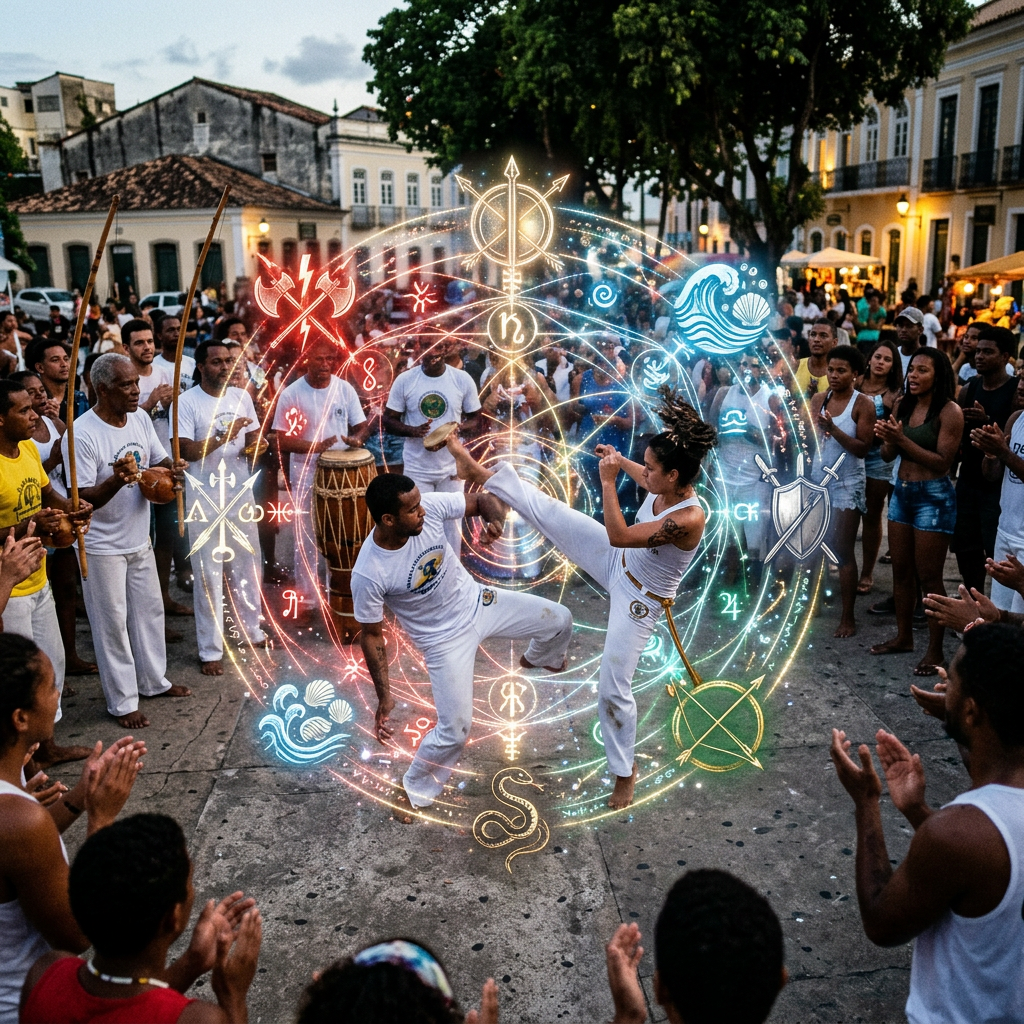
The traditional African spiritual systems of Ifá and Candomblé provide a profound philosophical and cosmological framework for understanding Capoeira Angola, offering insights that link physical practice with deep spiritual meaning. Rather than viewing the Orishas as mere mythological figures, these traditions define them as fundamental energies and essential laws that govern the cosmos, interconnecting all aspects of existence. In this view, the Orishas emerge not only as deities to be venerated but as vital forces that influence the rhythms of life and the universe itself.
In the context of the roda (the Capoeira ring), this spiritual lens transforms a physical space into a consecrated crucible where cosmic energies—known as axé (or ashé)—are concentrated, magnified, and channeled through song, rhythm, and physical movement. Each kick and spin performed within the roda is not merely a display of agility but also an invocation of these energies, creating a dialog between the dancers and the spiritual world, fostering an atmosphere rich in cultural significance and communal connection. In this dynamic environment, participants engage in a sacred exchange that honors ancestral traditions, deepening their sense of identity and belonging while simultaneously inviting the Orishas to partake in the collective celebration of life, creativity, and resilience.
—–The Orisha Matrix in the Roda
Every strategy, gaze, and movement within Capoeira Angola can be mapped to an elemental force. Practitioners do not merely mimic a movement; they embody an archetype of this deeper matrix.
| Orisha | Capoeira Principle | Essential Quality & Embodiment |
| Exú | Unpredictability & Malícia | Energy of the crossroads and infinite choices. Manifests as trickery, elusiveness, and comfort with chaos. |
| Ogun | Direct Force & Persistence | Master of iron and pathfinding. Represents explosive power, structural integrity, and mental clarity. |
| Oxossi | Precision & Timing | The master hunter. Embodies stealth, tracking, and the patience to wait for the “perfect moment.” |
| Shango | Power & Control | Justice and thunder. Expressed as authoritative energy and the ability to control the flow and tempo of the game. |
| Iansã | Adaptation & Change | Mistress of wind and lightning. Represents the ability to adapt instantly to sudden shifts in the roda. |
| Obatala | Wisdom & Coolness | Embodies peace and grace. Expressed as mandinga tempered with intellect over brute force. |
| Yemanjá | Fluidity & Momentum | Queen of the ocean. Manifests as rhythmic, rolling transitions and unstoppable kinetic momentum. |
| Obaluaiyê | Low Defense & Rebirth | Lord of the earth. Manifests as hyper-low postures and explosive defense from the dirt. |
| Oxumaré | Flexibility & Spirals | The rainbow serpent. Manifests as spinal flexibility and sudden, looping traps. |
| Oshun | Grace & Deception | Mistress of fresh waters. Manifests as elegant aesthetics used to mask lethal intent. |
—–A Shared History of Resistance
The historical crossover between Candomblé and Capoeira in Bahia, Brazil, is a story of shared survival and deep spiritual symbiosis. Born from the same crucible of resistance against Portuguese colonial oppression, these two traditions grew together in Salvador and the surrounding Recôncavo region.Geographic and Structural Symbiosis
- The Shared Underground: Both Candomblé and Capoeira were strictly criminalized by the colonial government and the Brazilian Penal Code of 1890. To survive, practitioners occupied the same marginalized spaces, using terreiros (Candomblé temples) as sanctuaries for martial training.
- Ritual Infrastructure: Capoeira Angola inherited its etiquette from the liturgical world of Candomblé. Instruments like the atabaque and agogô were taken directly from temple rhythm sections. The lead berimbau gunga holds the exact same spiritual authority as a consecrated Candomblé drum; no player can enter the ring without the musical permission of the lead berimbau.
- Code and Chameleonism: When police raided Afro-Brazilian gatherings, practitioners blurred lines to confuse authorities. If a Capoeira ring was raided, they shifted cadence to resemble religious gatherings; if a religious ritual was interrupted, Capoeira movements were used to disarm police and escape.
—–The Mandingueiro and the Malandro
Two central archetypes emerged from this environment: the Mandingueiro (sorcerer-warrior) and the Malandro (street rogue).
- The Mandingueiro: This sorcerer-warrior blended physical mechanics with deep occult knowledge. They used spiritual energy as an active weapon system, including hypnotic gazes (olho grande) to destabilize opponents and the strategic use of enchanted powders (pó de pindaíba) to blind adversaries mid-movement. Figures like Besouro Mangangá, whose mastery of mandinga was legendary, ensured this heritage was preserved.
- The Malandro: The Malandro lived by their wits in shadow economies. Their clothing—the white linen suit (terno de linho branco), Panama hat, and silk scarf (lenço de seda)—served as both armor and status symbol. Pastinha famously integrated the malandro’s philosophical approach into Capoeira Angola, emphasizing that the art is a living archive of West African philosophy where “Capoeira is for everything the mouth eats… it is magic, it is mandinga”.
—–Martial Survival: Razor and Ritual
When a game turned violent—a jogo duro (hard game)—the mechanics shifted to raw, elemental martial application governed by the Orisha matrix.The Eras of Steel
In the late 19th and early 20th centuries, the jogo de navalha (razor game) was a reality. Practitioners often clenched a straight razor between their toes. This era necessitated the use of patuás (consecrated amulets) and the Reza das Sete Chaves (Prayer of the Seven Keys) to achieve Corpo Fechado (a closed body), a state believed to dull blades and protect the practitioner’s primary vulnerabilities.
By understanding this Orisha matrix, modern practitioners do more than perform athletic movements; they engage deeply with a rich tapestry of cultural heritage and spiritual symbolism. They enter an ancestral conversation that transcends the physical realm, allowing for a profound connection to the voices of their forebears and the divine energies they embodied. This dialogue enriches their understanding of the rhythms and flows of life itself, transforming their practice into a living ritual of cosmic alignment that resonates through time and space.
Each movement becomes an expression of reverence, weaving together the past, present, and future, as they embody the teachings of the Orishas and cultivate a harmonious balance between body, mind, and spirit.

