The Ghetto Lie: How Myths Shape Black Identity and Agency

The insidious, pervasive narrative often whispered, sometimes shouted, within and about Black communities—the “Ghetto Lie”—is not merely a social construct; it is a complex, multi-generational affliction actively undermining progress and leading to catastrophic outcomes. This “lie” is the toxic amalgamation of historical trauma, systemic disenfranchisement, and a dangerous cycle of self-fulfilling prophecy, tragically masquerading as an unavoidable, innate cultural reality. It is the sophisticated mechanism by which external oppression is converted into internal surrender.

This destructive ideology posits that the pathology associated with deeply impoverished, inner-city neighborhoods—characterized by high rates of single-parent households, poor educational outcomes, joblessness, and violence—is an inherent part of Black identity, rather than the symptom of socio-economic and structural oppression. By internalizing this lie, the focus shifts disastrously from demanding systemic change and equitable resources to merely managing the “symptoms” or, worse, accepting them as the natural order. The structural architects of disadvantage are thus absolved, and the victims are made to blame themselves for the conditions imposed upon them.

Before I go on with this post, we at Jogo de Corpo Fechado would like to to take a moment to give a huge, well-deserved shoutout to Black Stories Untold. They are the incredible creators and dedicated historians responsible for the powerful and insightful video that we’ve featured or linked to within this post. Their commitment to uncovering, documenting, and sharing marginalized narratives is truly invaluable.

Their work, and the specific video you’ve just engaged with, provides essential context and a critical perspective that often goes overlooked. We strongly encourage you to explore their channel further.

If you found the video as compelling and necessary as we did, we know that your support would mean a great deal to the team at Black Stories Untold. Producing high-quality, deeply researched content takes a considerable amount of time, effort, and resources.

There are many ways to show your appreciation and help them continue this vital work:

  • Contribute Directly: If you are in a position to do so, a direct financial contribution to their efforts is the most impactful way to support their production and research costs.
  • Engage with Their Content: If contributing financially isn’t possible right now, your engagement is still incredibly valuable. A simple “Like” on their videos and hitting the “Subscribe” button on their channel are crucial ways to support them. It helps increase their visibility, ensures their content reaches a wider audience, and provides them with the motivation to keep producing excellent material.

Thank you for watching and thank you for considering supporting Black Stories Untold!

Now, let’s continue.

The Core Components of the Ghetto Lie: An Anatomy of Deception

The Ghetto Lie is not a monolithic myth; it is composed of several reinforcing pillars, each designed to chip away at Black agency and potential:

1. The Myth of Innate Pathology: The Denial of Historical Context

This component falsely asserts that issues like academic disengagement, casual violence, and disdain for authority are cultural norms passed down through generations, rather than coping mechanisms developed in hostile, resource-starved environments. This fatalistic view systematically ignores the robust history of Black intellectualism, family structure, and community resilience that existed prior to and outside of concentrated poverty created by redlining, discriminatory housing covenants, and the brutal economic shock of deindustrialization.

The truth is that concentrated urban poverty—the geographical space the “ghetto” describes—was engineered through policy and prejudice. By framing the resulting behaviors as inherent “pathology,” the Lie distracts from the poverty and lack of opportunity that are the true root causes. This intellectual sleight of hand transforms a political and economic problem into a cultural and moral failing.

2. The Attack on the Black Family: Normalizing Instability

The most damaging facet is the normalization of fractured family units. While acknowledging the historical impact of slavery and Jim Crow on family separation, the Ghetto Lie elevates the single-parent, often matriarchal, structure from a necessity born of economic struggle and male incarceration to the accepted standard. This minimizes the critical, measurable role of present fathers and stable nuclear or extended families in providing economic stability, emotional security, and effective socialization for children. The consequence is a vicious cycle of poverty replication, where the very structure needed to escape generational poverty is systematically undermined and pathologized. The message becomes: your family is broken by design, not by external pressure.

3. The Culture of Anti-Intellectualism and Anti-Achievement: The Internal Censor

This lie creates a crushing societal pressure that often labels educational excellence, articulate speech, and professional ambition as “acting white.” This phenomenon, deeply rooted in the historical reality that Black success was often met with white violence, economic exclusion, or institutional sabotage, now functions as an internal mechanism of suppression. The fear of social ostracization or the desire to maintain community credibility limits educational attainment and upward mobility, creating a self-imposed ceiling on ambition. It is a defense mechanism turned destructive, leading to the tragic waste of millions of bright minds whose potential is sacrificed on the altar of manufactured authenticity.

4. The Normalization of Interpersonal Violence: Absolving External Responsibility

By accepting the high murder and crime rates within concentrated Black communities as simply “how things are,” the Ghetto Lie drains the collective will to fight for safer streets, better policing, and adequate mental health resources. It frames the violence exclusively as Black-on-Black crime—a self-inflicted wound—thereby absolving external institutions (government, education, law enforcement, healthcare) of their foundational responsibility to protect and serve these citizens equitably. This narrative weaponizes tragedy, using the symptoms of systemic neglect as justification for further neglect and punitive control (e.g., mass incarceration), rather than investment and restoration.

The Killing Mechanism: The Slow, Systemic Loss of Potential

The consequence of this internalized narrative is nothing less than the slow, systemic killing of potential. The Ghetto Lie kills:

  • Educational Opportunity: By lowering expectations in schools, fostering environments where academic rigor is mocked, and pushing students out of the classroom and into the school-to-prison pipeline.
  • Economic Mobility: By discouraging the disciplined effort, networking, and cultural code-switching often required to navigate professional, largely white-dominated, corporate spaces.
  • Physical Safety and Well-being: By allowing endemic violence and unchecked mental health crises to persist without the unified community and political action needed to stop them.
  • The Black Soul: By convincing individuals that their highest aspiration should be to merely survive their hostile environment, rather than to master it, transform their world, and realize their full, inherent brilliance.

The Economy of Dysfunction: Profit and Perception

Today, we are ripping the mask off the lie that has been insidiously poisoning our community’s soul for decades—the systemic fiction that has defined our struggle and obscured our brilliance. This is the harrowing story of how power structures meticulously convinced the world, and disturbingly, segments of our own people, that the term “ghetto” is synonymous with “Black.” This dangerous conflation is a masterful piece of social engineering, designed to erase the rich, complex tapestry of our culture and replace it with a single, devastating stereotype of deprivation and despair.

This narrative of pathology is not organic; it is meticulously cultivated because it is profitable. We must confront the uncomfortable truth: billion-dollar corporations and entrenched institutions are not merely observing our dysfunction—they are actively feeding off it. From predatory lending practices, exploitative housing markets, and the booming private prison and surveillance industries to the targeted marketing of harmful, addictive products (alcohol, tobacco, high-fat foods), a vast, complex economy thrives on keeping our communities marginalized, fragmented, and in a state of perpetual crisis. Our perceived dysfunction is their quarterly dividend; our instability is their investment opportunity.

The ultimate tragedy is the internal toll this constant assault has taken. We have, consciously or unconsciously, allowed the relentless, sensationalized media focus on our worst moments—the crime, the poverty, the division—to drown out the soaring symphony of our greatest achievements. The brilliance of our scientists, the passion of our artists, the resilience of our families, the political victories won through generations of struggle—these foundational truths are constantly obscured by a spotlight fixed only on our failures. We are allowing their narrative, the one that defines us by our deficits rather than our potential, to become the loudest voice in the room, threatening to silence the historical chorus of Black excellence and achievement forever.

The Path Forward: Refuting the Lie with Truth and Action

To save Black America and truly unlock its potential, the Ghetto Lie must be confronted and refuted with a forceful and uncompromising embrace of high standards, educational rigor, family stability, and an insistence on equitable societal investment in these communities.

The path forward requires replacing the lie of innate pathology with the truth of unfulfilled potential. This demands a dual approach: demanding external structural reform while simultaneously fostering internal cultural strength. We must aggressively dismantle the systems of inequity (housing, education, justice) while nurturing the values of excellence, scholarship, entrepreneurship, and stable family formation within our own communities, not as an appeal to external validation, but as the inherent, historical standard of Black life. The lie has been told long enough. The time for truth, potential, and collective action is now.

Never interrupt your enemy when they are making a mistake

“Never interrupt your enemy when they are making a mistake” is a profound and enduring piece of strategic wisdom, most famously attributed to Napoleon Bonaparte. This maxim underscores the immense value of patience and observation in any competitive environment, whether military, political, or business-related.

The Core Principle: Capitalizing on Self-Inflicted Error

The fundamental idea is simple: an opponent’s error is often the most potent weapon one can possess, and interrupting that process risks alerting them to their blunder, thereby giving them a chance to correct it. When an adversary is acting based on flawed information, poor judgment, or an incorrect assessment of the situation, their actions are inherently self-destructive. By allowing the mistake to fully unfold and compound, the observing party ensures the maximum possible negative impact on the enemy’s position.

Strategic Implications:

  1. Magnification of Damage: Every step taken based on the initial error deepens the trap. An interruption might merely negate the first mistake, but silent observation allows the opponent to commit successive, reinforcing mistakes (the “snowball effect”). The goal is not just to see an error, but to see it leveraged into a significant strategic or tactical disadvantage.
  2. Information Advantage: The act of observing an ongoing mistake yields critical intelligence. It reveals the opponent’s underlying assumptions, their current mental model, and their operational weaknesses. This knowledge is far more valuable than the temporary tactical gain of an immediate counter-move, as it can be used to plan future, more decisive attacks.
  3. Preserving Resources: Reacting prematurely to an error may force the observer to commit resources unnecessarily. By waiting, the observer can conserve their strength until the optimal moment to strike, which is typically after the opponent has fully committed to their flawed course of action and is too deeply entangled to easily withdraw.
  4. Maintaining Concealment: A well-timed interruption may expose the observer’s own intentions or tactical position. Silence and patience maintain the element of surprise, ensuring the eventual counter-move is both unexpected and devastating.

Application Across Domains:

  • Military Strategy: Allowing a poorly executed flanking maneuver to continue, or permitting an enemy to commit forces to a terrain they have misjudged, only to cut them off once they are fully engaged.
  • Negotiations and Politics: Remaining quiet while a rival makes an unreasonable or overconfident demand, thereby exposing their true bargaining floor or alienating their potential allies.
  • Business and Competition: Watching a competitor sink massive capital into a product or market based on faulty research, and only then launching a superior, well-timed alternative, knowing the competitor is now financially and operationally overextended.

In essence, this maxim is a call for disciplined restraint. It is a caution against the impulsive satisfaction of immediate engagement, arguing instead for the strategic patience required to secure a decisive, long-term victory by letting the enemy orchestrate their own downfall.

O VÍDEO DO DIA DA CAPOEIRA ANGOLA (3/02/25)

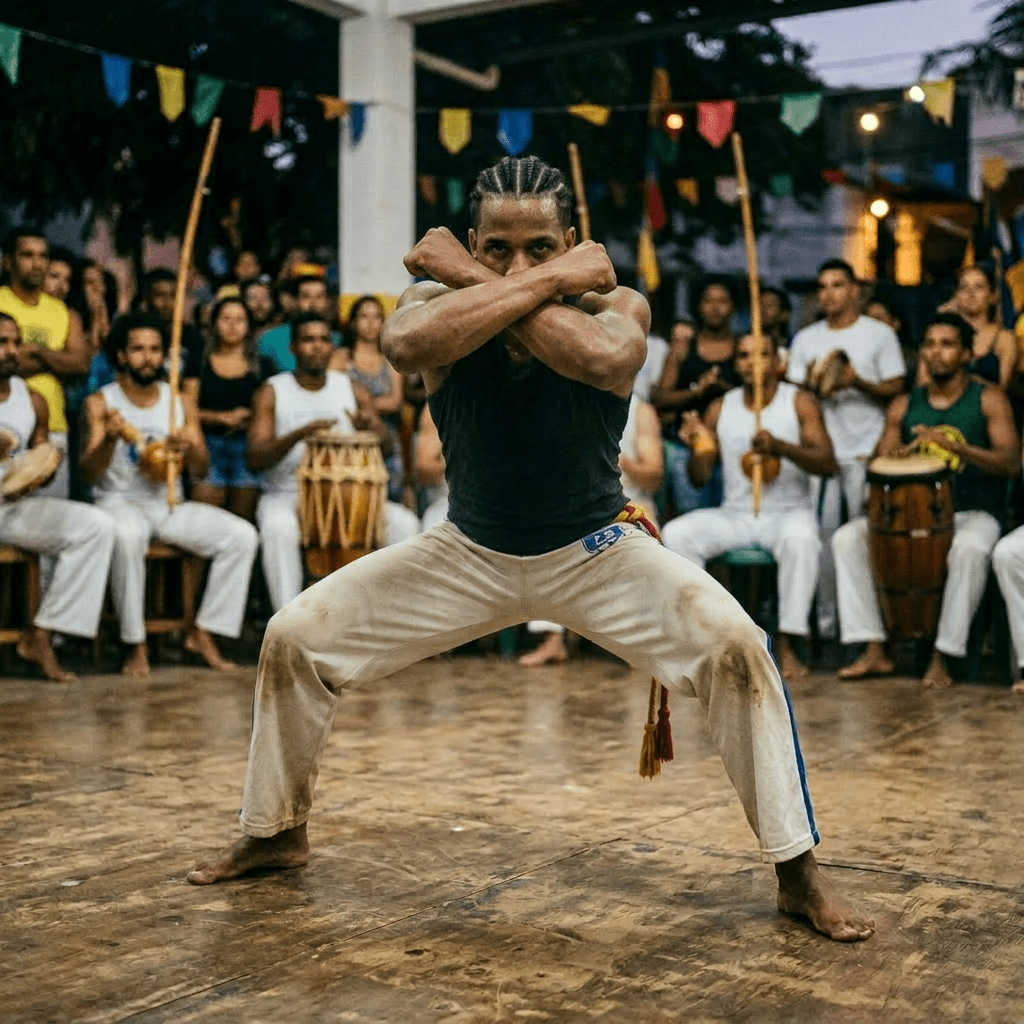
Capoeira Angola videos available online offer a captivating window into a rich and vibrant cultural tradition. These digital showcases go beyond simple instruction, acting as vital archives of Capoeira’s evolution as a complex, multifaceted art form. They meticulously document the intricate interplay of music, movement, self-defense, and historical expression. Viewers are treated to demonstrations of astounding agility and technical prowess, witnessing practitioners execute intricate movements that seamlessly integrate elements of acrobatics, rhythm, and strategy.

Crucially, these videos are invaluable resources for exploring the deep, often-untold history of Capoeira, placing it within the context of its origins and cultural significance. They consistently emphasize the art’s powerful role in fostering and strengthening community connections. Capoeira is presented as a unifying force, an art capable of transcending societal barriers and bringing together diverse individuals from various backgrounds and social groups within the unifying space of the roda (the circle where Capoeira is played).

Beyond mere performance, the footage serves an essential educational purpose, portraying Capoeira as a dynamic, living tradition that actively inspires and nurtures future generations. The demonstrations embody core values such as resilience, a deep-seated creativity necessary for improvisation within the game, and a profound sense of cultural pride. By witnessing the passion and commitment of the players, viewers are not merely entertained; they are issued an invitation to participate in this unique blend of dance, self-defense, and martial philosophy.

A significant element of these online features includes interviews with seasoned practitioners, often referred to as mestres (masters) or high-ranking students. These personal accounts provide depth and context, revealing intimate details about their individual journeys, the transformative impact Capoeira has had on their lives, and the profound sense of belonging and discipline it has instilled.

The Enduring Legacy of Capoeira Angola: A Resource for Understanding and Appreciation

The visual record of Capoeira Angola, captured in every filmed jogo (game) or roda (the circle in which the game takes place), is far more than mere documentation. These videos fulfill a profound dual role: they not only entertain with the sheer physical beauty, intricate strategy, and fluid performance of the art, but they also serve as a vital, accessible, and comprehensive resource. By offering an unedited glimpse into the practice, they are essential for truly understanding the deep historical roots, the sociological complexity, and the cultural significance of Capoeira Angola. Ultimately, through this visual medium, a deeper appreciation is fostered for this dynamic art form—recognizing it not just as a martial art or a dance, but as a powerful, living means of cultural expression, historical preservation, and a testament to human unity and resilience.

A Glimpse into the Living Tradition: Angoleiros do Sertão London Open Roda Anniversary

The enduring vitality and communal spirit of the Capoeira Angola tradition are perfectly exemplified by consistent community events, such as the one celebrated by Angoleiros do Sertão London. A particularly significant date was Saturday, April 6th, 2024. This day did not just mark another monthly gathering; it celebrated the second-year anniversary of the Angoleiros do Sertão London community open rodas.

These open rodas are a commitment to consistency, a practice that takes place faithfully on the first Saturday of every month. By maintaining this reliable schedule, the London community creates essential gathering points. These events transcend individual group affiliations, allowing practitioners (capoeiristas) from various schools, lineages, and backgrounds to meet, train together, exchange knowledge, and collectively celebrate the art. The open roda fosters a cross-pollination of styles and a reinforcement of the overarching global Capoeira family.

The Featured Jogo: A Dialogue in Movement

The emotional and technical centerpiece of the anniversary celebration was a high-level game played in the center of the roda, showcasing the collaborative and respectful spirit of the wider Capoeira community. This particular pairing featured:

  • Contra Mestre James Berimbau (representing Angoleiros do Sertão London)
  • Treinel Lazaroni (representing UR Capoeira)

This game was a masterclass in the slow, strategic, and deceptive movements characteristic of Capoeira Angola. The pairing of a Contra Mestre and a Treinel from different schools highlighted the collaborative spirit of the community, where rank and affiliation are set aside to engage in a profound and respectful dialogue of movement. The resulting jogo was not a conflict but a sophisticated exchange, marked by deep knowledge, mutual respect, and skillful improvisation.

The Bateria (Musical Orchestra): The Soul of the Roda

The rhythm, energy, and overall temper of the jogo are not controlled by the players but are entirely dictated by the bateria, the musical orchestra that provides the soul and heartbeat of the roda. For the anniversary event, the musicians present comprised a dedicated and highly skilled lineup of instrumentalists, each fulfilling a specific, crucial role in weaving the complex musical tapestry that guides the game.

InstrumentMusicianSchool/CommunityRole in the Roda
Viola (Smallest Berimbau)Treinel IanFilhos de AngolaResponsible for the counter-rhythm. It is the most melodic berimbau, weaving complex variations and maintaining the melodic line against the Gunga.
Gunga (Largest Berimbau)CM Boneco[School name not specified]The lead berimbau and conductor of the orchestra. It plays the main toque (rhythm), sets the speed and type of game, and dictates when the jogo begins and ends.
Berra-boi (Medium Berimbau)JoelAngoleiros do Sertão LondonPlays a rhythm that strategically bridges the Gunga and the Viola. Its role is to add rhythmic complexity and depth, complementing both the lead and the counter-rhythm.
Atabaque (Tall Drum)PeppaAngoleiros de KanagaThe primary drum, establishing the fundamental, unwavering pulse and heartbeat of the roda. It is the rhythmic anchor for all other instruments.
Pandeiro 1 (Tambourine)LupoFICAProvides a driving, consistent rhythm, adding texture and a bright, metallic jingling quality to the music.
Pandeiro 2 (Tambourine)BenUR CapoeiraComplements the first pandeiro, often adding syncopation or a slightly different rhythmic pattern to create a richer, more layered percussive sound.
Agogô (Double Bell)AlexUR CapoeiraProvides a vital, high-pitched, clear rhythmic pattern that cuts through the bass-heavy tones of the atabaque and the drone of the berimbaus.
Reco-reco (Scraper)Treinel JoanaMenino quem foi seu Mestre – Mestre RobervalA distinctive percussive instrument that adds a grating, high-pitched scratching sound, filling out the high-end frequency of the orchestra.

The heartbeat of the Capoeira roda lies within the collective effort of the bateria, the musical ensemble whose rhythm and energy are utterly indispensable. This intricate group, typically featuring the berimbau (often three, each playing a different melodic/rhythmic role), atabaque, pandeiro, agogo, and reco-reco, serves as the conductor of the entire experience. Their intricate interplay of traditional Brazilian and African rhythms ensures that the Capoeira roda remains a dynamic, cohesive, and fully integrated experience.

Within this circle, music, the acrobatic movement of the players, the traditional songs (quadras and corridos), and the deep historical and philosophical context are not merely related elements but are, in fact, inseparable, creating a living, breathing expression of this martial art and cultural heritage. The tempo and style set by the lead berimbau and the bateria dictate the pace, intensity, and nature of the game being played, seamlessly connecting the sound to the kinetic energy and narrative unfolding in the center of the roda.

MALANDROS IN ACTION (2/23/26)

The Modern Malandro: An Urban Study in Resilience and Identity

This comprehensive series offers an in-depth examination of the modern malandro within the context of contemporary urban society. Far from a simplistic stereotype, the malandro is presented as a complex figure defined by their compelling charm, remarkable resourcefulness, and unwavering resilience. The narrative is situated against the backdrop of significant economic disparity and pervasive social justice challenges, issues that form the very crucible of their existence.

Through a nuanced and comprehensive lens, the series meticulously explores the multifaceted identities of these individuals. It showcases their extraordinary ability to navigate complex social dynamics—a skill honed in environments where survival often depends on wit and adaptability. Crucially, the malandro manages to do this while fiercely maintaining a distinct sense of individuality and self-possession.

Often emerging from challenging and disadvantaged environments, the malandro transforms necessity into a unique form of genius. They learn not merely to cope, but to adapt and thrive, seeing obstacles not as barriers, but as raw material to be converted into opportunities. This journey of transformation is central to understanding their influential position.

The series illuminates their often-overlooked yet influential role in discussions of equity and social change. By presenting their stories, it challenges conventional wisdom, inviting viewers to fundamentally reconsider traditional notions of success and morality. Ultimately, it serves as a powerful celebration of their contributions to urban culture, recognizing their indelible mark on the social and artistic landscape.

By skillfully weaving together intimate personal stories with broader societal themes, the series aims to foster a deeper understanding of the malandro’s societal impact. It serves as a compelling call to action, urging audiences to reflect on the common threads of humanity that connect us all, regardless of differing backgrounds, circumstances, or social labels.

Furthermore, the exploration delves into the rich and diverse cultural expressions and artistic contributions of the malandro. It illustrates precisely how their narratives enrich the vibrant tapestry of urban life, acting as powerful catalysts that provoke thought and inspire action. In doing so, the series actively encourages a more empathetic and constructive approach to social issues—issues that ultimately affect every member of society

Today’s Focus: The Scrutiny of Online Authenticity

The shift toward digital commerce has brought new forms of sales tactics, demanding a heightened level of consumer scrutiny.

A Word of Caution for the Digital Consumer:

Don’t be swayed by spurious sales pitches. Specifically, don’t buy stuff from “cry babies” on TikTok. The use of highly emotional and often manipulative appeals has become a significant marketing trend. We encourage reflection: What other pervasive marketing tactics are you running into?

Investigating Emotional Appeals in E-Commerce:

The pervasive advice remains: Don’t fall for the emotional appeals of online sellers. Independent investigators are shedding light on the practices of digital vendors who rely on sob stories to drive sales.

  • Pleasant Green, a prominent digital investigator, has been spearheading the research into this specific TikTok trend of sob stories.
  • The investigation has uncovered surprising details about the origin and sales channels of certain products, exposing a disparity between the compelling narrative and the actual business operation.
  • The methodology involves deep dives into social media posts, scrutinizing associated websites, and utilizing powerful reverse image searches to authenticate or debunk the emotional claims made by sellers.

Credit and Further Exploration:

We extend our most sincere and heartfelt gratitude to Pleasant Green for their dedication in creating, meticulously researching, and generously sharing this truly essential video and accompanying content. Their work sheds critical light on a complex and often opaque subject, providing invaluable insight for all viewers.

To delve deeper into this compelling topic, continue your exploration, and actively support the vital work of investigative journalism focused on digital commerce ethics, consumer rights, and online transparency, we strongly encourage you to click \[HERE\].

By visiting their channel, you contribute directly to the sustainability of independent, in-depth reporting that holds digital marketplaces accountable and empowers consumers with crucial knowledge. We highly recommend subscribing and checking out their full library of content.

I HAD TO MAKE THIS POST

The return of successful rappers to the very environments they strove so hard to escape—specifically, their former, high-crime neighborhoods—represents a deeply perplexing and often self-destructive trend within contemporary hip-hop culture. Despite having amassed significant wealth, global fame, and a clear pathway to a safer existence, a substantial number of these artists appear to be under an intense internal and external pressure to re-engage with the perilous realities of “street life” or “the hood.” This compulsion frequently leads them into unnecessarily dangerous and confrontational situations, a pattern that is visible across diverse major musical hubs, from the influential trap heartlands of Atlanta and the raw, drill-music-fueled energy of Chicago, to the historically significant and complex streets of Los Angeles.

The highly regarded documentary-style project, Trap University, takes on the ambitious task of a critical and penetrating examination of this complex and often tragic behavior. Its central objective is to move past superficial explanations and truly understand the deep-seated psychological, cultural, and sociological drivers compelling these highly visible, multimillionaire artists to continuously revisit their old neighborhoods.

The documentary’s video content is structured around a compelling series of high-profile, real-world examples and case studies, meticulously showcasing various rappers as they navigate their impromptu, and sometimes highly calculated and staged, visits to different cities and communities. These raw, unscripted encounters serve to starkly illuminate the massive, often irreconcilable contrast between the glamorous, meticulously controlled environment of a modern celebrity’s life—complete with security, entourages, and private jets—and the unpredictable, volatile, and often harsh reality of the streets they left behind. This collision of worlds frequently culminates in unexpected, tense, and sometimes outright confrontational situations, challenging the very notion of a safe return.

This insightful commentary provided by Trap University delves far beyond the simple, surface-level explanation of “keeping it real,” which is often offered as a facile justification. Instead, the analysis explores the intricate and often manipulative interplay between the pressures of mega-fame, the meticulously crafted and commercially viable public image of a rapper (often predicated on a struggle-to-success narrative), and the deeply held cultural value of perceived authenticity tied directly to their street roots.

Trap University posits several complex theories, suggesting that this dangerous return may be fundamentally driven by a deeply ingrained perceived need to validate their initial narrative for their core audience, to explicitly prove their unwavering loyalty to their origins and the community that birthed them, or perhaps, most potently, to counteract the “softening” or “selling out” effect of mainstream, commercial success and acceptance. The fear of being viewed as disconnected or inauthentic appears to be a powerful psychological anchor, dragging them back into the fray.

Ultimately, the work is a profound effort to dissect the dangerous, contradictory, and often self-destructive complexities inherent in attempting to maintain a genuine, boots-on-the-ground connection to street life long after fame and fortune should have provided a clear, safe, and definitive exit. It serves as a powerful and sobering revelation of the high personal and professional cost of this perceived and required connection to “the struggle,” highlighting the severe risks taken for the sake of an image.

(Shoutout to TRAP University for creating and posting this important and critical video project.)

### Trap University

YouTube Channel: TrappUniversity

2nd Channel

Discord

CORRUPT POLICE FILES (2/20/26)

The Dual Mandate of Policing: Community Trust and the Corrosion of Corruption

The bedrock of effective law enforcement is fundamentally rooted in a dual mandate: community protection and trust-building. The vast majority of police officers diligently fulfill this mission, recognizing that positive community relations are not an optional extra but the essential foundation upon which safety is built. These dedicated professionals regularly engage in proactive outreach programs, including organizing local community events, conducting educational workshops, and participating in neighborhood watch initiatives. These efforts are crucial, serving to demystify police work, foster open dialogue, and educate citizens on vital topics like safety protocols and effective crime prevention strategies. The result is a mutual enhancement: police gain crucial intelligence and community cooperation, while citizens develop a greater understanding of and respect for the law enforcement role, strengthening the overall fabric of community ties.

The Shadow of Misconduct:

However, this vital foundation is perpetually at risk from the corrosive actions of a very small number of officers. When those sworn to uphold the law choose instead to misuse their power, engage in misconduct, or succumb to corruption, the damage is immediate and devastating. Such acts not only constitute a profound betrayal of public trust but also sow deep seeds of skepticism, fear, and hostility toward the entire institution. A single act of police criminality can undo years of positive community engagement, creating a hostile environment where citizens are hesitant to cooperate with law enforcement, ultimately hindering the ability of good officers to protect the public.

When the Badge Betrays: Stories of Police Corruption

The following is an unflinching look into the lives and crimes of individuals who crossed the line, becoming the very criminals they were sworn to combat. These are not isolated incidents but real-world cases that expose the vulnerability of the law enforcement system to exploitation and the devastating consequences that follow when power is abused for greed, violence, and personal gain.

This investigative focus seeks to pull back the curtain on how corruption can take root and thrive inside ostensibly disciplined law enforcement agencies.Featured Cases of Infamy and Betrayal:

Sgt. Wayne Jenkins – The Apex of Corruption

Wayne Jenkins served as the leader of the Baltimore Police Department’s infamous Gun Trace Task Force (GTTF). This specialized unit, intended to get illegal guns off the streets, morphed into a sophisticated criminal enterprise. Jenkins and his subordinates operated with impunity, routinely engaging in home invasions, robbing citizens and drug dealers, reselling confiscated drugs, filing fraudulent overtime, and even planting evidence. His leadership demonstrated a systematic betrayal of public trust, turning an elite police unit into a crew of organized criminals who used their badges as licenses for felony

.Daniel Hersl – Abuse of Authority and Criminal Misconduct

As a member of the GTTF under Jenkins, Daniel Hersl’s case epitomizes the abuse of power for personal enrichment. His actions involved the systematic theft of money and property from citizens, often targeting individuals they suspected of criminal activity, knowing their victims were less likely to report the crimes. His conviction, alongside his fellow GTTF members, sent a clear message about the federal commitment to prosecuting police criminality

.Marcus Taylor – The Betrayal of the Oath

Another key figure in the GTTF scandal, Marcus Taylor’s story is a profound example of the betrayal of the public’s implicit trust. The very oath taken to protect and serve was systematically violated through repeated acts of robbery and conspiracy. His participation solidified the public perception of the GTTF as a criminal organization disguised in uniform.

David Mack – From LAPD Officer to Convicted Criminal

David Mack’s career took a dark turn that shocked the nation. As an officer in the Los Angeles Police Department (LAPD), Mack used his position to facilitate a major bank robbery. His case was a central element in exposing broader issues of corruption and misconduct within the LAPD in the 1990s, particularly in the Rampart Division, highlighting how a respected officer could transition into a high-level criminal.

Jose Tejada – Corruption That Shocked the System

Jose Tejada represents cases where an officer’s corruption is so profound it reverberates across the entire system. While specific details vary by jurisdiction, cases like Tejada’s typically involve schemes like drug trafficking, accepting bribes to look the other way, or running protection rackets. Such deep-seated corruption damages the integrity of the courts and the investigative process, demanding systemic reform and external oversight.The Documentary-Style Breakdown

This in-depth, documentary-style exploration moves beyond simple reporting to dissect the anatomy of these crimes. It investigates the modus operandi of these corrupt officers—how they exploited loopholes, leveraged their authority to intimidate victims, and evaded internal affairs for as long as they did. Crucially, it details how they were ultimately caught, often through the painstaking work of federal investigators, internal whistleblowers, or the accumulation of evidence from marginalized communities. Finally, the analysis confronts the lasting impact of these betrayals on their communities, exploring the resulting civil litigation, policy changes, and the long, difficult road toward rebuilding a damaged trust.
Viewer discretion is strongly advised due to the nature of the criminal activities and the emotional impact of the victims’ stories.—–For those seeking more true crime cases, detailed breakdowns of historical police corruption stories, and in-depth true crime documentaries, please subscribe to the channel human and crime.

Debunking Stereotypes: Godfrey vs. Ignorance on Black History

Godfrey DROPS BOMBS On His Nigerian Co Host About Black American History: A Response to Persistent Misconceptions and Ignorance

Once again, this conversation is necessitated for those of you out there who perpetuate and actually believe the damaging, utterly false, and historically illiterate stereotypes that black people are inherently lazy, lack initiative, or have no discernible culture beyond shallow, modern trends.

The recent exchange between Godfrey and his Nigerian co-host was a critical, unfiltered moment that shone a harsh light on a pervasive issue: the misunderstanding and often outright dismissal of the unique, complex, and profound history of Black Americans, not just by people of other races, but often, jarringly, by individuals from the African diaspora themselves.

Godfrey’s passionate “bombs” were directed at correcting the record, specifically challenging the notion that the struggles and achievements of Black Americans can be glossed over or equated simplistically with the experiences of recent African immigrants or those still on the continent. He meticulously laid out the foundational trauma of chattel slavery, the systematic dismantling of family structures, the enforced illiteracy, and the centuries of post-slavery oppression—Jim Crow, segregation, systemic redlining, and disenfranchisement—that fundamentally shaped the Black American experience.

To suggest that a community subjected to such profound, government-sanctioned oppression has “no culture” or is “lazy” is not only deeply insulting but ignores the monumental feats of resilience and creativity born out of that struggle. Black American culture—which birthed Rock and Roll, Jazz, Blues, Gospel, Hip-Hop, profoundly influenced global cuisine, shaped American English, and drove the most significant civil rights movements in the nation’s history—is one of the most dominant and influential cultural forces in the world.


This wasn’t just a simple disagreement; it was a necessary confrontation designed to educate and remind listeners that the legacy of Black America is not one of failure, but one of triumph over insurmountable odds, creating a civilization of unique richness and contribution under the most hostile conditions imaginable.

Watch the full podcast down below:

THE MOMENT OF TRUTH FRIDAY CRIME REPORT (2/13/26)

The Friday Crime Report: Unpacking Systemic Injustice and the Fight for Equality

Every Friday morning, PROFESSOR BLACK TRUTH delivers “The Friday Crime Report,” a vital and unflinching program dedicated to dissecting the root causes and devastating impacts of systemic issues on the black community. The show operates as a crucial platform for addressing deeply entrenched problems such as systemic racism, pervasive economic inequality, and the critical issue of police brutality.

A Mission to Inform and Inspire

“The Friday Crime Report” goes beyond mere reporting; it is a call to awareness and action. By featuring candid expert interviews, deep-dive analysis, and compelling personal stories, the program illuminates the multifaceted challenges faced by marginalized individuals and communities. Its core objective is to spark essential public dialogue and inspire genuine community engagement, believing that informed discussion is the precursor to meaningful societal change. The show expertly blends factual evidence and rigorous analysis with relatable, human experiences, effectively making complex and often painful issues accessible to a broad audience. Ultimately, Professor Black Truth’s mission is to motivate every listener to become a passionate advocate for equality and justice within their own communities.

—–In Today’s Critical Installment: The Failure of Justice for a Middle School Assault

This week’s program focuses on a disturbing case that starkly illustrates the disparity and failures within the juvenile justice system.

The segment will investigate the shocking incident that took place last year, where a gang of middle school students carried out a sexual assault against a classmate. The gravity of the crime is compounded by the fact that the group was led by their very own class president, Vaughan Griffith, who not only participated but also recorded the entire attack on video.

The Pressing Questions for Justice

“The Friday Crime Report” seeks to answer the community’s most urgent questions surrounding the case:

  • Why has only one of the numerous assailants been officially charged? The lack of comprehensive legal action against all perpetrators raises serious concerns about accountability and the protection of victims.
  • Why have none of the involved individuals, including the ringleader Vaughan Griffith, been charged with the appropriate crime of sexual assault? The miscategorization or deliberate downplaying of the charges is a critical point of focus, suggesting a potential failure in applying justice equally, particularly when the accused come from backgrounds that may afford them certain protections or privileges within the system.

Professor Black Truth will use expert testimony and a detailed review of the case evidence to expose the mechanisms at play that allow such systemic failures to occur, ensuring that this victim’s story—and the broader implications for justice—are not erased.

—–Support the Pursuit of Truth and Justice

“The Friday Crime Report” is sustained by the community it serves. If you believe in the importance of exposing systemic injustices and advocating for the Black community, please consider supporting Professor Black Truth’s work:

CashApp: $ProfessorBlacktruth

Patreon:  / professorblacktruth

PayPal:  https://www.paypal.com/paypalme/ProfB…
Stay Connected: / profblacktruth

MARTIAL ARTS THEATER (2/6/26)

Welcome to MARTIAL ARTS THEATER, a vibrant community hub for martial arts enthusiasts that focuses on personal growth, discipline, and camaraderie. Here, you can access a wealth of resources, including expert interviews that delve into the philosophies behind various martial arts, instructional videos tailored for all skill levels, and engaging events that bring people together in the spirit of collaboration. Explore a diverse array of styles such as karate, judo, taekwondo, and Brazilian jiu-jitsu in an inclusive and supportive environment designed to cultivate both skill and character. Whether you’re a seasoned practitioner with years of experience or a curious beginner taking your first steps into the world of martial arts, you will find a welcoming community that fosters meaningful connections and encourages self-discovery, resilience, and empowerment through martial arts. Join us in this journey of transformation where each kick and kata not only builds physical strength but also instills confidence and fortitude to face life’s challenges.

In today’s installment…

Michael Jai White: The Action Star Hollywood Couldn’t Handle

Before the current era of superhero blockbusters, where meticulously rendered CGI and wirework often eclipse genuine physical performance, Michael Jai White was operating on an altogether different echelon of action stardom. He was not merely an actor portraying a martial artist; he was, and remains, a legitimate, high-level master of multiple fighting disciplines. His credentials are staggering: black belts in seven different styles, including Shotokan, Taekwondo, Kobudo, Kyokushin, Wushu, Tang Soo Do, and Goju-Ryu. This depth of authentic martial arts mastery provided the foundation for his screen presence, translating into fight choreography that was leagues ahead of the often-staged, overtly telegraphed combat sequences common in Hollywood films of the time.

White’s cinematic fighting style was characterized by its blinding speed, surgical precision, and a brutal, yet elegant, authenticity. His on-screen persona was a powerful, magnetic synthesis of physical grace, an imposing physical stature, and the easy charisma that defines a true leading man. Crucially, White rarely, if ever, required a stunt double for his most complex and demanding martial arts sequences. This unparalleled self-sufficiency and dedication to his craft made him the complete package: the skill, the look, and the commanding screen presence.

The logical, almost inevitable, trajectory for an actor with such a unique and formidable skill set should have been a clear path to major A-list superstardom. He possessed the raw material for a career in the mold of an Arnold Schwarzenegger or a Sylvester Stallone, yet with a layer of authentic martial arts credibility and skill that neither of those action giants could genuinely claim. Yet, this destiny of global franchise lead status never fully materialized, leading to one of the industry’s most frustrating case studies.The Problem of Being “Too Real”

The central, and perhaps tragic, irony of Michael Jai White’s career is that the very authenticity and superior skill that set him apart from his peers became, paradoxically, his greatest professional obstacle. In a profound sense, he was “too real” for a Hollywood studio system that historically prefers control, easily marketed archetypes, and actors who are content to rely heavily on special effects, camera tricks, and dedicated stunt teams to manufacture action credibility. White was a self-contained action powerhouse, a characteristic the system seemed ill-equipped to handle.

Cultural Theft: The Journey of Black Language

The Gentrification of Black Slang: A Cycle of Criticism, Co-option, and Cultural Theft

The phenomenon of Black slang being gentrified is a recurring and deeply troubling pattern within American culture. Time and time again, a clear and disheartening cycle unfolds: Black individuals innovate and popularize a form of cultural expression, usually through language. This expression is then met with initial criticism, dismissal, or outright ridicule from the mainstream—often framed as “uneducated” or “ghetto” speech. Subsequently, it is co-opted and imitated by non-Black communities, stripped of its original context and meaning, and finally, completely absorbed and rebranded as general internet slang or mainstream vernacular, effectively erasing its Black origins. The cultural originators are then often criticized for their own language once it has been deemed “cool” by others, or they are forced to innovate new terms to maintain cultural distinction.

A stark example of this cultural theft is the trajectory of the term “woke.” Originating within the Black community, particularly in the context of political awareness and social justice in the 20th century, “woke” meant being acutely aware of systemic racism and injustice. It was a call to consciousness. As it crossed over into broader usage, its meaning was first diluted and then weaponized. Now, it is often used dismissively by critics to mock social progressivism, a complete perversion of its intended, serious purpose.

This process is now visibly occurring with other elements of AAVE (African American Vernacular English).Understanding AAVE: Beyond “Slang”

It is crucial to understand that AAVE is not merely “internet slang,” “broken English,” or a collection of fleeting phrases. AAVE is a systematic, rule-governed dialect of American English, primarily spoken by Black Americans. It possesses its own distinct grammar, vocabulary, and phonology. Its roots are deep, complex, and historical, potentially linked to creole languages and Southern US dialects, evolving under unique historical and sociological conditions. For instance, AAVE often uses tense and aspect markers (such as the invariant be, as in “She be working”) in ways that precisely convey continuous or habitual actions, features distinct from Standard American English, demonstrating its internal logic and sophistication.

When elements of AAVE are extracted, sensationalized, and then misused by non-speakers—often without acknowledging the source—it constitutes a form of cultural appropriation. It reduces a rich, historically-rooted linguistic system to a mere trend, overlooking the very real social and professional penalties Black Americans often face for speaking the dialect in formal settings, penalties that non-Black speakers of the gentrified slang rarely encounter. The underlying sentiment is: when we do it, it’s wrong; when you do it, it’s cool.

Enough is enough. The cultural innovation of Black communities deserves respect, recognition, and protection from this repetitive cycle of theft and misrepresentation. Recognizing the origins and resisting the impulse to co-opt and mainstream AAVE terms without context is a necessary step in correcting this imbalance.

—–Support the Conversation and the Creator

Please support and amplify voices that are speaking directly to these issues and advocating for cultural respect and intellectual property.

Please support this young brother!

This is his main YouTube Channel:

➡️ Antonio Speaks

Stay Updated & follow him:

Tik Tok:

➡️ @toniospeakss

Instagram:➡️ @toniospeaks