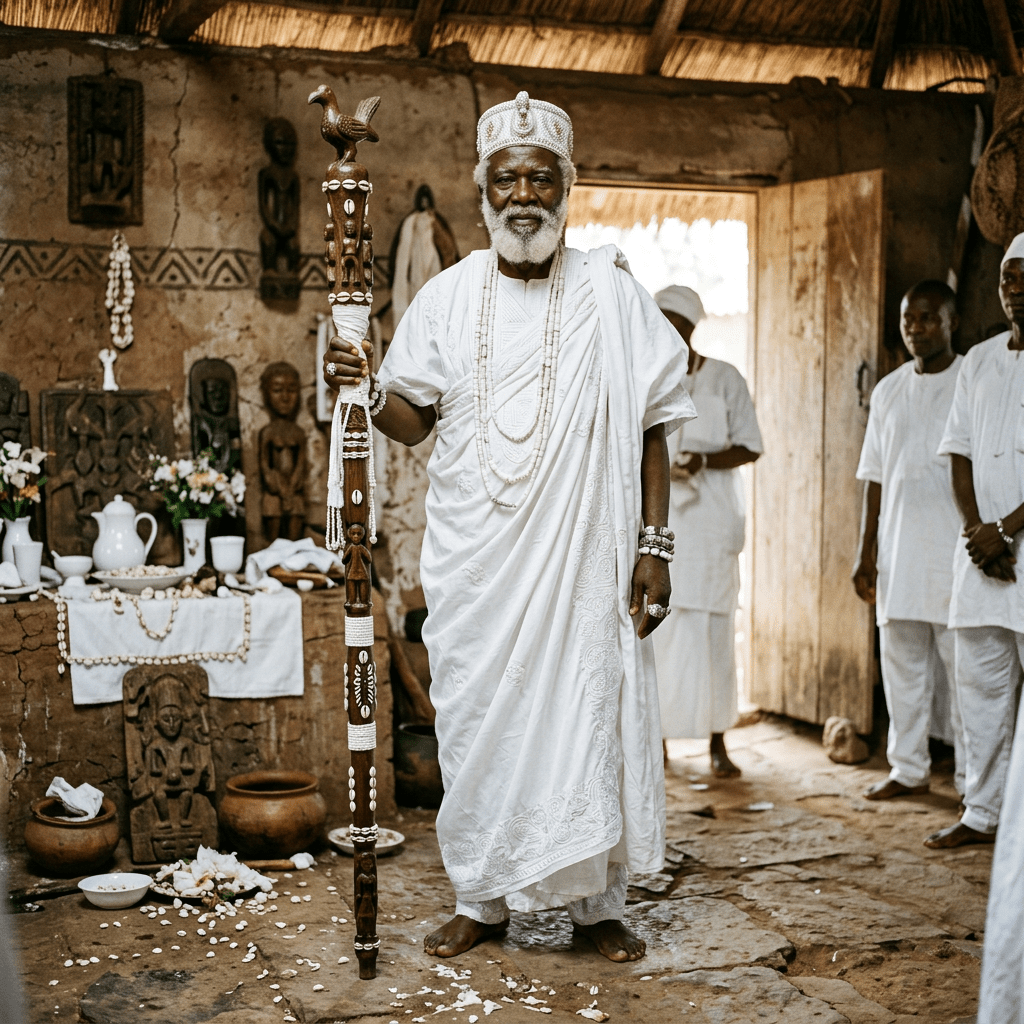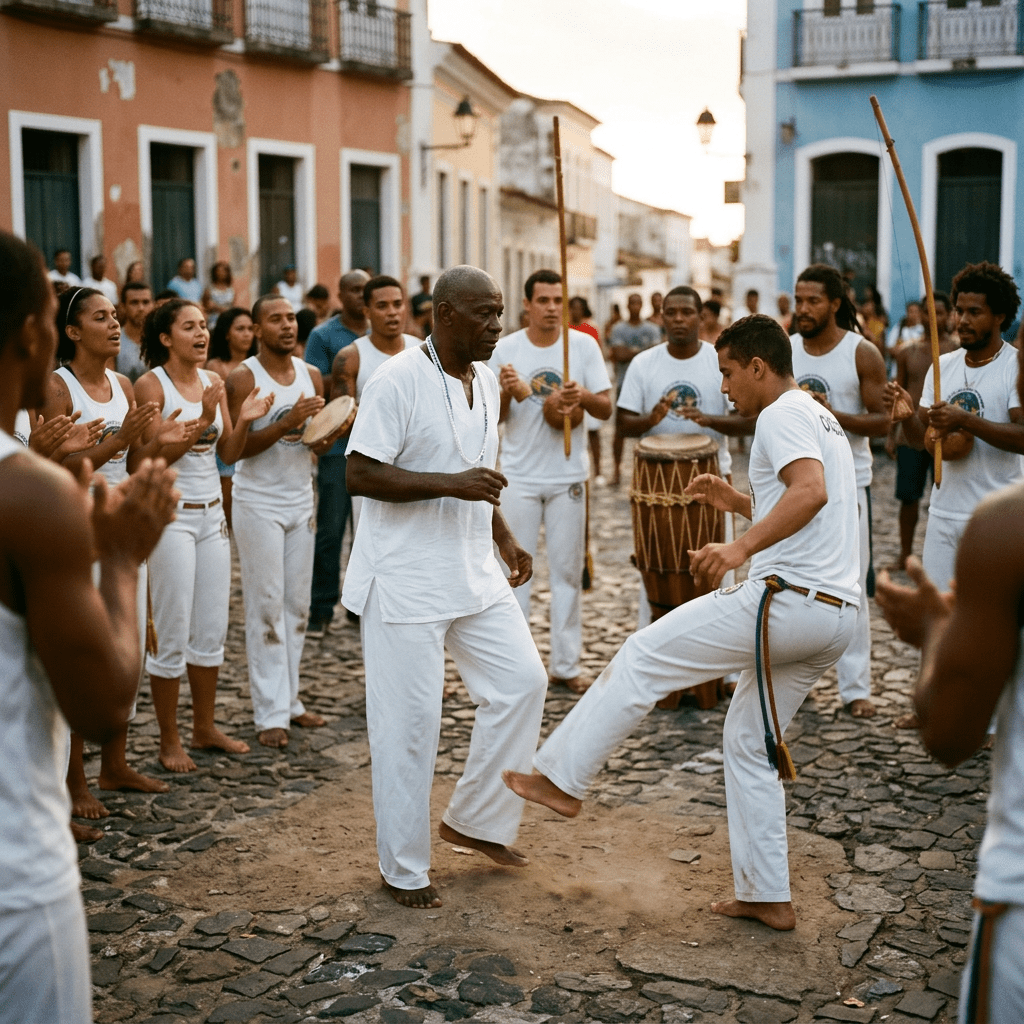
The assertion that Obàtálá is the “Keeper of Capoeira” shifts the perspective of the art from a physical martial game to a rigorous framework for character development. In Yoruba cosmology, Obàtálá is the Orisha of creation, consciousness, and ethical purity. When applied to the roda (the Capoeira ring), this connection manifests not as religious dogma, but as the practical mechanics of mastery. This metaphysical archetype guides the physical crucible through clarity, restraint, coolness, and purity, establishing a game rooted in egoless engagement and the transcendence of anger. By utilizing the psychological shield of the “white cloth,” a practitioner maintains unshakeable composure and complete self-regulation, ensuring that every movement is guided by conscious awareness rather than basic aggressive impulses.
+————————————————————-+
| OBÀTÁLÁ: THE METAPHYSICAL ARCHETYPE |
| (Clarity • Restraint • Coolness • Purity) |
+————————————————————-+
│
▼ [Functional Alignment]
+————————————————————-+
| THE RODA: THE PHYSICAL CRUCIBLE |
| (Precision • Strategic Pauses • Self-Regulation) |
+————————————————————-+
1. Axé of the Unstained: Purity of Intention vs. Malícia
In Capoeira, malícia is often celebrated—the street-smart deception, trickery, and cunning used to trap an opponent. At first glance, this seems to contradict Obàtálá’s association with pristine honesty. However, the concept of the “white cloth” reframes how malícia is deployed:
- Egoless Engagement: Obàtálá’s purity demands a game free from malicious intent to injure or vindictively humiliate. The goal is to outsmart, not to destroy.
- Transcendence of Anger: When a player gets struck, the immediate human impulse is emotional retaliation. The “white cloth” acts as a psychological shield. It requires the player to absorb the blow without staining their composure, returning to the center of the roda with a cool head (Itutu).
2. The Architecture of Restraint
Capoeira possesses devastating combat potential, featuring lethal kicks, sweeps (rasteiras), and headbutts (cabecadas). The presence of Obàtálá is felt in the micro-second decisions to withhold violence:
- The “Marked” Blow: True mastery is demonstrating that you could have landed a concussive kick, but choosing to halt it millimeters from the opponent’s face.
- Preserving the Ritual: This restraint transforms a street fight into an elevated dialogue. It proves that the practitioner governs their body completely, rather than being governed by basic survival instincts or aggressive impulses.
3. Chronological Clarity: Timing over Speed
A novice often mistakes speed for effectiveness, rushing through movements in a chaotic flurry. Obàtálá represents clarity of mind, which directly dictates a player’s relationship with time:
- Reading the Space: A calm mind perceives the roda in slow motion. It identifies the gaps in an opponent’s defense, the subtle shift in their weight, and the predictable trajectory of their next escape (esquiva).
- The Power of the Pause: In the sub-style of Capoeira Angola, players often freeze mid-movement, balancing on one hand or head. This stillness within chaos is the ultimate expression of Obàtálá’s coolness—maintaining absolute equilibrium when gravity and an opponent are actively working against you.
4. The Self-Correcting Roda
The text notes that when these principles are absent, “the art corrects.” This correction happens through immediate, physical feedback loops within the game:
| When a Player Exhibits… | The Roda Responds With… | The Obàtálá Correction |
| Arrogance / Excess | Overextension, loss of base, or running into a counter-strike. | Humility: The physical takedown forces a return to the earth. |
| Confusion / Panic | Predictable, frantic scrambling that leaves the spine exposed. | Clarity: The player is cornered until they find their composure. |
| Impatience | Striking out of rhythm with the berimbau (musical bow). | Alignment: The energy of the crowd and musicians isolates the player. |
5. Lineage via Living Culture
Because this knowledge is passed down through oral tradition rather than textbooks, the “white cloth” is kept clean through ancestral mimicry. A student watches an old Mestre (Master). They observe how the Mestre walks into the ring with calm dignity, smiles in the face of a threat, and uses minimal movement to neutralize maximum force. By copying this conduct, the student unreflectively embodies the archetype of the old, wise creator deity. The art remains intact because its preservation requires the practitioner to become a vessel for these exact virtues.
In Capoeira, the orisha Obàtálá serves as a “Keeper of the Art,” embodying clarity and restraint, with the “white cloth” representing a psychological state of composure within the roda. The art functions as a self-correcting system where practitioners learn to balance strategic deception with absolute control, ensuring mastery over aggressive impulses.
I am ooking at this from the perspective of a Angoleiro, and I want to anchor this analysis to capoeira angola
The White Cloth in the Mud: Why Obàtálá Rules the Roda of Angola
To look at Capoeira Angola through the lens of Obàtálá is to understand why we play close to the ground, why we slow the tempo down, and why the oldest Mestres move with an unsettling, immovable calm. In the Yoruba tradition, Obàtálá is the artisan of humanity—the old Orisha who creates form out of chaos, wraps himself in pristine white cloth, and demands absolute coolness (Itutu), patience, and clarity.
For an Angoleiro, Obàtálá is not a distant theological concept. He is the functional blueprint of our game.
+—————————————+
| THE ANGOLEIRO’S BALANCE |
+—————————————+
│
┌──────────────────────┴──────────────────────┐
▼ ▼
[ OBÀTÁLÁ: THE COOL MIND ] [ ILÊ: THE MUDDY GROUND ]
– Unshakable Composure – Low, Earthbound Chamadas
– Complete Self-Regulation – Strategic Malícia & Mandinga
– The Shield of the White Cloth – Tangible Physical Reality
The Paradox of the Clean Uniform on a Dirty Floor
There is a profound irony in Capoeira Angola. We traditionally wear our whites—or our starched uniforms—and then we dive headfirst into the dirt. We place our hands, our heads, and our backs on the floor.
This is where the principle of the white cloth becomes active:
- The Spiritual Boundary: The “white cloth” is a psychological boundary. The floor of the roda may be covered in dust, sweat, or gravel, but the Angoleiro’s mind must remain completely unstained.
- The Mastery of Itutu: When the game gets tight, tense, or aggressive, a lesser player lets the “mud” enter their mind. They get angry, they rush, and they strike out of malice. The true Angoleiro keeps the white cloth of Obàtálá wrapped tightly around their emotions, maintaining total clarity while executing a devastating game.
The Chamada: Obàtálá’s Ultimate Proving Ground
Nowhere is Obàtálá more alive in Angola than during the chamada (the ritual call). When a player opens their arms and invites you into that tense, close-quarters embrace, they are initiating a profound test of character and alertness.
| The Chamada Phase | The Trap of the Mud (Loss of Principles) | The Command of the White Cloth (Obàtálá) |
| The Approach | Rushing in blindly, driven by anxiety or aggressive ego. | Walking with measured, deliberate steps. Absolute paciência. |
| The Stance | Dropping your guard or letting your focus drift due to a false sense of safety. | Complete physical alignment. Conscious awareness of the opponent’s hips and eyes. |
| The Break | Reacting with panic when the trick (mandinga) is finally sprung. | Absorbing the sudden rasteira or cabeçada with a cool head and immediate recovery. |
The chamada mimics Obàtálá’s role as the old, patient judge. It demands that you slow down, look your partner in the eye, and move with flawless discipline. If you lack restraint, the chamada will instantly expose and correct you.
Mandinga Guided by Clarity
We often talk about mandinga and malícia—the theater, the trickery, the playing dead to catch your opponent off guard. But true mandinga is not chaotic trickery; it is highly strategic.
An Angoleiro who moves with the clarity of Obàtálá does not waste energy on empty theatrics. Every tilt of the head, every feigned limp, and every deliberate pause is calculated. You are creating a illusion for your opponent while your own mind remains completely sharp, sober, and steady. You play the fool to catch the wise, but inside, you are the architect of the entire exchange.
The Ancestral Mirror
When we watch the old Mestres, we are watching Obàtálá in human form. They don’t rely on explosive acrobatics or youthful speed. They use economy of movement. They sit on the heel, they look up with a serene smile, and with a two-inch shift of their torso, they cause a ferocious kick to miss by a millimeter.
That is the precision of the white cloth. It is the realization that the deepest power in Capoeira Angola does not come from the violence of the strike, but from the absolute sovereignty you hold over your own mind and body inside the circle.
The Law of Loyalty: Anchoring Obàtálá in Pastinha’s Lineage
When Vicente Ferreira Pastinha established the Centro Esportivo de Capoeira Angola (CECA) in Salvador, Bahia, he codified a philosophy that mirrors the ethical requirements of Obàtálá. Mestre Pastinha was known as the “philosopher of capoeira”. He did not view the art merely as a physical fight, but as an internal crucible.
His most famous core maxim aligns precisely with Obàtálá as a living principle:
“I practice the true Capoeira Angola and in my school they learn to be sincere and just. That is the Angola law… It is the law of loyalty.”
For an Angoleiro, mapping this lineage to the archetype of Obàtálá reveals how the “white cloth” is maintained through specific ancestral lineage and training structures.
+—————————————+
| THE CECA PHILOSOPHY (CECA) |
+—————————————+
│
┌────────────────────────────┴────────────────────────────┐
▼ ▼
[ PASTINHA’S APHORISM ] [ OBÀTÁLÁ ARCHETYPE ]
“Act with clear awareness” Clarity & Consciousness
“Calmness within the fight” Coolness under Pressure (Itutu)
“To be sincere and just” Ethical Purity (The White Cloth)
1. “Clear Awareness” as Consciousness
Obàtálá rules the head (Ori) and governs human consciousness. Mestre Pastinha explicitly demanded this intellectual presence from his students, stating: “One’s duty is to be honest with oneself, it is to respect oneself, it is to act with clear awareness.”
- In the Roda: “Clear awareness” means a player is never operating on blind, emotional impulse. If an opponent baits you with an open target, an undisciplined mind strikes instantly and gets caught in a counter-sweep (rasteira).
- The Pastinha Connection: Pastinha taught that the Angoleiro must recognize the trap before they move. The mind remains completely detached and analytical, reading the roda like a chessboard.
2. The Black and Yellow Uniform vs. The Unstained Mind
While Mestre Pastinha famously chose the black and yellow colors of his favorite soccer club, Ypiranga, for the CECA uniform, the metaphysical concept of the “white cloth” remained the internal shield of his lineage. Pastinha made it his explicit mission to systematically separate Capoeira Angola from senseless street violence.
- Dancing within the Fight: A well-known Angoleiro song asks: “Who taught you the beauty of dancing within the fight?” This is the exact intersection of Obàtálá and Pastinha. The transformation of a brutal struggle into a beautiful, deceptive dance requires absolute self-regulation. [1]
- The Stained Mind: To injure an opponent out of spite or anger is to “stain” the art. In Pastinha’s lineage, dropping your emotional composure means you have lost the game before a single kick lands.
3. The Guardians of the Secret: João Pequeno and João Grande
This framework of quiet majesty survived because Pastinha passed it down to disciples who became absolute pillars of the art—most notably Mestre João Pequeno and Mestre João Grande.
[ Mestre Pastinha ] ──> Codified CECA Philosophy & Restraint
│
┌───────┴───────┐
▼ ▼
[ João Pequeno ] [ João Grande ] ──> Carried the “Slow, Low, Crucial Calm”
If you watch old footage of João Pequeno or João Grande, they are the embodiment of Obàtálá’s old age and unbothered wisdom.
- They do not rush.
- Their movements are low, economical, and heavy with mandinga.
- They demonstrate that the ultimate evolution of an Angoleiro is to move away from athletic vanity and move toward pure, concentrated intent. They show that a master can dominate the entire roda simply by sitting on their heel and watching with an unshakeable, serene gaze.
To practice “White Cloth” self-regulation against an aggressive opponent, you must shift your objective from defeating the opponent to maintaining complete dominion over your own mind and movement. In Capoeira Angola, aggression is viewed as a loss of control—a state of being “dirty”—while your goal is to remain “unstained” and pristine.
Here is the tactical and psychological deconstruction of how to practice this inside the roda:
1. Psychological Deconstruction: Shifting the Goal
- Neutralize the Ego: Recognize that the opponent’s aggression is a trap designed to trigger your pride or fear. If you match their anger, your “cloth” is stained, and they have dictated the terms of the game.
- The Mirror Principle: View the aggressive opponent not as an enemy, but as a chaotic environment. Your role is to remain the calm center. Your absolute composure will often cause an aggressive player to overextend, exhaust themselves, or make critical mistakes.
2. Physical & Tactical Application
- Regulate the Breath (The Foundation of Itutu): Aggression triggers a fight-or-flight response, causing shallow breathing and muscle tightness. Force your breath into a deep, slow belly rhythm. This lowers your heart rate and preserves your peripheral vision, allowing you to see attacks coming.
- De-escalate Through Rhythm: Do not speed up to match their frantic pace. Maintain a grounded, deliberate ginga. By refusing to rush, you break their momentum and force them to play in your rhythm, or visibly expose their own impatience.
- Subside and Sink (Jogo de Dentro): When aggression flares, drop lower to the ground. Use negativas, cocorinhas, and rolês to fluidly move underneath and around their attacks rather than blocking them head-on. Absorbing or deflecting force requires no ego; resisting it does.
- Sober Mandinga (Calculated Malice): Use smiles, sudden pauses, or subtle shifts in eye contact. An aggressive player expects fear or retaliation; offering them a calm, knowing smile creates psychological friction, disrupting their focus.
3. Training Exercises to Build “White Cloth” Resilience
- The “No-Strike” Sparring Drill: Partner up where your partner plays with high intensity and aggressive intents, while your only objective is to evade, escape, and counter-balance using beautiful, low movements. You are forbidden from striking back. Success is measured solely by how relaxed you remain.
- The Interrupted Ginga: Practice your ginga while a training partner randomly shoves, crowds, or yells at you. Your goal is to absorb the disruption, immediately find your balance, and continue a smooth, elegant movement without tensing your shoulders or changing your facial expression.
Conclusion: Analyzing Capoeira Angola through the archetype of Obàtálá and the lineage of Mestre Pastinha reveals that the art is fundamentally a crucible for self-regulation, clarity, and ethical purity. The ‘white cloth’ represents an active psychological shield, allowing the Angoleiro to play deeply within the physical mud and chaos of the roda without letting aggression stain their internal composure or control. Through the ancestral wisdom preserved by masters like João Pequeno and João Grande, the game transcends athletic vanity, turning strategic trickery and restraint into a deliberate expression of consciousness. Ultimately, maintaining absolute sovereignty over one’s own mind and body inside the circle fulfills the true law of loyalty, ensuring that the practitioner remains completely unstained and victorious in their self-mastery.