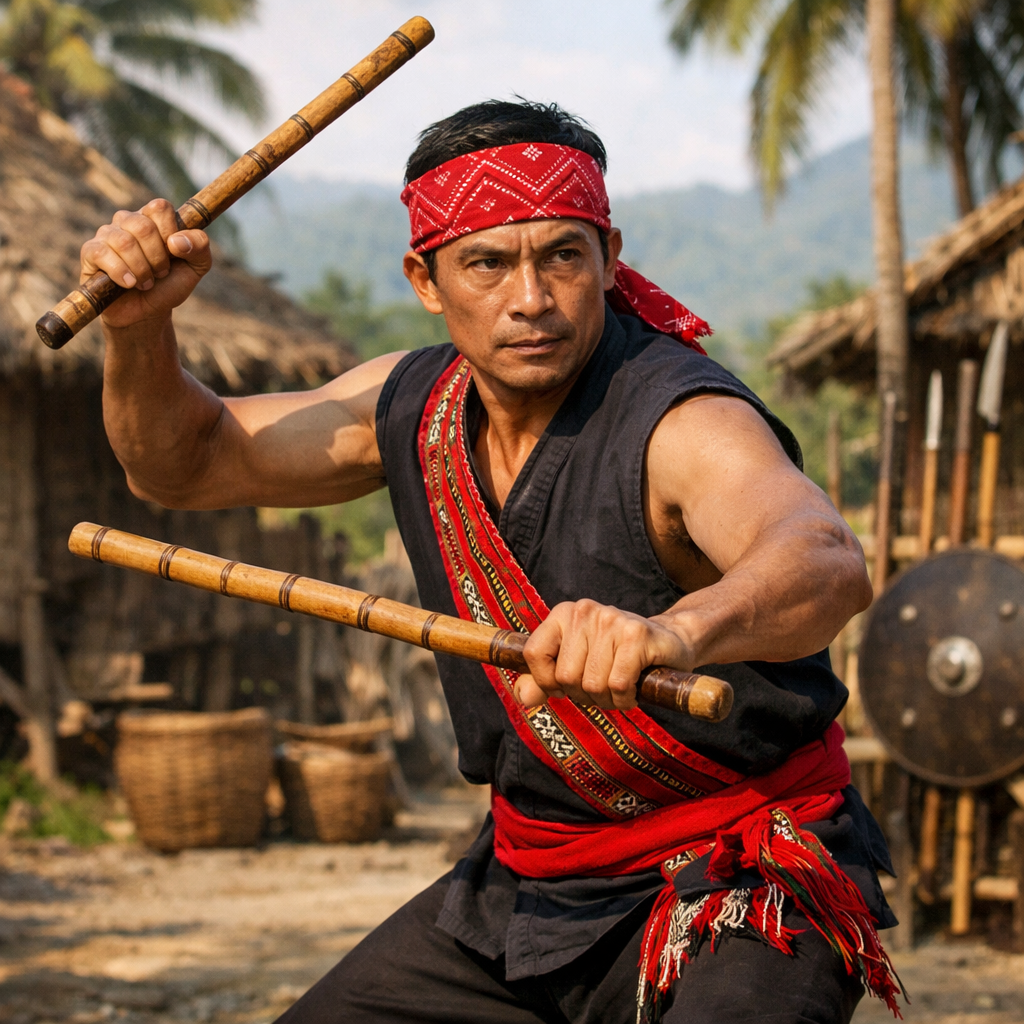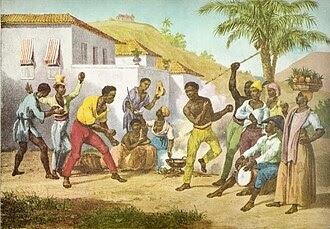
This academic exploration is dedicated to establishing, thoroughly analyzing, and articulating the profound connections and subtle yet significant differences that exist between the Afro-Brazilian art of Capoeira Angola and the diverse, ancient, and highly effective systems of Filipino Martial Arts (FMA), which primarily encompass the interrelated disciplines of Eskrima, Kali, and Arnis.
While these traditions are geographically disparate, having evolved on diametrically opposite sides of the globe—Capoeira Angola in the colonial melting pot of Brazil and FMA across the islands of the Philippine archipelago—both share foundational principles. These commonalities are deeply rooted not only in the practical application of self-preservation and combat effectiveness but also in a truly holistic approach to movement, physical culture, and combat philosophy. Crucially, both arts are interwoven with a deep, enduring cultural narrative of resistance, resilience, and survival, forged under the intense pressure of oppressive, often colonial, forces.
Unpacking these compelling historical and kinetic parallels does more than simply catalog similar techniques; it reveals a universal language of combat intelligence. This shared lexicon of strategic movement, adaptable weaponry (or lack thereof), and psychological fortitude was independently shaped by remarkably similar historical pressures, where the mastery of hidden, often disguised, martial skills was a necessity for cultural and physical survival. The investigation aims to move beyond superficial comparisons to identify the deeper structural, philosophical, and tactical mechanisms that bind these global arts of resistance.
Shared Core Principles and Philosophies: A Deep-Rooted Kinship
The underlying ethos of Capoeira Angola and the diverse family of Filipino Martial Arts (FMA) systems reveals a striking philosophical and functional kinship. This connection exists beneath the surface differences in their aesthetic, movement vocabulary, and execution, pointing toward a unified and profound understanding of kinetic combat, psychological strategy, and the essential dynamics of human interaction under pressure. Both traditions prioritize an intelligent, adaptive, and holistic approach to confrontation
The Principle of Flow and Continuous Motion: Ginga and Dynamic FMA Footwork
A central, non-negotiable tenet in Capoeira Angola is the ginga, the constant, flowing, and deliberately deceptive rocking motion, often likened to a pendulum. This movement is frequently misinterpreted by outside observers as merely a stylized dance or a ritualistic preparation. In reality, the ginga is the foundational, functional engine of the art—a dynamic, living defense system.
Functional Importance of Ginga
- Dynamic Defense: The ginga ensures the practitioner is never a static, predictable target, constantly shifting the center of gravity and preventing the opponent from establishing a fixed line of attack or accurate range.
- Distance Management: It is the active mechanism for maintaining optimal distance (the compasso or espaco) necessary for both immediate evasion and the preparation of an explosive counter-attack.
- Kinetic Energy Storage: The continuous motion stores and releases kinetic energy, allowing for powerful strikes, sweeps, and acrobatics to launch from any point in the cycle without telegraphing intent.
This principle of continuous, non-committal motion and dynamic stance finds a direct, functional parallel in FMA’s pervasive emphasis on “flow” and ceaseless movement.
FMA’s Concept of Flow
In Filipino Martial Arts (FMA), the concept of ‘flow’ is not a mere philosophical ideal but a rigorously practiced, systematic methodology integral to both training and live combat. It represents a state of continuous, dynamic motion that manifests as the rapid, seamless transition between distinct techniques, ranges, and weapon applications. This fluidity is a deliberate continuum designed to prevent any arrests, hesitations, or static pauses in the engagement, which an opponent could exploit.
Key aspects that define this ‘flow’ include:
- Seamless and Instantaneous Transitions: FMA practitioners are trained to execute immediate shifts across the entire fighting spectrum. This involves moving, without a perceptible break, from a sustained, high-powered weapon strike (such as a bolo or stick) to a close-quarters disarm, or instantly switching from an empty-hand parry or block to an intricate joint lock or submission hold. Crucially, the ability to change ranges—from the long-range fighting (largo), where footwork and reach dominate, to close-quarters grappling (corto)—must be instantaneous and disguised within the motion itself.
- Calculated Exploitation of Momentum: Training is heavily focused on controlling and understanding the three primary combat ranges: largo (long range/striking), medio (medium range/trapping), and corto (close range/grappling). However, the mastery of flow goes beyond positional control; it involves the crucial ability to exploit the momentary openings created not by the practitioner’s action alone, but by the opponent’s natural reaction, committed attack, or resulting excessive momentum. The opponent’s force and movement are redirected and utilized against them.
- The Unbroken Series (The Art of Dumog): Methods such as dumog (the Filipino system of wrestling, grappling, takedowns, and joint manipulation) are entirely dependent on the principle of the unbroken series. This is not a set of choreographed moves but an adaptive chain of actions and counter-actions. The practitioner constantly pressures the opponent, seeking leverage, control, and a position from which to finish the engagement, never allowing the opponent the time or space to stabilize or recover.
The overarching priority that dictates the tactical doctrine in both FMA and other flow-based arts (like Capoeira Angola) is the absolute avoidance of static, easily-readable, and linear positions. Any pause is an opportunity for the opponent. By cultivating continuous, cyclical, and multi-directional movement, the practitioner transforms their entire presence into a highly elusive, highly difficult target. This continuous motion makes the practitioner a profoundly unpredictable threat, forcing the opponent to perpetually react to a shifting, three-dimensional attack matrix rather than being able to initiate or predict the next step.
Deception and The Element of Play: Malandragem and Juego in Psychological Warfare
Capoeira Angola is famously defined by its essential element of malandragem (a rogue-like cleverness, strategic trickery, or sophisticated deception) and the overarching concept of jogo (the game).
Capoeira’s Psychological Layer
The movements exchanged within the roda (the circle/ring) are frequently playful, deliberately low to the ground, and profoundly deceptive. This is achieved through the use of feints, subtle invitations to attack, and misdirection designed to mask powerful, committed attacks.
- The Jogo de Fora (Outside Game): The fluid, dance-like, and seemingly non-aggressive nature of the exchange is a deliberate psychological strategy. It is engineered to lull the opponent into a false sense of security or to make them fundamentally misread the true intent, power, or operational range of the attack.
- Counter-Intuitive Power: The attacks often emerge from the lowest points of a sequence (like a low rasteira sweep) or from an inverted position, making them counter-intuitive and difficult to defend against, exploiting the opponent’s linear expectations.
This reliance on psychological warfare is powerfully mirrored across numerous FMA systems. FMA practitioners weaponize rhythm and perception to gain a decisive advantage.
FMA’s Deceptive Strategies
FMA heavily employs broken rhythm, strategic feints—particularly with the lead hand or training weapon—and unexpected shifts in angle or the primary striking tool (punong—shifting the weapon or controlling hand).
- Destabilization: The core goal is to overwhelm, confuse, disarm, or critically destabilize an opponent’s perception, timing, and defensive structure.
- Control of Perception: Advanced FMA utilizes precise timing, the exploitation of momentary psychological shock, and the meticulous control of the opponent’s visual and kinetic perception. The concept of ‘taking the center’ often involves dominating the opponent’s view and reaction time.
- Elevation to a Cerebral Game: This mastery of deception, misdirection, and exploiting the opponent’s psychological state elevates combat from a purely physical exchange to a high-stakes, cerebral game—a cornerstone of advanced practice in both disciplines.
Holistic Body Conditioning, Balance, and Spatial Awareness
Both disciplines require and develop an exceptionally high degree of physical literacy. Their conditioning methodologies emphasize functional attributes: proprioception (the sophisticated sense of self in space), dynamic balance, explosive core strength, and agile flexibility. The training is inherently functional, designed not for external appearance but for immediate, practical application in dynamic, unpredictable, and often hostile scenarios
Functional Strength and Multi-Planar Movement
Capoeira Angola’s foundation—built on constant low movement, rolls (aú), low bridge defenses (queda de quatro), and low sweeps (rasteiras)—systematically builds incredible functional leg and hip strength, unparalleled mobility, and a profound degree of spatial awareness.
Multi-Planar Competency: The art demands the capacity to operate effectively and powerfully from any plane: standing, crouched, inverted, or on the ground. Crucially, this must be achieved without any loss of power generation or stability. This ensures the practitioner remains functionally combat-ready regardless of their body’s orientation, a complete rejection of being locked into a single plane.
FMA’s focus on complex, non-linear footwork—often triangular or diamond-shaped (known variously as sunda, sayaw, or piyok)—and its rapid, intricate hand-eye coordination drills (such as sinawali and doblete) similarly foster complete full-body connectivity.
Integrated Footwork: FMA footwork is designed to simultaneously manage distance, create superior angles of attack (the exploitation of the opponent’s ‘blind’ or weak side), and safely displace the body away from the line of force.
Neurological Speed: The rapid-fire conditioning drills—often involving paired weapon work—foster profound neurological speed and precision, treating the body as a unified, cohesive weapon system where the feet, core, and hands are intrinsically linked and instantaneously responsive.
Consequently, both arts produce athletes who possess not brute strength, but functional strength: the highly practical ability to generate explosive power, maintain perfect equilibrium, and execute complex, precise movements while under maximal physical and psychological duress.
Methodological and Technical Convergence
Beyond philosophical overlap, specific technical and methodological aspects of the arts show fascinating points of convergence, suggesting universal solutions to combat problems.
Footwork, Distance Management, and Angle of Attack: In Capoeira Angola, footwork is the engine of the game (jogo), used not only to evade but critically to control the circular arena (roda) and create strategic openings. The practitioner moves along circular, pendulum-like, and evasive paths. FMA is equally renowned for its sophisticated, geometrical footwork systems, which dictate the precise angle of attack and defense—often utilizing a 4, 6, or 12-point system of entry and evasion. While the aesthetic differs—Capoeira’s movements are often broader, lower, and more sweeping—the functional goal remains identical: to enter and exit the opponent’s range safely and efficiently while simultaneously disrupting the opponent’s balance, rhythm, or equilibrium. Both arts excel at controlling the engagement distance.
Close-Quarters Combat, Trapping, and Sensitivity (The Clinch): The close-range aspects of both arts reveal fascinating, functional similarities. Capoeira Angola features numerous takedowns, controlling clinches, positional sweeps, and techniques like cabeçada (headbutts). The transition to the ground is fluid and intentional. In FMA, particularly in the unarmed sections (known as Pangamut, Dumog, or Hubud Lubud), trapping, joint locks (lukso), throws, and highly sensitive close-range parrying and checking are critical. The concept of “fencing with the hands” emphasizes sensitivity and positional dominance in the immediate close range. Both arts transition fluidly between long range (kicking or striking), middle range (hand-to-hand or weapon range), and short range (trapping, grappling, and locking).
Weapon to Empty-Hand Transition: While Capoeira Angola often appears purely unarmed in the roda, its historical roots include weapon use (e.g., the navalha or razor), and many movements translate perfectly to manipulating or evading weapons. FMA, which is fundamentally a weapons-based art, has empty-hand systems (Pangamut) that are direct methodological reflections of the weapon movements (e.g., the stick-fighting patterns directly inform punching and blocking). This shared principle—that all combat is interconnected, and the body itself is the ultimate tool—underscores the comprehensive nature of both disciplines.
A Comparative Study: Connecting Capoeira Angola with Filipino Martial Arts (FMA) Cultural and Historical Context of Resistance: A Shared Crucible
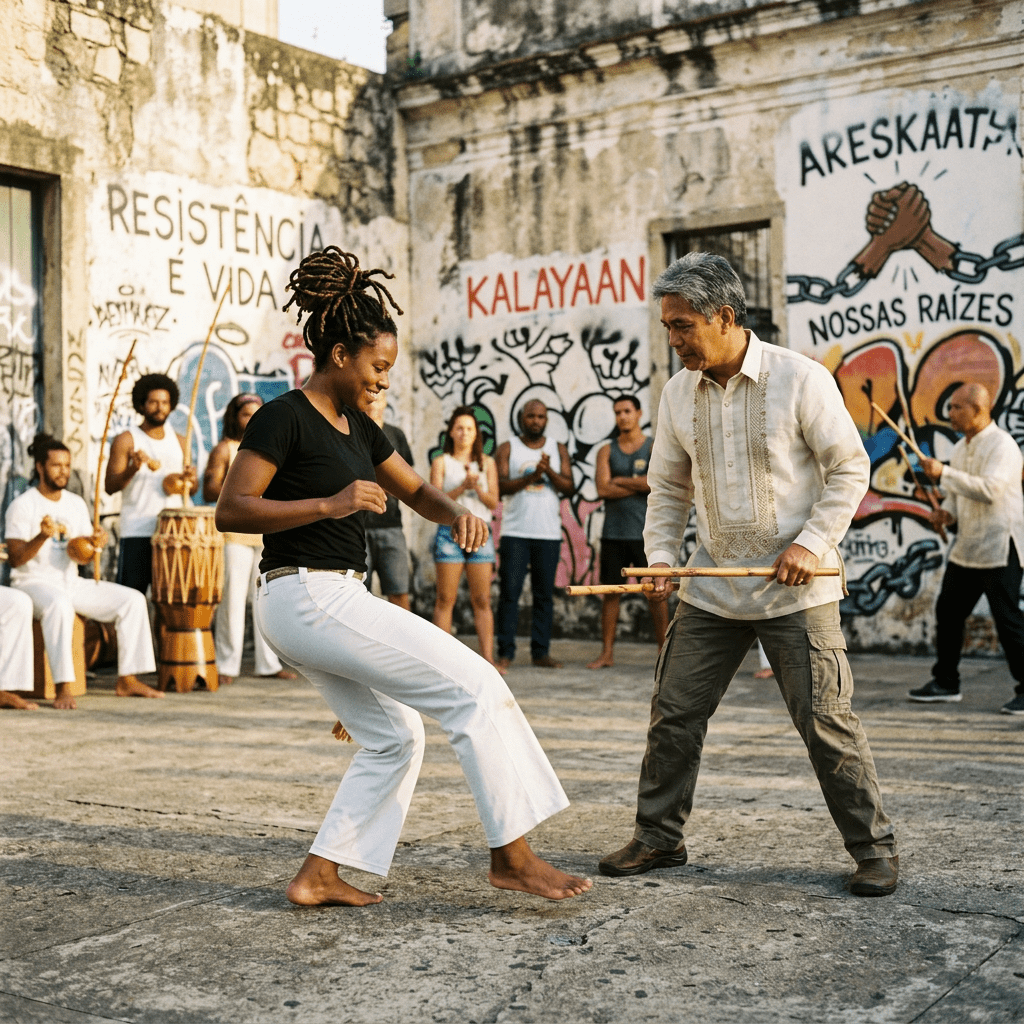
Perhaps the deepest and most compelling connection between Capoeira Angola and Filipino Martial Arts (FMA), such as Kali, Arnis, or Eskrima, lies in the shared socio-historical crucible of their development. Both arts were not merely systems of combat; they were complex, clandestine cultural archives forged in environments where practitioners needed to ingeniously disguise their fighting skills to evade the relentless scrutiny, persecution, and outright prohibitions of colonial or ruling powers. This necessity for secrecy transformed the arts into sophisticated, multi-layered forms of cultural resistance.
Disguise, Secrecy, and Preservation
The survival of these martial traditions hinged on their ability to camouflage themselves within the fabric of daily life, transforming innocuous activities into vital tools for self-defense and rebellion:
Capoeira: The Dance of Deception:
Enslaved Africans in Brazil, stripped of their freedom and cultural identity, developed Capoeira as a means to practice and preserve their martial prowess right under the noses of their captors. The movements—sweeps, kicks, and evasions—were skillfully interwoven with the aesthetics of dance, music, and ritual. This transformation made Capoeira appear as a playful, spiritual, or athletic pastime rather than a deadly fighting system.
The circle (roda) became far more than a performance space; it was a sacred sanctuary, a localized zone of autonomy, and a highly efficient training ground. Its circular nature ensured all-around awareness and allowed for rapid defense against outside intervention.
The berimbau—a simple musical bow—was central to this deception. It did not merely dictate the pace and intensity of the jogo (the game/fight); historically, it served as a vital communication and warning system. Changes in its rhythm could signal the approach of overseers (feitores), instantly transitioning the ‘fight’ back into an ‘innocent’ dance. This cultural mechanism was fundamental to the art’s survival and its enduring identity as a cultural marker of resilience.
Filipino Martial Arts (FMA): The Art in the Act:
The fighting movements were frequently disguised as intricate folk dances (Sayaw), ensuring the preservation of complex footwork, striking patterns, and defensive maneuvers within seemingly harmless cultural performances. The flowing, circular motions of the stick-and-blade fighting were retained, albeit stylized, in the Tinikling or other regional dances.
Essential martial knowledge was also embedded in agricultural practices or religious rituals. For instance, the use of the bolo (a common farming implement) mirrored its function as a war implement, and the movements for planting or harvesting could conceal fundamental disarming or trapping techniques. This strategic enculturation ensured that indigenous martial knowledge and the fighting spirit of the people could be passed down through generations despite relentless foreign oppression.
Cultural Artifacts as Symbols of Identity and Resilience
The tools and objects associated with both traditions transcend their functional utility; they stand as powerful symbols of identity, cultural continuity, and historical resilience.
The Berimbau and the Soul of Capoeira:
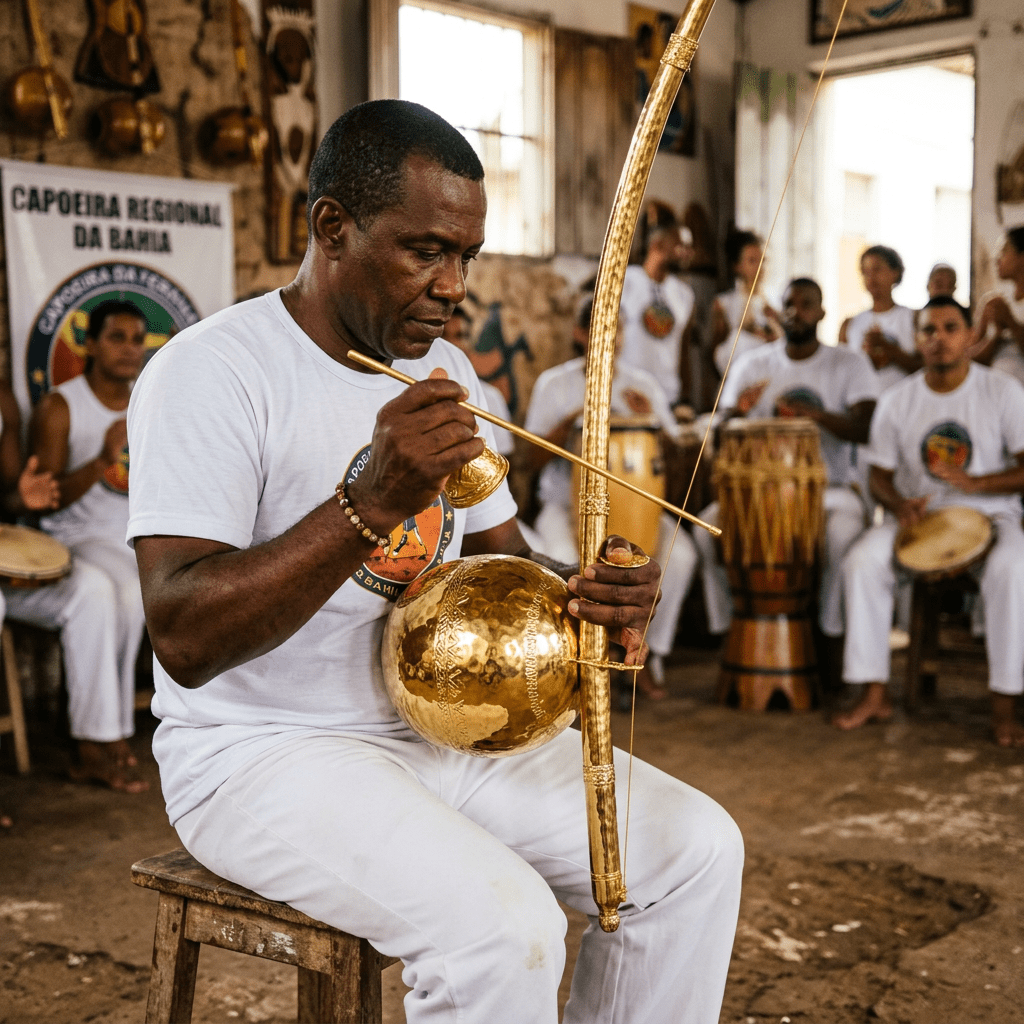
In Capoeira, the berimbau is the master instrument that dictates the very rhythm, energy, and character of the jogo (game/fight). It acts as the “soul” of the roda. Its sounds communicate not just the speed but the philosophical depth of the interaction, embodying the unity of music, movement, and fighting technique. It is the repository of the tradition’s oral history and ethical code, reminding practitioners that the art is a balance of aggression, evasion, and ritualistic respect.
The Olisi/Bolo and the Extension of the FMA Spirit:
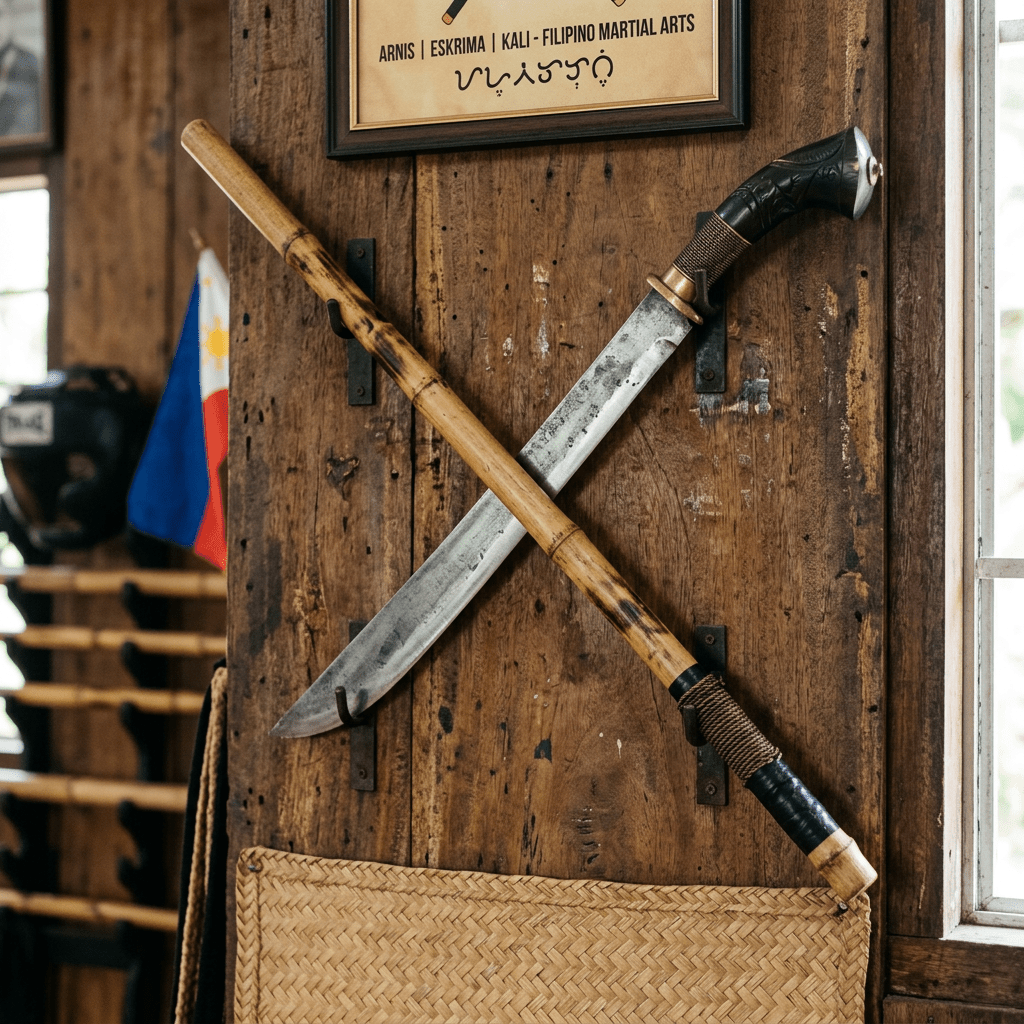
In FMA, weapons like the olisi (rattan stick) or the bolo (machete/sword) are considered direct extensions of the practitioner’s body, spirit, and history. The reverence for the weapon reflects the history of the Filipino people’s struggle for independence, where these tools were essential for both survival and warfare. The intricate relationship between the body and the weapon—emphasizing close-quarters, flowing, and unpredictable movement—is a testament to a complete martial philosophy where the weapon is seamlessly integrated into the natural motions of the human form.
Vehicles of Cultural Transmission
Ultimately, both Capoeira and FMA operate as holistic vehicles for cultural transmission. They are living histories that utilize more than just physical training to perpetuate their legacy. They pass on:
The profound connection between Capoeira Angola and Filipino Martial Arts (FMA) is deeply rooted in their historical and philosophical foundations, as well as their practical function as tools for survival and cultural preservation.
Shared Cultural and Historical Narratives
- History and Philosophy: Both arts serve as living archives, meticulously preserving the oral traditions, songs, and practical applications of their techniques. In Capoeira, the rhythmic songs (quadras and chulas) sung in the roda are powerful historical narratives, recounting the struggles, resistance, and enduring spiritual fortitude of enslaved African and Afro-Brazilian ancestors. Similarly, the philosophies and movements embedded within various FMA styles—such as Kali, Escrima, or Arnis—embody the histories of indigenous Filipino peoples and their defiance against colonial powers. They are testaments to a shared human experience of oppression, resilience, and the relentless fight for freedom and cultural identity.
Tools for Practical Survival and Holistic Development
- Practical Survival Skills: The arts transcend mere physical combat; they are comprehensive systems for survival that address the mental, spiritual, and communal aspects of existence. Beyond the mastery of strikes, blocks, and evasions, the traditions impart essential, life-sustaining lessons. Discipline is forged through rigorous practice and adherence to the art’s ethical code. Strategic thinking is honed by the improvisational, dynamic nature of the fight or game—demanding practitioners to anticipate, adapt, and exploit openings. Most critically, the arts foster community building and personal resilience. Under colonial regimes, the practice was often a clandestine act, requiring absolute trust and cooperation, thereby strengthening the social fabric. The physical and mental toughness cultivated was not just for fighting, but for enduring harsh living conditions and maintaining hope.
The Reinforcement of Collective Identity
- A Sense of Collective Identity: The physical space of practice becomes a sacred crucible for forging collective identity. In Capoeira, the roda (the circle) is a microcosm of society, where individual expression is balanced by communal support and responsibility. The energy, rhythm, and mutual respect within the roda transform individual practitioners into members of a shared lineage. Likewise, in the FMA training group or eskrima school, the communal training reinforces a powerful bond and collective purpose. By learning and embodying the art, practitioners cease to be mere individuals; they become active custodians and inheritors of a deep, complex, and hard-won cultural heritage, ensuring its transmission and vitality for future generations. This collective ownership transforms the martial art into a profound act of cultural sovereignty.
Conclusion:
The comparative study of Capoeira Angola and Filipino Martial Arts (FMA) reveals a profound and often overlooked relationship: that these disparate systems are bound by more than mere coincidence. Their independent evolution represents parallel trajectories in strategic combat intelligence, a testament to the universal capacity for innovation under duress. Both martial traditions emerged from the crucible of oppression—whether the Portuguese colonization of Brazil and the enslavement of African people, or the successive waves of foreign subjugation endured by the Philippines. This shared genesis instilled within them a core philosophy of survival, cultural preservation, and the unrelenting pursuit of physical and spiritual freedom.
The functional and philosophical convergences between Capoeira Angola and FMA are particularly illuminating. Both systems prioritize adaptability, utilizing low-profile stances, misdirection, and sophisticated timing to overcome a larger, often better-armed, adversary. In Capoeira Angola, the malícia (malice or feint) and the principle of constant flow (jogo de dentro) mirror the dynamic footwork, deceptive entries, and continuous flow (eskrima’s continuous attack principle) found in FMA. Furthermore, both arts developed methods of turning everyday objects or the practitioner’s own body into effective weapons—Capoeira’s concealed strikes and sweeping movements, and FMA’s mastery of the blade and impact weapons derived from farming tools. These convergences demonstrate that the most effective martial arts are not isolated technical inventions but organic, culturally-rooted responses to existential necessity.
While the aesthetic and stylistic differences are undeniable—the fluid, dance-like camouflage of Capoeira versus the linear, combative efficiency of many FMA styles—the foundational principles are identical: holistic engagement of mind and body, a profound respect for the lineage of knowledge, and the ultimate objective of resistance. The study ultimately posits that these arts serve as living archives of history, proving that resistance, when encoded into movement and culture, becomes an ineradicable force.