Welcome to MARTIAL ARTS THEATER, a vibrant community hub dedicated to honoring the rich heritage and diverse practice of martial arts, while enthusiastically promoting personal growth, discipline, and camaraderie among practitioners of all levels. We offer an extensive range of resources, including expert interviews, instructional videos, and engaging community events designed to explore various martial arts disciplines, such as karate, taekwondo, judo, and Brazilian jiu-jitsu. ‘Beyond just training, our goal is to create a supportive, inclusive environment for all members, from curious beginners embarking on their first steps to seasoned black belts honing their skills, fostering genuine connections and a transformative journey of self-discovery and empowerment through the art of martial arts. Join us as we cultivate a spirit of respect and mutual support, encouraging every individual to thrive in their personal martial arts journey, connecting through shared experiences, skills development, and vibrant friendships that extend far beyond the dojo.
In Today’s Installment…
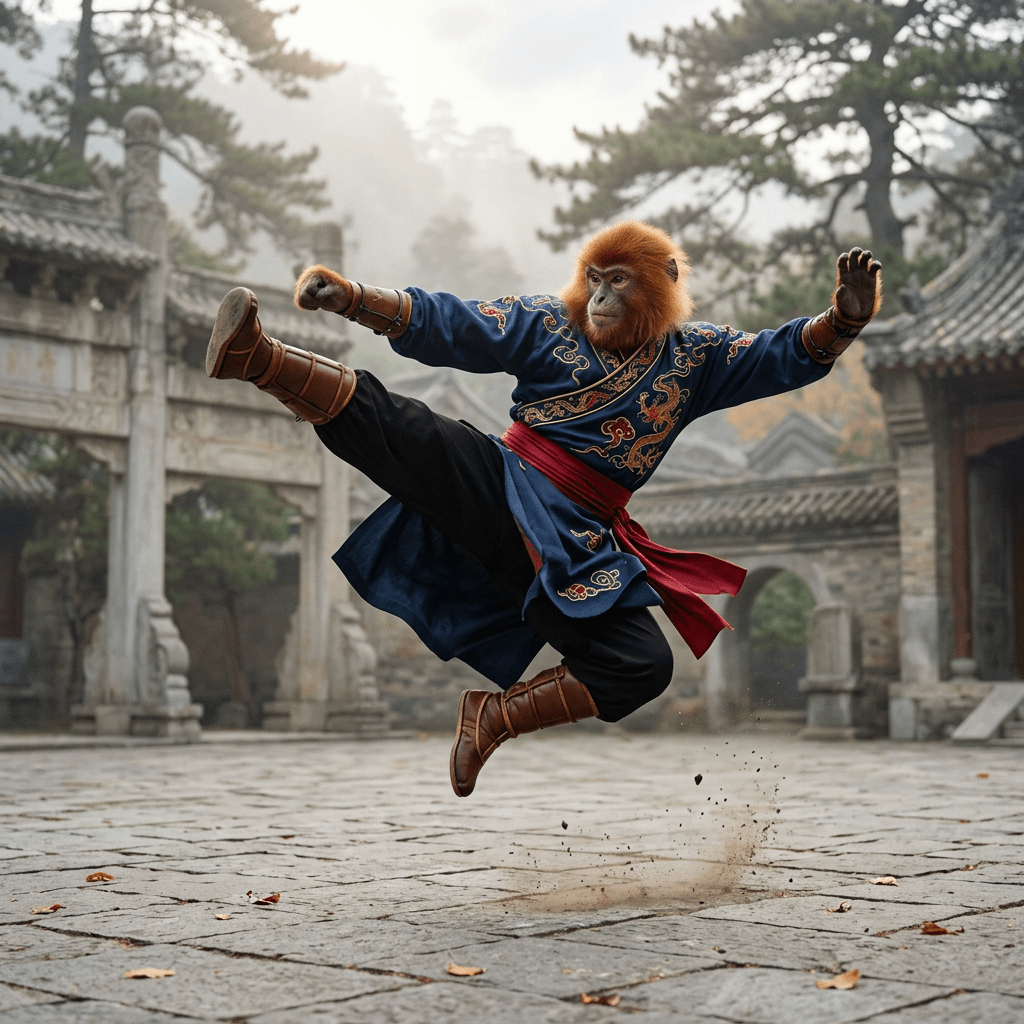
Monkey Kung Fu is one of the most misunderstood styles in martial arts history. Often dismissed as theatrical performance—or exaggerated as a secret Shaolin combat system tied to Bodhidharma and Shaolin mythology—Monkey Boxing (Hou Quan) actually has roots that stretch far beyond modern Kung Fu legends. While Jesse Enkamp, the Karate Nerd, has questioned if it serves as a “special forces style” for Shaolin, the historical reality suggests a much broader evolution. One major hypothesis suggests that Chinese Kung Fu, including its animal styles, may have evolved from South Indian Kalarippayat. Legend states that Bodhidharma, an Indian Buddhist monk from the south where martial arts were part of the curriculum in centers of learning known as salais, traveled to China and established the Shaolin temple.
The stylistic lineage can be traced from ancient India, where the monkey god Hanuman is featured in the Ramayana and serves as the patron deity for wrestlers who train with heavy clubs known as gadas. These Indian influences likely moved into Southeast Asia during the first few centuries of the Christian era through trading activities and the Indian exodus, potentially informing systems like Bokator, Muay Boran, and Silat Monyet. In the Philippines, the term “guro” (teacher) and the name of the supreme god “Bathala” (derived from Indra) reflect this deep Indian cultural export. Historically, the development of monkey movement incorporates Han Dynasty animal mimicry, Ming Dynasty military manuals, and the cultural impact of “Journey to the West” leading to the modern Great Sage Monkey system.
Beyond the mythology, Monkey Kung Fu utilizes specific techniques designed for mobility, unconventional attacks, deception, adaptability, takedowns, and psychological disruption, making it a versatile martial art that emphasizes the importance of creativity and unpredictability in combat. These principles contrast sharply with other regional styles, such as the heavy club methods of Indian warfare—vikshepa (paired combat), abhishepa (single club), and parishepa (circling)—each rooted in their own rich traditions and tactics that prioritize strength and direct confrontation.
Similarly, the light, rapid-fire rattan stick techniques found in Filipino martial arts like arnis-escrima showcase a different approach to combat, focusing on speed and fluidity rather than the more grounded techniques of the Monkey style. While modern culture often confuses opera and performance with battlefield systems, overlooking the historical context and evolution of these arts, the real function of Monkey Kung Fu remains deeply embedded in a complex historical exchange of martial knowledge across Asia, where influence was not only reciprocal but also adaptive, allowing practitioners to refine and innovate techniques that address both individual and collective challenges in martial practice.