Introduction: A Comparative Exploration of Internal Arts
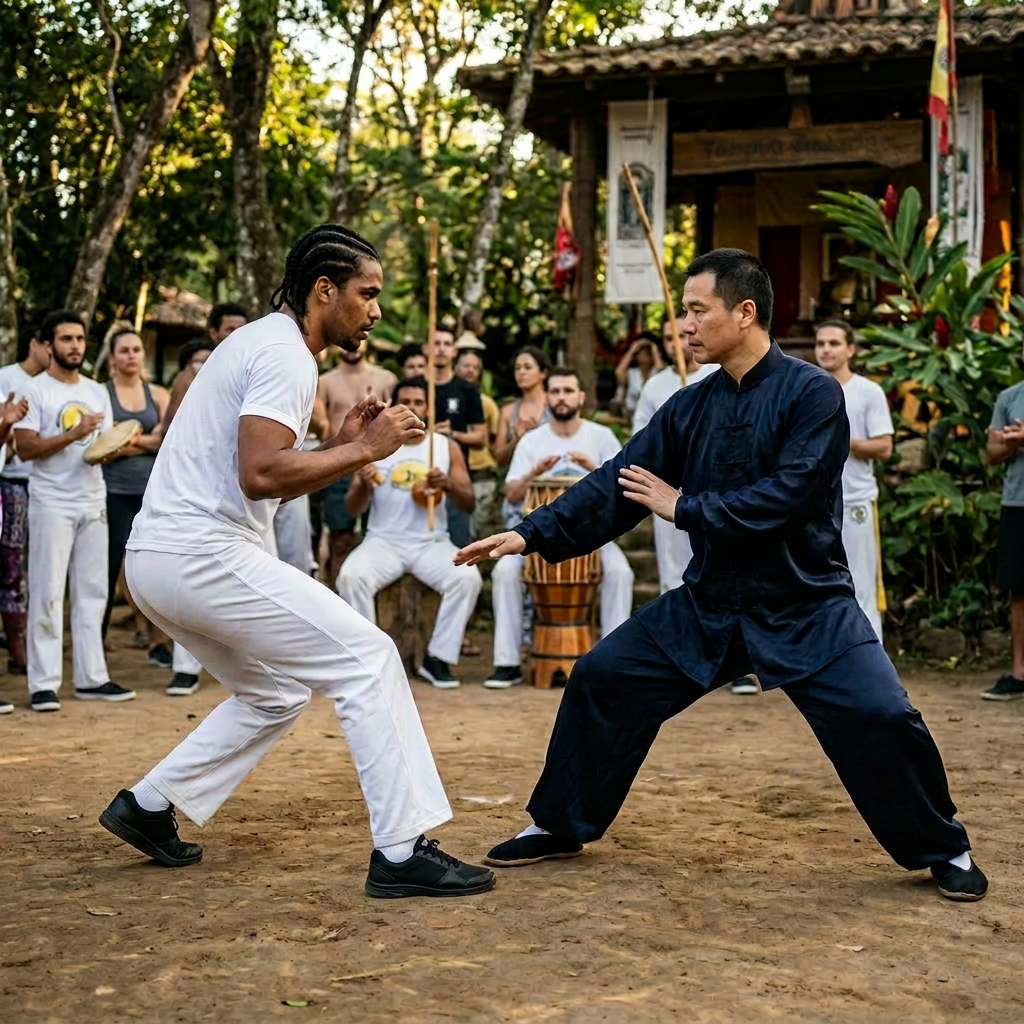
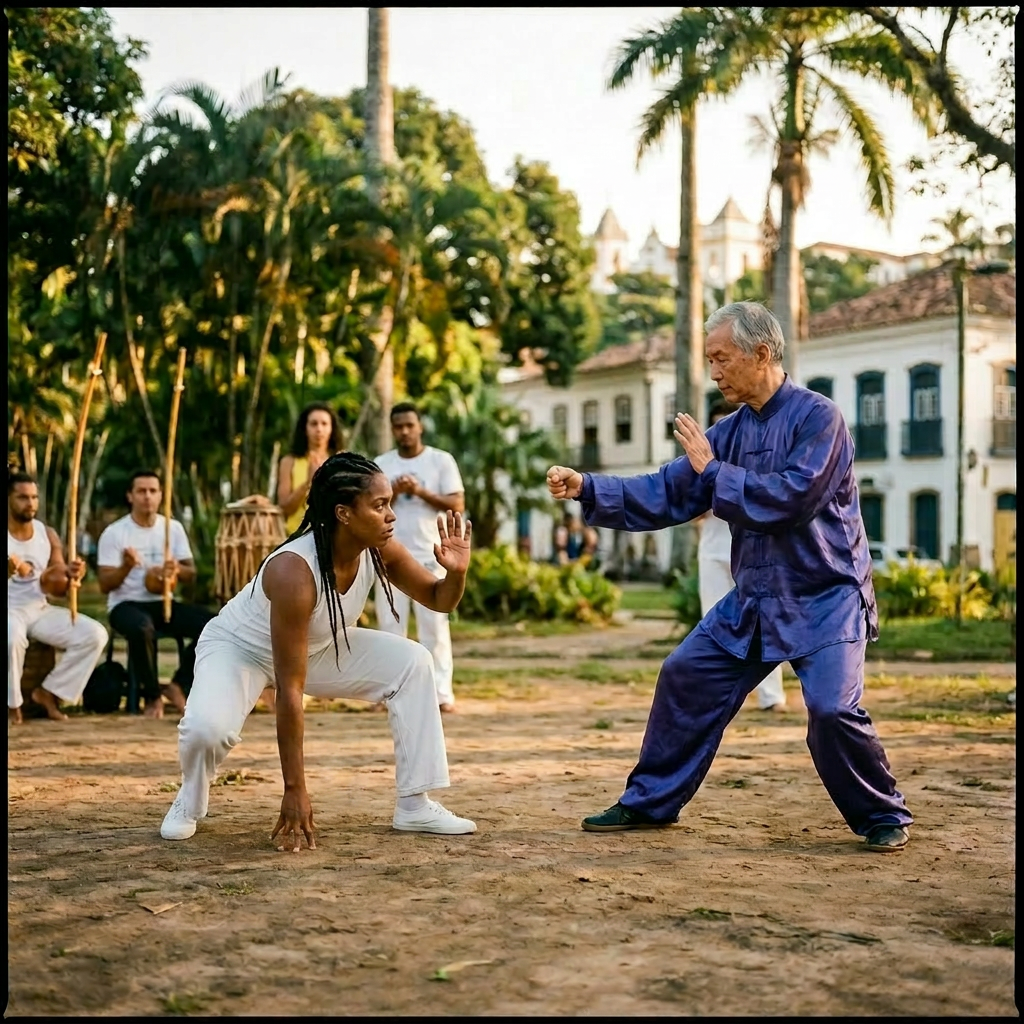
This document undertakes a comprehensive comparative analysis between the Afro-Brazilian martial art of Capoeira Angola and the three primary internal Chinese martial arts: Tai Chi Chuan (Taijiquan), Hsing-yi Chuan (Xingyiquan), and BaguaZhang (Baguaquan). At first glance, these disciplines appear to reside in vastly distinct cultural and historical spheres—one rooted in the hidden resistance and communal expression of enslaved Africans in Brazil, and the others emerging from ancient philosophical and military traditions in China.
Despite these disparate origins, a deeper examination reveals a profound convergence in their core principles. All four practices share an intense, non-obvious emphasis on internal power (often referred to as neijin in Chinese arts), characterized by relaxed, fluid movement and the generation of force from the body’s center rather than through brute muscular strength. Furthermore, they prioritize the seamless integration of mind, body, and spirit, making the practice a holistic endeavor that transcends mere combat training.
Crucially, this comparative study focuses on the cultivation of vital energy—chi (or qi) in the Chinese internal arts and axé in the Capoeira context. While the terminology and cultural framing differ, both concepts describe a pervasive, life-force energy that is refined through dedicated practice, enabling the signature fluidity, resilience, and explosive potential that defines these respective disciplines. This shared commitment to internal cultivation offers a rich and fertile ground for cross-cultural martial arts study, allowing for a deeper appreciation of universal principles in human movement, spirituality, and self-defense. The ensuing analysis will explore the specific mechanics, philosophical underpinnings, and application of these shared principles.
Capoeira Angola: The Art of Malícia, Grounding, and the Jogo
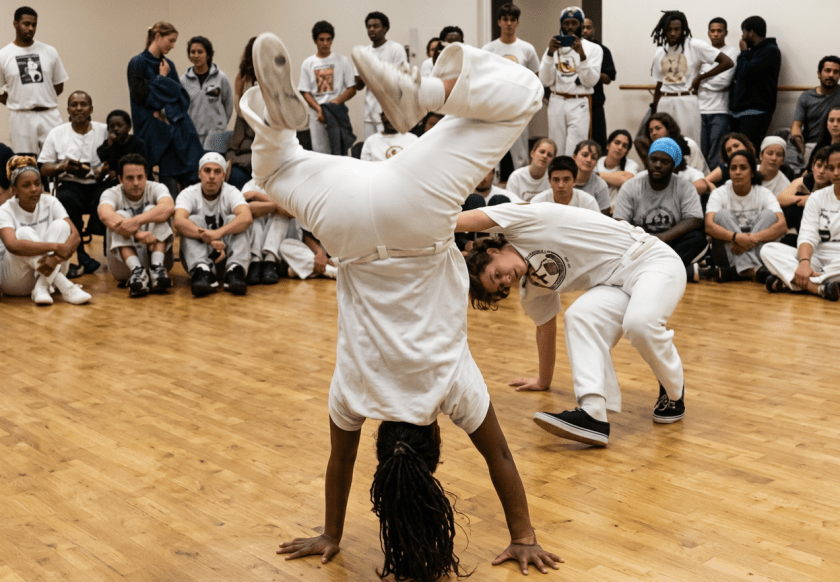
Capoeira Angola is a profound and complex Afro-Brazilian martial art, distinguished from its more acrobatic counterpart, Capoeira Regional, by its deliberate pace, low-to-the-ground movements, and deep philosophical underpinnings. Its character is fundamentally defined by three elements: grounding, malícia (malice or deception), and the continuous, strategic flow of the jogo (game).
Grounding and Movement Dynamics:
The physical manifestation of Capoeira Angola is rooted in its dedication to maintaining a low center of gravity. This “grounding” is not merely a stylistic choice but a strategic imperative, ensuring stability and providing the leverage for explosive, whip-like attacks. Signature low movements, such as the rabo de arraia (stingray tail, a low, powerful sweep) and the rasteira (low sweep), are essential tools for unbalancing an opponent. Unlike arts that rely on linear force or high-impact strikes, the power in Capoeira Angola is generated through a sophisticated chain of momentum, originating from the core and lower body. Movements often spiral and undulate, utilizing the entire body to create a dynamic, unpredictable martial dance.
Malícia: The Art of Strategic Deception:
Malícia is arguably the heart of Capoeira Angola. It represents a combination of strategic cunning, feigned vulnerability, and psychological warfare. A player using malícia will employ subtle misdirection, sudden changes in tempo, and masked intentions to draw their opponent into a trap. What appears to be a friendly, playful movement (brincadeira) can instantly transform into a devastating takedown. This element of deception is what makes the jogo unpredictable and requires constant, active interpretation from both players. It is the art of appearing harmless while being acutely dangerous.
The Jogo and the Rhythmic Dialogue:
The interaction between two capoeiristas is called the jogo, or the “game.” It is not a sparring match in the conventional sense but a continuous, cooperative yet combative dialogue. This flow is inextricably linked to the musical accompaniment, which acts as the ultimate director and energy source. The lead instrument, the berimbau (a single-stringed musical bow), dictates the pace, style, and intensity of the jogo—from slow, intense, and deceptive to moderately fast and evasive. Other instruments, like the atabaque (drum) and pandeiro (tambourine), along with the collective singing and clapping, create the roda (circle) energy, enveloping the players and forcing them to harmonize their movements with the rhythm. The jogo is a test of skill, endurance, observation, and adaptability, demanding that players remain in constant, fluid motion, always seeking the strategic opening.
The Internal Chinese Arts: Cultivating Internal Power (Neijia)
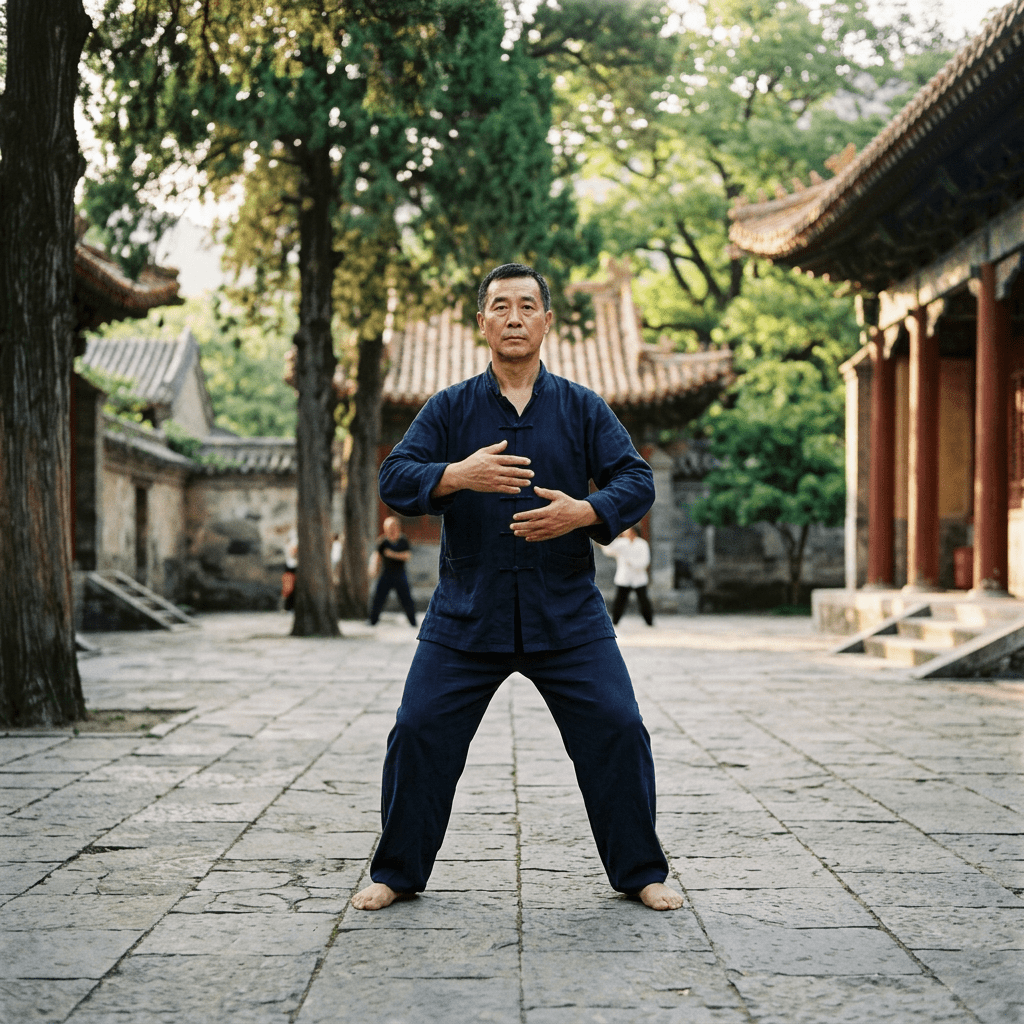
The three celebrated internal martial arts—Tai Chi Chuan (Taijiquan), Hsing-yi Chuan (Xingyiquan), and BaguaZhang (Baguaquan)—are collectively known as Neijia, or “Internal Family” arts. These disciplines represent a profound departure from the more externally focused, muscular strength-based Shaolin (Waijia) systems, emphasizing not just physical prowess but also a deep mental and spiritual connection to the practice. Neijia focuses intensely on cultivating and harnessing internal energy, or jing (refined essence) and qi (life force), which is then translated into potent, fluid power that flows harmoniously within the body. This cultivation is achieved through a meticulous methodology that includes slow, deliberate forms and movements that encourage mindfulness, extended periods of standing meditation (zhan zhuang) that enhance stability and balance, and specialized Taoist and Buddhist-influenced breathing techniques designed to synchronize mind, breath, and body structure, creating a unified system of movement and energy flow.
Practitioners engage in these methods not merely to enhance their physical capabilities but to foster a greater sense of awareness and connection to their surroundings. The ultimate goal is to develop “silk reeling energy,” characterized by its smooth and continuous quality, and rootedness, allowing a smaller or weaker practitioner to generate explosive force (fa jing) that originates from the core rather than the limbs. This integration of bodily movement, breath control, and mental focus culminates in a martial practice that transcends mere combat, promoting overall health, longevity, and a serene state of mind.
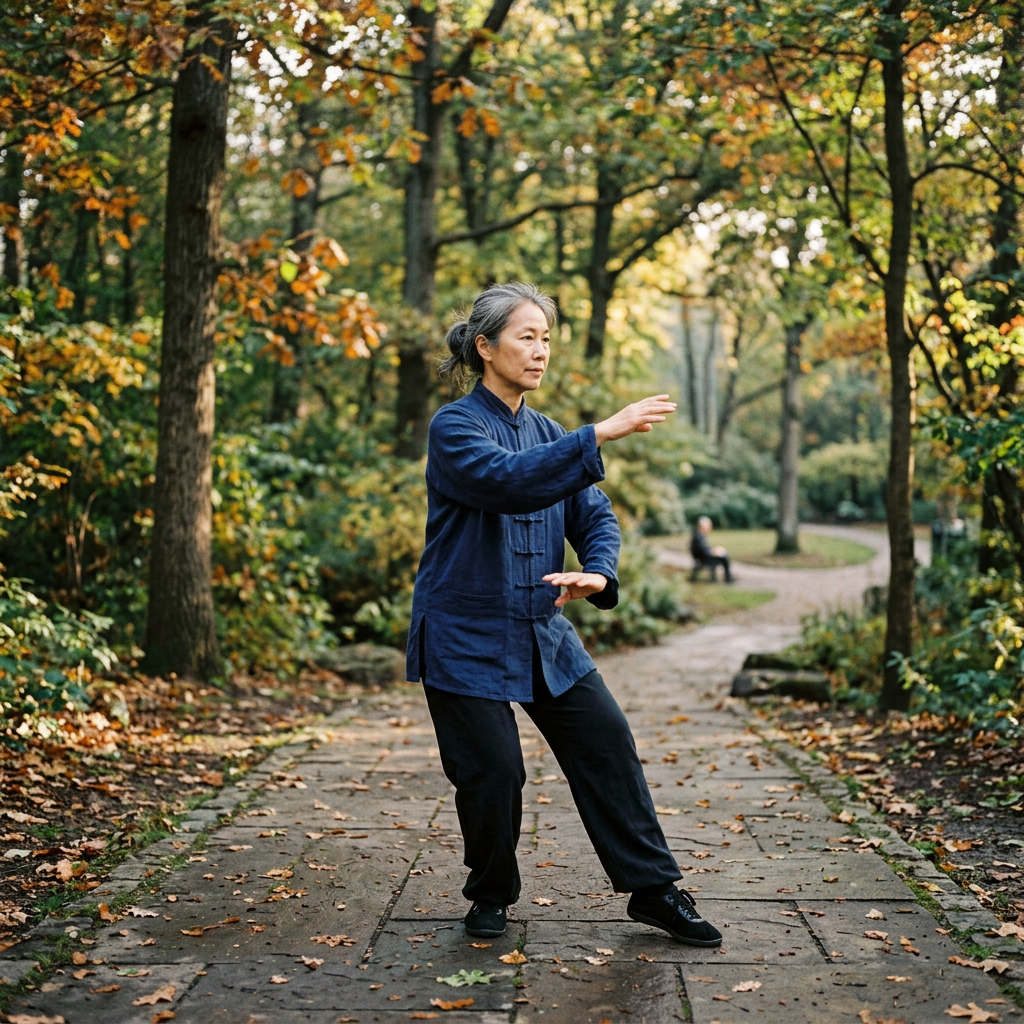
1. Tai Chi Chuan (Taijiquan): The Grand Ultimate Fist
Tai Chi Chuan is arguably the most globally recognized of the Neijia arts, celebrated for its aesthetic beauty and deep philosophical underpinnings. Its movements are characterized as soft, circular, and continuous, resembling a slow, moving meditation.
Core Principles: Tai Chi’s power lies in the principle of yielding to overcome force (sì liăng bō qiān jīn — “four ounces deflect a thousand pounds”). Rather than meeting an opponent’s force directly, the practitioner learns to absorb, neutralize, and redirect it, using the opponent’s own momentum against them. It emphasizes whole-body connection, where every movement is coordinated from the dantian (energy center in the lower abdomen), ensuring that the body moves as a single, integrated unit.
Philosophical Roots: It is deeply rooted in Taoist philosophy, specifically the concepts of Yin and Yang. The continuous, seamless transition between postures perfectly embodies this duality, expressed in the shift between empty (xu, or weightless/soft) and full (shi, or weighted/firm) postures. This constant interchange fosters balance, adaptability, and an effortless, natural power. The practice is often utilized for its profound health benefits, improving balance, flexibility, and circulation.
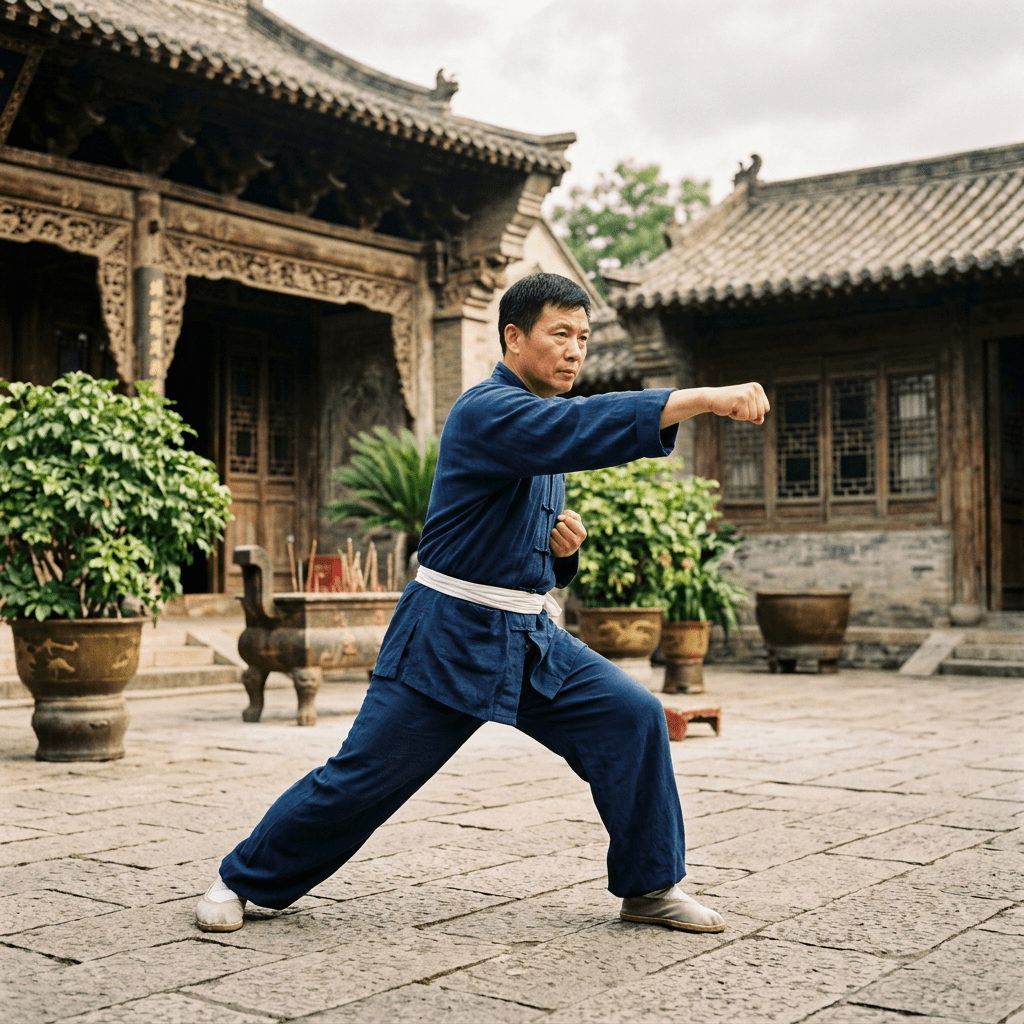
2. Hsing-yi Chuan (Xingyiquan): Form and Will Fist
Hsing-yi Chuan is the most linear, direct, and explosive of the three internal arts, often described as having the fighting spirit of a spear. It favors immediate entry and decisive action over the more evasive strategies of BaguaZhang or the neutralizing softness of Tai Chi.
The Five Elements: The foundation of Hsing-yi lies in the theory of the Five Elements (Metal, Water, Wood, Fire, Earth). Each element corresponds to a specific type of penetrating power strike and is linked to the internal organs:
Pi Quan (Splitting Fist – Metal): Downward, chopping power.
Zuan Quan (Drilling Fist – Water): Upward, piercing power.
Beng Quan (Crushing Fist – Wood): Forward, penetrating power.
Pao Quan (Cannon Fist – Fire): Exploding, simultaneous defense and offense.
Heng Quan (Crossing Fist – Earth): Horizontal, neutralizing power.
The Twelve Animals: In addition to the elements, the art incorporates the distinct characteristics of the Twelve Animals (e.g., Dragon, Tiger, Hawk, Snake, Bear). These manifest as specialized, focused power strikes and movements.
Fighting Essence: Its core principle is simultaneous offense and defense (shou ji yi ti), often moving aggressively on a straight line. The emphasis is on cultivating a strong, rooted structure and direct forward momentum, allowing the practitioner’s entire body mass to be channeled into a single, devastating strike.
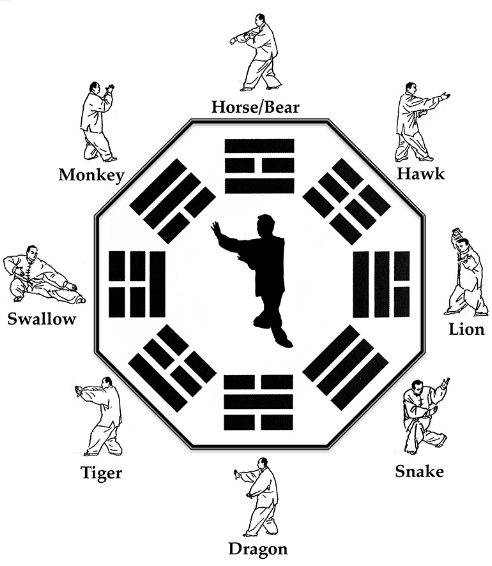
3. BaguaZhang (Baguaquan): Eight Trigrams Palm
BaguaZhang is perhaps the most complex and unique of the Neijia arts, instantly recognizable by its signature practice of “circle walking” (zou zhang). Its name, “Eight Trigrams Palm,” refers to the eight fundamental changes and directions of the I Ching (Book of Changes) which inform its movements.
Evasive and Spiraling Movement: The art is defined by its spiraling, evasive footwork and constant changes of direction, executed while walking continuously around a circle. This constant motion is not merely defensive; it is the engine that generates internal rotational power and keeps the opponent disoriented.
The Circle Walk Advantage: The circle walk allows the practitioner to seamlessly move to the opponent’s blind side and back, effectively “sticking” to them while avoiding their primary line of attack. Once the opponent is compromised, the Bagua practitioner is uniquely positioned to apply a versatile range of techniques, including swift joint locks, powerful throws, and specialized strikes delivered through a revolving, turning body structure. The open-palm strikes and dynamic body weaving movements distinguish its fighting method.
Comparative Themes and Shared Principles: Unpacking the Universal Martial Language
Despite their profound geographical and historical separation—Capoeira Angola emerging from the crucible of Afro-Brazilian enslavement and the Internal Chinese Arts (Tai Chi Chuan, Hsing-yi Chuan, and BaguaZhang) refined over centuries in China—these disciplines articulate several fundamental martial and philosophical principles that point to a universal language of effective human movement and combat strategy.
Internal Energy/Power: The Cultivation of Life Force (Axé and Chi/Jing)
The core of true mastery in both traditions is the generation of power from an internal source, not mere muscular bulk. Capoeira’s axé is more than just physical power; it is the vital, spiritual energy or life force that animates the jogo (the game/dance) and is shared between the participants. A powerful rasteira (sweep) or an explosive martelo (kick) is not a result of brute strength but of channeling this collective, centered energy. Similarly, the Internal Arts focus on cultivating chi (vital energy) and transforming it into jing (refined, explosive internal power). This force is generated through a specific body mechanics that emphasizes relaxation, proper skeletal alignment, and coordinated movement of the dantien (the lower abdomen energy center). Both concepts underscore the idea that a relaxed, connected body acts as a conduit, allowing internal energy to drive powerful, yet effortless, external action.
Fluidity, Continuity, and Perpetual Motion: Rejecting the Static Posture
A defining characteristic shared by all four arts is the absolute rejection of fixed, static fighting stances in favor of continuous motion. The Capoeira jogo is a non-stop, improvisational flow of attack, defense, evasion, and transition. The moment a player rests, they become vulnerable. This constant movement is mirrored directly in the Internal Arts. Tai Chi Chuan is celebrated for its seamless, unbreaking chain of movements, where every “posture” is merely a transitional moment between the last and the next. BaguaZhang is characterized by its signature circular walking, an exercise in perpetual rotation and spiraling movement that ensures the practitioner is constantly shifting angles and presenting a minimal target. Hsing-yi Chuan, while appearing more linear, focuses on a continuous forward-driving intention, where the five elemental fists flow into one another without interruption. This shared principle of continuity is a strategic advantage: it conserves energy, masks intention, and keeps the opponent constantly reacting to a moving target.
The Power of the Lower Body and Grounding: Rooting to the Earth
Capoeira Angola is intrinsically a grounded art. The vast majority of its movements—the gunga (low base position), the sweeps, the headstands, the evasions—are executed close to or on the floor. This low center of gravity ensures dynamic stability and allows for rapid changes in direction. This concept is a cornerstone of the Internal Chinese Arts, which stress the importance of “rooting.” Like an “old tree with deep roots,” the practitioner channels power from the earth. This rooting is achieved by consciously utilizing the kua (the hip/groin complex) to connect the lower body to the ground and facilitate the transfer of energy up through the torso and into the limbs. A strong root allows the practitioner to absorb and neutralize incoming force while simultaneously delivering penetrating power. Whether executing a low Capoeira queda (escape/fall) or a Tai Chi push, the power fundamentally originates from the strength and stability of the lower body.
Deception, Evasion, and Strategic Play: The Art of Malícia
The concept of strategic deception is elevated to an art form in these disciplines. Capoeira’s malícia (often translated as malice, cunning, or trickery) is the heart of its strategy. It is the use of playful, dance-like movements (floreios) to mask a lethal attack, the feint that draws the opponent out of position, or the smile that hides a hidden intention. This philosophical approach finds its structural twin in the evasive and non-committal strategies of the Internal Arts. Tai Chi’s yielding, sticking, and spiraling neutralize an opponent’s aggression by refusing to meet force with force, drawing them into a void before redirecting their own power back at them. BaguaZhang’s circular footwork is pure evasion and strategic angling, constantly shifting the practitioner outside the opponent’s line of attack. Hsing-yi Chuan, despite its directness, often uses small, subtle shifts in body structure to evade and enter simultaneously. All four arts prioritize tactical evasion over brute-force blocking, ensuring that the opponent is always fighting a ghost—a moving, deceptive, and unpredictable entity.
This comparative study serves not merely as an academic exercise but as a powerful testament to the universal principles of effective martial movement that transcend specific cultural origins. It emphasizes that true martial mastery, regardless of its birthplace, fundamentally lies in the cultivation of deep internal awareness, sophisticated fluid body control, and strategic psychological play.