

WE ARE ALL BEGINNERS!
In Capoeira Angola, you will often encounter Mestres who have dedicated 20, 30, or even 50 years to the art, yet they still humble themselves by claiming the title of a beginner. This concept can be deeply confusing or frustrating for a new student who has only been training for a few months and is looking for a clear path to mastery. However, this perspective is central to the philosophy of the art.
The reason practitioners, or angoleiros, maintain this “beginner” mindset is because the learning process is viewed as a comprehensive, lifelong commitment that goes far beyond physical movements. In Capoeira Angola, mastery is never considered complete; there is always a new observation to be made, a movement to modify, or a unique experience to be had within the roda. This inherent vastness of the tradition instills a profound sense of humility, reminding even 80-year-old masters that the well of tradition is too deep for any one person to fully exhaust.
To truly “live” the art is to adopt the posture of the eternal student. This journey involves several key dimensions of growth:
Holistic Development: Training requires a relentless focus on fundamental movements like the ginga, esquivas (dodges), and basic strikes. These must be internalized until they become a second-nature physical language that incorporates timing, strategy, and deception. This foundational layer of practice is not merely about physical fitness, but about creating a body that can respond instinctively to the unpredictable nature of the roda. Mastery of these basics allows the practitioner to eventually look beyond the mechanics of their own body and begin reading the subtle cues of their opponent.
Mastering Malícia: Beyond physical prowess, students must develop malícia (strategic cunning) and resilience. This sophisticated quality encompasses street-smartness and the ability to decipher deep truths hidden beneath surface actions, enabling a practitioner to cloak their true intentions while reading an opponent’s objective. In the roda, this manifests as the “poker face” (or “psycho face”) used to process an adversary’s breathing and micro-expressions, allowing for defenses that appear impossibly fast because they respond to pre-movement signals. The art is an integrated system of ethics, history, and music where every note played and every movement made is connected to ancestral roots of resistance and the collective memory of ancestors. Historically, malícia served as the vital “wisdom of the oppressed,” a survival mechanism used by enslaved peoples to navigate social landscapes and turn a position of vulnerability into a sudden, unexpected advantage. This elevated, instinctual intelligence transforms the roda into a cerebral battlefield where the quickest mind, rather than the quickest muscle, secures victory.
Interactive Growth: True progress occurs through the dynamic “conversation” that happens in the roda (circle). Real growth occurs through training with more experienced practitioners where the ginga serves as a primary, non-verbal communication system. This initiates a dynamic dialogue of physical motion and unspoken intent, allowing practitioners to engage in a constant exchange of intention. The roda acts as a microcosm of society, functioning as a high-pressure laboratory where fundamental human instincts, emotions, and calculated deceptions are in perpetual motion. Within this sacred space, practitioners engage in a “high-stakes dialogue” that demands continuous anticipation and predictive empathy. This interactive environment provides a safe container for vulnerability and trust, enabling individuals to model healthy relational patterns and move beyond the isolation of personal trauma. Mastery in this domain is demonstrated not through dominance, but through the ability to lead and define the interaction while maintaining a harmonious, shared flow that elevates the spiritual capacity of both participants.
Life Lessons: Capoeira Angola teaches universal laws such as cause and effect, serving as a real-time classroom for life. By finding the “lesson within the fall” after a takedown, practitioners learn to find lessons in failure. This process develops a resilient mindset capable of tackling long-term challenges in all aspects of their lives. Beyond the physical encounter, the game serves as a metaphor for navigating existence; the ability to remain calm under pressure, to read the intentions of an adversary, and to find beauty in struggle translates directly into personal growth. It instills a philosophy where every setback is reframed as an opportunity for observation and deeper understanding, reinforcing the idea that the journey of an eternal student is both endless and profoundly rewarding.
The immense complexity and cultural depth of Capoeira Angola present a scope that is fundamentally too vast for any single individual to fully master within a single lifetime. This inherent expansiveness is precisely why practitioners, regardless of having spent decades immersed in the game, continue to identify themselves as beginners. Embracing this “beginner” mindset is not merely an act of humility, but a strategic philosophical choice that keeps angoleiros deeply rooted in the art’s decolonial knowledge and historical memory.
By rejecting the finality of “mastery,” the community successfully resists the modern tendency to fragment the practice into a superficial fitness product or a standardized sport. This perpetual studenthood serves as a protective barrier, ensuring that the integrity, philosophical weight, and communal structures of the tradition remain intact despite contemporary pressures for simplification. Within this framework, every roda remains a laboratory for discovery, where ancestral resistance and collective memory are actively preserved through a commitment to lifelong learning.
And for you ACTUAL beginners out there…
Remember that this is a lifelong journey. The available knowledge in Capoeira Angola is like a vast ocean. You’re not gonna learn everything, so don’t worry about that. Just learn, absorb, and make whatever knowledge you can acquire a part of you. And after some time, the skills and knowledge you gained will shine through, and be evident to everyone.
To navigate this vastness, a beginner must embrace the “eternal student” posture, which involves moving beyond mere physical exercise to understand the art as a complete ecosystem of history, music, and philosophy. This process of absorption requires relentless focus on foundational movements like the ginga, esquivas, and rasteiras until they become an intuitive physical language. This foundational layer is the essential prerequisite for developing malícia (strategic cunning), allowing you to eventually read the subtle cues of an opponent within the roda.
Furthermore, your growth is intrinsically tied to the community. Capoeira Angola is a collective heritage that celebrates resilience and human connection. By participating in the roda, you are not just practicing a martial art; you are engaging with a living archive of resistance that has been carefully passed down through generations. This journey is a path of self-discovery where every setback or “lesson within the fall” serves as an opportunity for deeper observation and personal transformation.
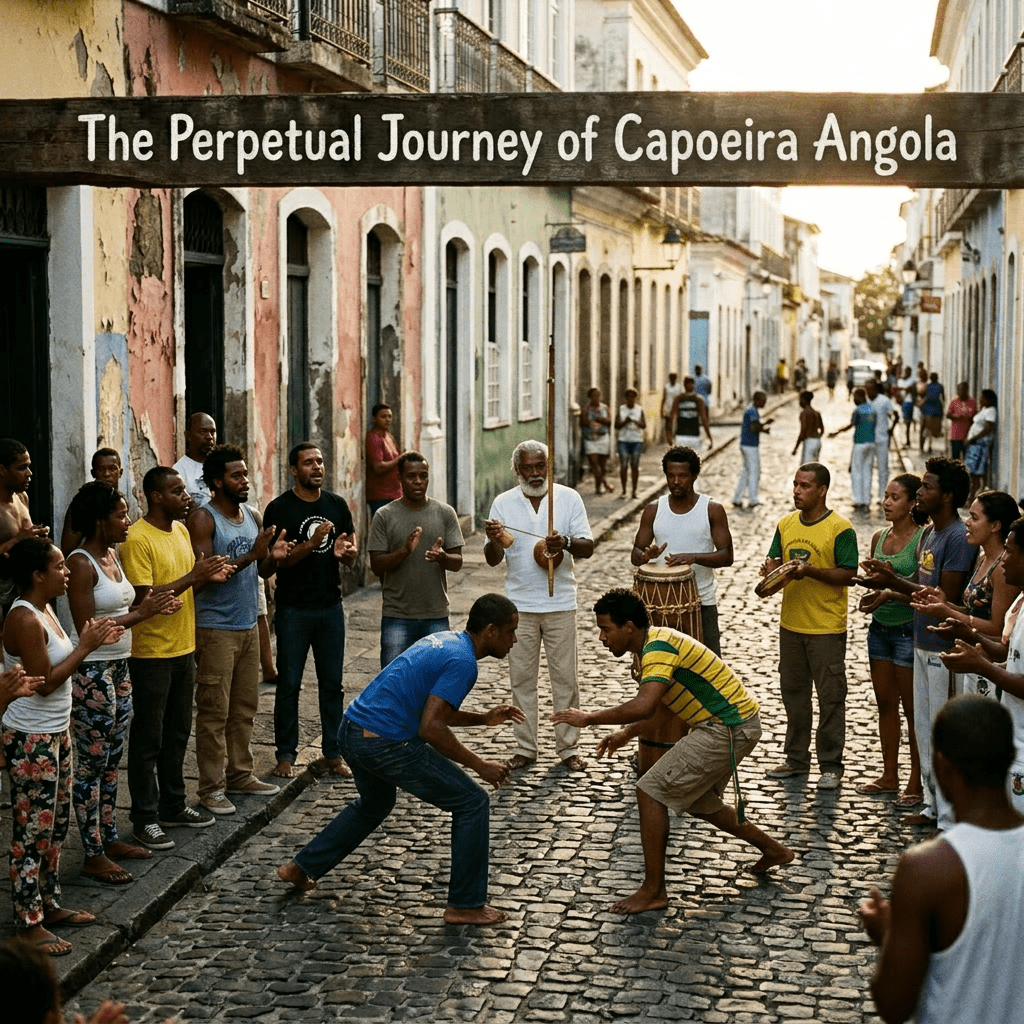
This post is dedicated to my friend and “fellow beginner” Angoleira Janelle, who inspired this post.

