
Note: I used concepts and terminology from FMA and esgrima de Machete y bordon, weapons arts I am Familiar with.
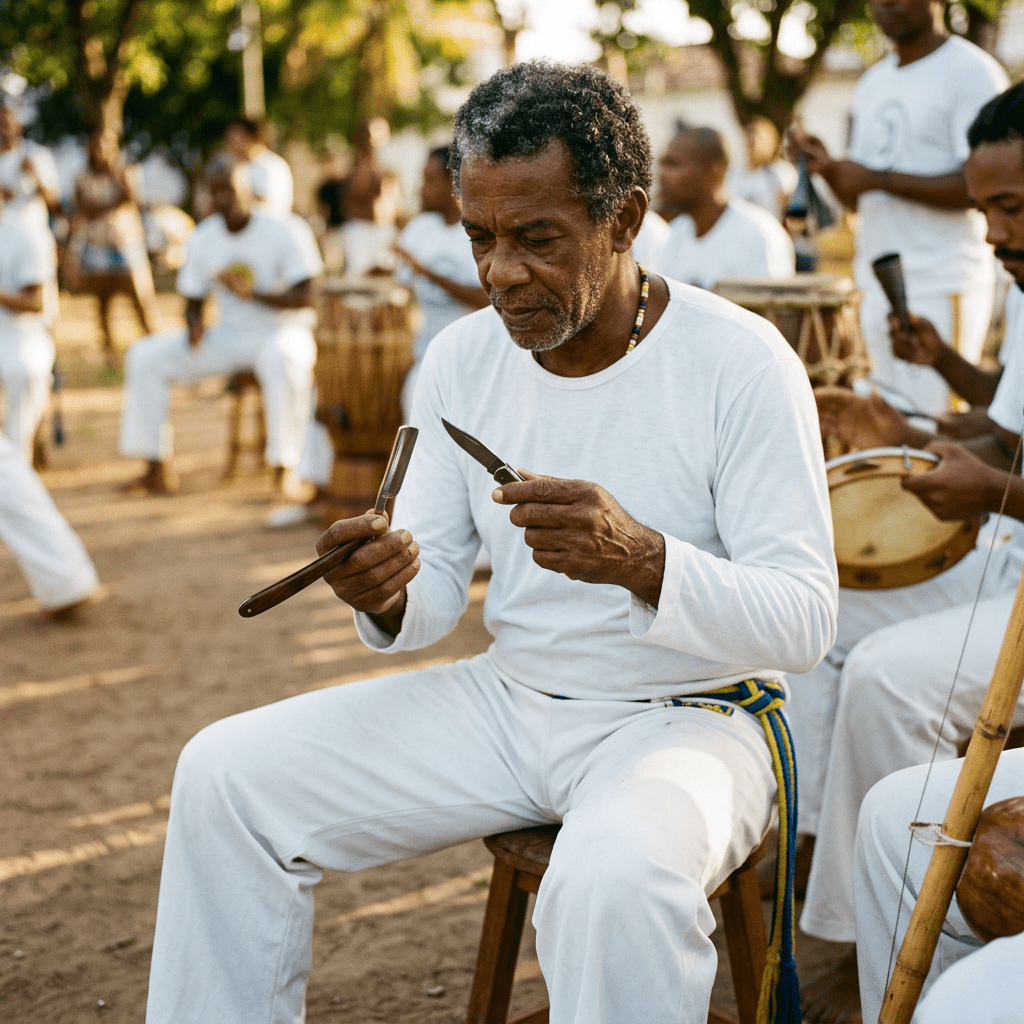
This guide outlines a foundational and advanced system for utilizing a bladed tool—be it a straight razor, a fixed or folding knife, or any everyday carry (EDC) implement—within the combat philosophy of the Angoleiro. It transcends mere technique, focusing on mindset, deception, and the continuous flow of conflict.
The “Four Quadrants”: A Foundational System for Weapon and Defense Mastery in Close-Quarters Combat
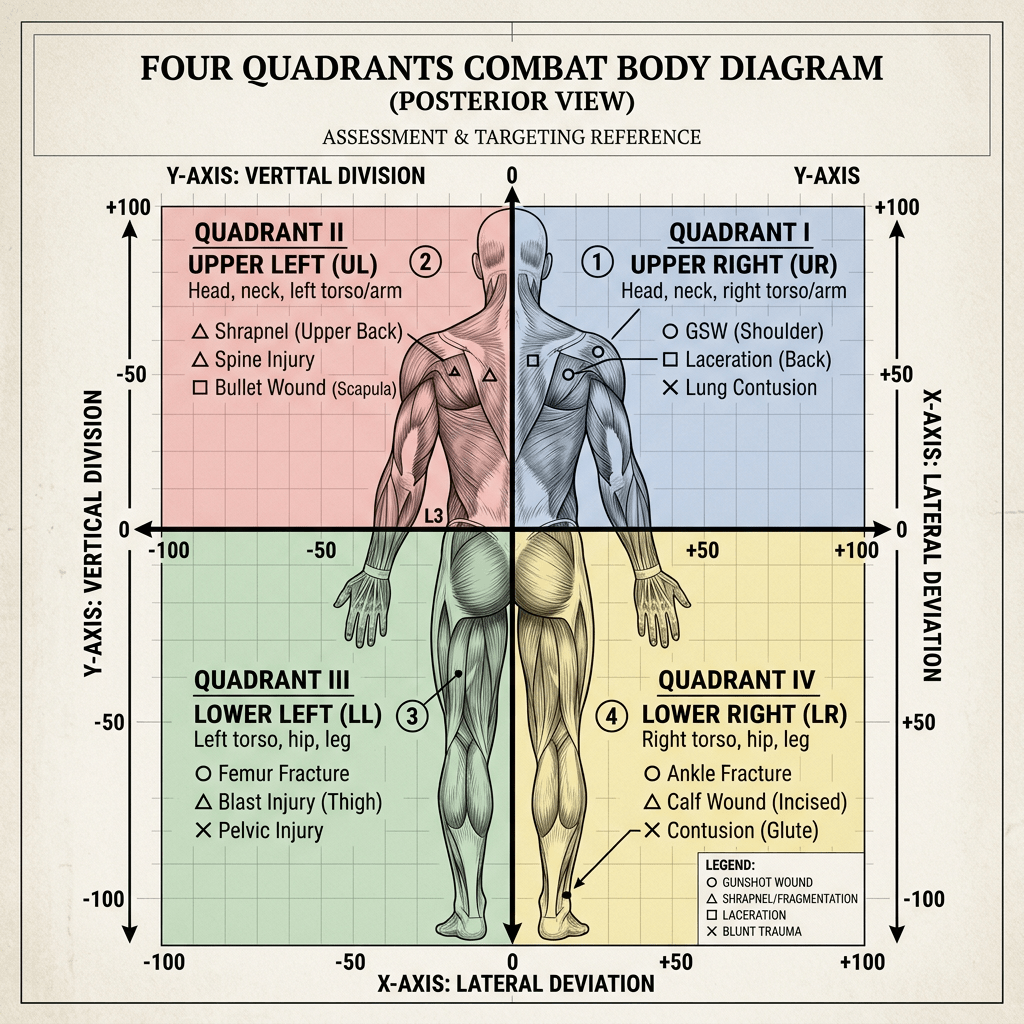
The concept of the “Four Quadrants” serves as the bedrock for understanding and controlling the intricate dance of close-quarters fighting space and, critically, the opponent’s body. By offering a universal, immediately comprehensible language for movement, defense, and offense, the Four Quadrants streamline the complex variables of a confrontation into a manageable, actionable framework.
Defining the Framework
The system functions by superimposing an invisible coordinate plane onto the opponent’s body, utilizing two primary axes to create four distinct zones:
- The Horizontal Axis (The Waistline): This line divides the opponent’s body into the Upper and Lower regions.
- Upper Quadrants (Head, Neck, Torso): These zones typically contain the most vital and immediate targets, requiring swift and decisive action. Control of the upper quadrants is essential for techniques aimed at disarmament, sight impairment, or incapacitation.
- Lower Quadrants (Hips, Legs): These zones primarily influence mobility, balance, and the opponent’s base. Targeting the lower quadrants can be an effective strategy for creating imbalance, opening up the upper body for a subsequent attack, or restricting movement for grappling or control.
2. The Vertical Axis (The Centerline): This line runs down the center of the opponent’s body, from the top of the head to the ground, dividing the space into Left and Right regions.
- Left Quadrants: The opponent’s non-dominant side, or the side furthest from the weapon.
- Right Quadrants: The opponent’s dominant or weapon-carrying side. Understanding this distinction allows the practitioner to anticipate attack angles and prioritize defensive positioning—often seeking to control or nullify the threat presented by the weapon-bearing side.
The Four Quadrants and Their Strategic Significance
The intersection of these two axes generates the four fundamental quadrants, each demanding a specific strategic approach:
| Quadrant | Location | Strategic Purpose |
| I (Upper Right) | Upper body, dominant/weapon side | Primary focus for aggressive action; neutralizing the weapon hand/arm, targeting head/neck. |
| II (Upper Left) | Upper body, non-dominant side | Secondary targeting area; often used for distraction, controlling the opponent’s secondary arm, or as an entry point when the weapon side is heavily guarded. |
| III (Lower Left) | Lower body, non-dominant side | Used to disrupt balance, limit mobility, and set up higher-level attacks. |
| IV (Lower Right) | Lower body, dominant/weapon side | Targeting the weapon-side leg/foot to compromise the opponent’s base and structure, making upper-body targets more accessible. |
Application in Combat Flow
The true power of the Four Quadrants lies in its dynamic application, dictating precise action in real-time:
Targeting and Entry Points: The system provides a clear map for offensive entry. For instance, a defensive block that leads to the clearing of Quadrant I immediately suggests a follow-up attack into the now-exposed area. Practitioners learn to move through the quadrants, not just at the opponent.
Defensive Maneuvers: Effective defense is about controlling space. By understanding which quadrant an attack originates from, the defender can execute precise movements (like a parry or an evasion) that simultaneously protect the threatened quadrant and create an opening in another (e.g., evading an attack in Quadrant I opens Quadrant III for a counter-disruption).
Seamless Transitions: The Four Quadrants facilitate the fluid transition between offense and defense, a hallmark of high-level Angoleiro mastery. When a technique fails in Quadrant I, the system immediately directs the practitioner to the most advantageous adjacent quadrant for the next move, maintaining relentless pressure and adapting to the opponent’s reaction. This constant flow—moving from upper to lower, or left to right—is what prevents the opponent from establishing their own rhythm.
In essence, the Four Quadrants transform the chaos of combat into a systematic equation. It is the core grammar for movement, ensuring that every foot placement, every cut, and every defensive gesture serves a clear, quantifiable purpose in the pursuit of mastery.
Understanding the Divisions:
- Horizontal Division (Upper/Lower): A line is mentally drawn across the opponent’s body, typically at the level of the solar plexus or waist.
- Upper Quadrants (Q1 & Q2): Encompass the head, neck, chest, shoulders, and arms. These areas are generally primary targets for disabling or fatal strikes, and their control is vital for managing the opponent’s striking range and vision.
- Lower Quadrants (Q3 & Q4): Include the abdomen, hips, groin, and legs. Targeting these areas can destabilize the opponent’s base (crucial in systems emphasizing footwork), create pain compliance, and open up opportunities for throws or takedowns.
- Vertical Division (Left/Right): A line is drawn down the center of the body, often following the spine or sternum.
- Left Quadrants (Q1 & Q3): The opponent’s left side (relative to their perspective).
- Right Quadrants (Q2 & Q4): The opponent’s right side (relative to their perspective).
The Four Quadrants in Application:
Q1 (Upper Left): Head and upper torso on the opponent’s left.
Q2 (Upper Right): Head and upper torso on the opponent’s right.
Q3 (Lower Left): Lower torso and legs on the opponent’s left.
Q4 (Lower Right): Lower torso and legs on the opponent’s right.
Practical Utilization and Mastery:
- Entry Points (The Attack): The Quadrants inform the angle of attack. An Angoleiro employing a straightrazor, for instance, might aim an entry strike specifically at the Q1 (neck/face) or Q2 (jugular/carotid) area. A low, sweeping defense might aim to control Q3 or Q4 (the opponent’s base) to create an imbalance. Mastering this involves training to transition fluidly from an entry in one Quadrant (e.g., a feint to Q4) to a true attack in another (e.g., a rapid strike to Q1).
- Defensive Maneuvers (The Defense): The system helps prioritize defense by defining the line of attack. If the opponent initiates a strike to Q2, the practitioner knows instantly where to position their defense (a block, parry, or body evasion). A core principle is to use defense in one Quadrant to open a counter-attack in an adjacent or opposite Quadrant, minimizing the time between deflection and retaliation.
- Transition Flows (The Flow): Advanced mastery involves using the Quadrants to create complex, non-linear sequences. A common flow is the diagonal transition: a defensive block against a Q1 attack creates an opening for a Q4 sweep or trip, or a Q3 block is immediately followed by a Q2 counter-thrust. This creates a continuous, circular motion that keeps the opponent off-balance and guessing, a hallmark of highly mobile fighting styles. The Quadrant system, therefore, is not merely a static map; it is a dynamic tool for visualizing and executing the necessary shifts in angle, distance, and intent required for superior weapon and defense mastery.
Target Areas on the Opponent
The selection of target areas during a confrontation is a critical component of effective straight razor utilization, primarily dictated by the need for swift and decisive incapacitation or control. These targets are not chosen arbitrarily but are instead the result of a calculated assessment of the opponent’s immediate vulnerability, the accessibility of the area under the duress of combat, and the specific psychological effect desired to break the opponent’s will to continue.
The overarching strategic focus is on regions where the straight razor can rapidly and fundamentally degrade the opponent’s capacity to maintain the fight. This involves a methodical prioritization of:
1. Major Blood Vessels (Hemorrhage for Immediate Incapacitation):
The most critical targets are superficial arteries and veins where a clean, deep cut can lead to rapid and significant blood loss, resulting in hypovolemic shock and immediate incapacitation.
- The Neck (Carotid and Jugular): This is the paramount target, offering the fastest route to either control or incapacitation due to the presence of the common carotid arteries and jugular veins. A strike here is inherently high-risk and high-reward.
- The Inner Thigh/Groin (Femoral Artery): A highly vulnerable and often overlooked target. A severe cut to the femoral artery is exceptionally dangerous and can lead to unconsciousness within seconds.
- The Axilla/Armpit (Axillary Artery): While protected by the arm, if exposed, a strike to the axillary region can sever the major blood supply to the arm and shoulder, leading to immediate loss of limb functionality and rapid blood loss.
2. Superficial Muscle Groups (Degrading Motor Function):
Targeting the large, superficial muscles can immediately compromise the opponent’s movement, power, and stance. The goal is to make basic combat movements painful or impossible.
- Forearms and Biceps: Strikes here can sever tendons and muscle fibers crucial for gripping and striking, effectively disarming the opponent or rendering their primary weapons (fists, hands) useless.
- Calves and Hamstrings: While difficult to reach, a deep cut to these areas severely limits mobility, forcing the opponent to lose their footing or be unable to pursue/retreat.
3. Joints and Connective Tissue (Immobility and Control):
Joints are targeted to disrupt the skeletal and muscular mechanics necessary for fighting, leading to instability, pain compliance, or complete immobility. The focus is on the flexor and extensor tendons.
- Wrists: Severing the major tendons here (flexor carpi ulnaris, etc.) results in the immediate inability to grip or form a fist, making the hand inert. This is a common defensive and control technique.
- Elbows and Knees: While the joint capsule itself is robust, the soft tissue surrounding the joints (ligaments and tendons) is vulnerable. A strike that compromises these can cause the joint to buckle or make movement excruciatingly painful.
4. Face and Head (Psychological and Sensory Disruption):
While not always guaranteeing rapid physical incapacitation, targeting the face and head carries immense psychological weight and can immediately impair sensory organs.
- Eyes: A strike near or across the eyes can cause temporary or permanent blindness, which is a massive psychological shock and immediately removes the opponent’s primary sense for fighting.
- Mouth and Nose: Cuts to the face are visually and emotionally devastating, often causing a break in the opponent’s resolve and a strong element of pain compliance.
In essence, the straight razor technique eschews reliance on blunt force trauma and instead focuses on precision, using the blade’s inherent efficiency to exploit the body’s most vulnerable points for the most rapid and comprehensive cessation of the hostile action.
The Five Cuts: The X Pattern and the Thrust
The foundation of offensive action with the straight razor is built upon five fundamental attacks, meticulously designed for maximum systemic impact with minimal commitment and exposure. These cuts prioritize anatomical weak points, leveraging the razor’s keen edge to create immediate and debilitating effect, thus concluding the engagement swiftly and decisively. They form the core of the Angoleiro’s close-quarters doctrine.
- Cut 1 (Diagonal Down-Left): The Corte de Fora (Outer Cut)
This is a sweeping, descending diagonal cut initiated from the user’s high-right to the target’s low-left. It is the most common opening attack, targeting the carotid artery, jugular vein, and primary sternocleidomastoid muscle on the far (outside) side of the opponent’s neck. Its trajectory utilizes gravity and the length of the arm for power, making it both fast and deep. It often capitalizes on the opponent’s forward momentum or slight turn away from the dominant arm. - Cut 2 (Diagonal Up-Right): The Corte de Dentro Baixo (Low Inner Cut)
An aggressive ascending diagonal, this cut moves from the user’s low-left to the target’s high-right. It is primarily a follow-up or counter-attack, aimed at the radial artery, biceps tendon, or the inner thigh/femoral artery if the opponent is bent or at a lower plane. When targeting the neck, it attacks the inner, closer side, often delivered in a swift underhand motion immediately following a parry or evasion, catching the opponent’s guard high. - Cut 3 (Diagonal Up-Left): The Corte de Dentro Alto (High Inner Cut)
Mirroring the descending Cut 1, this is an ascending strike from the user’s low-right to the target’s high-left. It is typically a defensive counter that becomes an immediate offense, aimed at the radial artery or the brachialis muscle on the near arm, or, more acutely, the lower mandible and ascending jawline. It is a deceptively powerful cut, often used to bypass a low block and score a disabling wound to the hand or forearm. - Cut 4 (Diagonal Down-Right): The Corte de Cima (Overhead Cut)
This is the descending diagonal that completes the “X” pattern, moving from the user’s high-left to the target’s low-right. Unlike the Corte de Fora, this cut is often delivered as a definitive, fight-ending blow, frequently targeting the opponent’s face, clavicle, or the back of the neck in an aggressive closing maneuver. Its overhead nature makes it difficult to defend against without retreating, compelling a severe reaction from the opponent. The combined four cuts form a devastating X pattern—two descending and two ascending diagonals—that anatomically dismantle the opponent’s defenses and circulatory system. - Cut 5 (The Thrust): The Estocada (Thrust/Stab)
The fifth, and perhaps most critical, attack is the linear thrust. The Estocada eschews a sweeping motion in favor of a direct, piston-like drive straight into the target. While the edge cuts are designed for arterial and muscular trauma, the thrust is a depth weapon, prioritizing penetration of the chest cavity, abdomen, or orbital sockets. It is used when space is too confined for a full cut or when immediate incapacitation of a vital organ is paramount. Mastery of the Estocada requires absolute precision and unwavering commitment, as a miss leaves the user dangerously exposed. It is the ultimate tool for achieving rapid, systemic shutdown.
The Cross Pattern: Bedrock of Universal Combat Flow
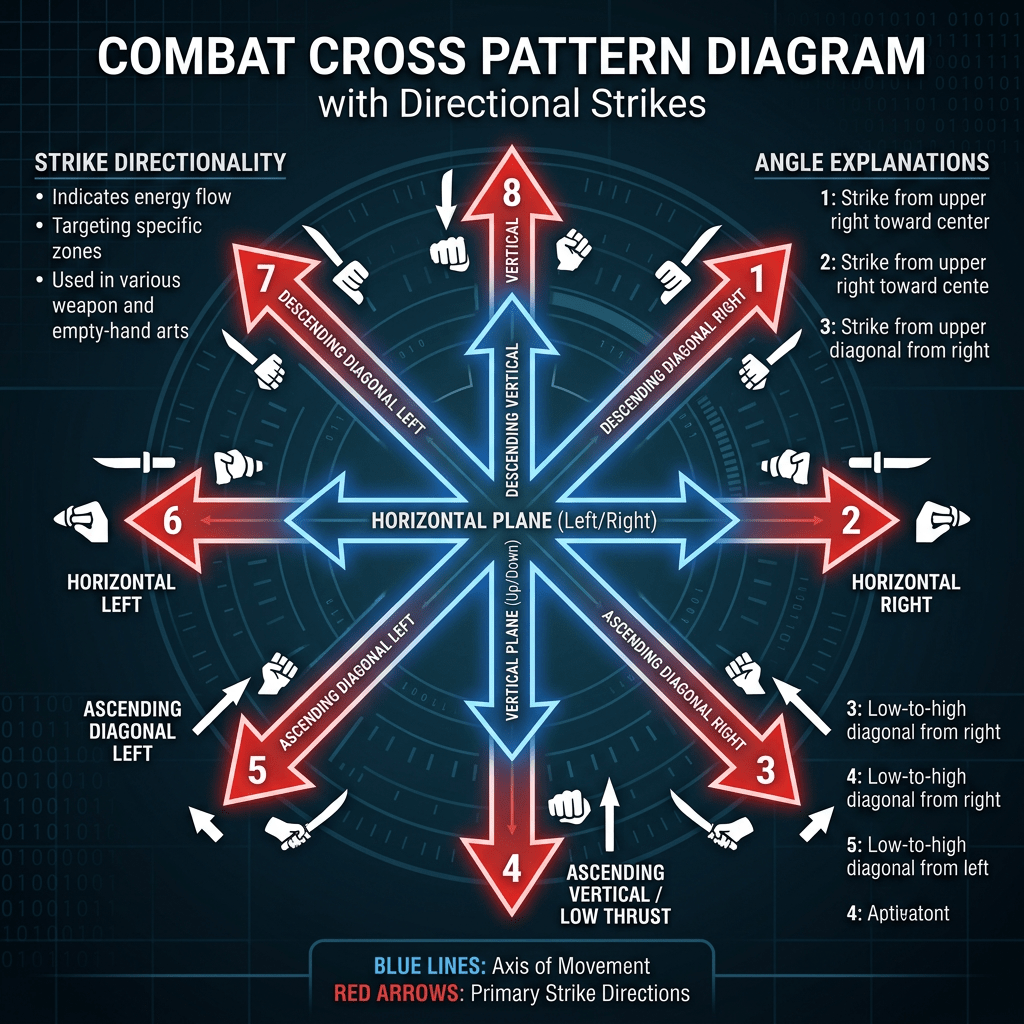
The Cross Pattern is not simply a technique but a foundational, universally applicable striking and defensive sequence that underpins effective and versatile engagement across a multitude of fighting disciplines. Whether the practitioner is armed with an edged or bludgeoning weapon—such as a machete, a large knife, or a fighting stick—or is engaged in dynamic empty-hand combat, mastery of this sequence is paramount. It serves as the bedrock for comprehensive offensive and defensive capability, as it rigorously trains the practitioner to command and defend across both the fundamental vertical and horizontal planes of attack. This dual-plane coverage ensures comprehensive defensive coverage, minimizing critical vulnerabilities and maximizing offensive options.
This essential four-point sequence transcends a mere static drill; it is a dynamic, living principle of combat flow, designed for seamless transitions between attack and defense.
The Four Pillars of the Cross Pattern
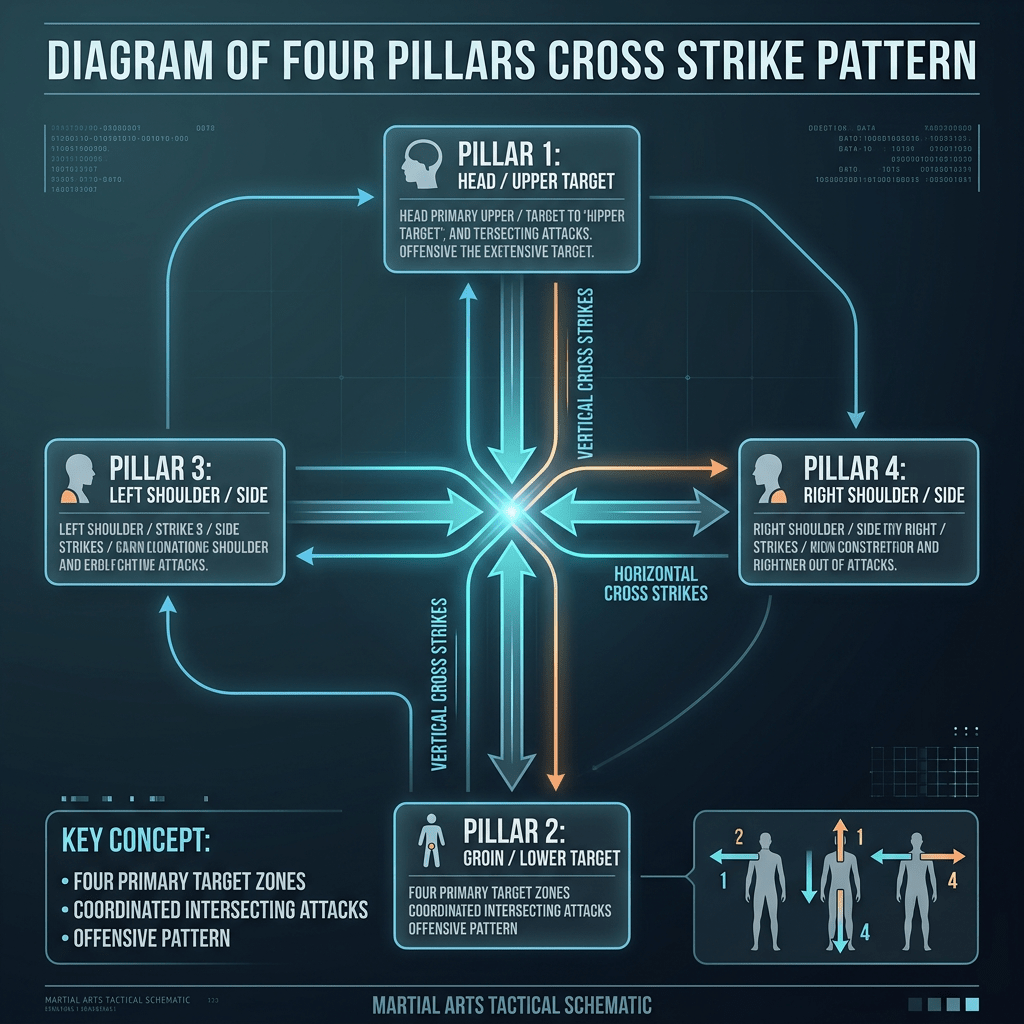
- Vertical Strike: Top to Bottom (The Cleaving Force)
- Description: This is the most direct and often the most powerful line of attack, delivered from a high point (e.g., above the shoulder or head) straight down toward a target (e.g., the head, collarbone, or torso).
- Principle: It embodies the “Cleaving Force,” relying on gravity and body weight to generate overwhelming momentum. Its primary function is to penetrate, split, or disable an opponent’s central line of defense.
- Application: Excellent for decisive, power-focused openings and for breaking through guard.
- Horizontal Strike: Left to Right (The Intercepting Sweep)
- Description: A forceful, sweeping motion traveling across the body on the horizontal plane, moving from the practitioner’s left toward their right.
- Principle: Known as the “Intercepting Sweep,” this strike is highly versatile for targeting the exposed sides of an opponent (e.g., ribs, neck, or limbs) or for parrying and clearing an incoming vertical attack out of the way. It is characterized by its wide arc and momentum-driven speed.
- Application: Crucial for lateral movement, cutting off peripheral attacks, and disrupting an opponent’s balance and stance.
- Side Strike: Horizontal Right to Left (The Counter-Balancing Reversal)
- Description: The mirrored counterpart to the previous strike, this motion travels horizontally from the practitioner’s right across their body to the left.
- Principle: This represents the “Counter-Balancing Reversal.” It is often deployed immediately following a block or deflection of the left-to-right attack, utilizing the recoiling energy for a swift counter-blow. It solidifies the defense of the opposite flank and ensures the practitioner is capable of attacking from both sides of the horizontal line.
- Application: Essential for maintaining a balanced offensive stance and for follow-up strikes that capitalize on the opponent’s disrupted state.
- Vertical Strike: Bottom to Top (The Ascending Surprise)
- Description: A powerful upward thrust or slice delivered from a low guard or starting position (e.g., hip or waist level) toward a high target (e.g., chin, chest, or underarm).
- Principle: This is the “Ascending Surprise.” It exploits the fact that most fighters primarily defend against downward and lateral attacks. Its low origin and high trajectory make it an effective strike for targeting vulnerable under-guarded areas and for lifting or disrupting the opponent’s core stability.
- Application: Used for finishing strikes, capitalizing on a momentary dip in the opponent’s stance, or for entering into close-quarters combat.
The Holistic Value of the Cross Pattern
The true genius of the Cross Pattern, in the context of combat and the Angoleiro’s discipline, lies not merely in its individual components, but in its integration and seamless application. It transcends a simple series of movements; it is a foundational combat philosophy distilled into four essential strikes.
The Foundation of Seamless Offense and Defense
When practiced fluidly, these four strikes—the vertical, horizontal, ascending, and descending movements—connect seamlessly, creating an overwhelming and unpredictable offensive and defensive matrix. This fluidity is what transforms the pattern from a drill into a true weapon. The practitioner is not locked into linear or predictable thought patterns. Instead, they can respond instantaneously to the dynamic and chaotic nature of any threat, shifting from a powerful vertical defense to a devastating horizontal offense without any perceptible hesitation or preparatory movement
Achieving Muscle Memory and Complete Coverage
Mastery of the Cross Pattern instills a fundamental, life-saving muscle memory. This memory covers the entire “wheel” of attack and defense—the 360-degree sphere of engagement, both high and low, left and right. This comprehensive coverage ensures that the Angoleiro (or any combatant) is never caught in a blind spot. It guarantees the ability to apply the fundamental principles of combat—distance, angle, timing, and power—with maximum efficiency. By internalizing this pattern, the practitioner can execute powerful, decisive movements that account for all primary vectors of incoming and outgoing force, ensuring complete and reliable coverage across the entire zone of engagement.
DEFENSE: The Seamless Integration of Evasion and Counterattack
The core philosophy of defense for the Angoleiro is not merely survival, but the immediate and seamless integration of evasion with a decisive counterattack. Defense, in this context, is not a reactive shield but a sophisticated form of offensive movement. It is the art of absorbing the opponent’s kinetic energy and instantly redirecting it back with superior leverage and timing. Evasion is never a pause in the fight; it is the calculated act of repositioning—a dynamic saída (exit) that establishes a superior counter-vector and creates a momentary imbalance in the opponent’s structure, which is immediately exploited.
The Foundation of Defense: The Rhythmic Imperative of the Ginga
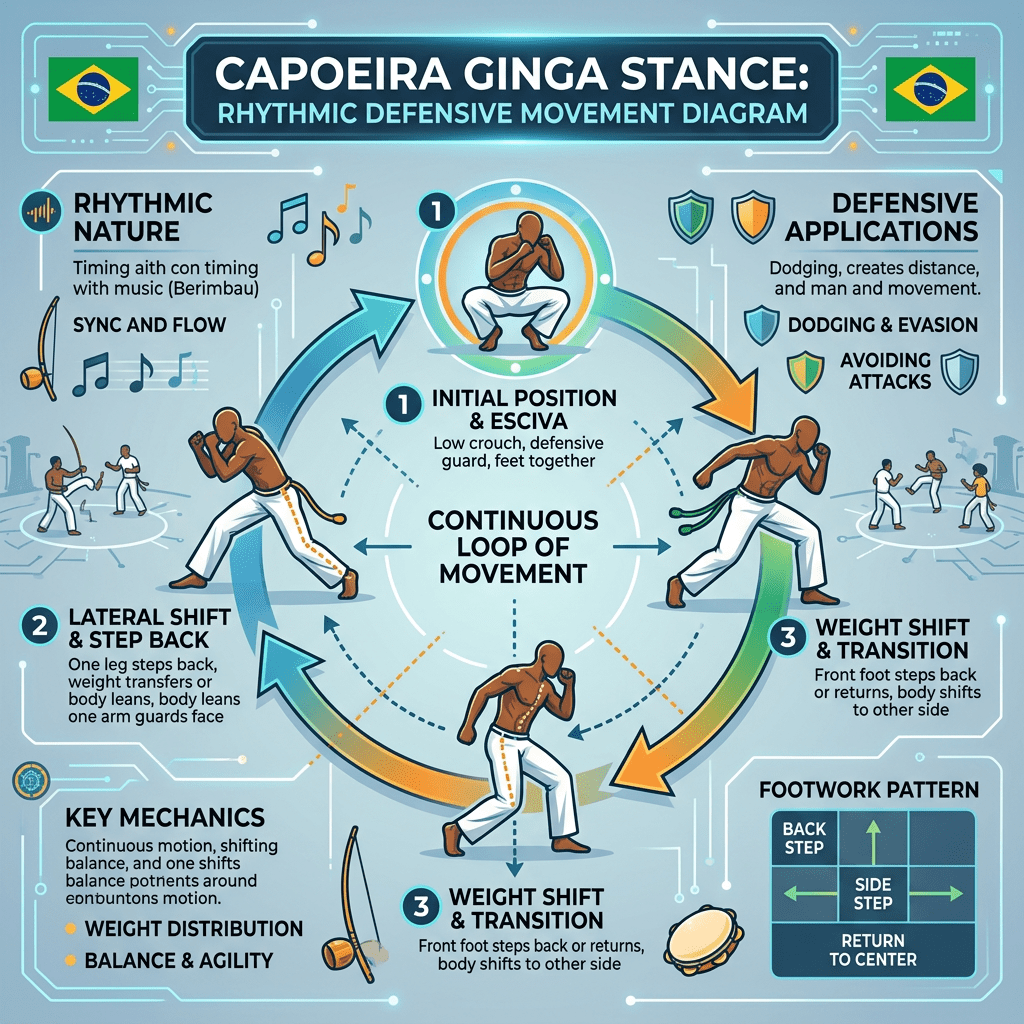
The Angoleiro’s defense is not a passive act of resistance but a proactive, kinetic language rooted in the fundamental movement of the art: the ginga. This rhythmic, continuous, and triangular footwork is more than a mere ready-stance; it is the Angoleiro’s perpetual state of kinetic readiness, misdirection, and strategic displacement. The ginga ensures that the practitioner is never caught flat-footed or static, preventing the attacker from establishing a stable line of attack. Defense, in this context, manifests not as a rigid block against incoming force, but as a sudden, fluid shift in geometry that repositions the Angoleiro to a point of advantage, dissolving the attacker’s trajectory rather than meeting it head-on.
Defense as Pre-Emptive Attack: Leveraging Momentum
Every defensive movement in Capoeira Angola is intrinsically linked to the potential for a counter-offensive. The low queda (fall), which allows the Angoleiro to evade a high kick or punch by dropping swiftly to the ground, is simultaneously a setup for a sweeping kick (rasteira) or a powerful rise. Similarly, the high cabeçada (head-butt), often employed as a counter against a charging opponent or to disrupt the attacker’s balance, is not just a block but a strike in its own right. This principle ensures that the attacker’s momentum is never wasted; it is instead leveraged and redirected against them, transforming their aggression into the fuel for the Angoleiro’s response. The defense, therefore, is pre-loaded—every evasion is a nascent strike, every retreat a strategic repositioning for a decisive return.
Integration and Flow: The Continuous Art of the Angoleiro
The philosophy of an Angoleiro, particularly one who embraces the discipline of utilizing a straight razor, centers on a profound understanding of integration and flow. This is not merely a description of the physical movements—though fluidity is key—but a state of continuous, mindful presence that permeates every action, from the preparation of the tool to the final, smooth result.
For the Angoleiro, the straight razor is an extension of the self, demanding a symbiotic relationship built on respect, precision, and unceasing attention. The process begins long before the first stroke:
- Integration of Self and Tool: The selection, stropping, and honing of the razor are meditative practices. The Angoleiro must feel the edge, understanding its temper and keenness. This initial interaction establishes a psychic link, ensuring that the razor moves with the user’s will, not against it. A dull blade is a betrayal of the self; a sharp, well-maintained tool is a testament to discipline.
- Flow in Preparation: The application of lather, the stretching of the skin, the positioning of the body—all must occur in a seamless, unbroken rhythm. Hesitation breaks the flow, leading to nicks and irritation. The hands move with practiced economy, minimizing wasted motion and maximizing effect. This phase integrates anatomical knowledge with kinetic grace.
- The Continuous Stroke: The act of shaving itself is a demonstration of continuous flow. The razor is guided by the whole arm, not just the wrist, ensuring long, steady passes. The angle is constant, the pressure light and even. There is no stopping or starting mid-stroke; the movement is like a river, finding the path of least resistance across the contours of the face. This unbroken action is the essence of Angoleiro technique—an unhurried, purposeful progression.
- Integration with the Environment: An Angoleiro is aware of the light, the temperature, and the subtle cues of the person they are serving or their own skin’s response. These external factors are not distractions but variables to be integrated into the technique, adjusting the speed and direction of the flow as necessary. The environment becomes a silent partner in the art.
- The Flow of Learning: True mastery in this continuous art is accepting that the learning process never ends. Each shave is a study in texture, grain, and sensitivity. The Angoleiro remains adaptable, flowing around unexpected challenges like scar tissue or a shift in the client’s posture. This open-ended approach is what transforms a simple chore into a genuine, living art form—a continuous cycle of action, observation, and refinement.
Ultimately, the goal of Integration and Flow is to achieve a state where the action becomes thoughtless—not careless, but executed with such complete absorption that the conscious mind steps aside, allowing pure, learned instinct to guide the hand. It is the continuous art of being present, deliberate, and exquisitely smooth.
Mastery of Continuous Flow: Beyond Technique and Fragmentation
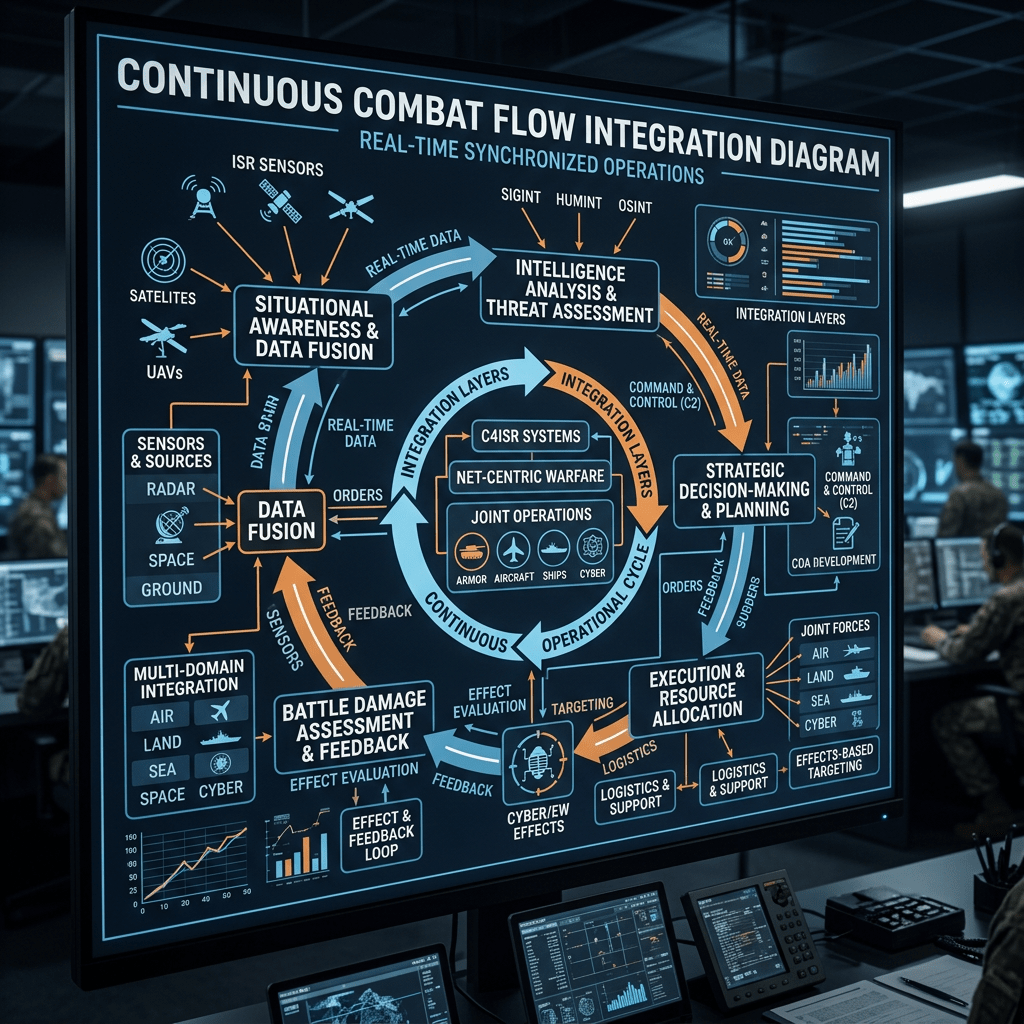
The Angoleiro’s philosophy of engagement fundamentally rejects the concept of discrete, isolated techniques. The mind trained in a fragmented model (a rigid thought process of “block-then-attack-then-move”) cannot grasp the true spirit and efficacy of Capoeira Angola. This segmented approach introduces momentary pauses and breaks in energy that the opponent can exploit. Instead, the highest state of conflict—the jogo (game)—is viewed as a single, uninterrupted stream of kinetic energy and intent. The Angoleiro seeks to move beyond the technical catalog of movements and into a state of pure, continuous flow. The fight is not comprehended as a series of stops and starts, but as a continuous, flowing narrative—a non-verbal dialogue where one’s movement is the response to, and the provocation of, the other’s. Mastery is achieved when the distinction between attack and defense dissolves, and the Angoleiro becomes a conduit for the flow, acting spontaneously and without conscious deliberation.
Mastery is achieved when the transition between defense, offense, and movement becomes invisible—a single, continuous flow dictated entirely by the opponent’s input. The mind, body, and spirit operate as a unified system, where the defensive esquiva (escape) naturally culminates in an offensive rabo de arraia (stingray tail kick) or rasteira (sweep), without any cognitive delay or interruption in the body’s kinetic chain. This is the state of malícia—the cunning, deceptive intellect that understands the rhythm of the opponent and moves with the attack, not just against it, turning every moment of danger into an opportunity for domination. The ultimate goal is not to win by force, but to control the flow and dictate the terms of the jogo (game) with unceasing, fluid motion.
The Kinetic Language of Conflict: The Principle of Continuous Vectoring
Every movement initiated by an opponent, whether offensive or defensive, instantly establishes a vector—a quantifiable line of force with a distinct magnitude and direction. The core superiority of the Angoleiro—a practitioner embodying the principle of Continuous Vectoring—is not found in brute opposition, but in the instantaneous and subtle reading of this kinetic signature.
Instead of meeting force with equal and opposite force, which is inherently energy-inefficient, the Angoleiro utilizes a highly refined sensitivity to the opponent’s momentum. This reading allows the practitioner to avoid, absorb, or, most critically, redirect the incoming vector with minimal effort. By strategically positioning the body and blade to intersect the opponent’s vector at an oblique angle, the Angoleiro creates a superior counter-vector that amplifies the opponent’s own energy into a devastating attack opportunity. This approach transforms combat into a practical application of Newtonian physics and geometry—a philosophy of maximizing kinetic leverage while minimizing wasted energy in opposition. The flow of conflict is never stopped; it is simply hijacked and channeled towards the Angoleiro’s objective.
The Art of the Feint and Transition: Applying Malícia
In the Angoleiro’s discipline, the feint transcends the mere definition of a trick or a false attack. It is a fundamental, integrated component of the kinetic language—a sophisticated and precise transitional movement. Its primary purpose is not to land a blow, but to function as a pressure-testing tool designed to elicit a specific, predictable kinetic and psychological response from the opponent.
The feint is a calculated lie told with the body and the razor, initiating a chain reaction that forces the opponent to commit their weight, attention, or weapon to defending an irrelevant space. This forced commitment inevitably creates a momentary void or opening elsewhere, setting the stage for the true, lethal attack.
This process is governed by the application of Malícia—an untranslatable quality encompassing deceptive cunning, predatory mindset, and profound situational awareness. Malícia elevates the feint from a simple diversion into a systemic pressure tool. It is the intelligence behind the movement, ensuring that every shift, every glance, and every false attack is orchestrated to manipulate the opponent’s emotional state—generating doubt, overconfidence, or fear—and funneling their defensive energy into a predetermined trap. The transition from the feint to the true strike must be seamless, utilizing the opponent’s reaction as the final, necessary component for the Angoleiro’s success.
The Mark of the True Angoleiro: Malícia as Systemic Pressure
Malícia is the psychological weapon. It is the art of controlling the opponent’s decision-making process. The Angoleiro uses a combination of unexpected angles, deceptive timing, and visible feints to overload the opponent’s cognitive ability, forcing them into predictable, defensive reactions that create systemic pressure and the opportunity for a decisive strike.
The Transactional Model: The Technician’s Flaw
Many martial arts rely on a transactional model: they wait for an attack, block it, and then execute a predetermined counter. This approach is slow, reactive, and fails under pressure. It is the flaw of the technician who prioritizes form over function.
The Systemic Flow: The Angoleiro’s Superiority
The Angoleiro operates within a systemic flow. They initiate pressure, dictate the rhythm, and treat the opponent’s reaction as merely part of their own attack sequence. The systemic flow is continuous, adaptive, and designed to manage the entire conflict space, not just a single exchange.
Core Tenets of Armed and Unarmed Conflict: The Angoleiro’s Mindset of Survival
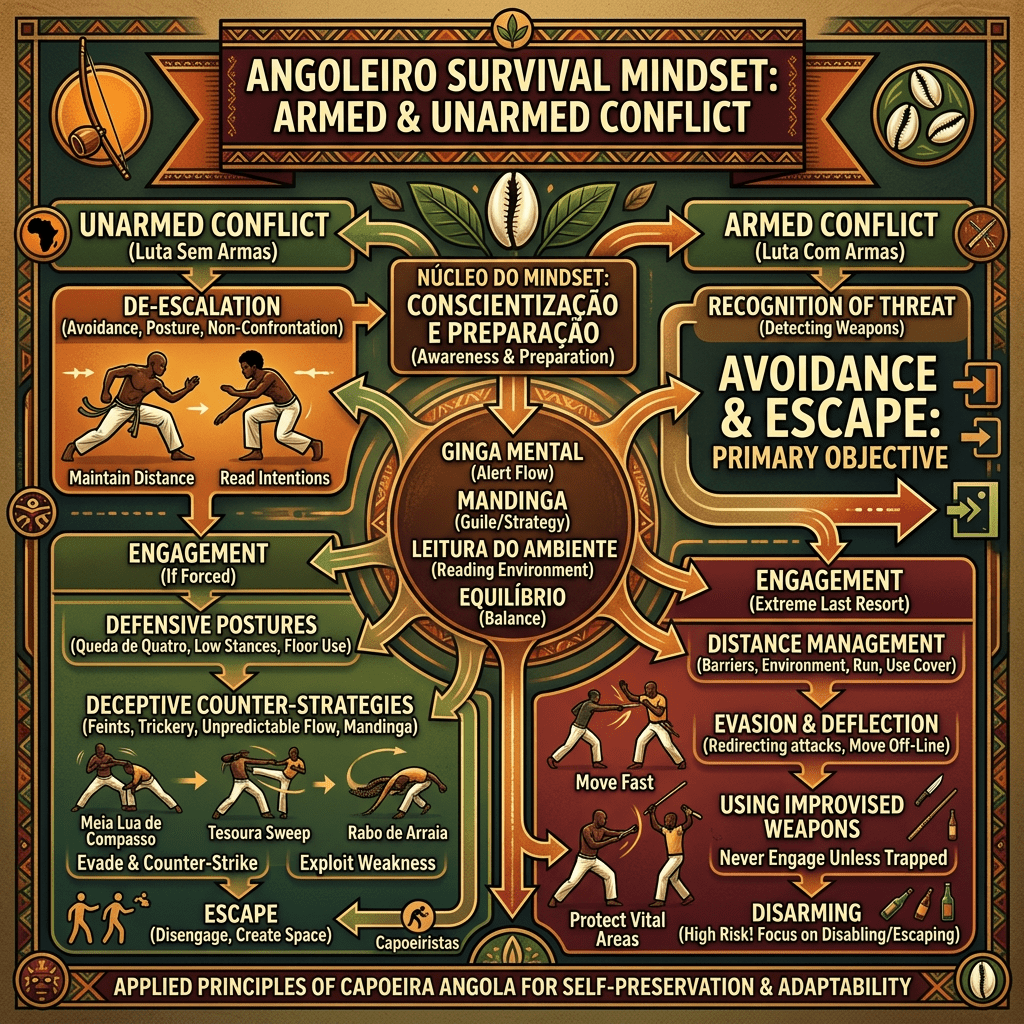
The philosophy of the Angoleiro—a practitioner of the lethal, old-school elements of Capoeira Angola—is forged in the crucible of brutal realism and total, unwavering commitment. The mind is the ultimate weapon, and its conditioning for survival is the first step toward victory. This mindset eschews sport, rules, and fair play in favor of raw, decisive action designed to end the threat instantly.
1. The Principle of Universal Threat: Assume They’re Carrying a Weapon
Never enter a conflict assuming it is unarmed. In a life-or-death scenario, the gravest mistake is underestimating the opponent’s capacity for violence. This immediate assumption is not paranoia; it is a critical survival mechanism. It must instantly govern every decision:
- Distance: Maintain maximum safe distance (the guingada range) until you have a clear plan to bridge the gap and strike. An unarmed distance is a fatal distance against a concealed blade or firearm.
- Approach: Never commit to a straight-line attack. Utilize angular movements, head fakes, and feints to disguise your true intention while actively looking for the glint of metal or the tell-tale bulge of a concealed weapon.
- Target Priority: The goal shifts from ‘disabling’ to ‘incapacitating’ with extreme prejudice. Targets must be selected for immediate, catastrophic failure of the opponent’s motor and sensory functions.
2. The Doctrine of Stealth: Your Knife is Meant to Be Felt, Not Seen
The weapon is a secret, a deadly surprise held in reserve until the moment of application. The Angoleiro does not display the blade as a threat or a negotiating tool.
- Stealth and Surprise: These are the paramount force multipliers. The opponent must be completely focused on your non-threatening posture, your feints, or your Malícia-driven deception.
- Decisive Presentation: The unveiling of the blade must be synchronized precisely with the first decisive strike. The opponent’s first realization that you are armed should be concurrent with the pain and effect of the wound. To telegraph the weapon’s presence is to give the enemy a target, an emotional advantage, and time to react.
3. The Art of Deception: Use Malícia to Close the Distance
The most dangerous part of any conflict is bridging the gap between safety and striking range. This must be accomplished through profound deception, known as Malícia—the cunning, fox-like trickery inherent to the Angoleiro.
- Employ Feints and Fakes: Use non-committal hand movements, false step commitments, and exaggerated body language to draw an irrelevant reaction from the opponent, momentarily confusing them about your true vector.
- Relaxed Posture: Adopt a seemingly non-aggressive, loose, and perhaps even confused stance. The opponent must misread your intent, viewing you as an easier, less prepared target.
- Superior Positioning: The goal is to safely bridge the gap and, simultaneously, gain a superior positional advantage, such as moving to the opponent’s outside line (linha de fora) or forcing them to look away before the attack commences. The opponent must be psychologically and physically disoriented until you are already within fatal striking range.
4. Rejection of Sport: Do Not Play the MMA Game in a Life or Death Situation
Sport fighting techniques are a luxury afforded by safety rules, referees, and padded environments. These are fatal liabilities in a true survival scenario.
- Ground Fighting: The ground is a death trap, especially when weapons are involved, and particularly if there is more than one opponent. It eliminates mobility, vastly increases vulnerability, and locks you into a prolonged struggle. Avoid the ground at all costs.
- Prolonged Grappling: Entangling oneself in a static, prolonged clinch or grappling exchange is a waste of time and energy. It allows the opponent to stabilize, access their own weapon, or be supported by allies.
- Goal: Rapid Incapacitation and Escape: The objective is not to win by points or submission. It is to inflict rapid, catastrophic injury that allows for immediate disengagement and successful escape from the threat zone. Techniques must be simple, high-percentage, and devastating.
5. Suspension of Morality: When Weapons are Involved, Fight Dirty
The moment a weapon is presented, the veneer of civilized conflict is irrevocably stripped away. The rules of engagement are suspended, and only one rule remains: survival.
- Target Selection: Target the zones of immediate incapacitation: the eyes, the throat, the groin, the knees, and the soft tissue of the arteries. These targets are often unprotected in sport-derived stances.
- Utilize Every Tool: The human body is a weapon system: use teeth, headbutts, stomps, elbows, and knees. Do not hesitate to use environmental factors—sand, chairs, bottles—as force multipliers.
- Unconventional Angles: Strike from angles and positions that are disallowed or irrelevant in sport (e.g., attacks from a bent-over position or while seemingly retreating).
6. The Principle of Total Commitment: Do Not Fight Unless You Have To. But When You’re In, GO HARD.
Conflict is a last resort. It is a sign that all other means of de-escalation, evasion, and negotiation have failed. Once the decision to fight is made, there is no ethical or practical room for hesitation or holding back.
- No Hesitation: The mental barrier between decision and action must vanish. Any moment of doubt allows the opponent to seize the initiative.
- Overwhelming Response: The response must be immediate, aggressive, and psychologically shattering. The goal is to overwhelm the opponent’s ability to process the attack, turning their offensive intent into a purely defensive, reactive state.
- Conclusive Action: The fight is not over until the threat is conclusively neutralized and you have successfully escaped the zone of danger. The Angoleiro fights to finish, not to spar.

 Jogo Corpo Fechado