
Note: Though this article was written with capoeira in mind, I also used terms and concepts from Esgrima de Machete y Bordon, and FMA, which I am also familiar with.
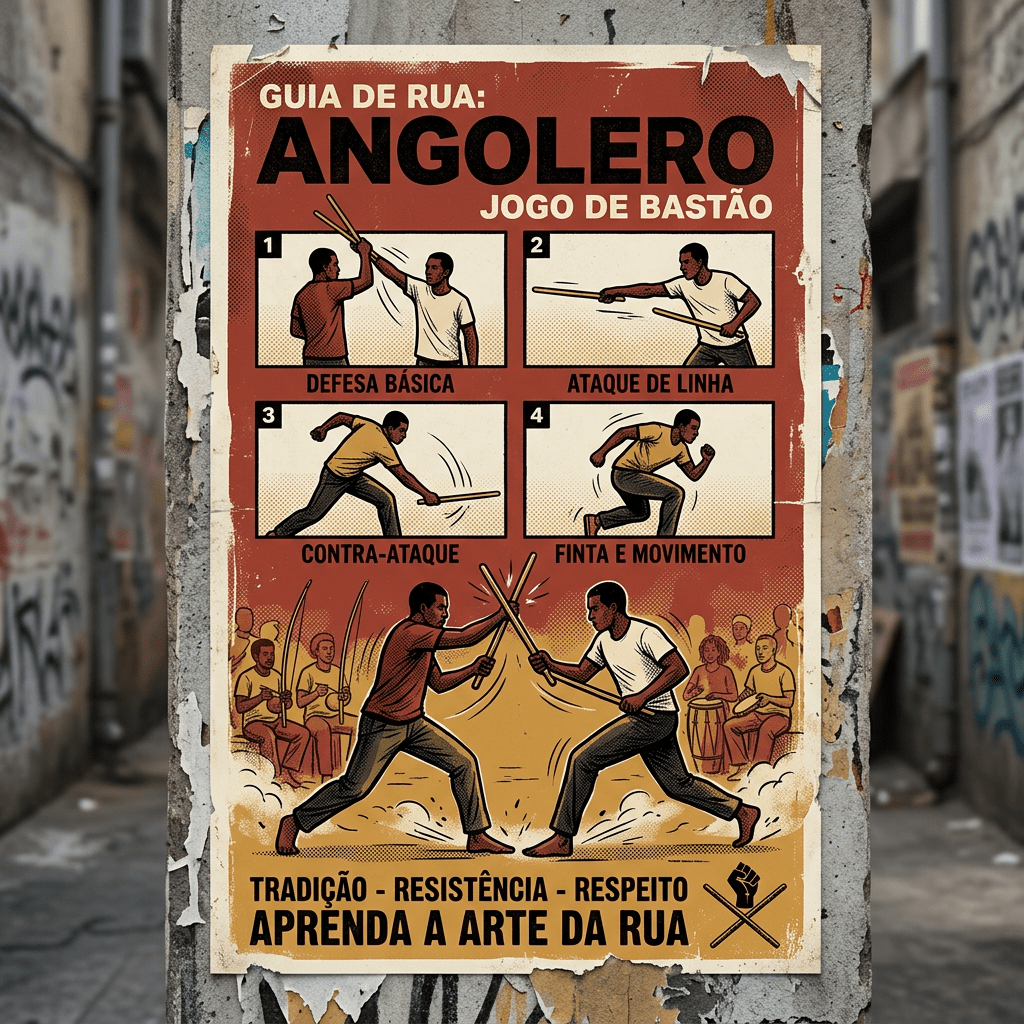
Introduction: The Stick as an Immediate Defensive Multi-Tool
In the volatile landscape of a street confrontation, the Angoleiro—a practitioner embodying adaptability, fluid movement, and pragmatic martial application—sees the profound defensive potential in an improvised or discreet stick-like object. This guide significantly expands upon the core principles for transforming an everyday item—from the highly concealable palm stick (or yawara) to the robust baston or a common walking stick—into a critical extension of one’s defensive and offensive structure. The stick transcends the role of a simple weapon; it is a versatile instrument for maintaining essential distance, executing decisive blocks, facilitating pain compliance, and delivering structurally debilitating strikes. Its efficacy lies not just in raw power, but in the surprise, precision, and efficiency of its application, ensuring the user’s survival and swift disengagement.
I. In-Depth Analysis of Stick Types and Tactical Utility
A street engagement demands immediate adaptability. The Angoleiro’s wisdom states that the best weapon is the one immediately accessible. While application technique is paramount, understanding the unique geometry and dimensions of each stick type optimizes its tactical deployment.
| Stick Type | Approximate Dimensions | Primary Utility in Conflict | Key Techniques & Applications |
| Palm Stick (Dulo-dulo/Yawara) | 4–7 inches (fits entirely in the hand) | Force Multiplier & Compliance. Designed to concentrate force into a small area, maximizing pressure on nerves and bone. Discreet, excellent for concealed carry. | Ideal for pressure point manipulation and leveraging joint locks in a clinch (Corto range). Use the exposed tips to strike the mastoid process, knuckles, or ribs for quick submission/release. |
| Short Stick (Tambo/Baton) | 12–20 inches | Intermediate Control & Snapping Strikes. Offers a balance of reach and maneuverability in constrained environments (e.g., car, doorway). Strikes are quick and percussive. | Effective for “Defanging the Snake” at a slightly extended range. Used for rapid, whip-like strikes to the hands, forearms, and elbow joints. Excellent for trapping an opponent’s limbs or weapon and creating an opening. |
| Escrima Stick (Baston/Rattan) | 24–30 inches | Range Dominance & Power Striking. The classic martial length, providing maximum leverage for powerful, cyclical strikes and parrying incoming attacks. | Employs the Figure-Eight Flow (Abaniko, Banda y Banda) to overwhelm defenses. Effective in the Largo range for powerful witiks (snapping strikes), thrusting motions, and for maintaining a safe zone against multiple attackers or weapon threats. |
| Walking Stick (Cane/Crook) | Customized (up to hip height) | Innocuous Tool & Hooking/Trapping. The ultimate “gray man” implement. Its weight adds impact, and the crook offers unique control dynamics not available with straight sticks. | The Follow-Up Hook: The crook is used for securing the neck, sweeping legs, hooking behind an arm for control/throw, or pulling a grounded opponent closer. The shaft is used like an Escrima Stick for striking and blocking. |
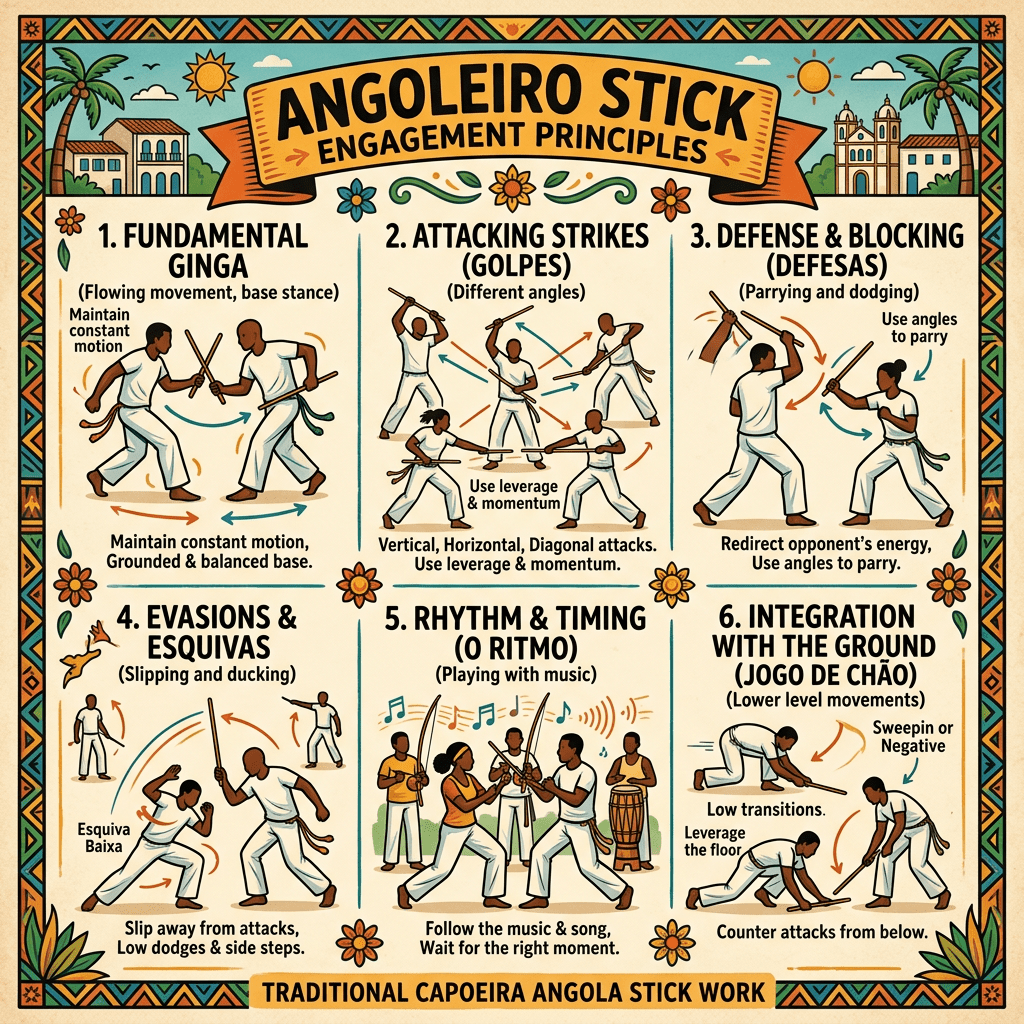
II. The Angoleiro’s Core Principles of Stick Engagement
The Angoleiro’s methodology is not merely a collection of techniques, but a cohesive philosophy rooted in structural integrity, psychological dominance, and efficient movement—ensuring every action serves the primary, non-negotiable goal of self-preservation and threat neutralization. This system prioritizes low-risk, high-reward maneuvers, utilizing the stick as a force multiplier and a psychological weapon.
1. Distance Management: Controlling the Engagement
The stick is the boundary, and the Angoleiro’s first objective is to establish and enforce that boundary. Mastery lies in utilizing the stick to dictate the opponent’s range of motion, ensuring personal safety while maximizing the stick’s effectiveness and power generation.
Largo (Long Range): The Domain of Power and Safety
Description: This is the most advantageous range, keeping the opponent at the stick’s maximum effective length—typically just outside the opponent’s ability to reach with an outstretched hand or foot.
Application: This distance allows for full-power whipping strikes (like the Banda or Redonda), generating tremendous kinetic energy from a long arc. It also permits fast, accurate thrusts (Estocada) to the head or body, minimizing the opponent’s ability to counter with hands, feet, or grappling attempts. The goal is to punish any attempt to close the distance.
Tactical Focus: Maintain the perimeter and utilize footwork to immediately backpedal or circle out whenever the opponent attempts to step inside.
Medio (Middle Range): The Critical Transition Zone
Description: The distance where the stick is held closer to the body, making a full wind-up impossible. This range is suitable for a Short Stick or a standard stick held with an overlap grip.
Application: Used for powerful blocks and parries that redirect incoming attacks with minimal effort. This is the range for trapping the opponent’s arm or weapon against the stick, and for quick, percussive strikes (Golpe Curto) that rely on bone density and mass rather than velocity for impact. These strikes are short, sharp, and targeted at breaking limbs or joints.
Tactical Focus: Aggressively seek to transition out to Largo or, failing that, rapidly incapacitate the opponent before they can transition to the clinch.
Corto (Close Range/Clinch): The Danger Zone
Description: The stick’s length advantage is minimized here, and the opponent has achieved a dominant position. This is the most dangerous zone for the Angoleiro.
Application: The primary tool here is the Palm Stick (a short, rigid cane handle or a small stick meant for thrusting) or utilizing the cane’s base/pommel for short, devastating thrusts or jabs to soft, vulnerable targets such as the midsection, solar plexus, ribs, eyes, or groin. The stick itself may be leveraged across the throat or used as a lever for joint locks.
Tactical Focus: The objective is not to fight here, but to rapidly create space (a concept known as Desligar) using short-range strikes or a powerful push/shove, allowing the practitioner to return immediately to the safe distance of Medio or Largo.
2. Calculated Target Selection: Immediate Incapacitation
Strikes are focused on non-lethal, high-percentage targets designed to immediately neutralize the threat by compromising the opponent’s ability to fight or pursue, minimizing long-term liability while maximizing tactical effect. The goal is “Damage and Retreat.”
Priority Targets (Disruption): Defanging the Snake
Targets: Hands, Wrists, Forearms (specifically the radial and ulnar bones, and the large nerve bundles).
Goal: Striking these areas causes excruciating, debilitating pain, involuntary muscle spasm, and often results in the immediate dropping of a weapon—a core concept known in FMA as “Defanging the Snake.” By destroying the opponent’s primary attacking tools, the threat is instantly mitigated. A break in the ulna or radius instantly compromises gripping and striking ability.
Mobility Targets (Compromise): Neutralizing the Pursuit
Targets: Knees (patella and surrounding ligaments) and Ankles (malleolus and tendons).
Goal: A decisive strike to a knee can instantly compromise an attacker’s balance, footwork, and pursuit capability. Similarly, striking the ankle can cause a cascade of pain and instability. This strategy turns a mobile attacker into a stationary target, simplifying the Angoleiro’s ability to control the range and disengage.
Structural Targets (Restriction): Limiting Range and Power
Targets: Collarbones (clavicle), Elbows, and Shoulder Joints.
Goal: Striking the collarbone with force (especially in a downward diagonal strike) restricts shoulder movement, severely limiting punching power and range of motion, effectively “shutting down” the opponent’s upper body attacks. Striking the elbow joint or shoulder socket can cause dislocation or extreme soft-tissue damage, making any further offensive action highly unlikely.
Extreme Threat Targets: Lethal Force Justification
Targets: Head, Neck, Spine (especially the base of the skull/cervical spine).
Protocol: These targets should be reserved exclusively for situations involving a lethal, unmitigated threat (e.g., an armed attacker actively attempting to kill or inflict grievous bodily harm).
The Angoleiro is keenly aware of the severe legal and ethical implications of utilizing lethal force (He/She should be, Anyway). The methodology is one of controlled, proportionate response. Any strike to the head or neck is considered potentially lethal and must be justifiable under the highest standard of self-defense law. The philosophy is to inflict the minimum necessary damage to ensure survival.ramifications of unnecessary force.
The Angoleiro’s Guide to Utilizing a Stick in a Streetfight
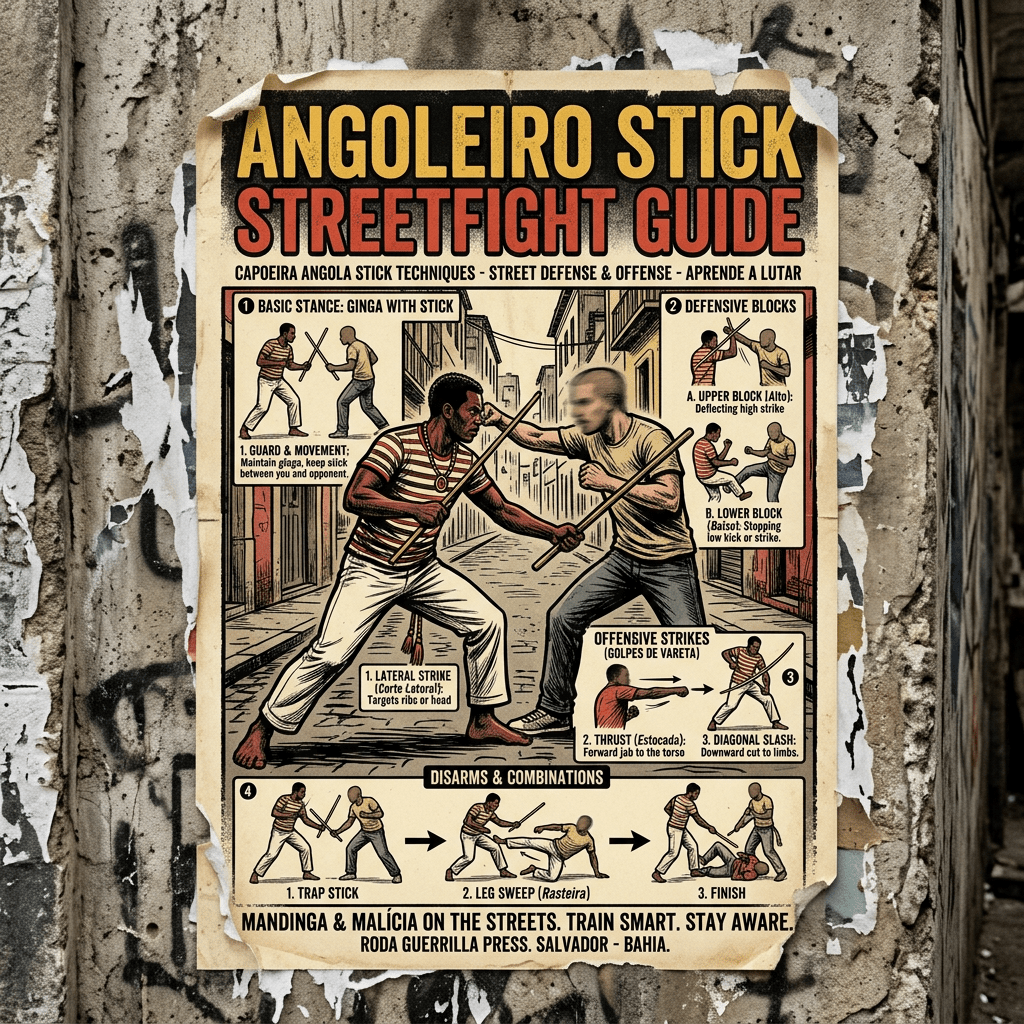
3. The Fencing Mindset: Thrust and Withdraw (The Rapier and the Rattlesnake)
In the initial, probing phase of confrontation, the stick wielder must adopt the disciplined, precise mentality of a historical rapier duelist. The foundational principle is simple: A thrust (or jab) is the fastest, most direct, and most energy-efficient line of attack to an opponent’s vital space. This approach favors speed and accuracy over raw power, creating opportunities rather than attempting a decisive blow from the outset.
Precision Thrusting: The Immediate Threat.
Employ the stick’s tip—or the last few inches of the striking surface—for rapid, linear, jabbing motions. The stick should be driven straight from the body mass, not swung from the shoulder.
This precision attack targets soft tissue (eyes, throat, solar plexus) or sensitive points (hands, knuckles, knee joints).
Advantage: These direct, linear strikes are significantly harder to parry, evade, or block than wide, telegraphed swings. They serve to interrupt the opponent’s rhythm, gauge their reaction speed, and, crucially, establish immediate space and respect.
Recoil and Reload: Maintain Integrity, Deny the Grab.
Following the thrust, the stick must be immediately and sharply withdrawn, maintaining what martial artists call “structural integrity” and what a fencer calls “measure.”
Purpose: This rapid withdrawal is non-negotiable. It denies the opponent the critical opportunity to grab, trap, or secure the weapon, which is often the first step in disarming the wielder.
Transition to Power: A successful, jarring thrust (even a light one) causes the opponent to recoil, flinch, or momentarily freeze. This is the optimal moment to transition to a more powerful, wide-arc attack, such as a witik (a powerful downward or circular swing), as the opponent is off-balance or attempting to close the distance aggressively. The rhythm is fast-in, fast-out, then heavy-strike.
4. Structural Defense: The Stick as a Portable Shield and Check
The stick should never be perceived exclusively as an offensive projectile weapon. Its secondary, but equally vital, function is that of mobile armor—a piece of dense wood used to reinforce the body’s natural defensive structures, absorb incoming force, and immediately transition the defense into a counter-attack.
Reinforced Blocking: Protecting the Central Line.
When facing immediate, close-range attacks (punches or kicks), the wielder must transition to a defensive posture where the stick (particularly the shorter cane or maculelê stick) is held horizontally or diagonally across the torso.
Target Protection: This technique focuses on protecting the central line—the vital targets of the head, throat, and floating ribs.
Force Deflection: Utilize the density of the wood to absorb the shock of an incoming punch or to deflect the trajectory of a kick. This is not merely blocking; it is using the stick as a shock absorber that leaves the wielder less jarred than a bare-arm block.
Checking and Trapping: The Immediate Counter-Offense.
The stick is the ultimate tool for interrupting the opponent’s momentum and movement, a hallmark of stick-fighting defense.
The Lead Leg Check: Use the stick to quickly “check” or deflect an opponent’s leading leg during a stance shift, charge, or kick attempt. A hard, low jab to the thigh or knee can destabilize their base.
The Arm Trap: During a punching exchange, the stick can be momentarily wedged against or laid across the opponent’s punching arm, pinning it briefly against their body or their other arm.
The Transition: The moment the check or trap is executed, the defensive action must immediately transition into offense, capitalizing on the opponent’s momentary paralysis or structural instability. The stick, having neutralized a threat, becomes the catalyst for the next offensive strike.
III. Advanced Techniques and Strategic Applications
A. Precision Limb Striking (The Immediate Tactic)
Against any imminent threat, whether armed with a weapon or simply an active, dangerous assailant, the immediate tactical priority is to neutralize the opponent’s ability to strike. This is achieved through the principle of Functional Failure of the active limb. The goal extends beyond inflicting simple pain; it is to create neurological and physical shock sufficient to render the limb temporarily useless.
The methodology involves repeated, sharp-angled, snapping strikes—not dull pushes or heavy static blows—aimed at key structural and sensory points. Focus strikes on:
- Major Muscle Groups: Hitting the biceps, triceps, or large flexors of the forearm causes involuntary muscle spasm, immediate loss of tensile strength, and often compels the opponent to reflexively drop a weapon.
- Bony Protrusions: Striking the knuckles, wrist bones (ulna/radius), or elbow (ulnar nerve, commonly known as the “funny bone”) transmits intense, sharp pain and shock directly into the central nervous system, leading to temporary motor control disruption.
This rapid-fire assault disrupts the opponent’s rhythm, compels a defensive retreat, and buys the Angoleiro critical seconds for a decisive follow-up or immediate disengagement.
B. The Figure-Eight Flow (Abaniko/Banda y Banda)
The Figure-Eight, or Ocho, flow is the cornerstone of continuous stick application within the Filipino Martial Arts tradition, highly applicable with the Escrima Stick or Cane. This pattern is a continuous, cyclical motion that allows the Angoleiro to generate immense tip speed and power with minimal wind-up.
Purpose and Strategy:
The flow is inherently designed to overwhelm the opponent’s perception and block/parry response. It is not intended as a single, terminal blow, but as a relentless series of unpredictable strikes, fakes, and positional threats. By forcing the opponent into a perpetual, reactionary defensive shell, the Figure-Eight sequence creates a vulnerability, or “opening,” in their guard.
The Angoleiro maintains the continuous rhythm until a target of structural or vital compromise is exposed. These targets include:
- The Knee Joint: A strike to the side or front of the knee can cause immediate structural collapse and end the confrontation.
- The Collarbone (Clavicle): A disabling strike that compromises the opponent’s ability to utilize their shoulder and arm.
- The Temple or Mastoid Process: Reserved for absolute lethal force situations due to the potential for fatal trauma.
C. Pressure Point Application: Leveraging the Palm Stick (Dulo-Dulo)
In the close-quarters environment of grappling, pinning, or a clinch—where the gross motor skills necessary for large swinging strikes are impossible—the small Palm Stick (Dulo-Dulo) or a similarly sized close-quarters implement becomes invaluable. It transforms from a striking weapon into a crucial Lever and Pressure Amplifier.
The stick concentrates the Angoleiro’s force into a single, needle-like point, allowing them to instantly disrupt the opponent’s focus and muscle contraction via nerve pain.
Strategic targets for the Palm Stick include:
- Median Nerve: Located centrally beneath the forearm; a sharp drive to this point can cause the opponent’s grip to instantly fail.
- Sternocleidomastoid (SCM) Muscle: Located on the side of the neck; pressure here can be intensely painful and temporarily disorienting.
- Solar Plexus: A strike or drive to this nerve center in the upper abdomen can instantly “short-circuit” the opponent’s breathing and focus, forcing them to release a submission hold or clinch.
The use of the Palm Stick is primarily for Escape and Disengagement, providing the Angoleiro with the fraction of a second needed to break the opponent’s control and return to a safer striking range.
IV. Legal, Ethical, and Psychological Mastery
The Angoleiro who chooses to carry and utilize a stick must possess not only tactical proficiency but also a profound grasp of the ethical and legal responsibilities that accompany such a force multiplier. While the immediate goal is survival, accountability remains inseparable from every action taken.
The Principle of Proportional Response
This principle is the absolute standard against which all use of force is legally and ethically measured. Force must be a measured, reasonable reaction to the immediate threat presented.
Justified Use (Defensible Action): The deployment of the stick (Cane, Escrima Stick, etc.) is legally defensible only when the Angoleiro possesses a reasonable, articulable belief that they or a third party face a threat of serious bodily harm or death. Using a stick to neutralize a vicious, sustained unarmed assault (e.g., stomping, multiple attackers) or to repel an attack from an opponent armed with a knife, gun, or bludgeon is generally considered a proportional response. The intent must be defensive and preservative of life or safety.
Unjustified Use (Disproportionate/Illegal Action): Any use of the stick that exceeds the immediate threat is illegal and constitutes criminal assault. This includes:
Using the stick, particularly for striking vital areas (head, spine), against a purely verbal threat or a mere shove.
Continuing to strike or deliver force against an opponent who is clearly retreating, has been incapacitated, or is actively disengaging from the fight.
Initiating an assault or confrontation with the stick in hand.
Immediate De-escalation and Disengagement
The ultimate mastery of the stick lies in the wisdom to avoid its use entirely. The Angoleiro’s superior training must prioritize De-escalation tactics whenever feasible. If the weapon is drawn or used, the duty to Disengage is paramount the instant the immediate threat has been neutralized. Once the opponent is no longer a credible threat of serious bodily harm, the fight is over, and all force must immediately cease. A successful engagement is one that preserves life, minimizes injury, and withstands legal scrutiny.
The defining principle of the Angoleiro’s method is the controlled application of necessary force. The very instant the threat is neutralized—meaning the attacker is incapacitated, signals retreat, or is disarmed—the deployment of the stick must immediately cease. This is not a system of retaliation or vengeance; the stick serves an exclusively defensive purpose as a tool for self-preservation and escape.
The Angoleiro’s strategic priority is not to punish the aggressor or prolong the conflict for dominance. Rather, the entire goal of the defensive action is to create a temporary window of opportunity. As soon as this window opens—the attacker is reeling, surprised, or temporarily disabled—the Angoleiro must execute a swift disengagement and retreat to a position of absolute safety. A successful defense is one that ends as quickly as possible with the Angoleiro intact and safely away from the scene of the confrontation. Any continued application of force beyond that necessary for safe retreat constitutes aggression and violates the core ethos of this defensive system.The Element of Surprise and Psychological Deterrence
Street confrontations are often predicated on a fundamental miscalculation by the assailant. Most aggressors assume that their target—a common citizen—is either completely unarmed, physically non-confrontational, or mentally unprepared to defend themselves with any degree of proficiency or decisive violence.
The initial, controlled, and utterly decisive deployment of an everyday, innocuous item like a sturdy walking stick—wielded with clear martial intent and precision—delivers a profound psychological shock that is arguably more effective than the physical strike itself. This element of surprise shatters the attacker’s preconceived narrative and their psychological dominance over the victim. When the expected easy victim transforms instantly into an unpredictable, formidable combatant, it introduces doubt and fear into the aggressor’s mind.
This immediate psychological shift, facilitated by the precision and authority of the Angoleiro’s action, is a critical force multiplier. It often acts as a preemptive conflict terminator, fulfilling the system’s primary directive: survival through meticulous preparation and the minimal necessary force required to establish safety. The confrontation is frequently aborted by the attacker, who, having lost the advantage of surprise and the will to continue, chooses retreat over further engagement with an unexpected and formidable opponent.
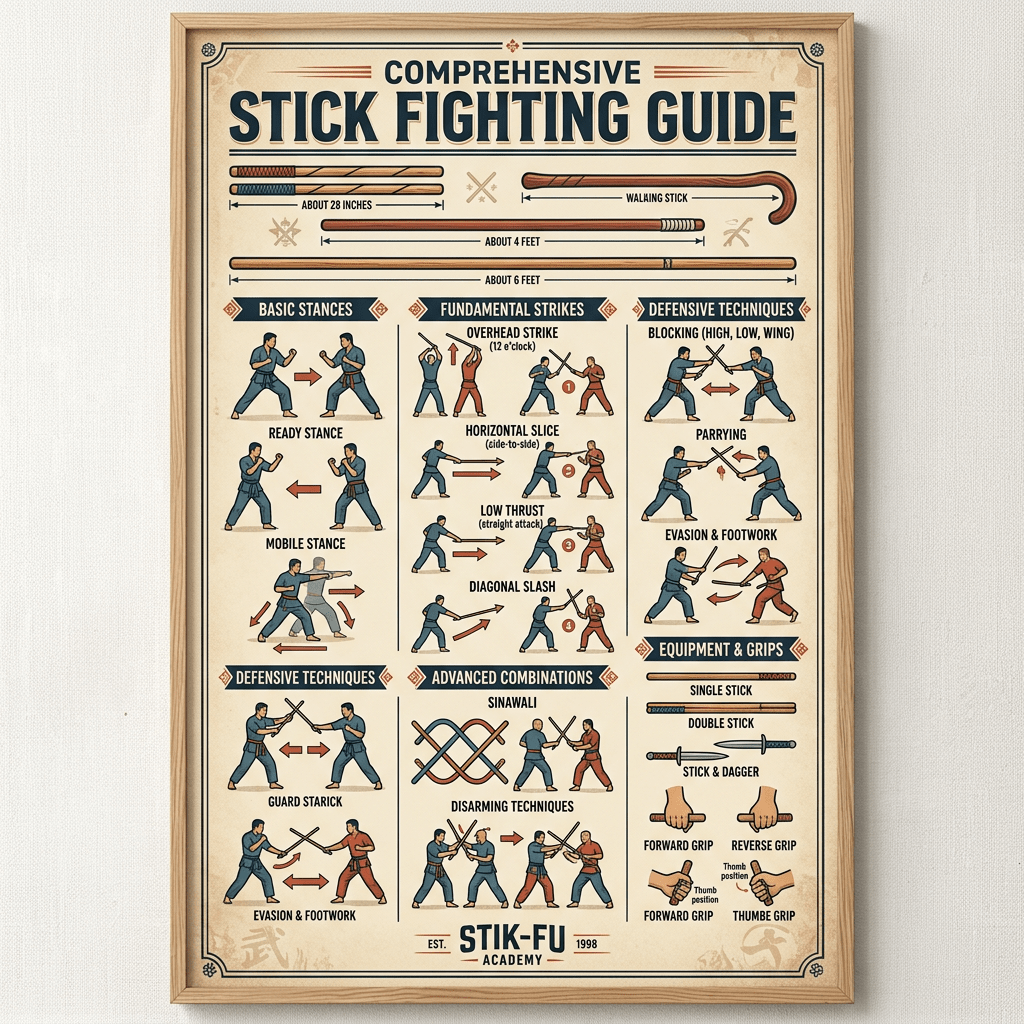
 Jogo Corpo Fechado