Welcome to the WARRIOR CLASS podcast, a unique self-protection and self-defense podcast that equips listeners with essential skills and knowledge for personal safety. Each episode features engaging discussions, expert interviews, and practical tips to boost your confidence and preparedness, along with analyses of martial arts techniques and inspiring stories of resilience from guests who have overcome adversity. Self-protection with Black Power!
Tune in every Saturday at 1pm EST and be empowered to become the strongest version of yourself, physically and mentally, while exploring the rich cultural heritage of martial arts and the importance of community resilience in everyday life. Don’t miss out on the journey to becoming a warrior!
Today, we have a older episode.
The Science of Self-Defense: An Interdisciplinary Exploration
This book, “The Science of Self-Defense,” delves into the multifaceted scientific principles that underpin our inherent capacity and fundamental desire to protect ourselves and those around us. It offers a comprehensive and accessible analysis, moving beyond mere techniques to explore the fundamental “why” and “how” of effective self-preservation.
A Holistic Approach to Protection:
“The Science of Self-Defense” is unique in its interdisciplinary approach, synthesizing knowledge from three crucial scientific domains:
Physics: This section investigates the mechanics of motion, force, leverage, and impact. It explores how understanding principles like momentum, kinetic energy, and center of gravity can optimize defensive maneuvers, striking power, and evasive actions. From the biomechanics of a powerful punch to the physics of deflecting an attack, readers will gain insights into maximizing their physical effectiveness.
Biology: Here, the focus shifts to the human body’s physiological responses to stress, threat, and injury. Topics include the “fight or flight” response, the role of adrenaline, pain thresholds, and the vulnerabilities and strengths of the human anatomy. Understanding these biological realities is crucial for both effective defense and responsible use of force.
Psychology: This dimension explores the mental aspects of self-defense, including threat perception, fear management, decision-making under pressure, and the psychological impact of conflict. It delves into the art of de-escalation, the power of situational awareness, and the psychological tactics that can be employed to “dupe” or mislead an aggressor, often avoiding physical confrontation altogether.
Mastering the Four Ds of Self-Defense:
Through this integrated scientific lens, the book systematically explores how individuals can effectively and efficiently achieve four critical objectives in a self-defense scenario:
Defend: This encompasses blocking, parrying, and maintaining a defensive posture to minimize harm and create opportunities.
Dodge: Understanding movement, footwork, and evasive maneuvers to avoid attacks and create distance.
Do Damage: When necessary, applying appropriate force to neutralize a threat, focusing on vulnerable points and efficient strikes.
Dupe: Employing psychological strategies, verbal de-escalation, and misdirection to avoid or mitigate conflict without physical engagement.
Learn from the Experts: Readers are invited to join a team of experienced instructors as they not only discuss the theoretical underpinnings of “The Science of Self-Defense” but also provide practical demonstrations. Through real-world applications and illustrative examples, these experts will illuminate how these scientific principles translate into actionable strategies that YOU can learn and utilize to enhance your personal safety and the safety of those you care about. This book is an essential resource for anyone seeking a deeper, more informed understanding of self-defense, empowering them with knowledge that goes beyond rote memorization of techniques.
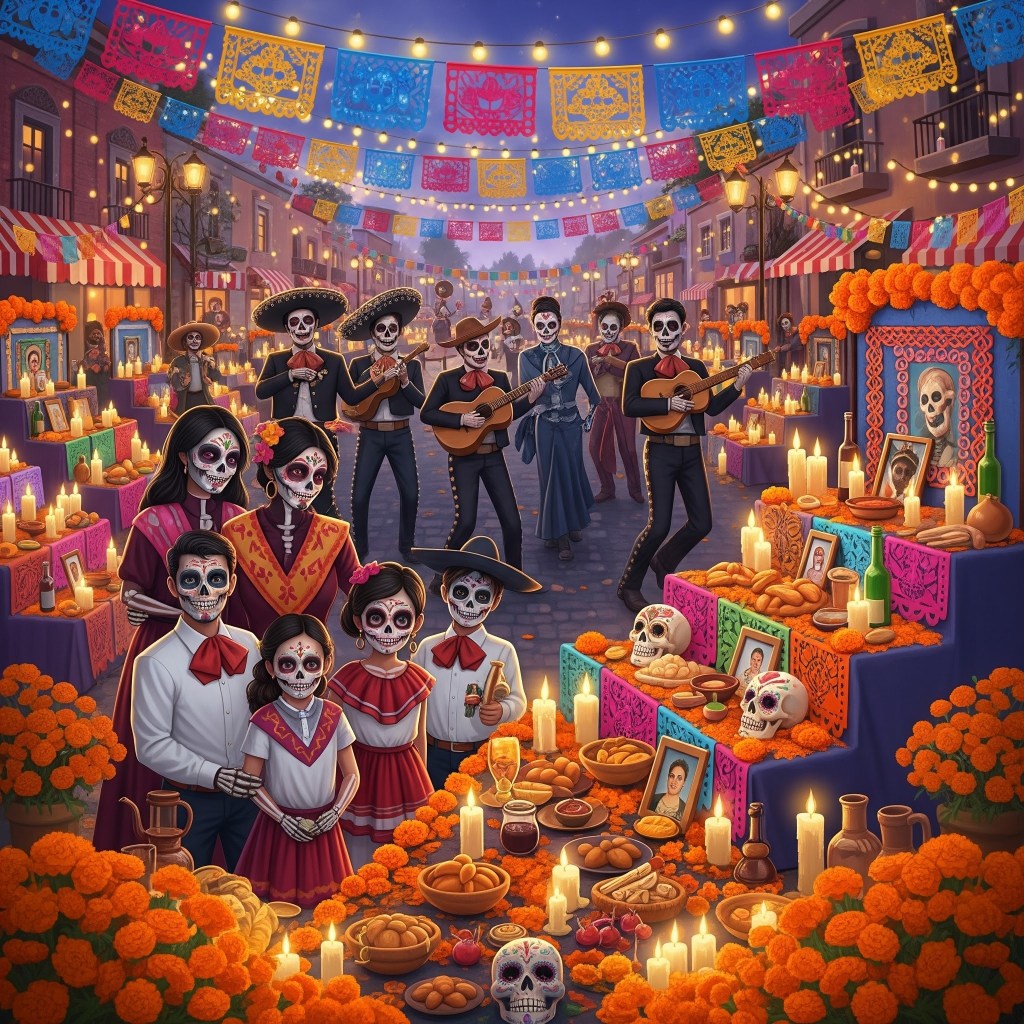
Happy Halloween! Tomorrow, we’re having a roda for the holiday, El Día de los Muertos, Spanish for the Day of the Dead.
The Day of the Dead is a vibrant and deeply meaningful Mexican celebration, primarily observed on November 1st and 2nd. Far from being an occasion of sorrow, it is a time of profound joy and lively remembrance. Families gather to honor and remember their deceased loved ones, rooted in the beautiful belief that the souls of the departed temporarily return to the world of the living to visit their families. This ancient tradition, with its origins in Mesoamerican indigenous cultures, is a testament to the enduring bond between the living and the dead.
The celebration is characterized by its colorful altars, known as ofrendas, which are lovingly decorated with marigolds (cempasúchil), candles, photographs of the departed, and their favorite foods and drinks. Calaveras (skulls), often made of sugar or clay and playfully decorated, are iconic symbols, reminding us of the cyclical nature of life and death. Music, dancing, storytelling, and shared meals create a festive atmosphere that embraces death not as an end, but as a continuation of the spiritual journey.
How, then, would such an individual navigate the raw grief of losing a loved one or a cherished friend? The pain of loss is universal, yet a Capoeirista might approach it with a unique blend of stoicism and emotional release. The communal aspect of the roda, the shared energy and support, would likely extend to moments of mourning. They might find solace in the shared memories, the songs, and the movements that bind them together. The grief would be felt deeply, but perhaps not as an ending, but as a transformation, echoing the constant shifts within the capoeira game itself. The spirit of the departed, like a powerful movement, might be seen as continuing to influence and inspire those left behind.
And even, how would they process the passing of an adversary, acknowledging the complex dance of life and conflict? In Capoeira, the “adversary” is often also a partner, a crucial element in the learning and growth process. There is respect even in conflict, a recognition that the opposition helps one to refine their own art. Therefore, the passing of an adversary might be met with a complex mix of emotions: perhaps a sense of completion, a reflection on the lessons learned from their interactions, and even a profound respect for the role they played in one’s own journey. The “game” of life and conflict, in this sense, would have concluded, leaving behind a legacy of shared experience.
More deeply still, how would a Capoeirista cultivate a life of resilience and joy, embracing the present moment, so that when their own time comes, they could face death not with fear, but with an open heart, grace, and profound acceptance? This is where the core philosophy of Capoeira Angola truly shines. The constant improvisation, the ability to adapt to any situation, and the emphasis on “mandinga”—the cunning and wisdom inherent in the art—all contribute to a mindset of resilience. The music, the singing, and the sheer physicality of Capoeira instill a deep sense of joy and vitality. By living fully in the present, by engaging with the world with an open heart and a willingness to learn and adapt, a Capoeirista would, in essence, be preparing for their own transition not as an end, but as another movement in the eternal dance of existence. Death, in this view, would not be an enemy to be fought, but a natural progression to be met with the same grace, rhythm, and profound acceptance that defines their life within and beyond the roda.
A Capoeirista, in their pursuit of a life imbued with resilience and joy, would embark on a profound journey of self-cultivation, deeply rooted in the philosophy and practice of Capoeira. This journey would emphasize not only physical prowess but also mental fortitude, emotional intelligence, and spiritual awareness.
Embracing the Present Moment:
Mindful Movement: The very essence of Capoeira—its fluid, improvisational movements, the call-and-response of the berimbau, and the dynamic interplay with a partner—demands complete presence. A Capoeirista learns to shed distractions and fully inhabit each ginga, each esquiva, each rabo de arraia. This constant practice of mindful movement translates into an ability to be fully present in all aspects of life, savoring each experience without dwelling on the past or fretting about the future.
Active Listening and Observation: In the roda, a Capoeirista must be acutely aware of their surroundings, anticipating their opponent’s moves and responding instinctively. This heightened sense of observation extends beyond the roda, allowing them to truly see and hear the world around them, to appreciate small details, and to engage deeply with others.
The Axé of Now: The concept of axé in Capoeira—a vital life force, energy, and good vibrations—is intrinsically linked to the present. A Capoeirista cultivates axé by fully engaging with the moment, pouring their energy into their practice, their community, and their daily interactions. This energetic embrace of the present fosters a deep sense of connection and vitality.
Cultivating Resilience:
Overcoming Physical Challenges: The demanding physical training of Capoeira builds incredible strength, flexibility, and endurance. Beyond the physical, it teaches a Capoeirista to push past perceived limitations, to embrace discomfort as a path to growth, and to develop a tenacious spirit that refuses to be easily defeated.
Navigating the Roda of Life: Capoeira, with its constant flow of attack and defense, provides a metaphorical training ground for life’s challenges. A Capoeirista learns to adapt to unexpected situations, to fall and rise again with grace, and to find creative solutions in moments of pressure. This constant negotiation within the roda builds a profound sense of adaptability and problem-solving.
Community and Support (Comunidade): The strong sense of community within Capoeira—the mutual support, encouragement, and shared struggle—is a powerful source of resilience. Knowing they are part of a larger family, a Capoeirista finds strength in their connections, understanding that they don’t have to face life’s difficulties alone.
Discipline and Perseverance: The journey to mastering Capoeira is long and arduous, requiring immense discipline and perseverance. This commitment to continuous improvement, to showing up even when tired or discouraged, instills a deep-seated resilience that extends to all areas of life, enabling them to weather setbacks and pursue long-term goals.
Nurturing Joy:
The Ginga of Happiness: The foundational ginga of Capoeira, a constant, swaying movement, embodies a playful and joyful spirit. It’s a dance, a game, and a fight all rolled into one, and this inherent playfulness permeates the Capoeirista’s outlook on life. They learn to approach challenges with a light heart and to find joy in the process, not just the outcome.
Musicality and Expression: The music of Capoeira—the rhythmic instruments, the songs, and the clapping—is an integral part of its joy. A Capoeirista learns to express themselves through music and movement, to release emotions, and to celebrate life with infectious enthusiasm. This deep connection to rhythm and self-expression becomes a wellspring of personal joy.
Connection and Celebration: The roda itself is a celebration—of culture, of skill, of community, and of life. The shared laughter, the camaraderie, and the collective energy create an atmosphere of profound joy that strengthens bonds and uplifts spirits.
Personal Growth and Self-Discovery: The journey of learning Capoeira is one of continuous self-discovery. As a Capoeirista gains new skills, overcomes fears, and deepens their understanding of themselves and their craft, they experience a profound sense of accomplishment and personal joy.
Facing Death with an Open Heart, Grace, and Profound Acceptance:
Detachment from Outcome, Attachment to Process: Capoeira teaches a certain detachment from rigid outcomes, focusing instead on the beauty and flow of the process. This mindset allows a Capoeirista to release the fear of what comes next, including death, and instead to appreciate the journey of life itself.
The Cycle of Life and Death in Nature: Drawing parallels from nature’s cycles of growth, decay, and renewal, a Capoeirista would understand death not as an end, but as a natural transition within the grand tapestry of existence. Their connection to the earth and its rhythms would foster a sense of harmony with this inevitability.
Living a Full Life: By living a life of presence, resilience, and joy, a Capoeirista would accumulate a wealth of experiences, wisdom, and meaningful connections. This rich tapestry of a life well-lived would provide a sense of completeness, diminishing the fear of what might be missed.
Grace in Every Movement: The grace cultivated in Capoeira extends beyond physical movement to a grace of being. This inner grace allows for a calm and composed acceptance of life’s ultimate transition, facing it with dignity and peace.
Legacy and Continuity: A Capoeirista understands that their impact, their axé, lives on through their students, their community, and the memories they create. This awareness of their legacy, of contributing to something larger than themselves, fosters a profound acceptance of the individual’s place within the continuum of life and death.
In essence, a Capoeirista cultivates a life that mirrors the roda itself: a continuous flow of challenge and grace, effort and joy, and ultimately, an understanding that every ending is simply a prelude to a new beginning, faced with an open heart and profound acceptance.
The intricate and beautiful interconnectedness of life, death, and the ancestral wisdom that underpins both Capoeira Angola and Día de los Muertos offers a remarkably rich tapestry for contemplation and understanding. These two seemingly disparate traditions, one a martial art, dance, and philosophy born from the transatlantic slave trade, and the other a vibrant Mesoamerican celebration of the departed, share a profound common ground in their recognition of the cyclical nature of existence and the enduring power of memory. They both serve as powerful cultural mechanisms for confronting mortality, honoring those who have passed, and reinforcing communal bonds across generations.
In Capoeira Angola, every movement, every song, every interaction in the roda (the circle where Capoeira is played) is a testament to the fleeting beauty of existence and the enduring spirit of those who came before. The slow, strategic, and often deceptive movements of Angola embody the struggles and resilience of enslaved Africans who used Capoeira as a means of resistance and cultural preservation. This physical expression, seemingly a dance, was a veiled form of combat training and a repository of cultural identity, ensuring that the spirit of freedom and defiance was never truly extinguished. The songs, often sung in call-and-response, narrate stories of hardship, liberation, and the wisdom of ancestors, invoking their presence and guidance in the present moment. These lyrical narratives are not merely historical recounts but active spiritual invocations, drawing the ancestors into the roda as participants and mentors. The berimbau, the central instrument of Capoeira, with its haunting melodies, acts as a conduit to the spiritual realm, connecting players to a lineage of practitioners and to the broader African diaspora. Its various tones and rhythms dictate the pace and energy of the game, guiding players through a ritualistic dance that blurs the lines between physical exertion and spiritual communion. Death in Capoeira is not just a physical end, but a transformation, a return to the ancestral realm from which new life and wisdom emerge. This perspective is deeply rooted in African cosmologies, where the line between the living and the dead is permeable, and ancestors actively participate in the lives of their descendants. The respect shown to elders and masters, both living and departed, highlights the continuous flow of knowledge and energy across generations, ensuring that the legacy of Capoeira, and the spirits that shaped it, remain vibrant and influential. The Axé, the vital life force and spiritual energy inherent in Capoeira, is passed down through these lineages, making each roda a living memorial and a dynamic continuation of ancestral practices.
Similarly, Día de los Muertos, with its vibrant altars (ofrendas), its joyful calaveras (skulls), and its heartfelt remembrances, provides a framework for honoring the departed, recognizing their continued presence in our lives, and celebrating the unbreakable bonds that transcend the veil of death. Far from a morbid observance, Día de los Muertos is a joyful and colorful celebration, a time when the veil between worlds is believed to thin, allowing the spirits of the deceased to return and commune with their families. Ofrendas are meticulously prepared with the favorite foods, drinks, and personal belongings of the departed, inviting them back to a world filled with love and warmth. The whimsical calaveras, often depicted as elegant skeletons engaged in lively activities, serve as a playful reminder of the universality of death and the importance of living life to the fullest. Through storytelling, shared meals, and the creation of beautiful artworks, families actively engage in a dialogue with their ancestors, reinforcing their identity and connection to a rich cultural heritage. This tradition emphasizes that while the physical presence may be gone, the love, influence, and memories of the departed continue to shape and enrich the lives of the living.
Both traditions, in their unique expressions, remind us that death is not an end but a transition, a part of the grand cycle of being, and an opportunity to deepen our appreciation for the precious gift of life itself. They teach us that acknowledging our mortality can lead to a more profound understanding of our humanity and a greater capacity for joy and connection. By embracing the wisdom of those who came before, and by creating spaces for remembrance and celebration, Capoeira Angola and Día de los Muertos offer powerful models for navigating the complexities of life and death, fostering a sense of continuity, community, and an enduring respect for the past that enriches the present and informs the future. They are living testaments to the universal human need to make sense of our existence, to honor our roots, and to find beauty and meaning even in the face of impermanence.
I will delve deeper into the intricate relationship between Capoeira Angola and the concept of death in a future blog post. This complex subject merits a thorough exploration, examining how the philosophy and practice of Capoeira Angola confront, symbolize, or even transcend mortality. We will explore the historical and cultural roots of Capoeira Angola, tracing its origins back to the enslaved African communities in Brazil and understanding how their struggles and beliefs shaped its worldview. This will involve analyzing specific movements, rituals, and musical elements within Capoeira Angola to uncover their hidden meanings and connections to themes of life, death, rebirth, and the ancestral realm. Furthermore, we will consider how individual practitioners experience and interpret these profound concepts through their engagement with the art form, potentially offering insights into personal resilience, confronting fear, and finding meaning in the face of impermanence. For now, however, let us set aside these profound reflections and fully embrace the spirit of the upcoming holiday, looking forward to a time of celebration and joy.
Welcome to MALICIA AS A GAME OF POWER, a compelling blog series that delves deeply into the intricate strategies of human interactions, encompassing a wide range of topics such as effective communication, conflict resolution, negotiation techniques, and the subtle art of manipulation. This series not only addresses essential themes like leadership, personal branding, and online reputation management but also offers insightful and practical strategies designed to enhance influence and build meaningful relationships in both personal and professional contexts. Through thorough analysis, engaging discussions, and real-life examples, the series aims to empower readers to navigate the complexities of interpersonal dynamics, equipping them with the tools and knowledge necessary to strengthen their personal and professional lives. As we journey through various scenarios and strategies, expect to uncover the nuances of social influence, the importance of emotional intelligence, and the impact of strategic thinking in fostering successful interactions, ultimately helping you to thrive in a world where power dynamics are at play.
In this installment, we will explore the 40th law of power in the book, the 48 laws of power by Robert Greene. You can buy a copy by clicking HERE.
Law 40: Despise the free lunch
In a world increasingly driven by convenience and immediate gratification, it’s easy to fall into the trap of accepting what’s offered for free. However, a closer examination reveals a crucial principle: What’s offered for free is often dangerous. This isn’t to say all free things are inherently bad, but rather that true value, independence, and respect are rarely found without personal investment.
Consider the act of paying your own way to avoid guilt and gratitude. When you receive something for free, particularly from another individual, a subtle (or not-so-subtle) debt is incurred. This can manifest as an obligation, a feeling of being beholden, or a desire to reciprocate that may not always be convenient or desirable. By taking responsibility for your own expenses and contributions, you maintain your autonomy and freedom from such entanglements. This fosters genuine relationships built on mutual respect rather than a perceived imbalance of favors.
Furthermore, there’s a profound connection between investment and quality. No cutting corners with excellence is a principle that extends beyond financial outlays. When you commit your resources – be it time, effort, or money – to a pursuit, you are inherently striving for the highest possible standard. Conversely, seeking shortcuts or free alternatives often leads to compromised results, diminished quality, and ultimately, dissatisfaction. Excellence demands commitment, and that commitment is often reflected in the willingness to invest appropriately.
This commitment to investment isn’t about hoarding resources; quite the opposite. It’s about understanding the power of circulation. Be lavish with your money, keep it circulating. This isn’t an endorsement of reckless spending, but rather a recognition that money, like energy, gains power when it flows. Investing in quality products and services, supporting local businesses, and contributing to worthy causes all contribute to a vibrant economy and create opportunities for others. True wealth isn’t measured by what you accumulate, but by the positive impact your resources have when put into motion.
Ultimately, this philosophy culminates in a profound understanding of Generosity as a sign and magnet for power. This isn’t about transactional giving, where you expect something in return. Rather, it’s about a deep-seated belief in abundance and the understanding that true generosity, extended freely and without expectation, broadcasts a powerful message. It signals confidence, security, and a capacity to give beyond oneself. Such an attitude naturally attracts opportunities, alliances, and resources, making generosity a powerful force in both personal and professional life.
Example: Gypsies and Gifts offers a historical and cultural illustration of this principle. Traditionally, many Romani (Gypsy) communities have been known for their reluctance to accept gifts or favors without offering something in return, even if it’s a small token or a performance. This cultural practice, whether conscious or unconscious, serves to preserve their independence and prevent them from becoming indebted or perceived as reliant on others. It underscores the wisdom of maintaining a balance in exchanges, ensuring that dignity and autonomy are preserved. This example, while specific to a particular culture, highlights a universal truth: true power and freedom are often intertwined with self-sufficiency and the judicious management of exchanges, both material and immaterial.
How to use the 40th Law of Power ethically:
The 40th Law of Power, often summarized as “Despise the Free Lunch,” suggests that what is offered for free is often a trick or comes with a hidden cost, and that one should always pay one’s way, as it is a mark of respect, independence, and intelligence. While the law in its raw form is a tool for self-protection and maintaining power, its ethical application requires a nuanced understanding of its underlying principles. Applying this law ethically means using its wisdom to foster healthy, transparent, and mutually beneficial relationships, rather than simply as a defense mechanism against perceived exploitation.
Ethical Interpretation and Application:
Value Transparency over Suspicion: The ethical approach is to use the principle of “Despise the Free Lunch” as a prompt for inquiry and due diligence, not automatic rejection. Instead of assuming malice, inquire about the terms, costs, and expectations attached to any offer.
Ethical Action: When presented with something “free,” ask clear, respectful questions about the value exchange: “What is the expected outcome for you/your company?” or “What responsibilities are attached to this offer?”
Foster True Reciprocity, Not Debt: The law rightly warns against the psychological burden and manipulation inherent in one-sided transactions. Ethically, this translates to a commitment to genuine reciprocity. Instead of simply refusing a gift, seek a commensurate, non-monetary way to contribute or offer assistance in return, ensuring the balance of power remains equal.
Ethical Action: If a mentor offers time or resources, actively look for ways to pay their generosity forward, either by offering your unique skills in a small capacity or by committing to mentor others in the future. The focus is on balancing the exchange in a way that preserves the dignity and independence of both parties.
Invest in Relationships, Not Just Transactions: Applying the law ethically means recognizing that some “gifts” are sincere expressions of goodwill, friendship, or love. In these cases, to rigidly refuse them can be an insult. The ethical judgment lies in distinguishing a manipulative ploy from a genuine relationship-building gesture. The principle of paying your own way should be focused on professional or transactional settings where power dynamics are in play.
Ethical Action: In personal relationships, accept a genuine gift graciously, reciprocating with authentic appreciation and commitment to the friendship. In professional settings, insist on clear contractual terms and fair compensation, ensuring your contribution is valued and paid for.
Promote Self-Sufficiency and Dignity: The most ethical aspect of the 40th Law is its emphasis on self-reliance. Ethically, this means refusing to become dependent on charity or favors when one is capable of earning their own way. By paying the fair market value for services and goods, one supports a functioning, equitable economy and reinforces their own sense of capability.
Ethical Action: Always strive to pay your fair share in collaborative projects or social settings. If someone does a favor for you, offer to pay for their expenses or return the favor with something of equal effort, thereby respecting both their time and your own self-sufficiency.
Use the Insight for Altruism: Recognizing the subtle ways people can be manipulated by free offers allows you to protect others. An ethically powerful person can use their insight to warn others about predatory “free” schemes or ensure that when they themselves give, it is a clean, unconditional gift designed truly to help, not to indebt the recipient.
Ethical Action: If you choose to offer a service pro-bono or a gift, make the terms of its freeness explicitly clear—stating that there are no strings attached—to prevent the recipient from feeling the psychological burden of debt that the law warns about.
The 40th law of power, often summarized as “Despise the Free Lunch,” carries a unique and profound resonance when viewed through the lived experience of an angoleiro. An angoleiro, a practitioner of Capoeira Angola, understands that true mastery and respect are never simply given; they are earned through persistent effort, sweat, and a deep commitment to the tradition’s rigorous philosophy.
For the angoleiro, the “free lunch” is a seductive illusion—a shortcut that inevitably leads to weakness, dependence, and the stagnation of one’s jogo (the game/fight). The law is interpreted not just as financial prudence, but as a core principle of self-reliance and the necessity of personal investment:
1. The Price of the Axé (Energy/Life Force):
In Capoeira Angola, the axé is the spiritual and physical energy that vitalizes the roda. An angoleiro knows this energy must be constantly generated and renewed. If you receive a favor, a lesson, or even a moment of glory without paying for it—whether through dedicated practice, respect for the Mestre, or service to the community—the axé is unstable. The 40th law teaches that everything of value has a cost, and an unpaid debt (even a non-monetary one) leaves one vulnerable to control. The greatest masters demand investment, not compliance.
2. The Illusion of the Shortcut:
The journey of Capoeira Angola is defined by patience, repetition, and the slow, deep internalization of the movements, music, and philosophy. A beginner might seek “quick tips” or “easy moves.” The angoleiro understands that free, readily available knowledge (the “free lunch” of the internet tutorial or the lazy lesson) lacks the weight and foundation of hard-earned understanding. True power in the roda comes from the muscle memory forged in countless hours of disciplined training, which cannot be outsourced or acquired for free.
3. The Danger of Dependence:
When something is given freely, the receiver becomes indebted to the giver, consciously or unconsciously. In the context of power, this is a fatal flaw. The angoleiro must be sovereign, self-contained, and independent in their skill. To rely on the free generosity of a patron or the free advice of a rival is to surrender a measure of one’s autonomy. The 40th law demands that the angoleiro earn their place, their nickname, and their belt, ensuring that their standing is rooted in their own merit, not the unstable favor of others.
Conclusion:For the Capoeirista, “Despise the Free Lunch” is an affirmation of the principle that genuine power is internal. The angoleiro pays for their knowledge with sweat, their respect with sincerity, and their skill with dedication, thereby ensuring that the jogo they play is truly their own.
Welcome to HIDDEN SPIRITUALITY – From Spirit Science, where we explore global spiritual practices in movies and games. Our goal is to reveal the spiritual wisdom in cinematic narratives, enhancing our appreciation of film and spiritual journeys. By examining various cultures and their stories, we aim to illuminate valuable lessons and insights that resonate deeply with our individual experiences and collective consciousness. We invite you to discover how symbolism and storytelling influence our lives and spirituality, fostering reflection on the interconnectedness of all beings, regardless of their backgrounds or beliefs. Through thoughtful discussions and open dialogues, we seek to create a vibrant community passionate about the spiritual dimensions of art and life. Join us as we bridge spirituality and entertainment, uncovering hidden messages that resonate within us, and encouraging personal growth and transformation through the power of storytelling. Together, we can embark on a journey of discovery, seeking to understand the profound impact that these narratives can have on our perception of reality and our quest for meaning in a complex world.
In today’s installment…
“Obvious Spirituality”: The Dark Crystal and Its Enduring Legacy
As many discerning viewers and critics have observed, certain cinematic works wear their spiritual heart on their sleeve, inviting an immediate recognition of their deeper philosophical and existential themes. For these films, the term “Obvious Spirituality” feels not like a critique, but rather an apt description of their overt engagement with matters of the soul and the cosmos. The Dark Crystal stands as a quintessential example within this fascinating subgenre.
A Deep Dive into the Original Film:
It is crucial to clarify at the outset that this exploration will meticulously focus on the original 1982 Jim Henson and Frank Oz masterpiece, The Dark Crystal. While the recent Netflix prequel series offered a captivating expansion of the lore, our current discussion will not delve into its narrative or thematic elements. However, the allure of revisiting the world of Thra through the lens of the prequel remains a tempting prospect for future discourse.
Before we embark on this journey, a Spoiler Warning is in order. Given the film’s long-standing presence in cinematic history, many will undoubtedly be familiar with its plot developments. Nevertheless, for those who may be experiencing this profound narrative for the first time, or those who wish to revisit its intricacies with fresh eyes, this heads-up is provided as a courtesy.
Unveiling the Hidden Spirituality of Thra:
Join us, then, as we embark on an immersive journey through the mystical and richly imagined world of The Dark Crystal. Beyond its groundbreaking puppetry and enchanting visual design, this film offers a remarkably clear and resonant portrayal of spirituality and the archetypal journey of the soul. In this dedicated episode of “Hidden Spirituality,” we will meticulously unpack the layers of meaning woven throughout this enchanting movie.
Our analysis will illuminate the pervasive alchemical symbolism embedded within the narrative, exploring how the film’s characters and events mirror the transformative processes of spiritual refinement. We will also uncover the subtle yet impactful astrological references that provide an additional dimension to the characters’ destinies and the cyclical nature of Thra’s existence. Furthermore, we will delve into the overarching spiritual themes that underpin the entire saga, examining concepts such as duality, balance, sacrifice, and redemption.
While the film’s spiritual undercurrents are, as we’ve established, quite “obvious” to the attentive viewer, our mission is to dive beyond the surface. We aim to explore the profound subtle nuances that elevate The Dark Crystal from a mere fantasy film to a timeless classic. These intricate details, often overlooked, contribute significantly to its enduring power and its ability to resonate deeply with audiences across generations.
Welcome to HIDDEN SPIRITUALITY – From Spirit Science, where we explore global spiritual practices and philosophies reflected in movies and games. Our goal is to uncover the profound spiritual wisdom embedded within cinematic narratives, enhancing our appreciation of film while significantly enriching our spiritual journeys. By diving deep into various cultures and their narratives, we aim to illuminate the lessons and insights that these visual art forms can provide. We invite you to discover how these elements, deeply rooted in symbolism and storytelling, influence our lives and spiritual practices, fostering a deeper reflection on the interconnectedness of all beings and the universe. Through discussions, analyses, and open dialogues, we hope to create a vibrant community of seekers who share a passion for understanding the spiritual dimensions of art and life. Join us on this enlightening journey as we bridge the worlds of spirituality and entertainment, uncovering the hidden messages that resonate within our hearts and minds.
Today…
Prepare for an unparalleled intellectual and spiritual adventure as we embark on a profound exploration of “Lucy,” the cinematic masterpiece that transcends mere entertainment to offer a startling glimpse into the boundless frontiers of human consciousness. This film is far more than a thrilling narrative; it’s a meticulously crafted journey that challenges our most deeply held perceptions of reality, urging us to question the very fabric of existence.
Join us as we meticulously unravel the intricate tapestry of mystical and spiritual themes woven into the very heart of this gripping story. We will delve into the profound and often overlooked connections between psychedelics as tools for inner exploration, the concept of ascension as a path to higher states of being, and the ultimate evolution of human potential. These elements coalesce to form a rich and compelling existential inquiry, inviting viewers to ponder the deepest questions about purpose, meaning, and the nature of intelligence itself.
Discover the myriad secrets that “Lucy” holds, as we follow the titular character, brilliantly portrayed, on an extraordinary odyssey that defies the conventional boundaries of space and time. Her transformation becomes a metaphor for our own latent capabilities, unlocking not only the mysteries of the universe but also posing profoundly significant questions about the true nature of intelligence, the elusive concept of freedom, and the inherent responsibilities that accompany such power.
Each meticulously framed scene in “Lucy” serves as a potent portal, inviting us to step through into different levels of awareness and perception. The film masterfully urges us to contemplate the true and often underestimated limitations of the human mind and spirit in their current state, suggesting that there is so much more within us waiting to be awakened. It’s a cinematic call to action, inspiring introspection and a desire to transcend our perceived boundaries.
Get ready to significantly expand your mind and profoundly elevate your spirit with this special, in-depth episode of Hidden Spirituality. We extend an earnest invitation for you to engage in a contemplative journey, pondering the far-reaching implications of embracing our fullest, most authentic potential. Imagine a world brimming with wonders, insights, and uncharted territories of understanding, just waiting to be explored and integrated into our collective human experience. “Lucy” is not just a film; it is a catalyst for personal and collective awakening.
Capoeira Angola videos online showcase its vibrant culture through music and movement, highlighting its evolution as a form of self-defense and expression that integrates elements of acrobatics, rhythm, and strategy. They demonstrate intricate techniques with astounding agility while exploring the rich history of Capoeira, emphasizing community connections and the art’s ability to unite diverse individuals from various backgrounds and social groups. These videos educate viewers about Capoeira as a living tradition that inspires future generations, illustrating its values of resilience, creativity, and cultural pride, while inviting participation in this unique blend of dance and martial arts. Additionally, they often feature interviews with seasoned practitioners who share insights into their personal journeys, revealing how Capoeira has impacted their lives and fostered a sense of belonging. With each performance, these videos not only entertain but also serve as a vital resource for understanding the depth and significance of Capoeira, ultimately appreciating this dynamic art form as a means of cultural expression and unity.
Today, I recount a very special day for me.
A Day of Capoeira, Community, and Giving Back in MacArthur Park
This is the story of a memorable day, captured in two special videos, marking my first public Capoeira game. While I might be my own harshest critic, and I can’t claim instant mastery, the experience itself was profound. We gathered that day alongside Solsinmotion, who, in collaboration with Revolutionary Autonomous Communities (RAC), had generously volunteered to provide fresh, organic food to the MacArthur Park community, all while showcasing the vibrant art of Capoeira.
From noon until a little after 2 PM, our Capoeira demonstration unfolded. The rhythmic movements, the music, and the energy captivated the community. It was a powerful display of culture, athleticism, and the spirit of collaboration.
Following our performance, we lent a hand to RAC, assisting them in organizing and distributing the much-needed food to the grateful residents of MacArthur Park. It was truly inspiring to witness the direct impact of these efforts, as the smiles on the faces of the families we helped added a profound sense of fulfillment to our work. Many of the residents expressed their heartfelt gratitude, sharing stories of their challenges and the importance of community support during difficult times. We also had the opportunity to engage with the local volunteers, who brought their own enthusiasm and dedication to the cause, making the day even more memorable. For a more detailed account of that day’s events, you can find a comprehensive blog post HERE.
Reflecting on that day, one particular lesson from Charles still resonates deeply within me: the fundamental essence, the very glue that binds Capoeira together, is COMMUNITY. This insight has only grown stronger with time. Community is not merely a collection of individuals; it is the vital force that brings people together, fostering shared experiences, mutual support, and collective growth. It’s about building connections, learning from one another, and creating a sense of belonging that enriches us all. The day in MacArthur Park was a powerful testament to this truth, demonstrating how the synergy of Capoeira and community engagement can create a truly meaningful and impactful experience for everyone involved.
How Capoeiristas have historically dealt with State repression and violence has been a complex and multifaceted issue, steeped in rich cultural traditions and resilience. Throughout history, Capoeira emerged as a form of resistance against oppression, allowing practitioners to blend martial arts with dance and music to evade detection by colonial authorities. The strategic use of Capoeira as both a means of self-defense and a way to foster a strong community has enabled practitioners to maintain their identity in the face of harsh societal challenges. This vibrant art form has not only provided a physical outlet for those subjected to violence but also a spiritual sanctuary, reinforcing bonds among practitioners and serving as a source of pride and cultural heritage. Furthermore, the ongoing evolution of Capoeira has seen it adapt to modern forms of resistance, where the principles of agility and creativity are now extended to address contemporary social injustices, proving that its inherent values of unity and strength continue to resonate deeply within communities striving for autonomy and recognition.
Capoeira, a quintessential Afro-Brazilian art form, stands as a profound testament to human resilience and cultural ingenuity in the face of relentless state repression and violence. Its historical trajectory is not merely a narrative of survival but a vibrant illustration of how a community forged a powerful instrument of resistance from the crucible of oppression. Originating in the dark era of colonial Brazil, Capoeira ingeniously blended martial arts, dance, and music, creating a sophisticated language of defiance that allowed its practitioners, the Capoeiristas, to evade detection by the very authorities who sought to suppress them. This strategic fusion transcended mere disguise; it was a deeply embedded cultural practice that enabled the honing of combat skills in plain sight, veiled under the guise of festive celebration and communal gathering.
The intrinsic duality of Capoeira—serving simultaneously as a potent means of self-defense and a powerful instrument for fostering community cohesion—was absolutely critical in preserving the identity and dignity of its practitioners amidst relentless societal challenges. In a world bent on stripping them of their heritage and humanity, Capoeira offered a sacred sanctuary, a dynamic space where physical prowess seamlessly intertwined with spiritual solace. It acted as a powerful social glue, reinforcing the bonds among practitioners and cultivating a robust network of solidarity that was absolutely crucial for their collective survival. Beyond its practical applications in combat and community building, Capoeira blossomed into a profound source of pride, a living embodiment of cultural heritage, and a vibrant tapestry meticulously woven from threads of resistance, resilience, and unwavering hope.
The enduring legacy of Capoeira is further underscored by its remarkable adaptability, a characteristic that has allowed it to transcend its origins and address contemporary social injustices. As societies evolved and new forms of oppression emerged, so too did Capoeira, continuously transforming itself to remain relevant and impactful. The core principles of agility, creativity, and strategic evasion, meticulously honed over centuries in the face of historical oppression, found new and profound relevance in modern forms of activism and social protest. This continuous evolution powerfully demonstrates that Capoeira’s inherent values of unity, strength, and the unwavering pursuit of autonomy resonate deeply within communities striving for recognition, justice, and self-determination, unequivocally proving its timeless power as a transformative force for social change.
As the Brazilian government intensified its repressive measures against Capoeira practitioners, including outright criminalization and the brutal application of state-sponsored violence, Capoeiristas responded with ingenious and highly effective strategies to navigate this increasingly hostile environment. They masterfully transformed public spaces—city squares, street corners, and open fields—into vibrant stages for their resistance. These gatherings, often appearing as spontaneous festivals and lively performances, were, in fact, cleverly orchestrated acts of defiance. Under the vibrant and seemingly innocuous guise of cultural celebration, they subtly challenged state authority and showcased their indomitable spirit, their physical prowess, and their unwavering cultural pride.
This clever camouflage served a crucial purpose, allowing Capoeiristas to demonstrate their extraordinary skills, practice their art, and reinforce their community ties without inviting direct, often violent, confrontation from the authorities. The vibrant energy and communal spirit of these gatherings fostered an incredibly deep sense of solidarity among practitioners, strengthening their resolve and commitment in the face of persecution. By transforming these events into public spectacles, they not only meticulously preserved their cherished art form but also raised crucial awareness about their struggles, their deep cultural roots, and their unwavering resilience. As Capoeira solidified its reputation as a potent symbol of resistance against oppression, it began to attract diverse audiences, transcending its original context to become a vital expression of broader Brazilian identity and a powerful advocate for social justice, echoing the voices of the marginalized and oppressed.
This innovative practice, born out of necessity and brilliant improvisation, served a critical dual purpose. Firstly, it effectively circumvented direct confrontations with oppressive forces, thereby minimizing casualties and maintaining the integrity of their community. Secondly, and perhaps more profoundly, it played a pivotal role in reclaiming cultural heritage and fostering profound solidarity among community members. It ignited a powerful sense of identity and belonging, providing an unyielding bulwark against the forces of dehumanization and cultural eradication. The transformative journey of Capoeira, from a grassroots struggle for survival among enslaved and marginalized populations to its current elevated status as a globally recognized and celebrated cultural symbol, eloquently underscores the extraordinary tenacity, inventive spirit, and enduring courage of those who practice it. This remarkable evolution vividly illustrates how the art form has adapted and thrived over time, seamlessly blending the rhythmic intricacies of music, the expressive and fluid movements of dance, and the disciplined, potent techniques of martial arts to forge a dynamic, compelling, and utterly unique expression of resistance.
Ultimately, this profound transformation of Capoeira reflects not merely a fight against oppression but also a joyous and vibrant celebration of culture, community strength, and the indomitable human spirit. It serves as a powerful and timeless reminder that even in the darkest hours of oppression, the spirit of Capoeira possesses the extraordinary power to inspire resilience, galvanize resistance, and ignite hope. It stands as a shining beacon of hope and inspiration for future generations, encouraging them to embrace their roots, honor their heritage, and continuously innovate for a brighter, more equitable tomorrow. The enduring legacy of Capoeira is, therefore, a living testament to the human spirit’s boundless capacity for creativity, unwavering resilience, and an unshakeable commitment to freedom and cultural preservation against all odds.
Capoeira’s profound transformation transcends a mere struggle against oppression; it blossoms into a jubilant and vibrant celebration of culture, the unwavering strength of community, and the indomitable human spirit. This evolution serves as a powerful and timeless reminder that even amidst the darkest hours of tyranny, the spirit of Capoeira possesses an extraordinary power to inspire resilience, galvanize resistance, and ignite hope.
It stands as a shining beacon of hope and inspiration for all future generations, actively encouraging them to embrace their roots, honor their heritage, and continuously innovate for a brighter, more equitable tomorrow. The enduring legacy of Capoeira is, therefore, a living testament to the human spirit’s boundless capacity for creativity, its unwavering resilience in the face of adversity, and an unshakeable commitment to freedom and cultural preservation against all odds.
This dynamic art form, born from the crucible of slavery, meticulously wove together elements of martial arts, dance, music, and ritual. It provided an clandestine means for the enslaved to practice self-defense, forge strong communal bonds, and preserve their African traditions under the watchful and often brutal eyes of their oppressors. Each movement, each rhythm, and each song within Capoeira became a coded language, a form of silent defiance against the forces that sought to strip away their humanity.
Over centuries, Capoeira adapted and evolved, transcending its origins to become a global phenomenon. It moved from the hidden senzalas and quilombos to the bustling streets of Brazilian cities, and eventually, to dojos and cultural centers across the world. This journey was not without its challenges, facing periods of state repression and outright prohibition, with capoeiristas often being persecuted and criminalized. Yet, through it all, the essence of Capoeira – its spirit of freedom, adaptability, and cultural pride – persisted.
Today, Capoeira is not just a physical discipline; it is a holistic philosophy that fosters self-awareness, discipline, and respect. It teaches its practitioners the importance of community (“comunidade”), the beauty of improvisation (“improvisação”), and the power of individual expression (“expressão individual”). The “roda,” the circle in which Capoeira is played, symbolizes a sacred space where individuals connect, challenge each other, and collectively create a living, breathing testament to their shared heritage.
In essence, Capoeira’s journey from a tool of survival to a celebrated cultural art form encapsulates the very best of human endurance and ingenuity, illustrating a remarkable transformation over centuries. Rooted in the struggles faced by enslaved Africans in Brazil, Capoeira emerged not just as a means of self-defense but as a means of expression, allowing practitioners to convey their emotions and identities through movement and rhythm. It demonstrates that culture is not static; it is a dynamic, living entity that can adapt, resist, and flourish even in the most hostile environments, shaping itself through the experiences and creativity of its practitioners. Its continued growth and global reach stand as an irrefutable testament to the power of cultural resilience and the universal human yearning for freedom and self-determination, drawing diverse individuals into its fold and fostering a sense of community that transcends borders, languages, and backgrounds. As Capoeira evolves, it continues to inspire future generations, serving as a potent reminder of the enduring spirit of those who fought to preserve their heritage and the importance of cultural exchange in a rapidly changing world.
Welcome to another addition to the “ROOTS OF CAPOEIRA” blog series, which explores the importance of Afro-Brazilian culture in Capoeira, highlighting the connection with the heritage of the AFRO-BRAZILIAN PEOPLE who express their creativity and resilience through art forms like dance, music, and storytelling. This rich cultural tapestry weaves together historical narratives and personal experiences, emphasizing how each element of Capoeira serves not only as a means of self-defense but also as a vital expression of identity and heritage. By understanding these cultural roots, I hope that you can appreciate Capoeira as both a self-defense practice and a unifying cultural expression celebrating shared heritage, where every movement and song embodies a story and every encounter reinforces the legacy of Afro-Brazilian culture. In delving into the interplay between tradition and innovation, we invite our audience to recognize Capoeira not only as a martial art but also as a living tradition, continuously evolving while remaining anchored in its historical significance.
In today’s installment…
What you see in the above video, is a festival called, Nego Fugido, which loosley translated means, Runaway Negro.
The nego fugido is an annual ritual performance in Acupe, Brazil, that reenacts the dehumanization of slavery and the struggle for emancipation. It serves as a form of memorial mediation where the Quilombola community reappropriates its history through a counter-narrative of oppression and resistance, linking art, politics, spirituality, and collective memory. The performance powerfully portrays the history of subjugated people and their tireless struggle for freedom from slavery, shedding light on the cultural richness and resilience often overshadowed by narratives of oppression. Participants create living images (tableaux vivants) that embody the memory of oppression and the resistance of those who were enslaved, communicating not just a story, but an experience etched in the hearts and minds of generations. In contrast to dominant historical accounts, Nego Fugido creates a sovereign counter-narrative from the perspective of those whose history has been suppressed or erased, serving as a radical assertion of identity and dignity. This ritual stands as a testament that the past is not a distant memory but a living influence on the present.
The ritual is a way for the Quilombola community to reclaim its past, reinterpreting its colonial heritage in the context of the present, imbuing contemporary culture with historical significance that resonates with today’s struggles for justice. It operates at the intersection of art, politics, spirituality, and the transmission of knowledge, fostering solidarity and common purpose among participants and the audience. The collective act prompts questions about whose voices shape historical memory and who determines the narratives that form a nation, inviting reflection on the nature of truth, memory, and the continual journey towards liberation. Through this performance, the Quilombola community not only honors the ancestors but also challenges prevailing injustices, forging a path towards a more inclusive future grounded in recognition and respect for all histories.
Welcome to NAMED AND SHAMED, a vital platform addressing abuse in martial arts by revealing stories of practitioners misusing their authority in profound and alarming ways. We share personal accounts and expert interviews to highlight the urgent need for awareness, safe spaces, and supportive environments for those affected by these troubling experiences. Our mission is to expose injustices that often go unnoticed, while also aiming to empower victims by providing them with a voice and community. Inspired by the impactful work of the YouTube channel McDojo Life, we strive to promote transparency and accountability within the martial arts community, encouraging open discussions and fostering a culture that prioritizes safety and respect for all practitioners. Through our efforts, we hope to create an environment where individuals can train without fear and trust their instructors completely, facilitating personal growth and well-being in their martial arts journey.
Today, we check out a martial artist, Martin Amba, who has been accused of some pretty horrific things, including serious allegations of misconduct and unethical behavior, which have sparked a significant backlash within the martial arts community and beyond.
The ripple effect created by these accusations has led to intense discussions among fans, practitioners, and industry professionals, raising important questions about accountability and integrity in the sport. As more details come to light, many are left grappling with the implications of these claims, reflecting on how such controversies can impact not only the individuals involved but also the broader perception of martial arts as a whole. The diverse opinions being shared highlight the complexity of the situation, urging a reevaluation of how standards and ethics are upheld within the community. Furthermore, this discourse has sparked a deeper examination of the mechanisms in place that govern conduct and whistleblowing, shedding light on the potential need for reform to ensure a safe and respectful environment for all participants. As the conversations unfold, they not only serve to illuminate the darker corners of the sport but also advocate for a culture of transparency and respect, which is vital for the future of martial arts.
GOOD NEWS!!!
Well, something good has come from this. Martin Amba, was sentenced to 25 years in prison for sexual assault.
The martial arts community should focus on empowerment and confidence, addressing negative behaviors to foster trust and respect. Education on misbehavior and support among members enhance personal growth and shared values. Open discussions and mentorship promote unity, making members feel valued and fostering collaboration. This sense of belonging creates a resilient community where individuals share experiences and inspire each other towards excellence, while strong relationships and communication build collective strength to face challenges and celebrate successes.
Welcome to HIDDEN SPIRITUALITY – From Spirit Science, where we delve into spiritual practices and philosophies from all over the world, revealing the rich tapestry of beliefs that shape our understanding of existence, hidden in some of the movies that we watch, and the games we play. Our exploration aims to uncover the profound messages embedded within cinematic narratives, illustrating how these films often serve as vehicles for transmitting spiritual wisdom. As we analyze various cultural traditions and contemporary interpretations, we invite you to join us on a journey of discovery that not only enhances our appreciation of film but also enriches our own spiritual journeys, encouraging a deeper reflection on the interconnectedness of all beings and the universe itself. Through this lens, we hope to foster a greater understanding of how these elements influence our daily lives and spiritual practices.
In today’s installment, We explore Final Fantasy 7.
As lovers and players of Final Fantasy ourselves, this episode is an homage to the precious, imaginative moments of childhood that many of us hold dear. It draws us back to a time when our dreams were filled with adventures in fantastical worlds, battling mighty foes and forging unbreakable bonds with companions. What at first seems like a regular “fantasy” experience becomes completely transformed when you understand the deeper mystical meaning behind each symbol and character; every twist and turn in the plot offers a new layer of complexity and nuance.
Final Fantasy 7 is rich with insight, exploring themes of identity, loss, and the relentless pursuit of hope, if only we choose to dig deep and uncover its many secrets. This captivating journey invites players to immerse themselves in the intricate narratives of its characters, each with their own struggles and triumphs, revealing the profound connections we share as human beings. As we navigate through the beautifully crafted landscapes and face formidable foes, we experience a rollercoaster of emotions that resonates with our own lives. The game encourages us to reflect on our choices and relationships, serving as a poignant reminder that the adventure is not just about the destination but also about the bonds we form along the way.
In our pursuit of understanding this complex world, we find joy in celebrating both the laughter and the tears that come with each new encounter in this timeless saga, ultimately reminding us of the delicate balance between light and dark that defines our existence.
Discover the power of connection and community with Spiritverse – our online haven for the evolution of consciousness. In this vibrant space, individuals from all walks of life come together to share their experiences, insights, and journeys towards self-discovery and spiritual growth. Here, you will find a wealth of resources, interactive tools, and inspiring content designed to help you navigate the complexities of life and cultivate a deeper understanding of yourself and the universe. Join us as we embark on this transformative journey, fostering connections that uplift and inspire. Click here to gain access now: https://www.spiritverse.app/




 Jogo Corpo Fechado