The Indispensable Voice: “The Moment of Truth’s Friday Crime Report” with Professor Black Truth
A Cornerstone of Critical Media Commentary
“The Moment of Truth’s Friday Crime Report” is not merely a program; it is a vital public service and a cornerstone of critical media commentary. A program of paramount importance and consistently powerful insight, it delivers an essential, unvarnished perspective that is often missing from the broader public discourse.
Broadcast reliably every Friday morning, the timing itself carries a profound, tacit suggestion: the unflinching pursuit of truth, particularly difficult truth, is worth the anticipation and the weekly commitment of its dedicated audience. The show is expertly hosted by the respected, brilliant, and unflinching voice of PROFESSOR BLACK TRUTH. His leadership provides the program with a gravitas and an analytical rigor that sets it apart.Beyond the Headlines:
Deep Societal Analysis
The program transcends the function of a simple weekly news recap or a summary of crime events. Instead, it stands as an essential, critical platform dedicated to a deep, analytical, and uncompromising exploration of the intricate forces that shape our society, justice system, and economy.
Professor Black Truth focuses his incisive analysis on the systemic issues—the societal, judicial, and economic forces—that disproportionately, and often devastatingly, impact the Black community. It is a necessary corrective to the often-simplistic or intentionally misleading narratives propagated by mainstream media. The show consistently offers a perspective that is frequently marginalized, obscured, or actively suppressed by dominant media structures, providing a space for truth, context, and intellectual honesty.
Today’s Essential Installment: A Case Study in Crisis
Today’s installment exemplifies the show’s commitment to tackling difficult, complex, and tragic realities.
In a horrifying case of domestic and familial devastation, the program delves into the actions of Jenna Strouble. Last month, Ms. Strouble reportedly made the calculated decision to kill her boyfriend and his parents. More chillingly, the case reveals a further layer of premeditation: she also planned to kill her own parents. The stated motive for this extended spree was to ensure that, upon her children’s resulting or eventual custody placement, no one—specifically her own parents—would be available to gain legal guardianship. This disturbing case serves as a point of departure for Professor Black Truth to analyze the confluence of mental health, socio-economic desperation, and the systemic failures that allow such tragedies to metastasize.
Support the Mission: Sustaining the Unflinching Voice
The vital work of Professor Black Truth and “The Moment of Truth’s Friday Crime Report” is sustained by the community it serves. To continue providing this essential, critical analysis and to amplify this indispensable voice, listeners are encouraged to offer financial support.
Support Professor Black Truth’s Independent Journalism:
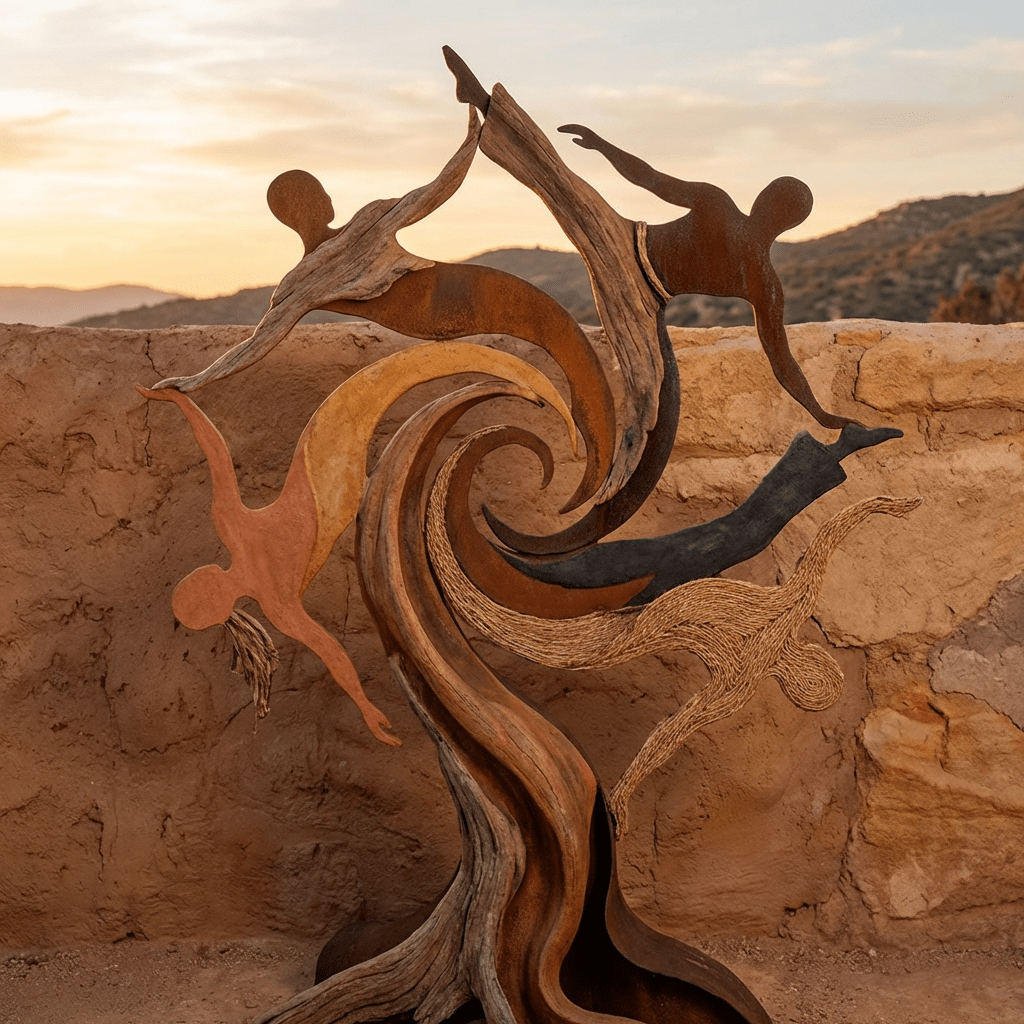
A breathtaking mixed-media sculpture depicts figures flowing together in a graceful, spiraling dance against a desert sunset.
The relentless expansion of capitalist logic has profoundly impacted cultural forms, transforming them into marketable commodities, a process that is particularly visible and damaging when applied to practices with deep spiritual and historical roots, such as Capoeira Angola. This process of cultural commodification, viewed through a critical lens, functions as a powerful mechanism of alienation. It systematically strips a practice like Capoeira Angola of its original, integrated social, spiritual, and historical context, reframing its purpose solely to serve the accumulation of capital. The art is pulled from its organic community setting—the roda (circle), the terreiro (sacred ground), and the oral tradition—and re-packaged for global consumption.
The production, packaging, and consumption of Capoeira in contemporary capitalist society often prioritize spectacle, marketability, and standardization over its deep-rooted philosophical and communal foundations. The authentic experience, which encompasses the history of resistance, the specific rhythm and movements of a tradition passed down from enslaved Africans, and the philosophical dialogue between players, is often sidelined. Instead, commercial studios and international workshops tend to focus on the acrobatic, easily digestible aspects of the art, which translate better to consumer demand for fitness, performance, and easily quantifiable skill acquisition.
This trend not only undermines the integrity of Capoeira but also obscures the rich cultural narratives that inform it, reducing a multifaceted practice to mere entertainment. The vibrant community ethos that traditionally accompanied Capoeira, characterized by collective participation and shared learning, is frequently replaced by a competitive spirit fueled by individual accomplishment. This simplification and emphasis on the superficial inevitably leads to a dilution of its essential elements—the subtle dialogue of the game, the intricate meanings of the songs and instruments, and the critical consciousness embedded within the practice, leaving future generations disconnected from the profound social and historical context that gives Capoeira its true meaning and significance.
Furthermore, this transformation fosters a profound disconnection between the practitioner and the full, authentic experience of the art. The historical trauma, resilience, and spiritual depth that gave birth to Capoeira Angola become mere footnotes in a commercial curriculum. Practitioners, especially those in Western contexts, may relate to the practice primarily as a form of exercise or an exotic hobby, rather than as a living historical document and a mode of cultural resistance. This alienation is twofold: it separates the art from its cultural producers (the Mestres and the communities of origin) by turning their knowledge into a purchasable good, and it separates the new practitioner from the art’s true, transformative power by presenting a sanitized, commodified version devoid of its radical core. The challenge, therefore, lies in preserving the integrity, philosophical weight, and communal structure of Capoeira Angola against the overwhelming pressure to conform to the standardized, profit-driven dictates of the global market.
How can a Capoeira Angola teacher navigate this commodification process in a way that is beneficial for themselves and their students?
This pervasive challenge requires a highly sensitive and delicate balance—it demands acknowledging the practical economic realities of sustaining a professional teaching practice and an escola (school) while simultaneously erecting defenses against the commercial pressures that inherently threaten the art’s cultural integrity, philosophical depth, and spiritual essence. A truly dedicated teacher must move beyond mere passive instruction and consciously employ proactive strategies that transform the traditional classroom space and the roda into a powerful site of cultural resistance, rather than allowing it to become just another compliant node in the global cultural market.
This navigational strategy involves several interconnected and mutually reinforcing principles:
Reclaiming and Prioritizing Educational Autonomy and Integrity: The core of this resistance lies in consciously moving the curriculum’s emphasis away from purely physical, measurable, and easily marketable techniques. The teacher must prioritize the holistic transmission of the art’s complete system: its profound history, its foundational Afro-Brazilian philosophy and worldview, its complex musicality (the berimbau and accompanying instruments), its songs (the quadras and chulas), and the deep ritual structure of the roda. This intentional focus ensures that students internalize Capoeira Angola as a complete, integrated, and living system of decolonial knowledge, historical memory, and resistance—not merely a convenient form of physical exercise, competitive sport, or a shallow consumer-grade entertainment product designed for immediate gratification.
Developing Ethical Pricing and Sustainable Access Models: To actively resist the market’s tendency to restrict cultural access only to those who can afford a high price, the teacher must develop sustainable and socially conscious financial models for the escola. This ethical approach directly counters economic exclusion. Practical solutions might include:
Sliding Scales: Implementing a tiered payment structure based on a student’s economic capability.
Community Outreach Programs: Actively recruiting and subsidizing training for students from economically disadvantaged or historically marginalized communities.
Cooperative or Collective Structures: Shifting the financial burden away from a purely transactional model toward a system where students and community members collectively contribute time, skills, and resources to the escola‘s maintenance and growth, fostering a deeper sense of ownership. This deliberate strategy ensures that financial hardship does not become a barrier to the preservation and transmission of this vital cultural heritage.
Fostering Critical Consciousness and Cultural Stewardship: A crucial element of the pedagogy must involve educating students not just about the history of Capoeira Angola, but about the very modern-day processes of commodification and cultural appropriation that are at play. By discussing market forces, media portrayals, and the historical struggle for cultural autonomy, the teacher empowers students to become highly informed, critically engaged participants and proactive protectors of the tradition. The goal is to move the student’s role from that of a passive consumer of a commercial product to that of an active steward, critical thinker, and responsible guardian of the art’s future.
Prioritizing the Comunidade (Community) over the Market:
Ultimately, navigating commodification requires a foundational philosophical shift in how the training environment is conceptualized and structured. The teacher must rigorously structure the roda and the entire training process to emphatically emphasize principles derived from Afro-Brazilian communal values:
Mutual Respect (Respeito) and Cooperation: Countering the hyper-individualism and self-interest promoted by capitalist competition. The roda must be a space for mutual upliftment, where the development of the collective is paramount.
Historical Memory and Ancestry: Ensuring that every practice is consciously tied to the lineage, the Mestres (Masters) of the past, and the original context of the art’s creation, thus resisting the market’s drive toward constant, decontextualized innovation for novelty’s sake.
Collective Development and Shared Responsibility: Structuring assessment and progression around contributions to the community and the roda, rather than solely on quick, measurable, individual physical results (which cater directly to a consumer mindset seeking fast, tangible returns on investment).
By intentionally embedding these collective, philosophical, and ethical principles into every facet of the escola and the roda, the Capoeira Angola teacher can ensure their practice remains economically sustainable without sacrificing the soul, purpose, and revolutionary integrity of this profound African-Brazilian art form.
How can we properly preserve Capoeira Angola as complete as possible, despite this process [of commodification]?
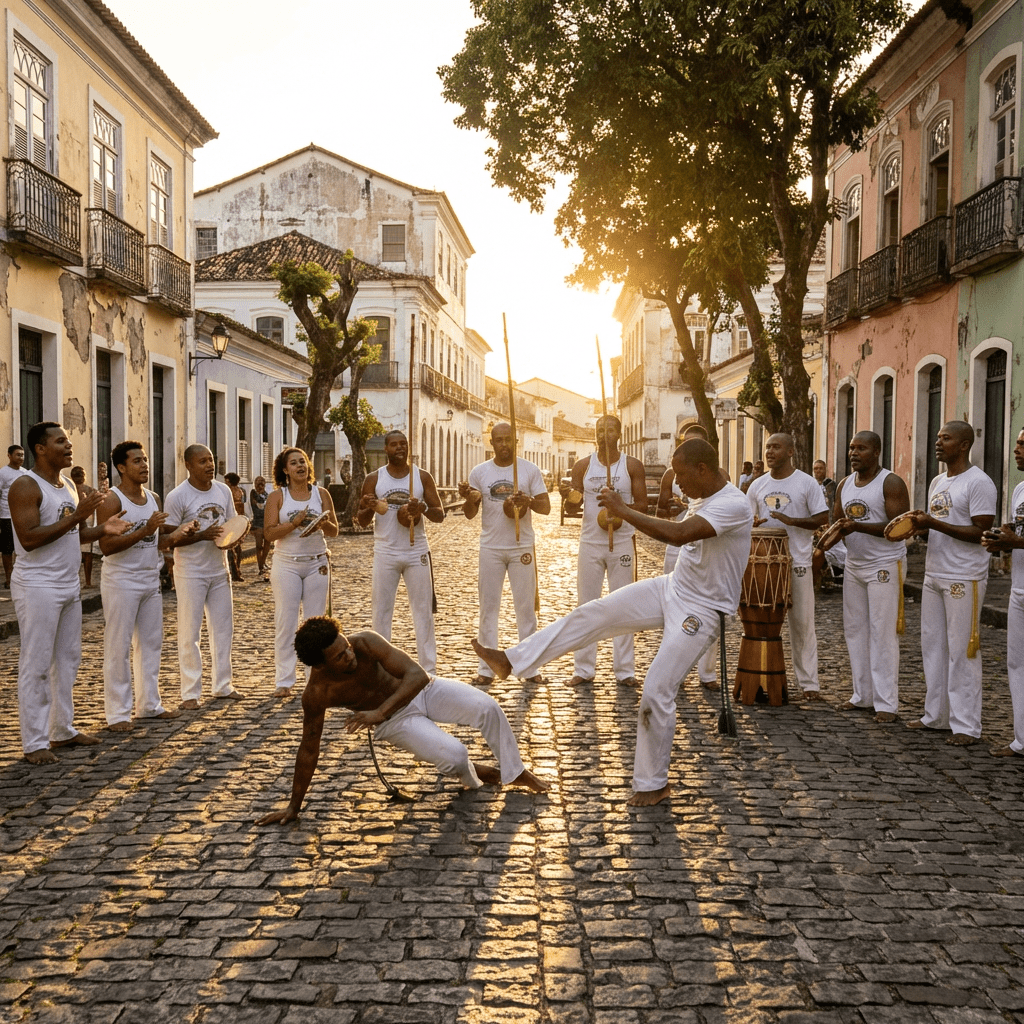
Practitioners showcase the rhythmic beauty of Capoeira during a golden hour performance in a historic Brazilian street.
The essential challenge in the modern global landscape is the preservation of Capoeira Angola’s completeness—its interwoven tapestry of fight, dance, music, history, philosophy, and spirituality. This totality demands active, intentional, and multi-faceted effort to resist the fragmenting and reductive forces of commodification that often prioritize marketable elements over deep cultural integrity.
The preservation of this complex art form hinges on several critical, interconnected actions:
1. Maintaining the Integrity of the Roda as a Sacred and Cultural Space
The roda is the crucible of Capoeira Angola, the essential arena where all its components converge. Preservation requires uncompromising vigilance in upholding its traditional structure, hierarchy, and musical canon.
Upholding Ritual Structure: The roda must be maintained as a ritual space—a circle of shared cultural performance, dialogue, and spiritual connection—and not permitted to devolve into merely a venue for athletic display or competitive spectacle. This includes adhering to the proper seating arrangement, the sequence of instruments, the call-and-response dynamics, and the appropriate reverence shown to the instruments and the space itself.
Prioritizing the Musical Core: The berimbau and the complete bateria (instrumental ensemble) are the heart and voice of the roda. Protecting the traditional rhythms (toques) and the historical song canon is paramount. The music dictates the energy, pace, and philosophical depth of the game (jogo); its authentic preservation prevents the roda from becoming a silent, purely physical exercise.
Honoring Hierarchy and Authority: The traditional hierarchy, centered around the Mestre (Master) and experienced players, is essential for maintaining order, safety, and the transmission of nuanced, often non-verbal knowledge. Respect for this structure safeguards the art from being dictated by transient, commercial interests or inexperienced practitioners.
2. Deepening the Historical, Philosophical, and Cultural Rootedness
Capoeira Angola is fundamentally an embodied form of historical memory and political resistance. Its preservation requires practitioners to continuously emphasize its profound link to the broader history of the Black Diaspora, African spiritual traditions, and anti-colonial resistance movements.
Understanding as Historical Memory: Students must be taught to understand the practice not just as a martial art or dance, but as a living testament to the resilience, ingenuity, and cultural survival of enslaved Africans in Brazil. This ensures the practice is understood as a form of political action and a continuous conversation with ancestral knowledge.
Integrating Philosophy and Malícia: Beyond physical technique, the philosophical principles—such as humility, respect, community (comunidade), and malícia (a complex blend of cunning, wisdom, and street-smarts)—must be central to the curriculum. This depth of character training is what separates Capoeira Angola from a purely physical discipline.
Engagement with Source Culture: Practitioners must be encouraged to engage deeply with Brazilian and African history, language (Portuguese), music, and spiritual practices (where appropriate to the individual and lineage) to understand the full context from which Capoeira Angola emerged.
3. Protecting Oral Tradition, Pedagogy, and Lineage (Linhagem)
Commodification thrives on standardization and mass-produced curricula, which often strip the art of its subtlety and personal touch. The traditional mode of transmission is crucial to resist this simplification.
Prioritizing Direct Transmission: The art form must safeguard the direct, hands-on transmission of knowledge and wisdom from Mestre to student. This intimate relationship fosters an understanding of the jogo that cannot be codified in books or videos. The knowledge is personal, contextual, and often passed on through observation, correction, and shared experience.
Honoring the Linhagem: Recognizing and actively honoring the continuity of the teaching lineage is vital. This establishes a sense of accountability to the past Masters and their unique contributions, preventing the practice from being detached from its historical roots and becoming a generic, self-invented interpretation.
Preserving the Nuanced Oral Culture: The traditional pedagogy relies heavily on oral tradition, metaphor, song, and subtle, non-verbal cues. This nuanced culture, which commercialization often seeks to simplify and formalize into static, easily digestible curricula (e.g., rigid belt systems or standardized lesson plans), must be actively protected.
4. Engaging with the Global Community Critically and Ethically
While Capoeira Angola’s global spread is a testament to its power and universal appeal, this expansion must be managed with stringent ethical considerations and profound respect for the source culture.
Setting Ethical Boundaries: The global community must prioritize ethical stewardship, ensuring that the art is not reduced into a generic “world music” background, a mere “fitness trend,” or a commodity stripped of its cultural context. This includes educating local instructors on the importance of cultural fidelity.
Support for Source Communities: Global schools and practitioners must find ways to ethically support the continued practice and existence of the art in its places of origin (Brazil), ensuring that the economic benefits of its globalization flow back to the traditional communities.
Distinction from Commercialized Forms: Practitioners must be clear about the distinction between Capoeira Angola and more commodified, gymnastic styles of Capoeira, and advocate for the unique importance and preservation of the Angola tradition’s deep cultural substance.
Preservation, in this context, is not a passive plea for stagnation or isolation. It is the active, conscious, and complex practice of the tradition in its complete and demanding form within the dynamic, often turbulent, pressures of the modern world. It is a continuous act of resistance against cultural erasure.
Now, I have a treat for you. The inspiration for this post, “Commodification and Capoeira Angola: Preserving an African Art in a Western World,” didn’t spring from a vacuum. It was sparked by a fascinating and rather intense conversation I had with two people deeply immersed in the world of Capoeira: my Capoeira sister, Liza Bernstein, and my highly respected Capoeira Teacher, Charles Williams.
We were wrestling with the core challenge of how to maintain the spiritual, cultural, and historical integrity of Capoeira Angola—an inherently anti-colonial, African-rooted art form—while navigating the commercial pressures and cultural appropriations so common in a Western context. It’s a conversation about survival versus popularization, tradition versus trend.
In the midst of this dialogue, Liza—always a fantastic source of academic insight—mentioned a seminal dissertation that directly addresses this very subject. The work was authored by Womualy Omowale. This academic work provides a deep dive into the mechanisms of commodification and the preservation strategies employed by practitioners.
To further enrich the discussion and provide a primary source perspective, Liza also shared a compelling video with me, which I am now sharing with you. Fair warning: this video is entirely in Portuguese, the language of Capoeira’s origin and the essential tongue for understanding its deepest cultural nuances. And honestly, if that poses a problem for you, then maybe you should just LEARN THE LANGUAGE!
The challenge of learning Capoeira Angola without relying on immediate translation is not merely an inconvenience to be overcome; it is, fundamentally, a transformative opportunity and a crucial gateway to truly understanding the profound art form you are engaging with. To truly engage with Capoeira is to wholeheartedly embrace its complete ecosystem: its language (primarily Portuguese), its deep and often challenging history, its philosophical underpinnings, and the vibrant, complex culture from which it emerged. Attempting to master the art while clinging to the ‘crutch’ of constant, on-demand translation creates a barrier, preventing a fluid and intuitive integration of the physical, musical, and oral traditions. Therefore, the accompanying video is designed as a foundational component of that deeper, essential education, urging the student to immerse themselves fully and directly into the heart of the art form’s authentic expression.
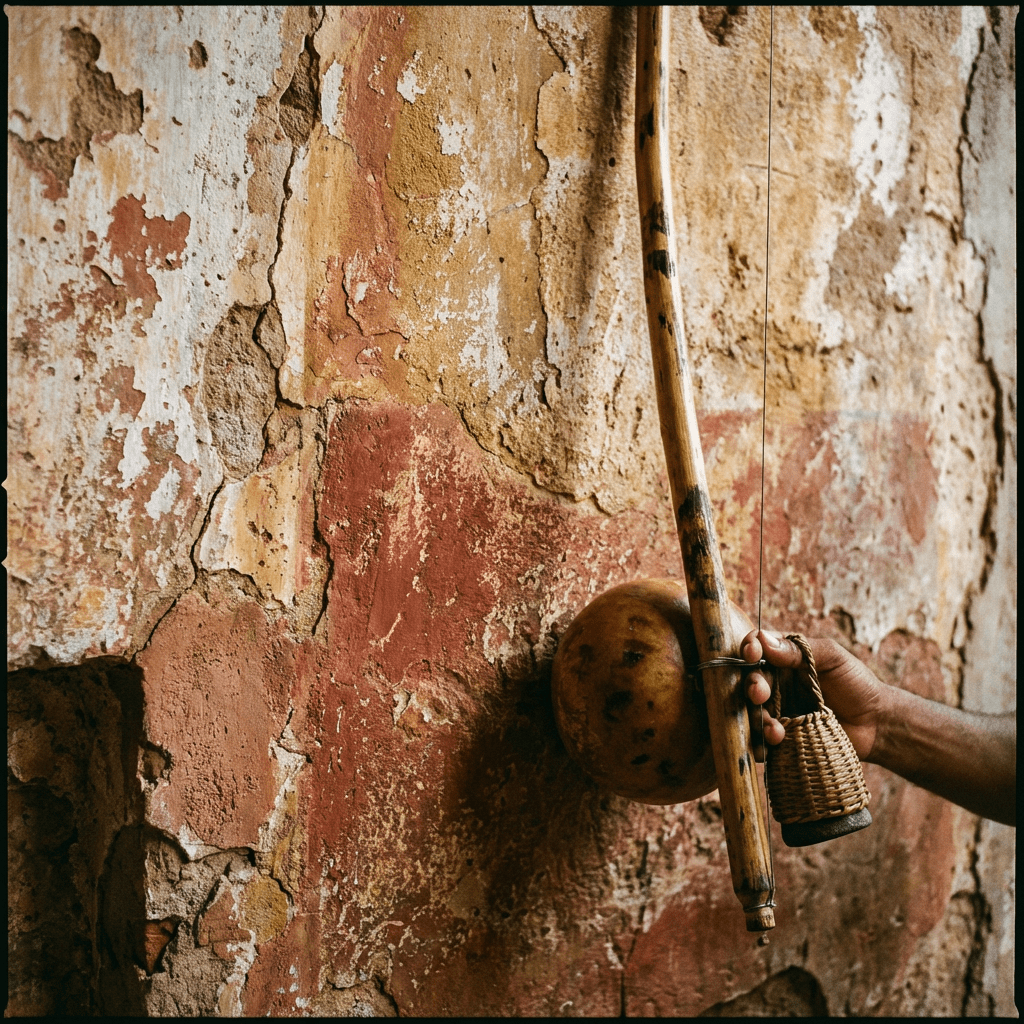
A traditional Brazilian berimbau is held against a rustic, peeling wall, showcasing the beauty of Capoeira culture.
I recently had the opportunity to watch a compelling documentary on Netflix that immediately sparked a deep line of questioning about the current state of manhood.
Louis Theroux is back, delivering a thought-provoking, and arguably controversial, look into the so-called ‘manosphere.’ This feature-length documentary, titled Louis Theroux: Inside The Manosphere, follows Louis from the sun-drenched streets of Miami to the exclusive resorts of Marbella, introducing us to the figures and followers who are actively working to reshape—and in the view of many, radicalise—the fundamental ideas that young men hold about masculinity and manhood. The film premiered on March 11th and is currently available to watch on Netflix.
Setting aside my own critical observation that the documentary seems to miss the mark in several ways concerning an accurate portrayal of the “manosphere” as a whole, the central question it raises is unavoidable: What has truly become of masculinity in this contemporary age? It feels distinctly like a profound departure from the values and examples that shaped my own understanding—the quiet strength, responsibility, and moral compass I learned from my father, his generation of friends, and the elders who were formative influences in my life.
This widespread cultural conversation about what it means to be a man has only intensified following the documentary’s release.
Performative vs. Authentic Masculinity
Louis Theroux’s documentary, by highlighting polarizing figures such as Andrew Tate, has thrust the debate about masculinity back into the mainstream spotlight. The figures gaining the most attention are often those championing a rigid, aggressive, and often explicitly anti-feminist brand of manhood. However, I believe the core of the public discussion is fundamentally misplaced, focusing too narrowly on the symptoms of a societal malaise rather than its historical root. We are witnessing a public obsession with performative masculinity—a hollow, manufactured display—while the genuine article, authentic masculinity, remains obscured.
A closer look at history suggests that the issue is not with the concept of masculinity itself, but rather with the distorted form it has been allowed to take in a modern, disconnected world. Historically, the virtues associated with manhood—strength, courage, discipline, and protectiveness—were not divorced from morality, honor, and self-control. They were, in fact, contingent upon them.
Consider the early 19th century in Britain, where one of the most celebrated men was a legendary prizefighter named John “Gentleman” Jackson (1769–1845). Jackson was a brutal, successful combatant by trade—the bare-knuckle champion of England. Yet, he was simultaneously revered as a mentor and teacher, a man who commanded the respect and admiration of poets, politicians, and the upper echelons of society, including the renowned Romantic poet Lord Byron.
Jackson’s nickname, “Gentleman,” was earned not in spite of his profession, but because of the character he demonstrated within and outside of it. He embodied a powerful, physical form of masculinity tempered by discipline, integrity, and grace. He founded a highly respected academy for “pugilistic science” where he taught the aristocracy how to fight, not just for aggression, but as a discipline—a way to build physical fortitude and moral courage. Jackson understood that true strength required a gentle hand and a well-regulated mind. His legacy serves as a powerful reminder that the man of action and the man of character were once considered two sides of the same coin, proving that genuine power is rooted in self-mastery, not dominance over others.
The modern crisis, therefore, is not a crisis of masculinity but a crisis of character. In the absence of authentic examples, men are adopting extreme, cartoonish personas—the performative mask—to signal belonging and strength in a world that offers them few genuine rites of passage or moral frameworks. The challenge is to retrieve the historical, richer understanding of authentic masculinity, one where strength is in service of honor, and power is a tool for responsibility.
So, what accounts for the dramatic shift between Jackson’s era and our own?
The key distinction lies between performative masculinity—a superficial display often built on aggressive posturing and material wealth—and the authentic, enduring masculinity that is forged through pressure, genuine responsibility, and meaningful real-world experience.
From the raw, unscripted arenas of Georgian prizefighting, where survival depended on raw grit and honor, to the controlled, highly-regulated environments of modern combat sports like professional boxing, MMA, and jiu-jitsu, a consistent, undeniable thread of authentic masculine development exists. This profound thread connects acts of physical courage—the willingness to face a difficult opponent or challenge—with the deeper, often overlooked necessity of moral responsibility. The courage displayed in the ring must be mirrored by the integrity shown in life. The pursuit of genuine manhood is not, in my view, what the popular media—or the sensationalist documentary that seeks to define it through controversy and fleeting trends—is currently suggesting.
The genuine path to manhood is rarely found in the fleeting glow of viral videos, the performative posturing on social media, or the insular, aggressive echo chambers of online discourse. Instead, it is forged in the crucible of real-world experience: in the demanding, challenging, and often painful character-building experiences of life. It’s found in showing up when it’s difficult, honoring one’s commitments, and accepting the full weight of one’s consequences. This is a path of action, not mere assertion.
So, what is authentic masculine development? It is the conscious, continuous effort to integrate strength with discipline, courage with compassion, and capability with humility. It is the journey of transforming latent potential into reliable, ethical action.
Authentic masculine development is not a passive state, but a dynamic, lifelong process of self-cultivation. It is the conscious, continuous effort to integrate inherent strength—both physical and mental—with rigorous self-discipline, ensuring power is directed constructively and ethically. This development requires merging profound courage—the willingness to face fear and uncertainty—with genuine compassion, extending kindness and understanding outward to others and inward to oneself. Furthermore, it demands combining robust capability and competence—the honed skills and knowledge to navigate the world effectively—with deep humility, acknowledging one’s limitations and remaining open to growth and learning.
Fundamentally, this is the demanding yet profoundly rewarding journey of transforming latent potential—the raw abilities, the undiscovered strengths, and the deep, often intimidating emotional and intellectual reserves within every man—into reliable, ethical, and courageous action in the world.
It is about moving past passive contemplation to active contribution; not merely possessing good intentions, but consistently embodying them. This process is the crucible for building a resilient character, one that is emphatically not defined by outdated metrics of bravado, unearned confidence, or the need for dominance and control over others.
The modern definition of manhood is not built on outdated stereotypes of stoicism or physical dominance, but on a more robust and ethical framework anchored by three fundamental principles: Unwavering Integrity, Profound Responsibility, and The Commitment to Purpose and Service.
1. Unwavering Integrity
This is the bedrock of modern manhood. Integrity is the active and constant commitment to align one’s private reality—core values, secret thoughts, and internal moral compass—with one’s public life—spoken words, outward actions, and decisions. It is not merely the absence of deceit, but the presence of consistent moral discipline.
Trustworthiness and Transparency: It means being a reliable person whose word is a bond. This involves transparency in one’s dealings, sharing intentions honestly, and avoiding the creation of misleading appearances.
Accountability Before Coercion: A man of integrity holds himself accountable for his actions and failures before external pressure or discovery forces him to do so. This proactive ownership is a hallmark of true character, demonstrating self-respect and respect for others.
The Cost of Convenience: Integrity is most critically tested when it is inconvenient or costly. The modern man chooses the harder, ethical path over the easier, compromised one, even if it entails financial loss, social discomfort, or personal sacrifice.
2. Profound Responsibility
Manhood demands an active and conscious acknowledgment of one’s duties and the subsequent, vigorous effort to shoulder those burdens. It is an expansive concept of duty that extends far beyond self-interest.
Duty to Self and Growth: Responsibility begins with the self—to maintain one’s health, mental acuity, and moral fitness, and to continuously strive for personal development and emotional maturity.
The Family and Immediate Community: This involves providing stability, emotional support, and leadership within one’s family unit, and being a reliable pillar within one’s immediate circle of friends and colleagues. It is the commitment to not be a burden, but a source of strength.
Ownership of Mistakes and Repair: A profound sense of responsibility means taking complete ownership of one’s missteps, failures, and the consequences they create. It is not enough to simply apologize; the modern man dedicates his energy, resources, and time to the arduous process of repair, reconciliation, and subsequent behavioral growth.
Civic and Global Duty: Extending one’s sphere of responsibility to the wider community and the world, recognizing a duty to contribute to social justice, environmental stewardship, and the overall well-being of the broader society.
3. The Commitment to Purpose and Service
The essence of a meaningful life, and therefore of modern manhood, lies in transcending purely selfish or material pursuits. A man must find a meaningful mission that drives him, dedicating his unique gifts and energy toward its realization.
Identifying a Mission: This requires deep introspection to identify a purpose, mission, or cause that resonates with one’s core values—whether it is in art, business, education, or community activism. The mission acts as a moral and professional compass.
Contribution Over Consumption: The energy and talents developed are not merely tools for personal gain or accumulating wealth, but are deployed in service of this greater purpose. This means intentionally fostering an environment of support, opportunity, and flourishing for those within one’s influence—mentoring, building, and contributing to systems that benefit others.
Leaving a Legacy of Value: The ultimate aim is to leave the world, or at least one’s corner of it, better than one found it. This service-oriented mindset transforms ambition from a narcissistic pursuit into a powerful engine for collective good.
True strength, in this elevated and complex context, is fundamentally redefined. It is not measured by physical dominance or unfeeling stoicism. Instead, it is measured by self-control in the face of temptation, emotional intelligence in navigating relationships and internal conflicts, and the quiet, persistent effort—the daily grind of doing the right thing—required to maintain these high ethical standards amidst the inherent complexities, temptations, and ceaseless challenges of the modern world.
So, how does this process of authentic masculine development apply specifically to an angoleiro?
An angoleiro, as a practitioner of Capoeira Angola, embodies a role deeply rooted in tradition, community, and a nuanced understanding of self and history. The journey of masculine development for an angoleiro is intrinsically linked to the philosophy and practice of their art.
Embracing Tradition and History: Authentic masculinity, in this context, requires the angoleiro to deeply internalize the history and lineage of Capoeira Angola. This is not merely an intellectual exercise but a physical, emotional, and spiritual connection to the masters, or mestres, who preserved and developed the art. The maturity of the angoleiro is reflected in their respect for tradition, their commitment to the established rituals of the roda, and their dedication to passing this cultural heritage on to the next generation. This act of preservation is a powerful expression of responsible manhood—one that honors the past to enrich the future.
The Role of Malícia and Patience: The jogo (game) of Capoeira Angola demands qualities that mirror authentic masculine maturity. Malícia, often mistranslated as malice, is better understood as cunning, street-smarts, and psychological wisdom. A developed angoleiro uses malícia not for aggression, but for strategic self-protection and to control the flow of the game. Coupled with this is profound patience. The slow, grounded movements of Angola require the discipline to wait, to observe, and to choose the precise moment for action—a metaphor for thoughtful, measured conduct in life outside the roda.
Leadership and Community (The Roda): The roda itself is a microcosm of community and leadership. The angoleiro’s development is evident in their capacity to lead the music, maintain the energy of the roda, and ensure the safety and inclusion of all participants. True strength is demonstrated not through physical dominance, but through the ability to harmonize the group, support newer players, and humbly accept correction from elders. This sense of shared responsibility and servant leadership is a cornerstone of mature masculinity.
Groundedness and Self-Knowledge: The low, close-to-the-earth stance of Capoeira Angola symbolizes groundedness and humility. Authentic masculine development for the angoleiro involves cultivating this internal state—being rooted in one’s values, aware of one’s limitations, and connected to the immediate reality of the moment. The constant, subtle dialogue between two players in the jogo forces intense self-awareness. The angoleiro must know his own fears, strengths, and reactions to truly engage with his partner, a process that accelerates self-knowledge and emotional regulation.
In essence, for the angoleiro, authentic masculine development is a lifelong process articulated through the practice of Capoeira Angola—a commitment to wisdom over brute strength, community service over personal glory, and historical reverence over fleeting trend.
The human experience is, at its core, a constant and vigorous contest—not primarily with external forces, but with the complex and often contradictory landscape of one’s own soul. This reflection on identity, responsibility, and the direction of your life acknowledges a profound and inescapable truth: there is a real battle happening—not just in the world, but within every man. This internal conflict is not a metaphor; it is the daily, high-stakes crucible in which character is forged or forfeited, determining the quality and impact of one’s entire existence.
The Three Fronts of the Internal Conflict
This internal war is a ceaseless, high-stakes confrontation waged across three primary fronts, each demanding intentionality and vigilance:
1. The Battle Between Discipline and Distraction
The first front is the struggle for consistent action. A battle between discipline and distraction. Discipline, the committed, consistent action toward a defined and worthy goal, represents the high road of self-mastery. It is the arduous, yet rewarding, choice to delay gratification in favor of long-term achievement. It is the accumulated power of small, intentional sacrifices. Distraction, whether manifested as aimless consumption of media, chronic procrastination, or the strategic avoidance of necessary discomfort, is the path of least resistance. It is the insidious erosion of potential, leading inevitably to stagnation and regret. To choose discipline is to choose the future you envision; to yield to distraction is to remain trapped in the comfort of the present moment.
2. The Battle Between Purpose and Self-Sabotage
The second front concerns the direction and momentum of your life. It is a struggle between purpose and self-sabotage. Purpose provides the essential compass, the unwavering why, and the deep-seated momentum that gives weight and meaning to daily efforts. It anchors a man to a vision greater than his immediate wants. Self-sabotage, however, is often insidious and unconscious, the tendency to actively undermine one’s own success and happiness. It operates through the voices of fear, doubt, and destructive habits, ensuring that extraordinary potential remains tragically unfulfilled. This self-inflicted wound stems from a deep-seated fear of success or an unconscious belief in one’s own unworthiness, making the internal victory over self-sabotage a prerequisite for external achievement.
3. The Defining Choice: Destiny vs. Mediocrity
Most critically, this is a spiritual and existential defining choice between who God called you to be—and who you settle to become. This spiritual dimension frames the entire conflict as one of destiny versus voluntary mediocrity. The “called” self is the integrated, fully realized individual operating in alignment with their highest values, intrinsic gifts, and divine design. It is the self capable of operating at maximum influence and integrity. The “settled” self is the version of you that capitulates to ease, fear, and the low expectations of the world, choosing the temporary comfort of the familiar over the challenging, yet rewarding, covenant of their potential. The victory here is the courageous act of choosing one’s destiny over comfort.The Foundation of Radical Responsibility
A man may not choose his starting point. The circumstances of birth, the wounds of childhood, the initial resources provided—all of these are outside the sphere of his initial control. You may not control how you started. These facts are the unchangeable historical context of your life.
However, the immense and sovereign power of human agency rests entirely in the present and the future. But you are responsible for how you finish. This statement is not an accusation; it is a clarion call to radical responsibility. It demands a profound shift in perspective, moving the focus from the factors that acted upon you (victimhood) to the choices you make now (agency). Radical responsibility demands ownership not just of one’s deliberate actions, but of one’s entire life trajectory, emotional state, and spiritual condition. It is the rejection of the external blame game and the full acceptance of the power inherent in the present moment to choose differently.
The Pathway to Transformation: Alignment and Action
The pathway out of the inner war and into a life of meaning and impact begins with a deliberate, foundational shift. Alignment with God changes everything. This is not merely a passive religious sentiment, but a structural change in the mind, spirit, and life architecture. It is the deliberate decision to anchor your life to a transcendent, unwavering standard and principle, thereby gaining irrefutable clarity on what is truly important, eternal, and worth dedicating your life to. This higher standard provides the blueprint for the “called” self.
This alignment initiates the transformative process, which requires continuous, disciplined effort and commitment:
When you renew your mind: This is the internal revolution, the intellectual and spiritual dismantling of the settled self. It means actively identifying and replacing old, limiting beliefs, negative self-talk, and patterns of scarcity with empowering truth. It is the daily practice of replacing the worldview shaped by fear, trauma, and culture with the truth revealed through spiritual principle and clear vision. This mental overhaul is the first battleground.
Develop discipline: Discipline is the bridge between a high-minded intention and a grounded reality. It is the practiced ability to consistently do what must be done when it needs to be done, regardless of fleeting mood or inclination. It is the accumulation of small, consistent acts of fidelity to one’s defined purpose, which builds an unshakeable foundation of reliability and self-trust.
And commit to growth: This is the lifelong posture of the learner, the rejection of finality, and the courageous embrace of challenge. It means actively seeking out opportunities for intellectual, emotional, and spiritual expansion. To commit to growth is to accept that you are an ongoing project, always becoming, never fully arrived, and always capable of more.
How does this apply to an Angoleiro, a practitioner of Capoeira Angola, whose very art is a profound study in the tension between internal discipline and external expression, between self-mastery and dynamic interaction?
The principles of “Radical Responsibility” demand that the Angoleiro acknowledge that the roda is a mirror of their internal state. Every movement, every chapa, every evasive coccix is not merely a physical technique, but a manifestation of their commitment, their focus, and their emotional control. If an Angoleiro enters the roda carrying fear, anger, or distraction, those internal states will manifest as clumsy footwork, predictable attacks, or a failure to read their opponent (the jogador). The internal war is fought and won not just in hours of solo training, but in the moment-to-moment decisions within the game.
Radical Responsibility means the Angoleiro takes full ownership of the quality of the game. If the music falters, it is their responsibility to sing louder. If the energy drops, it is their responsibility to invite greater connection and challenge through their movement. They do not blame their partner for a poor game, nor the mestre for a difficult challenge, nor their own lack of sleep for a slow response. Instead, they recognize that their level of presence is the only factor they can truly control. This responsibility extends beyond the technical execution of the jogo. It encompasses the cultural and historical weight of the art. An Angoleiro is responsible for upholding the integrity, respect (axé), and philosophical depth of Capoeira Angola, ensuring that their practice is a living testament to the resilience and wisdom of its Afro-Brazilian origins. In essence, for the Angoleiro, radical responsibility is the commitment to being a vessel for axé—the vital life force and energy of the art. They understand that to truly play Capoeira Angola is to engage in a continuous, conscious practice of bringing their highest self, their most disciplined mind, and their most generous spirit into the circle.
The Consequence: A Higher Level of Living
The inevitable consequence of this transformation is a fundamental elevation of one’s existence—you step into a higher level of living. This elevated life is not defined by material wealth or societal acclaim, but by intrinsic value, integrity, and profound impact. It is characterized by three markers:
A life of purpose: Every action is infused with meaning, contributing to something greater than self-gratification. The man knows his why and organizes his what around it.
A life of responsibility: The man accepts his essential role as a steward of his gifts, his relationships, and his entire sphere of influence. He becomes reliable, dependable, and a bedrock of strength for his family, community, and those he leads.
A life that produces: The focus shifts decisively from passive consumption to active creation. This life generates tangible value—whether through mentorship, art, entrepreneurship, service, or dedicated family stewardship—leaving a positive and enduring legacy that outlasts the man himself.
This is discipleship. It is the comprehensive, holistic process of self-mastery under a higher standard, culminating in a life that is intentional, fruitful, and fundamentally aligned with the design of its Creator. It is the courageous act of winning the inner war and becoming the man you were always meant to be.
A heartfelt SHOUT OUT is extended to Byron Rodgers for the creation and generous sharing of this insightful video content.
For those seeking more of this valuable material, we encourage you to subscribe to the MAN OF PEACE podcast on YouTube.
I like to say in regards to “techniques”, I like to say that the BEST technique done at the WRONG time will never work, but the WORST technique done at the RIGHT time, will always work.
Every martial art, at its core, holds value and possesses techniques that are effective in specific circumstances. The common adage that “every martial art works” is generally true, but this statement must be qualified by the understanding that effectiveness is entirely dependent on the situation. No single martial art is a universal panacea for all forms of conflict.
The fundamental dilemma for any serious practitioner is a matter of time and human limitation. It is simply an impossibility for any individual to dedicate the necessary decades to learn, practice, and ultimately master every martial discipline that exists in the world. Consequently, no one person will ever achieve a state of being victorious in all possible scenarios—be it a grappling engagement, a striking exchange in an open field, a weapons defense in a cramped space, or a multiple-attacker situation.
What, then, is the ultimate answer to this complex challenge? The solution lies not in accumulating an exhaustive repertoire of techniques, but in cultivating adaptability. A fighter must be flexible enough, both mentally and physically, to rapidly adjust their learned skills to the immediate, unpredictable demands of the unfolding situation.
This adaptability manifests in several key ways:
Mental Flexibility: The practitioner must not be rigidly bound to a pre-planned strategy or a specific “school” of fighting. They must be prepared to discard an approach that is failing and transition instantly to one that is better suited to the new range, environment, or opponent’s actions.
Transitional Skill: True mastery involves recognizing the universal principles that underpin all combat, such as balance, distance management, timing, and structural integrity. A truly adaptable fighter can translate these principles across different ranges—moving seamlessly from striking to clinching, to ground work, and back again—regardless of the specific martial art they initially studied.
Situational Awareness: Adaptability requires acute perception of the environment (e.g., uneven ground, obstacles, lighting, presence of bystanders) and the nature of the threat (e.g., armed or unarmed, singular or multiple opponents, aggressive intent). The learned techniques must be modified, simplified, or entirely abandoned based on these external factors.
In essence, while different martial arts provide the tools, adaptability is the intelligence that chooses the right tool for the right moment. It is the core philosophy that allows a limited set of learned skills to be maximized across an infinite variety of conflicts, making it the most critical trait for survival and effectiveness.
The Indispensable Role of Digital Media in Preserving and Propagating Capoeira Angola
Online videos and digital archives stand as an absolutely vital, irreplaceable resource for the preservation and dynamic transmission of Capoeira Angola. This profound cultural practice is far more than a mere sport; it is an intricate, multi-faceted blend of music, fluid movement, practical self-defense, and rich, layered history. These digital visual archives are crucial because they meticulously capture and document the art form’s core characteristics: the incredible agility of the practitioners, the depth of its technical vocabulary, and the complex, strategic interactions (jogos) that unfold within the roda.
A Testament to History and Community
Beyond the physical spectacle, the footage powerfully illuminates Capoeira Angola’s deep historical and profound cultural significance. It is portrayed not just as an artistic endeavor, but as a crucial, unifying social force. The communal space of the roda—the circle where Capoeira is played—is a microcosm of society where bonds are strengthened, respect is actively fostered, and a powerful sense of collective identity is vividly expressed and reinforced. By embodying core values such as resilience in the face of adversity, spontaneous creativity, and fierce cultural pride, the visual record serves as a profound wellspring of inspiration for current and future generations of practitioners across the globe.
The Essential Context of Narrative and Pedagogy
A particularly significant and irreplaceable element of this digital preservation is the inclusion of extensive interviews and personal narratives from highly esteemed mestres (masters) and high-ranking, experienced students. Their voices provide essential, often oral-based, historical context, creating a direct and living bridge between the art’s complex historical origins—often rooted in resistance and survival—and its robust, contemporary global practice. These personal accounts offer unparalleled, intimate insights into the philosophical underpinnings of Capoeira and its transformative personal and social impact on individuals and communities alike. They capture the pedagogical wisdom that has been passed down, often unbroken, for generations.
Conclusion: An Invaluable, Living Cultural Record
Ultimately, the comprehensive visual record of Capoeira Angola is an invaluable, multi-dimensional resource. It is indispensable for a complete appreciation of its history, for a deep understanding of its sociological complexity as a community-building tool, and for recognizing it as a powerful, dynamic, and perpetually living form of cultural expression. It stands as a compelling testament to the power of human unity, the enduring spirit of resistance, and the universal drive for cultural preservation.
In Today’s Installment: A Beautiful, Historical Roda in São Paulo
This particular segment highlights a moment of significant importance and historical weight within the global Capoeira Angola community. We feature the esteemed Mestre Budião, a figure of profound respect and lineage, performing alongside Da Lua at the official opening ceremony (roda abertura) at the Capoeira Angola Beringandão School.
This event took place on August 5, 2023, marking a critical expansion of the art form’s physical presence and pedagogical reach in Brazil. The school is situated in the culturally vibrant Vila Nova Alba neighborhood of São Paulo/SP, a metropolis often seen as a key hub for Afro-Brazilian cultural preservation and development.
The recording of this roda (the circle in which capoeira is played) is more than mere documentation; it serves to immortalize specific historical moments in the art’s global trajectory. By capturing the energy, the skill, the musicality, and the interaction between figures like Mestre Budião and Da Lua, the footage offers viewers a direct, immediate, and invaluable window into the current vitality and living lineage of the Capoeira Angola practice. It acts as a primary source for students, researchers, and enthusiasts worldwide, showcasing the transmission of knowledge and the continuation of the tradition in a contemporary setting.
HIDDEN SPIRITUALITY from Spirit Science shows how deep, universal spiritual truths and ancient archetypes are woven into modern pop culture—films, games, literature, and comics. We assert that principles like consciousness, cosmic cycles, and the soul’s journey shape contemporary media.
Our mission is to decode these embedded themes, turning entertainment into a vehicle for self-discovery. We focus on perennial concepts found in major spiritual traditions:
The Hero’s Journey: Campbell’s monomyth, mapping the soul’s path of transformation and individuation.
Karma and Causality: The law of cause and effect, reflected in narrative arcs and moral lessons.
Oneness (Non-Duality): The ultimate truth of unified consciousness and interconnected existence.
Cycles of Death and Rebirth: The constant pattern of dissolution and renewal essential for evolution and symbolizing personal change.
We offer mystical analysis of symbolism and mythology in popular media, viewing these stories as profound psychological and spiritual mirrors for our inner journeys, providing clues for self-realization.
Building a Conscious Community
HIDDEN SPIRITUALITY fosters a conscious global community, empowering viewers to recognize the spiritual significance in their entertainment. We build a vital bridge between casual media consumption and the application of perennial spiritual truths to life’s challenges.
Today’s Featured Installment: Decoding the Depths of Avatar: The Last AirbenderUnlock Your Inner Elemental Power: The Four Elements Transformation
Discover the Four Elements Transformation, our newest online course and mystical experience designed to harmonize mind, body, and spirit by mastering ancient elemental principles.
Hidden Spirituality: The Journey of the Teenage Avatar
“Avatar: The Last Airbender” captured the hearts of millions with its charming ensemble of characters, exhilarating action sequences, and surprisingly profound spiritual and philosophical underpinnings. Beyond the thrill of elemental bending and the epic quest to defeat the Fire Lord, the series subtly explores themes of destiny, choice, and spiritual growth. But pause for a moment and consider a curious narrative constant in stories like this: why is it always a young teenager, often with little-to-no guidance from parental figures or established authorities, who is tasked with saving the world?
In the second and deeper part of our “Hidden Spirituality” series on “Avatar: The Last Airbender,” we move beyond the surface elements to explore the profound nature of spiritual mastery, maturity, and evolution as exemplified through Aang, the twelve-year-old Avatar, and his companions.The Paradox of Youthful Destiny
The story centers on Aang, who is technically a 112-year-old monk but a mental and emotional pre-teen, waking up to a world at war and a burden he never asked for. His journey is a powerful metaphor for the spiritual path itself. The series suggests that the lack of traditional, rigid authority and the inherent immaturity of youth may, in fact, be prerequisites for true spiritual breakthrough. Young minds are often less cluttered by the dogma, cynicism, and fear that accumulate with age and “worldly experience.”
We will dive deeper into the unique spiritual crucible Aang is forced into—a journey of rapid and intense personal development. His initial reluctance to accept his destiny and the subsequent trauma of his past life are not merely plot devices; they are examinations of the soul’s resistance to its higher purpose and the necessary process of confronting and healing ancient wounds.Mastery: Not Just Bending, But Being
Aang’s quest is ostensibly about mastering the four elements: Air, Water, Earth, and Fire. Yet, the show consistently elevates this physical mastery to a spiritual one. True mastery, as revealed through his lessons, requires overcoming personal obstacles that are far more challenging than any technical bending move:
Air Nomad Spirituality: Rooted in detachment and freedom, Aang’s native philosophy forms the foundation. His initial struggles to learn Earthbending and Firebending reflect a need to integrate seemingly contradictory spiritual principles—the stubborn resilience of Earth, and the passion and focused energy of Fire.
The Avatar State: This powerful tool is a connection to all past Avatars, but it is also a symbol of true enlightenment—the complete, integrated self. We examine Guru Pathik’s teachings on the Chakras, a clear and direct introduction to a central concept in Eastern spiritual traditions, and how Aang’s love for Katara becomes the final, most difficult “earthly attachment” to overcome for full spiritual power.
The Role of Maturity and Evolution
The core cast’s journey—Aang, Katara, Sokka, and later Zuko—is a powerful study in maturity and evolution.
The Gaang’s Support System: Aang is not truly alone; his friends form the crucial “support system” often missing in life. Katara embodies compassion and nurturing, the emotional anchor. Sokka represents grounded logic, strategy, and humor, often preventing Aang from becoming too ethereal. This small, makeshift family shows that spiritual growth is rarely solitary; it requires a community of likeminded souls.
Zuko’s Redemption Arc: The journey of Prince Zuko is arguably the most compelling spiritual evolution in the series. His path from fear, anger, and a destructive pursuit of external validation to one of self-acceptance, integrity, and genuine purpose is a profound exploration of Teshuvah (repentance and return) and the essential spiritual act of choosing one’s own destiny over a path dictated by trauma and familial expectation.
Through the thrilling narrative of “Avatar: The Last Airbender,” we uncover a universal truth: the journey towards spiritual enlightenment and saving one’s own world—whether that world is the planet or just one’s inner landscape—demands courage, self-confrontation, and the willingness to shed old identities. It is a process of evolution, where the innocent clarity of youth is tempered and strengthened by the maturity gained through hardship and unwavering purpose.
Don’t miss this fascinating exploration of one of the most beloved animated series of all time, an exploration that proves sometimes, the biggest struggles we have come from not having the right support system to help us navigate the ups and downs of life.—–Come and join the Spirit Science community and connect with likeminded souls from around the world:
Today, April 1st, marks the beginning of Black Media Appreciation Month! We at Jogo Fechado are excited to invite you to join us in celebrating the vital role that independent, Black-led media plays in our community and in the broader world. This month is dedicated to recognizing the pioneers, the platforms, and the content creators who provide authentic, unfiltered perspectives for the Black grassroots.
To kick off this important month, we have a special message from The Professor to all of us gathered here in cyberspace.
Why New Black Media Appreciation Matters: A Foundation for Empowerment and Self-Determination
The establishment and sustained appreciation of independent Black media is far more than a cultural preference; it represents a foundational necessity driven by the unwavering principle of Black grassroots self-determination.
As the Black grassroots, we think and act for ourselves. This core, inalienable right to self-governance in thought and action is the very reason why we have diligently established, supported, and continue to evolve our own robust media ecosystems. For generations, the landscape of traditional and mainstream media has proven insufficient—and often actively detrimental—to the well-being of the Black community. These dominant narratives frequently fail to represent the full spectrum of our nuanced experiences, complex priorities, and diverse voices. Worse still, they often engage in misrepresentation, stereotyping, or the outright erasure of issues vital to our survival and prosperity.
New Black Media steps into this critical void, serving a dual, essential function: it acts as a truthful mirror for our community to see itself reflected with dignity and accuracy, and it operates as a powerful megaphone to project our lived truths, demands, and achievements into the wider public discourse.
This media infrastructure provides a platform for essential dialogue, allowing for internal community conversations that prioritize Black liberation and development. It moves beyond simply reporting on events to providing deep analysis rooted in a historical and cultural context that the mainstream either ignores or cannot comprehend. By controlling the narrative, New Black Media empowers the community to define its own agenda, celebrate its own heroes, critique its own challenges, and mobilize for collective action without external filters, ultimately strengthening the foundation for social, political, and economic empowerment.
This appreciation month is our opportunity to honor and celebrate:
The People: The independent journalists, content creators, podcasters, writers, producers, and community activists who dedicate their time, resources, and passion to building these platforms. They are the intellectual architects and the truth-tellers of our generation.
The Events: The critical discussions, organizing efforts, and community-building initiatives that are amplified and facilitated through this media. Black media is the essential infrastructure for grassroots thought and action.
The Empowerment: The direct impact this media has on our collective consciousness, providing education, fostering critical thinking, promoting economic self-sufficiency, and driving political engagement. By having our own narratives, we are better equipped to challenge systemic injustice and build a stronger future.
Supporting these platforms is an act of communal investment. It ensures the longevity and independence of the voices that truly speak for us.
Support The Professor’s Work
The work of The Professor and the community he serves relies on the direct support of those who value independent Black thought and analysis. If you appreciate the commitment to truth, the critical insight, and the educational content provided, please consider supporting the mission through the following platforms:
The Enduring Legacy of Capoeira Angola: More Than Just a Game
Online videos of Capoeira Angola offer a captivating and vital window into this rich cultural tradition, serving as both indispensable archives and dynamic educational resources. These visual records are crucial for preserving and transmitting the intricate blend of music, movement, self-defense, and profound history that defines the art. They capture the astounding agility, technical prowess, and strategic depth found within every choreographed movement and spontaneous interaction.
Crucially, these documented moments explore Capoeira’s deep historical roots and immense cultural significance, emphasizing its role not just as a physical discipline, but as a unifying social force. Within the roda (the circle where the game is played), Capoeira strengthens community connections, fosters mutual respect, and serves as a powerful expression of collective identity. Beyond the sheer performance of the jogo (game), the preserved footage inspires and educates future generations by embodying core Capoeira values: resilience in the face of adversity, boundless creativity, and unwavering cultural pride.
A significant element of the video archive is the inclusion of interviews and testimonials from esteemed mestres (masters) and high-ranking students. These personal narratives provide essential context, offering deep insights into the transformative impact and discipline that Capoeira instills in its practitioners. They bridge the gap between the historical origins of the art and its contemporary, living practice.
Ultimately, the visual record of Capoeira Angola—in every filmed jogo and roda—stands as a comprehensive and invaluable resource. It is foundational for anyone seeking a deep appreciation for the art, essential for understanding its historical roots, and key to recognizing its sociological complexity. Capoeira Angola is a powerful, living form of cultural expression, a profound act of historical preservation, and a testament to the enduring power of human unity and resistance.
A Tribute to the Axé: Celebrating Contra Mestra Rita Angoleira
Today, my focus shifts from the general body of work to a specific, luminous individual who embodies the axé (life force, energy) of Capoeira Angola: Contra Mestra Rita Angoleira.
She is more than just a highly skilled angoleira (a female practitioner of Capoeira Angola); she is a lovely soul, a dedicated mother, and a vital sister within the wider Capoeira community. Her presence brings not only technical skill but also warmth and spirit—the dendê (a term referencing the powerful, fiery energy derived from the Afro-Brazilian palm oil, often used to signify vigor and spirit in the game).
I first had the distinct pleasure of meeting Contra Mestra Rita and watching her play at an unforgettable open Roda in Los Angeles State Historic Park. It was on the evening of December 27th, 2025—fittingly dubbed the “Last Roda” of the year. I had brought a friend of mine, who had only started her journey with Capoeira Angola a few months prior. My intention was for her to witness the vibrant, diverse spirit of the Los Angeles Capoeira scene and see how practitioners of all styles “get down” in this community.
Contra Mestra Rita played one of the very first games that evening, and her performance was nothing short of incredible. Her movement was fluid, powerful, and deeply rooted in the tradition. I was instantly amazed, and profoundly happy that her game was the introduction my friend saw in Capoeira Angola from an accomplished leader outside of her immediate school. It was a moment of pure inspiration, showcasing the art at its highest level.
This video wasn’t from that day, but it does show what an amazing player Contra Mestre Rita is.
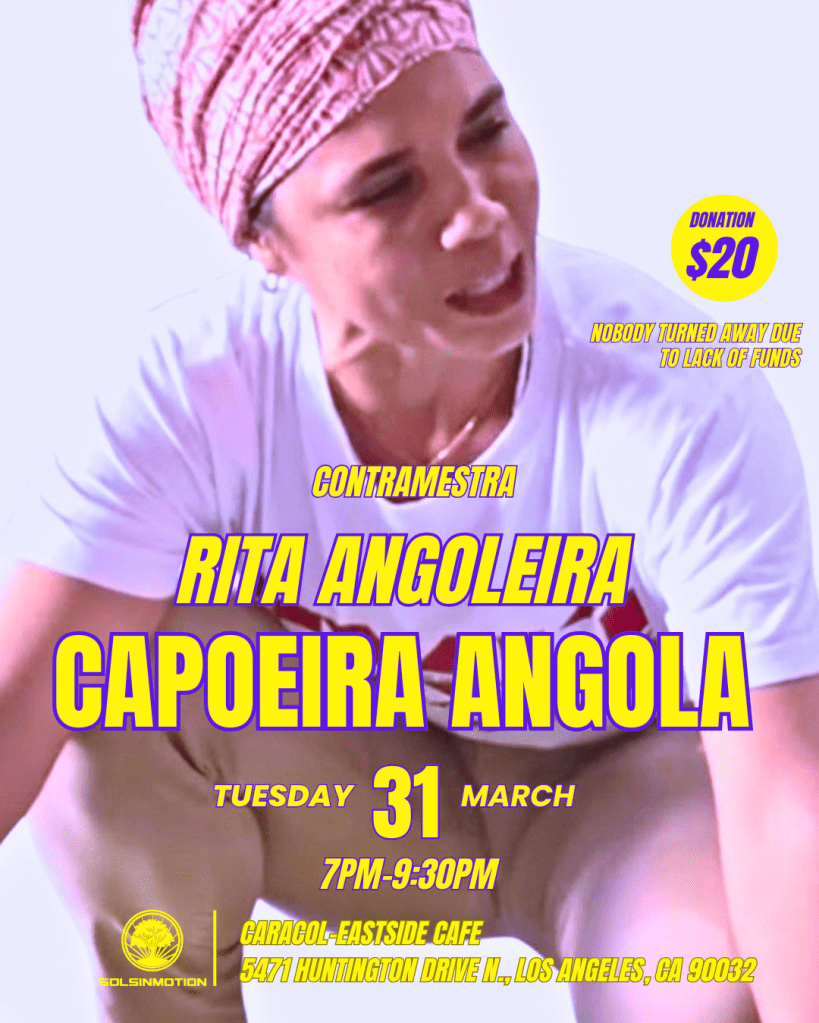
Building on that inspiration, I am incredibly proud and excited to announce a fantastic opportunity for our local community. This coming Tuesday night, March 31st, Contra Mestra Rita Angoleira will be sharing her knowledge and spirit by teaching a special class and workshop at my teacher’s school.
The event is scheduled to run from 7:00 PM until approximately 9:30 PM. This is a chance to learn directly from a master, to absorb her unique perspective on the jogo, music, and philosophy of Capoeira Angola.
Therefore, this entire post serves as a dedicated tribute to Contra Mestra Rita Angoleira, and by extension, to every Angoleira who sustains this powerful tradition. These remarkable individuals embody the essence of the culture, dedicating their lives to the art form and ensuring its vitality for future generations. To those who step into the roda, holding it up with their skill and spirit, they create a vibrant tapestry of movement and sound that resonates with the history and struggles of their ancestors. They connect deeply with the roots of their art, managing to blend the past and present while fostering a sense of community and belonging among practitioners and admirers alike. In every beat of the berimbau, they bring dendê and axé into every song and every movement, infusing their performance with energy that captivates the audience and honors the legacy of those who came before them in this beautiful, transformative journey.

 Jogo Corpo Fechado