
Mandinga is arguably the most essential and multifaceted concept within the practice, philosophy, and performance of Capoeira Angola. Far more than a simple set of tricks or a fighting style, mandinga encompasses a profound spiritual, psychological, and physical strategy, reflecting the deep African and Afro-Brazilian roots of the art form. It is the intangible power that defines a master Angoleiro, representing the capacity to deceive, surprise, and manipulate the opponent’s perception and expectation within the roda (the circle where Capoeira is played).
Physically, mandinga manifests as fluid movement, unexpected shifts in tempo, and the deceptive use of space—a feinted kick or a sudden, low sweep that breaks the rhythm of the game. Psychologically, it involves the skillful reading of the opponent’s intentions, exploiting their impatience or overconfidence, and maintaining an outward demeanor of calm or even submission to mask imminent attack. Spiritually, mandinga is connected to the historical struggle of enslaved Africans in Brazil, where cunning, resilience, and symbolic communication became tools for survival and cultural preservation. It represents the inherited wisdom and hidden knowledge—a form of power that is not brute strength, but intellectual and ancestral. The true essence of mandinga is therefore the power of deception: the art of making the predictable unexpected and the visible irrelevant.
Mandinga: The Multi-Dimensional Power and Deception in Capoeira Angola
At the very heart of Capoeira Angola, mandinga stands as a complex, multi-layered concept that transcends mere physical technique. It is the spiritual, psychological, and aesthetic essence that imbues the art with its unique power, deception, and historical depth. More than just a collection of clever tricks or feints, mandinga represents a holistic philosophy—a mastery of misdirection and subtle influence that defines the Angoleiro.
Mandinga operates on several interconnected levels, transforming the simple game of the roda into a profound engagement of wits, spirit, and heritage.
1. The Psychological Dimension: The Art of Misdirection
Psychologically, mandinga is the supreme art of deception. It involves reading an opponent’s intentions while simultaneously obscuring one’s own. This is achieved through calculated hesitation, unexpected changes in rhythm (jogo de dentro and jogo de fora), and the calculated display of vulnerability. The Mandingueiro uses subtle shifts in posture, eye contact, and even a deceptive smile to lure the opponent into a false sense of security or a premature attack. This level of engagement turns the roda into a chess match where the mind is the primary weapon, forcing the opponent to doubt their perception and second-guess their reactions.
2. The Aesthetic and Technical Dimension: Malícia
On a technical level, mandinga is expressed through malícia—a cunning, fluid grace that makes movements unpredictable. It is the ability to execute a difficult defense or a powerful attack with a casual, almost indifferent ease. The aesthetic component manifests in the deceptive slowness or exaggerated calm of a movement that suddenly explodes into decisive action. A low, meandering sweep (rasteira) may look like an invitation to step over, only to be snapped up at the last second. This deceptive fluidity ensures that every movement, whether a genuine attack or a feint, serves the higher purpose of control and positional dominance.
3. The Spiritual and Historical Dimension: Axé
The spiritual underpinning of mandinga is arguably its most profound layer, drawing heavily on the historical context of slavery and resistance in Brazil. The word mandinga itself has roots connected to African spiritual practices and charms. In Capoeira Angola, this translates to axé—the positive, vital energy and force imbued by the ancestors, the masters, and the collective spirit of the roda. A truly effective act of mandinga is not merely clever; it is imbued with axé, carrying a weight of tradition and spiritual conviction. This connection links the contemporary jogo directly to the historical fight for survival, making the deception a culturally significant act of resilience and power.
Ultimately, mandinga is the Capoeirista’s greatest asset: the power to control the flow of the jogo not through brute force, but through intelligence, rhythm, and profound cultural understanding. It is what separates the skilled athlete from the true master of Capoeira Angola.
1. Spiritual and Magickal Essence: The Root of Potency
In its original and most profound context, mandinga refers to a powerful form of folk-magick, spiritual force, or ancestral knowledge, fundamentally rooted in West African traditions. This dimension suggests that the power of a master capoeirista is not solely physical, but is underwritten by a spiritual energy that influences the outcome of the jogo (the game).
- Ancestral and Cultural Retention: The term mandinga is widely believed to derive from the Mandinka people and language of West Africa, unequivocally underscoring its historical connection to the enslaved peoples who forged the foundations of Capoeira in Brazil. It is a powerful cultural legacy, a hidden language of resistance preserved through ritual and movement.
- Charms and Protection: This spiritual aspect is often associated with the use of charms, talismans, and amulets, most notably the patuá. These items are believed to offer direct spiritual protection to the wearer, warding off malevolent forces, bad luck, or the spiritual attacks of an opponent.
- Influence and Disruption: A truly skilled practitioner of mandinga is believed to possess a force capable of subtly influencing the flow of the game—protecting themselves from harm, or even actively disrupting an opponent’s balance, concentration, or luck, rendering their attacks ineffective through unseen means.
2. Psychological Deception: The Art of Malícia
This element represents the most immediately visible, interactive, and intellectual manifestation of mandinga within the dynamic confines of the roda. It is not a physical technique but a masterful application of psychological warfare, involving cunning, calculated trickery, the feigned appearance of vulnerability or weakness, and pure mental acuity. This sophisticated mental game is encapsulated by the concept of malícia (literally “malice,” but more accurately and profoundly translated as cleverness, slyness, cunning, or street smarts).
The Strategic Components of Malícia
- Misdirection and Feigning (The Lull and the Lie): A player employing mandinga effectively uses deception to manipulate the opponent’s perception and subsequent tactical decision-making. The essence of this strategy lies in deliberate misrepresentation. The capoeirista might adopt a stance that appears deceptively passive, slow, or even genuinely tired, exhibiting a false sense of vulnerability. This seemingly unguarded state is an invitation—a psychological bait—designed to encourage a premature attack, a reduction in the opponent’s vigilance, or a critical lapse in their concentration. This apparent lull or weakness is, in fact, the strategic setup. It allows the player to suddenly and explosively transition into a lightning-fast, decisive counter-movement or attack at the very moment the opponent is least prepared or expecting it, capitalizing on their momentary psychological overconfidence.
- The Unpredictable Aura (The Constant Question Mark): The true essence of psychological mandinga is the cultivation of an aura of potent, yet utterly unpredictable capability. The opponent must never be able to fully decipher the capoeirista’s intentions. This constant, unsettling uncertainty transforms the player’s actions into a perpetual question mark in the opponent’s mind, forcing them to hesitate, second-guess, and doubt the timing and efficacy of their own movements. This induced hesitation is a tactical advantage, as it subtly but effectively compels the opponent to cede control over the jogo‘s (game’s) rhythm and the space within the roda.
- Reading the Intent: A crucial dimension of malícia is the ability to project an intention while simultaneously reading and nullifying the true intent of the adversary. This involves maintaining a deceptively calm exterior—a “poker face”—while internally processing the opponent’s breathing, eye movements, weight shifts, and micro-expressions to anticipate their next action before they commit to it. The capoeirista with high malícia often appears to react to the opponent’s move, but in reality, is responding to the pre-movement signals, making their defense or counter-attack appear impossibly fast.
Control Through Perception and Tempo
The ultimate and most sophisticated goal of this mental manipulation is not merely to trick the opponent into making a mistake, but to achieve complete domination over their awareness, focus, and the overall tempo of the jogo. By mastering the opponent’s gaze and dictating their focus—diverting it from the true threat or fixing it on a feigned movement—the capoeirista can dictate precisely when and where the critical action will occur. This psychological control allows the player to turn the opponent’s own aggression, energy, and momentum into the instrument of their own undoing. Malícia, therefore, transforms the roda into a cerebral battlefield where the quickest mind, not merely the quickest muscle, secures victory.
3. Aesthetic and Movement Strategy: Embodied Grace – The Physical Art of Mandinga
Mandinga in Capoeira Angola is a profound concept that transcends mere mental cunning or spiritual presence; it is fundamentally embodied in the unique physical aesthetics, movement profile, and strategic execution of the art form. The Angoleiro’s technique is a physical paradox, meticulously designed to maximize evasion, fluidity, and, most crucially, strategic misrepresentation—using the body as the ultimate tool for psychological warfare and deceptive artistry.
The Architecture of Deception: Low and Fluid Movement
The signature Angola style—low to the ground, fluid, and constantly shifting—is the most immediate and visible manifestation of mandinga. This foundational posture and approach are not merely stylistic choices; they are a sophisticated strategic framework:
- Disguise and Misdirection: Movements are often deliberately exaggerated, playful, slow, or even tentative. This “veil of dance-like ease” serves to mask the true, lethal intention behind powerful, dangerous kicks, headbutts, and take-downs. The opponent is encouraged to misjudge the distance, the speed, and the intent of the Angoleiro, creating a false sense of security or superiority.
- Rooted Instability: Being low to the ground provides both stability for sudden, explosive movements and a constantly shifting center of gravity that makes the player difficult to predict and nearly impossible to sweep or trip. The low posture is a constant threat, as the player can explode upward or horizontally in an instant.
- The Economy of Motion: While appearing extravagant, the fluid movement ensures that no energy is wasted. The Angoleiro flows seamlessly from attack to defense, conservation of energy being another subtle form of mandinga—making the opponent tire themselves out attacking a seemingly available, but always elusive, target.
The Matrix of Power and Avoidance: Ginga as the Cradle of Deception
The strategy of mandinga focuses not on linear attack, confrontation, or brute strength, but on utilizing the entire body in a complex, rhythmic pattern to create a dynamic, three-dimensional “matrix” of engagement. Within this matrix, the player is simultaneously avoiding danger and threatening an attack, keeping the opponent in a state of constant strategic ambiguity.
- The Ginga: Fundamental Deceptive Rhythm: The ginga, the fundamental rocking, shifting motion, is the very cradle of this embodied power. It is more than just a preparation for movement; it is a rhythmic, deceptive shuffle that is central to the strategy of mandinga.
- Keeps the Opponent Guessing: The constant back-and-forth, side-to-side movement makes it almost impossible for an opponent to commit to a direct, timed attack. The ginga is never predictable and is constantly modulating in pace and size to prevent the opponent from establishing a rhythm.
- The Loading Mechanism: While appearing relaxed, the ginga is the mechanism through which weight is continuously shifted and momentum is stored, allowing for explosive, unpredictable attacks to be launched from any point in the cycle.
- Call and Response: The entire movement profile operates on a sophisticated call-and-response dynamic with the opponent and the music, using feints, smiles, and pauses as strategic punctuation marks to invite or reject engagement, forcing the opponent to reveal their intentions first.
The Impossible Escape: The Zenith of Physical Mandinga
The most dramatic demonstration of physical mandinga is the ability to execute the Impossible Escape. This is the art of surviving and recovering from a seemingly inescapable or gravely dangerous situation—a devastating kick, a committed take-down, or a moment of being caught off-guard—with a movement that is not merely defensive, but a masterpiece of style and defiance.
- Turning Danger into Grace: The impossible escape involves an almost miraculous, flowing, and often nonchalant movement—a low queda de rins, a sudden aú, or a rolling cabeçada—that turns the moment of highest danger into a moment of pure, defiant grace.
- Psychological Impact: This physical feat has a crushing psychological effect on the opponent. It strips them of the satisfaction of the attack, demonstrating the Angoleiro’s total mastery over space and time in the roda. By escaping a powerful, committed attack with seeming ease, the Angoleiro communicates a profound message: “Your strength is ineffective against my cunning.” This is where the physical performance of mandinga truly merges with its psychological and spiritual dimensions.
4. Social and Historical Power: A Survival Mechanism
Historically, the concept of mandinga was never merely an academic or theoretical construct. It was, rather, a vital, often life-saving, mechanism for survival, primarily for enslaved and marginalized peoples in colonial and post-colonial Brazil. It fundamentally embodies the intellectual, spiritual, and psychological power of the weak, strategically turned against the overwhelming physical, military, and institutional power of the strong. Mandinga became the secret language and operational code for resistance, a tool for covert defiance against a system engineered to crush the human spirit.The Dynamics of Concealment and Resistance
Mandinga served as the essential veil of deception that allowed the practice of Capoeira Angola to endure and evolve despite brutal colonial repression.
- Cloaked Resistance: The Art of Disguise: The most profound historical function of mandinga was its capacity to cloak a deadly and effective fighting art under the guise of culturally acceptable activities, namely dance, folklore, and mere “play” (brincadeira). This masterful deception was a critical political and historical act of resistance. By framing the fluid movements, powerful kicks, and strategic takedowns as mere aesthetic performance, enslaved people could train openly—or at least with reduced suspicion—ensuring the continuous development and transmission of the practice, even as laws and slave masters sought its utter eradication. The jogo de cintura (game of the waist/hips) became a physical metaphor for political maneuvering, where the true purpose was obscured by graceful feints and smiles.
- A Weapon of the Mind: Beyond the physical camouflage, mandinga instilled a sense of mental and psychological superiority. It was the knowledge that one possessed a secret, potent skill—a hidden power—that the oppressor did not comprehend. This psychological advantage fueled resilience and eroded the sense of omnipotence that the colonial structure sought to maintain, transforming the practitioner from a mere victim into a covert agent of resistance.
Retention of Cultural and Spiritual Identity
The spiritual dimensions of mandinga were equally critical to its historical role, providing an internal sanctuary against dehumanization.
- Spiritual Fortification: By retaining the spiritual, magickal, and often syncretic aspects of mandinga—which involved a deep, resilient connection to African heritage, belief systems, and ancestral knowledge—the practitioners were able to fortify their cultural identity and internal resilience. This was a direct counter-force to the relentless cultural and religious oppression aimed at stripping away their identity and reducing them to chattel. Mandinga became a nexus where traditional African religious concepts, cunning, and martial skill coalesced, making the practitioner whole again in a world that sought to break them.
- The Power of the Malícia: Integral to mandinga is the concept of malícia (malice, cunning, or street smarts), which is not mere trickery, but an elevated, instinctual intelligence. Historically, this malícia was the critical tool for navigating the treacherous social landscape of the plantation and the repressive streets of the city. It involved reading the opponent (or the overseer) with instantaneous clarity, anticipating their moves, and exploiting their arrogance or blind spots. It was a philosophy of survival demanding constant vigilance and strategic ambiguity.
The Fortified Art: A Testament to Ingenuity
Ultimately, the historical context reveals that mandinga represents a profound, revolutionary act: the transformation of raw physical defiance and desperation into a spiritually, mentally, and strategically fortified art form. It is the purest testament to human ingenuity, the enduring power of cultural resistance, and the relentless will of the oppressed to not only survive but to thrive and maintain their dignity in the face of insurmountable odds. Mandinga ensured that Capoeira Angola remained not just a fight, but a living, breathing history of survival, cunning, and profound cultural strength.
In essence, a master of mandinga is a player who can seamlessly integrate the power of spiritual belief, the strategy of psychological warfare, and the agility of deceptive movement into a single, cohesive, and compelling presence in the roda. This profound skill is not merely a collection of techniques; it is a philosophy of engagement, a way of being that elevates the practitioner from a simple fighter to a true artist of deception and influence.
The spiritual dimension of mandinga taps into the deep well of Afro-Brazilian cosmology, where belief in ancestral spirits (guias) and protective forces imbues the player with an almost mystical confidence. This conviction is often manifested through subtle, ritualistic movements, chants, or even the wearing of certain colors or amulets, all designed to channel spiritual power and unsettle an opponent who recognizes these signs. The belief acts as a self-fulfilling prophecy: the master believes they are protected and potent, and this absolute conviction projects an aura of invincibility.
Concurrently, mandinga is a high-level psychological game, a form of warfare waged without physical contact. The mandingueiro controls the flow and energy of the roda, using subtle cues—a calculated pause, a provocative stare, an unexpected change in rhythm, or even a feigned weakness—to manipulate the opponent’s perception and decision-making. The goal is to induce doubt, impatience, or overconfidence, causing the opponent to make a tactical error that the mandingueiro is poised to exploit. This psychological mastery transforms the roda into a chess game played at the speed of instinct, where the mind is the primary weapon.
Finally, the component of deceptive movement is the physical articulation of the master’s intent. Unlike the direct force of some martial arts, the movements of mandinga are characterized by economy, fluidity, and misdirection. The mandingueiro favors the malandragem—the art of cleverness and trickery—employing feints, unexpected pivots, and low, evasive maneuvers that hide their true attack. An opponent is constantly left guessing, reacting to what might happen rather than what is happening, draining their energy and mental focus. This agility of deception ensures that the master is always a step ahead, turning the predictable nature of combat into a labyrinth of uncertainty for the adversary.
It is the invisible force—this masterful blend of spirit, mind, and body—that makes Capoeira Angola an art of profound depth and danger, one where the greatest victories are won not with brute strength, but with wit and illusion. It is a mesmerizing game played on the edge of the spiritual and the material, where beauty is the perfect, deceptive mask for a deadly, compelling truth.


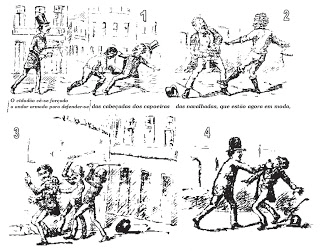

 Jogo Corpo Fechado