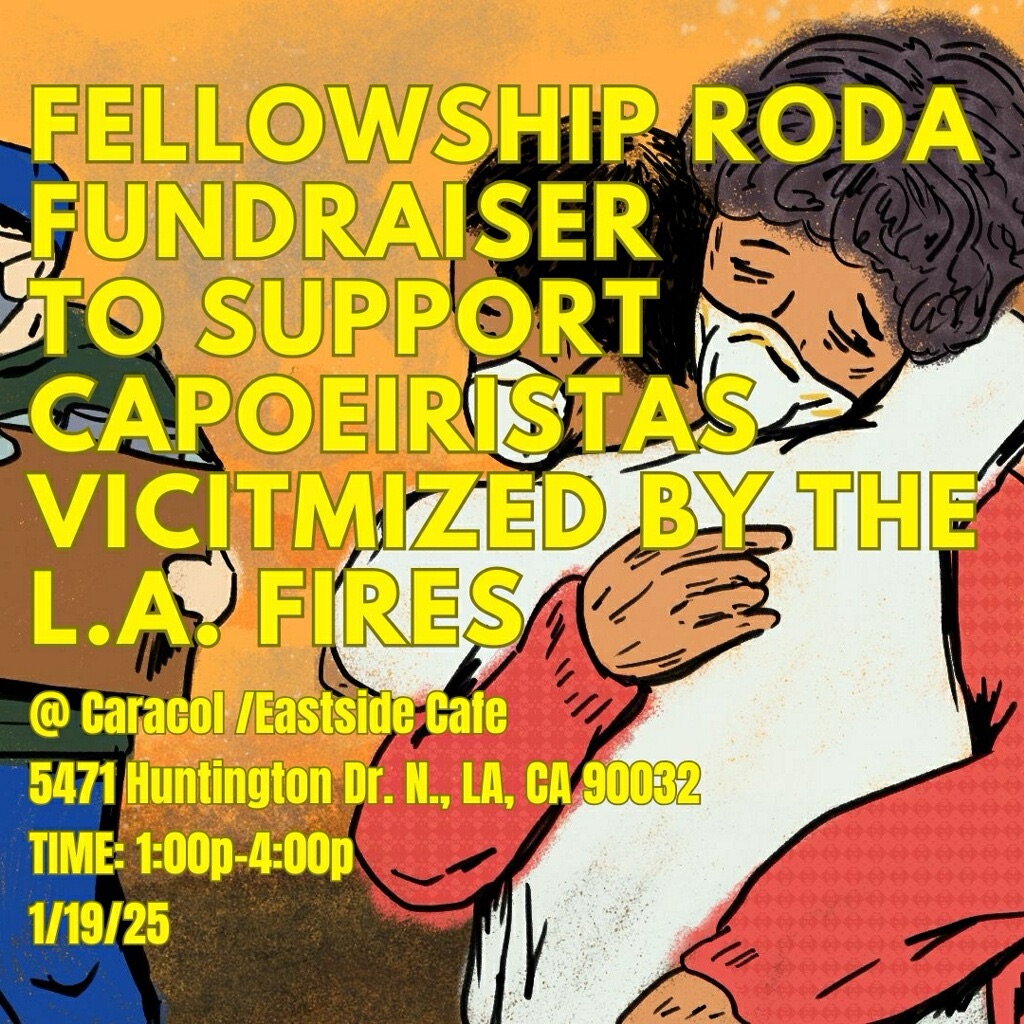
In light of the devastating impacts of the recent fires in Los Angeles, we are organizing a dedicated fundraiser aimed at providing assistance to the capoeiristas who have suffered significant losses. This event will not only help in the recovery of those affected but will also bring our community together to celebrate the spirit of resilience and support.
Join us for an afternoon filled with uplifting music, vibrant dance, and heartfelt camaraderie, as we come together to raise essential funds that will help our fellow capoeiristas rebuild their lives after recent hardships and preserve the rich cultural heritage of capoeira that we all cherish deeply. This event is not just a gathering; it’s an opportunity to bond with friends, make new connections, and show support for a cause that unites us all.
Each rhythm we dance to, every note we hear, contributes to a larger purpose, and we invite you to be a part of this beautiful journey. Your participation and generosity can truly make a profound difference in the lives of those impacted by this tragedy, ensuring that the spirit of capoeira continues to thrive for generations to come.
We need your support to help breathe new life into our community and uphold the traditions that define us.
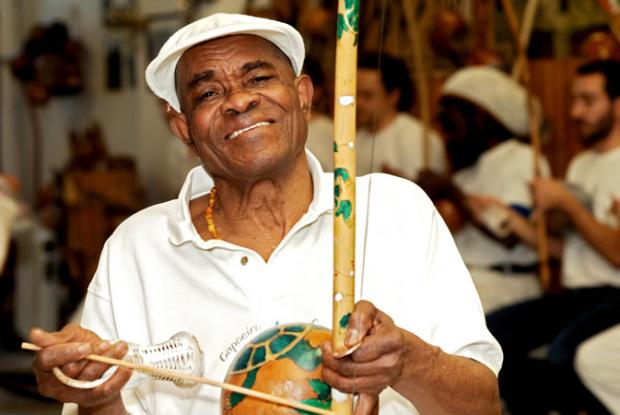
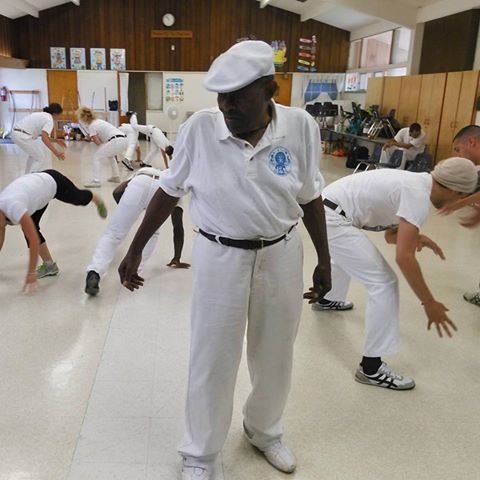
HAPPY BIRTHDAY, MESTRE JOAO GRANDE!!! May this special day be filled with joy, love, and laughter as we celebrate the incredible person you are. Your wisdom and guidance have touched the lives of many, and today we honor not only your birth but also the remarkable legacy you continue to build.
Here’s to many more years of health and happiness, surrounded by those who care deeply for you!
FELIZ ANIVERSÁRIO, MESTRE JOÃO GRANDE!!! Que este dia especial seja repleto de alegria, amor e risadas enquanto celebramos a pessoa incrível que você é. Sua sabedoria e orientação tocaram a vida de muitos, e hoje honramos não apenas seu nascimento, mas também o legado notável que você continua a construir.
Aqui está a muitos mais anos de saúde e felicidade, cercado por aqueles que se importam profundamente com você!
This series honors African and Diasporic heroes who have impacted politics, arts, sciences, and social justice, inspiring future generations. Their stories highlight resilience and creativity while emphasizing the significance of African heritage in the pursuit of equality. By exploring their lives and struggles, we understand the connection between cultural identity and activism, urging the recognition of contemporary efforts that align with the values of these figures, thus reinforcing that the fight for justice is a continuous, collective journey.
Today is January 15th, the birthday of Rev. Dr. Martin Luther King Jr. On this significant occasion, we not only celebrate the remarkable life and achievements of this iconic leader but also reflect deeply on the profound messages he imparted.
Dr. King was not just a champion for civil rights but also a powerful advocate for peace and social justice. His opposition to the Vietnam War stemmed from a moral conviction that sending troops to fight was a betrayal of the principles he fought for at home. He believed that the war diverted resources and attention away from the pressing issues facing African Americans and the poor. And today, we honor his legacy by telling the truth about why he was REALLY opposed to the Vietnam War, emphasizing his unwavering commitment to nonviolence and his profound understanding of the interconnectedness of all struggles against oppression.
Shout out to Professor Black Truth for creating this insightful video. Professor Black Truth creates engaging videos that simplify complex topics across history, science, and culture, making learning enjoyable for all ages. His approach not only captivates his audience but also encourages critical thinking and a deeper understanding of the subjects he covers. From exploring historical events to dissecting scientific concepts, his content is both thought-provoking and accessible. Check out his unique content HERE and discover the wealth of knowledge that awaits!
Now in case you’re wondering why it’s SO important to honor Dr. King’s TRUE legacy, it’s because certain “entities” have misrepresented him to suit their agenda.
For example…
Below, Anand Giridharadas explains how white moderates (and conservatives) have twisted the legacy of Dr. Martin Luther King in opposition to Dr. King’s own political agenda, often cherry-picking quotes and misinterpreting his calls for justice and equality. They tend to emphasize his vision of peace and unity while conveniently glossing over his fervent critiques of systemic oppression, economic inequality, and the urgent need for radical change. This selective memory serves to uphold the status quo and dilute the powerful messages that Dr. King fought to communicate, ultimately undermining his true vision for a just society that actively confronts and dismantles the structures of racism and inequality.
Today, I’m concluding this post with Dr. King’s iconic “I Have a Dream” Speech, delivered during the March on Washington for Jobs and Freedom on August 28, 1963. This monumental speech, which called for civil and economic rights and an end to racism, served as a pivotal moment in the civil rights movement, resonating deeply with millions and addressing over 250,000 supporters gathered at the Lincoln Memorial.
During this historic gathering, Dr. King passionately expressed his vision of a future where individuals would be judged by the content of their character rather than the color of their skin, a radical idea that challenged the status quo of segregation and inequality.
As you listen, take a moment to reflect on the powerful imagery and the profound hope woven throughout his words, and remember the true significance of his message for our ongoing struggle against injustice and the work that still lies ahead in achieving true equality for all.
Welcome to MARTIAL ARTS THEATER, a vibrant platform for martial arts enthusiasts that offers diverse content on various disciplines, from traditional styles like karate and taekwondo to innovative techniques such as Krav Maga and Muay Thai, celebrating the rich history, profound philosophy, and unwavering dedication inherent in martial arts. Here, we delve into the nuances of each martial art, explore their unique techniques, engage with expert practitioners, and provide training tips for all skill levels, creating a community where passion for martial arts thrives. Whether you are a seasoned fighter or a curious beginner, our extensive resources aim to inspire and educate, fostering a deeper appreciation for the artistry and discipline that martial arts embody.
In this installment, Chu Hong, a Chinese martial artist, trains rigorously to integrate his martial arts skills with archery for an upcoming tournament, competing against other archers and learning lessons about perseverance, focus, and competition.
In 1030 CE, Chu Hong learns from his astute friend Liang Gao that a surprise archery competition, hosted by the local magistrate, is coming to their village, igniting a spark of excitement and nervous anticipation within him. This thrilling event not only draws in participants from neighboring towns but also attracts many spectators eager to witness the display of talent and skill.
As the details unfold, Hong realizes that this competition presents him with a golden opportunity to showcase his remarkable martial arts skills, honed over years of rigorous training, and earn much-needed money for his family, as outlined by Peter Lorge. The prospect of victory fills him with determination, fueling his desire to support his loved ones and bring honor to his name in their small community. With each passing day leading up to the competition, he practices relentlessly, envisioning himself standing at the center of the village square, the cheers of the crowd ringing in his ears as he triumphs over his rivals.
Okay, this blog title is clickbait, so… If you’re looking for some kind of showdown, you will be SORELY MISTAKEN.
But anyway, I found this cool video clip on YouTube, and I thought I’d share it with you.
What you’re actually looking at is a friendly sparring match between two dedicated Martial Artists from each of the two styles mentioned in the title of this blog. Of course, I always say that videos like these, where one style is pitted against another, are for the most part pointless.
Why?
Because although some styles are better than others for fighting, it really depends on the training and skill of the FIGHTERS, as well as the unique experiences that each brings to the mat.
Each practitioner carries with them a wealth of knowledge and personal techniques, honed over countless hours of training and real-world application, which not only shape their physical abilities but also inform their mindset and approach to challenges. What truly matters is how effectively they can leverage their respective skill sets, whether the scenario involves a friendly contest, a simulation of deadly combat, or everything in-between, as each situation presents unique variables that require quick thinking and adaptability. In essence, the outcome is not solely determined by the style itself but rather by the adaptability, strategy, and mental fortitude of the individuals involved, showcasing that the art of fighting transcends mere techniques and delves deep into the heart of each fighter’s spirit and determination.
This interplay of skills and psychological resilience is what elevates a simple competition into a profound expression of personal growth and mastery, ultimately highlighting that the journey of a martial artist is as significant as their victories in the ring.
Now having said or rather, “Typed” about that, there’s another important thing that I would like to type about.
In that video, the narrator mentioned that many of our young sisters have been coming up missing in the USA, in particular the state of Virginia, where the numbers have been rising alarmingly over the past few years. This heartbreaking issue affects families and communities deeply, leaving unanswered questions and a sense of fear in the hearts of many. I for one, URGE you to check out missingkids.org, a vital resource dedicated to finding missing children and raising awareness about this pressing crisis.
Together, we can take proactive steps to help locate these vulnerable children and work towards ensuring their safety and well-being. By leveraging community resources, collaborating with local organizations, and raising awareness through various platforms, we can significantly increase our reach and effectiveness in this critical mission. Let’s unite our efforts and spread the word far and wide so that we can find these missing children and bring them back home, safe and sound, to their loved ones who are desperately waiting for their return. Every shared story, every posted photo, and every conversation can contribute to a greater chance of recovery, reminding us that together, our collective impact can bring hope and healing to families who are suffering in silence.
I will be posting more about this particular subject n the near future.
In this series, we honor the heroes of Africa and the African Diaspora who have profoundly influenced politics, arts, sciences, and social justice, inspiring future generations through their struggles and legacies while highlighting the importance of African heritage in the fight for equality. Their remarkable stories not only reveal the resilience and creativity that have driven transformative movements worldwide, but they also showcase the multifaceted contributions these trailblazers have made across various fields, from literature and music to civil rights and technological innovation.
By examining their lives and the challenges they overcame, we gain insight into the dynamic interplay between cultural identity and activism. This exploration encourages readers to consider cultural heritage’s vital role in fostering a just society and motivating younger generations to embrace activism in their communities. Additionally, it emphasizes the necessity of recognizing and supporting contemporary efforts that resonate with the values and aspirations these historical figures championed, reinforcing the idea that the fight for justice is an ongoing journey requiring collective effort and unwavering commitment.
In today’s installment…
Yesterday was the birthday of Dr. Khalid Abdul Muhammad, a man who made ferocious advocacy for his people into his personal hallmark, and a man who taught us the importance of being fearless in the face of evil and uncompromising in the face of cowardice. His unwavering resolve and resilience in the struggle for justice and equality resonate deeply with those who continue to fight against oppression today.
Dr. Muhammad’s life was a testament to the power of conviction and the impact one individual can have in mobilizing communities toward a shared vision of progress. He inspired countless others to stand up, speak out, and take action against social injustices, reminding us that the fight for equality is not merely a choice but a responsibility that each generation must embrace. His teachings remain relevant as they challenge us to reflect on our own roles in the ongoing battle for human rights and to champion the cause of the marginalized, ensuring that no voice goes unheard in the pursuit of a more equitable world.
I admit I didn’t agree with all of his views, yet I acknowledge and honor the warrior and scholar that he was, recognizing the passionate dedication he displayed in uplifting voices that were often marginalized. His legacy serves as a powerful reminder of the impact one individual can have in challenging the status quo and inspiring others to stand firm in their beliefs, no matter the cost.
Professor Black Truth produces engaging videos that simplify complex topics, making learning enjoyable for all ages. His channel combines visuals with clear explanations, covering history, science, and culture to inspire curiosity and a love for lifelong learning. Explore unique and informative content HERE!
They say that all it takes for evil to triumph is for good men to do nothing. This rings especially true in the context of human trafficking, a horrific crime that plagues societies across the globe. Every day, countless individuals fall victim to this insidious practice, stripped of their freedoms and dignity. Human trafficking is something that must stop, and it requires a collective effort from individuals, communities, and governments alike to raise awareness, enact stronger laws, and support survivors in their journey to reclaim their lives.
Together, we can create a world where every person is valued and protected, ensuring that such atrocities become a distant memory rather than a present reality. By fostering a culture of empathy and understanding, we can empower communities to stand united against injustice.
Deep in the Brazilian Amazon, women navigate a harsh reality where sex is exchanged for gold from illegal mines, entering a world fraught with exploitation and despair. This environment, which has seen a significant rise in mining activities due to increasing global demand for gold, leads to both survival and suffering, as much of the gold extracted is exported globally, often fueling further illegal practices and environmental destruction. These women, many of whom are drawn into this grim trade by economic necessity, face not only the immediate dangers of violence and disease but also the long-term consequences of living in a region devastated by rampant deforestation and toxic waste. The rapid industrialization of these areas, primarily driven by foreign interests seeking profit, perpetuates a cycle of poverty and dependency, leaving little room for hope or alternative livelihoods. As the jungle is stripped bare, the cultural foundations of local communities are eroded, and the dreams of a better future slip further away, trapped in a relentless cycle of exploitation.
The UN warns that this situation increases risks of violence and trafficking against women, who become vulnerable to predatory behaviors in such lawless spaces. These women, often forced to navigate a precarious existence, face not only the physical threats that loom overhead but also the psychological toll that comes from living in constant fear and uncertainty. In response to these alarming circumstances, BBC 100 Women and BBC Brasil meticulously explored the lives of these women, uncovering their struggles and resilience as they seek a safer future amidst the dangers of mining. Their investigations reveal the multifaceted challenges these women encounter daily, ranging from economic hardship to social isolation, as well as the systemic issues that perpetuate their vulnerability. Furthermore, the documentaries shine a light on their courage and determination to reclaim their stories and fight for their rights in an environment that often seeks to silence them, showcasing inspiring examples of activism and solidarity among women who band together to uplift one another despite overwhelming odds. Through personal narratives and community efforts, they are forging pathways towards empowerment and change, proving that even in the harshest conditions, hope and tenacity can lead to transformative outcomes.
It is essential to provide education and resources that equip individuals with the knowledge and courage to challenge discrimination and violence. By fostering an inclusive environment and encouraging open dialogues, we empower communities to confront injustices head-on. Through collective efforts, including advocacy, awareness campaigns, and support for vulnerable populations, we pave the way for a future where dignity and respect are fundamental rights for all. This involves not only educating ourselves but also actively listening to the experiences of those affected and amplifying their voices. Let us work diligently to transform our societies into safe havens, where love and compassion triumph over fear and hatred, thereby creating a strong, interconnected network of allies dedicated to upholding human rights for everyone, regardless of their background.
Before I go into this post, I want all of you out there to know that the topic of race and racism in brazil is a very loaded and confusing topic. Why? well, watch the vkideo below.
Synopsis of the video: Jessica says she’s black. Her cousin says she’s white. This difference in their self-identification highlights the complex tapestry of racial identity that exists in Brazil, a country notorious for its diverse population and the myriad shades of skin tones within it.
Stephanie Nolen spends time with one family to find out just how complicated race in Brazil can be, delving into the historical context and cultural nuances that shape these identities. Through her exploration, she uncovers stories of resilience and pride, as well as the ongoing challenges that individuals face in a society still grappling with its colonial past and the implications of colorism on personal and communal relationships. By engaging in candid conversations with family members across generations, Nolen reveals how the legacy of slavery continues to influence social dynamics, personal aspirations, and community ties.
Now the video below, heartbreaking as it can be to some of us, hits close to home for me.
In this touching video, a Brazilian social influencer tries to convince her black grandmother that she is beautiful, sharing heartfelt words and personal stories to uplift her spirit. The grandmother, however, remains skeptical and struggles to embrace this affirmation due to the deep-rooted beliefs shaped by all the racist things she’s heard and experienced as a black woman in Brazil throughout her life.
The influencer gently recounts moments of pride and resilience within their family’s history, drawing attention to the stories of her ancestors who overcame adversity and celebrated their unique identities throughout generations. By sharing these cherished memories, she hopes to spark a profound sense of self-love and appreciation in her grandmother’s heart, encouraging her to reflect on the legacy of strength that runs through their bloodline. This narrative emphasizes that beauty comes in many forms, whether it is through cultural practices, shared traditions, or personal triumphs, and is inherently tied to one’s identity and heritage. She passionately believes that recognizing this interconnectedness can foster a deeper understanding of oneself, allowing her grandmother—and others—to embrace their own worth and the rich tapestry of their background.
Now the reason this nits close to home for me is all the “Yo mama’s so black“jokes, and all the reminders that in the not so distant past, and even in our present, blackness equated to ugliness. The darker someone’s skin was, the worse they were treated, often subjected to cruel stereotypes and derogatory comments that permeated everyday life. These so-called jokes were not just harmless humor; they were deeply rooted in historical prejudice and societal norms that devalued the beauty and worth of those with darker complexions. It pains me to reflect on how these narratives have shaped perceptions, reinforcing a damaging hierarchy based on skin tone.
This experience highlights the urgent need for a broader understanding of beauty that celebrates diversity rather than diminishes it, urging society to challenge and dismantle these harmful stereotypes that continue to persist today.
Hi, I guess this is where I talk about my New Year’s resolutions, or at least where this website is concerned.
This blog is dedicated to the arts and culture of Africa and its diaspora, focusing on Capoeira Angola as both a physical art form and a deep cultural expression with a rich history. Within this vibrant realm, there are many issues and genres surrounding it, and I aim to explore every facet in detail. That means delving deep into the intricate dance movements, the powerful self-defense techniques, the soulful music, and the meaningful rituals that bring communities together, creating an environment of unity and shared identity. Each element not only serves a purpose but also tells a story, revealing the importance of oral traditions and the historical context that shapes these practices.
As I examine the evolution of Capoeira Angola, I will highlight its roots in African cultures and how they have intermingled with various influences throughout history. Each aspect reflects the diverse culture and historical significance of this extraordinary practice, showcasing how it allows individuals to connect with their roots and each other across generations, fostering a sense of belonging while celebrating the vibrancy of their heritage. Furthermore, I plan to look into contemporary adaptations and how younger generations are keeping this tradition alive, ensuring that the essence of Capoeira Angola continues to thrive and inspire future artists and cultural advocates around the world.
Right now, let’s start 2025 with Mestre Pastinha, the father of Capoeira Angola, whose legacy continues to inspire and shape the practice of this art form. His teachings not only emphasize the importance of physical prowess but also highlight the cultural roots of Capoeira, encompassing music, dance, and the historical struggles of the Afro-Brazilian community.
By revisiting his philosophy and techniques, we can deepen our understanding of Capoeira as a powerful tool for self-expression and social connection, fostering a sense of unity in our communities as we embrace the new year ahead.
In 1492, Christopher Columbus arrives on Hispaniola, leading to the enslavement of its inhabitants and significant population decline due to disease and harsh conditions introduced by European settlers.
For three centuries, many slaves are imported to serve European colonizers, as the demand for labor to cultivate sugar cane and other valuable crops escalates, further exacerbating the suffering of the indigenous peoples. The Haitian Revolution (1791-1804) is inspired by the French Revolution, which ignites a desire for liberty and equality among enslaved individuals, resulting in a successful rebellion against oppression that astonishes the colonial world.
In Haiti, the machete serves as both a weapon and a vital tool for farmers, exemplified by Alfred Avril, a skilled machete fencer and subsistence farmer whose expertise highlights the deep cultural significance of this implement. The practice of machete fencing has roots in the Haitian Revolution, where enslaved people, facing a lack of firearms, expertly wielded machetes from their sugarcane work as a means of survival and resistance. This historical context not only speaks to the resilience of the Haitian people but also underlines the ingenuity behind their adaptation to adversity.
In a short film by Third Horizon, Avril discusses his craft and the machete’s significance in Haitian history, both practically and spiritually, underscoring how, for many, the machete embodies a dual identity as a tool for agricultural sustenance and a symbol of revolutionary spirit and cultural heritage. He shares the deep connections forged between the machete, the land, and the people, revealing how this simple tool is intertwined with the vibrant tapestry of Haitian identity and collective memory.
Haiti gains independence on January 1, 1804, becoming the first nation founded by former slaves, though it faces isolation from European powers and the U.S., which fears the spread of revolutionary ideas and potential slave uprisings. This historic achievement was not only a remarkable testament to the resilience and courage of the Haitian people but also a significant turning point in the global narrative of freedom and human rights. The U.S. recognizes Haiti’s sovereignty in 1862, during the American Civil War, marking a significant turning point in international relations; however, Haiti continues to struggle with internal challenges such as political instability, economic hardship, and social division, alongside external pressures from foreign interventions and historical debt to France. These difficulties would profoundly shape its complex history in the following decades, as Haiti endeavored to assert its identity and navigate a world often resistant to the ideals of autonomy and self-governance.

 Jogo Corpo Fechado